Background
Globally, residential aged care (RAC) has become increasingly marketised in recent decades. Government intervention has diminished, and the interaction between residents and providers to determine what is supplied, where, and at what price, is increasingly relied upon to mediate supply and demand, establish safety and quality standards, and impose accountability.
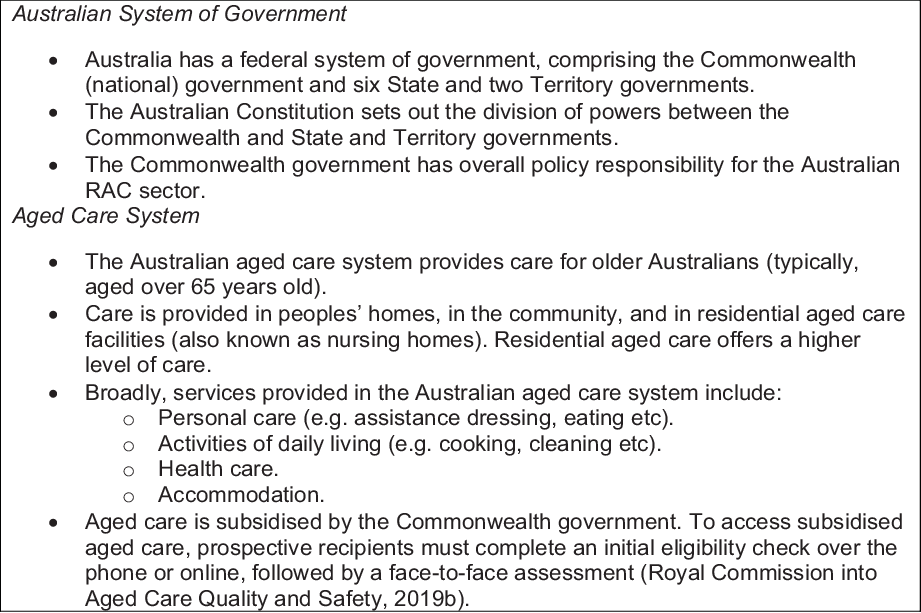
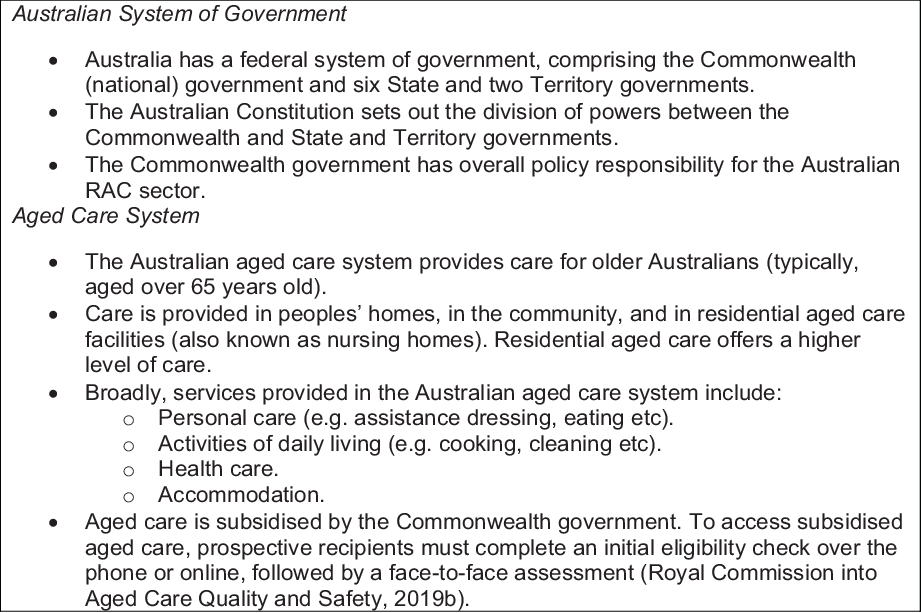
This article focuses on Australian RAC which the Aged Care Act 1997 (Cth) (‘the Act’) defines (in summary) as personal and/or nursing care provided in a residential facility (the Act, s 41-3(1)). RAC is also referred to as long term care, social care, nursing or care homes (see Figure 1). The Australian RAC market is large and complex. At 30 June 2020, it comprised 845 approved providers offering care through 2,722 services for 183,989 residents (Department of Health, 2020). Over half (51.9 per cent) of these residents have dementia (Department of Health, 2020) and many have complex care needs. The total aged care workforce (which includes RAC) comprises over 366,000 people (Department of Health, 2020). In 2019-20, the government spent $13.4 billion on RAC (Department of Health, 2020) with the RAC sector generating a revenue of $19.3 billion in 2018-19 (ACFA, 2020). The sector is regulated primarily by the Commonwealth Department of Health and the Australian Aged Care Quality and Safety Commission (ACQSC). In a period of three months in early 2020, the Australian Aged Care Quality and Safety Commission received 1414 complaints about RAC, with only one notice issued as a result of these complaints (ACQSC, 2020). More concerning is that between 2000 and 2013, 15.4 per cent of deaths in RAC were premature and potentially preventable (Ibrahim et al., Reference Ibrahim, Bugeja, Willoughby, Bevan, Kipsaina, Young and Pham2017).
Australian system
We begin by considering the likely impacts, in an Australian context, of continued pursuit of marketisation. We consider the impact of marketisation on providers’ service delivery, revenue and workforce. Regarding residents, we discuss how marketisation affects their choice of facility and the quality of care and services which they receive. We then consider how further marketisation may shift the role of the government as a regulator in respect of safety, quality, complaints and sanctions, and monitoring expenditure of funding. We conclude by proposing an alternative framework to underpin a dignified, safe and sustainable aged care system that is ‘fit for purpose’, as envisaged by the ongoing Royal Commission into Aged Care Quality and Safety (‘the Royal Commission’)(2019c).
Free market policies and Australian RAC
What is a free market?
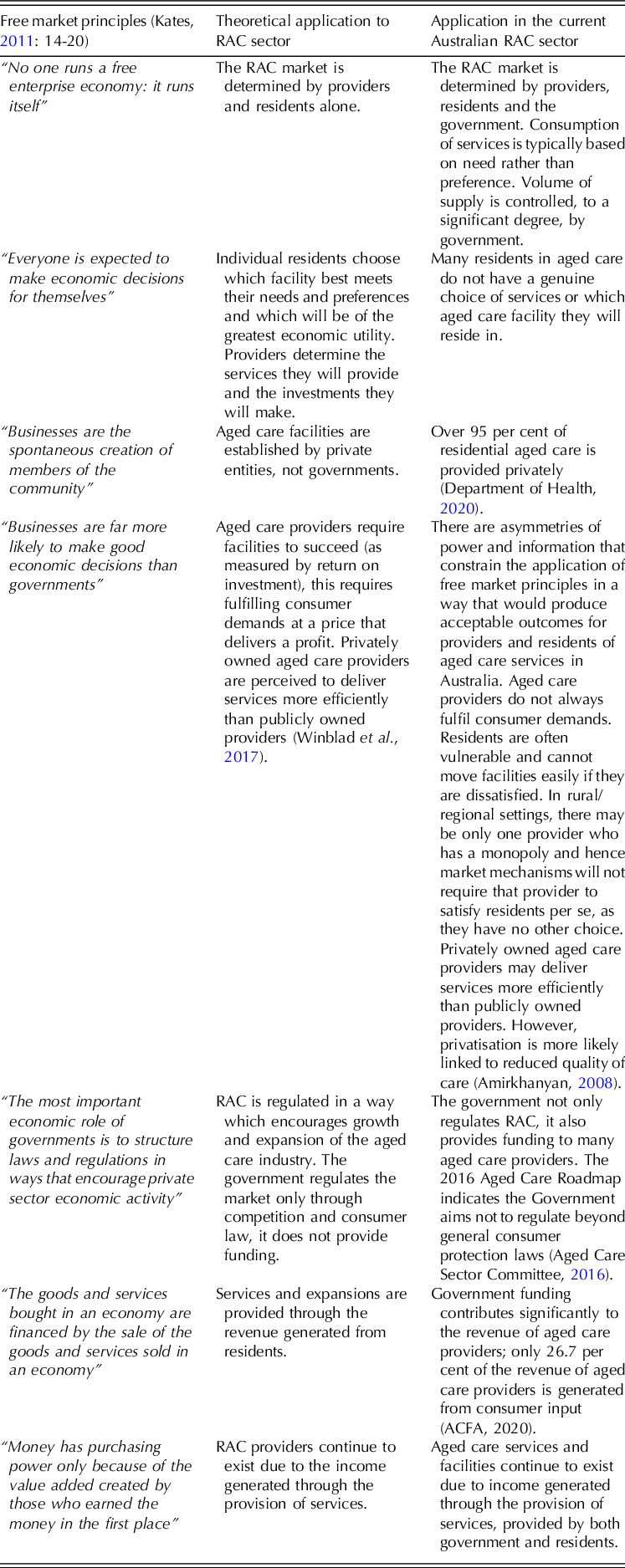
Markets are characterised as more or less ‘free’ relative to the extent to which their operation is constrained by, or free of, government intervention (see Table 1), by:
-
mediating supply or demand (e.g. legislation setting pricesFootnote 1 ), and/or
-
regulation (e.g. by legislation for safety, quality and fitness for purpose).
Application of free market principles in residential aged care (RAC)

Other regulatory interventions, not directed at the provision of products per se, may also profoundly affect market operations (e.g. legislation concerning workers’ conditions).
The overarching imperative of ‘free’ markets is to maximise profits and thus dividends to shareholders by providing products of a kind, at a price and under conditions that are valued by residents.
Who is in the Australian RAC market?
The key stakeholders in Australian RAC are residents, RAC providers and the Australian Government.
Residents, described in the Act as ‘care recipients’ (see part 2.3 of the Act), are typically female (AIHW, 2020), aged over eighty years old, many of whom are affected by dementia (Department of Health, 2020). The decision to enter RAC is generally made by the resident with the support of their family or representatives.
Residential aged care providers (‘providers’) supply the RAC services, which generally include assistance with activities of daily living, nursing care and other services such as provision of meals, laundry and cleaning. Service offerings vary according to the needs and financial resources of individual residents and the services which the provider is willing and able to offer.Footnote 2 The transition towards a freer market has led to changes in the profile of RAC providers. In Australia in 2019-20, places in RAC were provided by for-profit providers (41.2 per cent), not-for profit providers (55 per cent) and government providers (3.8 per cent) (Department of Health, 2020). In 2009-10, places in RAC were provided by for-profit providers (35 per cent), not-for profit providers (58.5 per cent) and government providers (6.4 per cent) (Department of Health and Ageing, 2010).
Governments set policy, fund service delivery by for-profit and not-for-profit providers, undertake service delivery and regulate through accountability mechanisms. The national government has overall policy responsibility for aged care. State and Territory governments have responsibility for policies and programmes relating to the care of vulnerable adults; for example, guardianship jurisdictions. This fragmentation can be problematic for all stakeholders, including by blurring lines of accountability and governance.
Some degree of regulation is generally accepted as necessary, even in competitive markets, to ensure adequacy of care and services for residents. This includes (a) good laws informed by evidence-based policy, (b) adequately resourced regulators, and (c) regulatory culture that embraces a willingness to regulate proactively, and judiciously apply calibrated sanctions.
The key regulators of aged care in Australia are the national Department of Health and the ACQSC. The Act confers on the Commonwealth responsibilities to:
-
through the Secretary of the Department – fund eligible providers through payment of subsidies (the Act, Part 3.1) and residential care grants (the Act, Part 5.1), and
-
through the Aged Care Quality and Safety Commissioner – enforce compliance with the Act and, from 1 January 2020, approve providers.
Aged care markets: innately flawed or just in need of repair?
The Interim Report of the ongoing Royal Commission canvasses the history of aged care in Australia since Federation in 1901 (Royal Commission into Aged Care Quality and Safety, 2019a). Over the past century, the national government has incrementally increased (relative to the states and territories) its involvement in aged care. Outbreaks of COVID-19 in RAC facilities in Australia have focused public attention on continuing fragmentation of government responsibilities between the national government and the states and challenges arising from this fragmentation.
Prior to 1997, care for older people was delivered in nursing homes and hostels. Nursing homes provided more intensive care, typically for people who had chronic or terminal illnesses, whilst hostels provided accommodation for people with fewer care needs (Clarke, Reference Clarke1997). Hostel operators could charge fees to residents prior to their entry into a hostel, which resulted in well-maintained facilities (Parliament of Australia, 1997). In contrast, nursing homes were unable to generate sufficient funds to conduct capital works to improve facilities as resident payment and government funding were only sufficient to cover the cost of providing care (Parliament of Australia, 1997). The Aged Care Act 1997 (Cth) sought to improve the poor quality of nursing home infrastructure by providing for residents to pay a bond upon entry to nursing homes (Explanatory Memorandum, Aged Care Bill 1997 (Cth)).
Since 1997, the national government has increased marketisation in aged care (Aged Care Sector Committee, 2016; Royal Commission into Aged Care Quality and Safety, 2019b). The rationale for these reforms is that free market policies empower residents to choose facilities that best meet their needs and preferences (Konetzka and Werner, Reference Konetzka and Werner2010), and encourage providers to improve efficiency, innovation and quality (Productivity Commission, 2011). This assumes:
-
parity of power as between residents and providers
-
availability of choice for residents, as between potential providers, and
-
access by residents to pertinent and credible information about providers, enabling informed comparison.
The best case scenario is one in which residents prioritise their needs and desires, supplied with reliable information about which providers offer services that best match the residents’ priorities. If these assumptions do not hold in respect of a particular transaction, it is unlikely that the potential benefits of a free market in RAC will accrue to the resident. Moreover, the resident may be vulnerable to harm, loss or damage.
What may prove to be the highpoint of government endeavours to gradually disengage and leave aged care to self-regulation was the 2016 Aged Care Roadmap (‘the 2016 Roadmap’) (Aged Care Sector Committee, 2016). The Roadmap assumed that rigorous application of free market principles would empower consumers, secure higher quality services, incentivise innovation through competition, and reduce the government’s financial and political exposure.
We argue that none of these outcomes has been achieved in the twenty-three years following the 1997 Act, and that at the core of this lack of success are asymmetries of knowledge and power arising from, inter alia:
-
failure by providers to make publicly available clear and accurate information about the products offered, and information in a standard form among providers, to enable reliable and valid comparison (Royal Commission into Aged Care Quality and Safety, 2019a)
-
lack of community knowledge about the aged care system, (Royal Commission into Aged Care Quality and Safety, 2019a) and a tendency among many cohorts to defer finding out about the system until a need arises
-
geography (i.e. location of services is often not a matter of choice for the resident); this is compounded for people living in rural, regional and remote communities (Royal Commission into Aged Care Quality and Safety, 2019a)
-
the need for cultural safety for Aboriginal and Torres Strait Islander people (Royal Commission into Aged Care Quality and Safety, 2019a)
-
language and cultural barriers for culturally and linguistically diverse people (Royal Commission into Aged Care Quality and Safety, 2019a)
-
trauma among older people caused by institutional abuse earlier in life (including the Stolen Generations, Forgotten Generation people, and people from the LGBTIQ communities), sometimes by the same organisations that are offering RAC; and
-
urgency.
Some of these constraints can be mitigated for current residents (e.g. provision of information, culturally safe services, trauma-informed services). Some can be mitigated for future generations, but not for current residents (e.g. trauma caused by institutional abuse). Others, however, cannot be mitigated by provider or resident behaviour (e.g. geography, urgency).
Unsurprisingly, there have been challenges to the reliance on market-based strategies to build and sustain fit for purpose RAC (Bishop, Reference Bishop1988; Braithwaite, Reference Braithwaite2001). Sporadic media attention to shortcomings (and outright scandals) in RAC has been met by fundamentally reactive measures such as the 2017 Legislated Review of Aged Care (Tune, Reference Tune2017) and the 2017 Review of National Aged Care Quality Regulatory Processes (the ‘Carnell-Paterson Review’) (Carnell and Paterson, Reference Carnell and Paterson2017). However, a particularly scathing media investigation aired on Australian television in late 2018 (ABC, 2018) and, following this, the government announced a Royal Commission into Aged Care Quality and Safety. The Royal Commission also considered how the aged care system has responded to COVID-19 pandemic, including the respective roles of the national and state governments (Royal Commission into Aged Care Quality and Safety, 2020d).
Against this backdrop, policy-makers are being challenged to consider whether free market principles, and the profit motive, should have a place in RAC.
Impact of marketisation
For the purposes of this article, ‘marketisation’ refers to a reduction in government funding and an accompanying shift towards self-regulation. Whether and to what extent individuals should contribute to the costs of their own aged care and/or to support the RAC sector is complex (see, for example, Janus and Koslowski, Reference Janus and Koslowski2019) and is beyond the scope of this article.
Impact of marketisation on providers
Ongoing marketisation of RAC would: 1) lead to increasingly greater proportion of funding by residents, rather than Government, 2) change service delivery and marketing, and 3) lessen regulatory burdens and require providers and residents to negotiate service contracts with decreasing reliance on government to set and enforce terms under which services are provided. As foreshadowed, the impact of freer market conditions will vary across Australia, according to factors described in the preceding section, as well as broader socio-economic factors. The more that the terms of service depend on individual negotiation, the more pervasive variation will become, potentially compounding geographical inequity.
Service delivery
Competitive markets compel providers to adapt, change and improve, by offering appealing services at prices that reflect how the resident values those services. Providers that fail to do so may not survive. Competition has been posited to improve the quality of services, because facilities that provide poor quality services are less likely to survive in a competitive market (Productivity Commission, 2017). The degree of competition within a market depends on numerous factors including the type of provider and the proportion of each provider type within the market.
A 2009 systematic review analysing eighty-two studies (seventy-four from the United States of America (USA); five from Canada; one from Australia; one from Taiwan) found that more studies demonstrated higher quality care in not-for-profit RAC facilities compared to for-profit RAC facilities (Comondore et al., Reference Comondore, Devereaux, Zhou, Stone, Busse, Ravindran, Burns, Haines, Stringer, Cook, Walter, Sulliven, Berwanger, Bhandari, Banglawa, Lavis, Petrisor, Schünemann, Walsh, Bhatnagar and Guyatt2009). The included Australian study supports the overall findings of the review (Pearson and Riggs, Reference Pearson and Riggs1992; Comondore et al., Reference Comondore, Devereaux, Zhou, Stone, Busse, Ravindran, Burns, Haines, Stringer, Cook, Walter, Sulliven, Berwanger, Bhandari, Banglawa, Lavis, Petrisor, Schünemann, Walsh, Bhatnagar and Guyatt2009). In Australia in 2018-19, 16 per cent of not-for-profit and 18 per cent of for-profit RAC facilities failed to meet the expected outcomes under the Accreditation Standards (Royal Commission into Aged Care Quality and Safety 2020b), many of which related to quality of care. If not-for-profits provide higher quality care, an increase in the number of not-for-profit facilities in a given market may yield an overall increase in quality of care within that market (Grabowski and Hirth, Reference Grabowski and Hirth2003).
For-profit facilities are more likely to have greater efficiency than not-for-profit facilities (Grabowski and Hirth, Reference Grabowski and Hirth2003; Tran et al., Reference Tran, Nguyen, Gray and Comans2019). Efficiency is defined as the extent to which a RAC facility achieves the highest level of productivity, where productivity is the ratio of outputs (services) to inputs (resources) (Tran et al., Reference Tran, Nguyen, Gray and Comans2019). Competition between not-for-profit and for-profit facilities may lead to improved efficiency in not-for-profit facilities (Grabowski and Hirth, Reference Grabowski and Hirth2003; Tran et al., Reference Tran, Nguyen, Gray and Comans2019), thereby increasing efficiency in the market. Nonetheless, claims of efficiency in RAC may describe cost-cutting measures, including fewer staff who have received less training and have less equipment (Lloyd et al., Reference Lloyd, Banerjee, Harrington, Jacobsen and Szebehely2014). This is likely to have a negative impact on the quality of services.
Revenue
Over 67 per cent of government funding of aged care providers is supplied via the Aged Care Funding Instrument (ACFA, 2020). RAC providers experienced a slight decline in financial performance in 2018/19, with 42 per cent of providers operating at a loss, following a significant financial decline in 2017/18 (ACFA, 2020). This decline had a disproportionate impact on regional and rural providers (ACFA, 2020). In an increasingly free market, residents would be expected to contribute increasing proportions of the costs of RAC, on the basis that ‘Consumers are primarily responsible for their accommodation and everyday living costs, as they have been throughout their lives’ (Aged Care Sector Committee, 2016: 11). However, the 2016 Roadmap contemplated that government would continue to support residents with more limited financial resources (Aged Care Sector Committee, 2016). As demand for RAC, and for increasingly ‘bespoke experiences’, increases with Australia’s ageing population, revenue increases may provide stronger returns on investment for providers.
Facilities located in competitive markets typically have improved financial outcomes (Weech-Maldonado et al., Reference Weech-Maldonado, Zinn and Brannon1999). This suggests that if the shift towards a freer market increases competition, then provider revenue may increase. However, possibilities of increased revenue are fewer in rural/regional areas and in areas that otherwise are affected by socio-economic disadvantage. In such locations, new for-profit RAC facilities are less likely to be established as scope for profitability is limited. These locations will presumably have the greatest need for government to remain as the predominant funder, to ensure that existing facilities remain viable and to promote equitable access to quality RAC.
Workforce
Freer markets may influence providers’ workforce composition. In the USA, nurse practitioners and physician assistants are more likely to be employed by providers in competitive markets (Intrator et al., Reference Intrator, Feng, Mor, Gifford, Bourbonniere and Zinn2005). This may be due to a combination of attempting to remain competitive, and increased demand leading to improved profitability, which would provide the resources to pay better qualified staff. In major cities, competition can prompt providers to employ more highly qualified staff to better appeal to residents. In less competitive markets, skills profiles may be diluted due to cost-cutting measures.
In 2019, 57.6 per cent of Australian residents lived in RAC facilities with unacceptable low levels of staffing (Eagar et al., Reference Eagar, Westera, Snoek, Kobel, Loggie and Gordon2019). In the USA, there is a negative relationship between profit and staff levels (O’Neill et al., Reference O’Neill, Harrington, Kitchener and Saliba2003), while in Sweden, publicly-owned facilities employ more staff per resident than privately owned facilities (Winblad et al., Reference Winblad, Blomqvist and Karlsson2017). Increasing marketisation in Australia would increase the impetus for RAC facilities to improve financial performance. This may lead to further reductions in staff levels, given that employee costs were the greatest financial expense for Australian RAC providers in 2018-19 (ACFA, 2020). It is possible this will be mitigated by competitive forces, as residents may prefer facilities with high staffing levels. However, this is premised upon all facilities transparently reporting their staffing levels and residents having a genuine informed choice.
The composition of the workforce may therefore depend on the economic success of any given facility and the demographic of residents. Exactly how further marketisation would affect workforce profile will depend on an array of factors, including the facility type and the location in which it exists.
Impact of marketisation on residents
The 2016 Roadmap stated that ‘consumers will drive quality and innovation by exercising choice…’(Aged Care Sector Committee, 2016: 13). This is contingent upon the existence of a genuinely competitive market in which consumers have genuine choice. The improvements in quality supposedly offered in a competitive free market will not necessarily be observed in rural and regional areas, or other areas that are economically and socially disadvantaged, where competition is limited. This is a grave inequity and illustrates how social and cultural determinants of health can echo to the end of life. It is an inequity which seriously undermines the suitability of free market principles to support a contemporary Australian aged care system. Finally, the need for a Royal Commission, and the contents of its Interim Report, demonstrate the failure of the free market policies of the past twenty years.
Choice
Freer markets are expected to give residents more choice than public or government-provided aged care models (Bishop, Reference Bishop1988). According to Le Grand, a balance of choice and competition incentivises providers to improve the quality of their services (Le Grand, Reference Le Grand2007). Providing choice is also supposed to empower residents and may mitigate power imbalances between residents and providers (Glendinning, Reference Glendinning2008). Whilst providing residents with greater choice is positive, market mechanisms do not necessarily create or support choice. Other mechanisms are arguably as, or more, effective in doing so. For example, in the United Kingdom, people with disabilities lobbied for direct payments (social payments made directly to the people with disabilities, rather than payments made for services provided to those people) to empower them to exercise greater choice and control (Glasby, Reference Glasby2005). This was motivated by a commitment to improving autonomy, not market mechanisms. The direct payment model (which has been extended beyond the disability sector) is said to have resulted in better services, lower costs and greater empowerment for its users (Le Grand, Reference Le Grand2007); nonetheless, it remains subject to controversy (Glasby, Reference Glasby2014).
Choice and information
Improving efficiency in any market assumes that residents make informed and rational choices (Saunders and Fine, Reference Saunders and Fine1992). The Aged Care Standards 2019 provide that residents should be able to ‘make informed choices about [their] care and services, and live the life [they] choose.' (ACQSC, 2019: 6). Theoretically, in a competitive market, if some providers are forthcoming with pricing/service information, market forces would encourage competitors to do the same, on the assumption that residents are attracted to facilities where extensive and time-consuming research is not required to determine pricing/service information. But if providers know that a proportion of residents will not conduct any research (e.g. because of urgency), those forces will not work. Further, the onus is placed on the resident to enquire and research the facilities that best suit their needs.
The 2016 Roadmap states that ‘consumers will be able to compare prices and negotiate the price they pay…’ (Aged Care Sector Committee, 2016: 11). Providing this information through ‘My Aged Care’ has only recently been made compulsory. Prior to this, pricing information was often not readily available (COTA Australia, 2018). While price is now more readily ascertainable, it is only one factor for residents to consider prior to entering RAC. A 2018 report highlighted the lack of other important information available to residents, including RAC facilities failing to provide information on religions, cultures and languages they support (COTA Australia, 2018). The information that has (at least until very recently) been readily available to the public has been so opaque as to deprive residents of a basis on which to make valid, reliable comparisons. It has also been incomplete, because information about even substantiated complaints has not been publicly accessible. It would seem that the Commission has started addressing this (judging by the ability to determine the ‘sanctions status’ for particular facilities). A recent research paper has noted widespread lack of knowledge about aged care arrangements and options in Australia (Royal Commission into Aged Care Quality and Safety, 2020c).
In the USA, the Nursing Home Report Card system has been associated with higher quality care in highly competitive markets (Castle et al., Reference Castle, Engberg and Liu2007), but not in less competitive markets (Grabowski and Town, Reference Grabowski and Town2011). This indicates that provision of information may assist residents in choosing a facility and be associated with improved service quality – but only in competitive markets.
Choice – timing, location, prior health
The reality of choice also depends on where prospective residents live and their health before entering RAC. Residents may not have a genuine choice if they need to move into RAC urgently. Further, it may not be feasible for residents to exercise choice by moving between facilities: as, in some cases, older people may be unable to cope with the major changes associated with moving (Woods et al., Reference Woods, Phibbs and Severinsen2017).
An additional concern is that virtually no choice is provided in many rural and regional Australian settings. With 38 per cent of RAC facilities in ‘remote’ and 75 per cent in ‘very remote’ Australian areas, having capacity to accommodate fewer than twenty residents (AIHW, 2018), it is highly unlikely that there will be multiple viable facilities between which a resident can choose. Further, issues of cultural safety, and previous traumatisation by a provider who offers the only reachable services, may harm residents.
Location can be problematic even in large metropolitan markets with numerous providers – for example, if a member of a couple needs to live in RAC on the other side of town, which might be difficult for their partner to reach. Barriers that prevent or discourage visitors can also profoundly affect the resident experience.
Residents affected by these factors may not have a genuine choice, because asymmetry of power (mismatch of supply and demand) compounds asymmetry of knowledge.
Quality
Disparities in quality of care exist between facility types. The Royal Commission has recently found that government providers offer higher quality services across thirty-one quality indicators (compared to not-for-profit and for-profit facilities). Not-for-profit providers offer higher quality services across two quality indicators, while for-profit providers only provide higher quality services on one quality indicator (Royal Commission into Aged Care Quality and Safety, 2020b). This suggests that increasing privatisation in the RAC sector may negatively impact quality of care for residents.
The Australian Charter of Aged Care Rights (‘the Charter’) stipulates that residents have a right to ‘safe and high quality care and services’ (User Rights Principles 2014 (Cth), Schedule 1). RAC providers must comply with the Charter (Aged Care Act 1997 (Cth), ss 54-1(c); 56-1(m)) and sanctions may be imposed for non-compliance (Aged Care Quality and Safety Commission Act 2018 (Cth), s 63N). While residents must be informed of the Charter and assisted in understanding it (User Rights Principles 2014 (Cth), 11(1)-(2)), many residents are not in the position to enforce and advocate for their rights. This shifts the onus to the regulator to ensure that RAC providers are complying with their obligations under the Charter, including providing ‘safe and high quality care and services’. It is clear that the existence of the Charter and its current enforcement are not a guarantee of quality, in light of the findings of the Royal Commission. Hence, changes are warranted and will be discussed later.
Changes in staffing numbers and mix (which could accompany ongoing transition towards a freer market) may also affect the quality of services. More resident-centred care is provided by facilities which have more numerous staff dedicated to the organisation (Choi et al., Reference Choi, Choi, Lee, Han and Kim2016). The employment of nurse practitioners and physician assistants in the USA has been positively associated with quality and is more commonly employed in competitive markets (Intrator et al., Reference Intrator, Feng, Mor, Gifford, Bourbonniere and Zinn2005). Hence, residents in competitive markets may enjoy improved quality. This is unlikely to be enjoyed by residents in remote and regional areas.
Impact of marketisation on government
As previously noted, agencies of the national government play various roles with respect to RAC: policy-maker, funder, provider, and regulator.
The role of regulator encompasses:
-
approval of providers to receive funding
-
monitoring expenditure of funding by providers
-
setting safety/quality standards
-
investigating and resolving complaints, and
-
applying sanctions.
Australian national government policies have shifted the RAC sector towards a consumer-driven, market-based industry (Royal Commission into Aged Care Quality and Safety, 2019b), significantly altering the government’s role. In 2019-20, the national government spent approximately $21.2 billion on aged care, of which $13.4 billion was spent on RAC (Department of Health, 2020). In terms of gross domestic product, Australia spends less on RAC than the average of Organisation for Economic Co-operation and Development country (Royal Commission into Aged Care Quality and Safety, 2020a). Against this background, we note the influence of ongoing marketisation on the following government roles.
Safety, quality, complaints and sanctions
In a freer market with proportionally greater reliance on private funding, relying on accountability for use of taxpayer funds would become less relevant as a lever by which government could perform a regulatory role (were it to retain that role). However, other levers would remain available. For example, approved providers also have legislated responsibilities (Chapter 4 of the Aged Care Act 1997 (Cth)) including quality of care and resident rights (Divisions 54 and 56 of the Aged Care Act 1997 (Cth)). The Australian Competition and Consumer Commission (ACCC) could increasingly regulate RAC providers who are not accredited or approved, on the basis of general consumer law, as envisaged by the 2016 Roadmap. For example, the ACCC successfully brought action against an aged care provider for making misleading representations and accepting payments for extra services which were not provided (ACCC v Bupa Aged Care Australia Pty Ltd, 2020). Whether increased reliance on consumer law would achieve better quality and safety outcomes is speculative. Consideration should also be given to the accessibility of these mechanisms for persons for whom there are barriers to invoking consumer rights.
Monitoring expenditure of government funding
Providers must be approved by the Secretary of the Department to receive government funding. A facility which is not run by an approved provider is not subject to the conditions imposed by the Act, which constitute accountability mechanisms for public expenditure and for minimum quality and safety standards (although ‘approved provider’ status does not guarantee safety or quality, as demonstrated by evidence to the Royal Commission). For providers that do not seek government subsidy or grants, there is no incentive to obtain government approval and subject themselves to legislated obligations.
As discussed earlier, the government has previously indicated its inclinations towards requiring increased resident contributions for those who can contribute to RAC and to rely more heavily on market mechanisms for regulation (Aged Care Sector Committee, 2016). Consistent with the 2016 Roadmap, the government would increasingly be a ‘back up’ only, a funder or provider of last resort, where the market is operating poorly or where residents cannot afford to pay. The 2016 Roadmap acknowledged the challenge of affording equitable access in freer markets, and stated that ‘the move to a more market based model will require innovation to ensure equitable access…’(Aged Care Sector Committee, 2016: 7). However, it is unclear what this ‘innovation’ would entail, who would be accountable for it, how it would be encouraged, and how it could align with the more rights-based framework underpinning the Dementia, Ageing and Aged Care Mission Roadmap 2020 (see Medical Research Future Fund, 2020).
An alternative framework to support safety and quality in RAC
In the past decade, numerous Royal Commissions have arisen from scandalous mistreatment of vulnerable individuals by powerful institutions.Footnote 3 Three of the most recent (into financial services, aged care services, and treatment of Australians with disability) were resisted fiercely by government and institutions, and were preceded by years of advocacy and many investigations, reports and reviews. It was said that Royal Commissions were unwarranted because perpetrators were a ‘few bad apples’, there was adequate oversight, and adequate accountability mechanisms on the statute books. However, regulators were beholden for funding to those whom they regulated, and ‘co-regulation’ models embraced, as in the 2016 Roadmap.
Not all failings of the Australian RAC sector are necessarily attributable to increased marketisation. Some challenges arise due to unmodifiable characteristics inherent in the population of people who access RAC. For example, challenges surrounding the geographical distribution of residents in regional and remote Australia and the lack of control surrounding timing for entry to residential aged care will arise under alternative models. Nonetheless, scathing Royal Commission findings demonstrate that the promises of marketisation have gone unfulfilled despite numerous reviews, recommendations and reforms. This is particularly so for human services. Marketisation principles underpinning the Aged Care Act 1997 (Cth), and subsequent reforms and initiatives (such as the 2016 Roadmap) have, in over twenty years: failed to deliver improved quality; entrenched asymmetries of knowledge and power; and sustained structural inequities deriving from social and cultural determinants of health.
Carnell and Paterson (Reference Carnell and Paterson2017: 111) concluded that consumer law and market forces cannot deliver quality and safety, observing that: ‘The Aged Care Act is a weak framework for promoting the rights of older people, including the right to be free from abuse and exploitation, since it only provides for the reporting of serious physical and sexual assaults’.
A different landscape
Events have overtaken the 2016 Roadmap, and further outsourcing quality, safety and oversight to the market is likely to be politically untenable in the short to medium term. A markedly different landscape must be navigated, including the Royal Commission into Aged Care Quality and Safety, the Royal Commission into Violence, Abuse, Neglect and Exploitation of People with Disability, the Government’s commitment to counter ageism in the National Plan to Respond to the Abuse of Older Australians (Elder Abuse) 2019-2020 (‘the Plan’), and the national government’s acknowledgement of the social and economic hardship emerging from COVID-19 pandemic.
COVID-19 pandemic has offered alarming insights into the pervasiveness of, and tolerance for, ageism. It has also stimulated conversations about health care and aged care, the need for community connection, individual responsibilities and freedoms, safe living spaces and workspaces, food safety, monetary policy, trade policy, and appetite for increased government intervention, including through incurring national debt. The destination, however, remains the same: aged care that delivers high quality, innovative services that are valued by residents, in which residents’ personhood is the central organising principle.
We are unconvinced that increased marketisation can ever reach that destination in the Australian context and suggest that a human rights based framework is more likely to encourage innovation and improvement, address asymmetries of knowledge and power, and structural inequities. The RAC market could remain; however, it would be regulated and constrained by human rights principles (cf. a true free market). A human rights framework would counter pervasive ageism that, in our view, has contributed to long tolerance of substandard and institutionalised RAC services. The Royal Commission into Aged Care Quality and Safety (2019b: 3) noted ‘…a prevailing narrative that the ageing of the population is seen as a problem to be fixed and that older people are a burden facing the nation’.
There are some indications of a shift, in government, towards a more human rights aligned framework for aged care, including in the Charter of Aged Care Rights, which came into effect on 1 July 2019 and the draft Dementia, Ageing and Aged Care Mission Roadmap (Medical Research Future Fund, 2020).
A human rights framework
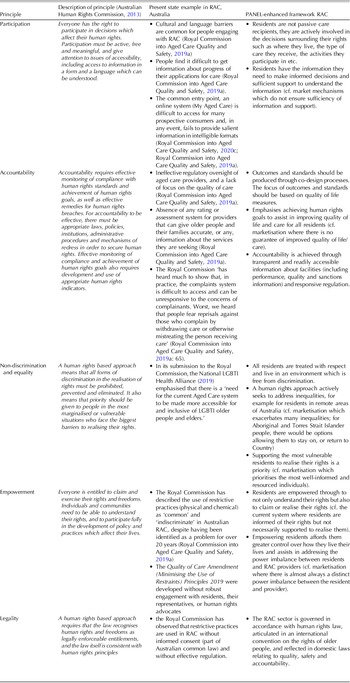
A robust human rights framework would make the rights of residents paramount in relation to, for example, commercial considerations or institutional convenience. It would also support strengths-based frameworks for policies, legislation and service responses. Human rights frameworks are: ‘…characterised by five underpinning human rights principles. These are known as the ‘PANEL principles’ – Participation, Accountability, Non-discrimination and equality, Empowerment, and Legality.’ (Australian Human Rights Commission, 2019: 14) (see Table 2).
Application of PANEL principles to residential aged care (RAC) in Australia

The European Network of National Human Rights Institutions has developed detailed guidance on applying a human rights framework to RAC (European Network of National Human Rights Institutions, 2017). Australian common law and public international law recognise universal rights to health and wellbeing (Secretary of the Department of Health and Community Services v JWB and SMB (1992) 175 CLR 218 (‘Re Marion’); International Covenant on Economic, Social and Cultural Rights Article 12; Convention on the Rights of Persons with Disabilities Article 25). However, the rights of older persons have been somewhat overlooked in the development of international and Australian human rights discourse and policy. While aspects of the Convention on the Rights of Persons with Disability, the Convention on the Elimination of All Forms of Discrimination Against Women, and more generalist instruments such as the Universal Declaration of Human Rights, offer degrees of explicit recognition, older people suffer from the lack of an equivalent to the Convention on the Rights of the Child, the Convention on the Rights of Persons with Disability, or the Convention on the Elimination of All Forms of Discrimination Against Women. Further, it is unhelpful to conflate characteristics such as disability and age, or gender and age – this serves no cohort, no cohort being homogenous even within itself, let alone across intersecting characteristics. Existing frameworks do not provide adequate protection for older people; a coherent and specialised framework is required to support the realisation of the human rights of older people (Office of the High Commissioner for Human Rights, 2021).
A human rights framework for RAC would involve re-conceptualising accreditation, regulation and compliance as activities emanating from a tripartite relationship between residents, accrediting agencies/regulators and providers – with residents having primacy. It would appear from evidence that the Royal Commission has received to date that, too often, discussions about accreditation and compliance are conceptualised within a dyad comprising only (or, at best, dominated by) government and providers. This is incompatible with a human rights based, person-centred system.
Responsive regulation to vindicate human rights in aged care settings
The 2016 Roadmap (Aged Care Sector Committee, 2016: 3) envisaged
… an agile and proportionate regulatory framework….[and that] Government [would] have a more proportionate regulatory framework that gives providers freedom to be innovative whilst ensuring a safety net for consumers.
Events recounted to the Royal Commission indicate that effective regulation in aged care is not, as has been suggested by some stakeholders, precluded by overly onerous requirements imposed on providers. Rather, effective regulatory conduct has been eschewed in favour of tick-a-box processes focusing on administrative outputs rather than resident-valued outcomes. For example: ‘default’ three-year accreditation cycles; consulting only 10 per cent of residents at a facility when assessing a provider; and, reliance on a binary measure (met/not met).
Responsive regulation refers to regulation which responds to the actions of regulated parties, industry context and the environment (Braithwaite, Reference Braithwaite2011). A responsive regulation approach would support a human rights based framework by, for example:
-
calibrating accreditation periods with reference to real time data
-
developing, through co-design, nuanced outcomes and standards that are valued by older people
-
transforming regulator culture to make considered use of tiered sanctions and enforcement measures
-
affording access to systemic and individual advocacy, including through community visitors programmes
-
conferring legal protections for complainants and their caregivers/loved ones.
Additional measures to support this framework may include bolstering transparency measures and checks and balances on the profits made by providers. For example, in the United Kingdom, it has been suggested that a limit be placed on the proportion of a provider’s income to be spent on property, debt repayment and profit and that an agreed proportion of the provider’s income be spent on staffing and other operating costs (Kotecha, Reference Kotecha2019).
Recommendations
Recommendation 1: adopt a human rights framework based on the PANEL principles
A human rights framework should be implemented in place of increasing marketisation. The framework should be based on the PANEL principles, complemented by responsive regulatory practices undertaken by regulators who are funded independently of those whom they regulate and who are trained to apply responsive regulation principles.
This framework would better promote quality of care and services, choice and equality, thereby benefiting the residents living in RAC. Given the widespread affronts to human rights recounted before the Royal Commission, it would appear prudent for the government to at least consider a human rights based framework for RAC. We note, though it is outside the scope of this article to canvass, that a human rights framework does not preclude fiscal sustainability.
Recommendation 2: promote an international convention on the human rights of older persons
An international convention focusing on the human rights of older persons should be promoted, along with the appointment of a special rapporteur (these elements should be included in the National Plan). According to the Australian Human Rights Commission, an international convention on the human rights of older persons will encourage the development of laws and policies focused on protecting the rights of older people. Further it may assist in shifting negative perceptions of older persons towards more positive perceptions, with older people viewed as rights bearers and contributors to society (Australian Human Rights Commission, 2014). The development of such a convention would serve to benefit older adults and would come at a minimal cost to the parties to the convention.
Strengths and limitations
This article draws upon numerous reviews into the Australian RAC sector and the peer reviewed literature to provide an overview of the failings of increased marketisation in RAC in Australia. The article also provides an alternative policy framework for the provision of RAC aimed at promoting the quality of life and care of residents. The authors are a multidisciplinary team with knowledge, experience and expertise in public health, policy, law, geriatric medicine and geriatric and gerontology research.
There is limited empirical data on the impact of marketisation in Australian RAC which makes it difficult to draw conclusions and resolve many tensions highlighted in this article. The absence of a universal approach to measuring efficiency versus quality further limits the conclusions that can be drawn. The retrospective nature of this analysis also gives rise to the potential for hindsight bias. Further empirical research is required on marketisation in RAC.
Conclusion
Shifts towards a freer market arguably diminish the role of the government as policy makers, funders and regulators, seeking to rely more heavily on market mechanisms to promote quality, efficiency and choice in the RAC sector. The assumption that increased marketisation will benefit all parties is premised upon the existence of a genuinely competitive market. In this article, we have questioned whether there can be a genuinely competitive market on which residents can rely to self-regulate and meet resident needs and preferences. Furthermore, it is highly questionable whether free market principles can ever be relied on in circumstances of intractable asymmetries of knowledge and power, where the subject of the bargain is not a commercial transaction, but a relationship of care. We propose an alternative human rights based framework which seeks to address the failings of increased marketisation and improve the wellbeing and quality of life of residents.