Background
Arthritis is one of the most prevalent chronic diseases in North America and one of the leading causes of activity limitations among seniors (Health Canada, 2010). Several arthritis self-management interventions have been proposed for people with arthritis. The short-term impact of these interventions on participants’ psychological and physical health is well-reported (Astin, Beckner, Soeken, Hochberg, & Berman, Reference Astin, Beckner, Soeken, Hochberg and Berman2002; Barlow et al., Reference Barlow, Turner, Swaby, Gilchrist, Wright and Doherty2009; Lorig & Holman, Reference Lorig and Holman1993; Reid et al., Reference Reid, Papaleontiou, Ong, Breckman, Wethington and Pilemer2008; Yip et al., Reference Yip, Sit, Fung, Wong, Chong and Chung2007). Maintenance of this impact over time has been studied to a lesser extent, but results are promising (Astin et al., Reference Astin, Beckner, Soeken, Hochberg and Berman2002; Barlow et al., Reference Barlow, Turner, Swaby, Gilchrist, Wright and Doherty2009; Niedermann, Fransen, Knols, & Uebelhart, Reference Niedermann, Fransen, Knols and Uebelhart2004; Reid et al., Reference Reid, Papaleontiou, Ong, Breckman, Wethington and Pilemer2008). At the same time, much of the research on self-management interventions for arthritis has included younger and more independent older adults (ages 55–65) rather than frail older adults who may be largely housebound and have elevated levels of depression and social isolation (Callahan et al., Reference Callahan, Mielenz, Freburger, Shreffler, Hootman and Brady2008; Goeppinger, Armstrong, Schwartz, Ensley, & Bradey, 2007; Hughes et al., Reference Hughes, Seymour, Campbell, Huber, Pollak and Sharma2006).
Recently, we developed a self-management program based on Bandura’s (Reference Bandura1977) social cognitive theory (SCT) specifically for frail older persons living with arthritis who were largely housebound and in need of home care services (Laforest et al., Reference Laforest, Nour, Parisien, Griskan, Poirier and Gignac2008a; Nour, Laforest, Gauvin, & Gignac, Reference Nour, Laforest, Gauvin and Gignac2006; Nour, Laforest, Gignac, & Gauvin, Reference Nour, Laforest, Gignac and Gauvin2007). A randomized controlled trial conducted to evaluate the program immediately post-intervention, by comparing the experimental group receiving the program with a control group on a waiting list for the program, showed a decrease in self-reported functional limitations (p = 0.04) and feelings of helplessness (p = 0.05). In addition, the trial showed a tendency for greater coping effectiveness (p = 0.06) related to living with arthritis, and for using physical exercise and relaxation strategies to manage arthritis (Laforest et al., Reference Laforest, Nour, Parisien, Griskan, Poirier and Gignac2008b; Nour et al., Reference Nour, Laforest, Gauvin and Gignac2006).
However, a difficulty faced by many researchers in designing interventions is not only in changing behaviour, but also in maintaining effects over time. In this article, we examine the maintenance of program effects eight months after its completion, and we explore the added value of reinforcement phone calls as a strategy to optimize that maintenance. A previous paper showed that physical exercise and relaxation activities were maintained eight months after the end of the program (Nour et al., Reference Nour, Laforest, Gignac and Gauvin2007).
Some Strategies to Promote Self-Management
Self-management interventions can be presented in a variety of modes and formats. Traditionally, face-to-face interventions such as individual follow-ups or group sessions have been preferred. More recently, a literature review showed some effectiveness and usefulness of Internet-based education interventions (Nguyen, Carrieri-Kohlman, Ranki, Slaughter, & Stulbarg, Reference Nguyen, Carrieri-Kohlman, Ranki, Slaughter and Stulbarg2004). In this regard, a randomized trial of 855 adults showed that the Internet version of the well-known Arthritis Self-Management Program was a viable alternative to the small-group format since it improved some health status measures among participants (Lorig, Ritter, Laurent, & Plant, Reference Lorig, Ritter, Laurent and Plant2008). On the other hand, Nguyen and colleagues reported that when they included older people, Internet self-management interventions generally required a major component of home-based training and/or technical support (Nguyen et al., Reference Nguyen, Carrieri-Kohlman, Ranki, Slaughter and Stulbarg2004).
Phone call interventions are more common and may be used alone as educational techniques or coupled with other strategies. A systematic review supported the efficacy of behavioural change (physical activities and nutrition) among adults and older adults with telephone calls as the primary educational method (Eakin, Lawler, Vandelanotte, & Owen, Reference Eakin, Lawler, Vandelanotte and Owen2007). Also, a telephone-based self-management intervention conducted by a health educator was found to reduce pain among patients with osteoarthritis followed in a primary care setting. The intervention consisted of educational materials coupled with 12 monthly telephone calls to support individualized goals (Allen et al., Reference Allen, Oddone, Coffman, Datta, Juntilla and Lindquist2010).
In their review of self-management programs specifically designed for patients with rheumatic diseases, Iversen, Hammond, and Betteridge (Reference Iversen, Hammond and Betteridge2010) proposed that regardless of program format, selected program components showed promising results including promotion of physical activity, adoption of a rigorous protocol, and program delivery by the same trained leader.
Maintenance of Effects
Maintenance of the effects of a self-management program on perceived functional limitations for an arthritic population has been reported in some studies (Barlow et al., Reference Barlow, Turner, Swaby, Gilchrist, Wright and Doherty2009) but not in others (Lindroth et al., Reference Lindroth, Brattstöm, Bellman, Ekestaf, Olofsson and Strömbeck1997; Lorig & Holman, Reference Lorig and Holman1993; Sharpe, Sensky, Timberlake, Ryan, & Allard, Reference Sharpe, Sensky, Timberlake, Ryan and Allard2003; Yip et al., Reference Yip, Sit, Fung, Wong, Chong and Chung2007). In addition, maintenance of changes in coping effectiveness was observed in one study (Lindroth et al., Reference Lindroth, Brattstöm, Bellman, Ekestaf, Olofsson and Strömbeck1997) but not by Sharpe et al. (Reference Sharpe, Sensky, Timberlake, Ryan and Allard2003). The only study that examined perceptions of helplessness did not show maintenance of effects over time (Freeman, Hammond, & Lincoln, Reference Freeman, Hammond and Lincoln2002). Moreover, none of these studies included frail elders, and their post-intervention time frame varied considerably, ranging from 12 months to eight years.
Social Reinforcement
Some authors have suggested that social reinforcement following an intervention helps to maintain short-term program benefits, particularly for people with a chronic illness (Jaarsma, Abu-Saad, Dracup, & Halfens, Reference Jaarsma, Abu-Saad, Dracup and Halfens2000). Social reinforcement is defined as positive support (verbal, physical, and psychological) that a person receives to help maintain a behavioural change (Bandura, Reference Bandura1977). These strategies can be included in a self-management program through peer or practitioners’ booster group sessions, telephone calls, or mailings.
To examine the effects of reinforcement, Lorig and Holman (Reference Lorig and Holman1993) randomized 589 participants from a 12-hour arthritis self-help group either to (1) receive a bimonthly newsletter; (2) attend a new six-week arthritis reinforcement program (ARP); or (3) receive no reinforcement. Between baseline and 20 months, all participants reduced their pain, depression, and visits to physicians, but the results were not enhanced by reinforcement. Although the authors did not provide a clear explanation for the lack of effect from the post-intervention reinforcement, they suggested that the program itself may facilitate self-reinforcement, leading to long-term maintenance of benefits.
In other work, Riemsma, Taal, and Rasker (Reference Riemsma, Taal and Rasker2003) analyzed a five-week group program that included booster sessions at three, six, and nine months after the program. Their randomized trial with 218 people living with rheumatoid arthritis showed no significant short-term effects of group education. After 12 months, effects were observed for self-efficacy and fatigue only. Considering the lack of effect on other variables, the authors concluded that booster sessions were not very effective in enhancing the benefits of patient education. The absence of short-term effects halted further examination of the potential of booster sessions on maintenance of effects. In addition, given that booster sessions were offered to all experimental group participants, it would be difficult to isolate the impact of this specific program component from any overall intervention effects.
Phone calls following an intervention have sometimes been proposed as a reinforcement strategy (Dale, Caramlau, Lindenmeyer, & Williams, Reference Dale, Caramlau, Lindenmeyer and Williams2009). Telephone interventions aimed at increasing knowledge and awareness, and using problem-solving and other strategies, have been hypothesized to maintain program changes in attitudes, behaviours, and health outcomes (Bennett et al., Reference Bennett, Perrin, Hanson, Bennett, Gaynor and Flaherty-Robb2005; Kolt, Schofield, Kerse, Garrett, & Oliver, Reference Kolt, Schofield, Kerse, Garrett and Oliver2007). Castro, King, and Brassington (Reference Castro, King and Brassington2001), for example, suggested that phone counselling methods can be beneficial and cost-effective. Some researchers have examined phone support offered at the same time as the intervention. These studies show increased adherence to and satisfaction with the program (Collier et al., Reference Collier, Ribaudo, Mukherjee, Feinberg, Fischl and Chesney2005; Shearer, Cisar, & Greenberg, Reference Shearer, Cisar and Greenberg2007). Pariser and colleagues (Pariser, O’Hanlon, & Espinoza, Reference Pariser, O’Hanlon and Espinoza2005) also found that social reinforcement within a program offers positive short-term results for older adults with arthritis. There is a need to evaluate the impact of telephone call reinforcement after the intervention on maintenance of short-term effects, especially among frail older adults since previous research involved more autonomous and younger participants (mean age under 65).
The Current Study
In this randomized controlled trial (RCT), we examined post-intervention social reinforcement effects in the form of telephone calls conducted by volunteer peers. This strategy was considered to be the most promising for optimizing outreach and efficiency and has been recommended by other researchers (Dennis, Reference Dennis2003; Parry & Watt-Watson, Reference Parry and Watt-Watson2010). The practitioners on the project’s steering committee suggested that telephone boosters were particularly suitable for frail populations given their potential social isolation. We hypothesized that participants receiving the program with social reinforcement would have better maintenance of effects eight months post-program than those not receiving it in relation to our primary outcomes, including perceived functional limitations, coping effectiveness, and helplessness (i.e., variables that had changed immediately post-program).
Methods
Details regarding the intervention, which we summarize here, have been presented elsewhere (Laforest et al., Reference Laforest, Nour, Parisien, Griskan, Poirier and Gignac2008a; Nour et al., Reference Nour, Laforest, Gauvin and Gignac2006, Reference Nour, Laforest, Gignac and Gauvin2007).
Intervention
I’m Taking Charge of My Arthritis! (Laforest et al., Reference Laforest, Nour, Parisien, Griskan, Poirier and Gignac2008a) is a self-management intervention for frail older adults consisting of six one-hour sessions conducted in the participant’s home by a trained health care practitioner for six consecutive weeks. Visits include information about topics such as pain management; exercise and relaxation; coping with negative emotions and support; formulation of goals and action plans; and reviews of successes and barriers to changing behaviour. Detailed guides for the program and training of practitioners were developed and are available online (see www.myarthritis.ca).
Social Reinforcement
Evaluation of the intervention was based on the RCT. Social reinforcement was randomly provided to half the intervention group and consisted of bi-monthly phone calls in the two months immediately after the program (four calls), followed by monthly phone calls for four additional months (four calls). The follow-up period lasted six months, and each call lasted approximately 15 minutes. In order to facilitate modeling, semi-structured telephone calls were conducted by trained volunteers who also had arthritis. To enhance adherence to the intervention protocol, volunteers used a detailed telephone interview guide including all the questions to be asked during each call. The guide included some closed and some open-ended questions – for example: “Since the end of the program, have you set some new personal goals?” and “What could you do to better control your pain?” The calls were not recorded, but volunteers completed a questionnaire for every call and returned it to the study coordinator. During each call, volunteers provided positive feedback, stimulated reflection, and facilitated problem-solving activities while following up on the participant’s personal action plan. Volunteers also reviewed themes covered during the face-to-face intervention such as (a) strategies to control stiffness, (b) medication management, (c) physical exercise, (d) relaxation techniques, (e) actions to keep up morale, and (f) energy management strategies.
Participants and Design
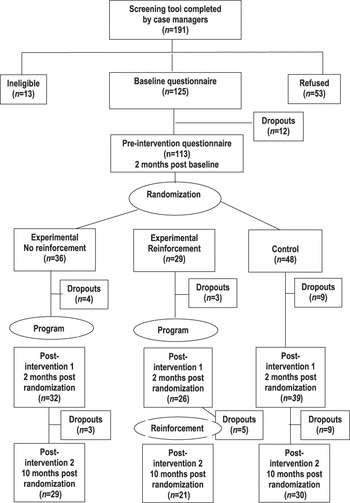
Figure 1 shows a Consolidated Standards of Reporting Trials CONSORT study flow diagram for this RCT. Participants were recruited from local Community Health Services Centers (CLSCs), which are part of the Québec health and social services network. From the 29 Montréal CLSCs invited to join the project, 15 agreed to participate. Over a one-year period, home care case managers recruited participants by phone and identified eligible participants by examining their clients’ medical records and using a screening tool we had provided them. A series of eligibility criteria had to be met: (a) living at home; (b) housebound (i.e., not leaving home on one’s own more than twice a month); (c) aged 50 or older; (d) self-reporting moderate to severe pain during the previous week; (e) suffering from medically diagnosed osteoarthritis (OA) or rheumatoid arthritis (RA); (f) speaking English or French; and (g) reporting difficulties in performing domestic activities or activities of daily living.
Flow chart of participants through the randomized controlled trial

We excluded individuals who (a) had received a polymyalgia diagnosis; (b) had a recent health problem requiring rehabilitation; or (c) had a cognitive impairment. A total of 125 participants were recruited: 113 women and 12 men. Participants were assigned to one of the two experimental groups or to the control group using a list of numbers, each of which was randomly paired with one of the three groups (experimental, experimental with social reinforcement, or control). This list was made before the project started. Assignment to the control group was made by the study coordinator after participants completed the pre-intervention questionnaire. The ethics committee for Applied Health Sciences of the Université de Montréal approved the study, and participants signed an informed consent form prior to involvement.
The intervention was evaluated using a randomized experimental design with measures recorded at baseline (eight weeks prior to the pre-intervention to adjust for reactivity to measurement: n = 125), immediately before randomization (pre-intervention: n = 113), immediately following the completion of the intervention two months post-randomization (post-intervention 1: n = 97), and ten months after the randomization (post-intervention 2: n = 80). This period was selected for the last post-test in order to have a complete year after baseline, which was possible given that the social reinforcement period lasted six months. Other researchers testing the same type of program with similar outcomes have used the same timing for their evaluations (Barlow et al., Reference Barlow, Turner, Swaby, Gilchrist, Wright and Doherty2009; Buszewicz et al., Reference Buszewicz, Rait, Griffin, Nazareth, Patel and Atkinson2006; Lorig et al., Reference Lorig, Ritter, Laurent and Plant2008).
Eight trained interviewers administered two-hour structured questionnaires to participants in their homes. The interviewers were blind to group allocation and to the intervention’s specific objectives. The same interviewer performed all four interviews with participants. Participants were offered breaks during the interviews but usually declined them.
After the pre-intervention assessment, participants were randomly assigned to one of three groups: (1) a wait-list control group (n = 48); (2) an intervention group receiving the program with no social reinforcement (n = 36); or (3) an intervention group receiving both the program and social reinforcement for six months (n = 29). We chose to have three arms in this RCT because we wanted to be able to test whether or not there was maintenance of short-term effects and to test whether or not maintenance was greater in the experimental group receiving social reinforcement, compared to the experimental group not receiving reinforcement.
The study protocol involved recruitment of 50 subjects per group; however, we modified this goal because of budgetary and practical constraints. As a result, the number of participants in the social reinforcement group was smaller than hoped for and thus allowed for exploratory analyses. Details regarding power calculations for the main outcome (i.e., pain) have been reported elsewhere (Laforest et al., Reference Laforest, Nour, Parisien, Griskan, Poirier and Gignac2008a). Briefly, power was calculated using a pain variable which is a well-documented outcome compared with other outcomes. We estimated that with an alpha of .05 and a sample size of 50 per group, there would be 90 per cent power of detecting effects size between .25 and .50. The maintenance analyses were ancillary in the study, and thus power calculations were not performed for these outcomes.
Variables and Measures
Outcome Variables. Functional limitations were measured by means of the Western Ontario and McMaster Universities Osteoarthritis Index (WOMAC) (Bellamy et al., Reference Bellamy, Watson, Buchanan, Goldsmith, Campbell and Stitt1988; Choquette, Bellamy, & Raynauld, Reference Choquette, Bellamy and Raynauld1994). Participants rated the degree of difficulty they had in performing 17 activities on a 5-point Likert scale ranging from 1 (no difficulty) to 5 (extreme difficulty). A mean score was calculated, and higher scores reflect greater limitations. Cronbach’s alpha for the limitations subscale was .88 in our sample. The WOMAC’s psychometric properties have been shown to be excellent with older adults, and scores have been found to be highly correlated with the Health Assessment Questionnaire (HAQ) disability index (Wolfe, Reference Wolfe1999).
Helplessness was measured using the abbreviated version of the Arthritis Helplessness Inventory (DeVellis & Callahan, Reference DeVellis and Callahan1993). Participants indicated their feelings of helplessness in dealing with arthritis on a 5-point Likert scale ranging from 1 (totally disagree) to 5 (totally agree). Higher scores reflect less helplessness. Cronbach’s alpha was .52 for sample in our current study, although the scale has previously been shown to have acceptable reliability levels in older samples (Gignac, Reference Gignac2000). We used the mean score.
Coping effectiveness was measured with a four-item scale on how effectively participants coped with arthritis-associated pain, emotions, relationships, and daily problems (Gignac, Reference Gignac2000). A 5-point Likert scale was used, which ranged from 1 (strongly agree) to 5 (strongly disagree). Lower scores reflect less perceived coping efficacy. Convergent validity was assessed for the scale and reliability was .80 (Gignac, Reference Gignac2000). The mean score was used.
Individual Variables
We analysed three variables in our study: (a) demographics; (b) pain and type of arthritis; and (c) psychosocial health characteristics.
Demographics: We collected information on age, gender, socioeconomic status, and years of education.
Pain and type of arthritis: Participants’ case managers identified the type of arthritis. We also collected information from participants on self-reported health, co-morbidities, and medications used (Daveluy et al., Reference Daveluy, Pica, Audet, Courtemanche, Lapointe, Côté and Baulne2001). Pain intensity was evaluated with 100-mm Visual Analogue Scales (VAS). Participants placed an X on the scale to indicate their levels of pain and fatigue. The scale ranged from 0 mm (no pain or no fatigue) to 100 mm (pain [fatigue] as bad as it can be) (Duruoz et al., Reference Duruoz, Poiraudeau, Fermanian, Menkes, Amor and Dougados1996).
Psychosocial health characteristics: Depressive symptomatology was measured using the Center for Epidemiological Studies-Depression Scale (CES-D), a 20-item index that assesses the presence of symptoms of depression (Blalock, DeVellis, Brown, & Wallston, Reference Blalock, DeVellis, Brown and Wallston1989) using a 4-point Likert scale ranging from 1 (rarely) to 4 (most of the time). The CES-D shows excellent internal consistency (Cronbach alpha > .85) and test-retest correlation (r > .5) (Radloff, Reference Radloff1977). Cronbach’s alpha for the scale was .80 in this sample. Participants were dichotomized into those with depressive symptoms (i.e., mean scores of 16 or above out of 60) and those with no depressive symptoms, on the basis of the recommendation of Fuhrer and Rouillon (Reference Fuhrer and Rouillon1989). Satisfaction with social life was measured with a single question derived from the “Enquête sociale et de santé au Québec”, a provincial survey presenting good face validity: “How satisfied are you with your social life?” (Daveluy et al., Reference Daveluy, Pica, Audet, Courtemanche, Lapointe, Côté and Baulne2001). Scores ranged from 1 (very satisfied) to 4 (not satisfied at all).
Statistical Analysis
Using Statistical Package for the Social Sciences SPSS (version 10) for Microsoft Windows 2000, we performed univariate analyses to verify the normality of distributions and identify outliers. All continuous variables (i.e., age, years of education, functional limitations, coping effectiveness, and helplessness) were normally distributed. Bivariate analyses were conducted to compare characteristics of participants from different groups at pre-intervention and dropouts with those who remained in the study using t-tests and chi-square tests. We applied multilevel modeling techniques with HLM 5.04 (Hierarchical Linear Modeling, Scientific Software International, Chicago, IL) to overcome the challenges presented by the data set (e.g., different initial and final sample sizes) and to assess data from participants over time. These techniques, similar to a repeated measures analysis, compare changes in the groups from baseline to post-intervention 2, including the pre-intervention measure and the post-intervention 1. These analyses are equivalent to an “intent to treat analysis”, and it allows for control of potential confounding variables (age, education, arthritis type, depressive symptoms, and socioeconomic status). We chose these variables from the literature and forced them into our model even if there was no statistical difference at baseline. We set the significance level at .05. Given the conceptual model and an a priori hypothesis, we decided not to adjust for the number of outcomes in the analysis. This is an option supported by different authors (Goodman, Reference Goodman1998; Pernerger, Reference Pernerger1998). Given that these analyses were cast as exploratory and that the study was designed to be sufficiently powered to detect effects on pain immediately post-intervention, we did not perform post hoc power analyses for these secondary analyses.
Initially, we tested the program without the social reinforcement variable, and we demonstrated that the program had short-term effects on different variables. In studying the program’s maintenance, we were interested in seeing whether or not these effects were maintained globally and in examining whether or not the maintenance of effects was affected by social reinforcement. Hence, the goal of our data analysis was to determine if the intervention was associated with the maintenance of short-term effects on functional limitations, coping effectiveness, and helplessness, and to explore the role of social reinforcement. In the first series of analyses, we included the same variables as for the short-term analysis without social reinforcement to verify whether changes were maintained overall.
In the second series of analyses, we added social reinforcement (no reinforcement = 0; reinforcement = 1) and the interaction term with the intervention in order to study the moderating role of social reinforcement. In these models, we were interested in detecting significant interaction terms. Significant interactions were plotted to allow interpretation (data not shown).
Results
Characteristics of the Sample
No statistically significant differences were found between the participants who completed the post-intervention follow-ups (n = 80) and the participants who had been randomized at pre-intervention (n = 113). There were no statistically significant differences, either, between those who remained until the last follow-up (n = 80) and those who left the study (n = 33). Reasons for leaving the study included hospitalization, death, deterioration of health status, a move to a seniors’ residence, and a participant’s belief that the study would be too demanding.
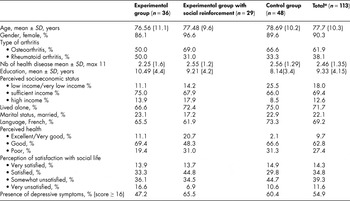
The mean age of the 113 participants was 71.7 years (SD = 10.99), 90 per cent were women, and 72 per cent lived alone. Participants’ characteristics at pre-intervention are presented in Table 1. No statistically significant differences were observed across the three groups. Nevertheless, the following three differences were present: (1) the proportion of persons with rheumatoid arthritis was greater in the experimental group without reinforcement (50% vs. 32%); (2) the proportion of persons perceiving their income as lower was greater in the control group (26% vs. 13%); and finally, (3) the proportion of persons with depressive symptoms was smaller in the experimental group without reinforcement (47% vs. 63%). A more complete profile of the sample is available elsewhere (Laforest et al., Reference Laforest, Nour, Parisien, Griskan, Poirier and Gignac2008b).
Demographic and health characteristics of housebound older adults with arthritis (pre-intervention values)

a T-test and chi-square tests did not reveal any statistically significant difference between groups at pre-intervention for all variables. There were no statistically significant differences between those who remained in the study (n = 80) and those present at pre-intervention (n = 113), or between those who dropped out before the pre-intervention (n = 12) and those present at pre-intervention (n = 113), or between the dropouts after pre-intervention (n = 33) and those who remained in the study until the end (n = 80).
SD = standard deviation
Effects of the Intervention
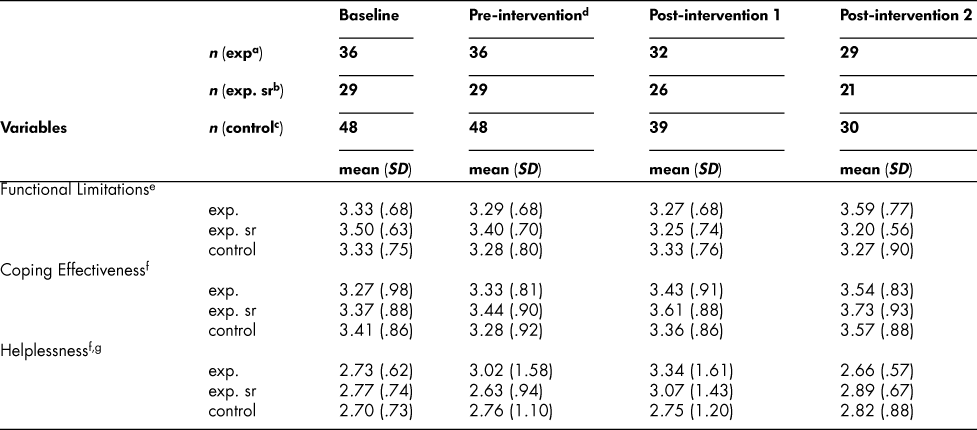
Table 2 presents observed values for the outcome variables at the four measurement times. We used these raw data for the multilevel analysis to test the effects of the program immediately after intervention (post-intervention 1) and eight months later (post-intervention 2) while adjusting for confounding variables. In the post-program meeting, volunteers reported that they enjoyed making these calls and that they believed that the participants appreciated them.
Observed values for outcome variables at baseline, pre-test, and post-tests
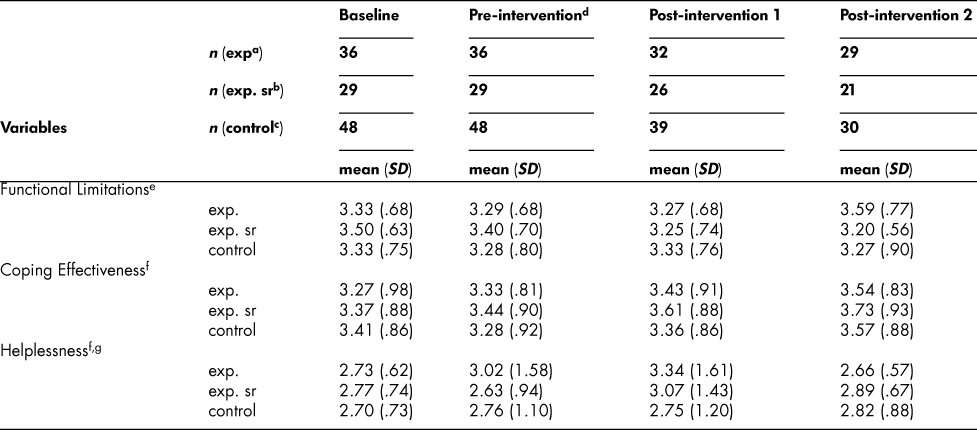
a exp = experimental group
b exp. sr = experimental group with social reinforcement
c control = control group
d T-test and chi-square tests did not reveal any statistically significant differences between groups at pre-intervention (after randomization)
e Higher scores reflect worse conditions. Negative effect size and percentage of change indicate improvements.
f Lower scores reflect worse conditions
g The information contained in this table is the observed data used in the multilevel analysis
SD = standard deviation
Global Maintenance of Short-Term Effects Eight Months Post-program
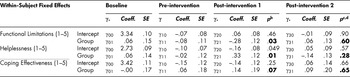
Table 3 reveals that when participants from the two intervention groups (with and without social reinforcement) were combined, the significant short-term effects of the program observed immediately post-intervention were not maintained at post-intervention 2 (functional limitations, p = .60; helplessness, p = .28; and coping effectiveness, p = .65).
Multilevel modelling analysis results testing the impact of a home-based self-management intervention on physical and psychological health (experimental groups with and without reinforcement combined)Footnote a

a All analyses were adjusted for age, years of education, type of arthritis, depressive symptoms, and socioeconomic status.
b Parameter γ21 reflects effects of the intervention immediately post-program (p values are in bold).
c Parameter γ31 reflects effects of the intervention 8 months later. None of the short-term effects noticed were still present when the two intervention groups were combined (p values are in bold).
d To test moderating effects of social reinforcement, the same model was run by adding an interaction term. Social reinforcement had a significant moderating effect on functional limitations (p < .05) and coping effectiveness (p = .07). Maintenance of short-term effects was significantly greater for those receiving social reinforcement. Results are not shown in Table 3.
Coeff. = coefficient
SE = standard error
Significance of coefficient γ31 is indicative of intervention effects using the following model:
Level 1 model: Outcome = ß0j + ß1jX1 + ß2jX2 + rij
Where i: 1 … N individuals; rij: level 1 error term; γij: parameter coefficients; uoj: level-2 random effect; ß: coefficient; Gr: group membership (1 = experimental, 0 = control); X1: dummy variable (1 = pre-intervention, 0 = otherwise); X2: dummy variable (1 = post-intervention 1, 0 = otherwise); X3: dummy variable (1 = post-intervention 2, 0 = otherwise);
Level 2 model: T1 ß0j = γ00 + γ01 Grj + uoj
T2 ß1j = γ10 + γ11 Grj
T3 ß2j = γ20 + γ21 Grj
T4 ß3j = γ30 + γ31 Grj
Meaning of Coefficients:
γ00 = Predicted value in outcome variable at baseline for participants in control group
γ01 Grj = Predicted difference in outcome variable at baseline for participants in experimental group
γ10 = Predicted change in outcome variable from baseline to pre-intervention for participants in control group
γ11 Grj = Predicted difference in change in outcome variable from baseline to pre-intervention for participants in experimental group
γ20 = Predicted change in outcome variable from baseline to post-intervention 1 for participants in control group
γ21 Grj = Predicted difference in change in outcome variable from baseline to post-intervention 1 for participants in experimental group
γ30 = Predicted change in outcome variable from baseline to post-intervention 2 for participants in control group
γ31 Grj = Predicted difference in change in outcome variable from baseline to post-intervention 2 for participants in experimental group
Moderating Effects of Social Reinforcement
We tested the moderating effects of social reinforcement with multilevel modeling using the raw data in Table 2. Specifically, we added an interaction term to compare the groups from post-intervention 1 to post-intervention 2 (the results are not shown in Table 3). These tests enabled us to determine whether or not the social reinforcement effect is statistically significant after adjustment in the models.
The adjusted models confirm the beneficial effects of social reinforcement for functional limitations. Whereas the combined data failed to show maintenance of effects at post-intervention 2, the interaction effect was statistically significant (p = .05). Examination of the data showed that the experimental group with social reinforcement maintained their improved function over eight months, whereas the experimental group without social reinforcement showed decreases in function at post-intervention 2.
The interaction term examining moderating influences on coping effectiveness approached but did not reach statistical significance (p = .07). When the intervention group was stratified as a function of social reinforcement, the group that received social reinforcement tended to show greater outcome expectations than the intervention group without social reinforcement, although this effect did not reach statistical significance.
Finally, maintenance of changes in perceived helplessness was not maintained by either the social reinforcement group or the intervention group without reinforcement. The interaction effect was not statistically significant (p = .35).
Discussion
As mentioned, the purpose of this study was to examine the maintenance of the short-term effects of an arthritis self-management intervention on the physical and psychological health of frail older adults with arthritis, and to explore the role of social reinforcement, namely phone calls from volunteers, in moderating the intervention effects. Findings show that the program’s short-term effects on participants’ perceived functional limitations were significantly maintained among those who received social reinforcement but not among those who did not receive social reinforcement. There was also a trend for the effects of social reinforcement on the maintenance of changes in perceptions of coping effectiveness (p = .07). These promising results regarding maintenance of benefits from a self-help intervention are consistent with some previous studies (Lindroth et al., Reference Lindroth, Brattstöm, Bellman, Ekestaf, Olofsson and Strömbeck1997; Lorig & Holman, Reference Lorig and Holman1993; Sharpe et al., Reference Sharpe, Sensky, Timberlake, Ryan and Allard2003; Yip et al., Reference Yip, Sit, Fung, Wong, Chong and Chung2007).
Although there was a significant decrease in perceived helplessness immediately post-intervention, this change was not maintained over the eight-month period following the intervention regardless of whether or not social reinforcement was provided. Few studies have focused on changes in helplessness over time among older adults. Freeman et al. (Reference Freeman, Hammond and Lincoln2002) did find similar results and an improvement in helplessness, but not beyond six months post-program. Their self-management group consisted of eight hours of intervention over four weeks (four two-hour meetings), compared to ours, which offered six hours over a six-week period. Their population was younger (mean age: 51) and less frail than ours (they were newly diagnosed). It may be that perceived helplessness is a psychosocial dimension that needs a more powerful intervention to achieve significant gains. In addition, just the fact of participating in a self-management intervention can represent, for a person living with a chronic illness, a sign of hope that influences feelings of helplessness. But this sense of hope may be reduced when the program is over and the person realizes that it did not reverse or cure the illness. Over the long term, the intervention (reinforcement phone calls) in our study offered by these volunteers may not be intense enough to maintain this type of effect. It is probable that the therapeutic link with the health professional is crucial in order for the phone calls to have an effect on helplessness, a variable that is highly correlated with depression.
Regarding social reinforcement, despite the fact that the study was not designed to detect effects in these secondary outcomes, the observation of significant differences across groups is indicative of the added value of booster calls. Social support, particularly instrumental support (e.g., help, encouragement, and resources), has been found to be associated with a decrease in disability and physical limitations in other research (Neugebauer & Katz, Reference Neugebauer and Katz2004). On the other hand, some studies have not demonstrated the benefits of social reinforcement post-intervention to help maintain the program effects (Lorig, & Holman, Reference Lorig and Holman1993; Riemsma et al., Reference Riemsma, Taal and Rasker2003). Notably, however, these earlier studies did not use phone calls and did not target frail older adults. Although telephone reinforcement and peer reinforcement are strategies that have previously been recommended to enhance the effects of an intervention (Dale et al., Reference Dale, Caramlau, Lindenmeyer and Williams2009; Jaarsma et al., Reference Jaarsma, Abu-Saad, Dracup and Halfens2000), they are not often included in arthritis self-management programs.
Several explanations are possible for the results on the benefits of social reinforcement. First, the post-intervention phone calls may have provided encouragement and concrete strategies on ways to help participants to move around more inside their homes and to carry out more of their daily activities, thereby enabling them to feel less limited which is particularly important with housebound individuals. Second, it may be that the telephone calls helped reinforce perceived efficacy over time. Participants who were more confident about their skills may have engaged in behaviours that resulted in fewer functional limitations. For example, the maintenance of physical activity and relaxation behaviour (Nour et al., Reference Nour, Laforest, Gignac and Gauvin2007) may have contributed to a decrease in participants’ functional limitations. Further support for this explanation is shown in the tendency to observe that changes in perceived coping effectiveness were maintained over time in the social reinforcement group. With a greater number of respondents, these findings might have reached statistical significance and supported the benefits of reinforcement in helping people perceive their coping efforts as beneficial. To date, studies on the maintenance of short-term effects on coping effectiveness (Lineker, Bell, Wilkins, & Badley, Reference Lineker, Bell, Wilkins and Badley2001; Sharpe et al., Reference Sharpe, Sensky, Timberlake, Ryan and Allard2003) have reported conflicting results, and none of the studies examined effects of reinforcement strategies post-program.
Several limitations of the study have already been mentioned, including the limited number of males and of participants in the social reinforcement group, which may have limited the power to investigate effects on these secondary outcomes. Another study limitation is a potential deviation from the scripts by the volunteers involved in the study. However, we took steps to minimize this problem by providing volunteers with a detailed script and training. A further potential limitation is the difficulty we had in ensuring that the interviewers remained blind to group allocation, although much effort was made to do so. This study also has several strengths such as the RCT design, the inclusion of baseline data collected prior to pre-intervention data, and the rigorous statistical analyses that we performed.
In terms of practical implications, our study suggests that social reinforcement strategies post-program may make a difference in the maintenance of short-term effects. Supportive calls suggest an important avenue to explore, especially given that reinforcement is a critical aspect of SCT (Bandura, Reference Bandura1977). As noted in a previous paper, participants and volunteers appreciated the calls (Nour, Laflamme, Laforest, & Bouchard, 2005). However, in the current study, social reinforcement was offered by volunteers who did not previously know the clients. It would also be interesting to examine the impact of social reinforcement provided by the health professional intervening with participants, as a continuation of the therapeutic alliance established with participants (Horvath, Del Re, Fluckiger, & Symonds, Reference Horvath, Del Re, Fluckiger and Symonds2011). Although health professionals may know and understand participants, the costs of professionals providing social reinforcement may be high. If research demonstrated that similar benefits could come from volunteers, this type of reinforcement might be a more cost- effective and beneficial way to maintain the impact of interventions.
Future research should specify the format and nature of social support to be directed towards the client in order to maintain intervention effects and help to explain the mechanism by which social reinforcement is useful. Studies should also include more men and explore the impact of education on results. It would also be helpful to include additional measures and data collection time-points in order to better understand the processes and mechanisms whereby social reinforcement has some benefits. For example, we did not address the therapeutic alliance in this research, but it would be interesting to study its role in achieving and maintaining some benefits from a self-management program. Also, benefits from other sources of support (e.g., family members and health care services) that may help reinforce changes could also be explored. It would also be interesting to explore other ways of providing support (e.g., e-mails).
Conclusion
Ours is among the few studies conducted with housebound older adults with arthritis for the purpose of evaluating the added-value of post-intervention social reinforcement to maintain the benefits of an individual face-to-face self-management program. In this program, a relatively inexpensive form of reinforcement, telephone calls with peer volunteers, was used to follow up with intervention participants. The study showed that effects on participants’ perceived functional limitations were significantly maintained among participants who received some booster calls from volunteers. These results suggest the need for reinforcement strategies post-program to maintain the short-term effects of self-management programs. Health promotion programs such as I’m Taking Charge of My Arthritis!, which include individual intervention coupled with telephone follow-up calls, may help homebound older adults with arthritis who must deal with symptoms on a daily basis.