INTRODUCTION
The ecological communities that characterize the rocky intertidal shores of South America are often dominated by dense, largely single-species stands of small mussels primarily belonging to the genus Brachidontes Swainson, 1840, sensu lato (s.l.) (Tanaka & Magalhães, Reference Tanaka and Magalhães2002; Thiel & Ullrich, Reference Thiel and Ullrich2002; Silliman et al., Reference Silliman, Bertness, Altieri, Griffin, Bazterrica, Hidalgo, Crain and Reyna2011). These Brachidontes-dominated beds are present along both coasts of South America, from southeast Brazil to Tierra del Fuego on the Atlantic side and from Tierra del Fuego to northern Chile on the Pacific side. The beds thus extend across biogeographic boundaries between the cold-temperate coasts of Patagonia (the so-called Magellanic Province; Balech & Ehrlich, Reference Balech and Ehrlich2008), and the warm temperate regions of the south-western Atlantic (Argentinian Province) and the south-east Pacific (Chile–Peru Province; Briggs & Bowen, Reference Briggs and Bowen2012).
In the south-western Atlantic (the focal area of our study), there is evidence indicative of replacement among nominal species of Brachidontes, defined on the basis of shell phenotypes, along environmental gradients (Figure 1). First, there is a gradual latitudinal replacement of B. purpuratus (Lamarck, 1819), a cold-temperate species, by B. rodriguezii (d'Orbigny, Reference d'Orbigny1842), a warm-temperate species, between 43° and 41°S (northern Argentine Patagonia) (Scarabino, Reference Scarabino1977). This transition appears to be tightly correlated with sea-surface temperature. Second, B. rodriguezii is replaced by the estuarine species B. darwinianus (d'Orbigny, Reference d'Orbigny1842) along the northern coast of the La Plata River estuary, from east to west, presumably in relation to the salinity gradient (Scarabino et al., Reference Scarabino, Zaffaroni, Clavijo, Carranza, Nin, Menafra, Rodríguez-Gallego, Scarabino and Conde2006). The mussel beds are remarkable for their uniform appearance, particularly on exposed rocky shores, and in spite of shifts in the dominant species.
Latitudinal range of distribution of Brachidontes s.l. species present in the south-western Atlantic (bars) and sampling sites for this study (symbols); (♦) B. darwinianus, (▴) B. rodriguezii, (•) B. purpuratus. Numbers indicate locations: 1, Punta Canario; 2, Santa Clara del Mar; 3, Bahia San Blas; 4, Bahia Rosas; 5, Puerto Madryn; 6, Caleta Carolina; 7, Puerto Deseado; 8, Surfer Bay; 9, Bahia Ensenada (see Table 1 for more information).

In the past, these and other species of Brachidontes have been separated solely on the basis of shell phenotypic characters. High phenotypic variability and homoplasy, however, have led to considerable confusion. For instance, recent molecular studies clarified the systematics and phylogeography of Brachidontes in Central and North America. Lee & Ó Foighil (Reference Lee and Ó Foighil2004, Reference Lee and Ó Foighil2005) found that what was generally considered a single species, B. exustus (Linnaeus, 1758), is actually a complex of five species in the Gulf of Mexico and the Caribbean Sea, plus two geminates on the Pacific coast of Central America. Opinions are contradictory in the case of the species from the south-western Atlantic. Aguirre et al. (Reference Aguirre, Perez and Negro-Sirch2006a), based on the application of morphometric techniques to planar projections of shell outlines, concluded that the three species are indistinguishable; accordingly, B. rodriguezii and B. darwinianus would be junior synonyms of B. purpuratus. More recent morphological studies, however, highlighted characters purportedly allowing the differentiation of B. rodriguezii and B. purpuratus (van der Molen et al., Reference van der Molen, Márquez, Idaszkin and Adami2012; Adami et al., Reference Adami, Pastorino and Orensanz2013). Rios (Reference Rios1994), and other Brazilian authors after him, have considered B. darwinianus as a junior synonym of B. exustus, which as mentioned earlier is a complex of cryptic species. While many authors (e.g. Coan & Valentich-Scott, Reference Coan and Valentich-Scott2012) place B. purpuratus in the monotypic genus Perumytilus Olsson, Reference Olsson1961, others retain it in Brachidontes s.l. (e.g. Zelaya, Reference Zelaya, Häussermann and Försterra2009; Huber, Reference Huber2010; Adami et al., Reference Adami, Pastorino and Orensanz2013). We prefer to follow the latter, at least until phylogenetic relations within Brachidontes s.l. are better understood.
Beyond the taxonomic conundrum, extreme viewpoints on the distinctness of these species implicitly support alternative ecophylogenetic hypotheses (Webb et al., Reference Webb, Ackerly, McPeek and Donoghue2002; Mouquet et al., Reference Mouquet, Devictor, Meynard, Munoz, Bersier, Chave, Couteron, Dalecky, Fontaine, Gravel, Hardy, Jabot, Lavergne, Leibold, Mouillot, Münkemüller, Pavoine, Prinzing, Rodrigues, Rohr, Thébault and Thuiller2012). If the three nominal species were closely related to each other, differentiated along environmental gradients (temperature, salinity), then physiognomic uniformity of intertidal mussel beds across biogeographic boundaries would reflect conservative design in the species dominating these beds. If, on the other hand, they belonged to separate clades, then the uniformity in appearance of these intertidal mussel beds from sub-antarctic to subtropical ecosystems, along both coasts of South America, would reflect convergence in communities assembled with elements of different origins.
The objectives of our study were to clarify the status of the nominal species of Brachidontes from the south-western Atlantic. We hypothesized that Brachidontes darwinianus, B. rodriguezii and B. purpuratus are indeed different species and used molecular information (one mitochondrial and two nuclear markers), to investigate their phylogenetic relations, and to discuss their patterns of distribution in the light of current ideas on the biogeography of the region.
The genus Brachidontes in the south-western Atlantic
The genus Brachidontes Swainson, 1840, s.l. (including Hormomya Mörch, Austromytilus Laseron, and Perumytilus Olsson, Reference Olsson1961) includes between 25 and 35 valid species (depending on accepted synonymies) distributed world-wide along warm and warm-temperate coastlines. Only one species, B. purpuratus, extends into cold-temperate waters (Figure 1). This species is also remarkable because its geographic range spans two entire biogeographic provinces located in different regions as defined by water temperature: the cold-temperate Magellanic Province (around southern South America), and the warm-temperate Chile–Peru Province (Zelaya, Reference Zelaya, Häussermann and Försterra2009). In the south-western Atlantic, B. purpuratus ranges northward to the transition zone between the cold and warm-temperate regions (41–43°S), corresponding, respectively, to the Magellanic and Argentine biogeographic provinces. The fact that B. purpuratus ranges into the warm-temperate region in the south-east Pacific but not in the south-western Atlantic is somewhat puzzling, but may be a consequence of density-dependent and founder effects (Waters et al., Reference Waters, Fraser and Hewitt2012) and the pre-existence in the warm-temperate region of the south-western Atlantic of a close competitor, i.e. Brachidontes rodriguezii (see below). As mentioned earlier, two other species have been consistently recorded in the south-western Atlantic. Brachidontes rodriguezii, originally described on the basis of specimens collected by Alcide d'Orbigny (Reference d'Orbigny1842, Reference d'Orbigny1846) in Bahia San Blas (northern Argentine Patagonia, ~40°26′S), ranges from Punta Ninfas (42°58′S) to Rio Grande (southern Brazil, 32°10′S) and is thus confined to the Argentine province. Brachidontes darwinianus was described on the basis of specimens collected in Rio de Janeiro (~22°56′S, Brazil), Maldonado (~34°55′S, Uruguay) and Bahia Rosas (= Ensenada de Ros, 41°09′S, northern Argentine Patagonia). This species has often been considered a synonym of the nominal species B. exustus (Linnaeus, 1758) (Rios, Reference Rios1994), which is in fact a complex of cryptic species (Lee & Ó Foighil, Reference Lee and Ó Foighil2004, Reference Lee and Ó Foighil2005).
Besides these three species, others have been reported for the region of focal interest. Brachidontes solisianus (d'Orbigny, Reference d'Orbigny1842), placed under the genus Mytilaster Monterosato by some authors (Scarabino, Reference Scarabino2003; Huber, Reference Huber2010, followed by WoRMS), was originally described on the basis of specimens collected in the rocky intertidal of Rio de Janeiro (Brazil) and Maldonado (Uruguay). While never recorded again for the Uruguayan littoral, it has been reported to occur along the coasts of Brazil (Rios, Reference Rios1994). The status of this species requires clarification, but given its reported distribution range this is beyond the scope of the present study. Brachidontes blakeanus Melvill & Standen (Reference Melvill and Standen1914) was described based on sublittoral specimens collected in Roy Cove (Malvinas/Falkland Islands), and later reported for Patagonia in some ecological studies (Rios et al., Reference Ríos, Mutschke and Morrison2003; Kelaher et al., Reference Kelaher, Castilla, Prado, York, Schwindt and Bortolus2007). Kelaher et al. (Reference Kelaher, Castilla, Prado, York, Schwindt and Bortolus2007) also reported B. granulatus (Hanley, 1843) for the rocky intertidal zone of Argentine Patagonia. Otherwise, its known range of geographic distribution is restricted to the warm-temperate Chile–Peru Province.
MATERIALS AND METHODS
Specimens
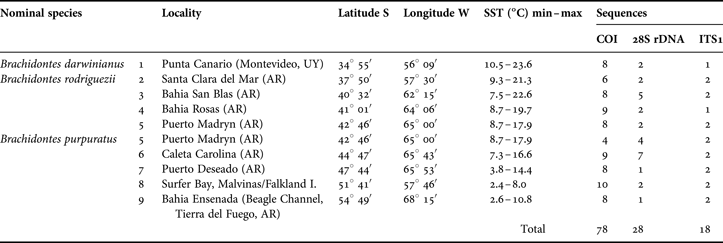
Specimens attributable to the nominal species Brachidontes darwinianus, B. rodriguezii and B. purpuratus were collected from nine localities in the south-western Atlantic, ranging from Montevideo (Uruguay) to the Beagle Channel (Tierra del Fuego) and the Malvinas/Falkland Islands (Table 1), and preserved in 95% ethanol. The sampling sites of Punta Canario (34°55′S 56°09′W, Uruguay, Figure 1) and Bahia San Blas (40°32′S 62°15′W, Argentina, Figure 1) are close to type localities of B. darwinianus and B. rodriguezii, respectively. In order to support assignment of specimens used in our genetic study to nominal species based on phenotypic shell characters we obtained high quality pictures of all the type materials of B. darwinianus, B. rodriguezii (Figure 2) and B. solisianus, deposited in the British Museum of Natural History, and of B. blakeanus, deposited in the collections of The Manchester Museum. The type material of B. purpuratus appears to have been lost (Dr Guido Pastorino, personal communication). Separation of B. rodriguezii and B. purpuratus was further supported with results from recent morphological and morphometric studies (van der Molen et al., Reference van der Molen, Márquez, Idaszkin and Adami2012; Adami et al., Reference Adami, Pastorino and Orensanz2013). Specimens selected for sequencing included juveniles of B. rodriguezii from Bahia Rosas (41°01′S 64°06′W, Figure 1), superficially resembling B. darwinianus (e.g. Figure 2K), as well as worn-out or atypical specimens from the region where the ranges of B. purpuratus and B. rodriguezii overlap, obvious candidates to be misclassified. We also examined extensive collections covering the geographic range of our study and kept at the Museo Nacional de Historia Natural (Montevideo, Uruguay), the Museo Argentino de Ciencias Naturales (Buenos Aires Argentina), and the Museo de Ciencias Naturales de La Plata (Argentina). Some of those collections were also used in related studies focused on taxonomic and ecological aspects (Adami et al., Reference Adami, Pastorino and Orensanz2013).
Selected specimens of Brachidontes s.l. sequenced in this study and type specimens. (A–F): B. darwinianus; (A, B) syntype illustrated by d'Orbigny (Reference d'Orbigny1842): original illustration (A) and presumably the same specimen conserved at the British Museum (B); (C, E) syntypes, (D, F) sequenced specimens from Punta Canario, (Montevideo, Uruguay). (G–K) B. rodriguezii; (G, H) lectotype (H), presumably corresponding to the specimen illustrated by d'Orbigny (Reference d'Orbigny1842) (G); (I) paralectotype (J, K) sequenced specimens collected at the type locality (Bahia San Blas). (L) B. purpuratus, sequenced specimen from Puerto Deseado. Scale bar: 1 cm.
Sampling locations, corresponding minimum and maximum monthly mean seawater temperature (SST, min–max), and number of samples sequenced per gene. AR, Argentina; UY, Uruguay.
DNA extraction, amplification and alignment
Total DNA was isolated from the posterior adductor muscle using the phenol-chloroform protocol (modified from Sambrook et al., Reference Sambrook, Fritsch and Maniatis1989). Three target gene fragments were amplified and directly sequenced from the study taxa. A 560 nucleotide (nt) portion of mt cytochrome c oxidase subunit I (COI) was amplified via Folmer et al.'s (Reference Folmer, Black, Hoeh, Lutz and Vrijenhoek1994) primers, LCO1490 and HCO2198, and another primer pair designed for this study nested within the Folmer's primers, position 46 and 650, CO1aF, 5′AAT GTT TGG TAT ATG AAG 3′/ CO1aR, 5′ ATC TCC GCC TCC TAT WGG ATC 3′. In addition, two discrete segments of the nuclear ribosomal gene cluster were sequenced. A 709 nt (aligned length) fragment of the large nuclear subunit (28S) rDNA, encompassing domain 2 and part of domain 3, was characterized using primers D23F and D6R (Park & Ó Foighil, Reference Park and Ó Foighil2000). The nuclear ribosomal first internal spacer (ITS1, 563 nt aligned length) was characterized using primers annealing to flanking regions of the 18S and the 5.8S (White et al., Reference White, McPherson and Stauffer1996).
When possible we sequenced ten specimens per locality for the mitochondrial gene COI and two per locality for the nuclear genes 28S rDNA and ITS1, obtaining a total of 124 sequences (Table 1). To amplify the genes we used Tsg polimerase (Bio Basic Inc., Canada). The protocol used included an initial denaturing temperature of 95°C for 5 min, followed by 30 cycles of 95°C for 45 s, an annealing temperature of 45°C for 1 min for the COI and 52°C for the 28S rDNA and ITS1, 72°C for 1 min, and a final extension at 72°C for 10 min. After extraction and amplification the DNA was visualized by UV transillumination in 1% agarose gels stained with green gel (BIOTUM). Extractions and amplifications of DNA samples were performed in the Gene Probe Laboratory of Dalhousie University (Nova Scotia, Canada) and in the Laboratory of Molecular Biology (CENPAT, Argentina), while the purification of PCR products and sequencing of both strands of DNA were carried out mostly by Macrogen Inc. (Maryland, USA); the remainder was performed at the CENPAT laboratory using the same primers in the amplification. DNA sequence data were edited in CodonCode Aligner v.2.0.4. and aligned using default parameters with Clustal W (Thompson et al., Reference Thompson, Higgins and Gibson1994) in Bioedit (Hall, Reference Hall1999), and then adjusted manually where necessary. No gap or stop codon was found in the sequences. A total of 124 sequences of a mitochondrial (COI) and two nuclear (28S rDNA and ITS1) markers of the nominal species B. darwinianus, B. rodriguezii and B. purpuratus were obtained. All DNA sequences were deposited in GenBank under the Accession Numbers KC844362–KC844484.
Some mytilids have a unique form of mtDNA inheritance known as ‘doubly uniparental inheritance’ (DUI) (Zouros, Reference Zouros, Freeman, Ball and Pogson1992; Skibinski et al., Reference Skibinski, Gallagher and Beynon1994). A maternally inherited mitochondrial genome is present in the eggs and the somatic tissues of female and male individuals, whereas a different paternally inherited mitochondrial genome appears in the male germ line (Rawson & Hilbish, Reference Rawson and Hilbish1995). The paternal mtDNA is preferentially replicated, particularly in the gonad (Skibinski et al., Reference Skibinski, Gallagher and Beynon1994), although there are some exceptions (Garrido-Ramos et al., Reference Garrido-Ramos, Stewart, Sutherland and Zouros1998; Kyriakou et al., Reference Kyriakou, Zouros and Rodakis2010). This phenomenon has been found in some species of Brachidontes, but not in others (Lee & Ó Foighil, Reference Lee and Ó Foighil2004; Terranova et al., Reference Terranova, Lo Brutto, Arculeo and Mitton2007). Following Lee & Ó Foighil (Reference Lee and Ó Foighil2005) we expect that by targeting DNA from posterior adductor muscle tissue, possible problems associated with heteroplasmy were minimized. Infiltration of the muscle tissue by germ line tissue is unlikely, and so we expected it to be dominated by maternally transmitted mitochondria, irrespective of the gender of the individual mussel sampled.
Within-nominal species genetic structure
Genetic variation of mitochondrial DNA (COI) of B. darwinianus, B. rodriguezii and B. purpuratus was estimated using the number of polymorphic sites (S), number of haplotypes (H), haplotype diversity (Hd), average number of nucleotide differences (k) and nucleotide diversity (Pi) in DnaSP version 5 (Librado & Rosas, Reference Librado and Rozas2009). To determine whether the individuals were in mutation–genetic drift equilibrium of mitochondrial COI sequences a test of Tajima's D was performed in DnaSP. Levels of among-population genetic differentiation were estimated by pairwise FST (mtDNA) in Arlequin version 3.5.1.2 (Excoffier & Lischer, Reference Excoffier and Lischer2010) and were visualized constructing a principal component analysis (PCA) implemented in Infostat 2011 (Di Rienzo et al., Reference Di Rienzo, Casanoves, Balzarini, Gonzalez, Tablada and Robledo2011). Intralineage divergences were calculated using MEGA 4 (Tamura et al., Reference Tamura, Dudley, Nei and Kumar2007). Maximum-parsimony COI haplotype networks were constructed individually for each nominal species using the median joining algorithm (Bandelt et al., Reference Bandelt, Forster and Röhl1999) with default parameters in Network 4.6.1 software (Polzin & Daneschmand, Reference Polzin and Daneschmand2003).
Among-nominal species genetic structure
To calculate interlineage differences (mean genetic distance) between groups of taxa we used MEGA 4 and the method selected was p-distance. To determine the partition that maximizes the differences among groups we performed an analysis of molecular variation (AMOVA; Excoffier et al., Reference Excoffier, Smouse and Quattro1992) implemented in Arlequin. The AMOVA was performed based on a distance matrix of pairwise differences and the significance was estimated using 10,000 iterations. The pattern of geographic structure was visualized with GenGIS v1.08 (Parks et al., Reference Parks, Porter, Churcher, Wang, Blouin, Whalley, Brooks and Beiko2009), a bioinformatics application that provides a graphical interface for the merging of information on molecular diversity (DNA sequences) with the geographic location from which the sequences were collected.
Phylogenetic analysis
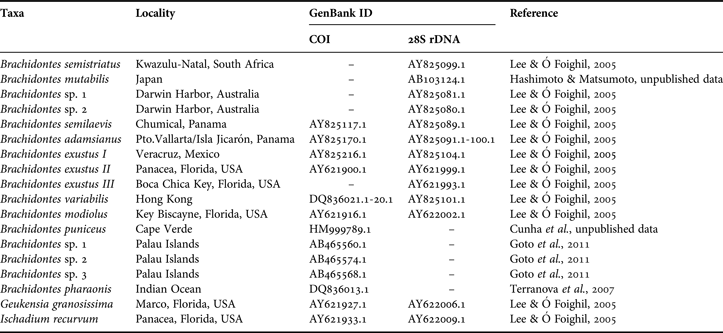
Two global phylogenies of Brachidontes s.l. were constructed based on COI and 28S rDNA sequences obtained by us and retrieved from the GenBank data base (Table 2); Ischadium recurvum and Geukensia granosissima were used as outgroups; the same species were also used as outgroups by Lee & Ó Foighil (Reference Lee and Ó Foighil2005). The phylogeny of Brachidontes s.l. could not be resolved using as outgroups members of more distantly related mytilid subfamilies (e.g. Perna, Mytilus, Mytella). To evaluate character congruence among COI and 28S rDNA datasets a partition-homogeneity test (Farris et al., Reference Farris, Källersjö, Kluge and Bult1995) was performed (100 random replications) using PAUP*4.0b10 (Swofford, 2003); the phylogeny of the ITS1 gene was not included due to the low number of sequences available in comparison with the other two genes. The two datasets were not significantly incongruent (P = 0.08) and were analysed as a combined dataset. The same general tree topology was obtained with the combined data sets and with the COI data alone.
Sequences of COI and 28S rDNA from Brachidontes species and other mytilids from other studies used in the phylogenetic analyses, with indication of locations of origin, GenBank Accession codes, and references.
Bayesian analyses were performed on each dataset using Mr Bayes v3.1.2 (Ronquist & Huelsanbeck, Reference Ronquist and Huelsenbeck2003) under the best-fit substitution model (HKY + G + I for COI and HKY + G for 28S rDNA datasets) determined by Bayesian information criteria (BIC) as implemented in jModelTest (Guindon & Gascuel, Reference Guindon and Gascuel2003; Posada, Reference Posada2008). Model parameters were treated as unknown and were estimated for each analysis. To produce one 50% majority rule consensus tree for each analysis, random starting trees were used. Each Bayesian analysis comprised four chains which were sampled every 10,000 generations for a total of 10,000,000 generations and the burn-in used was 25%. Maximum likelihood (ML) analyses were conducted with PAUP 4.0 (Swofford, Reference Swofford1998) using the heuristic search option. Nodal support was estimated through bootstrap analysis (Felsenstein, Reference Felsenstein1985) using 1000 replications with 10 random additions per each bootstrap replicate. The editing of the trees was carried out in Dendroscope 2.7.4. (Huson et al., Reference Huson, Richter, Rausch, Dezulian, Franz and Rupp2007).
RESULTS
Screening of reference collections
Specimens used for sequencing were assigned to three nominal species differentiated on the basis of shell phenotypes: Brachidontes darwinianus (Figure 2A–F), B. rodriguezii (Figure 2G–K) and B. purpuratus (Figure 2L). Specimens of B. rodriguezii collected at the type locality (Bahia San Blas) (Figure 2J, K) share the phenotypic diagnostic characters of the species, defined by Adami et al. (Reference Adami, Pastorino and Orensanz2013) observable in the type series (BMNH 1854-12-4-809, 6 specimens consisting of paired valves, two of them shown in Figure 2H, I). The specimen presumably used by d'Orbigny (Reference d'Orbigny1842) for illustration (Figure 2G; BMNH1854.12.4.809/1) is easily singled out in the series (Figure 2H), and is the one selected as lectotype by Aguirre (Reference Aguirre1994). Shell ribs are relatively thin as compared to other specimens (Figure 2I, J), but diagnostic characters (Adami et al., Reference Adami, Pastorino and Orensanz2013) are easily observable. The location of origin of specimens of B. darwinianus deposited in the British Museum (BMNH 1854-12-4-799 (six paired shells), -800 (four specimens) and -801 (five paired plus three single shells)) is not clearly identified (three locations were indicated by d'Orbigny, Reference d'Orbigny1842), but specimens collected in Punta Canario (Montevideo, close to Maldonado, one of d'Orbigny's locations) fall within the range of phenotypic variation of the syntype series (compare Figure 2C, E with Figure 2D, F). We were unable to confirm the unlikely presence of this species in northern Argentine Patagonia. Directed collections made in Bahia Rosas (= Ensenada de Ros, one of the three locations indicated by d'Orbigny) yielded small specimens of B. rodriguezii (Figure 2K) with an outline that resembles the subtriangular shell outline of the specimen of B. darwinianus selected by d'Orbigny for illustration (Figure 2A, B). We did not include B. solisianus in this study because its occurrence in the region of interest remains unconfirmed. Based on phenotypic characters, the type series (BMNH 1854-12-4-797, three paired and three single shells) is difficult to separate from eroded specimens of B. rodriguezii. Re-examination of the holotype of B. blakeanus, deposited in The Manchester Museum (Catalogue # EE.7674, Figure S1) revealed that it does not correspond to a mytilid, but rather belongs in the genus Philobrya Carpenter (family Phylobryidae) (see Supplementary Material). Kelaher et al. (Reference Kelaher, Castilla, Prado, York, Schwindt and Bortolus2007) reported B. granulatus for the intetidal zone of Argentine Patagonia, where its occurrence is considered unlikely. No voucher specimens from that study appear to exist (Professor J.C. Castilla, personal communication). Extensive studies conducted in the same region and habitats failed to confirm its presence (Liuzzi & López-Gappa, Reference Liuzzi and López Gappa2008).
Within-nominal species genetic structure
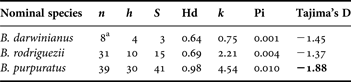
Genetic diversity indices such as the number of polymorphic sites (S), number of haplotypes (h), haplotype diversity (Hd), nucleotide differences (k) and nucleotide diversity (Pi) were variable among the three nominal species (Table 3). Brachidontes purpuratus showed higher diversity values than B. darwinianus and B. rodriguezii. Haplotype diversity was similar among B. darwinianus and B. rodriguezii. Tajima's D test was negative for all nominal species but was significant only for B. purpuratus, suggesting population expansion for this species but not for the others.
Genetic diversity indices for Brachidontes s.l. species based on mtDNA (COI) sequences. n, number of specimens analysed; h, number of haplotypes; S, number of polymorphic sites; Hd, haplotype diversity; k, average number of nucleotide differences; Pi, nucleotide diversity. Number in bold has P-value <0.05.
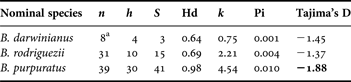
a, all haplotypes derived from a single location.
Pairwise FST values within B. rodriguezii indicate that the samples from Santa Clara del Mar differ from the other localities (0.32–0.60) (Figure 3). On the other hand, pairwise FST values within B. purpuratus indicate a lack of genetic differentiation among localities (Figure 3). Pairwise FST values were not estimated for B. darwinianus because all haplotypes were obtained from a single location. Individual median-joining network analyses resulted in star-like genealogies for B. darwinianus and B. rodriguezii (Figure 4A, B) and in a more expanded genealogy for B. purpuratus (Figure 4C). No haplotype is shared among the three nominal species. In the network analysis for B. darwinianus, notwithstanding the fact that all samples for this species come from a single locality, haplotype 1 has the highest frequency and many connections (Figure 4A), while in the analysis for B. rodriguezii (Figure 4B) haplotype 4 is the most frequent and shows a wide geographical distribution. Brachidontes rodriguezii from Santa Clara del Mar do not share haplotypes with the other localities to the south, a result consistent with the strong genetic differentiation revealed by the pairwise FST analysis mentioned earlier. Brachidontes purpuratus showed a complex genealogy (Figure 4C) with high levels of genetic similarity among populations. These results support the low level of genetic differentiation among localities indicated by the pairwise FST analysis.
Principal component analysis (PCA) of FST obtained from the COI mitochondrial gene. (♦) B. darwinianus, (▴) B. rodriguezii, (•) B. purpuratus. Numbers indicate locations: 1, Punta Canario; 2, Santa Clara del Mar; 3, Bahia San Blas; 4, Bahia Rosas; 5, Puerto Madryn; 6, Caleta Carolina; 7, Puerto Deseado; 8, Surfer Bay; 9, Bahia Ensenada (see Table 1 for more information).
Median joining haplotype networks based on COI mitochondrial gene. (A) Brachidontes darwinianus; (B) B. rodriguezii; (C) B. purpuratus. Each haplotype is represented by a circle whose size is proportional to its frequency; colours indicate locality of origin. Latitude and longitude information for each locality indicated on Table 1.
Among-nominal species genetic structure
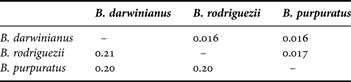
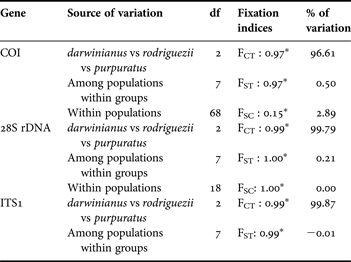
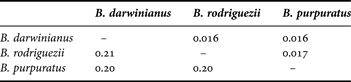
The pairwise FST among localities of mtCOI point out a significant genetic differentiation among the three nominal species (0.95–0.99; Figure 3). In addition, the intralineage divergences within B. darwinianus, B. rodriguezii and B. purpuratus ranged between 0.1% and 1.1% (SE = 0–0.3), whereas the interlineage sequence differences ranged from 20.0% to 21.0% (Table 4). The hypothesis of panmixia, tested with the AMOVA with all localities of the three nominal species as one-gene pool, was rejected (P < 0.05). We found that variation among phenotypically defined groups (‘darwinianus’, ‘rodriguezii’ and ‘purpuratus’; Table 5) explain 96.61%, 99.79%, and 99.87% of the genetic variance in COI, 28S rDNA and ITS1, respectively. Strong genetic differentiation is consistent with the genetic divergence detected by the three molecular markers observed in the phylograms (Figure 5A–C). In all the recovered trees, B. purpuratus is sister to the well supported clade formed by B. rodriguezii and B. darwinianus.
Association of the phylogenetic relationship among Brachidontes species and their geographic distribution in the region of interest based on (A) mtDNA COI, (B) nuclear 28S rDNA and (C) nuclear ITS1. (♦) B. darwinianus, (▴) B. rodriguezii, (•) B. purpuratus. Numbers indicate locations: 1, Punta Canario; 2, Santa Clara del Mar; 3, Bahia San Blas; 4, Bahia Rosas; 5, Puerto Madryn; 6, Caleta Carolina; 7, Puerto Deseado; 8, Surfer Bay; 9, Bahia Ensenada (see Table 1 for more information).
Uncorrected genetic distances among the three species of Brachidontes s.l. present in the south-western Atlantic, based on the gene COI. Between groups mean distance below the diagonal; P values above the diagonal.
Molecular variation analysis (AMOVA) of the genes COI, 28S rDNA and ITS1 for the three species of Brachidontes present in the southwestern Atlantic.
*, P < 0.05.
Phylogenetic analysis
Phylogenies of Brachidontes s.l. constructed from the nuclear COI and 28S rDNA datasets are shown in Figure 6. Both ML and Bayesian analyses reveal two well-supported nuclear/mitochondrial clades sister to Geukensia/Ischadium. One clade was formed by the specimens of B. purpuratus (Bayesian posterior probabilities 0.99/ML bootstrap 100 and 1.00/100, from both mitochondrial and nuclear genes trees) and the other clade includes all the other species of Brachidontes s.l analysed. In the latter clade, the specimens of B. rodriguezii form a strongly supported clade (Bayesian posterior probabilities 1.00/ML bootstrap 99 and 1.00/100, from both mitochondrial and nuclear genes trees), separated from the clade formed by the specimens of B. darwinianus (Bayesian posterior probabilities 1.00/ML bootstrap 100 and 0.98/100, from both mitochondrial and nuclear genes trees). For B. darwinianus, the topologies obtained from the COI mitochondrial gene were generally consistent with those from the 28S rDNA nuclear gene, although some differences were observed. In the mitochondrial tree, B. rodriguezii is sister to a well supported clade containing a polytomy which includes B. darwinianus and the other species of Brachidontes studied (Figure 6A); while in the nuclear gene tree, B. darwinianus is basal to the remainder species (Figure 6B).
Bayesian trees of Brachidontes s.l. based on (A) the mitochondrial gene COI and (B) the nuclear gene 28S rDNA, including species sequenced by us and in previous studies and using Ischadium recurvum and Geukensia granosissima (Mytilinae) as outgroups. Numbers above the branches represent the Bayesian posterior probabilities/maximum likelihood bootstrap values (>60 only) for the supported nodes. Numbers in parentheses following sampling locations indicate multiple individuals sharing the same genotype.
DISCUSSION
Status of Brachidontes species from the south-western Atlantic
Mitochondrial and nuclear DNA sequences revealed three different lineages of Brachidontes s.l. in the south-western Atlantic. These units satisfy the phylogenetic species concept (Nixon & Wheeler, Reference Nixon and Wheeler1990) and correspond to B. darwinianus, B. rodriguezii and B. purpuratus. The AMOVA for all three genes, the pairwise FST and the genetic distance analyses for COI consistently indicate a high level of genetic divergence among the three species. A variety of metazoan species exhibit what has come to be known as a barcoding gap in the COI region of the mitochondrial DNA whereby intraspecific divergences are typically <3%, while interspecific divergences range between 10% and 25% (Hebert et al., Reference Hebert, Cywinska, Ball and deWaard2003; Bucklin et al., Reference Bucklin, Steinke and Blanco-Bercial2011). The estimated genetic distances among the three Brachidontes groups in our study (20–21%) suggest that these groups are indeed three different species. Hypotheses postulating that B. darwinianus and B. rodriguezii are junior synonyms of B. purpuratus (Aguirre et al., Reference Aguirre, Perez and Negro-Sirch2006a, Reference Aguirre, Hlebszevitsch-Savalscky, Dellatorre and Rabassa2008), and that B. darwinianus is a junior synonym of B. exustus (Rios, Reference Rios1994), are thus rejected. This is consistent with results on chromosomal mapping of several genes in B. purpuratus and B. rodriguezii (Pérez-García et al., Reference Pérez-García, Cambeiro, Morán and Pasantes2010a, Reference Pérez-García, Guerra-Varela, Morán and Pasantesb).
In the south-western Atlantic B. purpuratus is confined to the cold-temperate region (Magellanic Biogeographic Province), while B. darwinianus and B. rodriguezii occur in the warm-temperate region (Argentine Biogeographic Province) (Figure 1). Our results confirm that B. rodriguezii and B. purpuratus coexist in the same beds along the transition zone (41–43°S), represented in our study by the collections from Puerto Madryn. The presence of B. darwinianus in the Montevideo area (La Plata River estuary) is consistent with previous studies indicating that this is an estuarine species (Avelar & Narchi, Reference Avelar and Narchi1983; Scarabino et al., Reference Scarabino, Zaffaroni, Clavijo, Carranza, Nin, Menafra, Rodríguez-Gallego, Scarabino and Conde2006).
The status of other species reported for the region is questionable. Brachidontes solisianus needs to be evaluated with materials from south-eastern Brazil, north of our area of focal interest. Brachidontes blakeanus, originally described from the Falkland/Malvinas Islands is not even a mytilid, and must be transferred to the genus Philobrya (Philobrydae) (see Supplementary Material). Records of B. blakeanus and B. granulatus from Argentine Patagonia may correspond to other species, most likely B. purpuratus or juveniles of other mytilids.
Within-species genetic structure and phylogeographic implications
The low genetic differentiation among populations of B. purpuratus, coupled with the negative sign for Tajima's D, suggest that this species experienced a recent population expansion in the south-western Atlantic. Similar patterns have been documented for the notothenioid fish Eleginops maclovinus (Ceballos et al., Reference Ceballos, Lessa, Victorio and Fernández2012) and the limpet Nacella magellanica (de Aranzamendi et al., Reference de Aranzamendi, Bastida and Gardenal2011), both endemic to the Magellanic Province. The cold-temperate portion of the south-western Atlantic, most of which was never glaciated, must be considered in the context of Quaternary glaciation episodes (Rabassa et al., Reference Rabassa, Coronato and Martínez2011; Fraser et al., Reference Fraser, Nikula, Ruzzante and Waters2012). At the time of the Last Glacial Maximum (LGM, ca. 23–25 cal. ka BP) the coasts of Chile south of approximately 43°S were covered by ice (Ruzzante et al., Reference Ruzzante, Walde, Gosse, Cussac, Habit, Zemlak and Adams2008, their figure 1). At the same time the coastline of the south-west Atlantic was located 200–400 km east of its current position depending on latitude (Ponce et al., Reference Ponce, Rabassa, Coronato and Borromei2011), and was presumably dominated by depositional environments. As the coastline moved westward following a rise in sea level during post-LGM millennia, availability of hard substrates and sheltered habitats was very limited, in contrast to the convoluted coastline and rocky shores (sheltered and exposed) from the south-east Pacific. It is likely that hard substrates in the south-western Atlantic, dominated by abrasion platforms of friable sedimentary rocks, were colonized by immigrants from the south-east Pacific, where diversification of invertebrates associated with hard substrates was likely facilitated by habitat diversity (González-Wevar et al., Reference González-Wevar, Nakano, Cañete and Poulin2011) and glaciation-related fragmentation of coastscapes (Fraser et al., Reference Fraser, Nikula, Ruzzante and Waters2012). Low genetic differentiation of Nacella magellanica and B. purpuratus in the south-western Atlantic could be explained by relatively recent (post-LGM) colonization originating from populations in the south-eastern Pacific. Brachidontes purpuratus is well represented in Early Pleistocene–Holocene terraces of Argentine Patagonia (Aguirre et al., Reference Aguirre, Richiano and Negro-Sirch2006b), but no related fossils are recorded from earlier periods, including the rich Late Miocene deposits of northern Patagonia (Madryn Formation; del Río & Martínez, Reference del Río and Martínez1998), a region of overlap with B. rodriguezii during Holocene and Recent times. Testing the hypothesis of a post-LGM range expansion of B. purpuratus will require further research on haplotypic diversity along the south-eastern Pacific, which is beyond the scope of the present study.
Brachidontes purpuratus is the only species of Brachidontes s.l. whose range extends into cold-temperate waters, encompassing two entire biogeographic provinces: Magellanic (cold-temperate) and Chile–Peru (warm-temperate). A broad transition zone between these two provinces extends approximately between 32° and 42° (Fernández et al., Reference Fernández, Jaramillo, Marquet, Moreno, Navarrete, Ojeda, Valdovinos and Vásquez2000). We doubt that the low genetic differentiation observed in the south-western Atlantic will be mirrored in the south-east Pacific once sequences become available from that region. In fact, Pérez et al. (Reference Pérez, Guiñez, Llanova, Toro, Astorga and Presa2008) observed significant genetic heterogeneity (using microsatellite markers) between populations from central Chile (Tralca, 32°26′S, warm-temperate region) and Argentine Patagonia (Puerto Lobos, 41°42′S, cold-temperate region), the latter close to the northern range limit of the species in the south-west Atlantic. Genetic diversity related to the biogeographic divide of the south-east Pacific has been reported for other groups of marine organisms (Fraser et al., Reference Fraser, Thiel, Spencer and Waters2010; Macaya & Zuccarello, Reference Macaya and Zuccarello2010).
In contrast to the low level of genetic differentiation observed in B. purpuratus, pairwise FST values in B. rodriguezii indicate that the samples from the northernmost location where this species was sampled in our study, Santa Clara del Mar, differ from the other localities to the south. Sequenced specimens from Santa Clara del Mar do not share haplotypes with other localities, a result consistent with the strong genetic differentiation revealed by the pairwise FST analysis mentioned earlier. Between Santa Clara del Mar and the other locations to the south considered in this study (Bahia San Blas, Bahia Rosas, Puerto Madryn) there are hundreds of kilometres of coastline consisting of exposed sandy beaches and mud flats (SEGEMAR, 2000), habitats not occupied by Brachidontes species. This scenario created a substantial barrier to dispersal by means of pelagic larvae. The three locations from northern Patagonia, on the contrary, are connected by a continuum of intertidal hard substrate habitats (SEGEMAR, 2000). Fossil shells of B. rodriguezii, presumably of Pleistocene age, have been recovered from cores obtained at 68 m depth off of Mar del Plata (Richards & Craig, Reference Richards and Craig1963), near to our sampling sites, confirming a long presence of the species in that region during the Quaternary. Fossils of Brachidontes from the Late Miocene (Madryn and Paraná Formation; del Río & Martínez, Reference del Río and Martínez1998) are phenotypically close enough to B. rodriguezii to have been classified as a subspecies, B. r. lepida (Philippi, 1893). Genetic intraspecific differentiation, a long history of occurrence in the region, and the phylogenetic position of B. rodriguezii within the main Brachidontes clade in the COI-based phylogeny (discussed later) prompt the hypothesis that B. rodriguezii is derived from a local stock, with a history of presence in the warm-temperate waters of the south-western Atlantic traceable to the Late Miocene. Evaluation of this hypothesis will require the concatenation of new molecular, palaeontological and morphometric data.
Phylogenetic relations of Brachidontes s.l.
The Mytilidae have been classified into a variable number of subfamilies (see Huber, Reference Huber2010, for an overview). Several studies (Distel, Reference Distel2000; Matsumoto, Reference Matsumoto2003; Owada & Hoeksema, Reference Owada and Hoeksema2011) have contributed substantially to the clarification of the relationships among mytilid genera based on genetic data. Huber (Reference Huber2010) summarized available information and subdivided the Mytilidae into ten subfamilies. Brachidontes s.l. (including Hormomya Mörch, Austromytilus Laseron, and Perumytilus Olsson) was placed in a revived Brachidontinae Nordsieck, together with Mytilaster Monterrosato and the modioliform Geukensia van de Poel (after genetic results presented by Distel, Reference Distel2000).
Our results strongly support an early divergence of B. purpuratus from the other species of Brachidontes s.l.. Studies involving other species of Brachidontes and related genera will be required before the taxonomy of the group is settled.
In contrast to B. purpuratus, B. darwinianus and B. rodriguezii are nested within a clade that includes all the other Brachidontes species for which sequences of our target genes (nuclear and mitochondrial) are available. Discordance between phylogenies based on different genes regarding the position of B. rodriguezii within the clade is not uncommon in phylogenetic contexts. Quite often, this occurrence has been attributed to introgression or hybridization, but can also be explained by differences in mutational rates between marker types, sensitivity to effective population size, incomplete lineage sorting, or mode of inheritance (Ballard & Whitlock, Reference Ballard and Whitlock2004). One potential generic cause of the partial incongruence between the nuclear and mitochondrial DNA-based trees is a weak phylogenetic signal, which may result in poor phylogenetic resolution or inaccurate gene trees as an artefact of phylogenetic reconstruction (Funk & Omland, Reference Funk and Omland2003). Further studies including more species of the Brachidontes s.l. and related genera, covering also other regions of the world ocean are needed to resolve the full phylogeny of the group.
While their intrinsic and extrinsic traits (sensu Webb et al., Reference Webb, Ackerly, McPeek and Donoghue2002) overlap, the small mussels (Brachidontes spp. s.l.) that dominate the appearance of intertidal communities along rocky shores of the south-western Atlantic belong to different lineages. Determining whether this reflects evolutionary convergence or conservation of ancestral traits will require a better resolution of mytilid phylogeny.
ACKNOWLEDGEMENTS
Drs T. Lee (University of Michigan) and T. Zemlak (Dalhousie University) offered valuable technical advice. We are grateful to M. Barrionuevo (Centro de Investigaciones Puerto Deseado), P. Brickle (Falkland Islands Shallow Marine Surveys Group), G. Lovrich (CADIC/CONICET, Ushuaia) and F. Scarabino (Museo Nacional de Historia Natural, Montevideo, Uruguay) for kindly assisting with the provision of samples. We greatly acknowledge Mrs Rebecca Machin (Curatorial Assistant, The Manchester Museum) for providing pictures of the type material of Brachidontes blakeanus (Melvill & Standen), and Ms Andreia Salvador (Curator, Higher Invertebrates, Department of Zoology, British Natural History Museum) for excellent photographic and archival information on the type series of Brachidontes species described by Alcide d'Orbigny.
FINANCIAL SUPPORT
This study was funded by Project PICT/RAICES 1839 (FONCYT, Argentina). A fellowship from the Department of Foreign Affairs and International Trade (DFAIT) from the Government of Canada funded B.T.'s visit to Dalhousie University.
Supplementary materials and methods
The Supplementary material referred to in this paper can be found online at journals.cambridge.org/mbi.