Thousands of international investment agreements and contracts that include Investor-State Dispute Settlement (ISDS) clauses allow foreign investors to sue host states directly for compensation regarding alleged property rights violations—in ad hoc tribunals without a formal appeals system, without the approval of their home states, and often without exhausting local courts in the host state. Just being sued may signal increased political risks to third-party investors, pulling down foreign investment overall.Footnote 1 A host state worried about litigation may delay enacting otherwise preferred policies if those policies could adversely affect foreign investors, a phenomenon known as “regulatory chill.”Footnote 2 And, despite years of econometric machinations, scholars have found it difficult to demonstrate that host state commitments to ISDS attract investment—the key motivation for host states to sign on in the first place.Footnote 3 Unsurprisingly, the backlash against ISDS and its potential to constrain states’ sovereignty grows as more arbitrations arise.Footnote 4 Dozens of states are renegotiating enabling treaties, with some pulling out unilaterally, although none of the 120- odd states that have been sued has eschewed ISDS altogether.Footnote 5 Such growing outcry prompts the question: what, if anything, is good about ISDS, particularly from the host state's point of view?
At its best, ISDS would accomplish goals traditionally expected of the law. A primary goal is to coordinate the joint expectations of parties so as to forestall potential disputes.Footnote 6 Should a dispute nevertheless occur, and not be resolved through informal means, a secondary goal of law is to facilitate a return to cooperation between the parties via institutionalized bargaining in an ex ante agreed-upon formal procedure. In the setting of investor-state disputes, ISDS is the procedure: via adjudication in an international tribunal, the host state and foreign investor coordinate on the amount of compensation due as a result of the host state's (alleged) adverse action. Compensation can make a breach “efficient” in economics jargon: the host state takes an adverse action but pays compensation to make the investor whole to its ex ante position, resolving time inconsistency, such that the relationship can return to the ex ante status quo.Footnote 7
Yet adding to the backlash is the perception that ISDS is bad at accomplishing even these basic goals. For example, the US Trade Representative argues that ISDS generates “the potential for future retaliation against the investor by the government being sued,” making it “typically a recourse of last resort.”Footnote 8 In this worst-case scenario, the very choice to to adjudicate the dispute through formalized ISDS precludes a return to cooperation, necessitating exit. In fact, some accuse claimant investors of never intending to return to cooperation. As one lawyer is quoted in a journalistic exposé, “You have a lot of scuzzy sort-of thieves for whom this is a way to hit the jackpot.”Footnote 9
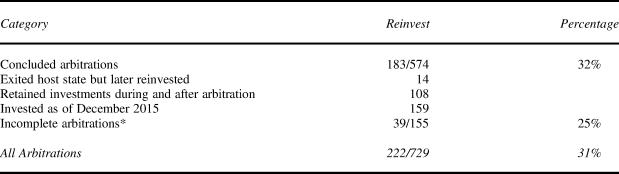
I take up the task of measuring whether ISDS consistently, if not inevitably, leads to exit by the claimant. In fact, I find that at least 31 percent of claimant investors “reinvest,” defined as the claimant investor retaining investment in the host state during and after the ISDS arbitration process, or exiting but later returning to the host state (222 of 729 ISDS investment arbitrations, filed from 1990 to 2014, with reinvestment assessed as of December 2015). This evidence demonstrates that international investment law sometimes operates in ways consistent with standard expectations of law. At the same time, reinvestment is not the norm. To understand variation, I explore characteristics of the law and dispute. Among investors who file for arbitration, and controlling for sector, important correlates of reinvestment include the claimant's legal strategy; the extent of the claimant's grievance and success; and the incidence of post-arbitration litigation.
The existence of reinvestment does not mean that the likelihood of reinvestment is high enough to motivate host state commitments to the current regime. It does, however, suggest an avenue through which institutional design that maximizes conditions conducive to reinvestment could increase the direct benefits of ISDS relative to its costs. Those pushing to reform and not abandon the current regime would do well to focus not on the unique aspects of ISDS, but on how to reinforce its conventional aspects.
Reinvestment
To measure reinvestment, I expand a database of 729 ISDS arbitration filings (1990–2014) in which investors invoke ISDS and arbitrations are public.Footnote 10 Reinvestment occurs if there is definitive evidence that the claimant investor exits but returns to the host state by December 2015; stays in the host state during and for at least one year after the ISDS arbitration; or the claimant investor is operating in the host state as of December 2015 (whether or not what happens in the interim is known).Footnote 11 Reinvestment also occurs if there is evidence that a subsidiary of the claimant fits these criteria because continuing operations through a differently named subsidiary might be a political risk-mitigation strategy that enables the one-time claimant to reinvest without highlighting its contentious history. The presumption is that reinvestment is undercounted, biasing results away from establishing variation.Footnote 12
As Table 1 summarizes, there are 222 instances of reinvestment around the 729 ISDS arbitrations (31%). In only fourteen instances, the foreign investor fully exited the host state before the ISDS arbitration ended and reentered in the study period. Moreover, in thirty-nine arbitrations not concluded in the study period, the claimant investor remained in the host state (25%). Overall, it appears that remaining in the host state during and after arbitration is not uncommon: this occurred in (at least) 108 instances.
Reinvestment summary

Note: *Total = Retained investment as of December 2015.
This binary conceptualization of a return to cooperation is useful. Given the backlash, it is pertinent to ask whether ISDS suggests direct benefits of any magnitude that could balance against its costs. Host states can and do use the continued presence of one-time claimants in attempts to assuage the worries of third-party observers; officials can boast about a claimant remaining an investor even if it has only a proverbial storefront in the country. For example, Ukrainian officials in charge of FDI promotion emphasize reinvigorated cordial relations with some one-time claimants, particularly after settling.Footnote 13 Sometimes claimants that reinvest, too, publicly celebrate the resolution of their dispute even if their post-arbitration investment is minimal. The Western NIS fund, for example, highlighted to potential clients that it was able to use ISDS to resolve its dispute with Ukraine, as it sought to regrow its presence in the country.Footnote 14
Nonetheless, the duration of reinvestment is surely politically meaningful: a claimant in the process of liquidating its assets is different from one that maintains a long-term presence. Importantly, of the 159 reinvestors as of 2015, arbitration had ended five or more years ago for 55 percent and two or more years ago for 84 percent. This evidence helps dispel the concern that the coding procedure captures only very short-term reinvestment, such as instances in which divestment is in process at the time of the arbitration's end. Still, one may worry that reinvestors, even if not in immediate liquidation, are running skeleton operations rather than growing them. Unfortunately, systematic data on the intensity of reinvestment, capturing both duration and levels, are unreliable: accounting practices, the accuracy of project announcements, and transparency standards differ across public and private firms, across host states, and over time in nonrandom ways. However, based on narrative data gathered for a subset of forty-one reinvestors that filed arbitrations from 1990 to 2003, the absolute value of reinvestment by one-time claimants can be meaningful: as of the end of the study period, investment amounted to hundreds of millions of US dollars for those for which data are available (consistent with the observation that ISDS claimants are often quite large firms).Footnote 15 In this subset of forty-one cases, host states include Poland, Argentina, the US, and others. Indeed, (binary-coded) reinvestment takes place in all regions of the world at relatively comparable rates (see Appendix A.1).
Is a 31 percent reinvestment rate low or high? If one expects post-arbitration retaliation by the host state to be the norm, as the USTR warns, the rate is notable for being far from zero. If, on the other hand, one expects that foreign investors are on the whole destined to reinvest because of limited exit options, 31 percent suggests that reinvestment is far from the norm. Regardless, reinvestment provides a proof of concept that, rather than precluding a further relationship, formal adjudication under ISDS can allow the parties to coordinate on adjustments to their relationship in the wake of the host state's (perceived) adverse action.
A useful way to conceptualize reinvestment following a legalized investor-state dispute is through a standard time-inconsistency framework. A host state may have a long-term preference that a particular foreign investor remain productive in its territory if the host state evaluates that the foreign investor is generating sufficient benefits. Yet an otherwise FDI-accepting host state may face a short-term shock that motivates it to act contrary to its long-term preferences. A variety of economic and political exigencies could generate such a short-term shock. For example, new governments may renege on contractual commitments made by the prior one: political turnover in Egypt triggered six public ISDS arbitrations in 2011–2012.Footnote 16 Economic crisis may lead a host state to prioritize domestic over foreign interests: during the financial crisis, Belgium bailed out its domestically owned banks but did not bail out a Chinese-owned bank and was sued for that inaction.Footnote 17 In fact, a host state might not realize that responding to a short-term shock is inconsistent with long-term FDI openness: Slovakia argues that its re-regulation of its health insurance sector was not intended to affect, much less discriminate against, the Dutch insurers who later filed for arbitration.Footnote 18
Whatever its motive (or not), a host state can still be interested in accruing long-term benefits from a particular foreign investor despite taking an action today that conflicts with the investor's property rights. Reinvestment indicates that the host state allowed the claimant investor to remain in or reenter the country, such that ISDS arbitration did not result in reinvestment-denying retaliation on the part of the host state. Further, reinvestment indicates that the claimant is sufficiently satisfied with the resolution of the dispute to again operate in the host state. In these circumstances, we can infer time inconsistency and that the ISDS arbitration coincided with a move toward efficient breach. This cooperation despite formal adjudication reinforces a robust literature that finds positive correlations between rule of law and FDI.Footnote 19
Yet reinvestment is not the norm. In the 69 percent of cases in which reinvestment is not present, it is possible the host state's short-term and long-term preferences to act adversely align.Footnote 20 The host state could be willing—or even seeking—to lose the investment in question altogether, such that its preferences exactly align to act adversely and in an extreme form. Or, a host state with at least some interest in maintaining the investment could improve its preference alignment by mitigating long-term downsides. For example, the host state could resell (or give) remaining assets to a domestic firm or continue operations itself. Still, the host state would incur some loss from foregoing foreign ownership if the foreign investor was more productive. Additionally, the host state could seek out an alternative foreign investor to take over ownership and operate the remaining assets, although the replacement investor would likely attempt to mitigate risk by contracting in ways conducive to a higher rate of return.Footnote 21 One particular feature of international investment law may help reduce expected losses: tribunals award compensation for the host state's adverse action, but they do not require policy change.Footnote 22 Thus, a host state can comply with ISDS arbitration without incurring the costs of policy reversal.
Nonetheless, the data suggest that host state actions can be time inconsistent, such that the host state at least sometimes desires to return to cooperation after ISDS. The correlates of reinvestment on the claimant's side are thus of interest to a host state weighing the costs of a possible adverse action, as well as reformers interested in designing institutions to maximize cooperation.
Explaining Variation
I lay out a set of theoretically reasonable correlates of reinvestment that can be observed and weighed by host states and institutional designers, with the mea culpa that complex selection processes in the data make rigorous hypothesis testing difficult. Nonetheless, correlates matter: actors are making decisions about the future of international investment law in real time, causality be damned.
Sector
The canonical explanation for the effects of investor-state relations on investment behavior operates via sector. Sectors with assets characterized by immobility or site specificity are more vulnerable to property rights violations.Footnote 23 Investors in these sectors can negotiate advantageous deals ex ante, when the host state requires the investors’ capital and expertise. However, as time goes on and investors make site-specific investments, they lose credible threats of exit, and their deals with the host state “obsolesce.”Footnote 24 Foreign investors who cannot feasibly exit would be more likely to reinvest despite the host state's adverse action.Footnote 25
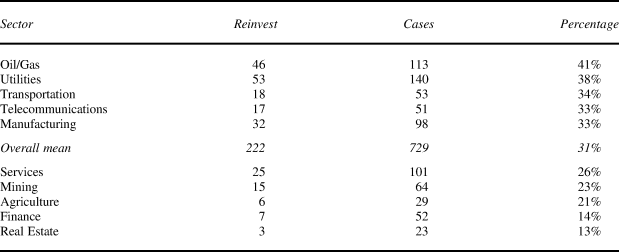
Table 2 reports the distribution of ISDS arbitrations and reinvestment rates by sectors endogenously created from the data. Reinvestment in the canonically site-specific oil and gas sector is the highest. Reinvestment is also high for investors in utilities, which consist mainly of water and sewage concessions, power plants, and electricity transmission networks. Nonetheless, reinvestment in manufacturing, a sector traditionally categorized as mobile, is above the overall mean while mining, traditionally site specific, is below.
Reinvestment by sector

Note: Sector is unknown in five instances.
Several key implications follow from Table 2. First, if ISDS inevitably triggers retaliation, it follows that captured investors would select not to invoke it, lest they exacerbate their obsolescing bargains. Instances of immobile investors invoking ISDS provides prima facie evidence that ISDS has the potential to resolve rather than exacerbate grievances.Footnote 26 Second, if it is only immobile investors who reinvest, international investment law would be epiphenomenal to structural determinants of returns to cooperation. In fact, investors outside the canonical captured sectors of oil and gas, utilities, and mining reinvest at least 27 percent of the time. What else beyond sector correlates with reinvestment?
Law
I hypothesize that legal processes associated with reinvestment include the claimant's legal strategy, the extent of a claimant's grievance and success, and post-arbitration litigation.
First, the source of an investor's access to ISDS arbitration should correlate with reinvestment. Bilateral Investment Treaties (BITs) and the larger category of International Investment Agreements (IIAs) facilitate aggrieved investors’ access to ISDS arbitration.Footnote 27 Beyond treaties, some foreign investors negotiate specific and thus more complete contracts with the host state that provide access to international investment arbitration. For example, resource concession contracts, contracts to provide services for the state, and contracts to build infrastructure for the state regularly have international arbitration clauses.
Cases adjudicated based on a contract rather than a treaty should be more likely to be associated with reinvestment. When a claimant invokes a treaty, other foreign investors with access to that treaty (and their law firms) are likely to be interested in its application because treaty protections are often subject to interpretation. For example, arbitrators decide what it means to be “foreign” and what it means to have an “investment” under a given treaty.Footnote 28 Adjudication processes in the presence of active third-party observers are more complex than bilateral processes and may raise the risk that the parties cannot reconcile.Footnote 29 In contrast, specifically tailored contractual terms are inaccessible to otherwise interested outside actors and less informative of their political risks, so adjudication is more likely to proceed based on the interests of the disputing parties and not potentially disrupted by other influences.
H1
An ISDS claimant is more likely to reinvest if its arbitration is brought under an investor-state contract as opposed to an International Investment Agreement.
Next, the type of adverse action of which a host state is accused likely affects reinvestment. Direct expropriation is the state's taking of property without sufficient compensation, such as when buying it in an involuntary transaction or nationalizing it in whole or part. Direct expropriation is one of a menu of legal claims available in ISDS-enabling treaties or contracts. While the menu varies, other potential legal claims generally concern the host state's adverse impact on the foreign investor's operations and its expected profits, an impact relatively less severe than illegitimately taking over ownership. Pelc argues that cases in which the claimant invokes indirect (rather than direct) expropriation might be pursued in order to “chill” regulation, such that the respondent state and/or third-party states delay regulation at least until the legitimacy of that regulation under international investment law is verified.Footnote 30 Taking action to forestall or delay regulation would suggest the claimant is interested in reinvesting. Most importantly, if an investor claims direct expropriation, it owns less property (if any) in the host state and has less capacity to reinvest. Thus, I expect more reinvestment in instances when the investor's formal legal claims do not include direct expropriation. Note that I expect the investor's perception as embodied in its claim to correlate with reinvestment, whatever the legal ruling on the claim.
H2
An ISDS claimant is more likely to reinvest if its legal claim(s) do not include direct expropriation.
Next, consider the arbitration outcome. Settlement should occur when the value of the settlement, in terms of compensation as well as costs avoided, outweighs the expected value of the uncertain ruling, in terms of expected compensation as pulled down by expected costs, which can include spillovers from the dispute on third-party behavior. For an investor that settles, the counterfactual outcome were its case to go to ruling is unobservable. By contrast, investors who are not able to agree on a settlement will in expectation receive an outcome better than the settlement. However, if some investors receive rulings worse than expected and worse than earlier settlement offers, they are dissatisfied once the outcome is reached. I expect satisfaction with the resolution of the dispute to correlate with reinvestment, such that investors who invoke ISDS but settle their cases before a ruling are more likely to reinvest than investors who choose to follow the arbitration through to a tribunal ruling.
Two factors could weaken the predicted relationship between settlement and reinvestment. First, if “regulatory chill” is the claimant's goal, then it may be more satisfied with a longer resolution process such that a ruling would trump any settlement.Footnote 31 Second, if settlement indicates satisfaction, and satisfaction correlates with reinvestment, then investors who settle but never invoke ISDS should be the most likely to reinvest. Thus, this argument requires that not every claimant investor is motivated to cause regulatory chill.Footnote 32 It also requires that investors who invoke ISDS and then settle can still derive sufficient satisfaction from settlement to make reinvestment possible.
H3a
An ISDS claimant is more likely to reinvest if its arbitration does not end in a tribunal ruling compared to when the arbitration goes through to a ruling.
Additionally, the outcome of the arbitration with respect to compensation should correlate with reinvestment. Pre-ruling settlement generates compensation; even an investor that abandons its case may be thought of as having received compensation at least in that it caused the host state to incur costs. A claimant investor that wins a pro-investor tribunal ruling receives compensation, though this compensation may be less than the claimant sought. In contrast, when the tribunal makes a pro-state ruling, the claimant investor is not compensated (and it may have to pay the host state's litigation costs). It is straightforward that claimant investors who are compensated are more likely to reinvest than those who are not. This seemingly banal point is made more interesting because ISDS concerns only compensation. Across the muddy field of international investment law, there is no requirement that a host state change its underlying policy action that caused the violation. Compensation in the absence of policy change will not necessarily restore the investment environment to its ex ante position. Further, even if the host state changes the underlying policy—despite not being required to do so—the claimant would still operate in a host state that understands adverse actions have a price but are not prohibited. It is a legitimate exercise to test whether receiving compensation correlates with reinvestment when the law does not compel the host state to change the offending policy.
H3b
An ISDS claimant is more likely to reinvest if it settles the arbitration before its conclusion or wins a pro-investor ruling as opposed to when the ruling is pro-state.
Hypothesis 3b implies that the greater the compensation a claimant investor receives, the more likely it is to reinvest, which motivates Hypothesis 4.
H4
An ISDS claimant is more likely to reinvest if it wins a larger proportion of the compensation sought.
Finally, while there is no formal appeals process in international investment law, initial rulings can be followed by annulment and/or enforcement processes. Annulment is possible at only one venue, the World Bank's International Center for the Settlement of Investor Disputes (ICSID). The criteria for annulment are very limited and involve questions of procedure rather than questions of the tribunal rulings’ accuracy. Annulment proceedings can be invoked by the host state or the claimant investor, which may be interested in creating a clean slate that can facilitate another “bite at the apple” or erasing a tribunal ruling that it pay host state costs. Whether the host state or the claimant investor files annulment, the ISDS arbitration itself has not fully resolved the investor-state dispute. I expect any reinvestment to be foregone or delayed, such that it is less likely to manifest at least in the short to medium term.
Following arbitration in any venue, parties are generally allowed to challenge rulings in the domestic courts of the seat of arbitration, that is, under the domestic law of the state in which the arbitration is physically held. For example, when sued under NAFTA, Mexico is within its rights to apply to domestic Canadian courts to challenge a ruling in favor of a US investor, if the tribunal was constituted in Canada.Footnote 33 However, this is still not an appeals process. Even if a pro-investor tribunal ruling is set aside in the seat of arbitration, it does not necessarily remove the state's obligation to pay the award because there is no binding precedent in the complicated de facto international investment law regime.Footnote 34 It should be noted that host states filing for set-asides are not necessarily rejecting payment of compensation but rather contesting its terms. Still, delay in compensation payment by the host state conflicts with the spirit of resolving the dispute in a timely way, whatever the law allows. In sum, whichever party files for a set-aside, the investor-state dispute has not been resolved by the ISDS arbitration. Thus, reinvestment should be less likely.
Sometimes host states face domestic pressure not to pay awards: compensation awards require the host state to effectively pay money out of their coffers—including taxpayer pockets—directly to private foreign actors. If the state does not pay the award to the foreign investor's satisfaction, the onus is on the investor to get the award enforced since the regime is predicated on voluntary host state compliance. Under the 1958 Convention on the Recognition and Enforcement of Foreign Arbitral Awards (New York Convention), over 150 signatory states have committed to recognize international arbitration awards, including those from ISDS proceedings. Foreign investors look to enforce their awards in domestic courts of third-party states (1) that are signatories and (2) in which the host state holds significant, accessible assets. Accessible assets are those that are not subject to sovereign immunity protections. For example, as part of its efforts to enforce a USD 2 billion ISDS award against Venezuela, ConocoPhillips in 2018 attempted to seize assets of the Venezuelan state oil company PDVSA in the Dutch Caribbean island of Curaçao. Assets that are part of legitimate international state activity generally cannot be seized, such as embassy property or central bank assets, although whether or not any particular asset qualifies is often the subject of litigation.Footnote 35
Foreign investors sometimes choose to file for enforcement in the domestic courts of the host state.Footnote 36 Host states, too, sometimes challenge rulings in their own courts. While foreign investors are generally free to choose this path, the law in most if not all cases precludes the host state from going to its domestic courts after an ISDS arbitration. Indeed, a key motivation behind ISDS has been to adjudicate disputes outside of host state courts that may be biased toward the host state. In brief, subsequent litigation in third-party states or in the host state's domestic courts indicate that arbitration does not fully resolve the investor-state dispute, making reinvestment less likely.
H5
An ISDS claimant is more likely to reinvest if the tribunal ruling is not followed by annulment and/or enforcement proceedings compared to when it is.
Evidence
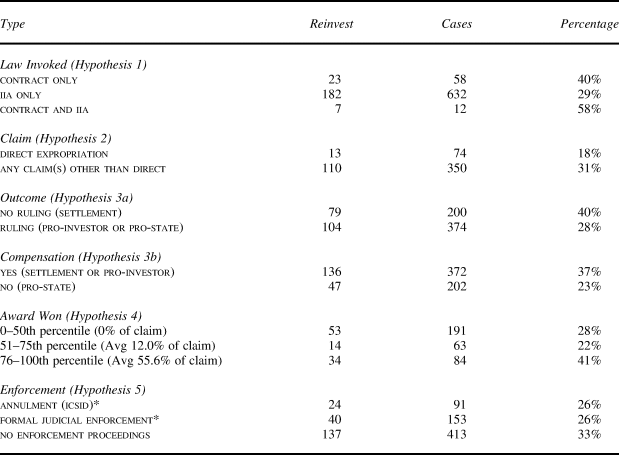
I use the novel data introduced here to explore the relationships posited in Hypotheses 1 to 5. Because selection effects in the data make causal identification difficult, I present a series of t-tests and then explore correlations in a regression format.Footnote 37 This empirical strategy, while not ideal, is nonetheless reasonable and useful: whether or not causation is in fact present, correlations are surely of relevance to actors in a policy space characterized by young institutions facing a backlash. Table 3 provides summary information on reinvestment relevant to each hypothesis. According to Hypothesis 1, reinvestment is more likely when an investor invokes a contract with or without an IIA compared to when it only invokes an IIA (p = 0.01).Footnote 38 According to Hypothesis 2, reinvestment is more likely when an investor invokes any claim(s) other than direct expropriation, relative to instances when it invokes direct expropriation (p = 0.02).
Reinvestment summary (Hypotheses 1–5)

Note: Categories marked with an asterisk are not mutually exclusive.
Of the 729 ISDS arbitrations in the data, 592 were complete by December 2015 and the outcome is public for 574. Of these, settlement occurred in 35 percent, the investor won in 30 percent, and the state won in 35 percent.Footnote 39 Following Hypothesis 3a, reinvestment is more likely for investors who settle prior to a ruling compared to those that do not (p = 0.004). In support of Hypothesis 3b, investors who receive at least some compensation via settlement or a pro-investor ruling are significantly more likely to reinvest (p = 0.001). That said, the 23 percent reinvestment rate following a state win is notable: sometimes even losing claimants reinvest in the host state.
In providing evidence for Hypothesis 4, I conservatively rely on the main amount claimed and awarded, excluding ancillary claims and awards regarding interest.Footnote 40 Although data on both the initial claim and the tribunal award are available in only 338 instances, this measure is meaningful because these are the public data that host states and those seeking to reform ISDS institutions can observe. As Table 3 reports, 191 claimants were awarded 0 compensation.Footnote 41 Claimants in the 76th to the 100th percentile are significantly more likely to reinvest than claimants in other percentiles (p = 0.01).
The variable no enforcement proceedings equals 1 when the initial tribunal ruling is not followed by annulment and/or legal enforcement proceedings of any kind.Footnote 42 Importantly, enforcement proceedings are costly and complicated. Once initiated, they can turn into a war of attrition between the foreign investor and a recalcitrant host state, often pulling diplomats into the fray. No enforcement proceedings implicitly assumes that claimant investors that do not pursue post-arbitration litigation are sufficiently satisfied with the arbitration outcome and the host state's compliance weighed against the costs of additional litigation. It should not be interpreted as a measure that claimants are not frustrated with the host state's willingness and speed in paying an award. Instead of starting post-arbitration litigation, frustrated foreign investors looking to get paid may agree to settlements on ISDS awards by accepting a haircut on the award, agreeing to a payment plan, agreeing to be paid in a different currency, or accepting payment in sovereign bonds. Still, the notion that claimant investors resorting to ISDS arbitration might agree to settlements on awards rather than always pursuing further litigation suggests in itself an interest in returning to cooperation. Claimants with cases that ended with no enforcement proceedings are more likely to reinvest than those with cases that ended with post-arbitration litigation of some kind, with close to statistical significance (p = 0.11).
Moving beyond t-tests, I provide evidence consistent with these hypotheses in a series of multivariate regressions. I use logit because the outcome is bivariate, indicating whether reinvestment took place in the period or not. I reduce the sample to completed ISDS arbitrations when this is the correct comparison category for hypothesis testing: no ruling; settlement/investor win; % claim won; and no enforcement proceedings. Sector fixed effects are of crucial importance given heterogeneity in reinvestment rates across sectors (Table 2). I also include host region fixed effects. Organisation for Economic Co-operation and Development (OECD) host states are categorized as their own region, given that the incentives foreign investors have in suing the richest host states may differ from those in suing developing countries. I control for time since end, a time trend counting the years since the arbitration ended, since we might expect time to help heal wounds and facilitate reinvestment. Standard errors are clustered by host state.
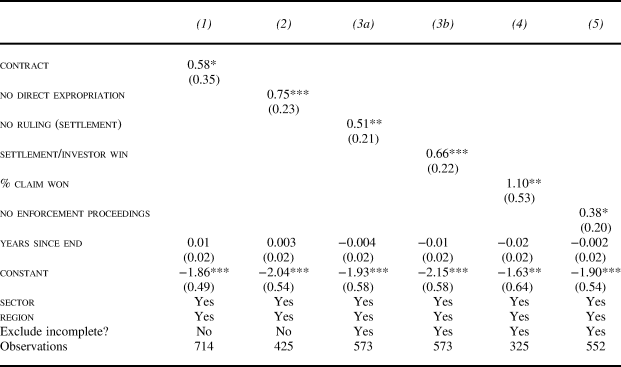
Table 4 reports results for models examining each hypothesis separately. In all models, coefficients on variables of interest are positive and significant as expected. Aspects of the law are important correlates of reinvestment, even accounting for sectoral effects. Reinvestment is positively associated with a contract-based arbitration (Model 1), the absence of direct expropriation (Model 2), the percentage of the claim won (Model 4), and the absence of enforcement proceedings (Model 5).Footnote 43 Models 3a and 3b separate the outcomes of arbitrations with regard to different reference categories. Reinvestment is positively associated with no ruling as evidence of increased average investor satisfaction with the resolution (Model 3a); and a settlement or pro-investor ruling, as evidence of compensation (Model 3b). The coefficient is largest for % claim won, suggesting that losing big is particularly unlikely to correlate with reinvestment. Note also that years since end is not a significant correlate of reinvestment; patterns are not explained by time healing all wounds.
Reinvestment (considering H1–5 separately)

Notes: Standard errors clustered by host state. *p < .10; **p < .05; ***p < .01.
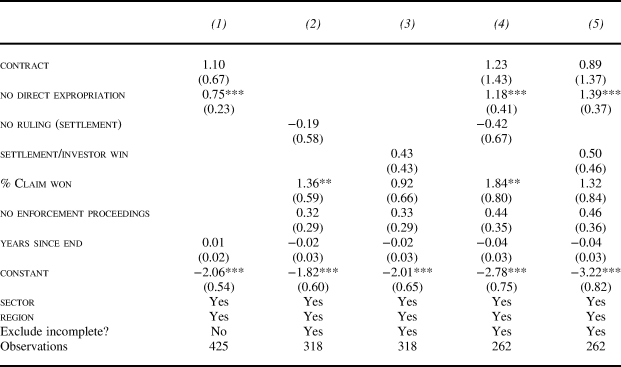
Table 5 examines hypotheses in combination. When included, no direct expropriation is consistently positive and significant (models 1, 4, and 5). Additionally, the % claim won is significant in two of four models (models 2 and 4). Coefficients on contract, settlement/investor win, and no enforcement proceedings are consistently positive but do not achieve significance. Finally, in multivariate models, the sign on no ruling is contrary to expectations albeit insignificant, suggesting that this is not a compelling correlate when considered alongside others. The coefficient on years since end continues to be insignificant and small.
Reinvestment (considering H1–5 in combination)

Notes: Standard errors clustered by host state. *p < .10; **p < .05; ***p < .01.
In terms of robustness, Appendix A.3 examines sector dummies; in general and as expected, reinvestment is more likely in more traditionally mobile sectors. Appendix A.4 includes potential national-level correlates of reinvestment; correlations identified here are largely robust.Footnote 44 Specialists may be interested in including ICSID as a covariate, supposing that the arbitration venue matters. ICSID requires transparency such that we know the full population of ISDS arbitrations heard there (64 percent of the sample here), though details of claims and awards can be kept private.Footnote 45 I do not have strong priors: ICSID publicizes cases, which could raise stakes and dampen further cooperation, but the host state's willingness to use the World Bank institution might suggest it is more open to cooperation. Most tellingly, the accepted wisdom among practicing lawyers is that venue choice is more a matter of convenience than strategy because the law is determined by the treaty or contract invoked, not the venue.Footnote 46 Regardless, the reinvestment rate for ICSID cases is 36 percent (166/466); for cases brought elsewhere, it is 21 percent (56/263). As reported in Appendix A.2, nine of ten models are robust to including an ICSID dummy. While I am reluctant to interpret the coefficient on icsid, it is consistently positive and significant.
Conclusion
On the investor's side, given that invoking ISDS need not be a last-ditch Hail Mary by a claimant on its way out, an investor's selection into formal international arbitration is more puzzling. The patterns identified here generate some testable insights for selection, conditional on a credible preference for reinvestment on the part of the aggrieved investor and the host state's full knowledge of that preference. Under these conditions, both the investor and the host state may find formal dispute settlement in ISDS useful in facilitating more efficient breach, consistent with basic goals of the law. An investor may bring an efficiency-driven arbitration exactly because it facilitates future cooperation, in stark contrast to the contention that investors selecting into ISDS are on the whole “scuzzy sort-of thieves.”Footnote 47
On the host state's side, efficiency-driven arbitrations may carry lower political stakes than an arbitration with a “thief-like” veneer—perhaps brought under an international treaty, concerning a huge monetary claim, alleging nationalization, with the investor gone and not coming back. What does the possibility of efficiency-driven arbitration mean for host state incentives, which have been lurking behind this study? Given that the form and extent of a host state's breach is endogenous to the expected outcome, a host state interested in reinvestment but considering breach could be emboldened in the presence of the legal correlates examined here. The more likely a return to cooperation, the more confident the host state can be that it can act in a time-inconsistent way now and repair the breach later through ISDS-adjudicated compensation. This logic, that being sued in ISDS might even sometimes be part of the host state's plan, is consistent with the nuanced variation in the importance of being sued in ISDS as a determinant of states’ choices to renegotiate or terminate IIAs.Footnote 48
Understanding an investor's selection into ISDS and a host state's selection into contract breach is crucial for understanding the politics of international investment law and its implications for FDI.Footnote 49 If the motivation for selection into ISDS varies on a spectrum from efficient to “scuzzy,” the implications of ISDS arbitrations for markets and politics likely vary as well. For example, the motivations behind an arbitration can send nuanced signals about political risk to interested market actors.Footnote 50 The motivations behind arbitration also suggest different effects on diplomatic relations between the home state and host state.Footnote 51 Every study of ISDS necessarily looks at only a slice of the phenomenon of investor-state conflicts, but attention to selection into that slice allows us to use ISDS to generate insights into the unobservable population of investor-state conflicts.
Nothing of what is written here establishes that current ISDS provisions are normatively the best way to organize the adjudication of investor-state disputes. Certainly, the usefulness and fairness of the de facto international investment regime are topics of considerable scholarly and public debate. This research note contributes to that debate by specifying and providing evidence on one possible upside in terms of reinvestment. Within the current system, beneficial institutional reforms might focus on maximizing the likelihood of reinvestment given ISDS is invoked. Rather than marking the end of bilateral investor-state relationships, international investment law can sometimes reinvigorate direct investment from the aggrieved investor itself.
Supplementary Material
Supplementary material for this article is available at <https://doi.org/10.1017/S0020818319000225>.
Acknowledgments
For excellent research assistance, I thank Allyson Veile, Calvin Thrall, Iasmin Goes, Connor Smith, and students from Innovations for Peace and Development at UT Austin. I thank Terrence Chapman, Yoram Haftel, Carolina Moehlecke, Felicity Vabulas, and Soo Yeon Kim for feedback, as well as audiences at the Hebrew University of Jerusalem, Cornell, Texas A&M, the University of Houston, Political Economy of International Organizations, and the International Political Economy Society.