Has Barack Obama's success transformed the racial divide? Did he somehow transcend or help bring to an end centuries of racial division in the United States? Did he deliberately run a strategically race-neutral, race-evading campaign? Did his race and ingrained American racism constrain the reach of his success? Have we arrived at that postracial moment that has long been the stuff of dreams and high oratory? Or was the outcome of the 2008 presidential election driven entirely by nonracial factors, such as a weak Republican ticket, an incumbent party saddled with defending an unpopular war, and a worsening economic crisis? It is at once too simple and yet entirely appropriate to say that the answers to these questions are, in a phrase, complicated matters. These complexities can, however, be brought into sharper focus.
To begin with, race, politics, and personal identity have long been intertwined in Barack Obama's career as a political figure. Even though he had not yet been elected to the U.S. Senate, Obama was on his way to a place of special prominence in the Democratic Party as a keynote speaker at the 2004 Democratic National Convention. The then U.S. Senate candidate from Illinois tried to play down all of the attention focused on him, saying, “I'm not someone who takes hype so seriously” (Leibovich Reference Leibovich2004). But as a reporter for the Washington Post put it at the time, “[This] doesn't stop hypesters from taking Obama seriously. Or people from asking him—with some regularity and straight faces—when he will run for president” (Leibovich Reference Leibovich2004). Even then there was no ambiguity that race played a part in Obama's rapid rise to notoriety. As the 2004 Post story noted: “He is merely a candidate—a dynamic, stirring and potentially historic candidate who would be the only African American in the U.S. Senate and just the third since Reconstruction” (Leibovich Reference Leibovich2004). The point was not lost on the then aspiring senatorial candidate himself, who said: “‘It's understandable that a lot of people would be interested in the racial aspects of it than they might otherwise be. But I've always been clear that I'm rooted in the African American community but not limited to it’” (Leibovich Reference Leibovich2004).
As this remark suggests, even then Obama's engagement with race was somehow importantly different. To be sure, the 2004 keynote speech itself was a phenomenal success, securing a place for Obama on the national stage. The Washington Post's David S. Broder declared it a far more successful address than the one delivered earlier by Senator Ted Kennedy, noting that “Obama made up for the veteran's shortcomings with an address that built in pace and power as it went on. When he reached his climax, the convention crowd was on its feet, cheering every phrase” (Broder Reference Broder2004). More pointedly, the New York Times declared that Obama had abandoned the usual racial narrative of Black public figures. Instead, as the page-one story opened:
Barack Obama took the dais as the keynote speaker at the Democratic convention here on Tuesday and told a classic American story of immigration, hope, striving and opportunity. He did not speak of race or civil rights or a struggle for equality. He did not speak, as the Rev. Jesse Jackson did so passionately in 1996, of the legacy of the Rev. Dr. Martin Luther King Jr. and a black America still in despair
(Seelye Reference Seelye2004).Even once he became an announced presidential contender, and despite some claims to the contrary, Obama never fully disengaged from the dilemmas of race and racial division, though he might have preferred to do so. A careful parsing of his candidacy announcement in Springfield, Illinois, in early February Reference Obama2007, reveals at least seven references to race. For example, he declared himself a “civil rights lawyer” and explicitly referenced Martin Luther King, Jr.'s, “I Have a Dream” speech and King's call to “let justice roll down like water, and righteousness like a mighty stream.” More than this, the entire announcement, including the site he chose, was framed in terms of Abraham Lincoln's successful quest to keep united and whole a nation deeply divided by race-based slavery (Obama Reference Obama2007).
Of course, race was an issue throughout the 2008 Democratic primary season. Obama's thrilling victory in the Iowa caucuses notwithstanding, the prospect that race might derail his candidacy immediately surfaced in New Hampshire when he lost by three points to Hillary Clinton, despite a comfortable lead in all of the published polls. Many commentators immediately suspected a “Bradley effect,” wherein many White voters misrepresent their willingness to vote for a Black political candidate.Footnote 1 From then on—from ill-considered remarks by former President Bill Clinton heading into the South Carolina primary to the openly racial and divisive remarks of former Democratic vice presidential nominee Geraldine Ferraro to the release of the Reverend Jeremiah Wright tapes to Obama's historic speech on race in Philadelphia, and numerous other events—race remained a major undercurrent of the campaign.
Indeed, a year ago at this time, the final two primaries of the long contest for the Democratic nomination took place in South Dakota (which New York Senator Hillary Clinton won) and Montana (which Obama won). Obama finally secured enough delegates to declare himself the presumptive presidential nominee of the Democratic Party. Yet, even in that moment of historic victory, there were profound signs that race and racism might still prove his undoing. As Politico.com writer David Paul Kuhn put it: “Nevertheless, small but continued minorities of whites admitted that race was a factor in their support of Clinton, as one in ten said in South Dakota…. Obama never was able to make sustainable inroads with working-class, female, and older whites” (Kuhn Reference Kuhn2008).
Over the course of the general election season, concerns about race undermining Obama's candidacy continued. Analysts debated the potential for another major “Bradley effect.” Some pollsters tried innovative ways to measure “implicit” anti-Black attitudes that might derail Obama's bid. The McCain and Obama camps traded charges of having “played the race card” (see Holmes Reference Holmes2008; Nagourney Reference Nagourney2008; Fournier and Tompson, Reference Fournier and Tompson2008; Kornblut Reference Kornblut2008).
And yet, on November 4, 2008, Barack H. Obama was elected the forty-fourth, and first African American, president of the United States. This outcome had seemed improbable, if not laughably absurd, to many commentators little more than twelve months earlier. Indeed, as Obama himself had observed on January 3, 2008, basking in the glory of his Iowa caucus victory:
You know, they said this day would never come. They said our sights were set too high. They said this country was too divided, too disillusioned to ever come together around a common purpose. But on this January night, at this defining moment in history, you have done what the cynics said we could not do…. We are one people. And our time for change has come
(Obama Reference Obama2008a).More than a few of these naysayers were social scientists, students of race perhaps most prominent among them.
To characterize Obama's election as profoundly historic, ironically, seems altogether too reserved an assessment. The clarity of his victory is one aspect of the historic quality of the 2008 election. According to CNN (2008), Obama received well over 69 million votes, 9 million more than his Republican challenger, Arizona Senator John McCain, received. Obama needed only 270 Electoral College votes to secure the White House but ended the day with 365. He carried twenty-eight of the fifty states, plus the District of Columbia. This included nine states the previous Democratic Party nominee, Massachusetts Senator John Kerry, had lost in 2004, key among them the battleground states of Indiana, Ohio, North Carolina, and Florida.
The 2008 election also sparked remarkably high voter interest and high voter turnout. Figure 1 reports trends in expressed voter interest in the presidential election by month of the campaign season, as measured by Pew Center surveys for each of the presidential election years since 1992. The level of popular interest in the 2008 campaign started out higher than in any previous election and stayed near that high mark till the November balloting, clearly exceeding the level of interest in every previous election, with the exception of the November 2004 election with which it tied. Of course, Obama inspired the highest African American voter turnout ever. The Joint Center for Political and Economic Studies reported that Blacks as a percentage of the total electorate increased from 11% to 13% between 2004 and 2008 (Bositis Reference Bositis2008). Moreover, with roughly 16.6 million ballots cast by Blacks, “2008 black turnout [was] 66.8 percent—smashing the previous record of 58.5 percent in 1964” (Bositis Reference Bositis2008, p. 13). The 2008 election also saw the highest overall voter turnout since 1960, with 63% of eligible voters casting ballots, the third highest number since women got the right to vote in 1920 (Center for the Study of the American Electorate 2008).
Adults giving “quite a lot” of thought to the coming presidential electiona
Source: Pew Research Center surveys of U.S. adults 1996–2008; Times Mirror 1992. Reported opinions are for registered voters only. N ranges between 795 and 3402.
a“How much thought have you given to the coming presidential election…? Quite a lot or only a little?” Responses of “some” and “none” were volunteered by respondents.

This was also an election that, literally, the “whole world” watched. Surveys reported by the Gallup Organization from seventy-three countries outside the United States showed that by margins of more than three to one, those with opinions favored Barack Obama over John McCain (Gallup Organization 2008). Following the election, a worldwide avalanche of news coverage celebrated Obama's victory. As the New York Times put it:
From the front lines of Iraq to more genteel spots like Harry's Bar in Paris, the election of Barack Obama unlocked a floodgate of hope that a new U.S. leader will redeem promises of change, rewrite the political script and, perhaps as important as anything else, provide a kind of leadership that will erase the bitterness of the Bush years
(Cowell Reference Cowell2008).And, as with so many aspects of the Obama phenomenon, “There was little doubt that for some, Mr. Obama's skin color made his victory all the more exhilarating” (Cowell Reference Cowell2008).
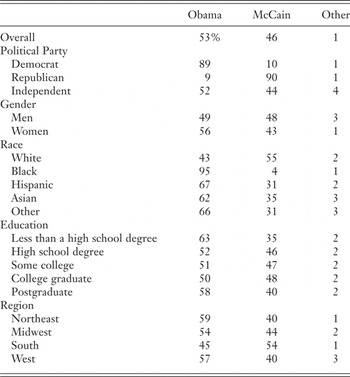
Prior to the election, some had speculated “the end of Black politics” (Bai Reference Bai2008), and others went so far as to declare “the end of the black American narrative” (Johnson Reference Johnson2008). Postracial discourse only grew in the wake of the election itself. Yet, we wish to stress several key facts about Obama's electoral success. The election of the first African American president is an extraordinary achievement. It is as much an achievement defined by race as it is an achievement that signals a potential for the transcendence of race. Obama received 53% of the vote. However, as Table 1 shows, based on national exit poll data, Obama received only a minority (43%) of the White vote. His winning coalition thus involved a substantial White minority joined with supermajorities of the Asian (62%) and the Hispanic (67%) vote, as well as a hypermajority of the African American (95%) vote. It is hard to read these results as signaling the irrelevance of race.
National Presidential Election Exit Poll Vote Results by Selected Characteristics

Source: Edison Media Research/Mitofsky International
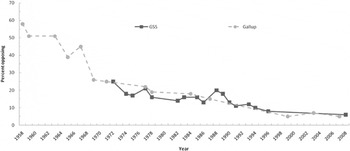
Yet, Obama's entire candidacy, and his ultimate success, was premised on the fact of an enormous transformation in racial attitudes and outlooks in the United States. The single most consistent trend in studies of racial attitudes in the United States is a repudiation of the Jim Crow racism of an earlier era and the emergence of new norms of racial equality, nondiscrimination, and integration (Schuman et al., Reference Schuman, Steeh, Bobo and Krysan1997; Bobo and Charles, Reference Bobo and Charles2009). One clear illustration of this point, and of immediate relevance to presidential politics, has been the unabated decline in the number of White Americans who say they would not support a Black candidate nominated by their own party. Figure 2 shows trends from national surveys fielded by the Gallup Organization and the National Opinion Research Center's (NORC) General Social Survey on willingness to vote for a qualified Black candidate for president nominated by “your party.” Nearly three in five of White Americans said they were not willing to vote for a Black candidate when Gallup first asked this question in 1958. That proportion fell to below one in five White Americans by 1980 and to below one in ten by the 1990s. In short, at least in principle, the overwhelming majority of White voters consistently express a willingness to consider voting for a Black presidential candidate and have said so for more than a decade.
White opposition to voting for a qualified Black presidential candidate nominated by their political party
Source: General Social Surveys, 1972–2008;a Gallup Polls 1958–2007b
a“If your party nominated a (Negro/black/African American) for president, would you vote for him if he were qualified for the job?” (General Social Surveys Cumulative Data File, 1972–2006)
b“If your party nominated a generally well-qualified person for president who happened to be black, would you vote for that person?” (as reported in Jones Reference Jones2008)

This opening for a Black candidate notwithstanding, there are at least four ways in which the Obama campaign had to navigate a quite treacherous field of racial division. First, negative stereotypes of African Americans remain alive and well in the United States, even if now expressed with greater subtlety and a larger measure of sophistication than in the past (Smith Reference Smith1991; Sniderman and Carmines, Reference Sniderman and Carmines1997; Bobo Reference Bobo, Krysan and Lewis2004). For example, Figure 3 shows trends for two modern stereotype measures taken from NORC's General Social Survey. As recently as 1990, these data show some 68% of Whites rating Whites as more hardworking than Blacks and just under 60% rating Whites as more intelligent than Blacks. Although both items register declining endorsement among Whites, both remain at nontrivial levels of endorsement as of 2008. Such outlooks have relevance to how voters think and are likely to behave. For example, one New York Times story reported on racial prejudice as a possible influence even among young voters. It quoted a White student from the University of Kentucky as saying: “I don't have any problem with a black president. I think it would be fine, because a lot of things people stereotype black people with, I don't think Obama has any of them” (Dewan Reference Dewan2008). In short, Obama had “escaped” or transcended the stereotype. Analytically, however, the key point here is that any Black candidate for president almost certainly had this set of negative expectancies to overcome (Kinder and McConnaughy, Reference Kinder and McConnaughy2006).
Whites' trait ratings of Whites' industriousnessa and intelligenceb in comparisonc to Blacks
Source: General Social Surveys, 1990–2008
a“The second set of characteristics asks if people in the group tend to be hard-working or if they tend to be lazy. Where would you rate whites in general on this scale? Blacks?”
b“Do people in these groups tend to be unintelligent or tend to be intelligent? Where would you rate whites in general on this scale? Blacks?”
cThe comparison is generated by subtracting the score given for Whites on this 1–7 point scale from the scores of Blacks for each measure. On the resulting scale, positive numbers indicate that Blacks are rated as possessing more of the desirable trait than Whites, negative scores indicate that Whites are rated more positively, and zero indicates that both groups received equal ratings. Negative scores were coded as agreeing. Overall, 7% of Whites rated Blacks as more hardworking than Whites, and 6% rated Blacks as more intelligent.

Second, and moreover, there is strong evidence of new types of racism (Sears Reference Sears, Katz and Taylor1988; Bobo et al., Reference Bobo, Kluegel, Smith, Tuch and Martin1997) and, in particular, quite widely shared collective racial resentments (Kinder and Sanders, Reference Kinder and Sanders1996) dominating modern public opinion on race. That is, there are commonly accepted ideas in current political culture of a highly racially tinged nature that have implications for the political viability of any candidate, perhaps especially one who is Black. These ideas, or more precisely resentments, involving group or collective judgments about appropriate relations between Blacks and Whites go to the heart of what sociologist Herbert Blumer (Reference Blumer1958) once phrased as “prejudice as a sense of group position.” Accordingly, the core sentiment today is that Blacks have no compelling grounds to make special claims or demands on society. One question on this topic asks people to agree or disagree with the assertion that “Irish, Italians, Jewish and many other minorities overcame prejudice and worked their way up. Blacks should do the same without special favors.” As shown in Figure 4, roughly three-fourths of White Americans endorse this sentiment and have done so for more than a decade. A high and slightly rising percentage of African Americans endorse this view as well, though there are good reasons to believe that their responses have a different meaning and have less political consequence among Blacks. Any candidate advancing a traditional civil rights era script of African American injury and just entitlement to redress would, arguably, have run counter to a quite stable feature of mass White public opinion.
Belief that Blacks should overcome prejudice without special favorsa
Source: General Social Surveys, 1994–2008
a“Do you agree strongly, agree somewhat, neither agree nor disagree, disagree somewhat, or disagree strongly with the following statement: Irish, Italians, Jewish and many other minorities overcame prejudice and worked their way up. Blacks should do the same without special favors” (agree strongly and agree somewhat coded as agree).

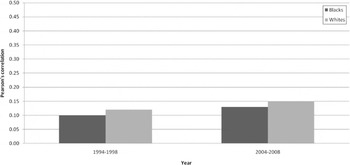
Third, this type of collective racial resentment is of discernible political relevance. As Figures 5 and 6 show, this type of sentiment is related to both party identification and to reported voting behavior. As collective racial resentments increase, so do the chances of identifying as a Republican and of voting for the Republican presidential candidate, particularly among White Americans.Footnote 2 Indeed, there is reason to believe that the connection of this type of sentiment to political choices and identities has grown over time, perhaps especially so among Southern Whites (Valentino and Sears, Reference Valentino and Sears2005). It is of little surprise, therefore, that Obama's Philadelphia speech on race spoke explicitly to these types of resentments and the need to transcend them. After explaining his understanding of the sort of anger expressed in Rev. Jeremiah Wright's sermons, Obama said:
A similar anger exists within segments of the white community. Most working- and middle-class White Americans don't feel that they have been particularly privileged by their race. Their experience is the immigrant experience—as far as they're concerned, no one's handed them anything, they've built it from scratch…. So when they are told to bus their children to a school across town; when they hear that an African American is getting an advantage in landing a good job or a spot in a good college because of an injustice they themselves never committed; when they're told that their fears about crime in urban neighborhoods are somehow prejudiced, resentment builds over time
(Obama Reference Obama2008b).Correlations between racial resentment and Republican Party affiliationa across selected years
Source: General Social Surveys, 1994–2008
aAs opposed to identifying as Democrat, Independent, or Independent leaning Democrat.

Correlations between racial resentment and voting for the Republican presidential candidatea across selected years
Source: General Social Surveys, 1994–2008
aAs opposed to voting for Democrats, third-party candidates, not voting, or refusing to state.

Obama then moved to characterize both Black anger and White resentment as counterproductive. He recognized both as having real roots, roots that needed to be mutually acknowledged by each side of the racial divide. But more than this, he pointed out how such tensions and resentments had been exploited and manipulated by politicians, pundits, and spinmeisters for a generation. He linked that cynical politics of “distraction” to a persistent failure to address broad, common problems of failing schools, inadequate health care, a shrinking job base, an unnecessary and unwinnable war, and rising fear about the future. He stressed a common, overarching set of problems, purposes, and greater promise. Whatever one makes of his rhetoric or intentions, it is hard to look at the available data and fail to recognize that this was the road a successful Black presidential candidate had to travel.
Fourth, this strategy of calling for mutual recognition of group grievances and insisting on a primary focus on larger common problems was really the only path open to him if Obama was to continue to appeal to and mobilize African Americans as well. That is, rejecting completely Black claims and totally disassociating himself from the Black community was not an option. Previous research has made clear the strong sense of linked fate and common identity that provide a unifying thread to African American public opinion and political behavior (Dawson Reference Dawson1994; Dawson Reference Dawson2001). Certainly, any Obama calculus required not only winning African American votes but also motivating a historic Black mobilization and turnout (which he did). To wit, disassociation from the Black community or an open repudiation of the long-felt grievances of Black America was no more an option for Obama than was a simple embrace of the civil rights era protest politics associated with the Reverend Jesse Jackson or the Reverend Al Sharpton.
As the above suggests, Obama's path was challenging and complicated. We seek now to better understand exactly how he navigated it. This special issue of the Du Bois Review: Social Science Research on Race aims to shed light on how and why Obama's victory was won and the broader meaning of his electoral success. We begin with a new feature for DBR, an interview of distinguished sociologist William Julius Wilson by noted public intellectual and W. E. B. Du Bois Institute Director Henry Louis Gates, Jr. Their conversation brings to light the thinking of one of the most penetrating social thinkers of the modern era on what it was like to witness the 2008 presidential election. In a candid and an often powerful way, Wilson recounts his own support for Obama. The interview is perhaps most striking for Wilson's forceful defense of Obama's social policy agenda and how it will help the urban poor.
Our “State of the Discourse” section is rounded out by a series of highly provocative essays tackling at different levels the implication that Obama's success somehow signals the end of serious racial division in the United States. Eminent political scientists Rogers Smith and Desmond King compel us to think analytically about the competing racial projects, or racial orders, that vie for institutional dominance in the current era. One of these competing racial orders stresses a color-blind ethos, and the other a race-conscious ethos. They put in sharp relief the current material conditions that define a still clear-cut racial divide in status and quality of life experience.
Legal scholar Richard Thompson Ford puzzles through what Obama's election means for discourse within the Black community and for our larger understanding of the historic racial divide. He makes a series of provocative claims, pointing to a steady decline of racism; the rise of the Black middle class, who he suggests will be increasingly treated like hardworking ethnic immigrants groups of the past; and the growing fissure between the Black middle class and the unruly Black poor. The latter argument forces to the surface competing claims for “political respectability” (Higginbotham Reference Higginbotham1993) and for which voices in the Black community are recognized and embraced as legitimate (Cohen Reference Cohen1999).
Sociologist Howard Winant uses the Du Boisian idea of double consciousness to illuminate the meaning of Obama's rise to power. He stresses the enduring quality of many structural features of racial inequality while recognizing two signal accomplishments. First, that Obama (and many other African Americans) now operate from positions of greater power, though without having completely eliminated the “color line.” Second, that an old racial regime and logic has fallen but without ending structured racial inequality or, therefore, the need to engage the problem of race. Destiny Peery and Galen Bodenhausen bring a social psychological lens to the 2008 election. In particular, they review a variety of experiments suggesting an evolving public understanding of the racial divide itself. They point to evidence of a powerful logic of hypodescent—the one-drop rule—as guiding thinking about racial group membership in the United States. This pattern can be weakened, however, when individuals are encouraged to reflect and deliberate more in their judgments. Accordingly, some measure of Obama's success may be attributable to a long campaign season that resulted in more deliberation in voters' thinking and to an increasingly racially mixed understanding or multiracial view (as opposed to simply Black view) of Obama's identity.
A series of articles in our “State of the Discipline” section help to specify the types of social psychological processes and factors that shaped voters' reactions to the 2008 election. Distinguished social psychologist Susan Fiske and colleagues elaborate on how their “stereotype content model” can help explain Obama's success. Specifically, they identify several mechanisms, what they call “subtyping by social class” and “habituating,” that make it possible for someone to escape the stigmas that might otherwise be associated with membership in a particular social category. Obama's Ivy League background and other social-class cues, along with the lengthy primary and general election campaign season, should, they suggest, have weakened the otherwise potentially negative effect of anti-Black racial stereotypes among potential Obama voters.
John Jost, Tessa West, and Samuel Gosling assess whether there are potential aspects of personality and “ideology” that may have shaped voting in the 2008 election. Important in their account is that personality characteristics, such as openness, conscientiousness, and extraversion, and ideological characteristics may shape political outlooks and behaviors. Features of social personality, while not ideological in the narrow sense of being arrayed along a general, abstract liberal-to-conservative continuum, nonetheless are durable traits that influenced potential conversion to support for Obama. In a somewhat similar vein, Jennifer Crocker and Shayne Hughes make a case for what they call the “ecosystem perspective.” This is an attitudinal or ideological outlook that distinguishes those who tend to think in a more wholistic, interconnected fashion about society and politics. They suggest that Obama's steady appeal to focus on broader common problems, and the idea that each of us are our brothers' and sisters' keepers, powerfully evoked an ecosystem perspectives in the electorate. A closely related approach is advanced by Richard Eibach and Valerie Purdie-Vaughns. They note the importance of the types of issues framing strategies used by Obama, which should reduce zero-sum thinking and encourage more bridging outlooks.
Winning election, however, does not automatically bring about the political changes the victorious side seeks. Indeed, as American Political Science Association President Dianne Pinderhughes has pointedly suggested:
While there is much joy and excitement associated with the turn of events that brought Barack Obama to the White House, there is also a need to stay grounded in the issues of historical concern to African Americans and other people of color, and particularly how the new Obama administration will address such issues
(Pinderhughes Reference Pinderhughes2009, p. 3).One key concern in the answer to this question is Obama's ability to continue mobilizing the large numbers of people galvanized during the campaign season to help advance his policy agenda. Political scientist Traci Burch brings innovative new data to bear on Obama's capacity to continue drawing upon his large “volunteer army.” She and a team of researchers conducted interviews and observations in three cities—Chicago, Illinois; Charlotte, North Carolina; and Atlanta, Georgia—in order to assess the extent, process, and effects of the unique Obama mobilizing efforts. Drawing on political participation and social movement research literatures, she identifies key practices, incentives, and constraints for the sustainability of this historic mobilization effort.
So much discussion has focused on the implications of Obama's success for our understanding of racism and the racial divide that it is easy to neglect the significance of his election in the eyes of African Americans. Matthew Hunt and David Wilson aim to shed light on the meaning that White, Black, and Hispanic Americans said they would attribute to an Obama victory. Their analyses of national survey data collected prior to the general election suggest that African Americans were the most likely to perceive electoral success for Obama as bringing with it a series of abstract improvements in race relations. African Americans were less likely, however, than their Hispanic or White counterparts to expect Obama's election to bring deeper structural changes in society.
Political scientist Christopher Parker and colleagues analyze data on White respondents from a Washington State survey. They show that negative racial stereotypes, collective racial resentments, and patriotism all affect likely support for Obama. With a historic new national sample of Asian Americans, political scientist S. Karthick Ramakrishnan and colleagues assess the extent to which racial consideration influenced Asian American voters. Results from their pathbreaking National Asian American Survey do point to some ways in which racial considerations influenced Asian American voters. However, they stress that age, gender, and other issue-based factors were more consequential for the behavior of Asian voters in the 2008 election.
The full and final analysis of the 2008 presidential election has yet to be written. At the time of this writing, we are slightly more than one hundred days into the Obama presidency, making the meaning of this time in office impossible to judge as well. There remain some issues not addressed fully in even the diverse collection of essays and analyses contained herein. For example, the impact of McCain's selection of Alaska Governor Sarah Palin as his running mate, the economic collapse, and other aspects of McCain as a candidate (e.g., age, support for the war in Iraq, concessions to the deeply conservative Republican base on issues such as immigration) are matters still calling for more careful examination than what we are able to devote to them here. Our primary lens has been the lens of race. Yet and still, we know a fair bit about the path Obama had to travel to successfully claim the White House, and we have a number of strong hypotheses about the types of factors that shaped his success.
The notion that Obama has fundamentally transcended race and opened the postracial epoch in the American experience is easy to dismiss. To be sure, Obama may well embody what he referred to throughout his campaign as “the Joshua Generation,” that group ready to “cross the river.” But as New Yorker magazine writer and editor David Remnick points out, race was inescapably central to the Obama phenomenon and the path Obama has traveled:
A powerful thematic undercurrent of his oratory and prose was race. Not race as invoked by his predecessors in electoral politics or in the civil-rights movement, not race as an insistence on tribe or on redress; rather, Obama made his biracial ancestry a metaphor for his ambition to create a broad coalition of support, to rally Americans behind a narrative of moral and political progress. He was not its hero, but he just might be its culmination
(Remnick Reference Remnick2008, p. 68).The challenge before social scientists now is to carefully map the journey Obama and the nation have taken. With this special issue of DBR we hope to have identified several of the key guideposts and trails that define this historic trek.