Introduction
Invasion of the thyroid gland by laryngeal cancer is not very common, although the ipsilateral lobe of the thyroid is usually resected during surgery. This resection can lead to hypothyroidism in approximately 23 percent of cases, and in up to 70 percent if surgery is followed by radiotherapy.Reference Gal, Gal, Klotch and Cantor1, Reference Brennan, Meyers and Jafek2
Annually, laryngeal cancer constitutes 2–5 percent of all malignancies worldwide. Asian individuals, especially those from the Indian subcontinent, are at higher risk of laryngeal cancer: their risk is approximately twice that of US individuals.Reference McKenna, Fornataro-Clerici, McMenamin and Leonard3, Reference Chu and Kim4 At diagnosis, laryngeal cancer is regional (i.e. limited to regional lymph nodes) in 25 percent of patients, metastatic in 8–10 percent and localised in 65 percent.
Thyroid gland metastases have been reported to arise from systemic malignancies of the kidney, breast, lung, colon and rectum, and also to develop due to direct involvement by laryngeal, hypopharyngeal or oesophageal cancer.Reference Croce, Moretti and Bianchedi5 The thyroid gland is often involved in cases of subglottic laryngeal cancer, although rarely in a primary fashion; however, 22 percent of glottic tumours invade the thyroid.Reference McKenna, Fornataro-Clerici, McMenamin and Leonard3, Reference Chu and Kim4 Thyroid involvement by laryngeal cancer occurs by direct, lymphatic or haematogenous spread. Yuen et al. found that direct destruction of the thyroid gland was reported in 19 percent of patients with stage IV laryngeal cancer of tumour stage (T) 3 and/or T4; furthermore, thyroid capsule involvement was detected in 16 percent of patients.Reference Yuen, Wei, Lam and Ho6
Lymphatic spread accounts for 60 percent of thyroid gland metastases, and occurs via the paratracheal lymph nodes.Reference Harrison7 This high rate of lymphatic spread is due to the rich lymphatic circulation in the subglottic region.Reference Tucker8 It has been shown that 96 percent of laryngeal lymphatic drainage occurs through the paratracheal nodes.Reference Welsh9 Haematological spread of laryngeal cancer to the thyroid has not been completely evaluated, even though the thyroid and adrenal glands have high blood flow. Given such marked vascularity, one could expect a high prevalence of haematogenous metastasis to the thyroid.Reference Sano and Hamashima10, Reference Bosetti, Garavello, Levi, Lucchini, Negri and La Vecchia11
In Biel and Maisel's study of patients with tumours requiring total laryngectomy, hypothyroidism was reported in 38 percent of those receiving radiotherapy alone, 23 percent of those undergoing hemi-thyroidectomy, 70 percent of those receiving both therapies and 20 percent of those receiving neither.Reference Biel and Maisel12
Yuen et al. studied 16 patients with stage IV laryngeal cancer, and observed that, among 5 patients surviving for 10 years, 2 suffered from subclinical hypothyroidism and 1 from clinical hypothyroidism. These authors suggested that hemi-thyroidectomy should be performed in patients with subglottic cancer.Reference Yuen, Wei, Lam and Ho6
The present study aimed to investigate the prevalence of thyroid involvement by laryngeal cancer in Iranian patients, in order to shed light on the efficacy and complications of thyroid resection.
Materials and methods
In this retrospective study, we reviewed the hospital records of all patients with a definitive diagnosis of laryngeal cancer (n = 351) referred to the Imam Khomeini and Amir Alam Hospitals and the Iranian Institute of Cancer, in Tehran, and the Kermanshah General Hospital in Kermanshah, between 1996 and 2009. Data were gathered using a questionnaire completed during the chart review.
In these patients, frozen sections of thyroid tissue had been sent for pathological assessment during surgery. The presence of thyroid invasion was determined based on pathological findings reported at the time of operation. Tumour staging was performed using the tumour-node-metastasis system, while tumour grades were defined based on pathological findings and classified into grades G1 to G4 based on cell differentiation.
The EPI Info statistical software program was used for data analysis.
The ethics committee of Tehran University of Medical Sciences approved the study protocol.
Results and analysis
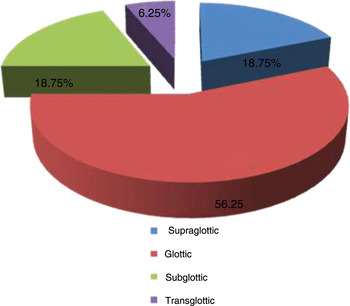
Of the 351 patients, 16 (4.55 percent), all male, were identified as having direct thyroid invasion by laryngeal cancer. Of these 16 cases, two-thirds had thyroid invasion in only 1 thyroid lobe. All cases of thyroid invasion occurred in patients with stage III (81.25 percent) or IV (18.75 percent) cancer. No case of metastasis was reported. The glottic region was the most common site of tumour origin (9 cases; 56.25 percent) (Figure 1).
Original laryngeal cancer regions giving rise to thyroid invasion.

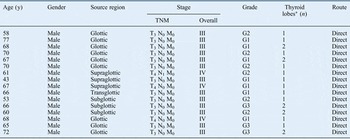
In all 16 patients, the invading cancer was squamous cell carcinoma (SCC). Table I summarises information for the 16 patients with thyroid invasion by laryngeal cancer.
Patients with thyroid involvement by laryngeal SCC: summary data

*Thyroid lobes involved. SCC = squamous cell carcinoma; y = years; TNM = tumour-node-metastasis; G = grade
Thyroid invasion was commonest among 60–69 year olds (56.25 percent, 9 cases), followed by those aged 70 years or more (25 percent; 4 cases).
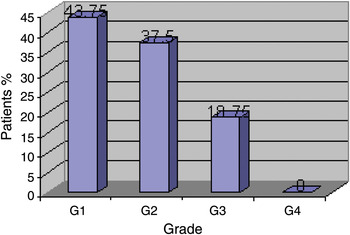
Most cases of thyroid invasion occurred in patients with grade G1 (43.75 percent; 7 cases) or G2 (37.5 percent; 6 cases) cancer (Figure 2).
Distribution of laryngeal cancer grading, among patients with thyroid invasion.

Discussion
The present study found thyroid invasion in 4.55 percent of laryngeal cancer patients. This is very similar to the prevalence reported by Biel and Maisel in 1985, but significantly lower than that of other similar studies.Reference Biel and Maisel12 Biel and Maisel's study had the largest sample size reported to date, with 261 patients. This sample size was substantially less than the number of cases reviewed in the present study (351 patients). The highest prevalence of laryngeal cancer thyroid involvement reported thus far has been by Croce et al., who in 1991 found that 30 percent of their 23 patients with laryngeal cancer had thyroid involvement.Reference Croce, Moretti and Bianchedi5 This represented a doubling of their previously reported rate (14.2 percent among 35 patients).Reference Croce, Moretti, Bianchedi, Boccia and de Vincentiis13
Our findings confirm previous reports that the glottic region is the site with the highest prevalence of thyroid gland invasion. In our study, the majority of cases of thyroid invasion arose from the glottic region (56.25 percent) rather than the subglottic or supraglottic regions. On the other hand, Gilbert and colleagues' 1986 study found that 21 of 23 (91.3 percent) cases of thyroid involvement arose from subglottic malignancies.Reference Gilbert, Cullen, van Nostrand, Bryce and Harwood14 Similarly, Yuen et al. found a higher rate of thyroid invasion from subglottic laryngeal cancer.Reference Yuen, Wei, Lam and Ho6
No previous study has addressed the relationship between laryngeal tumour grading and thyroid invasion. Our study found a higher prevalence of invasion by laryngeal cancer of grades G1 and G2. Only three patients had a grade G3 cancer, which not only invaded the thyroid gland but also involved both lobes.
It has been stated that the higher the grade of laryngeal cancer, the greater the prevalence of thyroid invasion. However, this association was not supported by the present study, which found that 81.25 percent of thyroid invasion cases involved patients with either grade G1 (48.75 percent) or G2 (37.5 percent) cancer.
As regards tumour staging, 13 of the 16 patients with thyroid gland invasion had a stage III tumour, while only 3 had a stage IV tumour. This was similar to Brennan and colleagues' finding that, out of 247 patients, all 19 with thyroid involvement had stage IV (and T3 or T4) laryngeal carcinoma.Reference Brennan, Meyers and Jafek2
In the present study, all thyroid involvement occurred by direct invasion, as also reported by Biel and Maisel in 1985.Reference Biel and Maisel12 In addition, both Croce et al. and Gilbert et al. reported that direct invasion was the main route of spread of malignant cells, being seen in 80 and 65.2 percent of cases, respectively.Reference Croce, Moretti, Bianchedi, Boccia and de Vincentiis13, Reference Gilbert, Cullen, van Nostrand, Bryce and Harwood14
• This retrospective study assessed thyroid invasion in Iranian laryngeal cancer patients
• This was found in 4.55 percent
• All cases involved direct invasion
• In most cases, involvement was limited to one thyroid lobe
• Thyroid invasion most commonly arose from glottic cancers
As regards gender, the present study found a significantly higher prevalence of thyroid invasion among men: in fact, all patients with thyroid invasion were male. Paparella and colleagues' 1991 text cited a female:male ratio of 1:12, while Smolarz and colleagues' 2000 study reported a ratio of 1:8.Reference Thawley, Paparella, Shumrick, Gluckman and Meyerhoff15, Reference Smolarz, Malke, Voth, Scheidhauer, Eckel and Jungehülsing16
The pattern of thyroid lobar involvement had not been evaluated before the present study. We found that two-thirds of our cases of thyroid invasion by laryngeal cancer had single-lobe thyroid involvement. This finding may be useful when resecting affected parts of the gland, as it suggests that approximately 33 percent of patients will have invasion of both thyroid lobes.
Amongst our 16 patients with thyroid invasion by laryngeal cancer, the only cancer type encountered was SCC.
Acknowledgement
The authors wish to thank the Farzan Institute for Research and Technology for technical assistance.