Hurricane Sandy made landfall in New York City (NYC) on October 29, 2012, causing extensive physical and economic damage due to flooding and widespread destruction of buildings, transportation systems, and residential homes. Reference Schwartz, Gillezeau and Liu1 It is estimated that approximately 300,000 New York homes were destroyed during Hurricane Sandy. Reference Blake, Kimberlain and Berg2 On November 14, 2012, 2 wk after Hurricane Sandy, NYC launched the Rapid Repairs program, which restored electricity, heat, and hot water to almost 12,000 buildings and provided assistance to 54,000 NYC residents. Reference Goldstein, Peterson and Zarrillo3 The Rapid Repairs program was estimated to cost $640 million in construction repairs to New York City communities. Reference Goldstein, Peterson and Zarrillo3 As of February 2013, The New York City Office of Management and Budget estimated the total cost of damage to the city to be $19 billion Reference Blake, Kimberlain and Berg2 ; including $5 billion to the New York City Metropolitan Transit Authority (MTA) and $4.5 billion to agencies such as the New York City Housing Authority (NYCHA) and the Health and Hospitals Corporation. Reference Blake, Kimberlain and Berg2 While there have been multiple studies assessing and quantifying the economic impacts immediately following Hurricane Sandy, Reference Blake, Kimberlain and Berg2–Reference Subaiya, Moussavi and Velasquez4 research on the long-term consequences of damage sustained due to the storm is limited, although many NYC communities continue to face economic and health consequences such as respiratory diseases Reference Kim, Schwartz and Hirsch5 and long-term mental health effects, Reference Lieberman-Cribbin, Liu and Schneider6,Reference Schwartz, Rasul and Gargano7 as well as difficulty restoring damaged property. Reference Fecht8 Specific NYC communities severely impacted by Hurricane Sandy include The Rockaways, Queens Reference Blake, Kimberlain and Berg2,Reference Goldstein, Peterson and Zarrillo3,Reference Fecht8 Brooklyn, Reference Blake, Kimberlain and Berg2,Reference Goldstein, Peterson and Zarrillo3 and Staten Island, NY. Reference Blake, Kimberlain and Berg2,Reference Goldstein, Peterson and Zarrillo3
The 311 Call Center is a nonemergency service line created to submit service requests, file official complaints, and obtain general information on NYC resources and agencies. 9 The 311 Call Center offers language assistance for 6 languages other than English: Spanish, Russian, Cantonese, Mandarin, Korean, or Creole. NYC residents can use 311 to access information on New York City Department of Health (DOH), Department of Transpiration (DOT), and other city agencies. In the aftermath of Hurricane Wilma, which made landfall in Miami-Dade County, Florida October 20, 2005, the 311 Contact Center in this region was shown to be a key tool in communicating Hurricane recovery and relief information to residents. Reference Schellong and Langenberg10 Pre-Hurricane Wilma, residents used the line to request information regarding school closures and evacuation routes, whereas Post-Hurricane, they called to be updated on power outages, the distribution of food and water, and damage to homes and buildings. Reference Schellong and Langenberg10 Thus, the NYC 311 Call Center Inquiry database can be used in a similar way to identify immediate and long-term areas of need, in the years since the storm surge.
This study aimed to investigate the NYC 311 call volume and most prominent inquiry types in the immediate aftermath of Hurricane Sandy and the extent of concerns in the years following the storm. A secondary objective was to determine which agencies received the largest volume of calls during the 2 wk following Hurricane Sandy to establish agencies that are essential for emergency hurricane preparedness and response. It is hypothesized that there would be an influx of Hurricane Sandy-related calls during the 2 wk following Hurricane Sandy, and the frequency of calls would decrease over time. It is also hypothesized that most calls during the first 2 wk would be directed toward the NYC Emergency Management (NYCEM) and Federal Emergency Management Agency (FEMA), and transition to clean-up and recovery. It is predicted that most call inquiries would be related to property damage, restoration, and general hurricane information.
Methods
NYC Open Data is a publically available database of 311 Call Center inquiries and contains information on NYC residential calls made to 311. 9 This database is updated daily and contains calls from 2010 to the present. Data from NYC 311 Call Center was directly downloaded from the NYC Open Data website to assess and characterize Hurricane Sandy-related calls across NYC in the 2 wk after and in the years following Hurricane Sandy. These data contain the date the call was placed, the agency contacted, as well as the name of the call inquiry, a brief description, and the resolution of each call. In the 2 wk following Hurricane Sandy (October 29, 2012 to November 15, 2012), all 311 calls that contained the keyword “Sandy” or “Hurricane” in the call inquiry or brief description fields were downloaded and classified by research team as Hurricane Sandy-related calls. For calls in the years following Hurricane Sandy, (October 29, 2012 to May 26, 2020), only calls containing the keyword: “Sandy” in the call inquiry or brief description fields were included in order to exclude any calls related to other hurricanes. Although the storm was also referred to as Superstorm Sandy, a review of the database revealed that “Superstorm” was not used by 311 to classify calls; thus, it was not included as a search term.
Frequencies of Hurricane Sandy related calls were examined by city agency (abbreviations listed in Supplementary Table 1), call inquiry type, and brief description, both in the immediate aftermath and the years following Hurricane Sandy. To assess Hurricane Sandy-related calls over the years, categories of call inquiries and brief descriptions were collapsed into broader inquiry type categories, as described in Supplementary Table 2. These categories included Finance/Business Assistance, Food/ Supplies Services, General Information/ Assistance, Legal Assistance, Mental Health Services, and Property Damage/ Building Restoration.
Results
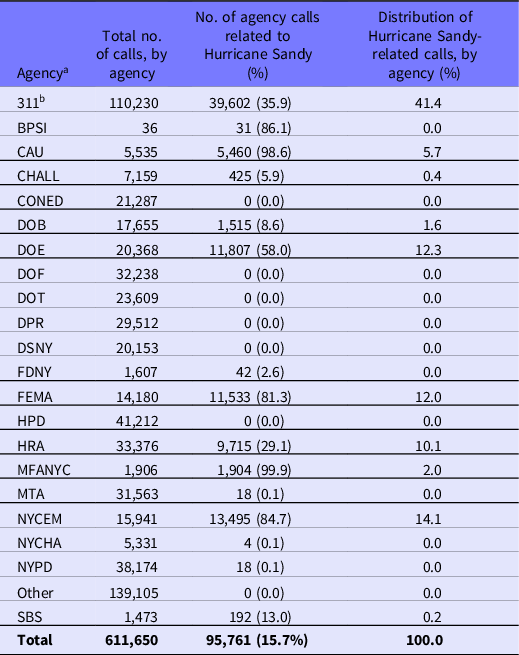
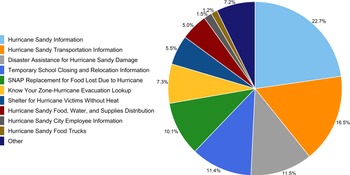
A total of 611,650 calls were made to 311 in the 2-wk window following Hurricane Sandy, with 95,762 (15.7%) of them directly related to Hurricane Sandy (Table 1). During this time, 98.6% of calls to Community Affairs Unit (CAU), 86% of calls to Borough President of Staten Island (BPSI), 81% of calls to Federal Emergency Management Agency (FEMA), 84.7% of calls to NYC Emergency Management (NYCEM), and 58% of calls to the Department of Education (DOE) were specific to Hurricane Sandy (Table 1). Among Hurricane Sandy-related calls, 41.4% came to the general 311 line, and were not routed to another agency. Approximately 49% of calls were directed to the DOE, FEMA, HRA, and NYCEM. There were no Hurricane Sandy-related calls to 311 that were directed to Consolidated Edison (CONED), New York Police Department (NYPD), Fire Department of New York (FDNY), and the MTA immediately after Hurricane Sandy. Of the Hurricane Sandy-related calls, 22.7% were requesting Hurricane Sandy information and 16.5% were requesting transportation information related to Hurricane Sandy (Figure 1). Additional calls were related to disaster assistance for Hurricane Sandy damage (11.5%), temporary school closing and relocation information (11.4%), and hurricane evacuation zone information (7.3%).
Percentage of NYC 311 call center inquiry calls related to Hurricane Sandy by agency from October 29 to November 15, 2012

N = number of calls
a A full list of agency abbreviations is provided in Supplementary Table 1.
b 311 calls that were received by the 311 call center and not re-directed to another agency.
NYC 311 Call Center inquiries containing the keywords “Sandy” or “Hurricane” from October 29 to November 15, 2012 (n = 95,762).

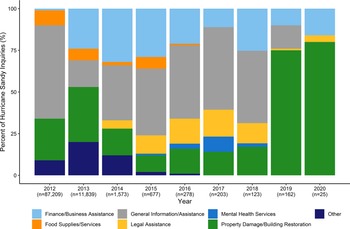
The number of Hurricane Sandy-specific calls immediately decreased after 2012 but persisted from 2013 to 2020 (Figure 2). A total of 87,209 calls were made in 2012, 11,839 calls during 2013, 1,573 calls during 2014, 677 calls during 2015, 278 calls during 2016, 203 calls during 2017, 123 calls during 2018, 162 calls during 2019, and 25 calls were made in 2020. Approximately 56% (n = 49,181) of the calls made in 2012 were requesting general information and assistance, whereas in 2020 no calls requesting general information were made and all of the calls in 2020 (n = 25) were related to property damage and restoration, legal assistance, or financial and business assistance (Figure 2).
NYC 311 Call Center inquiry types per year containing the keyword “Sandy” from October 29, 2012 to May 26, 2020.

During 2014 to 2019, 253 calls were placed requesting legal assistance related to Hurricane Sandy. From 2015-2018, a total of 40 calls were made requesting information on mental health services following Hurricane Sandy. A total of 25,866 calls related to property damage and building restoration were made from 2012 to 2020. Specific concerns related to property damage and restoration include Free Post-Hurricane Sandy Design Consultation, Hurricane Sandy Recovery, and Hurricane Sandy Home Repairs for Low Income Homeowners. A complete list of all specific concerns for each call type can be found in Supplementary Table 2. Through 2012 to 2020 there were 4,750 Hurricane Sandy-related calls requesting finance or business assistance. From 2012 until 2016 there were 9,007 calls related to food or supplies services.
Discussion
Main Finding of This Study
This is the first study to analyze 311 Call Center inquiries to determine the short- and long-term impacts of Hurricane Sandy, and to asses which government agencies people relied on during disaster response and recovery. Our main finding is that the consequences of Hurricane Sandy are still persistent in NYC communities today, almost 8 y after the storm surge, although the nature of peoples’ needs has changed over time. Specifically, the volume of Hurricane Sandy-related 311 calls has diminished over time and the call inquiry types have changed from 2012 to 2020. Most inquiries immediately following Hurricane Sandy were requesting general information related to Hurricane Sandy and reporting damage. Immediate concerns of NYC residents following the storm surge were related to temporary public school closures and relocations, disaster assistance, hotel evacuation centers, and transportation. Over time, the majority of call inquiries shifted to reflect rebuilding, legal and financial assistance, and mental health needs.
What Is Already Known on This Topic
A previous investigation quantified Hurricane Sandy-related 311 calls from September 2012 to 2017 and generated a timeline of how these calls relate to Hurricane Sandy recovery milestones. Reference Wolfe and Roeder11 For example, Congress approved $51 billion in recovery aid in January 2013 and subway transportation was restored in affected areas by June of 2013, both leading to large influxes of 311 calls. The DOE and NYCEM received the highest volume of calls during fall 2012. During this time period it was noted that fewer 311 calls were made on the weekends than during week days.
To our knowledge, this is the first research study to analyze trends in Hurricane Sandy-related calls to 311 from immediately after the storm to present day. Our results are consistent with the immediate needs shown in other natural disasters, such as of Miami-Dade County residents affected by Hurricane Wilma in October, 2005. Reference Schellong and Langenberg10 Following Hurricane Wilma, the 311 Contact Center received an influx of calls related to school, transit, and government office closures, curfews, power outages, food and water distribution, and FEMA. Reference Schellong and Langenberg10
What This Study Adds
This analysis serves as a valuable resource to inform disaster response preparedness and for policy-makers to understand how the needs and concerns of the NYC population changed over time. Hurricane Sandy-related concerns regarding general information, and financial and business assistance have remained relevant over the entire study period, although the volume of calls requesting general information has decreased, financial and business assistance 311 calls were made requesting information on donating money to Hurricane Sandy relief efforts, FEMA and insurance assistance, property tax rebate and relief, bill reviews, and tax extensions for damaged properties. Beginning in 2014 to present day, the 311 Call Center received an influx of calls related to legal assistance following Hurricane Sandy; these calls were specifically related to reporting Hurricane Sandy fraud and general legal services. It is possible that increases in financial and legal calls were related to government programs that were implemented to provide legal aid to victims of the hurricane. 12 During the 2013 tax season, the Internal Revenue Service provided a tax relief, deduction and assistance program for individuals, families, and businesses still dealing with repairs, homelessness, and insurance issues due to Hurricane Sandy. 13 As of 2013, New York Rising Community Reconstruction Program had allocated $25 million to assist with rebuilding and community resilience in NYC communities severely impacted by Hurricane Sandy. 14 Other legal services, and financial and business assistance programs that may have prompted Hurricane Sandy victims to call 311 include NYC Hurricane Sandy Loan & Grant Program, 15 NYC Restoration Business Acceleration Team (RBAT), 16 and the Build It Back Program. 17
Call inquiries related to food, water, and supplies began immediately following the storm surge and ceased during 2016, 4 y after Hurricane Sandy. These inquiries were specifically related to the distribution of food and water, the donation of individual items such as clothing and blankets, food truck locations, and Disaster Supplemental Nutrition Assistance Program (also known as D-SNAP) for people with disabilities. A rapid needs assessment, conducted immediately after Hurricane Sandy found that most NYC residents living in Rockaway peninsula, Queens, had to travel outside of the area to purchase food or receive food donations. Reference Subaiya, Moussavi and Velasquez4 NYC residents reported being worried about food following the hurricane, Reference Subaiya, Moussavi and Velasquez4 which suggests food insecurity was a concern. Organizations such as the Food Bank for New York City 18 and The Campaign Against Hunger, 19 assisted NYC residents with obtaining food during the aftermath of the storm.
We show here that starting in 2015, the 311 Call Center began to receive calls related to mental health services for victims of Hurricane Sandy; specifically to NYC CARES: Mental Health Services for Youth Victims of Hurricane Sandy. This campaign was created in 2015 by Department of Children and Families (DCF) to provide parents with information regarding counseling and mental services available for children and teens following Hurricane Sandy. 20 The mental health consequences of Hurricane Sandy have been well studied, Reference Lieberman-Cribbin, Liu and Schneider6,Reference Schwartz, Rasul and Gargano7 and indicate that high flood exposure throughout NYC was associated with negative mental health outcomes, including anxiety, depression, and posttraumatic stress disorder (PTSD). Reference Lieberman-Cribbin, Liu and Schneider6 Although there was a lag in time between the storm and the recording of calls related to mental health, it is possible that people were feeling mental health consequences immediately after the storm, but programs to address these needs were not yet widely available at that time. In a self-reported survey of individuals in the NYC area exposed to Hurricane Sandy, lack of access to medical care, physical harm, and witnessing death or injury during the storm surge were positively associated with PTSD. Reference Schwartz, Rasul and Gargano7 Therefore, although it is expected that 311 mental health service-related inquiry calls would increase in volume in the years following Hurricane Sandy, emphasis on mental health needs and services is important through all disaster and recovery phases.
The Mayor’s Fund to Advance New York City (MFANYC), CAU, BPSI, NYCEM, FEMA, and DOE were the agencies that received the highest volume of calls during the 2 wk following Hurricane Sandy. MFANYC is a nonprofit organization that works closely with government and nongovernment agencies to implement initiatives that will ultimately improve the lives of New Yorkers. 21 To support New Yorkers affected by Hurricane Sandy, MFANYC partnered with organizations such as Walmart, Goldman Sachs Gives, Nike, and Whole Foods to provide food, supplies, and funding for reconstruction to those impacted by the hurricane. 22 Similarly, the CAU is also responsible for integrating the NYC government within communities of the 5 boroughs. 23 The DOE was a critical resource for providing NYC residents with information regarding schools closures, relocations, and temporary home-schooling. 24 NYCEM and FEMA were key agencies responsible for emergency planning and preparedness. All of the described agencies had important and active roles in the immediate response to Hurricane Sandy. This study brings further attention to the importance of essential agencies such as FEMA and NYCEM when preparing for future natural disasters.
Limitation of This Study
This study is not without limitations. Due to the relatively limited number of language services offered by 311, inquiries from NYC residents speaking another primary language will not be captured through the 311 database. After 2012, only inquiries with the term “Sandy” could be included in the study to ensure that 311 calls related to other hurricanes were not included. It is also possible that NYC residents are reaching out to specific agencies, such as CAU, CONED, MTA, and DOF directly to report Hurricane Sandy-related concerns. Therefore, it is possible that this analysis missed some relevant inquiries, although the inclusion of these would strengthen our conclusions about the lasting impact of Hurricane Sandy. The 311 database does not contain information regarding the caller’s area of residence; therefore, this study is unable to identify specific NYC boroughs or neighborhoods that are still impacted by Hurricane Sandy. Dozens of Hurricane Sandy-related inquiry types were also reported to the 311 Call Center. For the purpose of this study, these inquiries were categorized, which may have resulted in the loss of information.
Conclusions
This study was based on 311 Call Center inquiries that were directly related to Hurricane Sandy from 2012 to 2020. This study emphasizes that the needs of Hurricane Sandy victims have changed over time from requiring general information regarding closures, property destruction, and immediate disaster relief to legal, financial, and mental health aid. As such, disaster response policy must be sensitive to changing needs of affected residents and target resources accordingly.
Supplementary material
To view supplementary material for this article, please visit https://doi.org/10.1017/dmp.2021.102
Data availability statement
311 Data are available to download at: https://data.cityofnewyork.us/City-Government/311-Call-Center-Inquiry/wewp-mm3p
Conflicts of Interest
The authors have indicated that they have no potential conflicts of interest to disclose.
Funding statement
No funding was received for this work.