Introduction
Alzheimer's disease (AD) and vascular dementia (VaD) constitute the majority of dementia cases among elderly persons. Distinguishing AD from VaD is important from a clinical perspective as this will guide the types of interventions initiated. Neuropsychological assessment is a frequently used tool in this process. A large number of studies have examined potential differences in cognitive performance between diagnosed AD and VaD subjects. The most consistent finding has been that VaD patients are more likely to have relative preservation of verbal long-term memory and greater deficits in frontal-executive functioning compared to AD patients (Looi & Sachdev, Reference Looi and Sachdev1999; Reed et al., Reference Reed, Mungas, Kramer, Ellis, Vinters, Zarow and Chui2007; Sachdev & Looi, Reference Sachdev and Looi2003). These differences seem to be most pronounced when comparing AD and subcortical VaD (Laukka et al., Reference Laukka, Karlsson, MacDonald and Bäckman2009; Oosterman & Scherder, Reference Oosterman and Scherder2006). This pattern is consistent with previous findings of prominent deficits in free recall and recognition for cortical dementias and executive function deficits in subcortical dementias (Libon, Price, Garrett, & Giovannetti, Reference Libon, Price, Garrett and Giovannetti2004; Salmon & Filoteo, Reference Salmon and Filoteo2007). However, other studies have failed to observe differences in cognitive performance between AD and VaD (Looi & Sachdev, Reference Looi and Sachdev1999; Sachdev & Looi, Reference Sachdev and Looi2003). Inconsistencies in the literature may be due to differences in study populations, dementia subtypes, or in type of task administered. The results from a recent meta-analysis highlight the difficulties in discriminating between AD and VaD on the basis of cognitive performance. Very few cognitive tasks were found to reliably differentiate between clinically diagnosed AD and VaD cases, and even for the two most discriminative tasks (delayed story recall and emotional recognition), the overlap in scores was almost 50% (Mathias & Burke, Reference Mathias and Burke2009).
Previous studies have demonstrated a long preclinical phase in AD, where cognitive deficits at the group level may be detected already 10 years before diagnosis (Elias et al., Reference Elias, Beiser, Wolf, Au, White and D'Agostino2000). This is an important time period, as the prospect of delaying onset requires early detection and intervention, before irreparable neuronal damage has occurred. Furthermore, attempts to improve differentiation between AD and VaD would seemingly be more effective during the preclinical phase, before fulfilling the diagnostic criteria for dementia. This is because patients with AD and VaD become increasingly cognitively similar as the diseases progress. Yet, studies targeting the preclinical period have also often found impairment in the same cognitive domains for the two dementia types (Ingles, Wentzel, Fisk, & Rockwood, Reference Ingles, Wentzel, Fisk and Rockwood2002; Laukka, Jones, Small, Fratiglioni, & Bäckman, Reference Laukka, Jones, Small, Fratiglioni and Bäckman2004; Sacuiu, Sjögren, Johansson, Gustafson, & Skoog, Reference Sacuiu, Sjögren, Johansson, Gustafson and Skoog2005).
Taking into account data from repeated testing occasions may prove to be more sensitive in differentiating between impending dementia and normal aging and to differentiate between AD and VaD. Recently, several studies have used a change point method to demonstrate an acceleration in cognitive decline several years before AD diagnosis (Grober et al., Reference Grober, Hall, Lipton, Zonderman, Resnick and Kawas2008; Hall, Lipton, Sliwinski, & Stewart, Reference Hall, Lipton, Sliwinski and Stewart2000; Hall et al., Reference Hall, Ying, Kuo, Sliwinski, Buschke, Katz and Lipton2001; Howieson et al., Reference Howieson, Carlson, Moore, Wasserman, Abendroth, Payne-Murphy and Kaye2008; Jacqmin-Gadda, Commenges, & Dartigues, Reference Jacqmin-Gadda, Commenges and Dartigues2006; Ji, Xiong, & Grundman, Reference Ji, Xiong and Grundman2003; Johnson, Storandt, Morris, & Galvin, Reference Johnson, Storandt, Morris and Galvin2009; Thorvaldsson et al., Reference Thorvaldsson, MacDonald, Fratiglioni, Winblad, Kivipelto, Laukka and Bäckman2011). However, no study using this approach has specifically targeted VaD, or compared the two dementia types. The aim of the current study was to examine possible differences in time of onset and rate of decline between preclinical AD and VaD for a range of cognitive functions.
Methods
Participants
The samples were selected from the Kungsholmen Project, a longitudinal population-based study, which has been described in detail elsewhere (Fratiglioni et al., Reference Fratiglioni, Grut, Forsell, Viitanen, Grafström, Holmén and Winblad1991, Reference Fratiglioni, Viitanen, von Strauss, Tontodonati, Herlitz and Winblad1997). The original population included all inhabitants in the Kungsholmen area of Stockholm, Sweden, who were ≥75 years on October 1, 1987. At baseline, a dementia-free cohort (n = 1475) was identified from 1810 participants. Persons who refused participation at the clinical phase (n = 63; 9%) were younger, more often men, and more frequently scored <24 on the Mini-Mental State Examination (MMSE: Folstein, Folstein, & McHugh, Reference Folstein, Folstein and McHugh1975) relative to examined subjects (Fratiglioni et al., Reference Fratiglioni, Grut, Forsell, Viitanen, Grafström, Holmén and Winblad1991). All participants were invited back for three follow-up assessments at approximate 3-year intervals. Individuals from the dementia-free cohort who refused participation at first follow-up (n = 168; 12%) were younger, but had a similar sex distribution and MMSE scores as the returning participants (Fratiglioni et al., Reference Fratiglioni, Viitanen, von Strauss, Tontodonati, Herlitz and Winblad1997). Only 6% (n = 45) of those non-demented at first follow-up and 7% (n = 32) of those non-demented at second follow-up refused further participation. The Kungsholmen Project was approved by the ethical committee of Karolinska Institutet, Stockholm, Sweden, and informed consent was obtained from all participants.
The present study sample (n = 914) included persons from the dementia-free cohort who were diagnosed with AD or VaD during the 10-year follow-up period, or who remained non-demented until they died or the study ended. Persons who refused further participation were excluded (n = 245), as were persons diagnosed with dementia subtypes other than AD or VaD (n = 26), persons with uncertain dementia diagnosis (n = 5), Parkinson's disease (n = 13), severe psychiatric disorder (n = 12), or those who did not have data for any of the cognitive tasks (n = 260).
Diagnosis of dementia at baseline and follow-up visits was made in three steps according to the Diagnostic and Statistical Manual of Mental Disorders, Third Edition, revised (DSM-III-R: American Psychiatric Association, 1987) criteria. First, the examining physician made a preliminary diagnosis, followed by an independent diagnosis based on computerized data only. In cases of disagreement, a supervising physician made the final diagnosis. The cognitive assessment used for diagnostic purposes included items regarding general knowledge and past personal information (memory), interpretation of proverbs (abstract thinking), problem solving (judgment), object naming (language), figure copying (visuospatial construction), and simple motor activities (apraxia). Diagnosis of dementia was a clinical judgment following standardized criteria, taking into account all available information from the examination. The physicians also had access to the MMSE scores of the participants. No computerized algorithm was used. The physicians were blind to the results of the cognitive test battery, which was administered at a separate occasion. For participants who died between assessments, their clinical records and death certificates were sought, and a dementia diagnosis was made based on this information.
Differential diagnosis between AD and VaD was based on clinical data. A diagnosis of AD required gradual onset, progressive deterioration, and lack of any other specific causes of dementia. The AD diagnosis in the Kungsholmen Project corresponds to the National Institute of Neurological and Communicative Disorders and Stroke-Alzheimer's Disease and Related Disorders Association criteria for probable AD (McKhann et al., Reference McKhann, Drachman, Folstein, Katzman, Price and Stadlan1984). A diagnosis of VaD required abrupt onset, stepwise deterioration, history of stroke, or focal deficits. Because brain imaging or neuropathological examinations could not be performed, the majority (approximately 70%) of participants diagnosed with VaD in the Kungsholmen Project have a history of one or several clinically significant strokes, closely related in time to the onset of dementia symptoms. Thus, the VaD diagnosis was primarily a diagnosis of post-stroke dementia. A history of stroke was assessed through self-report, interview with next-of-kin, and review of medical records. The criteria used for VaD corresponds closely to the possible VaD category according to the National Institute of Neurological Disorders and Stroke-Association Internationale pour la Recherche et l'Enseignement en Neurosciences criteria (Roman et al., Reference Roman, Tatemichi, Erkinjuntti, Cummings, Masdeu, Garcia and Scheinberg1993).
The incident AD group (n = 286) consisted of persons who were non-demented at baseline and diagnosed with AD at first (n = 125), second (n = 90), or third (n = 71) follow-up. The incident VaD group (n = 63) consisted of persons diagnosed with VaD at first (n = 27), second (n = 22), or third (n = 14) follow-up. As the research focus concerns preclinical cognitive impairment, data from testing occasions after the time of dementia diagnosis were excluded from the analyses. The comparison group of non-cases (n = 565) comprised persons who either remained non-demented for all three follow-ups (n = 249), or died during the assessment period without being diagnosed with dementia (n = 316).
Cognitive Assessment
To facilitate comparisons among different domains, all cognitive measures were converted to T scores (M = 50; SD = 10), using the baseline means and SDs as the standardization base.
Episodic memory
Word recall and recognition (Bäckman & Forsell, Reference Bäckman and Forsell1994) were assessed by two word lists, comprised of 12 unrelated words. One list was presented at a fast rate (2 s/word) and the other at a slow rate (5 s/word). Immediately after presentation of each list, participants were given 2 min for oral free recall. After free recall, they were given self-paced recognition tests where the 12 target words were presented randomly intermixed with 12 distractors. Each distractor was semantically related to one of the target words. As performance for rapidly and slowly presented words were highly related at all testing occasions for both free recall (mean r = 0.61; p < .001) and recognition (mean r = 0.61; p < .001), they were aggregated into word recall and recognition composite scores.
Visuospatial ability
A modified version of Block Design from Wechsler Adult Intelligence Scale-Revised (WAIS-R) (Wechsler, Reference Wechsler1981) was administered according to standard procedures. The modification was done to increase the possibility of grading even severely demented persons. The task consisted of seven designs, each involving four blocks. One design was entirely red and another was red-and-white checked. The remaining designs were the first five designs from WAIS-R. For clock reading (Christensen, Reference Christensen1984), participants were asked to report the time indexed by the hands of 5 different clocks. The times used were two o'clock, five o'clock, three o'clock, ten-forty-five, and seven-fifteen.
Verbal ability
Category fluency (Lezak, Reference Lezak1995) was used to assess verbal ability. Here, participants were asked to generate as many food items as they could think of in 60 s.
Statistical Analyses
Differences in sample characteristics were examined by analyses of variance and χ2 goodness-of-fit tests. For the longitudinal analyses, we fit a series of piecewise linear mixed models to the cognitive data (Raudenbush & Bryk, Reference Raudenbush and Bryk2002). We estimated the change point, characterizing the number of years before dementia diagnosis that the incident dementia cases deviated from the normal aging curve and exhibited accelerated cognitive decline, for the five cognitive tasks. A profile likelihood method was used to select the best fitting change point based on the −2 log likelihood values (Hall et al., Reference Hall, Ying, Kuo, Sliwinski, Buschke, Katz and Lipton2001). We allowed the knot of the spline (i.e., the change point) to vary across models by 1 month increments, ranging from time of diagnosis to 10 years before diagnosis. Before the knot, time was specified as a function of chronological age (i.e., years from birth from each individual measurement), with change estimates for this age slope based on cognitive data for both the incident dementia cases and the non-cases. After the knot, time was specified as a function of time to diagnosis (i.e., years to diagnosis from each individual measurement), with preclinical slope estimates based on cognitive data for the incident dementia subjects. Fixed effects in these models refer to average level and rate of linear change. Random effects were estimated for the intercept term, permitting level of cognition at the change point to vary across subjects. The AD and VaD groups were analyzed in separate models, using the same comparison group. The parameter estimates were based on a full maximum likelihood function and are unbiased under the assumption that data are missing at random (Little & Rubin, Reference Little and Rubin1987). The age term was centered at 75 years, which represents the youngest age in this sample. All models were adjusted for age differences at baseline. For the 95% confidence intervals (CIs) reported in this study, the critical value is 0.1466 times the value of the maximized likelihood (Hall et al., Reference Hall, Ying, Kuo, Sliwinski, Buschke, Katz and Lipton2001).
Results
Sample characteristics are shown in Table 1. Individuals in the two incident dementia groups and the non-cases were approximately of the same age at baseline (M = 82.0; SD = 5.0). The participants were censored from the study when they became demented, died, or the study ended. On average, this occurred at 88.6 years of age (SD = 4.3). Individuals in the incident AD group were more likely to be women and less educated, and the incident dementia persons scored at a lower level on the MMSE at baseline relative to the non-cases. There were no significant differences for these variables between the incident AD and VaD groups. The participants were assessed on average 2.8 times (SD = 1.0) during the 10-year follow-up period.
Sample characteristics according to diagnosis at follow-up

AD = Alzheimer's disease; VaD = vascular dementia; MMSE = Mini-Mental State Examination.
*Significant difference relative to the non-cases, p < .05.
**Significant difference relative to the non-cases, p < .01.
aData available for 313 persons.
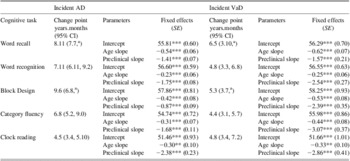
The estimated parameters from the best-fitting change point models are shown in Table 2. The distribution of the likelihood functions used to select the best-fitting models is presented as supplementary material. Results for the incident AD versus non-cases and the incident VaD versus non-cases contrasts are presented separately. In Table 2, the change points refer to the average onset of acceleration (in years and months) in cognitive decline before dementia diagnosis. In general, the change point occurred earlier for the incident AD persons (4–9 years before diagnosis) than for the incident VaD persons (4–6 years before diagnosis). The shortest preclinical period was observed for clock reading where both dementia groups deviated from the normal aging curve approximately 4.5 years before diagnosis. Although the incident AD and VaD groups were modeled separately, comparison of the 95% CIs provide some indication of whether the change points for the two groups differ significantly. Despite large differences in change points between incident AD and VaD, only word recognition shows complete non-overlap in 95% CIs.
Estimates from the best-fitting preclinical change point models across cognitive tasks for incident AD and incident VaD, respectively

Note. All models are adjusted for age at baseline. The change point refers to average onset of acceleration in cognitive decline relative to dementia diagnosis (in years and months). The fixed effects intercept refers to average performance at the change point for a 75-year-old reference individual. The age slope refers to average annual change for the total sample before the estimated change point. The preclinical slope refers to acceleration in change (relative to the age slope) within the estimated preclinical period. AD = Alzheimer's disease; VaD = vascular dementia; CI = confidence interval.
**p < .01.
***p < .001.
a The upper limit of the confidence interval (CI) was not identified for some tasks as the upper bound fell beyond the 10-year assessment range.
The fixed effects intercepts refer to average performance at the change point for a 75-year-old individual. The age slopes refer to average annual change for the total sample before the estimated change point. Significant age-related decline was observed for all cognitive measures (p < .01). This decline was most pronounced for the more executively demanding tasks, such as word recall and Block Design. For example, for word recognition and clock reading, the participants declined at approximately half the rate compared to word recall.
Following the change point, the annual decline accelerated dramatically for all cognitive tasks in both dementia groups (p < .001). The preclinical slope refers to the acceleration in change (relative to the age slope) within the estimated preclinical period. The annual rate of decline after the change point equals the sum of the age slope and the preclinical slope. For word recall and Block Design, this represents a three-fold increase, compared to normal age-related change. For category fluency, a six-fold acceleration was observed, and for word recognition and clock reading, a nine-fold acceleration. Moreover, the incident VaD group consistently showed a faster rate of decline compared to the incident AD group, with the exception of clock reading where similar patterns were observed on both change point and rate of decline for the two dementia groups.
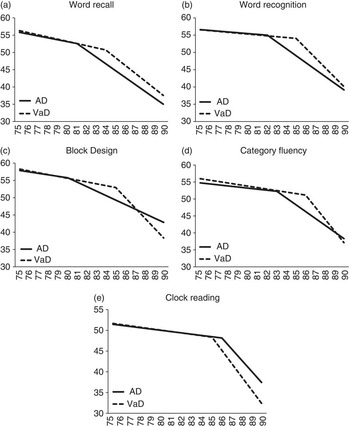
Figure 1 provides a graphical illustration of the different patterns observed for incident AD and incident VaD. It shows the estimated cognitive trajectories for two hypothetical persons diagnosed with dementia at age 90. Using word recall as an example, accelerated decline for an incident AD person would begin at age 81, whereas an incident VaD person would exhibit accelerated decline for the same task several years later (at the age of 83.5 years).
Estimated trajectories for two hypothetical persons diagnosed with Alzheimer's disease (AD) or vascular dementia (VaD) at age 90 across the five cognitive tasks (A–E).

Discussion
Consistent with the cognitive aging literature, we observed moderate but significant age-related decline for all cognitive tasks (Hofer & Alwin, Reference Hofer and Alwin2008). However, within the preclinical period, cognitive decline accelerated 3–11 times faster compared to normal age-related change. The estimated change points suggest that a long preclinical period with deficits in several cognitive domains precedes the dementia diagnosis for both AD and VaD. In general, the incident AD persons entered the preclinical period earlier compared to the incident VaD persons. However, the rate of cognitive decline was faster for the incident VaD persons, once having entered the preclinical period.
The normal age-related decline observed in this sample may reflect age-related brain shrinkage in areas important for cognition, such as the hippocampus and frontal regions (Raz, Ghisletta, Rodrigue, Kennedy, & Lindenberger, Reference Raz, Ghisletta, Rodrigue, Kennedy and Lindenberger2010). However, it could also be a result of dementia-related pathology, such as neurofibrillary tangles, Lewy bodies, and cerebral infarction (Wilson, Leurgans, Boyle, Schneider, & Bennett, Reference Wilson, Leurgans, Boyle, Schneider and Bennett2010). In diagnosed AD patients, several studies indicate that synapse loss shows the strongest correlation with cognitive impairment (Scheff, Price, Schmitt, DeKosky, & Mufson, Reference Scheff, Price, Schmitt, DeKosky and Mufson2007; Terry et al., Reference Terry, Masliah, Salmon, Butters, DeTeresa, Hill and Katzman1991). For vascular dementia, cognitive decline could be caused by cortical or subcortical infarcts, lacunes, and white-matter changes (Pantoni, Poggesi, & Inzitari, Reference Pantoni, Poggesi and Inzitari2009). Before entering the preclinical period, cognitive decline was relatively modest among the incipient dementia cases. After the change point, however, decline accelerated, likely as a result of accumulating pathology. Upon reaching a critical threshold, the individual may no longer be able to compensate for these brain changes and, thus, enters the dementia stage of cognitive impairment.
The long preclinical period for word recall observed for incident AD is consistent with results from previous studies using the same methodological approach (Grober et al., Reference Grober, Hall, Lipton, Zonderman, Resnick and Kawas2008; Hall et al., Reference Hall, Ying, Kuo, Sliwinski, Buschke, Katz and Lipton2001; Thorvaldsson et al., Reference Thorvaldsson, MacDonald, Fratiglioni, Winblad, Kivipelto, Laukka and Bäckman2011), although our study reports a somewhat earlier change point. Episodic memory deficits have been long regarded as an early marker of AD (Bäckman, Jones, Berger, Laukka, & Small, Reference Bäckman, Jones, Berger, Laukka and Small2005; Elias et al., 2000) and this form of memory has also been found to be impaired in preclinical VaD (Laukka et al., Reference Laukka, Jones, Small, Fratiglioni and Bäckman2004). The early onset of accelerated decline for Block Design is consistent with previous findings that persons in a preclinical phase of AD exhibit visuo-constructive deficits more than 10 years before dementia diagnosis (Kawas et al., Reference Kawas, Corrada, Brookmeyer, Morrison, Resnick, Zonderman and Arenberg2003). In the AD group, category fluency took an intermediate position with regard to time of onset of accelerated decline, although this measure has shown accelerated decline more than a decade before AD diagnosis (Amieva et al., Reference Amieva, Le Goff, Millet, Orogozo, Pérès, Barberger-Gateau and Dartigues2008).
In general, we found that executively demanding tasks, with high levels of difficulty (e.g., word recall, Block Design), exhibited the earliest decline during the preclinical period of both AD and VaD. In contrast, more knowledge-based measures (e.g., clock reading) began declining much closer to diagnosis, again consistent with previous findings in preclinical AD (Grober et al., Reference Grober, Hall, Lipton, Zonderman, Resnick and Kawas2008; Hall et al., Reference Hall, Ying, Kuo, Sliwinski, Buschke, Katz and Lipton2001; Thorvaldsson et al., Reference Thorvaldsson, MacDonald, Fratiglioni, Winblad, Kivipelto, Laukka and Bäckman2011). In response to age- and dementia related changes, older people may maintain their level of cognitive function through compensatory mechanisms (e.g., reorganization of brain pathways or recruitment of atypical pathways) or a high level of cognitive reserve. However, as task demands increase, or the pathological burden becomes more severe, cognitive decline will eventually be evident (Buckner, Reference Buckner2004; Grober et al., Reference Grober, Hall, Lipton, Zonderman, Resnick and Kawas2008). A few years before dementia diagnosis, even knowledge-based tasks (e.g., clock reading) start to show decline (Hall et al., Reference Hall, Ying, Kuo, Sliwinski, Buschke, Katz and Lipton2001; Thorvaldsson et al., Reference Thorvaldsson, MacDonald, Fratiglioni, Winblad, Kivipelto, Laukka and Bäckman2011). At this point, there might also be an additional acceleration of cognitive decline for measures that started to accelerate at a faster rate earlier (e.g., episodic memory), as has been suggested in previous studies (Amieva et al., Reference Amieva, Le Goff, Millet, Orogozo, Pérès, Barberger-Gateau and Dartigues2008; Bäckman, Small, & Fratiglioni, Reference Bäckman, Small and Fratiglioni2001; Grober et al., Reference Grober, Hall, Lipton, Zonderman, Resnick and Kawas2008; Smith et al., Reference Smith, Pankratz, Negash, Machulda, Petersen, Boeve and Ivnik2007; Twamley, Legendre Ropacki, & Bondi, Reference Twamley, Legendre Ropacki and Bondi2006).
Importantly, the cognitive tasks that showed less age-related decline were more sensitive to dementia-related change. For example, age-sensitive tasks like word recall and Block Design showed relatively little acceleration in cognitive decline in the preclinical period, because even the non-cases exhibited robust decline. This may in turn reflect the long preclinical phase observed for these measures. Given that dementia-related decline is observed many years before diagnosis for these tasks, it is very difficult to unequivocally demonstrate normal age-related decline, where everyone in a preclinical phase of dementia has been excluded, even in a study with 10 years of follow-up. In contrast, clock reading, a simple task that most participants should be highly familiar with, showed little age-related decline but considerable acceleration in the preclinical period. Given that performance on many tasks show decline in normal aging, less age-sensitive tasks, indexing crystallized abilities, may be more effective in capturing persons in the later preclinical stages of pathological cognitive decline.
The results suggest that the same cognitive domains are affected in both preclinical AD and VaD. Although it could be expected that the different etiologies of AD and VaD would result in different types of cognitive impairment, previous work has shown that various kinds of brain pathologies, such as hippocampal and frontal damage, can yield similar behavioral output (e.g., episodic memory impairment; Reed, Eberling, Mungas, Weiner, & Jagust, Reference Reed, Eberling, Mungas, Weiner and Jagust2000). This fact, combined with the frequent overlap in brain pathology between AD and VaD (Schneider, Arvanitakis, Bang, & Bennett, Reference Schneider, Arvanitakis, Bang and Bennett2007), could explain why the same tasks often exhibit similar impairment in AD and VaD (Mathias & Burke, Reference Mathias and Burke2009). That said; note that the VaD sample used in this study to a large extent consisted of post-stroke dementia cases. Thus, this sample should be expected to be affected by cortical brain damage. A sample of subcortical VaD cases may exhibit a different pattern of cognitive decline. Notably, however, observed differences in change points and rates of cognitive decline between AD and VaD are consistent with the view that AD neuropathology develops in a protracted and gradual manner, whereas VaD development (at least post-stroke dementia) is more abrupt, being the consequence of one or several acute vascular events.
The cognitive task that showed the best differentiation between the two dementia groups was episodic word recognition, where the AD group clearly exhibited precipitous decline before the VaD group. This is a task that previously has been shown to be relatively spared in subcortical VaD patients compared to AD patients (Schmidtke & Hüll, Reference Schmidtke and Hüll2002; Tierney et al., Reference Tierney, Black, Szalai, Snow, Fisher, Nadon and Chui2001; Yuspeh, Vanderploeg, Crowell, & Mullan, Reference Yuspeh, Vanderploeg, Crowell and Mullan2002). Recognition performance has been reported to be within normal limits also in subcortical VaD patients performing at a lower level relative to controls in free recall (Traykov et al., Reference Traykov, Baudic, Raoux, Latour, Rieu, Smagghe and Rigaud2005; Vanderploeg, Yuspeh, & Schinka, Reference Vanderploeg, Yuspeh and Schinka2001), suggesting that episodic memory impairment in subcortical VaD and AD has different mechanisms. The observed pattern of impairment is consistent with the view that retrieval is the main problem in subcortical VaD, whereas consolidation and storage are major problems in AD. This difference may reflect the fact that the episodic memory deficit in AD is largely driven by hippocampal pathology, whereas the deficit in subcortical VaD is more related to frontal-subcortical damage (Reed et al., Reference Reed, Eberling, Mungas, Weiner and Jagust2000). Although this pattern of episodic memory deficits has been observed mainly in subcortical VaD, also persons with post-stroke dementia may be expected to exhibit a more subcortical pattern of memory impairment compared to an AD group, especially in the preclinical phase when a stroke may not yet have occurred.
It should be stressed that we find differences with regard to the preclinical cognitive trajectories in AD and VaD, despite the fact that a very old sample was used. Previous studies have shown that the majority of dementia cases in this age group have mixed brain pathologies (Schneider et al., Reference Schneider, Arvanitakis, Bang and Bennett2007), making it unlikely that the AD and VaD groups in this sample consisted of pure dementia cases. Thus, a younger sample may yield even more differentiated patterns of preclinical cognitive deficits in AD and VaD, both with regard to onset and rate of decline.
There are several practical implications of the present study. The long preclinical phase observed for both AD and VaD indicates a large time window for identifying persons at risk for dementia. The results also demonstrate important differences between AD and VaD in terms of early dementia development. Despite previous reports of similar cognitive profiles for preclinical and clinical AD and VaD, we observed differences in the timing and progression of cognitive impairment between the two dementia subtypes. The long preclinical phase in AD suggests that dementia-related pathology accumulates over many years before reaching the threshold for dementia. Clinicians should attempt to capitalize on this prolonged period for targeting early interventions, as delays are likely to reduce treatment benefits. In contrast, the preclinical period in VaD is shorter and cognitive decline more rapid, suggesting that early preventive strategies, such as treatment of vascular risk factors or promotion of a healthy lifestyle, before the occurrence of a stroke, may be most important for preventing VaD.
The contrast between age- and dementia-related decline shows that within-person change in cognitive performance is useful for identifying persons transitioning toward a dementing disorder, especially given the large variation in level of cognitive performance (Bäckman et al., Reference Bäckman, Jones, Berger, Laukka and Small2005). In addition, the sequence of cognitive impairment for various cognitive domains is essential information when performing clinical trials to evaluate treatment effects. This study suggests that, for the detection of signs of increased dementia risk in the earliest preclinical stage, tasks like word recall and Block Design are the best choice. However, these tasks show little discrimination between age-related and dementia-related cognitive decline. Thus, for a clinical trial, tasks like category fluency and word recognition may be more useful, given that cognitive decline accelerates by a factor of 6 or more in the preclinical period for these tasks.
Some limitations of the present study should be noted. A challenge in any study on dementia is the identification of the exact time point when symptoms become severe enough to justify a clinical diagnosis. There is always a risk of confounding the preclinical and early dementia periods. The 3-year retest interval in the Kungsholmen Project in combination with a limited number of testing occasions renders somewhat imprecise estimates. Furthermore, it would be reasonable to expect a non-linear change trajectory within the preclinical period, leading up to dementia diagnosis. This has been observed for episodic memory in incident AD (Grober et al., Reference Grober, Hall, Lipton, Zonderman, Resnick and Kawas2008) and may be expected also for incident VaD. However, to estimate a second change point, more follow-up assessments would have been required. It should also be noted that a very old sample was used for this study and the results may not be generalizable to younger populations. Major strengths of the present study include the use of a large population-based dementia sample with careful clinical diagnosis and a representative comparison group tested on a broad range of cognitive domains. An important question for future studies is to address which factors may modulate the timing and progression of accelerated cognitive decline in preclinical AD and VaD.
Acknowledgments
The authors thank the staff and participants of the Kungsholmen Project for their important contribution. This work was supported by the Swedish Council for Working Life and Social Research (E.J.L., L.F., L.B), Swedish Brain Power (L.F, L.B), the Swedish Research Council (L.B), an Alexander Humboldt Research Award (L.B.), a donation from the af Jochnick Foundation (L.B.), the Michael Smith Foundation for Health Research (S.W.S.M.), the regional agreement on medical training and clinical research (ALF) between Stockholm County Council and Karolinska Institutet (L.F., L.B.), and Gamla tjänarinnor foundation (E.J.L.). There are no financial or other relationships that could be interpreted as a conflict of interest affecting this manuscript.