Violence between ethnic, religious, sectarian, national and partisan groups continues to plague many parts of the world. Despite the prevalence of intergroup violence, there is still considerable uncertainty about why it occurs, and why it occurs where and when it does. One reason is that most scholars take a ‘top-down’ approach, focusing on leaders and group motives,Footnote 1 while ignoring the question of why thousands of people take part in the murder and mayhem.Footnote 2 Moreover, in contrast to other forms of collective violence – such as civil war – intergroup violence comprises attacks on civilians by civilians; it is thus defined as mass participation. Therefore, the question of why ordinary people take part appears especially important as a means of understanding intergroup violence. The first contribution this study makes is to tackle this neglected question of participation, adding to the small body of existing research that examines conflict and violence from the ‘bottom up’.Footnote 3
The second contribution is its use of emotion, rather than selective incentives or social pressure, to explain individuals’ decisions to join in an attack on another group. Political scientists and social psychologists are increasingly proposing and testing emotional explanations for intolerance, racism, support for violence, participation in elections and protest and ethnic war, but none have so far turned their attention to participation in intergroup violence.Footnote 4 In particular, I use the emotion of intergroup anger to account for individual decisions about whether to join an attack against another group.Footnote 5 Indeed, anger is a powerful mechanism for producing aggression because it shapes both the preference for confrontation and beliefs about the risks of taking part.Footnote 6
A third contribution of this research is to embed the somewhat fleeting explanation of emotion into a more enduring and stable concept: evaluations of the intergroup context. To do so, I combine the insights of the appraisal theory of emotions and the large body of conflict research that makes use of some form of intergroup comparison.Footnote 7 Specifically, I propose that feelings of intergroup anger are rooted in comparisons of the perceived intergroup distribution of resources to the distribution that is believed to be desirable. I call these evaluations, respectively, group endowments and group entitlements. When group endowments and group entitlements are incongruent, either because the outgroup are enjoying resources to which they are not entitled, or the ingroup are receiving less than their share, anger is felt towards the outgroup, and large numbers of ingroup members may become willing to take part in intergroup violence. Participation in intergroup violence is thus not just about who gets what, but also, who deserves what.
While existing individual-level studies of emotions and conflict use samples that are exceedingly unlikely to take part in intergroup violence, such as students or citizens of developed countries, the fourth contribution of this study is to use survey data from a site where intergroup violence has actually occurred. The survey dataset was gathered in Alexandra, a township in South Africa, where a national wave of violence against immigrants began in 2008 and where tensions remained at the time of the fieldwork in 2011.Footnote 8 The actual experience of intergroup violence and – in some cases, participation in it – made the questions about participation both salient and meaningful to the subjects I surveyed.
The data show that perceived violations of group entitlements are strongly linked with feelings of intergroup anger. These, in turn, are associated with more pronounced intentions to take part in another attack on the other group. Anger, moreover, is a significant mediator of the effect of violations of group entitlement. These effects are robust when controlling for a number of other possible explanations, including realistic conflict with the outgroup, the social influence exerted by peers and community leaders, and previous participation in intergroup violence.
THE CONTEXT OF THE STUDY: ANTI-IMMIGRANT VIOLENCE IN SOUTH AFRICA
A familiar feature of the South African political landscape is the faultline between white and black.Footnote 9 As the repression of apartheid began lifting in the early 1990s, however, a new frontier of intergroup tensions began to emerge between black South Africans looking forward to a better life under democracy and immigrants, largely from Zimbabwe and Mozambique, searching for a better life away from the economic hardships of their homelands.Footnote 10
This antipathy has been most marked in the areas where most African immigrants live, the slums and shantytowns that ring South African cities. Vigilante attacks against African immigrants occur with disturbing regularity in these ‘townships’, as they are known in South Africa.Footnote 11 One such incident of anti-immigrant violence occurred on the evening of 11 May 2008 in Alexandra, a densely populated slum near the heart of Johannesburg.Footnote 12 An armed mob in the ‘Beirut’ area of Alexandra went door-to-door searching for foreigners. Anyone who could not pass their test – which was to provide the Zulu word for ‘elbow’ – was beaten. Two were killed that first night.
In contrast to previous incidents, the violence only intensified during the subsequent nights. By 14 May, Alexandra was in uproar, with thousands of residents ‘toyi-toying’,Footnote 13 attacking people believed to be foreign and clashing with police. Over the next few days, anti-immigrant violence, looting and the destruction of shacks occurred in other shantytowns around Johannesburg. By the following week, the violence had spread to the centre of Johannesburg and parts of Cape Town. Finally, after three weeks, a measure of calm returned, leaving sixty-two people dead, 670 wounded and 100,000 displaced.Footnote 14
While narrative accounts of the 2008 riots describe competition over the scarce resources of jobs and government housing, the most thorough research, that by Misago et al. finds that the leaders of informal community policing institutions often played an important role in organizing the attacks.Footnote 15 These informal leaders appear to have been using violence to consolidate their positions, which, although meagre, allow for various opportunities to extract payments from residents seeking policing or other government services. The question of why residents of townships like Alexandra so readily took part remains, however, both unexamined and mysterious. This paradox of participation is a feature of the more general literature on intergroup violence, as I argue in the next section.
INTERGROUP VIOLENCE AND THE PARADOX OF PARTICIPATION
Intergroup violence is, first, a form of collective violence: there are dozens, hundreds or thousands of perpetrators. Secondly, the targets are chosen largely because of their presumed membership in a group,Footnote 16 the groups of interest being those that are widely believed to be an important social category in the given context, such as ethnic, religious, racial, national and partisan groups. Thirdly, both the victims and the perpetrators of intergroup violence are civilians.Footnote 17
Research on intergroup violence and related forms of conflict tends to use explanations from two different levels of analysis. The first set of scholars focus on elite mobilization, arguing that intergroup conflict is the result of leaders competing for power.Footnote 18 Brass and Wilkinson, for example, show how elected politicians are involved in intergroup violence in India, while Misago's research in South Africa finds that local leaders organized the attacks of 2008.Footnote 19
A second strand in the literature assumes that groups act in pursuit of some collective goal, with violence resulting when these group preferences collide. Some authors focus on competition over material public goods such as jobs or government housing.Footnote 20 These also emerge as important grievances in interview research conducted after the violence in South Africa.Footnote 21 Although this approach is often termed ‘realistic group conflict theory’, a similar set of explanations, albeit focusing on symbolic group goals such as status or worth, is also prominent in this literature.Footnote 22
Both traditions of research are noticeably silent, however, when it comes to the micro-level mechanisms linking leaders or groups and the participation of thousands of civilians.Footnote 23 Even if leaders do stand to benefit from orchestrating communal violence, it is not clear how they get large numbers of participants to do their bidding. Nor is it obvious why individuals should take part in pursuit of some group goal, from which they may or may not personally benefit. This criticism holds whether this group goal is construed as primarily material or largely symbolic: one may desire a higher status for one's own group, but also desire not to be injured or arrested because of an attack on a higher-status group.
Participation in intergroup violence is, moreover, accompanied by significant costs. Being caught taking part may have legal consequences, particularly for those who loot or openly attack members of the outgroup. It may simply be that the police use violent, repressive tactics themselves, as they did in South Africa in 2008, or the other group might fight back, particularly if their lives or livelihoods are threatened.Footnote 24 Additionally, there are the moral costs of face-to-face violence against other people, seldom mentioned in the political science literature, but convincingly demonstrated by Collins.Footnote 25
The question of participation in intergroup violence is thus not only neglected, but is also paradoxical. Indeed, as my argument has suggested, participation in intergroup violence is the subject of the well-known paradox of collective action. The classical theory of collective action argues that unless groups are particularly small, or endowed with members who are likely to act regardless of what the rest of the group does, the group will face a collective action problem where all prefer to free ride rather than take part.Footnote 26 Yet even for such ‘latent’ groups, Olson argues that collective action is possible. However, selective incentives – either punishing nonparticipants, or providing inducements for participants – are necessary.
Researchers who have applied the theory of collective action to conflictual and violent situations have identified four varieties of selective incentives:, two punishments and two inducements.Footnote 27 Participants might be offered payments in cash or kind, contingent on their participation or, for a similar effect, may be able to reward themselves by looting the target group's possessions.Footnote 28 Leaders might also seek to shape the incentives of would-be participants through coercion, punishing those who do not participate.Footnote 29 Perhaps the most prevalent explanation for participation in conflict, however, is social pressure supplied by other members of the community.Footnote 30
There are, however, problems with all of these explanations when it comes to participation in intergroup violence. First, episodes of intergroup violence are chaotic and confusing: they diffuse over space, with perhaps many battlefronts, and ebb and flow over time.Footnote 31 They also draw attention, thus attracting numerous bystanders as well as participants.Footnote 32 Participants themselves may be more or less involved. Some lead the attacks, others may act more as cheerleaders. Bystanders may become participants as the violence develops, or the reverse.Footnote 33 It would, therefore, appear to be very difficult, if not impossible, for either leaders or other members of the community to monitor who participates and who does not. Without effective monitoring, threats of punishment or promises of reward are not credible.
Secondly, the leaders or organizers of intergroup violence are unlikely to be able to reward participants. In the South African case – one of the few where leaders have been identifiedFootnote 34 – they are themselves poor township residents, who do not have the means to provide payments to any significant number of participants.Footnote 35 Indeed, Horowitz suggests that some incidents of intergroup violence actually have no leaders, or perhaps only ‘endogenous leaders’, who arise only at moments of conflict, before disappearing back into the masses.Footnote 36 Nor does it appear that leaders can promise access to valuable public goods. In Alexandra, the jobs or housing that residents desire are allocated by the market and the state, respectively, and thus cannot be credibly promised by community policing leaders.
Finally, although looting occurs in intergroup violence, victims may be poor, as they were in the South African case, while participants are numerous. The ex ante expectations of gain from looting would thus appear to be quite low. In many cases, possessions are burnt or destroyed rather than looted, and in some instances, as with the Ayodhya riots in India in 1992, destruction is the goal.Footnote 37 Looting may well be an epiphenomenon that is parasitic on the occurrence of intergroup violence.
This article thus departs from the selective incentive mechanisms that are frequently used to explain participation in conflict and turns, instead, to an emotional mechanism. Emotions have a compulsive quality,Footnote 38 which makes them an ideal element for studying the aggressive and non-normative behaviour of taking part in a mob attack on another group. As I argue in the next section, anger is the emotion that is particularly interesting because it has a dual effect: it provides both the motivation for aggression and the means by which the risks, dangers and normative costs of participation are overcome.
THE EMOTIONAL PATHWAY TO PARTICIPATION
Emotions have re-emerged as important explanations for several political attitudes and behaviours. Of particular relevance for this study, researchers have previously linked emotions to intolerance, intergroup prejudice, support for violence and political participation.Footnote 39
Perhaps the most prominent account of emotions and conflict is Roger Petersen's Understanding Ethnic Violence.Footnote 40 He develops four models to account for ethnic war in the Balkans, where variables such as the historical relationships between groups and levels of state authority led to violence via the emotional pathways of ‘fear’, ‘resentment’, ‘rage’ and ‘hatred’. Although Petersen's macro-level, comparative historical approach does not speak directly to the micro-level question of why some individuals take part and others do not, his theoretical stratagem of using emotion to explain violence, and then linking emotions to more enduring background variables, is one that I adopt here.Footnote 41
There are thus two parts to my model of participation. The first, like Petersen, uses emotion to explain violence, although, in my case, the violence is at the individual level. The second part of the model then seeks to establish the roots of emotional reactions. My theory is about individuals, so these roots are themselves individual attitudes, but are more stable evaluations than emotions.
Explaining Participation
As Petersen's work suggests, there are a number of different emotions that might cause violence. The most prominent emotional determinant of violent behaviour is, however, anger.Footnote 42 Mackie and Smith develop this long tradition of anger and aggression research into an intergroup anger theory of participation in collective action.Footnote 43 Anger has a number of cognitive and behavioural features that make aggression more likely: an increased desire for confrontation, reduced perceptions of risk, a diminished role for risk in decision making and a superficial and stereotypical pattern of decision making.Footnote 44 Intergroup rather than merely interpersonal anger is then possible because when social groups are salient, individuals tend to categorize themselves into one of the available groups, identify with their group, take the goals and values of the group as their own and, most importantly, experience emotions on behalf of their group and directed at another group.Footnote 45
Other researchers have proposed other emotional pathways to conflict and violence. DeFigueiredo and Weingast foreshadow Petersen in claiming that fear produces ethnic conflict;Footnote 46 Tausch and colleagues argue that while anger leads to support for normative collective action, contempt produces support for non-normative collective action; and Halperin shows that anger is only linked with support for state violence among individuals who hate the outgroup.Footnote 47
Thus, while anger is the emotion most clearly linked with aggression and participation in risky collective action, there are at least four rival explanations: fear, hatred, contempt and resentment. Fear is the least promising of these, being both theoretically and empirically associated with withdrawal and risk aversion.Footnote 48 Multiple lines of evidence in research on basic emotions shows that hatred and resentment are in fact variations within the same ‘emotion family’ of anger.Footnote 49 Hutcherson and Gross find that contempt is most closely associated with an appraisal that the other party is incompetent,Footnote 50 suggesting that if contempt plays a role in intergroup conflict, its influence is limited to contexts where a powerful group encounters an oppressed and downtrodden minority group. This is not the case of South African local-immigrant conflict, nor is it the case in many examples of intergroup violence where higher status groups are attacked.Footnote 51
The most plausible emotional determinant of participation in intergroup violence remains anger, particularly intergroup anger. The first hypothesis is thus:
Hypothesis 1: Intergroup anger increases an individual's intention to participate in intergroup violence.
The Roots of Anger
Existing research shows that anger is caused by appraisals that one has been harmed, and that another party is responsible.Footnote 52 Anger is particularly likely when that harm is perceived as unjust or illegitimate.Footnote 53
The appraisals of harm, blame and injustice find a resonance in theories of conflict and violence that emphasize the power of intergroup comparisons. The first set of such studies examines the role played by intergroup distributions of resources, or inequality, in conflict.Footnote 54 A related strand in the literature makes use of the theory of relative deprivation, which argues that individuals or groups focus on the gap between their own positions and their expectations.Footnote 55 A third set of scholars has focused instead on the righteousness of each group's position and status: Sidanius and Pratto's ‘social dominance orientation’, Blumer's ‘group position’ theory, and Horowitz's notion of ‘group entitlement’ being the main examples.Footnote 56
I propose, firstly, to combine these theories using the concept of ‘violations of group entitlement’, and, secondly, to use this concept to explain why individuals feel anger about other groups in situations where they are in conflict. Group entitlements are violated either when the outgroup are getting more than they deserve, or the ingroup, less. This concept is composed of four basic group evaluations: ingroup and outgroup endowments (who gets what) and ingroup and outgroup entitlements (who deserves what). When the actual intergroup distribution of material and symbolic resources is incongruent with that which is thought to be normatively desirable, group entitlements are felt to have been violated, the outgroup is blamed, intergroup anger is experienced, and individuals become more willing to take part in an attack on the other group. If perceived violations of group entitlement and intergroup anger are widespread, the conditions are fertile for political entrepreneurs to organize a collective event – a march, a meeting, etc. – that may boil over into violence.
Hypothesis 2: Perceived violations of group entitlements result in increased levels of intergroup anger.
Data and Methods
There is something of a tradeoff between internal and external validity in the study of intergroup conflict at the individual level. While the determinants of antipathy and aggression towards outgroups can be tested in experimental studies, research ethics limit the extent to which real groups and samples from violence-prone settings can be used. Given that experimental tests, using student samples and contrived situations, of the link between intergroup anger and confrontational intentions exist,Footnote 57 I sought to gather data from the field; specifically, from a site where asking people about their actual and intended participation in intergroup violence is both realistic and meaningful. In this I was following the lead established by Humphreys and Weinstein and by ScaccoFootnote 58 in researching participation using a survey of a violence-prone community.
The chosen research site was Alexandra, the Johannesburg township where anti-immigrant violence had begun in 2008. This choice of site had two advantages. First, although anti-immigrant violence had begun in 2008, the tense relationship between locals and foreigners still remained at the time of research in 2011. Secondly, the goal of the fieldwork was to survey individuals who might conceivably participate in future intergroup violence. The population of Alexandra was not large, but a sample of a larger population would not have been likely to catch any significant number of potential participants.
The survey was conducted in April and May 2011, using face-to-face interviews of a representative sample of 497 adult South African residents of the area. Satellite photographs and a stratified, two-stage cluster sampling design were used to arrive at a representative sample. The response rate (AAPOR #3) is 69.2 per cent (further details are available in the online appendix).
Measurement
Intentions to participate in intergroup violence
My dependent variable is an individual's willingness or intention to take part in a future attack. In contrast to the work of Humphreys and Weinstein and that of Scacco, then, I do not use recollections of participation in a previous incident of violence. The reason is that my independent variables, particularly intergroup anger, cannot be validly measured by asking people for recollections of how they had felt a few years previously. Furthermore, to avoid gathering a measure of the outcome variable that is antecedent to the explanatory variables, participation needs to be conceptualized as intended future behaviour rather than as a recollection of past behaviour.
Similar intentional measures of behaviour have been used in other studies of collective action.Footnote 59 Meta-analyses of the intention–behaviour link show that intentions do have a causal relationship with behaviour.Footnote 60 Nevertheless, there is undoubtedly some slippage between one's intentions to participate in future and actual participation.
In particular, some individuals may profess an intention to participate without any real likelihood of doing so. Others might deny any intention to take part in future but are, in fact, likely to be mobilized because of their social networks.Footnote 61 I will thus test whether the results are robust across the subgroups who took part and did not take part in the previous attacks, as well as across the subgroups who attend and do not attend community meetings.
I also designed the survey instrument to ensure, as best I could, that respondents were expressing realistic intentions. First, I first checked that all respondents were familiar with the 2008 riots before asking questions about participation in this previous episode of violence. Once the memories of 2008 were fresh in the minds of respondents, I moved to questions regarding intentions to take part in future should violence recur.
In particular, respondents were asked if they would (1) join in a group protesting the presence of foreigners in Alexandra if someone asked them to; (2) assault someone, or (3) destroy shacks if others were doing so; or, alternatively, if they (4) would help a foreigner hide from the mob.Footnote 62 The responses were recoded as trichotomous indicators due to small numbers of observations in the middle two categories. Thirty-five per cent of respondents said they would definitely take part in an anti-foreigner protest; 12 per cent said they would definitely assault someone; 15 per cent expressed a firm intention to destroy shacks; while 60 per cent claimed that they would definitely not help any victims.
The latent variable of intention to participate in future violence is estimated using a two-parameter logistic item response theory (IRT) model for ordinal data. This model assumes that the latent variable is unidimensional, an assumption that is confirmed by establishing that only the first eigenvalue of the correlation matrix of items exceeds a value of 1. The scale is also reliable (Cronbach's alpha = 0.87). Parameter estimates of all measurement models are available in the online appendix.
Anger
Anger was measured at three different points in the survey: after short vignettes about foreigners working in Johannesburg and living in government houses in Alexandra, and again after the intergroup endowment and after entitlement comparisons (see below). In each of these three situations, respondents were presented with a list of nine words describing an emotion (happy, proud, angry, irritated, jealous, worried, ashamed, disappointed, and no feeling), and asked to choose the words that ‘best’ and ‘next best’ ‘describe how you feel, as a South African’ about the situation just described.
Following previous research,Footnote 63 the words ‘angry’ or ‘irritated’ are both taken as indicators of intergroup anger. There are thus six indicator variables: whether the respondent chose ‘angry’ as either the ‘best’ or ‘next best’ description across the three contexts, and whether they did so again using ‘irritated’. A two-parameter logistic IRT model fitted to the set of six measures is used to estimate the latent variable of intergroup anger.
Violations of group entitlement
Perceptions of group endowments and group entitlements were obtained using a version of Cantril's scale featuring a ladder with seven ‘rungs’.Footnote 64 The lowest rung was marked ‘1’ and described as a low position in society; the highest rung was marked ‘7’ and presented as a high level of endowment or entitlement. Four questions were asked, corresponding to ingroup and outgroup endowments and entitlements.
The variable measuring violations of group entitlements is calculated by adding the violation of ingroup entitlements (Entitlementin–Endowmentin) to the perceived violation of the outgroup's entitlement (Endowmentout–Entitlementout). Violations of group entitlements, in other words, measures the cumulative number of rungs on the ladder that both the ingroups and outgroups must move to get from the current distribution of resources between groups to the distributive situation that is desired by the ingroup.
Control variables
The use of observational data means that it is necessary to consider alternative explanations that may confound any observed relationships among the key variables. First, I control for realistic group conflict by collecting measures of exposure to resource competition with African immigrants. Indicators for being unemployed (leading to competition for jobs), living in poor quality housing (competition for government housing) and working as an informal trader (competition with foreign traders for customers) are collected.Footnote 65 Secondly, I control for the effects of elite mobilization using a scale measuring the extent to which respondents heard community leaders blaming immigrants for taking locals’ jobs or houses, or acting disrespectfully to locals. I also used fixed effects for the community policing sector to capture any unobserved heterogeneity due to leaders. Thirdly, to control for social pressure I use two measures. The first is number of community policing meetings the respondent had attended in 2011, by the time of the survey. The second is an index composed of three questions asking respondents whether, and to what degree, they had heard their peers blaming immigrants for taking locals’ jobs or houses, or acting disrespectfully to locals. Fourthly, I control for support for violence, a belief that violence is acceptable and appropriate,Footnote 66 which might be linked with both greater aggression and greater anger. Fifthly, I control for the strength of respondents’ national identities, which, again, might cause both intergroup aggression and anger. Finally, I also include a number of background factors: socio-economic status, age, the length of time the respondent has lived in Alexandra, level of education, gender and party support.
Empirical Strategy
Given that the theory has two components, I will test the hypotheses using two regression equations, one for participation intentions, and the other for anger:Footnote 67
 $${\rm{Anger}}\, = \,{{\alpha }_{\rm{1}}}\, + \,{{\beta }_{\rm{1}}}{\rm{GEV}}\, + \,{{\psi }_{\rm{1}}}{\bf {{X}}}\, + \,{{{\epsilon}}_{\rm{1}}}$$
 $${\rm{PartInt}}\, = \,{{\alpha }_{\rm{2}}}\, + \,{{\beta }_{\rm{2}}}{\rm{GEV}}\, + \,\gamma {\rm{Anger}}\, + \,{{\psi }_{\rm{2}}}{\bf {{X}}}\, + \,{{{\epsilon}}_{\rm{2}}}$$
The effects of interest are β 1 and γ. We might also be interested in the mediation effect: the effect of group entitlement violation on participation intentions, as expressed through the mechanism of anger. This effect can be calculated simply as the product of β 1 and γ, but I will also use the simulation technique of Imai and colleagues to provide an uncertainty estimate.Footnote 68
Given that the data were gathered using a complex survey design, I use survey linear regressions, which take account of the unequal probabilities of selection into the sample, as well as the additional uncertainty generated by weighting and two-stage cluster sampling.Footnote 69 Missing data were handled using multiple imputation.Footnote 70
RESULTS AND DISCUSSION
Bivariate Results
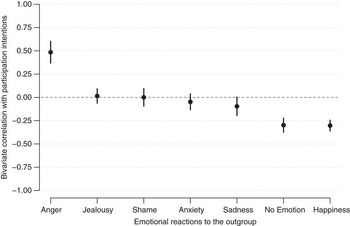
I begin by considering the bivariate relationship between emotion and participation intentions, on the one hand, and group evaluations and anger, on the other. Figure 1 shows the bivariate correlation coefficient, with 95 per cent confidence intervals, between participation intentions and each of the emotional reactions I measured.
Correlations between participation intentions and intergroup emotions.
Note: Each point shows the bivariate correlation coefficient between measures of intergroup emotions and participation intentions. While anger is measured using an IRT model, the other emotion measures are counts of mentions of the respective emotion words across the three contexts in the survey. Vertical lines indicate the 95 per cent confidence intervals.

The figure shows that respondents who feel anger towards immigrants show higher propensities to participate in future violence: the correlation is 0.48. No other emotion has a significant positive correlation. The other negative emotions show more or less no correlation with participation intentions, indicating that it is not the negativity of anger that matters for violence, but its confrontational, risk-averse action profile.Footnote 71 Both happiness and a neutral emotional response then have a negative correlation with participation intentions; in other words, they are associated with peaceful intentions.
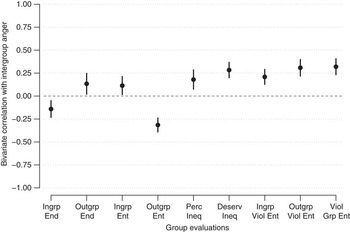
Next, I consider the bivariate relationships between anger and evaluations of group endowment and entitlement – the second link in the theoretical model. Figure 2 shows the bivariate correlation between intergroup anger and violations of group entitlement. It also shows the correlations between anger and the four constituent measures of group endowments and entitlements, as well as the correlations between anger and all pairwise combinations of these four constituent measures.
Correlations between intergroup anger and evaluations of group endowments and entitlements.
Note: Each point shows the bivariate correlation coefficient between a group evaluation and intergroup anger. The first four group evaluations are the four survey items: ingroup and outgroup endowments and entitlements. The next four are scales calculated using different pairs of these group evaluations: perceived and deserved inequality between groups, and violations of ingroup and outgroup entitlements. The final group evaluation is violations of group entitlements, which uses all four of the group evaluations. Vertical lines indicate the 95 per cent confidence intervals.

All correlations are significantly different from zero. As we might expect, whereas a higher position for the ingroup is associated with lower levels of anger, a higher outgroup endowment is associated with higher levels of anger. On the normative dimension, the position that is deserved by the ingroup has a positive association with anger, with the opposite effect observed for outgroup entitlements. The next four correlations use scales calculated using different pairs of these four group evaluations. All show positive correlations with anger with deserved inequality (ingroup entitlements relative to outgroup entitlements) and violations of outgroup entitlements (outgroup entitlement relative to outgroup endowments) having the strongest relationships. Thus, while theories such as relative deprivation focus on the gap between ingroup endowments and entitlements, it appears that the gap between those outgroup endowments and entitlements is at least as important.Footnote 72 And while many researchers use inequality to explain conflict, far fewer consider the level of inequality that the ingroup thinks is deserved.Footnote 73 Finally, the point in the plot furthest to the right shows the correlation between violations of group entitlement, which uses all four of the basic group evaluations, and intergroup anger. This correlation is the highest of any reported in this figure (0.32).Footnote 74
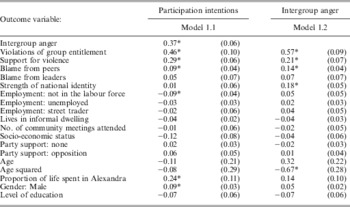
The bivariate relationships between anger and participation intentions, on the one hand, and group entitlement violations and anger, on the other, are consistent with the hypothesized model. To control for the effects of the potential confounds I identified earlier, I thus turn to the results of the regression models of participation intentions and intergroup anger. These are displayed in Table 1; ‘participation intentions’ is used as the outcome variable in Model 1.1, with ‘intergroup anger’ the outcome variable in Model 1.2.
Regressions of Participation Intentions and Intergroup Anger

Notes: N = 497. *p < 0.05. Models are survey linear regressions with design-based standard errors in parentheses. All models include an intercept and indicators for community policing sectors. All variables range from 0 to 1.
Model Results
Table 1 shows that respondents who feel angry at immigrants in Alexandra are indeed significantly more willing to take part in future violence against this outgroup. The effect is substantively large: the standardized regression coefficient for anger is 0.33.
This effect, moreover, controls for various other factors that could conceivably produce both anger and participation intentions. There are five in particular. Anger and willingness to take part in future violence might be thought to be a manifestation of (1) exposure to material competition with the outgroup, (2) the influence of peers, (3) mobilization by leaders, (4) normative support for violence, or (5) strength of national identity. The effect of anger is robust to the inclusion of measures of all of these factors. The regressions also control for background factors like poverty, gender and age, which have also been associated with participation in existing research.Footnote 75 The observed relationship between anger and participation intentions thus does not appear to be a spurious correlation produced by the effect of material threat from the outgroup, for example.
However, nor is it likely that the association between anger and participation intentions represents a reversed causal process, where participation intentions cause anger. Such an effect might be thought to occur if anger is a response to past violent behaviour, which the theories of self-perception and cognitive dissonance suggest might be possible.Footnote 76 Controlling for respondents’ behaviour in the previous attacks of 2008 does not, however, alter the observed effect of anger, suggesting that the causal arrow points from anger to participation intentions.Footnote 77
Nor is it very likely that respondents falsely expressed anger during the survey to mask their more venal motives. Three characteristics of the survey suggest that this is unlikely. First, the questions on participation and intentions to participate were asked at the end of the survey, after all the items measuring the independent variables. Secondly, the anger questions were not posed in the abstract, but were instead asked in reference to fairly detailed vignettes designed to prompt realistic emotional reactions in respondents. Thirdly, emotions were measured by asking respondents to choose a word from a categorical response set. This was expected to reduce the demand characteristics that might result from using a Likert scale response set for each possible emotional reaction (asking, in other words, how angry or irritated respondents felt).
Model 1.2 then presents the results of a regression testing the next component of the emotional model: the relationship between group entitlement violations and anger. This effect of group entitlement violations is positive and significant. This effect is also robust to the same set of controls used in Model 1.1; indeed, the standardized regression coefficient is 0.29, much the same size as the bivariate correlation. Thus, in accordance with Hypothesis 2, perceiving a violation of group entitlements appears to lead to higher levels of intergroup anger.
One might question whether the anger has a causal effect on violations of group entitlements rather than the hypothesized effect, which flows from the latter to the former. Although the possibility that each variable influences the other cannot be ruled out without the exogenous variance of an instrumental variable or experimental manipulation, research on the evolutionary roots of anger points towards a ‘hard-wired’ cognitive link between group entitlement violations and the emotional response of anger.Footnote 78 This suggests, at the very least, that there is a causal path from violations of group entitlement to anger.
Finally, we can also interpret these findings in terms of mediation. There is a significant indirect effect of group entitlement violations on participation intentions, exerted through the mechanism of anger.Footnote 79 Anger, in other words, mediates part of the total effect that violations of group entitlements exert on intentions to take part in intergroup violence. Note that anger appears to be a ‘partial mediator’ of group entitlement violations, because this variable also exerts a direct effect on participation intentions, as can be seen in Model 1.2.
Additional Findings
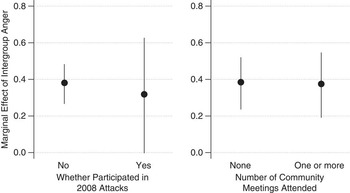
A further concern that one might have with this analysis is the link between participation intentions and actual participation. The measure of participation intentions might consistently underestimate or overestimate the probabilities that certain people would take part in future. Some individuals may profess an intention to participate without any real likelihood of doing so. Others might deny any intention to take part in future but are, in fact, likely to be mobilized because of their social networks. In the former case, respondents underestimate the costs of participation; in the latter, they underestimate the situational determinants. To address both of these concerns, interaction terms between anger and participation in the 2008 attacks, on the one hand, and attendance at the community meetings, on the other, are included. The former model permits a consideration of whether anger explains participation intentions among the subsample who participated in 2008, who have a full understanding of the costs and dangers of taking part. The latter model verifies whether anger has a diminished effect among the subsample who are embedded in community social networks, and who are thus more likely to be mobilized by their peers should violence actually recur. Neither of these interaction effects is significant.Footnote 80
The marginal effects of these interaction terms are then displayed in Figure 3. The figure shows that the point estimates of the effect of anger on intentions to participate in future violence are similar for respondents who took part in the previous attacks (Panel 1) – and thus understand the costs of participation – as well as those who did not. The effect of anger, moreover, is similar for respondents who attend meetings (Panel 2) – and thus are likely to be faced with the opportunity for participation in future – as well as those who do not attend. The reported effect of anger thus does not appear to be driven by individuals who are unlikely to be mobilized to take part if violence does recur. Nor is it a function of respondents who talk bravely of participation but have little understanding of the costs of taking part in intergroup violence.
Robustness of the effect of anger on participation intentions.
Note: The points indicate the marginal effects of anger on participation intentions when meeting attendance is 0 and 1. Vertical bars are 95 per cent confidence intervals around these estimates. The underlying regression model includes all other covariates used in Model 1.1.

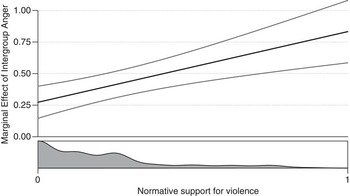
A second finding that is worth exploring in detail is the complex relationship between anger, participation, and support for violence. The results have shown that support for violence is a trigger of anger, as we might expect from the social-psychological literature.Footnote 81 It also is associated with a greater willingness to attack the outgroup, as we might expect from the sociological literature on ‘cultures of violence’.Footnote 82 In addition, however, support for violence moderates the effect of anger.Footnote 83 There is a significant interaction term between support for violence and anger,Footnote 84 the marginal effects of which are displayed in Figure 4. The figure shows that the effect of anger on participation intentions increases to the extent that the respondent supports violence. A combination of support for violence and anger at the outgroup is thus a particularly dangerous brew. Note that, however, despite this moderating effect, anger retains a positive marginal effect on aggressive intentions even for those respondents who strongly oppose violence (the left-hand side of Figure 4).
The moderating effect of normative support for violence.
Note: The upper panel of the figure indicates the marginal effects of anger on participation intentions as support for violence varies from its lowest to highest observed values, with 95 per cent confidence intervals. The lower panel of the figure shows the observed distribution of support for violence.

Moreover, this dual effect of support for violence (a direct effect on participation and a moderating effect on anger), has an implication for the broader issue of why intergroup violence occurs at all. As Horowitz observes, the incidence of intergroup violence declined precipitously in the West after the Second World War.Footnote 85 The mechanism of anger is itself insufficient to explain this dynamic societal-level variation, because anger is a fairly ‘hard-wired’ reaction to groups that may occur in any setting – educated, industrialized, developed or not. Instead, Horowitz's suggested explanation for the empirical puzzle is ‘a growing aversion to mass violence’ in the West after the War. This conjecture is a historical claim, but its psychological underpinnings find support in my data from Alexandra: anger appears to have an increasingly aggressive effect to the extent that violence is viewed as legitimate. If citizens of Western countries did indeed become largely averse to violence in the latter half of the twentieth century, then the mobilizing effects of intergroup anger would have been undercut.
CONCLUSION
As hypothesized, feeling angry at another group proves to be an important explanation for the willingness of ordinary people to take part in collective violence against that group. This effect of anger is robust to controlling for alternative explanations such as the influence of peers, material competition with the outgroup and mobilization by leaders. I show, furthermore, that intergroup anger is rooted in beliefs that the actual distribution of resources between the ingroup and outgroup is incongruent with the distribution that is desirable. Participation in intergroup violence is thus about perceptions of who deserves what, as well as who gets what.
This article uses data collected in a community where intergroup tensions exist and where intergroup violence is only too realistic. While this data-gathering strategy has the advantage of producing measures with construct and external validity, it has the disadvantage of producing observational data and an intentional, rather than behavioural, measure of participation. In future, it would be useful for research to examine the causal links between violations of group entitlement, intergroup anger and participation in intergroup violence more closely. Perhaps the most fruitful research design would be a panel survey of a violence-prone community, with indicators of participation captured after violence occurs, and anger and other independent variables measured in a pre-violence baseline survey.
It bears repeating that this article focuses on one part of the larger problem of why intergroup violence occurs – the puzzle of why ordinary people join in an attack on another group. In addition to a supply of willing participants, the occurrence of an episode of intergroup violence also requires some focal point or collective event where passions can spill over into violence. The model of participation that I have proposed is thus potentially complementary with macro-level research emphasizing the role that leaders play in organizing intergroup violence.Footnote 86
The model also resonates with macro-level research on the broader contexts that precipitate intergroup violence. One prominent theory holds that intergroup competition over material resources leads to violence between these groups.Footnote 87 My findings suggest, however, that realistic group competition may not be sufficient for intergroup violence to occur. What also matters is the belief that the other group has no right to take resources that ‘belong’ to the ingroup. Thus, according to my entitlement violation–anger model, at least part of the reason that labour market competition results in intergroup violence may be that it produces a sense that the outgroup have exceeded their entitlements.