


Introduction
Mania is the defining feature of bipolar disorder (American Psychiatric Association, 2013), and activation (heightened energy and activity levels) is a core feature of mania (Cheniaux et al., Reference Cheniaux, Filgueiras, Silva, de, Silveira, Nunes and Landeira-Fernandez2014). Therefore, for a comprehensive understanding of mania and bipolar disorder, elucidating the psychological mechanisms that underlie activation is of crucial importance (Mansell and Pedley, Reference Mansell and Pedley2008).
Cognitive models of psychopathology emphasize the importance of distorted ways of interpreting both internal and external experiences, such as catastrophic misinterpretation of bodily sensations in panic disorder (Clark, Reference Clark1986); culturally unacceptable attributions of delusions and hallucinations in psychosis (Morrison, Reference Morrison2001); and extreme, self-referent, positive and negative appraisals in the development and recurrence of mood swings and bipolar disorder (Mansell et al., Reference Mansell, Morrison, Reid, Lowens and Tai2007). Within the context of bipolar disorder, these extreme appraisals are often focused on activated mood states. Only one appraisal occupies awareness at any given time, driving mood regulation strategies in line with the appraisal; a positive appraisal of activation (e.g. ‘I have the energy to achieve anything I want’) is associated with attempts to enhance that feeling (up-regulate), whereas a negative appraisal of activation (e.g. ‘I am having a breakdown’) is associated with attempts to control or down-regulate activation. These default, in-the-moment appraisals are dynamic and online, based on underlying metacognitive beliefs about mood regulation, the self and others (e.g. ‘I need to have complete control over my moods in order to prevent myself from having a breakdown’). Several studies have reported that the Hypomanic Attitudes and Positive Predictions Inventory (HAPPI) (Dodd et al., Reference Dodd, Mansell, Sadhnani, Morrison and Tai2010; Mansell, Reference Mansell2006), which assesses extreme appraisals of internal states, is associated with increased activation as well as mania risk (Dodd et al., Reference Dodd, Mansell, Sadhnani, Morrison and Tai2010, Reference Dodd, Mansell, Bentall and Tai2011a; Mansell et al., Reference Mansell, Rigby, Tai and Lowe2008). Extreme appraisals are also heightened in those with a bipolar diagnosis compared with clinical and non-clinical control groups (Alatiq et al., Reference Alatiq, Crane, Williams and Goodwin2010), and predict increases in activation over time in individuals with bipolar disorder (Dodd et al., Reference Dodd, Mansell, Morrison and Tai2011b; Palmier-Claus et al., Reference Palmier-Claus, Dodd, Tai, Emsley and Mansell2016).
In this study, we examined extreme appraisals of activated mood from a dual processing perspective. Dual process models of cognition make a distinction between fast and automatic Type 1 processes, and slower, reflective or analytic Type 2 processes. In particular, we focus on the class of dual process theories that are default-interventionalist in structure (e.g. Evans and Stanovich, Reference Evans and Stanovich2013). This variety of dual process theory proposes that automatic Type 1 processing leads to intuitive, default responses. The role of Type 2 thinking is to intervene in those situations where the default response needs to be overridden by more conscious, reflective thinking.
In recent years there has been a great deal of research on individual differences in the propensity to monitor and override default, Type 1 responses (e.g. Toplak et al., Reference Toplak, West and Stanovich2011). One of the most widely used objective performance measures of this tendency is known as the cognitive reflection test (CRT; Frederick, Reference Frederick2005). The CRT consists of three simple questions, each of which prompts an intuitive (but incorrect) answer. Those with a propensity to reflect on their initial response soon realize that their intuition is misguided. On first glance of the example question given below, many people quickly give the answer ‘10 cents’.
A bat and a ball cost $1.10 in total. The bat costs $1.00 more than the ball.
How much does the ball cost? ____ cents
However, this impulsive and salient answer is incorrect; the difference between $1 and 10 cents is only 90 cents. Those who reflect on their answer soon realize that the answer is actually ‘5 cents’. Reaching the correct answer requires the ability to monitor, reflect on and supress impulsive responses, which is an ability that is seen to be distinct from general intelligence and executive functioning (Frederick, Reference Frederick2005). In dual-processing models, the intuitive response would be seen to reflect Type 1 thinking. Producing the correct response, which typically takes longer, requires people to engage in more analytical Type 2 thinking. Importantly, people differ in the propensity to override erroneous Type 1 processing and these individual differences are associated with a number of everyday consequences (Pennycook et al., Reference Pennycook, Fugelsang and Koehler2015). Those that give predominantly correct responses on the CRT show a greater willingness or propensity to engage in analytical reasoning and override the impulse to provide an intuitive, but incorrect answer (Frederick, Reference Frederick2005; Pennycook et al., Reference Pennycook, Fugelsang and Koehler2015). A recent review of the literature concluded that those with a greater propensity to engage in reflective thinking make fewer emotion-driven judgements, have fewer epistemically suspect beliefs and make more rational decisions (Pennycook et al., Reference Pennycook, Fugelsang and Koehler2015). These findings suggest that the propensity to engage in reflective thinking is associated with how people explain the world around them across a number of domains.
Given that interpretations of experience are key components of cognitive models of psychopathology (e.g. Mansell et al., Reference Mansell, Morrison, Reid, Lowens and Tai2007), this type of dual process model has more recently begun to influence clinical psychology. Such models (e.g. Beck and Haigh, Reference Beck and Haigh2014; Beevers, Reference Beevers2005) posit that negatively biased and self-focused ‘associative’ (default, Type 1) processing, such as initial interpretations of stimuli as threatening or negative, contributes to the development of depression. More ‘reflective’ (effortful, Type 2) processing that intervenes to correct automatic interpretations allows individuals to step out of the cycle, promoting resilience towards the development and persistence of more negative cognitive styles that contribute to depression. Such associative processing has also been implicated in the development of mania and depression in the context of bipolar disorder (Jones, Reference Jones2001), with models suggesting that repeated instances of depression or mania would reinforce biased associative processing; when someone has had many experiences of clinically significant mood episodes, this can itself bolster dysfunctional cognitions about the consequences of internal state change (Mansell et al., Reference Mansell, Morrison, Reid, Lowens and Tai2007). Those who have experienced activated mood states more often will be more inclined as a default, to automatically appraise these in a self-referent and overly positive or negative way (‘The world holds unlimited opportunities for me’ or ‘I am losing control of my mind’).
The type of associative processing described above makes it difficult for contradictory information to be considered, and, left unchecked, these default appraisals can cause levels of activation to escalate. Indeed, it has recently been shown that the inability to spontaneously identify such contrary information is associated with increased activation (Haigh and Dodd, Reference Haigh and Dodd2017). However, a key feature of default interventionalist dual process models is that default Type 1 responses can be overridden by the intervention of more reflective Type 2 processing. We therefore propose that the propensity to reflect on and override automatic Type 1 responses may be a mechanism that prevents activated states from escalating towards mania. In addition, reflective thinking may decrease belief in more extreme, self-referent, positively and negatively biased interpretations of experiences over time, as reflective thinkers are more able to process novel information that counters their biased beliefs about internal states – again, acting as a buffer against future heightened mood states.
Study 1
In this study, the CRT offers an objective and implicit means of exploring reflective thinking and its relationship with extreme appraisals of internal states. While this is important for understanding bipolar disorder, where excessive activated mood can be problematic, we recruited an analogue general population sample for this preliminary investigation. This is line with the continuum approach to psychopathology and cognitive models of psychopathology which suggest that the same processes that underlie clinical manifestations also underlie non-clinical manifestations of mood dysregulation, albeit to a lesser extreme (including Mansell et al., Reference Mansell, Morrison, Reid, Lowens and Tai2007). We predicted a negative association between the propensity to engage in reflective thinking and (i) extreme appraisals of internal states, and (ii) activated mood. Specifically, we predict that those with a greater propensity to engage in analytical thinking (higher scorers on the CRT) should have less extreme appraisals and lower levels of activated mood. We also expected to (iii) replicate previous research findings (Dodd et al., Reference Dodd, Mansell, Sadhnani, Morrison and Tai2010, Reference Dodd, Mansell, Bentall and Tai2011a,Reference Dodd, Mansell, Morrison and Taib; Mansell et al., Reference Mansell, Rigby, Tai and Lowe2008), demonstrating a positive association between extreme appraisals and activated mood. If hypotheses (i)–(iii) were supported, we aimed to test whether (iv) reflective thinking had a relationship with activation that was independent of extreme appraisals, by testing if this added unique variance to activation over and above extreme appraisals.
Method
Participants
A power calculation for multiple regression using G*Power (Faul et al., Reference Faul, Erdfelder, Buchner and Lang2009) indicated that we required a minimum sample of 82 to give an 80% chance of detecting a medium effect at an alpha level of 0.01. We aimed to recruit > 100 participants, as rules of thumb for sample size in multiple regression specify n > 104 + m predictors (which would be n = 109; Field, Reference Field2009), to allow the detection of any smaller effects, and to account for the drop-out inherent in online survey research (Hoerger, Reference Hoerger2010). All participants were recruited via the online participant pool Prolific Academic. This is an online participant pool where members are able to see advertised research volunteering opportunities. This pool has an international reach, with the majority of users describing themselves as US or UK nationals. One hundred and sixty-five consented to take part. Fifteen withdrew by closing their web browser prior to completion (four males, mean age 30.3 years), mostly at an early stage in the protocol, as would be expected (Hoerger, Reference Hoerger2010). Data from these participants were excluded. The final sample was n = 150 (80 males, mean age 30.9 years).
Materials
The Cognitive Reflection Test (CRT; Frederick, Reference Frederick2005)
The CRT is an objective cognitive style measure of the propensity to engage in reflective or analytical thought. It consists of three simple questions, including the example shown in the Introduction. Responses to questions are scored as correct or incorrect, with a minimum total score of zero and a maximum of three. Higher scorers are considered to have a more reflective, analytical cognitive style; with evidence to show that these individuals are significantly more patient and rational than low scorers (Frederick, Reference Frederick2005). In our sample, the mean CRT score was 1.77 correct responses, with the distribution of those providing 0 (23.3%), 1 (17.3%), 2 (18.7%) or 3 (40.7%) correct responses being comparable to both university-educated and general population samples (see Frederick, Reference Frederick2005). As the CRT is a widely used and publicized measure we opted to measure previous exposure (as recommended by Haigh, Reference Haigh2016). This was achieved by asking ‘Have you ever come across this set of questions before?’ to which participants could respond ‘yes’ (49.3%), ‘no’ (47.3%) or ‘don't know’ (3.3%).
Hypomanic Attitudes and Positive Predictions Inventory (Mansell, Reference Mansell2006; adapted by Dodd et al., Reference Dodd, Mansell, Sadhnani, Morrison and Tai2010)
The 61-item version (Dodd et al., Reference Dodd, Mansell, Sadhnani, Morrison and Tai2010) of the HAPPI was used to measure extreme, positive and negative, self-referent appraisals of internal states. The HAPPI asks participants to endorse their level of belief in appraisals of primarily activated states, such as ‘Unless I am active all the time, I will end up a failure’, ‘When I get excited about something, I have no control over my thoughts’ and ‘When I feel restless, the world becomes full of unlimited opportunities for me’. Responses to individual items are given on a scale from 0 = ‘I don't believe this at all’ to 100 = ‘I believe this completely’, used to calculate an overall mean HAPPI score (in this sample, Cronbach's α = .96).
Internal States Scale – Activation (ISS Activation; Bauer et al., Reference Bauer, Crits-Christoph and Ball1991)
The Activation subscale of the ISS was used as our measure of activated mood (e.g. ‘Today my thoughts are going fast’). Participants rated to what extent they felt the way described in each of 15 items on a visual analogue scale from 0 to 100. The scale has been associated with clinician-rated measures of manic symptoms (Bauer et al., Reference Bauer, Crits-Christoph and Ball1991). Cronbach's α for this sample was .78.
Procedure
Ethical approval was granted by the Department of Psychology Research Ethics Committee at Northumbria University. The study was administered online using Qualtrics survey software. The study description and URL were distributed by Prolific Academic to eligible users (those aged over 18 years and who spoke English as their first language). Volunteers then completed the study at their convenience. Each participant gave informed consent and then completed the CRT, HAPPI and ISS in that order. Participants were paid £1.50. Average completion time was 14 minutes.
Results
Missing and excluded data
As outlined above, 15 volunteers withdrew from the study and their data were excluded. A missing values analysis on the remaining 150 participants revealed a limited amount of missing data (for nine items, 0.7% of the data were missing). Missing data points were imputed using Expectation Maximisation in SPSS.
Descriptive statistics
Descriptive statistics are given in Table 1. The majority of participants described themselves as in paid employment (64.7%) or as students (18%). Most either held, or were studying towards, a Higher Education qualification (70%).
Descriptive statistics for the CRT, HAPPI and ISS Activation

To control for potential confounding variables, an independent samples t-test was conducted to test for the effect of gender on HAPPI and ISS Activation. Univariate ANOVAs tested for effects of employment and education. These were non-significant effects. An independent samples t-test was used to test the influence of familiarity with the CRT. Those who had seen the CRT before had a significantly higher mean score on this measure (mean = 2.11, SD = 1.2) than those who had not previously seen it or were unsure (mean = 1.43, SD = 1.14), t (148) = 3.53, p < 0.001.
Associations between reflective thinking, extreme appraisals and activation
Given the high proportion of the sample who were potentially not naïve to the purpose of the CRT and its answers, participants who had previously seen the CRT were removed from subsequent analyses (following the advice of Haigh, Reference Haigh2016). Pearson's correlations tested hypotheses (i) to (iii). Among participants who were naïve to the CRT (n = 76), there was a positive relationship between the HAPPI and ISS Activation (r = .47, p < 0.001). Associations between the CRT and HAPPI (r = –.10), and between the CRT and ISS Activation (r = –.16), were non-significant in this subsample. Given this, we did not test the unique variance of the CRT in a regression analysis [hypothesis (iv)].
Study 1 – Discussion
Previous research has shown that extreme appraisals of internal states are consistently associated with heightened activation (Dodd et al., Reference Dodd, Mansell, Bentall and Tai2010a,b; Dodd et al., Reference Dodd, Mansell, Morrison and Tai2011; Mansell et al., Reference Mansell, Rigby, Tai and Lowe2008), a core feature of mania (Cheniaux et al., Reference Cheniaux, Filgueiras, Silva, de, Silveira, Nunes and Landeira-Fernandez2014). The first finding of note is that we replicated this relationship for the first time in a general population sample (previous research has been with student and clinical samples). We also hypothesized that the propensity to engage in reflective thought (as measured by the CRT) would be negatively associated with both extreme appraisals of internal states and current activation. Our findings did not support this hypothesis. These findings suggest that the propensity to reflect on and override default Type 1 responses, as measured by an objective, implicit performance measure (Toplak et al., Reference Toplak, West and Stanovich2011), may not be a mechanism that enables people to better regulate their mood state.
Study 2 – Introduction
Nearly half of the participants in Study 1 had previously seen the CRT, which had an influence on scores. Specifically, those that had seen the CRT before produced higher scores. This is in keeping with prior research and potentially reduces its validity as a measure of reflective thinking (Haigh, Reference Haigh2016; Stieger and Reips, Reference Stieger and Reips2016). Among those that had not seen the CRT previously there was no correlation with activation and appraisals of activated states. This lack of correlation may have been driven by the relatively low power of this subsample. Given these limitations, we aimed to replicate Study 1 in a larger sample using alternative measures of reflective thinking, to further test the hypothesis that extreme appraisals and activated mood would be negatively related to reflective, open-minded and rational thinking using a broader range of measures relevant to these cognitive styles. To do so, a less familiar version of the CRT was added to the questionnaire battery (known as CRT-2; Thomson and Oppenheimer, Reference Thomson and Oppenheimer2016). The CRT-2 has been shown to be less familiar to participants than the standard CRT (Thomson and Oppenheimer, Reference Thomson and Oppenheimer2016) and is specifically designed to require less arithmetic ability than the standard CRT. Two additional measures tapped the propensity for effortful cognitive engagement. Both of these measures have previously been associated with the CRT, yet are distinct thinking styles (Campitelli and Labollita, Reference Campitelli and Labollita2010; Toplak et al., Reference Toplak, West and Stanovich2011).
The first was a measure of Need for Cognition (NFC; Cacioppo et al., Reference Cacioppo, Petty and Chuan Feng1984), which is ‘a stable individual difference in people's tendency to engage in and enjoy effortful cognitive activity’ (Cacioppo et al., Reference Cacioppo, Petty, Feinstein and Jarvis1996). Theoretically, less NFC would be associated with more belief in extreme appraisals, given that it is less likely that individuals low in NFC will be motivated to resolve the conflict between opposing appraisals of the same internal state that the HAPPI measures (i.e. less motivated to be reflective), increasing vulnerability to activated mood.
The second was a measure of Actively Open-Minded Thinking (AOT; Baron et al., Reference Baron, Scott, Fincher and Emlen Metz2015). This questionnaire measures the dispositional tendency towards being willing to search for and use new information, even if this goes against pre-existing beliefs. Therefore, we would expect those lower in AOT to be more likely to have higher rates of extreme appraisals and activated mood.
In sum, it may be that people who lack trait information processing styles that promote engagement with novel information and evidence, such as reflective thinking, NFC and AOT, could be more likely to hold the type of self-referent, extreme appraisals of internal states measured by the HAPPI, and be more likely to have higher levels of activated mood. It was hypothesized that (i) extreme appraisals of internal states would be negatively associated with reflective thinking (using an alternative version of the CRT), need for cognition, and actively open-minded thinking and (ii) all cognitive measures would be associated with current activated mood (positive for HAPPI, and negative for the CRT, AOT and NCF).
Method
Participants
Minimum sample size was calculated to give an 80% chance of detecting a bivariate correlation of r = .20 at alpha level of 0.05. This effect size was chosen as it was the size of the smallest effect in Study 1. The calculation specified a minimum sample of 194 participants. Participants were primarily recruited via social media (Twitter, Reddit Sample Size) as well as staff and student newsletters at Northumbria University and Lancaster University. A total of 600 people clicked on to the survey. Of these, 490 (81.7%) gave informed consent. A total of 249 (50.8%) closed their browser at some point, indicating their withdrawal from the survey as per the information sheet, leaving a final sample of n = 241 (58% female, mean age of 25 years) who completed the survey.
Measures
Demographics
Participants were asked to record their gender, age, employment and education status.
HAPPI
See Study 1. In this sample, Cronbach's α = .96.
ISS – Activation subscale
See Study 1. In this sample, Cronbach's α = .86.
CRT
See Study 1. We also asked participants if they had seen the test before. As in Study 1, participants were asked if they had seen the test before: ‘yes’ (18.7%), ‘no’ (77.2%) or ‘don't know’ (4.1%).
Cognitive Reflection Task – 2 (CRT-2; Thomson and Oppenheimer, Reference Thomson and Oppenheimer2016)
The CRT-2 has four items. As with the original CRT, each has an intuitive answer that is incorrect, e.g. ‘If you're running a race and you pass the person in second place, what place are you in?’ (intuitive response = first, correct response = second). Unlike the original CRT, not all questions involve arithmetic. The highest possible score is 4, and lowest is zero. As in Study 1, participants were asked if they had seen the test before: ‘yes’ (15.8%), ‘no’ (77.2%) or ‘don't know’ (7.1%).
Need for Cognition Scale – short (NCF; Cacioppo et al., Reference Cacioppo, Petty and Chuan Feng1984)
The 18-item version of the NCF was used. Participants rate how much items (e.g. ‘I find satisfaction in deliberating hard and for long hours’) apply to them, from 1 = extremely uncharacteristic to 5 = extremely characteristic. Higher scores indicate more enjoyment of cognitive efforts. In this sample, Cronbach's α = .92.
Actively Open-Minded Thinking Questionnaire (AOT; Baron et al., Reference Baron, Scott, Fincher and Emlen Metz2015)
This 8-item scale assesses ‘myside bias’, with items (e.g. ‘People should take into consideration evidence that goes against their beliefs’) rated from 1 = strongly disagree to 5 = strongly agree. Higher scores indicate greater propensity to use information that goes against existing beliefs. In this sample, Cronbach's α = .75.
Procedure
Ethical approval was given from the ethics committees in the Department of Psychology at Northumbria University and at Lancaster University. Adverts for the study were posted on social media (Twitter, Reddit Sample Size), an online participant pool, as well as university staff and student newsletters and portals. Interested participants were instructed to follow the link to the survey. First, participants had to read the information sheet and give online consent before proceeding to the survey. At the end of the survey, participants were thanked for their time and offered the opportunity to enter a prize draw for the chance to win a £15 online shopping voucher.
Results
Descriptives
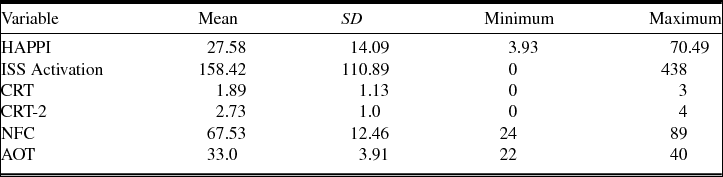
Around equal numbers had a Higher Education degree (43.6%) or were studying towards one (44.8%). Approximately half of the overall sample identified as students (51%), with a further 37.8% in paid employment, and 7% not in paid employment. Table 2 displays descriptive statistics for all measures of mood and cognition.
Descriptive statistics for cognitive and mood measures (Study 2)

CRT and CRT-2 scores
Table 3 shows scores on the CRT and CRT-2. The majority of people answered most items correctly on both measures. Independent samples t-test found that those who had seen the original CRT before (mean = 2.36, SD = 1.05) had higher scores than those who had not seen it (mean = 1.78, SD = 1.12), t (239) = –3.14, p < 0.05. The same pattern of results was found for the CRT-2 (had seen mean = 3.16, SD = 0.92; not seen mean = 2.65, SD = 1.0), t (239) = –2.92, p < 0.05.
Distribution of scores on the CRT measures (Study 2)

Correlations between activation, extreme appraisals, reflective thinking, need for cognition and actively open-minded thinking
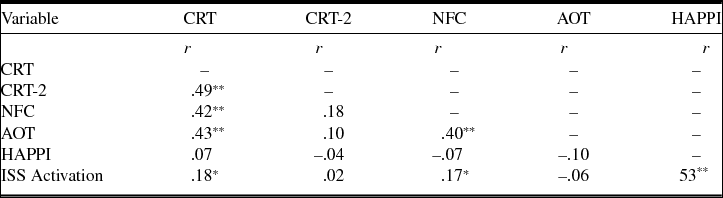
As with Study 1, only participants naïve to both CRT measures were included in these analyses (n = 177). There were moderate positive associations among the CRT, NFC and AOT. The CRT-2 was not significantly correlated with either the NCF or AOT (see Table 4). The positive correlation between ISS Activation and the HAPPI replicated Study 1. There were small, positive correlations between the original CRT and NCF with ISS Activation, and the HAPPI was not significantly related to either of these measures. Neither HAPPI nor ISS Activation were significantly related to the AOT or CRT-2.
Correlations among mood and cognitive measures (Study 2)

**p < 0.001, *p < 0.01.
Study 2 – Discussion
The association between the HAPPI and activated mood supports consistent findings that extreme appraisals of internal states are associated with (hypo)manic mood states. Contrary to hypotheses, the standard CRT and NFC were positively associated with activated mood, and all other hypothesized associations were non-significant. The results of Study 2 did not support the hypothesized link between the propensity to engage in effortful thought and either less endorsement of extreme appraisals or attenuated activated mood.
General discussion
These two studies investigated the hypotheses that propensity to reflect on and override automatic Type 1 responses is a mechanism that (i) relates to less extreme appraisals of internal states and (ii) prevents the escalation of activated mood, whereas (iii) extreme appraisals would instigate the escalation of activated mood.
As predicted, making more extreme, self-referent appraisals of internal states was associated with more activated mood symptoms. This adds to research that extreme appraisals are associated with hypomanic-type symptoms over and above psychological factors including depression-relevant cognitive styles and reward sensitivity/inhibition (Dodd et al., Reference Dodd, Mansell, Sadhnani, Morrison and Tai2010, Reference Dodd, Mansell, Bentall and Tai2011a,Reference Dodd, Mansell, Morrison and Taib; Mansell et al., Reference Mansell, Rigby, Tai and Lowe2008).
The hypothesized correlations between the CRT and activated mood and between the CRT and extreme appraisals were not significant in either study. However, contrary to hypothesis, in Study 2 there was a small, significant correlation in the opposite direction as hypothesized for the CRT and activated mood. This was only the case for the standard CRT, and not the revised version (CRT-2). There was also an unexpected significant, positive association between need for cognition and activated mood. However, both of these findings should be interpreted with caution, given that the effect size is small and the NFC is typically an adaptive trait that promotes effective decision-making and problem-solving. There was no association between actively open-minded thinking (attending to and using novel information that counteracts beliefs) and either activated mood or extreme appraisals.
Limitations and future directions
This research investigated the hypotheses that both mania-relevant cognitions (extreme, self-referent appraisals of internal states we know to be associated with activated mood states; Dodd et al., Reference Dodd, Mansell, Sadhnani, Morrison and Tai2010, Reference Dodd, Mansell, Bentall and Tai2011a,Reference Dodd, Mansell, Morrison and Taib; Mansell et al., Reference Mansell, Paszek, Seal, Pedley, Jones and Thomas2008; Palmier-Claus et al., Reference Palmier-Claus, Dodd, Tai, Emsley and Mansell2016), and activated mood states themselves, would be negatively related to dispositional thinking styles and performance on a reflective thinking test. These hypotheses were not supported.
In Study 2, there were unpredicted positive associations between activated mood and both CRT and NFC. These findings should be interpreted with caution as they may have arisen from Type I error. We are also unable to determine whether the association between need for cognition with activation represents overlap between these phenomena, as both have items referring to an ‘overactive mind’.
Additionally, it is unclear whether these null findings can be generalized to a clinical population due to the non-clinical sample. Nevertheless, there is a trend in psychopathology research to preliminarily investigate processes potentially relevant to clinical manifestations in non-clinical samples prior to clinical samples, and this approach has several pragmatic strengths, including employing a sample not taking medication or influenced by experiences of clinically significant mood episodes. However, as we did not screen for diagnosis, it is impossible to know how many of our participants had themselves experienced mania.
Despite null findings, these Type 2 processes remain an interesting avenue to explore in relation to mood disorders for several reasons. Firstly, as the cognitive mechanisms being investigated are of clinical relevance, it is important to explore these processes in a clinical sample. These dispositional thinking styles could differ between those with a lived experience of bipolar disorder compared with non-clinical controls, and could have an impact on outcomes such as activated mood in those with BD.
Secondly, reflective thinking has theoretical links with the formation of depressogenic cognitive styles (Beck and Haigh, Reference Beck and Haigh2014; Beevers, Reference Beevers2005) and other factors relevant to positive and heightened mood states as well as low mood. This includes impulse control and reward responsivity (Frederick, Reference Frederick2005; Pennycook et al., Reference Pennycook, Fugelsang and Koehler2015), both of which are related to mania risk (Giovanelli et al., Reference Giovanelli, Hoerger, Johnson and Gruber2013). Reflective thinking ability could also influence engagement with cognitive emotion regulation strategies relevant to mania and depression, such as amplifying and dampening positive and activated mood states (Gilbert et al., Reference Gilbert, Nolen-Hoeksema and Gruber2013), or negative rumination (Johnson et al., Reference Johnson, McKenzie and McMurrich2008). In the context of mood, rumination may form a type of reflective processing unlikely to correct automatic processing (Beevers, Reference Beevers2005). However, these processes are theoretically distinct such that reflective thinking is an adaptive information processing style that facilitates problem solving, whereas rumination involves focusing on how you are feeling in a maladaptive way, and disrupts emotion regulation and problem-solving. Rumination is widely identified as an emotion regulation strategy and these are typically construed as Type 1 processes (Toplak et al., Reference Toplak, West and Stanovich2011), while reflective thinking is a Type 2 process. There is experimental evidence that reflective processing of an emotive memory regulates positive mood more effectively than ruminative processing (Gruber et al., Reference Gruber, Harvey and Johnson2009). Further investigation of how these constructs relate to one another in the context of mood regulation would be interesting.
Finally, it may be that the measures used here were not the most appropriate to test the theoretical Type 1 and Type 2 processes that were expected to intensify and attenuate activated mood symptoms, respectively. It is difficult to know how automatic extreme appraisals are in the real world. Arguably, explicitly asking people to rate their belief in each appraisal on a self-report measure, as this study has done, measures a latent cognitive vulnerability rather than automatic, online processing of current mood. As suggested by Beevers (Reference Beevers2005), further research should seek to assess the automaticity of biased beliefs putatively linked to mood states, and associations with reflective and deliberative thinking styles that are less generalized and more relevant to mood regulation. Experimental and prospective designs would allow for such explorations.
Conclusions
In summary, this research was the first to explore associations between a measure of reflective thinking, dispositional tendencies towards more effortful cognitive activity and actively open-minded thinking, extreme appraisals of internal states, and activation. While extreme appraisals were positively associated with activation, predicted negative associations with dispositional thinking styles such as cognitive reflection, need for cognition and actively open-minded thinking were not found. Further research should aim to use instruments testing reflective thinking that are more relevant to mood, in order to facilitate development of a dual-processing model of positive, activated mood and mania, and the relationships between automatic versus reflective processing, automatic versus effortful emotion regulation strategies, and subsequent mood.
Emotion-relevant cognitions (extreme appraisals) were the most strongly associated with activated mood. Findings suggest that extreme appraisals of internal states are more specifically related to mood states that confer vulnerability to mania, rather than more general deficits in dispositional thinking styles and rational thinking. These findings are perhaps not surprising, given that the HAPPI is a theory-driven measure developed specifically to assess ways of thinking about (mainly activated) states that would putatively drive moods upwards and downwards. As such, this current study provides further support for the importance of tackling the ways in which people appraise their internal states in psychological interventions for mania.
Acknowledgements
We would like to thank all those who took part in this research.
Ethical approval: The authors assert that all procedures contributing to this work comply with the ethical standards of the relevant national and institutional committees on human experimentation and with the Helsinki Declaration of 1975, and its most recent revision. This study was approved by the ethics committee of the Department of Psychology at Northumbria University.
Funding: This work was partially supported by an Experimental Psychology Society Small Grant awarded to the second author.
Conflicts of interest: There are no conflicts of interest to declare.





Comments
No Comments have been published for this article.