The increasing proportion of the landscape used by humans has led, and is still leading, to the conversion of the original habitat into numerous small patches, often separated by a matrix of inhospitable land-uses. This habitat fragmentation is a major threat to biological diversity and is considered to be the primary cause of the present species extinction crisis (Aurambout et al. Reference AURAMBOUT, ENDRESS and DEAL2005). Survival in fragments is related to both intrinsic factors, such as abundance and sex ratio, and extrinsic factors related to patch quality (Ramanamanjato & Ganzhorn Reference RAMANAMANJATO and GANZHORN2001, Rovero & Struhsaker Reference ROVERO and STRUHSAKER2007). At first, the fragmentation process can randomly distribute animals among forest patches and across fragmented habitat and surrounding matrix (Marsh Reference MARSH and Marsh2003, Tischendorf et al. Reference TISCHENDORF, GREZ, ZAVIEZO and FAHRIG2005). Local populations can survive only if the colonized forest remnants are adequate and/or dispersal is possible (Marsh Reference MARSH and Marsh2003). Subsequently, a non-random distribution can result from local populations either remaining connected but distinct (metapopulation) or merging into a single large but patchy population (Harrison & Taylor Reference HARRISON, TAYLOR, Hanski and Gilpin1997). Such distribution can be dictated by different aspects of fragment quality, including size and vegetation variables (e.g. tree species diversity, large-tree abundance and food plant availability) (Ramanamanjato & Ganzhorn Reference RAMANAMANJATO and GANZHORN2001, Rovero & Struhsaker Reference ROVERO and STRUHSAKER2007). The mutual relationship among variables and their linkage to animal abundance have proven difficult to disentangle and mammals largely diverge in their response to different fragment quality aspects (Irwin Reference IRWIN2008, Ramanamanjato & Ganzhorn Reference RAMANAMANJATO and GANZHORN2001, Rovero & Struhsaker Reference ROVERO and STRUHSAKER2007).
This study evaluates, for the first time, population status and distribution of the Malagasy primate Propithecus verreauxi (Grandidier 1867) in spiny forest fragments of south Madagascar. Propithecus verreauxi (Verreaux's sifaka) is a lemur particularly sensitive to habitat disruption because it is strictly arboreal (vertical climber and leaper) and has an energetically poor diet (mainly folivorous; Norscia et al. Reference NORSCIA, CARRAI and BORGOGNINI-TARLI2006).
In this study we checked for possible intrinsic and extrinsic factors influencing sifaka distribution in spiny forest fragments, also compared to the riverine forests of the same area.
In March–April 2008 the authors and two field assistants performed a sifaka survey in the Berenty Estate (Androy Region; rainfall averages less than 500 mm y−1). The survey covered 134 ha of spiny forest and 60 ha of riverine forests. The spiny forest is usually 3–6 m in height with dwarf and xerophytic plants, and emergent trees (up to more than 10 m) of the Didieraceae, dominated by Allouadia procera Drake (Elmqvist et al. Reference ELMQVIST, PYYKÖNEN, TENGÖ, RAKOTONDRASOA, RABAKONANDRIANINA and RADIMILAHY2007).
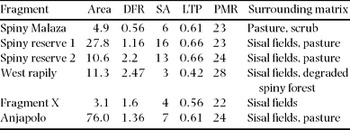
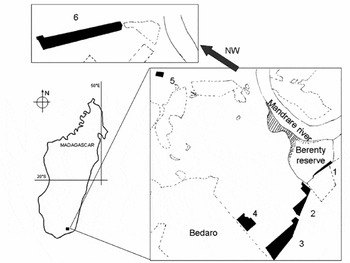
We performed a first survey in those spiny-forest fragments (24.93–25.03°S; 46.21–46.31E; Table 1; Figure 1) that are not used as cemeteries, which can be only accessed by local Tandroy family clans. All fragments underwent divisive fragmentation except one (Spiny Malaza), which probably underwent regressive fragmentation (sensu Marsh Reference MARSH and Marsh2003) (Table 1).
Study fragments and variables: Area (ha); DFR: distance from the river (m); SA: sifaka abundance (number of individuals); LTP: proportion of trees with dbh ≥ 5 cm; PMR: plant morphospecies richness (number of morphospecies).

Study site location: Berenty reserve (solid outline; white area: scrub; diagonal lines: Ankoba and Malaza riverine forests) and spiny forest fragments (black areas): 1 = Spiny Malaza, 2 = Spiny Reserve 1; 3 = Spiny Reserve 2; 4 = West Rapily; 5 = Fragment X; 6 = Anjapolo, about 13 km north-west of Berenty. Dashed outlines include degraded spiny and/or scrub areas. The rest of the territory (white) is covered by pasture and sisal fields. (Map based on Google Earth satellite view.)

We performed a second survey in three non-spiny areas of the Berenty Reserve, on the Mandrare river, comprising a northern section (the 40-ha secondary forest of Ankoba dominated by the exotic species Pithecellobium dulce (Roxb.) Benth.; 24.99°S, 46.29°E) and a southern section (Malaza: 25.01°S, 46.31°E), including a 7-ha gallery forest (dominated by tamarinds; Tamarindus indica L.) and a transitional forest (called ‘front’; 13 ha) between the gallery forest and a scrub area (Jolly et al. Reference JOLLY, KOYAMA, RASAMIMANANA, CROWLEY, WILLIAMS, Jolly, Sussman, Koyama and Rasamimanana2006) (Figure 1). In all areas logging and hunting are prohibited, the fossa (Cryptoprocta ferox Bennett 1833) is absent and, consequently, predation pressure is low. The minimum distance of each forest site from Mandrare river was evaluated via Google Earth.
We counted and sexed sifaka by walking at a speed of about 1 km h−1 along trails and forest paths chosen ad hoc to have visibility of at least 50 m right and left, cover the whole area and to avoid pseudoreplication (Norscia & Palagi Reference NORSCIA and PALAGI2008). For each forest area, the sex ratio (proportion of females to males) was calculated when at least one complete animal group could be sexed (fragment X was excluded).
In each fragment, we gathered vegetation data in an area of 0.1 ha divided into two subunits of 0.5 ha. With a local botanist we identified and counted plant morphospecies, and measured tree dbh (diameter at breast height), an indicator of leaf availability (Elmqvist et al. Reference ELMQVIST, PYYKÖNEN, TENGÖ, RAKOTONDRASOA, RABAKONANDRIANINA and RADIMILAHY2007, Ganzhorn Reference GANZHORN1995). We considered trees with a dbh ≥ 1 cm, thus excluding seedlings and including saplings (dbh 1–4.9 cm) and medium/large trees (dbh ≥ 5 cm).
Owing to the small sample size (n < 10 for forest sites) or deviation from normality (when n ≥ 10, for groups; Kolmogorov–Smirnov, P < 0.05), we applied non-parametric exact tests (software: SPSS 12.0 and STAXACT 7.0). For multiple tests, significance (α = 0.05) was adjusted downward via Bonferroni technique and P < 0.05 considered as a trend.
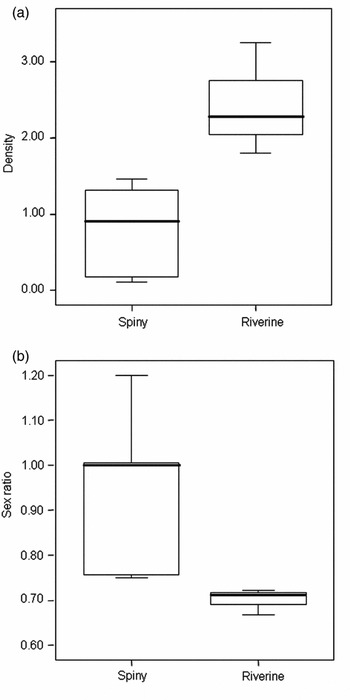
In total we counted 183 sifaka adults and 25 infants (less than 1 y old, not included in the analyses). Sifaka density (number of individuals/fragment area) and the minimum distance of forest sites from the river (0–0.16 km for the riverine forests; 0.56–2.47 for the spiny forest fragments, Table 1) were negatively correlated (Spearman, nforest sites = 9, r = −0.695, P < 0.05). Consistently, sifaka density was higher in riverine forest areas (range: 1.80–3.24 ind. ha−1; mean ± SD = 2.44 ± 0.73 ind. ha−1) than in spiny-forest fragments (range = 0.09–1.31 ind. ha−1; mean ± SD: 0.78 ± 0.54 ind. ha−1) (Mann–Whitney U test, nriverine = 3, nspiny = 6, Z = −2.32, P < 0.05) (Figure 2, Table 1).
Box plot showing the difference between the spiny fragments (n = 6) and riverine forest areas (n = 3) for sifaka density (ind. ha−1) (a) and sex ratio (b). Density values relate to 183 adult individuals in total; sex ratio for 102 adult males and 76 adult females. All differences are significant. Solid horizontal lines: medians; box length: interquartile range; thin horizontal lines: observed value range.

In riverine forest areas we counted 81 adult males and 57 adult females (adult sex ratio: 0.70), with males significantly outnumbering females (Wilcoxon test: ngroups = 32, ties = 10; T = 19, P = 0.001). In the spiny forest we counted 45 individuals but we were able to sex 21 adult males and 19 adult females (adult sex ratio: 0.90); males did not significantly outnumber females (Wilcoxon test: ngroups = 9, ties = 4; T = 3, ns). Overall, sifaka sex ratio was significantly more skewed in the non-spiny-forest areas than in the spiny-forest fragments (Mann–Whitney U test, nnon-spiny = 3, nspiny = 5, Z = −2.26, P < 0.05) (Figure 2).
To avoid spurious relationships, we first checked if the vegetation variables were independent (Table 1 reports variable summary). We found no correlation (P > 0.05) between (1) plant morphospecies richness and number of trees with dbh ≥ 5 cm (Spearman, r = −0.15, ns), (2) morphospecies and Alluaudia procera abundance (Spearman, r = −0.09, ns), and (3) number of trees with dbh ≥ 5 cm and Alluaudia procera abundance (Spearman, r = 0.79, ns). We found that sifaka abundance (number of individuals found in each forest fragment) correlated with the proportion of trees with dbh ≥ 5 cm (Spearman, r = 0.97, P < 0.013) but not with forest fragment area (Spearman, r = 0.42, ns) or plant morphospecies richness (Spearman, r = −0.15, ns). Alluaudia procera abundance (range: 42–107 plants; mean ± SE: 65.7 ± 32.1 plants) correlated with sifaka abundance (Spearman, r = 0.90, P < 0.05) but not when Bonferroni correction was applied.
The Berenty Estate mostly hosts small (1–10 ha) to medium-sized (10–100 ha) fragments (sensu Marsh Reference MARSH and Marsh2003) all created with the foundation of a 5000-ha sisal plantation and the establishment of protected sites in 1936, in agreement with Tandroy clans. Since fragmentation is not at its early stages, we did not expect a random sifaka distribution across fragments. A major predictor of sifaka distribution is probably river water availability because sifaka density decreases as the distance from the river increases and it is higher in the riverine forests (Ankoba and Malaza; 1.8–3.25 ind ha−1) than in the spiny forest fragments (0.09–1.31 ind ha−1) (Figure 2).
Other than density, fragmentation can be related to male-skewed sex ratio (Ramanamanjato & Ganzhorn Reference RAMANAMANJATO and GANZHORN2001). Consistently, we found a generally higher percentage of males across forest fragments. However, sex ratio was weakly biased in the spiny forest fragments, possibly due to sifaka habituation to harsh but steady conditions, and strongly male skewed in Berenty riverine forests, as the possible result of the decreased availability of lemur staple food (provided by tamarinds) and the increased competition over food by the introduced Eulemur fulvus Grandidier 1871) × E. collaris (Geoffroy, 1812) (Norscia & Palagi Reference NORSCIA and PALAGI2008; Figure 2).
Within spiny forest fragments the sifaka situation is puzzling, with density varying from low (0.09 and 0.27 ind ha−1 at Anjapolo and West Rapily, respectively) to high values (0.58–1.31 ind ha−1 for the other fragments), almost spanning minimum and maximum densities recorded for other sifaka species in other dry deciduous forest fragments of Madagascar (from 0.03 to 0.90–1.73 ind ha−1; Müller et al. Reference MÜLLER, VELO, RAHELIARISOA, ZARAMODY and CURTIS2000, Quéméré et al. Reference QUÉMÉRÉ, CHAMPEAU, BESOLO, RASOLONDRAIBE, RABARIVOLA, CROUAU-ROY and CHIKHI2009). While low densities in fragments may be a consequence of habitat contraction, high densities can result from different factors, such as home-range contraction and edge and refugium effects. Home-range shrinkage (as observed for P. diadema; Irwin Reference IRWIN2008) may be a possibility for Fragment X, whose area is at the lower limit of P. verreauxi home range (3 to > 8 ha depending on sites; Norscia & Palagi Reference NORSCIA and PALAGI2008) but it is unlikely for larger fragments. Positive edge effect (Ganzhorn Reference GANZHORN1995) cannot be considered because the vegetation is overexposed to sunlight both at the boundary and inside fragments. Instead, we suggest that forest fragments have a refugium value (as for Avahi meridionalis; Norscia Reference NORSCIA2008). Considering that sifaka are able to move through and partially exploit the surrounding matrix, a likely possibility is that sifaka leak out from degraded or overpopulated forest fragments (such as sifaka-packed Ankoba and scrub areas: Norscia & Palagi Reference NORSCIA and PALAGI2008; or the Tandroy spiny forest of Bedaro, exploited and inhabited by people) and use the protected spiny forest fragments as a shelter zone. The refugium hypothesis, which also predicts density values possibly inflated by small area, is consistent with the lack of correlation between sifaka abundance and fragment area.
Sifaka abundance correlated, instead, with the proportion of large trees (dbh ≥ 5 cm) and showed a correlation trend with Alluaudia procera abundance, probably because (1) large trees are an important degradation indicator, can approximate relevant vegetation, and are particularly important for vertical leapers (Norscia Reference NORSCIA2008, Ramanamanjato & Ganzhorn Reference RAMANAMANJATO and GANZHORN2001); (2) low values of dbh, reflecting low leaf availability, negatively affect folivores (Ganzhorn Reference GANZHORN1995); (3) Alluaudia procera is both an important food species for the sifaka and a crucial component of the spiny forest vegetation (Elmqvist et al. Reference ELMQVIST, PYYKÖNEN, TENGÖ, RAKOTONDRASOA, RABAKONANDRIANINA and RADIMILAHY2007, Wehr Reference WEHR2010).
Our results suggest that intrinsic factors (density and sex-ratio) do not shed light on population viability (due to their heavy fluctuation) and that, among extrinsic factors, vegetation structure overrides fragment size in dictating animal distribution in the small spiny-forest fragments. This scenario is expected in case of patchy animal populations using small patches as refugia, surrounded by an inhospitable matrix and with no source of continuous habitat to rely on. However, fragmentation per se is a landscape-scale process and a landscape-scale study on many species is needed to draw final conclusions in this respect.
Acknowledgements
Thanks are due to Monsieur Jean de Heaulme and the de Heaulme family; field assistants Daniela Antonacci and Chandra Brondi; Danny Randriamanantena for logistic help; forest manager Hajarimanitra Rambeloarivony; local guides and guardians Jean Lambotsimihampy, Mara Hozonbolo, Mosa Tsifary and Solosoa Alisoa; Paolo Cavicchio (Giardino Zoologico di Pistoia), Iole Palanca (Parco Zoo Falconara) and Maria Rodeano (Parco Zoo Punta Verde, Lignano Sabbiadoro), for funding this research.