Violence against women is a global problem that affects people and countries everywhere in varying degrees. The World Health Organization (WHO) revealed, through a study presented in 2005 and performed in 10 states with different cultural backgrounds (Bangladesh, Brazil, Ethiopia, Japan, Namibia, Peru, Samoa, Serbia and Montenegro, Thailand and the United Republic of Tanzania), that between 13% and 61% of women suffer physical violence, between 20% and 75% suffer psychological abuse and between 6% and 59% suffer sexual violence. Of all the forms of violence that women are subjected to, the violence that occurs within their current or past intimate relationships is particularly serious; due to both their high frequency and the harmful consequences they entail (WHO, 2005). In Spain, despite political and social efforts undertaken in recent years to eradicate it, violence against women perpetrated by their intimate partner or former partner (hereinafter IPV) remains a major problem. For example, from the year 2000 to June 2012, 798 women have been killed by their intimate partners or former intimate partners (Ministerio de Sanidad, Política Social e Igualdad, 2012). From 2002 to the first quarter of 2012, there have been a total of 1,026,629 domestic violence complaints filed by women against their male partners or former partners (Ministerio de Igualdad, 2007; Observatorio contra la violencia doméstica y de género 2010, 2011, 2012). However, the number of complaints does not reflect the real number of cases, for example, according to the National Health Survey of 2006, at least 162,010 women that year were victims of abuse by their partners or former partners, which nearly triples the number of complaints filed during that same period (Vives-Cases et al., Reference Vives-Cases, Álvarez-Dardet, Gil-González, Torrubiano-Domínguez, Rohlfs and Escribà-Agüir2009).
Despite the clear violation of women’s rights that IPV against them entails, studies in different countries and very different cultural contexts have found that some people justify this violence, and even place the blame on the victim, exonerating the perpetrator (Choi & Edleson, Reference Choi and Edleson1996; Ewing & Aubrey, Reference Ewing and Aubrey1987; Fundación Mujeres & UNED, 2004; Gentemann, Reference Gentemann1984; Gracia & Herrero, Reference Gracia and Herrero2006; Haj-Yahia, Reference Haj-Yahia2000, Reference Haj-Yahia2003; Mugford, Mugford, & Easteal, Reference Mugford, Mugford and Easteal1989). For example, Ewing and Aubrey (Reference Ewing and Aubrey1987) found that more than a third of their American adult sample agreed with the idea that the woman is partly responsible for the violence she has suffered. In an Australian sample, Mugford et al. (Reference Mugford, Mugford and Easteal1989) found that about 20% of participants also felt that, in some situations, violence against women was justified. Choi and Edleson (Reference Choi and Edleson1996), in a sample from Singapore, found that more than 5% of participants agreed or strongly agreed with that idea. Haj-Yahia (Reference Haj-Yahia2000), studying an Arab-Palestinian sample, found that the majority of participants agreed with the idea that an infidelity committed by the wife entitled her husband to beat her. In a more recent study, Haj-Yahia (Reference Haj-Yahia2003) surveyed 362 married men with Israeli nationality on their beliefs on violence against women, and found that 62% supported violence if the woman had committed a sexual infidelity, 37% if the wife had insulted her husband in front of their friends and 29% if she disobeyed her husband continuously. With regard to Spain, a study carried out on adolescents and young adults aged between 13 and 21 years showed that 20.6% of men in the sample agreed with the statement “sometimes it is women that provoke men and therefore are attacked” (Fundación Mujeres & UNED, 2004). In a recent study conducted by Valor-Segura, Expósito, and Moya (Reference Valor-Segura, Expósito and Moya2011), participants attributed more blame to the victim and exonerated the aggressor when no reason for the aggression itself was mentioned that when such reason was given.
In psychosocial literature, a particular interest is given to the study of the factors affecting the formation of this type of prejudiced attitudes on violence against women in intimate relationships (see Flood & Pease, Reference Flood and Pease2009, for a review). These factors can be grouped into two general categories: those related to the situation or context in which the violence occurs, and those referred to the recipient, i.e. the personal characteristics, beliefs and attitudes of the person issuing the evaluation.
The gender of the offender (Felson & Feld, Reference Felson and Feld2009), the economic dependence of the victim (Mann & Takyi, Reference Mann and Takyi2009; Valor-Segura, Expósito, & Moya, Reference Valor-Segura, Expósito and Moya2008), the type of relationship maintained between victim and perpetrator (Felson & Feld, Reference Felson and Feld2009; Langhinrichsen-Rohling, Shlien-Dellinger, Huss, & Kramer, Reference Langhinrichsen-Rohling, Shlien-Dellinger, Huss and Kramer2004), or the assumption of traditional roles by women (Btoush & Haj-Yahia, Reference Btoush and Haj-Yahia2008; Obeid, Ginges, & Chang, Reference Obeid, Chang and Ginges2010; Pavlou & Knowles, Reference Pavlou and Knowles2001; Yoshioka, DiNoia, & Ullah, Reference Yoshioka, DiNoia and Ullah2001) are some of the situational factors that have been associated with the social perception of this problem. For example, Valor-Segura et al. (Reference Valor-Segura, Expósito and Moya2008) asked a group of Spanish participants to read different stories about the IPV of a husband towards his wife that differed only in her economic dependence of him. The results showed that participants maintained a less negative attitude of the aggressor when the woman had her own income than when she was financially dependent of the husband. In relation to gender roles, Btoush and Haj-Yahia (Reference Btoush and Haj-Yahia2008) studied the attitudes of the Jordanian population towards gender violence and found that they tended to place the blame more on the woman than the man when she challenged her husband and did not respect the roles expected of her as a wife or mother. That is, when it was concluded that the woman had not cared for her husband, their children or their home, or when she had screamed or aired their secrets in public. These results are in line with those obtained by Obeid et al. (Reference Obeid, Chang and Ginges2010), who found that Lebanese participants justified abuse more when the woman had been unfaithful or had displayed sexual misconduct, had insulted her husband’s friends and acquaintances, had been disrespectful to the husband’s family, had been disobedient or did not follow the traditional roles expected of women. Yoshioka et al. (Reference Yoshioka, DiNoia and Ullah2001) also found among an Asian American population that violence was increasingly justified in cases where the wife had been unfaithful, had continually complained or had refused to cook or clean.
In a similar manner as with situational variables, various studies have paid great attention to the role that those variables directly related to the observer play in the perception of IPV. These include demographic variables such as gender, family history and others of a more cognitive nature, such as beliefs and attitudes. In relation to gender, numerous studies have shown that men, in comparison with women, are more likely to accept myths and beliefs that support the use of violence against women, and perceive a smaller range of behaviors as violent. They blame and show less empathy towards the victim and minimize the damage associated with physical and sexual assault. They also consider behaviors of violence against women as less serious, inappropriate or harmful (Ferrer, Bosch, Ramis, Torrens, & Navarro, Reference Ferrer, Bosch, Ramis and Navarro2006; Flood & Pease, Reference Flood and Pease2009; Gracia, García, & Lila, Reference Gracia, García and Lila2011; Gracia, Herrero, Lila, & Fuente, Reference Gracia, Herrero, Lila and Fuente2010; Kim-Goh & Baello, Reference Kim-Goh and Baello2008; Langhinrichsen-Rohling et al., Reference Langhinrichsen-Rohling, Shlien-Dellinger, Huss and Kramer2004; Nayak, Byrne, Martin, & Abraham, Reference Nayak, Byrne, Martin and Abraham2003; Valor-Segura et al., Reference Valor-Segura, Expósito and Moya2008, Reference Valor-Segura, Expósito and Moya2011). Having lived or observed violent scenes-whether between parents or between siblings- during childhood also appears to influence subsequent perceptions of IPV and of victims and perpetrators (Ferrer et al., Reference Ferrer, Bosch, Ramis and Navarro2006, Flood & Pease, Reference Flood and Pease2009).
Regarding variables of a cognitive nature, studies show that people with more traditional attitudes towards women’s roles are more likely to justify violence against them (e.g., Burt, Reference Burt1980; Obeid et al., Reference Obeid, Chang and Ginges2010; Wehbi , 2002) and in particular, IPV (e.g., Berkel, Vandiver, & Bahner Reference Berkel, Vandiver and Bahner2004; Willis, Hallinan, & Melby, Reference Willis, Hallinan and Melby1996). Among these cognitive variables, special attention has been paid to gender or sexist ideologies (e.g. Capezza & Arriaga, Reference Capezza and Arriaga2008; Flood & Pease, Reference Flood and Pease2009; García, Palacios, Torrico, & Navarro, Reference García, Palacios, Torrico and Navarro2007, Gracia et al., Reference Gracia, García and Lila2011; Sakalli, Reference Sakalli2001, Valor-Segura et al., Reference Valor-Segura, Expósito and Moya2011). Traditionally, sexist ideology has been described as a set of beliefs about the roles and expected behaviors characteristic and considered appropriate for men and women, as well as a set of beliefs or rules on how they should interact with each other. This ideology does not intend to promote equality, but to keep the traditional subordination of women to men (Glick & Fiske, Reference Glick and Fiske1996). In recent years, the ambivalent sexism theory has been studied profusely (Glick & Fiske, Reference Glick and Fiske1996). According to this theory, sexism includes both negative or discriminatory behaviors towards women whom are considered inferior (hostile sexism, HS), and positive attitudes, considering women to be good, pure and complementary to men, as long as they are limited to the roles traditionally expected of them (benevolent sexism, BS) (Expósito, Moya, & Glick, Reference Expósito, Moya and Glick1998; Glick & Fiske, Reference Glick and Fiske1996). According to Glick and Fiske (Reference Glick and Fiske1996), men may want to keep women away from certain activities and roles but at the same time, they need them for interpersonal and sexual relationships. So that “the simultaneous existence of men’s structural power and women’s dyadic power (based on the interdependence amongst relationships) create ambivalent gender ideologies, composed of hostile sexism and benevolent sexism” (p. 121).
Different studies have shown the relationship between HS and the perception of gender violence. Those with higher scores in HS usually show more prejudiced attitudes toward IPV against women (Russell & Trigg, Reference Russell and Trigg2004; Sakalli, Reference Sakalli2001, Valor-Segura et al., Reference Valor-Segura, Expósito and Moya2008, Reference Valor-Segura, Expósito and Moya2011), increased justification of the aggressor’s actions (Valor-Segura et al., Reference Valor-Segura, Expósito and Moya2011), give more conciliatory advice to the victim (Valor-Segura et al., Reference Valor-Segura, Expósito and Moya2008) and tolerate violence more, either physical or psychological (García et al., Reference García, Palacios, Torrico and Navarro2007; Valor-Segura et al., Reference Valor-Segura, Expósito and Moya2011). In relation to BS, studies have shown that those with high adherence to these beliefs also show greater tolerance to violence (García et al., Reference García, Palacios, Torrico and Navarro2007) and decreased willingness to unconditionally help women suffering from violence (Lila, Gracia, & García, Reference Lila, Gracia and García2010). However, Sakalli (Reference Sakalli2001) found that benevolent sexist men place a greater blame on men for the aggression. However, other studies have found no relationship between benevolent sexism and attitudes supporting violence against women (Glick, Sakalli-Ugurlu, Ferreira, & Souza, Reference Glick, Sakallı-Ugurlu, Ferreira and Souza2002).
The main objective of this study was to assess the social perception of the victim’s responsibility for physical violence within heterosexual relationships. Specifically, this study explores how judgments about the victim’s blame were affected by (1) the information given on the victim’s feminist ideology (2) their description as a “difficult to deal with” person and (3) the participants’ sexist ideology.
To our knowledge, no study has yet analyzed how the victim being a feminist, committed to equality, influences the judgments of the victim’s blame. However, indirect evidence allows for the hypothesis that victim’s gender ideology will influence the observer’s assessments. According to Nelson, Shanahan, and Olivetti (Reference Nelson, Shanahan and Olivetti1997), popular culture has distorted the feminist social movement in such a way that it is perceived negatively, at least within broad sectors of society. For example, although many people sustain egalitarian feminist ideas, they will not openly identify with this ideology because they believe that someone of such ideology should hold far more radical ideas than theirs (Liss, O’Connor, Morosky, & Crawford, Reference Liss, O´Connor, Morosky and Crawford2001). Male groups resistant to change have played a major role in creating this negative view of feminism, repeatedly labeling feminist demands as ridiculous, useless and outdated (Mendes, Reference Mendes2011; Vint, Reference Vint2010), and spreading the idea that the tactics used to achieve their claims have been plagued by bad manners, bigotry and fanaticism (Mendes, Reference Mendes2011). Even in the laboratory, the existence of a negative social perception of feminism has also been confirmed, even at an implicit level. For example, Jenen, Winquist, Arkkelin, and Schuster (Reference Jenen, Winquist, Arkkelin and Schuster2009) investigated implicit attitudes towards feminism using IAT (Greenwald, McGhee, and Schwartz, Reference Greenwald, McGhee and Schwartz1998). Their participants showed lower reaction times for the feminism-bad than for feminism-good association, faster responses for the traditionalism-good than for the traditionalism-bad association, and faster responses for traditionalism-female than for traditionalism-male association, which shows certain cognitive difficulty in relating feminism with good and traditional with bad.
Since one of the main causes of domestic violence lies in the man’s attempts to maintain the situation of power and control they exert over women (Anderson, Reference Anderson1997; Dobash & Dobash, Reference Dobash and Dobash1979; Stark & Flitcraft, Reference Stark and Flitcraft1996), and that violence is a culturally acceptable method for exercising control and dominance when a man’s masculinity is threatened, one might expect that men in general (and, more particularly, sexist men) will feel more threatened by the feminist movement and will thus, somehow justify violence against women of egalitarian / feminist ideology.
On the other hand, regarding the roles traditionally expected of women, the above-mentioned studies state that they were increasingly blamed for the violence received when it was taken into consideration that they had challenged, provoked or disobeyed their partner. For example, not fulfilling her obligations as a mother, as a wife or housewife, being disobedient, complaining constantly, being verbally aggressive, yelling at her husband, cheating or being disrespectful to the families and friends of her husband (Btoush & Haj-Yahia, Reference Btoush and Haj-Yahia2008; Hillier & Foddy, Reference Hillier and Foddy1993; Obeid et al., Reference Obeid, Chang and Ginges2010; Pavlou & Knowles, Reference Pavlou and Knowles2001; Yoshioka et al., Reference Yoshioka, DiNoia and Ullah2001). Considering the characteristics of our culture and these previous studies, it would be expected that when the behavior or character of the victim is not docile or accommodating, she will be blamed more and the actions of the aggressor will be increasingly justified. Thus, following the conclusions drawn by Yoshioka et al. (Reference Yoshioka, DiNoia and Ullah2001), who suggests that violence against a woman is increasingly justified when it occurs to a person who constantly complaints, this study intends to check if this is also the case in our culture under similar behaviors labeled as a “difficult to deal with person “.
Taking all of the above into consideration, the following hypotheses are proposed:
Hypothesis 1. Participants will increasingly blame the victim when she is described as having feminist / egalitarian ideology than when she is not.
Hypothesis 2. Consistent with previous research (Yoshioka et al., Reference Yoshioka, DiNoia and Ullah2001), it is expected that victims will be increasingly blamed when she is presented as a “difficult to deal with” person (egocentric, catastrophic, who thinks mostly about her problems and pays no attention to others’ problems ...) than when she is not.
Hypothesis 3. Participants with high hostile sexist ideology will generally blame the victim more than those less hostile sexist (Russell & Trigg, Reference Russell and Trigg2004; Sakalli, Reference Sakalli2001, Valor-Segura et al., Reference Valor-Segura, Expósito and Moya2008, Reference Valor-Segura, Expósito and Moya2011).
Hypothesis 4. Men, compared with women, will blame the victim more (e.g., Ferrer et al., Reference Ferrer, Bosch, Ramis and Navarro2006; Flood & Pease, Reference Flood and Pease2009; Gracia et al., Reference Gracia, Herrero, Lila and Fuente2010).
Hypothesis 5. Interactions between situational variables and HS are expected, in that the participants’ HS will exercise a greater influence on their judgments of blame when the victim is a feminist or a “difficult to deal with” person than when these characteristics are not mentioned. Not only these second-order interactions between situational variables and HS are hypothesized, but also a third-order interaction between those three, in so that the situation in which HS will predict blame judgments more strongly will be the one in which the victim is described as a feminist and “difficult to deal with”.
Hypothesis 6. Finally, since hostile sexist men may be the most threatened by the claims of feminist movement, a third-order interaction between Gender x HS x Victim’s Ideology is also hypothesized, in the sense that in men, but not in women, HS will relate positively with victim blaming but especially when the victim is presented as a feminist.
Method
Participants
The initial sample was composed of 246 participants studying different degrees within the Universidad de Granada, out of which 110 were females, 134 were males and 2 did not specify their gender. The average age was 21.06 (DT = 3.14) for women and 20.24 (DT = 2.73) for men. In relation to their nationality, 98% of the sample was Spanish students, while only 1.2% were foreigners and .8% did not facilitate this information. According to the studied degree, 31.7% of the sample were studying Computer Engineering, 15.9% were studying History, 8.5% were studying Pedagogy (Teaching), 8.9% Business Management and Administration, 8.1% Economy, 7.7% Spanish Philology , and 2.8% were studying Business Studies. Out of the total sample, 50.8% were undergoing first year, 5.7% second year, 21.7% third year, 18.9% fourth year and 2.9% fifth (final) year.
The entire sample took part voluntarily in the study, and did not receive any type of compensation for their collaboration.
Design
The study followed a between-group factorial design, using participant gender, the gender ideology of the victim (feminist/equalitarian vs. no information on their ideology) and their description (difficult to deal with vs. no description) as independent variables, and participants’ judgments on victim blame as the dependant variable. In addition, the participants’ sexist ideology was measured.
Instruments
For this study, a booklet including the instructions, questions on gender, age and education level of the participants was presented along with a questionnaire measuring ambivalent sexist attitudes and assessment of different IPV scenarios.
Ambivalent Sexism
The Ambivalent Sexism Inventory (ASI, Glick & Fiske, 1996 - Spanish version by Expósito, Moya, & Glick, Reference Expósito, Moya and Glick1998) was administered to measure participants’ adherence to sexist attitudes. This scale is composed of two 11-item subscales that assess HS and BS. Each of their items is answered using a Likert-type response format of six points (ranging from 0 = strongly disagree to 5 = strongly agree). Examples of HS subscale would be items such as “women are very easily offended”, “in reality, feminist women intend women to be more powerful than men” or “once a woman gets a man to commit to her, she usually tries to keep him closely controlled”. The BS subscale includes items such as “A man is incomplete without a woman”, “in the event of a disaster, women must be rescued before men” or “a good woman should be put on a pedestal by her man”. The Cronbach’s alpha for the full scale was .90 in the Spanish validation carried out by Expósito et al. (Reference Expósito, Moya and Glick1998) and .92 in our sample. Regarding the internal consistencies for the HS and BS subscales, Expósito et al.’s (Reference Expósito, Moya and Glick1998) study reported (α = .89 and α = .86) respectively, similar to those obtained in our sample, (α = .92) for HS and (α = .84) for BS.
Physical Violence Scenarios
To incorporate the experimental manipulation, four physical violence scenarios describing a heterosexual couple were created. All of them described a relationship between a man (John) and a woman (Mary) who had an argument that ended in an episode of physical violence consisting of John pushing Mary over. The scenarios differed in the information that was given on the gender ideology of the woman (feminist / egalitarian vs. no information) and in some features of her description (difficult to deal with vs. no information). The scenarios in full format are presented in the Appendix.
Dependent Measures
A total of 6 items were included to assess the blame attributed to the victim. These items were an adaptation of those used by Durán, Moya, Megías, and Viki (Reference Durán, Moya, Megías and Viki2010): (1) To what extent do you think Mary intentionally contributed to the outcome of the discussion?, (2) Do you think that Mary should feel guilty about what happened?, (3) To what extent do you think Mary contributed to the outcome of the discussion?, (4) To what extent do you think Mary’s personality contributed to result of the discussion?, (5) To what extent do you think that Mary could have acted differently to change what happened?, (6) To what extent do you think Mary’s behavior can be considered decisive for the outcome of the discussion?. Each item was answered on a 7-point Likert-type scale ranging from (1) nothing / not at all to (7) completely / a lot. A principal component analysis with Varimax rotation was performed on these 6 items to study their factorial structure. The Bartlett’s sphericity test, χ2(15) = 441.62, p < .001, and KMO test (.83) showed the suitability of the correlation matrix for this analysis. The results confirmed a single component with an eigenvalue equal to 3.41, which explained 56.83% of the total variance. Cronbach’s alpha was equal to .84.
Also, two items were included as “manipulation checks”: (1) “In the information that you have read: does it say that Mary is a feminist?” and (2) Does it say that Mary is a difficult to deal with woman, with whom it is difficult to live?”. Both questions could be answered “yes” or “no”.
Procedure
Participants completed the booklets in their classrooms, in approximately 20 minutes. They were asked to take part voluntarily in a study on young people’s interpersonal relationships. The answers were individual and anonymous. They were reassured that their data would not be analyzed individually but collectively and would only be used for research purposes. Each booklet contained one of four physical violence scenarios between a heterosexual couple created to insert the experimental manipulations. Participants read a hypothetical scenario in which a man, after having had an argument with his partner, pushed her away. Then, once the participants had answered the items used as manipulation checks, they assessed the blame they attributed to the victim for what happened. Finally, each participant completed the ASI. Once they completed their booklet, they were thanked for their participation and were informed about how to access the results of the study.
Results
Preliminary Analysis
All statistical analyzes were performed using SPSS for Windows (version 15.0.1). First, we checked the appropriateness of our experimental manipulations. In relation to the question that served as manipulation check on the gender ideology of the victim, 93% of participants answered correctly each condition; regarding the question on the woman’s description, 79.2% of the participants answered adequately. For subsequent analyzes, only participants who had correctly answered both questions were included. Therefore, the final sample consisted of 189 participants, of whom 84 were women, 103 men and 2 did not report their gender.
Table 1 presents the correlations between the ideological measures and the dependent variable. It also contains the participants’ mean scores for these variables, overall and according to gender, and their standard deviations. As expected, significant correlations were found between HS and BS with victim blame, and between HS and BS. Moreover, men blamed the victim more (M = 3.53, DT = 1.26) than women (M = 2.58, DT = 1.04) and showed greater adherence to both hostile sexist beliefs (M = 2.50, DT = 1.17) and benevolent sexist beliefs (M = 2.00, DT = 1.00) than women (M = 2.02, DT = 1.20, and M = 1.51, DT = .91, respectively).
Mean scores for men and women in the main variables of the study and correlations between them

Note: BS: Benevolent Sexism; HS: Hostile Sexism; VB: Victim Blaming. **p < .01; ***p < .001.
Victim Blaming
A hierarchical regression analysis was performed to determine the impact of the information of the victim’s feminist ideology and description, gender, and participants’ HS and BS on the blame attributed to the victim. HS and BS variables were centered prior to this analysis (Jaccard, Turrisi, & Wan, Reference Jaccard, Turrisi and Wan1990). Examination of the data showed no multicollinearity between variables, since no value exceeded limits set by the regression model (VIF maximum = 8.68, minimum tolerance level = .12) or the conditional indices (CI max = 15.2). In the first step, all main effects were analyzed and in the second and third steps, the second and third order interactions between the independent variables (victim’s ideology and description, participants’ gender) and HS and BS.
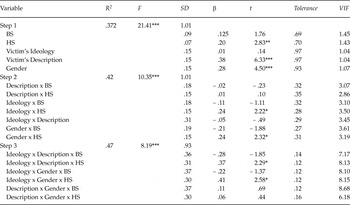
In the first step, the overall equation was significant, F(5, 186) = 21.41, p < .001, significant main effects were obtained for the variables Victim’s description β = .38; t = 6.33; p < .001, HS, β = .20; t = 2.83; p < .01, and Participants’ gender, β = .28; t =4.50; p < .001 (see Table 2). As predicted in Hypothesis 2, participants blamed the victim more when she was described as a “difficult to deal with” person than when no information was given about her personality. However, this did not occur when it was reported that the victim had a feminist ideology, contrary to expectations according to Hypothesis 1. On the other hand, in agreement with Hypothesis 3, the higher the HS adhesion the participants showed, the greater the blame they attributed to the victim. Hypothesis 4 was also supported, with men blaming the victim more than women.
Hierarchical regression with victim blaming as the dependent variable

Note: *p < .05; **p < .01; ***p < .001; BS: Benevolent Sexism; HS: Hostile Sexism.
However, these effects and two related second-order interactions (Victim’s ideology x HS, Gender x HS) must be interpreted in light of two third-order interactions between Victim’s ideology x Victim’s description x HS, β = .37, t = 2.29, p < .05 and Victim’s ideology x Gender x HS, β = .41, t = 2.58, p < .05. To interpret the first of these interactions, the effect of Victim’s ideology and HS on blaming was analyzed separately for each level of the Victim’s description variable (difficult to deal with vs. no information). A significant interaction was found between Victim’s ideology and HS only when the victim was described as “difficult to deal with”, β = .41, t = 2.23, p < .05, but not in the control condition, β = .07, t = .57, ns. The simple slopes test (Aiken & West, Reference Aiken and West1991) revealed that within the “difficult to deal with” woman condition, participants’ HS predicted victim blaming only when she was described as a feminist, β = .49, t = 3.83, p < .001, but not when nothing was said about her ideology, β = –.01, t = –.01, ns. Therefore, Hypothesis 5 received significant support, since the second-order interaction between Victim Ideology x HS and the third-order interaction between Victim’s Ideology x Victim’s description x HS were all significant. In sum, as hypothesized, the greater influence of HS on victim blaming judgments was found when the victim was described as a feminist and “difficult to deal with”.
To interpret the three-way interaction between Victim’s ideology x Gender x HS, the effect of the information of Victim’s ideology and HS on victim blaming was analyzed separately for men and for women. The interaction between Victim’s Ideology x HS was significant only for men, β = .32, t = 2.25, p < .05, but not for women, β = –.07, t = –.42, ns. The simple slopes test (Aiken & West, Reference Aiken and West1991) indicated that men’s HS predicted victim blaming only when she was described as a feminist, β = .52, t = 4.37, p < .001, but not when her ideology was omitted, β = .13, t = .92, ns. Therefore, Hypothesis 6 was also corroborated, which stated that men’s HS, but not women’s, would positively correlate with victim blaming when she was a feminist. No other second or third order interaction was significant.
Discussion
The main objective of this study was to examine the attribution of blame to women living situations of violence within heterosexual relationships. To this effect, the influence of two victim-related factors (feminist / egalitarian ideology and certain personality aspects) and one relative to the observer (sexist ideology) on the perception of victim blaming was analyzed. In general, results confirmed that not only both factors individually exert a significant influence on the participants’ judgments, but so does the interaction between them.
The first hypothesis posed that a feminist woman would be increasingly blamed for the violence received than a woman whose ideology was not known. Although the main effect of this variable was not significant, it did influence the participants’ judgments by moderating the influence of HS and the other situational variable, as Hypotheses 5 and 6 predicted and will be discussed later.
The second hypothesis was corroborated. Participants blamed the victim more for the violence received when she was described as a “difficult to deal with” than when no information was given. These results are in line with those presented by other authors regarding the traditional roles expected of women (Btoush & Haj-Yahia, Reference Btoush and Haj-Yahia2008; Hillier & Foddy, Reference Hillier and Foddy1993, Obeid et al., Reference Obeid, Chang and Ginges2010, Pavlou & Knowles, Reference Pavlou and Knowles2001; Yoshioka et al., Reference Yoshioka, DiNoia and Ullah2001). In all these cases, the woman is increasingly blamed for the violence suffered when she was considered to have challenging or provocative behaviors with her partner. According to this idea, the results of the present study might suggest that the victim’s character / difficult behavior is considered by observers as challenging or provocative and that is the reason why women “deserve” violence.
Consistent with the third hypothesis, participants who scored high on HS blamed the victim more than those who scored low. In a similar cultural context, Valor-Segura et al. (Reference Valor-Segura, Expósito and Moya2008) also found that the HS was the factor that best predicted the justification of the aggressor’s actions and the minimization of the aggression’s importance (see also García et al., Reference García, Palacios, Torrico and Navarro2007, Russell & Trigg, Reference Russell and Trigg2004; Sakalli, Reference Sakalli2001 and Valor-Segura et al., Reference Valor-Segura, Expósito and Moya2011).
Consistent with the fourth hypothesis, men blamed the victim more than women, as has also been shown in other research with Spanish population and from other countries (Ferrer et al., Reference Ferrer, Bosch, Ramis and Navarro2006, Flood & Pease, Reference Flood and Pease2009, Gracia et al., Reference Gracia, Herrero, Lila and Fuente2010; Kim-Goh & Baello, Reference Kim-Goh and Baello2008; Langhinrichsen-Rohling et al., Reference Langhinrichsen-Rohling, Shlien-Dellinger, Huss and Kramer2004, Nayak et al., Reference Nayak, Byrne, Martin and Abraham2003; Valor-Segura et al., Reference Valor-Segura, Expósito and Moya2008). The possible increased identification of women with the victims and their lower adherence to sexist beliefs may help explain these differences.
In the fifth hypothesis, interaction effects between situational variables and HS on victim blaming judgments were expected. This hypothesis has also been endorsed by the data of this study. The results have shown that HS, as an ideological variable, is especially influential on victim perception, when the victim is described as being a feminist and “difficult to deal with”. This result follows the proposal of the Ambivalent Sexism Theory (Glick & Fiske, Reference Glick and Fiske1996), according to which HS is characterized by, among other things, assuming that women are weaker and inferior to men and have none of the characteristics needed to succeed in the public sphere. This is exactly the opposite of what the feminist ideology stands for, seeking to achieve equality between men and women and bring them into the public sphere rather than relegating them to the private and family spheres. If in addition, the woman’s behavior does not correspond to the traditional roles of caregiver, nice, sensitive, kind ... but rather is problematic, egocentric, concerned primarily about herself... those participants that harbor more hostility towards women may blame them more for the violence they have received, considering that they deserved to be reprimanded. In fact, several studies have confirmed that counter-stereotypical behavior regarding gender roles can lead to punishment and negative evaluations of adult women, a phenomenon known as backlash (e.g., Eagly & Karau, Reference Eagly and Karau2002; Rudman & Fairchild, Reference Rudman and Fairchild2004).
Finally, in agreement with the sixth hypothesis, men with high HS scores especially blamed the feminist victim of the violence suffered in her relationship. According to feminist models (e.g. Anderson, Reference Anderson1997; Dobash & Dobash, Reference Dobash and Dobash1979; Stark & Flitcraft, Reference Stark and Flitcraft1996), one of the main causes of domestic violence lies in the man’s attempts to maintain a position of power and control over the woman. Since violence is considered on numerous occasions a culturally acceptable method to exercise this control and dominance when a man’s masculinity is threatened, it is expected that men in general and more particularly sexist men, would perceive more of a threat from the feminist movement. Therefore, these men would be more likely to divert the origin of violence to the attitudes and behavior of women themselves.
Although this study presents interesting findings, it also involves a number of limitations that must be taken into account. Firstly, although a large sample was used, the results should be generalized with caution as the sample was composed exclusively of university students. Future studies with a greater representation of the general population would be interesting. Another limitation is related to the experimental manipulation of the variable that described the victim as a “difficult to deal with” person, this description has generated confusion in some participants as was evident in one of the questions that served as manipulation checks. Further research should improve the definition and realization of this variable and explore the influence of other features more clearly counter-stereotypical in the social perception of victim blaming.
Despite these limitations, it is worth mentioning two important applied implications of this work. Firstly, valuable conclusions can be drawn from this study for the design of intervention programs against gender violence. Knowing factors that influence victim blaming can help minimize battered women’s secondary victimization processes, which often stem from unfair social values and judgments. Spreading this knowledge can contribute to a better performance of professionals dedicated to this area. Secondly, this work can also be useful for the design of gender violence prevention programs to be carried out in formal educational settings, incorporating actions aimed at correcting biased sexist attitudes and beliefs towards the victims.
This research was funded by the Spanish Ministerio de Ciencia e Innovación (Proyecto I+D+i Ref. PSI2010–15139) and the Junta de Andalucía (Proyecto Excelencia Ref. SEJ2010–6225) granted to the second author of this manuscript.
Scenario used in the study (the information that could vary depending on the experimental condition is presented between brackets).
Mary met John, her current boyfriend, twelve years ago through some friends. At first, they met with all members of the group to go out to dinner or for a drink at a bar. As they begun to know each other, they started to meet on their own and began their relationship. They went out together for five years as a couple, seeing each other almost every day before they decided to live together.
They looked around for an apartment for a few months until they found one they both liked. They lived in that apartment for three years, and then decided to buy their own home. [Mary is the typical woman who constantly talks about herself, fixates on her problems too much, get nervous easily and has a somewhat catastrophist view. She needs to be the centre of attention and needs constant approval by others; she likes people to be thoughtful with her, even though she is not thoughtful herself usually. In general, she is a difficult to deal with woman.] [Maria is also a feminist, and fights for equality between men and women and believes that women are discriminated against men when it comes to accessing a job, she thinks that both men and women should care for dependents equally, and also argues that the housework carried out by women at home is undervaluated].
Lately Mary and John are having many discussions in their relationship. Recently, they had a problem. They started arguing over economic issues, since they are not doing very well financially lately. The discussion kept getting more heated and eventually it ended in John giving Mary a push.