Introduction
Maternal nutrition and pre-pregnancy body mass index (BMI) are associated with fetal growth. The risk of a small for gestational age (SGA) infant is increased in underweight women,Reference Jeric, Roje, Medic, Strinic, Mestrovic and Vulic 1 – Reference Yu, Han, Zhu, Sun, Ji and Guo 3 and such infants are highly likely to develop cardiovascular disease, obesity and metabolic disorders in their future.Reference Barker, Winter, Osmond, Margetts and Simmonds 4 , Reference Boney, Verma, Tucker and Vohr 5 As Japan has a higher rate of underweight mothers (BMI<18.5 kg/m2) than that in other developed countries,Reference Morisaki, Kawachi, Oken and Fujiwara 6 improving maternal BMI before pregnancy is important in the prevention of SGA births in Japanese childbearing women. In addition, gestational weight gain (GWG) has been shown to play an important role in fetal growth in various ethnic groups, including Japanese.Reference Enomoto, Aoki, Toma, Fujiwara, Sakamaki and Hirahara 7 – Reference Pugh, Albert and Kim 9 GWG is a significant contributor to birthweight and newborn body composition in both underweight and normal-weight mothers.Reference Waters, Huston-Presley and Catalano 10 , Reference Nomura, Kido, Tanabe, Nagashima, Takenoshita and Ando 11
Furthermore, the relationships between maternal body composition indicators and fetal growth have been shown to vary with fetal sex.Reference O’Tierney-Ginn, Presley, Minium, Hauguel deMouzon and Catalano 12 For example, in diabetic mothers, there is a positive interaction between the gestational age at delivery and the type of diabetes mellitus (i.e., type 1 or type 2) in predicting SGA in male infants, but not female infants.Reference Sojo, Garcia-Patterson and Maria 13 Additionally, maternal body composition shows sex-specific associations with placental development, especially in overweight mothers (25 kg/m2⩽pre-pregnancy BMI <30 kg/m2) or obese mothers (30 kg/m2⩽pre-pregnancy BMI).Reference Mando, Calabrese and Mazzocco 14 However, there is a paucity of data regarding the association between maternal pre-pregnancy BMI or GWG and size for gestational age at birth in underweight pregnant women, particularly in terms of the effects of offspring sex. Therefore, the aim of the present study was to investigate the relationship of size for gestational age at birth with maternal pre-pregnancy BMI or GWG in Japanese underweight women, analyzing the role of offspring sex.
Methods
Study population
Data on full-term pregnancies in Japanese women who underwent perinatal care at Kawasaki Municipal Hospital between January 2013 and December 2017 were retrospectively reviewed. The exclusion criteria were as follows: pregnancy loss before 22 weeks of gestation, preterm birth (delivery before 37 gestational weeks), multiple pregnancies, women who did not recall their pre-pregnancy information (e.g., body weight) and pregnancies associated with a congenital anomaly. We also excluded women with gestational diabetes mellitus (GDM) or diabetes mellitus before pregnancy, as these patients controlled their diet and body weight during the pregnancy. The study cohort included underweight (pre-pregnancy BMI<18.5 kg/m2; n=566) and normal-weight women (n=2671). Four women were excluded from this study due to missing data. The maternal characteristics and perinatal outcomes were collected from the medical records of our institution. This research was performed in accordance with the Declaration of Helsinki and informed consent was obtained from the patients. This study was approved by the Ethical Committee of Kawasaki Municipal Hospital (No. 2017-9).
Birth outcomes
Gestational age was confirmed in the first trimester by crown-rump length measurements. Perinatal management for pregnancy-related symptoms (i.e., premature labor, rupture of the membrane, hypertensive disorders) was conducted at the discretion of each obstetrician, based on the clinical recommendation by the Japan Society of Obstetrics and Gynecology (JSOG).Reference Minakami, Maeda and Fujii 15 In our hospital, the pregnant women were weighed and their height was measured by the nursing staff using the electronic weight scale or stadiometer at their first visit and the time of admission to our hospital according to the onset of labor. Since all women were evaluated for the association between GWG and size for gestational age at birth without discrimination, we calculated the expected GWG at 40 gestational weeks by a model created using data from a subsample of 1283 mothers in Japan (data from Morisaki et al. Reference Morisaki, Nagata and Jwa 16 ); we then validated the model using data from those patients in our study who delivered at 40 weeks.Reference Morisaki, Nagata and Jwa 16 The model was then used to calculate the expected GWG. Appropriate maternal GWG was evaluated using Institute of Medicine criteria in the underweight (12.5 kg⩽GWG⩽18.5 kg) and normal-weight groups (11.5 kg⩽GWG⩽16.0 kg).Reference Rasmussen and Yaktine 17 Using the Japanese standard sex- and parity-specific birthweight percentile curves, a birthweight ⩾90th percentile was defined as large for gestational age (LGA), and a birthweight <10th percentile was designated as SGA.Reference Itabashi, Miura, Uehara and Nakamura 18 GDM was diagnosed using the JSOG criteria, which are based on the International Association of Diabetes and Pregnancy Study Group criteria.Reference Minakami, Maeda and Fujii 15 Hypertensive disorder in pregnancy (HDP) was defined as a systolic blood pressure of 140 mmHg or more, or a diastolic blood pressure of 90 mmHg or more, on at least two occasions at least 4 h apart in a patient who was normotensive before 20 gestational weeks.Reference Minakami, Maeda and Fujii 15 After excess blood was removed, the placentas were weighed with the fetal membranes and the umbilical cord by the nursing staff, using an electronic scale. Placental efficiency was evaluated using the ratio of birth weight to placental weight.Reference Macdonald, Natale, Regnault, Koval and Campbell 19
Statistical analysis
Data are presented as mean±s.d. or number (percentage) in the text and tables, as appropriate. Group differences were evaluated using the Student’s t-test for continuous data and the χ2 or Fisher’s exact test for categorical data. Relationships between variables were evaluated using logistic regression analysis. A multiple logistic regression analysis model was calculated based on adjusted odds ratio (OR) and 95% confidence interval (CI). We studied 10 explanatory variables: maternal age at delivery, maternal pre-pregnancy body weight category, parity, smoking during pregnancy, anemia during pregnancy, the expected GWG at 40 gestational weeks, offspring sex, gestational age at delivery, chronic hypertension complicated by pregnancy and HDP. Model fit was evaluated using the Hosmer–Lemeshow goodness-of-fit test, whereby models with a non-significant result were considered adequate. Then the models were adjusted for these factors to analyze the development of SGA using multiple logistic regression analysis. Statistical analyses were performed using R software (version 3.3.1; https://cran.r-project.org/bin/macosx/) and STATA (version 15 IC, College Station, TX, USA). A P-value <0.05 was considered to indicate statistical significance.
Results
Maternal and neonatal characteristics in the underweight and normal-weight groups
The maternal and neonatal characteristics of the underweight and normal-weight (i.e., control) groups are shown in Table 1. The underweight group was significantly younger than the normal-weight group (P<0.01). In addition, the gestational age at delivery, birthweight, birth length and placental weight in the underweight group were significantly lower than those in the normal-weight group (P<0.01, respectively). In contrast, there were no notable group differences in the expected GWGs at 40 gestational weeks, Apgar scores (1 min and 5 min), umbilical cord blood pH, the rates of nulliparity, smoking during pregnancy, anemia during pregnancy and offspring sex. The SGA incidence in the underweight group was significantly higher than that in the normal-weight group (P<0.01), while the LGA incidence in normal-weight group was significantly higher than that in the underweight group (P<0.01).
Comparison of maternal and neonatal characteristics between the underweight women and normal-weight women

BMI, body mass index. Data: mean±s.d. or n (%).
Group differences were evaluated using the Student’s t-test for continuous data and the χ2 or Fisher’s exact test for categorical data.
Maternal and neonatal characteristics according to offspring sex
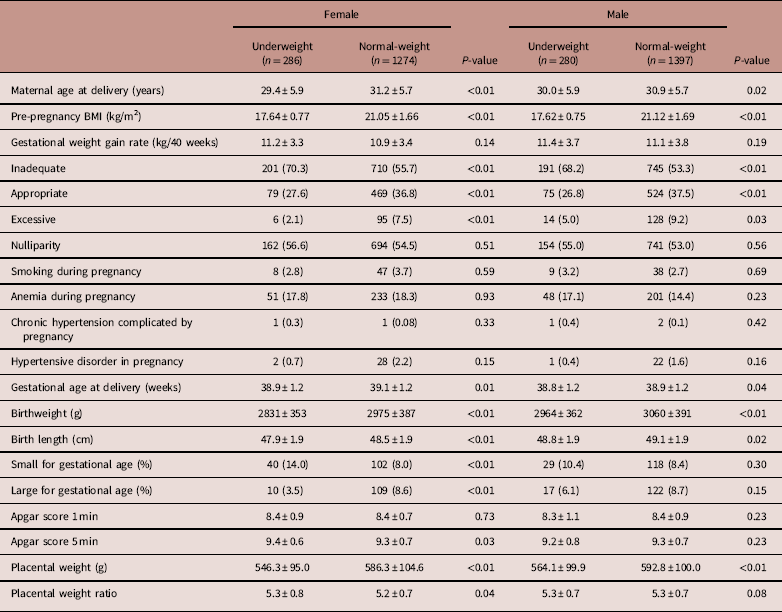
The maternal and neonatal characteristics of the underweight and normal-weight groups are shown stratified by offspring sex in Table 2. The maternal age at delivery, gestational weeks at delivery, birthweight, birth length and placental weight in underweight group were significantly lower than those in normal-weight group for both male and female neonates. Although there was no difference in the expected GWG at 40 gestational weeks between the underweight and normal-weight groups, the incidence of inadequate GWG in the underweight group was higher than in the normal-weight group for both male and female neonates (P<0.01, respectively). The incidence of SGA in the underweight group was significantly higher than that in the normal-weight group for female (P<0.01), but not male (P=0.30), neonates. The placental weight ratio in the underweight group was significantly higher than that in the normal-weight group for female (P=0.04), but not male (P=0.08), neonates.
Comparison of maternal and neonatal characteristics between the underweight women and normal-weight women according to offspring sex

BMI, body mass index. Data: mean±s.d. or n (%)
Group differences were evaluated using the Student’s t-test for continuous data and the χ2 or Fisher’s exact test for categorical data.
Relationship between SGA and maternal characteristics according to offspring sex
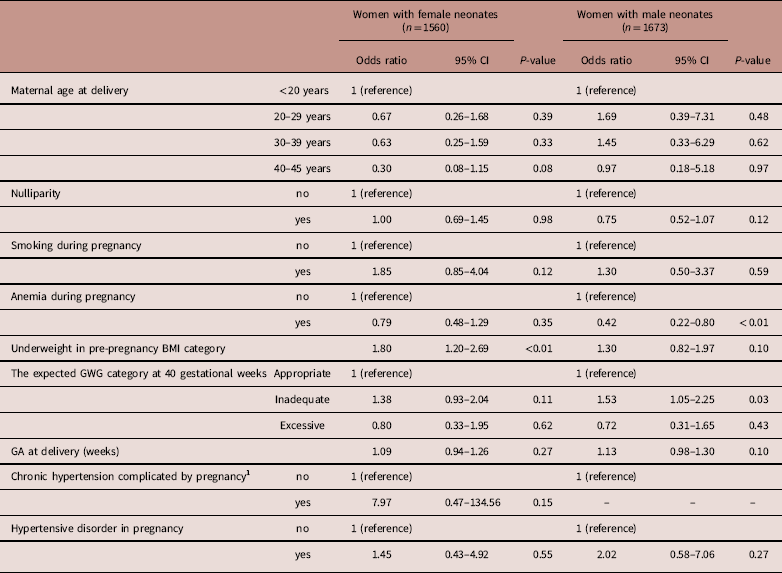
The results of the multiple logistic regression analysis evaluating the probability of SGA according to offspring sex are shown in Table 3. In the women with female neonates, pre-pregnancy underweight was significantly associated with an increased probability of SGA (OR: 1.80, 95% CI: 1.20–2.69). In the women with male neonates, inadequate expected GWG at 40 gestational weeks was significantly associated with an increased probability of SGA (OR: 1.53, 95% CI: 1.05–2.25). This association of inadequate expected GWG and SGA was not seen in women who were underweight pre-pregnancy and had female neonates (OR: 1.38, 95% CI: 0.93–2.04). Additionally, anemia during pregnancy was significantly associated with a decreased probability of SGA (OR: 0.42, 95% CI: 0.22–0.80). However, maternal age at delivery, nulliparity, smoking during pregnancy, gestational age at delivery, chronic hypertension complicated by pregnancy and HDP were not associated with the probability of SGA in both groups.
Multiple regression analysis of risk factors for small for gestational age in mothers according to offspring sex

BMI, body mass index; GWG, gestational weight gain; GA, gestational age; CI, confidence interval.
Relationships between variables were evaluated using logistic regression analysis. A multiple logistic regression analysis model was calculated based on adjusted odds ratio and 95% CI. We studied 10 explanatory variables: maternal age at delivery, parity, smoking during pregnancy, anemia during pregnancy, maternal pre-pregnancy body weight category, GWG, gestational age at delivery, chronic hypertension complicated by pregnancy and hypertensive disorder in pregnancy.
1 In this study, there were no women with chronic hypertension complicated by pregnancy who also had SGA male neonates.
Discussion
Overall, our results showed that maternal pre-pregnancy underweight and inadequate GWG affect size for gestational age at birth differently according to offspring sex. Analysis of the probability of SGA classified by offspring sex showed that for female neonates, pre-pregnancy underweight was significantly associated with an increased probability of SGA, but not inadequate GWG. In contrast, for male neonates, inadequate GWG was significantly associated with an increased probability of SGA, but not pre-pregnancy underweight.
Maternal pre-pregnancy BMI is known to be related to fetal growth. In the present study, the incidence of SGA in underweight women was significantly higher than that in normal-weight women. Consistent with this, a previous meta-analysis reported that pre-pregnancy underweight increased the probability of SGA relative to that in normal-weight mothers (OR: 1.81, 95% CI: 1.76–1.87).Reference Yu, Han, Zhu, Sun, Ji and Guo 3 In addition, GWG has been associated with fetal growth in underweight women.Reference Fujiwara, Aoki, Kurasawa, Okuda, Takahashi and Hirahara 2 Another previous meta-analysis reported that the probability of SGA is higher in underweight and inadequate GWG mothers relative to normal-weight and adequate GWG mothers (OR: 1.89, 95% CI: 1.67–2.14).Reference Goldstein, Abell and Ranasinha 20 As Japanese childbearing women are frequently underweight, controlling the pre-pregnancy BMI and GWG are important in the prevention of SGA births in Japanese women.
Furthermore, the maternal metabolic factors associated with size for gestational age at birth are known to differ according to offspring sex. In non-underweight women, the maternal pre-pregnancy BMI and GWG have been shown to be significantly associated with size for gestational age at birth in male, but not in female, neonates.Reference O’Tierney-Ginn, Presley, Minium, Hauguel deMouzon and Catalano 12 , Reference Lampl, Gotsch and Kusanovic 21 However, there has been a paucity of such data in underweight women. In the present study, female neonates, but not male neonates, showed a higher incidence of SGA in underweight women compared to that in normal-weight women. These results are compatible with those from previous reports.Reference Simon, Borrego, Darmaun, Legrand, Roze and Chauty-Frondas 22 , Reference Murai, Nomura, Kido, Takeuchi, Sugimoto and Rahman 23 For example, Simon et al. reported that fat mass in full-term female neonates is higher than that in male neonates.Reference Simon, Borrego, Darmaun, Legrand, Roze and Chauty-Frondas 22 The actions of sex steroid hormones in utero affect body composition differently depending on fetal sex.Reference Hull, Dinger, Knehans, Thompson and Fields 24 Therefore, we consider that female neonates might develop SGA due to decreased fat mass in underweight mothers. In contrast, in the women with male neonates, inadequate GWG was significantly associated with an increased probability of SGA, but pre-pregnancy underweight was not. O’Tierney-Ginn et al. reported that GWG played an important role not only in fetal fat mass development but also lean tissue growth.Reference O’Tierney-Ginn, Presley, Minium, Hauguel deMouzon and Catalano 12 Additionally, Simon et al. reported that lean body mass was higher in male neonates compared with female neonates among full-term neonates.Reference Simon, Borrego, Darmaun, Legrand, Roze and Chauty-Frondas 22 We studied how the relationships between maternal BMI indicators in underweight mothers and size for gestational age at birth vary according to offspring sex. Our results suggest that the pre-pregnancy nutritional status is important for size for gestational age at birth in women with female offspring, and that nutritional status during pregnancy was important for size for gestational age at birth in women with male offspring.
We were surprised to find that maternal anemia was protective against SGA in male offspring, but we are not able to give an explanation. While maternal anemia has been associated with SGA in several reports, a recent meta-analysis reported that maternal anemia is not associated with SGA.Reference Badfar, Shohani, Soleymani and Azami 25 Furthermore, there are no data as to whether maternal anemia affects size for gestational age at delivery differently according to offspring sex. Therefore, we believe that our result might be meaningful. Further investigations are required to determine the association between maternal anemia and SGA according to offspring sex. As previously reported, placental weight in the underweight group was significantly lower than that in the normal-weight group in this study.Reference Wallace, Horgan and Bhattacharya 26 Furthermore, when we classified the placental weight according to offspring sex in both groups, the result did not change.
The present study has some limitations. First, this is a retrospective study. However, in previous reports that evaluated birthweight and the role of offspring sex, the maternal characteristics were not described in as much detail as in the present study.Reference Melby, Yamada and Surkan 8 , Reference Simon, Borrego, Darmaun, Legrand, Roze and Chauty-Frondas 22 Furthermore, previous sample sizes were smaller than the current cohort. Thus, the present study adds to the limited data on the relationships between maternal BMI or GWG and male and female size for gestational age at birth. Second, pre-pregnancy maternal body weight information was obtained at the first hospital visit. Therefore, recall bias in this study is possible. However, we checked our data and there is no notable difference between the patient’s recalled body weight and the body weight measured at the first visit to our hospital. Third, as our study recruited women who had perinatal care in our hospital only, further research is needed based on the JSOG database to evaluate whether our findings are generalizable to the Japanese population. To the best of our knowledge, the present study is the first to examine sex differences in size for gestational age at birth relative to maternal pre-pregnancy BMI and GWG, with a focus on underweight mothers. The present results suggest that pre-pregnancy underweight is associated with SGA in female offspring but not in male offspring.
Acknowledgments
The authors are grateful to all medical staffs in the perinatal units of Kawasaki Municipal Hospital for excellent patient care. We would like to thank Editage (www.editage.jp) for English language editing.
Financial Support
None.
Conflicts of Interest
None of the authors have any potential conflicts of interest relevant to this article.
Details of Ethics Approval
This study was approved by Kawasaki Municipal Kawasaki Hospital an ethical committee, Kanagawa, Japan (No. 2017-9, approved June. 17, 2017).