INTRODUCTION
In August 2014, Abubakar Shekau, the leader of Boko Haram, declared the establishment of an ‘Islamic state’ (dawla islamiya), a so-called caliphate, in areas of north-eastern Nigeria under his movement's control.Footnote 1 This was the culmination of Boko Haram's long-term goal to ‘carve out’ territory for an Islamic entity in northern Nigeria and was consistent with the sermons of Muhammad Yusuf (Shekau's predecessor as leader of Boko Haram) as well as statements by Abu Qaqa, Boko Haram's former spokesman: ‘We do not have any agenda than working to establish an Islamic kingdom like during the time of Prophet Mohammed (PBUH) no matter what will happen to us.’Footnote 2 Within one year of this announcement, Boko Haram proceeded to annex into its territory dozens of towns in Borno, Yobe and Adamawa States (Pieri & Zenn Reference Pieri and Zenn2016: 66; Thurston Reference Thurston2018: 225). Though the Nigerian military in concert with the militaries of neighbouring countries were able to reclaim some land seized by Boko Haram in the lead up to and in the months after the Nigerian general and presidential elections of 2015, Shekau's formal announcement of an ‘Islamic state’ and his pledging of allegiance (baya’) to the Islamic State (in Syria and Iraq) in March 2015 demonstrated the seriousness of Boko Haram's message.Footnote 3
By January 2015, Boko Haram was in control of 20,000 square miles of territory in north-eastern Nigeria (land amassing to the size of Belgium) while also launching attacks in northern Cameroon, south-eastern Niger and Chad, including in July 2015 in Chad's capital of N'djamena itself. The creation of the group's ‘caliphate’ in 2014 and its pledge of allegiance to Islamic State in March 2015 marked the climax of Boko Haram's territorial control. Since the middle of 2016, however, the movement has been riddled with internal divisions primarily over the issue of violent tactics employed against Muslims in Nigeria or neighbouring countries (Kassim Reference Kassim and Zenn2018). Abubakar Shekau justified unrestrained violence against anyone who did not join Boko Haram's cause, and he became increasingly obsessed with the use of the doctrine of takfir. Takfir is a religious concept, which signifies the act of excommunication – declaring another Muslim an infidel (Akhlaq Reference Akhlaq2015: 1). The importance of this lies in ‘the proscribed punishment for those classified as apostates, namely death’ (Zenn & Pieri Reference Zenn and Pieri2017: 287). Shekau's widespread pronouncements of takfir became a way for him to discredit and kill his enemies. Shekau ultimately employed takfir even beyond the limits that the Islamic State recommended for Boko Haram to employ it in letters that one of the Islamic State's theologians sent to Boko Haram in the weeks after Shekau's pledge of allegiance to the Islamic State in March 2015 (Abu Malik al-Tamimi (Anas al-Nashwan) Reference Abu Malik2018).Footnote 4
Boko Haram has since August 2016, therefore, factionalised into two distinct entities: Islamic State in West Africa Province, which is part of the Islamic State, is loyal to the Islamic State self-appointed Caliph Abubakar al-Baghdadi, is somewhat discriminating in its use of takfir, and is under the leadership of Abu Musab al-Barnawi (the reported son of Muhammed Yusuf); and Jama'at Ahl as-Sunnah lid-Da'wah wa'l-Jihad (JAS),Footnote 5 which is neither formally affiliated with the Islamic State nor al-Qaeda, holds the most wide-reaching interpretation of takfir and is under the leadership of Shekau (Kassim Reference Kassim and Zenn2018).
While the strategic, operational and ideological evolution of Boko Haram has been charted in prior literature on the group, there is still a dearth of literature on the actual everyday lived experiences of those who are active participants in Boko Haram – namely the foot soldiers that make up the base of the movement. While scholars have also acquired an increasingly detailed understanding of the underlying ideology of Boko Haram (Anonymous 2012; Perouse de Montclos Reference Perouse de Montclos2014; Kassim Reference Kassim2015, Reference Kassim and Zenn2018; Walker Reference Walker2016; Thurston Reference Thurston2018), very little is known about what really motivates those at the grassroots level. At the same time, despite growing literature and interviews of former Boko Haram foot soldiers to discern their reasons for joining (Perouse de Montclos Reference Perouse de Montclos2016; Botha & Abdile Reference Botha and Abdile2017; UNDP 2017), it has still been relatively silent on the actual experiences of the fighters while they were living in and attempting to administer territory under Boko Haram control. In essence, we increasingly know about the military activities of Boko Haram and the official ideology of the leaders of Boko Haram through their propaganda videos and some of their internal discussions through leaked audios, but we do not know much about what ordinary foot soldiers do before and after their battles when they are not engaging in violent activities.
Indeed, limitations of two prior studies on Boko Haram foot soldiers (Perouse de Montclos Reference Perouse de Montclos2016; Botha & Abdile Reference Botha and Abdile2017) are their relatively limited sample size and representativeness (around 100 foot soldiers with only 10 qualitative interviews and only 51 ‘presumed’ foot soldiers from Niger in a prison in Niger, respectively). Also problematic are the conditions by which the foot soldiers were interviewed, namely while under watch by security officials, and that there is little corroboration of the foot soldiers’ accounts and how much they actually saw of the battlefield and territories under the group's control. While interesting that Botha & Abdile (Reference Botha and Abdile2017) find ‘revenge’ against the Nigerian state as a key motivation for joining Boko Haram, as Thurston notes, the ‘study's overall utility is limited owing to its poor design’ (Thurston Reference Thurston2018: 192). ‘The authors’, Thurston continues, ‘appeared keen to refute a series of essentially straw man arguments’ which ‘missed a major opportunity to approach recruitment as a multifaceted process – and to offer more nuanced understandings of how religious and economic motivations might work’ (Thurston Reference Thurston2018: 193).
Moreover, there are yet to be any studies of foot soldiers using visible source material showing their candid lifestyles as a methodology. The non-military activities of jihadists, according to Thomas Hegghammer (Reference Hegghammer2015), shed important light on how extremists think and behave. Indeed, Hegghammer terms this as one of the last major unexplored frontiers of terrorism research. This paper aims to bridge the gap by providing an insight into the everyday lived experiences of Boko Haram foot soldiers and how they operated for a unique period of time in Boko Haram's history in 2014–2015 while the group was administering its territory.
Do terrorists have their reasons for committing atrocities? Of course they certainly cite numerous reasons but, as Stephen Holmes notes (Reference Holmes2007: 17), ‘private motivations cannot always be gleaned from public justifications’. Sometimes people do what they do for the reasons they profess but there are times when what they do is motivated by reasons that are too dark to be openly acknowledged (Cottee Reference Cottee2015). This is why being able to look at what terrorists do in their spare time is important. It is why the private activities of individuals who join terrorist movements can often be as important to observe as the official statements that the group's leaders produce. These observations, in turn, allow us to gain a more authentic feel for the movement and to gain an additional and deeper understanding as to the motivations of the foot soldiers.
In order to discuss the non-military activities of Boko Haram foot soldiers, and to explain the significance of these activities to the way extremists think and behave, the paper is divided into several distinct sections. We first begin by outlining our theoretical framework through stressing the importance of analysing everyday lived experiences as a means of providing a more nuanced context in which movements such as Boko Haram operate. We then discuss our methods for data collection and analysis, with a focus on a video ethnography of footage filmed by Boko Haram videographers but not for propaganda purposes. Our analysis of the everyday lived experiences of Boko Haram foot soldiers is divided into four case studies, all based on video ethnography of the footage obtained from within Boko Haram. These case studies include the way in which Boko Haram engaged in conflict resolution with local people once the ‘caliphate’ was established; how Boko Haram communicated both the idea of the ‘caliphate’ and its relation to the Islamic State as well as enacted administration in it; how Boko Haram foot soldiers spent their leisure time including role play and nasheed singing; and finally how time was spent in the pursuit of media production.
THEORETICAL FRAMEWORK
When one thinks of jihadist organisations such as the Islamic State, Al Qaeda or Boko Haram, the first things that come to mind are not the daily interactions of members, their dress codes, grooming habits, or their love for poetry and Islamic hymns known as nasheeds. Instead, people think of attempts to carve out territories in which strict Shari'a law can be applied, attacks against western targets, or even the sexual slavery of women. These are, of course, all important aspects of contemporary jihadist movements, but they do not allow for a full picture as to why ordinary foot soldiers may join jihadist movements, nor more importantly, why they stay in these movements and carry out acts of violence on behalf of the movement.
Mustapha (Reference Mustapha2014) identifies five key pillars of analysing Boko Haram, and while they are not specific to understanding the motivations of foot soldiers, they are nevertheless a useful paradigm for understanding the context surrounding Boko Haram and its actions. Mustapha (Reference Mustapha2014: 166) lists his pillars as: ‘1) religious doctrines, 2) poverty and inequality – vertical and horizontal, 3) the political context of post-1999 electoral competition, 4) the personal agency of the youth directly involved in Boko Haram, and 5) the geographical and international context of the insurgency.’ In terms of considering the motivations of foot soldiers we stress the importance of religious doctrines and personal agency, but we also highlight the importance of other factors such as accessing new forms of masculinity (e.g. Boko Haram affords young men access to guns, uniforms, vehicles, and in some cases also brides), and most importantly creating bonds of solidarity through shared experiences and ties.
Ratelle & Souleimanov (Reference Ratelle and Souleimanov2017: 574) argue with regards to militant groups in the Caucasus that ‘macro-level explanations concentrating on ideological influences have stopped short of addressing the individual choices and dilemmas of insurgents’. The same sentiment is expressed by Lee Ann Fujii (Reference Fujii2008), who argues that ‘motives and interests are often rooted in local relations and power structures’ and that social networks and interpersonal relationships are also important. Drawing on Granovetter's concept of ‘social embeddedness’ the argument is that social networks make ‘certain people more available for recruitment than others; these same ties also shaped the form of participation … in a given movement’ (Fujii Reference Fujii2008: 579). It is also clear from the literature that those who join terrorist movements are often influenced by a sense of solidarity with family and/or friends, and that joining and remaining active in the activities of the movement for some foot soldiers may be more about commitment to a community rather than to ideology (Crenshaw Reference Crenshaw, Slater and Stohl1988; Della Porta Reference Della Porta1995; Borum Reference Borum2004).
Through employing a micro-level understanding of the ongoing violence in the region, we argue that understanding the way that individuals in the region interpret the history of the Lake Chad region (including a deep sense of a decline in regional prestige), the direct experience of the high level of corruption and abuses prevalent in the Nigerian state (Deckard & Pieri Reference Deckard and Pieri2017), a crisis in masculinity (Zenn & Pearson Reference Zenn and Pearson2014), the sense of brotherhood and solidarity that these movements offer, as well as financial incentives also enable us to understand the inflow of new recruits. This does not exclude the importance of ideological motivation for many recruits and especially for the leadership of the group, but rather argues that this is not the sole factor, especially for foot soldiers. This study illustrates that particular root causes of violent engagement are often intertwined, forming an overarching motivational underpinning that is highly complex and multi-layered.
Islam does play an important role in the process of violent engagement. This is especially true for those who have positions of leadership in jihadist movements, as well as for those who joined Boko Haram before its first major violent phase in 2009. While forms of jihadist ideology and narratives have been present in Northern Nigeria since the time of Usman Dan Fodio who established the Sokoto Caliphate in 1804 (Adeleye Reference Adeleye1971: 19), this was not particularly strong in the north-eastern part of the country where most of Boko Haram's violence occurs today. In reality, Salafi-Jihadism has been a relatively recent ideological development in north-eastern Nigeria, dating back to the late 1990s, and correlated with a greater influence stemming from Saudi funding (Brigaglia Reference Brigaglia2012a, Reference Brigaglia2012b). Instead a range of factors have to be taken into account when trying to understand what draws individual recruits to jihadist movements in Northern Nigeria, the ways in which participants who believe they are fighting a jihad understand and interpret their own positionality within the given movements, and the decisions recruits take to act on behalf of a given movement. As noted by Kalyvas & Kocher (Reference Kalyvas and Kocher2007), theories on violent mobilisation should focus on the general participants in the insurgency and not only on the ‘first comers’ with strong ideological motivations, such as Mohammed Yusuf or Abubakar Shekau. Furthermore, our understanding of violent engagement in an insurgency should not be limited to a dichotomy between participation and non-participation. In other words, one should also refrain from pinpointing a single motivation for insurgent activity.
METHODOLOGY
Given its complexity, ‘no ethnographic study of everyday life can possibly explore all facets of a given system’ (Caughey Reference Caughey1982: 237), and as such it is often useful for researchers to focus on aspects that strongly emerge from the available data. In the case of this study, we focus on the everyday lived experiences of Boko Haram foot soldiers, and life in general under Boko Haram's ‘caliphate’. In particular, we pay attention to social interactions among Boko Haram foot soldiers, and the types of non-militarised activities they take part in such as ‘hanging out’, singing nasheeds, preaching to villagers and interacting with the general population. The appreciation of poetry, music and dream interpretation is not something new to Islam, but something that is deeply entrenched in the culture of the religion. In this sense it should not be surprising that jihadis also draw on this long cultural tradition within Islam in order to express themselves.
In this paper we utilise an anthropological perspective that focuses on the importance of everyday lived experiences of members of Boko Haram, and in turn what these experiences tell us about why people join the movement, stay in it, and carry out actions on behalf of it. Given the complex security situation in Borno State, and the fact that Boko Haram is a closed and hostile group to ‘outsiders’, traditional academic ethnography within the ranks of the movement has not been possible for any researcher as of yet, whereas other terrorist groups have sometimes allowed researchers into their camps and to interview their leaders. To date, Boko Haram has only allowed one journalist since 2009 into its camp to meet Abubakar Shekau, but the journalist did not conduct any research activities beyond negotiations related to the kidnapping of the Chibok schoolgirls. As a result, video ethnography of Boko Haram foot soldiers’ activities provides an insightful, if not also the only, glimpse into the lives of foot soldiers while they are still active in the movement.
Both authors have spent a considerable amount of time in Nigeria researching the Boko Haram phenomenon, interviewing a range of actors including government, military, civil society and victims of the conflict. Jacob Zenn also served as a leader in a counter-violent extremism programme in Nigeria for two years in which one component of the programme was de-radicalisation and involved meeting (confidentially) with Boko Haram prisoners. Jacob Zenn was also an analyst on the organisational structure of Boko Haram for the Swiss Embassy in Nigeria, working alongside several individuals who were involved in the negotiations with Boko Haram for the Chibok schoolgirls (two exchanges in October 2016 and May 2017 led to the release of more than 100 of the schoolgirls). Jacob Zenn further visited Gambarou-Ngala both on the Nigerian and Cameroon side of the border in 2012 in what was one of the last times the area was still somewhat accessible to researchers. This, however, is not the same as spending physical time within the ranks of the movement and being able to observe the day to day interactions of the foot soldiers, or how the lives of civilians were impacted by Boko Haram's attempt at Shari'a governance. In lieu of this, we make use of the recently released videography from within Boko Haram itself. This is a form of ethnography known as video ethnography, and has supplemented all of our other qualitative field research on the movement.
Video ethnography in its broadest sense refers to ‘any video footage that is of ethnographic interest or is used to represent ethnographic knowledge’ (Pink Reference Pink2007: 169). One advantage of video ethnography is the ability of the researcher to return to the footage for unlimited observations of the ‘scene’ in a way that is not possible in conventional anthropology, and as such has been a major innovation in the field. As Gobo (Reference Gobo2008) notes, this allows for a more detailed analysis to take place, as the researcher may take unlimited notes, pause, rewind and play the ‘scene’ all over again. Video ethnography can also allow for a sense of greater authenticity in that it can capture and present behaviours as they occur. It is possible that some may find the process of being videoed intrusive, or that others may change their behaviour for the ‘benefit’ of the camera, but in the case of our research this was mitigated due to the fact that the footage was filmed informally by Boko Haram group members themselves who appeared relaxed and at ease with each other and the camera, almost certainly because they did not intend for the footage to ever be viewed by outsiders (and possibly unbeknownst to their commanders, who might not approve of them using the group's video equipment to make unofficial videos that could – and did – make it into the hands of non-members).
It should also be noted here that we do not consider the video footage from within Boko Haram to be a full representation of the everyday lived experiences of foot soldiers in the movement, nor of those who have lived under Boko Haram rule, but rather as a valuable segment that contributes to that overall picture. We recognise, for example, that some of the most sensitive aspects of Boko Haram, such as footage of the leader, Shekau, do not appear in this internal footage (although his deputy, Man Chari, does); nevertheless, since our focus is on the foot soldiers this does not significantly affect our study. One aspect which is more problematic is that of the relationship between gender and foot soldiers. In the footage, women only appear in the background, yet we know that since July 2014, women and children have been increasingly used by Boko Haram as ‘suicide’ bombers (Pearson Reference Pearson and Zenn2018). The lack of appearance of women in the footage except as segregated observers of Shari'a punishments or casually walking as pedestrians may be due to gender segregation rules enforced in areas administrated by Boko Haram, as well as the fact that kidnapped girls or the female ‘suicide’ bombers were, like the leader Shekau, too sensitive for ordinary foot soldiers to see or film. As per Caughey's (Reference Caughey1982: 234) suggestion, we treat video ethnography in the same critical way as we would any other piece of data, and view our video ethnography in conjunction with our broader longitudinal research on Boko Haram.
THE DATA
The video footage on which we base our current analysis of everyday life within Boko Haram comes from a series of recordings taken from the hard drive of Boko Haram videographers’ laptop computers, and which contains over 400 video files and about 18 hours of footage. The hard drive was delivered to Voice of America (VOA). VOA determined that the videos came from laptops that had been captured in a Nigerian military raid. The source for the videos was not affiliated with the Nigerian military or government, or with Boko Haram. According to VOA, the prime importance of these videos is that the recordings are by the group's own videographer, who appears to also have been responsible for centrally collecting videos from other videographers of the group in addition to filming videos himself (he appears in the footage when he gives his video camera to other foot soldiers to film). In much of the footage ‘militants are seen candidly chatting, boasting and going about their daily business – and flagrantly committing heartbreaking atrocities’ (VOA 2017). This is significant because it demonstrates that the footage was for the videographer and foot soldiers with him to capture and catalogue their everyday life within the sphere of Boko Haram's control. As VOA (2017) states, however, the footage is not all playful: among other things, ‘the clips reveal Boko Haram executing and flogging civilians, chopping off people's hands, attacking a military outpost and assassinating locals in a hunt for money and food. Militants are shown interrogating villagers, flying a drone and sanctimoniously condemning ‘unbelievers’ accused of violating their distorted version of Islam.’
VOA authenticated the videos through analysing time stamps on the videos, checking references made by fighters in the footage, and through correlating events described in news broadcasts heard in the background. According to VOA (2017) the recordings were made in late 2014 and 2015. This was a period of mass expansion by Boko Haram in north-eastern Nigeria which culminated in the physical takeover of territory which Abubakar Shekau, the group's then leader declared on 14 August 2014, as an ‘Islamic State’.
VOA hired a professional Kanuri translator, who can also translate Hausa, to translate the contents of the video footage into English and then matched locations to satellite images. One of the initial interesting findings was that foot soldiers speaking on camera do so almost exclusively in the Kanuri language, the group's common tongue, and which is different from much of the available Boko Haram propaganda published online, which is predominantly in Hausa or sometimes Arabic. This buttresses the argument by Barkindo (Reference Barkindo2016) that while the conflict in the Lake Chad region is not a Kanuri uprising; ‘most of Boko Haram's recruits are Kanuri and the Kanuri heartland provides the space and the local networks, fishing unions, market groups and farming communities for recruitment and mobilisation’. Barkindo (Reference Barkindo2016) further argues that the Kanuri language ‘facilitates the movement of arms, training of new recruits and establishment of camps’ and that in 2013, ‘letters were sent to known Kanuri soldiers, threatening them with death if they refused to stop fighting for the Nigerian government’.
It can be presumed that Boko Haram reserves Hausa or Arabic language videos for the general public in northern Nigeria or an international audience, since Kanuri people in northern Nigeria generally understand Hausa but people from a Hausa background are less likely to understand Kanuri. As such Hausa language videos can be understood by a larger audience in Nigeria. Scott MacEachern (Reference MacEachern2018: 160) claims that even Boko Haram's Hausa language broadcasts sometimes have ‘a Kanuri-inflected Hausa that can be hard for Hausa speaking people themselves to understand’. It is nonetheless still curious that not even one of Boko Haram's over 100 public videos and statements since the start of the insurgency in 2009 has been primarily in Kanuri, who seem to comprise most of the group's members. Shekau, for example, never said any more than a few sentences in Kanuri in any video and when he does use Kanuri it is for the purpose of summarising in a few sentences his previous Hausa or Arabic content (Barkindo Reference Barkindo and Zenn2018).
The video footage provides intimate details of the everyday lives of both those who take part in Boko Haram, and those who lived under Boko Haram control and administration. The footage, for example, tends to show an arid desert landscape where men travel around mostly by motorcycle and in which oxen pull carts, and camels are sold in markets. Women who appear in the footage (often in the background) are dressed in colourful chadours but appear free to walk around the town without a male guardian (mahram), and many of the men, including fighters, have adopted a mixture of Islamic and casual western dress. Boko Haram flags, which are modelled on the Islamic State's flag, and logos appear frequently throughout the footage, and prominently during Shari'a-based punishments, such as public executions or amputations, for which there are large crowds spectating with men and women segregated as they observe. Only men are invited from the audience to participate in the punishments. A number of Boko Haram members are shown holding a miswak, a twig with toothbrush-like bristles, and whose historical use in the Muslim world has been well documented (Al Sadhan Reference Al Sadhan1999). The miswak is important because it has strong connotations to the prophet Muhammed, and so through being shown with one, Boko Haram members may feel it adds to their credibility as self-proclaimed Salafis.
At least one clip was used in a later Boko Haram propaganda video that was released by the Islamic State. The clip featured Man Chari (Shekau's deputy) ordering the hand-cutting of two alleged thieves and the shooting and killing of a boy (in early teens) and a goat, who were both accused of homosexuality and bestiality. Notably, however, when this video was released online by the Islamic State with its official branding on behalf of Boko Haram (or, more specifically, Islamic State in West Africa Province) the part with the boy and the goat as well as an instance where Man Chari's gun was clogged and failed to shoot were edited out. This video, like others for public consumption, was in Hausa and the fighters in the videos were dressed in fresh black uniforms that they do not ordinarily wear, presumably designed for the film knowing that it was a propaganda video.
Jacob Zenn has been integral to the analysis of the VOA footage, working as a consultant to the VOA team, and so has had exclusive access to the entirety of the footage. In order to make our analysis more transparent, we are basing it only on the VOA footage for which there are publicly available clips, but the analysis is also coloured by access to the rest of the footage which has yet to be publicly released.Footnote 6 Zenn was able to identify a number of known Boko Haram militants and viewed the videos with an individual who considers himself to be a former ‘associate’ of the group, and who also has contacts to some elements of the leadership of the insurgency and has participated in the successful negotiations with the group.
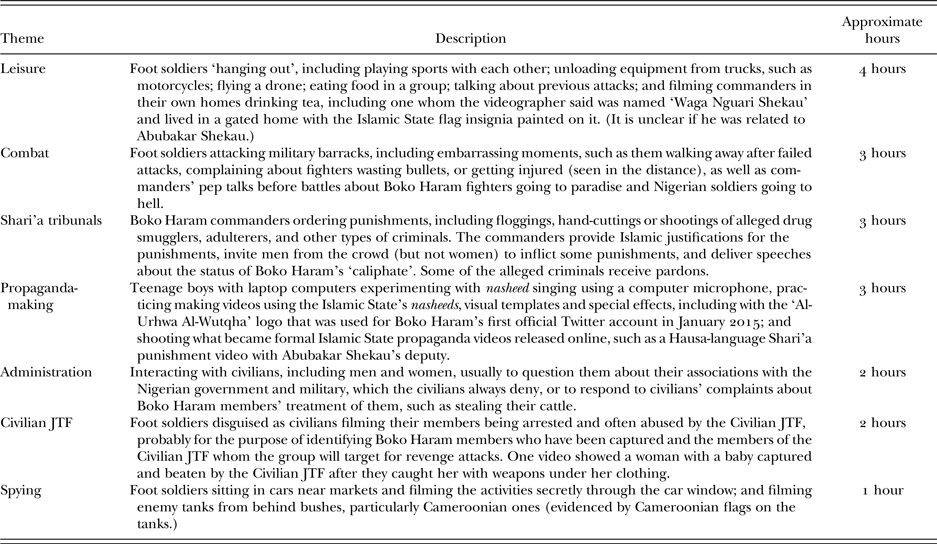
In Table I, we estimate the breakdown of the 18 hours of footage by theme.
Breakdown of VOA Boko Haram video footage

We identify with Hegghammer's sentiment that processing and presenting the data on non-military activities of those who participate in jihadist movements can be ‘tricky because the object of study – non-military social practices – is so vaguely defined’ (Hegghammer Reference Hegghammer2017: 177). Our approach was to review each video several times and to note the instances of non-military activities that were most prominent. There is of course some level of subjectivity in this, and our approach has been coloured by the non-military activities that Hegghammer (Reference Hegghammer2017) also highlight, such as poetry, nasheeds and group relaxation.
Examining jihadi poetry and nasheeds has to date been limited in the academic literature, though not absent (Said Reference Said2012; Hegghammer 2014, Reference Hegghammer2017; Creswell & Haykell Reference Creswell and Haykell2015; Kendall Reference Kendall, Kendall and Stein2015; Paraszczuk Reference Paraszczuk2015; Gratrud Reference Gratrud2016; Pieslak & Lahoud Reference Pieslak and Lahoud2018). Through delving into the everyday lived experiences of people who fight for Boko Haram, and specifically through their use of nasheeds, this article will shed light on why people join and stay in terrorist groups, particularly jihadist ones. We can start to understand the ties that poetry and literature can create through evoking emotions and creating bonds of solidarity. As Hegghammer (2014) puts it, poetry and music must do something more, or something different, than simply convey doctrine, or people wouldn't bother creating them. Out of all of this, Hegghammer (Reference Hegghammer2017: 177) stresses the importance of three main practices: ‘devotional, recreational, and identity-marking’. To that we add the practice of administration, and this is particularly important when a group has control over territories, and thus has to concern itself with aspects of governance.
CASE STUDIES
Conflict resolution with villagers
At first glance, the issue of conflict resolution is not something that is often considered to be a priority for Boko Haram, which is known for having little regard for life or property. Its leader at the time of the creation of the group's self-proclaimed ‘Islamic State’ in 2014, Abubakar Shekau, boasted about killing thousands of people. He said after one attack in January 2015 in which the group reportedly killed up to 2,000 people, ‘we killed the people of Baga. We indeed killed them, as our Lord instructed us in His Book …’ (Vanguard 2015). This level of violence, however, cannot be sustained if a movement wishes to administer its territories, which Boko Haram had to do for a short period of time once the movement's ‘caliphate’ was established in 2014.
At the local level in Borno, under the black flag of Boko Haram, the group's foot soldiers found themselves in a position of a paradox. The foot soldiers had immense power with the ability to arbitrate over life and death; but they also had to deal with a population that they could not simply kill their way through. They had to interact with civilians and especially tribal elders (Maina Reference Maina2017). In short, Boko Haram had to learn some acts of governance and of gaining the quiescence of local populations.
Contrary to the image presented by Shekau in propaganda videos, Boko Haram did engage in dialogue with locals and did not just ‘kill’. This was evident in Boko Haram's own videography and especially so in one case, where an elderly Kanuri man – as indicated by the language he spoke and tribal markings on his face – complained to a group of Boko Haram members who had just returned from a battle about other Boko Haram members seizing his cattle. Boko Haram foot soldiers are shown in the video footage explaining to the man in a dialogue of more than 15 minutes that he had more cattle than was allowed under their rules in that jurisdiction, and this is why they had the right to take away the excess cattle. Several Boko Haram members explained to the man their position, which they maintained, and respectfully said that he would not see his cattle returned.
This type of situation was not uncommon for Boko Haram in the ‘caliphate’, as cattle were an important source of food and income for the group (Searcey Reference Searcey2016). Though Boko Haram was normalizing its thievery of cattle it was also attempting to justify it. The issue of cattle later became a source of friction among the group when a faction broke away from Shekau in August 2016 and took over the leadership of the Islamic State in West Africa Province with approval from the Islamic State leadership in Syria and Iraq. One of the faction's complaints against Shekau was that his fighters had killed a villager who sold cattle against the group's orders to only herd the cattle: Shekau's fighters, however, accused that villager of ‘stealing’ from Boko Haram by selling the cattle.Footnote 7
In another case, Boko Haram filmed themselves interrogating an elderly man who had just been in a village that Boko Haram seized from government control. A Boko Haram foot soldier asked the man where he was from, to which the man replied, ‘from Banki’. According to the dialogue the man was on his way to his farm: ‘God willing, I was on the way to the farm. Very recently, before Eid al-Adha. Then [the military] caught me. They said, ‘you are a Boko Haram father’. And I confessed, ‘yes, my children and relatives and friends’ children are in Boko Haram.’ After this Boko Haram did not ask him any more follow-up questions. The man added that ‘When [the military] said, ‘pass’, I had to stay with them [the military] for two months’ because the military considered him to be a suspect until his release.Footnote 8
Here, the man is indicating to Boko Haram foot soldiers that while he may himself not be a member of the movement, he has children that are. Boko Haram members then ask the man about the wound on his hands, and if he knew the whereabouts of the perpetrators of those wounds, presumably referring to the military. The man explained that it was not a wound but rather a skin infection. Boko Haram members were also interested to find out if the man had collaborated with the government while in the government's custody for the two-month period, which was a crime punishable by death even if such collaboration was only receiving humanitarian assistance, according to Abubakar Shekau's takfiri ideology (Sahara Reporters 2016). The fighters asked, ‘When they took you to Banki, what did they do to you; how did they help you?’ The old man replied ‘They did not do anything for me. They did not even give us food, how could they give us clothes? With a little grain we were able to feed ourselves … For someone to say the government is helping, giving us food, that's a lie.’
The response is an interesting one, for it shows a population caught between a government that is unable to provide for them and a terrorist organisation that is promising to resolve the situation, but whose tactics of administration are brutal when one does not follow the strict laws it enforces. Boko Haram members also ask the old man what sort of advice he would give to those that are with the ‘non-believers’, or those who believe that the government could provide them with support. The old man's response is telling of the reality of the situation in north-eastern Nigeria for many people, ‘Everyone is just trying to help themselves. They don't care for us, anyone saying something different is lying.’
While Boko Haram was abusing its power it was at the same time showing it had a ‘diplomatic’ side. From much of the video footage we were able to see that foot soldiers wanted to protect the elderly so long as the elderly were not actively cooperating with the government. Elders in north-eastern Nigeria often hold honoured positions with communities, and as such, having elders on their side could be a benefit to Boko Haram in terms of more effective governance. This is especially so when elders could be mobilised to spread the message that the government of Nigeria is ineffective, that it cannot provide for the material needs of the people, and that people should leave the government's side. At the same time, there is no way to confirm the elderly man who had been in government custody for two months was telling the truth. At the very least, he probably knew that if he told Boko Haram that he was voluntarily with the government or received its assistance it could mean trouble for him and that if he told Boko Haram that his children were members it could probably help him.
For the most part the elderly man may have been a special case in the ‘caliphate’. The Shari'a tribunals, whether for propaganda purposes or ordinary ones for the public, did not feature elders on trial. The video footage obtained shows boys and middle-aged men being flogged, shot and having their hands amputated, while women are shown being flogged and stoned. This could signal Boko Haram did not seek to be seen as mistreating elders.
Communicating external affairs of the ‘caliphate’
One of the ways Boko Haram leadership communicated with villagers and foot soldiers in its ‘caliphate’ was by sending out messengers from Abubakar Shekau to different villages to convey messages to the population. These messages were relayed at Shari'a tribunals which took the form of a public spectacle bringing a whole village together, including men and boys and women and girls in segregated sections. Shari'a tribunals served a greater function than simply the punishments inflicted on transgressors, which ranged from floggings and stonings (of both men and women) to amputation of hands and shootings (apparently only of men). In addition to their role in punishment, the tribunals were a way for Boko Haram to convene several hundred people together and explain to them what they needed to know about the ‘caliphate’.
The tribunals would begin with an announcement over loudspeakers in the town from the mosques. The people would then filter into the public space – usually a grassy area just outside of the commercial area of the town – while Boko Haram hisba members blocked traffic and directed pedestrians to the area. Hisba is the classical Islamic concept to ‘command good and to forbid evil’ (Cook Reference Cook2003), and has often resulted in the formation of specialised ‘police’ forces to implement Islamic morality standards (Pieri et al. Reference Pieri, Woodward, Yahya, Hassan and Rohmaniyah2014). The villagers would enter the grassy area, which was surrounded by Boko Haram foot soldiers whose role was to organise the crowd, while commanders stood at the front overseeing the event.
Much of the commanders’ speech conformed to what appears to be a standard ‘template’ for tribunals, and included starting out through the offering of praises to Allah before moving on to wishing the success of the mujahidin not only in Nigeria but also neighbouring countries, specifically naming Chad and Cameroon. This captures Boko Haram's desire at the time to seen as representing jihad in a broader section of West Africa, which the Islamic State was keen to promote in its early propaganda promoting the Islamic State in West Africa Province attacks in Niger, Chad and Cameroon (Zenn Reference Zenn2018). At the same time there were also instances where part of the speech would be customised messaging, depending on the contextual circumstances of Boko Haram in any given location.
One example of this in the footage was in the months just before Shekau pledged loyalty, or baya’, to the Islamic State's self-proclaimed Caliph Abubakar al-Baghdadi in March 2015, when a Boko Haram member who described himself specifically as a messenger of Shekau spoke in front of a group of villagers and foot soldiers in Kumshe, Borno State. A commander, who was the only militant to wear all black and appeared notably more robust (and perhaps well-fed) than the foot soldiers, first conveyed his praises to Allah and then handed the microphone to the messenger. The messenger, speaking in Kanuri and wearing a blue outfit and sometimes interrupted by the screeching coming from the microphone, explained that he was sent to the town by Shekau and that two other imams speaking on behalf of the group should be ignored. He then explained that the group was now loyal to Abubakar al-Baghdadi, implying that those two imams had rejected the impending pledge by Shekau to al-Baghdadi. The messenger also offered guidance from Shekau, which was more mundane than the typical speeches and images of Shekau where he is described as ‘crazy’ and threatening (Barkindo Reference Barkindo and Zenn2018). The messenger said:
This is a message from leader Mallam Abubakar Shekau. The message came from him. Listen, listen and believe what you hear. And use it. And his message, If you live in the Muslim state, we must read the tawhid. If we are in our nation, if we are in the Muslim state, then you must know the regulations of La Illaha Ilaha [There is no other deity but God]. The imam [Shekau] has given us all these rules. We must know all the rules if we live in a Muslim state. There is time to pray and all the mosques in the cities and villages must have the same time of praying. And if it is time for prayers, there is a certain group of people who are given the responsibility for guarding to make sure everybody is abiding by the rule to pray when it is time. And if you are caught doing something else you will be in trouble. You have to be seen to be either praying or preparing to make ablutions.
From this it is clear that Shekau wanted to impress a uniformed version of Islam on areas that came under the control of Boko Haram's ‘caliphate’. There was no room for diversity of Islam under the ‘caliphate’, and to make sure of this, a hisba morality police was empowered with the responsibility of guarding to make sure everyone is abiding by the rules. That such a hisba existed is also evidenced on propaganda videos the group released of the hisba carrying out inspections of markets in Sambisa Forest.Footnote 9 The messenger continued with:
I hope you all understand. This is a directive from the Imam [Shekau]. If you betray our Imam we will betray you. I must love you, you must love me. That is what our Imam said. The Imam said we must learn all these things. Praying is part of the religion. We should pray that God protect the Imam. May God bless his family. Imam Muhammed Yusuf rest in peace, too. People that are sick, may they be well again. May pregnant women deliver their babies safely. May small children grow up to be good Muslims. I have forgotten something. There is also obedience to parents and to love them. The Imam also said this. This is a must! You must be obedient to your mother and father, said the Imam. We must do this. These are prayers that God wants us to do.
Although these were simple instructions the fact that it is Shekau who needs to tell them these rules through the messenger shows his cult of personality and that his leadership authority extended throughout the ‘caliphate’; his rule was recognised on a grassroots level and not just propaganda videos tailored to a mass Nigerian or international audience. The mention of Muhammed Yusuf also showed that the group sees Shekau in the line of leadership from Yusuf, who led the group before his death at the hands of the security forces in July 2009, after which Shekau became his successor.
Following this messenger's speech, various Boko Haram fighters emerged from the surroundings to implement punishments on the ‘suspects’ and explained why the suspects’ behaviour, such as drug smuggling, deserved flogging or, in the case of adultery, deserved the death penalty. This message was still several months before Shekau pledged loyalty to al-Baghdadi. It also shows that the pledge was not a ‘spontaneous reaction’ but there was a build-up and internal preparation for it. Indeed, documents released by the Islamic State in March 2015 also show that the dialogue about the pledge to al-Baghdadi from Shekau began at least early as November 2014 and continued until Boko Haram convened a shura (council) on the matter in February 2015 in which they agreed Shekau would make the pledge.Footnote 10 It also shows that beyond propaganda videos there were other ways Boko Haram communicated with its foot soldiers and civilians under its territorial control.
Leisure and non-combat time
It is well known that Boko Haram foot soldiers regularly engage in battle, often with dire consequences for the many that are killed or injured during an attack. Yet, battles are just one aspect of the lives of youths and foot soldiers in the ‘caliphate’. As Thomas Hegghammer (Reference Hegghammer2015) has argued with regards to other jihadist movements, there is also much time spent on non-military activities, and this is no different for Boko Haram. Indeed, most of the time Boko Haram foot soldiers are not engaged in fighting and thus the non-military activities in which they engage tells us something about life within the movement, why young foot soldiers join, and indeed stay in the movement, and act on its behalf, often in exceptionally brutal and violent ways. During what we term as ‘down time’, that is the time in which foot soldiers are not engaged in fighting, youths combined their martial purpose for being in Boko Haram with leisure.
During this ‘down time’, the video footage shows young Boko Haram foot soldiers sparring with each other, practicing handstands, engaging in piggy-back riding races, and even competing with one another in break-dancing. All of these activities had a sporting quality to them. This is of central importance because such activities allow young men not only to have fun, but at the same time creates a sense of bonding and bolsters the sense of community and brotherhood among the members (Cornell & Allen Reference Cornell and Allen2002). At the same time, sporting activities allow the young fighters to keep fit and also serve the purpose of a broader combat mission. The activities are also seen to be in keeping with Boko Haram's version of Islam, although breakdancing may not be officially endorsed by the movement, considering the foot soldiers’ style of doing ‘back spins’ was highly similar to US hip hop culture, which the group's leadership would surely deplore.
The video footage also shows Boko Haram youths being able to make light of their situation through role play and the use of dark humour. In one instance a foot soldier is filmed in an interaction with another foot soldier who was carrying a large chunk of goat meat on his head. The first foot soldier asks the one carrying the meat ‘How much is it?’ The foot soldier with the meat responds saying that it is ‘Five hundred [naira]’, which is about $2. The other foot soldier says, ‘Tell me the truth, how much is it; I'll give you four hundred.’ The foot soldier with the meat then laughed and walked away until the other foot soldier took out a gun and pointed it at the one carrying meat and said, ‘Hey somebody is following you with a gun. Now can I pay you four hundred?’ The foot soldier with the meat pretended to be shot and said, ‘Now I've given it to you for free!’ Though severely distasteful to an outsider looking in on Boko Haram, as this is likely to mark the lived reality for many locals encountering Boko Haram, it also shows that foot soldiers can make light of their lifestyles while using their weapons of war both to kill and joke in their daily lives.
Other activities were seemingly less martial, however. Shielded from the hot sun in huts, Boko Haram foot soldiers dressed in robes, some with miswak tooth brushes, and others with what look like new laptop computers (possibly that were stolen), lounged on mats and cushions, and practiced nasheed singing. Upon making an error they would joke together and try to re-chant the lyrics. At the same time, they would pass around the laptop computer microphone to one another to give another member a try. Boko Haram did publicly release several professionally recorded nasheeds during its time in control of the Caliphate, which were originally in a Hausa folk style but later were in Arabic and more typical of jihadist nasheeds that praised the conquests of the ‘caliphate’ with a chorus, in Arabic, referring to territories they controlled ‘We took Gwoza … We took Timbuktu …’
In one nasheed Footnote 11 that is not included in the videography, Boko Haram youth sing the following in Arabic, though it is obvious from the pronunciations that they are not native Arabic speakers:
Though short, this nasheed is exceptionally telling of the hopes and dreams of many of the young men present. The nasheed is also consistent with the long-term messaging of Boko Haram. In essence the youth are chanting that Nigeria will tomorrow no longer exist – it will be conquered or its territory will be separated from it into Boko Haram's ‘caliphate’. This is something that Boko Haram has long talked about, especially as they do not regard Nigeria as a legitimate entity, but rather as a colonial construct that put an end to the legitimate pre-existing Islamic states of the region, notably the Kanem-Borno Empire and the Caliphate of Sokoto (Pieri & Zenn Reference Pieri and Zenn2016). They extend the defeat of the Nigerian state to further tie it to the defeat of the United States of America which is seen as the primary exporter of values that Boko Haram and other jihadist movements oppose. Under the Nigerian state, Boko Haram foot soldiers see themselves as humiliated, but once the state is dismantled and they are successful in their agenda, that humiliation will be taken away. With praise to Allah, Boko Haram foot soldiers believe that victory is theirs for they have been able to establish a state outside of the Nigerian state.
These times of leisure, whether training or singing, offered a chance for the fighters to bond. This bonding is exceptionally important as it creates ties that bind, and helps to socialise foot soldiers into a group identity and community. In part it helps explain why foot soldiers remain in the movement, and are willing to act and die on behalf of it. Indeed, in other scenes of the footage, these same youths are seen preparing for battle where their commanders one-by-one give them pep talks and remind them that only one side will go to paradise after the battle and the other side will not. These bonds of brotherhood therefore extend from their playful times into their life-and-death experiences.
Media production
One of the most visible aspects of Boko Haram's relationship with the Islamic State was the Islamic State's support of Boko Haram's media capabilities (Zenn Reference Zenn2015). Prior to pledging allegiance to Abubakar al-Baghdadi, Boko Haram had only released videos through YouTube or by sending them to news stations that placed the videos on their websites. But in January 2015, Boko Haram for the first time launched an ‘official’ Twitter account, which was promoted by the Islamic State and featured videos with the Islamic State choreographic styles and on 7 March 2015 also hosted the audio of Shekau's baya’ to al-Baghdadi.
While much of this activity was visible on social media, behind-the-scenes it was Nigerian youths in small sheds in Borno State who were doing the work. Evidently the Islamic State would send these youths, presumably by e-mail, the templates for videos and Islamic State nasheeds, and the youths would film Boko Haram attacks locally and incorporate the local footage with the Islamic State templates and then send them to the Islamic State, again presumably by e-mail, for the Islamic State to disseminate on its social media channels. In correspondence with the Islamic State not connected to the VOA footage a Boko Haram media member explained to the Islamic State that the group's media team had to travel 300 kilometres from their locations in north-eastern Nigeria to find an internet connection fast enough to upload their materials and still had to wait 9 hours for a 50 megabyte video to process. This may have reflected the reality of these foot soldiers in the VOA videography (Kassim & Nwankpa Reference Kassim and Nwankpa2018: 403).
Much of the time, the youths, each of them equipped with a computer, would spend leisure time filming themselves joking around or sparring, while at other times they would film street scenes and incorporate this into the Islamic State templates as a form of practice for the ‘real shoots’ of battle scenes. In other words, some of their candid videography was taken for the purpose of practicing incorporating the footage with the Islamic State visual and audio templates that they had received and later, when they filmed actual footage of battles, they would already have the skills to incorporate that footage into propaganda videos that could be publicly disseminated by the Islamic State on Twitter or other online channels.
The ‘real shoots’ would occur not only during battles with the security forces but also when Boko Haram leaders would call on the media team to attend ‘staged’ tribunals. These tribunals would involve some leaders of the group. One such tribunal was led by Shekau's deputy, Man Chari, in which he called for the hand-cutting of two thieves and the execution of a boy and a goat for homosexuality, citing a 19th century ruling on bestiality that neither the boy nor the goat could be pardoned. Notably, however, only the hand-cutting was later featured in an Islamic State in West Africa Province video but the shooting of the boy and goat was not; perhaps because Islamic State practice was generally to throw homosexuals from the top of buildings or kill them in other ways, and not to shoot them. Nevertheless, even this ‘staged’ event was viewed by a group of villagers in the area, including one in a wheelchair. To the audience this would have been perceived as a movie set. Unlike the publicly released propaganda version, where various cameras were not seen, during the filming there were several cameras located at all angles. Moreover, there were ‘cuts’, such as when the gun to shoot the boy and goat jammed, and another gun was needed while the shooter waited and acknowledged his weapon's malfunction. This event, unlike non-propaganda video tribunals, was conducted in Hausa and not Kanuri, and the fighters wore sharp black uniforms for the occasion, perhaps to reach a larger audience and knowing it was intended for dissemination and thus to look more professional.
CONCLUSION
This article argues that ‘Jihadi Culture’ – namely the way that Boko Haram foot soldiers spend their non-combat time – provides an important, but under-studied, window into the motivations and lifestyles of foot soldiers. The article benefits from rarely seen sources, such as internal Boko Haram videos, which were primarily not intended for Boko Haram propaganda and featured foot soldiers dealing with civilians, giving speeches, meting out punishments, singing nasheeds, and joking and playing with each other. The sources point to four key practices that foot soldiers engage in outside of fighting. These are devotional (while not in the VOA footage, other sources show Boko Haram members at prayer), recreational (play fighting), identity-marking (communicating the ‘caliphate’ and what it is to be compliant with Boko Haram) and importantly administration (that is, attending to the business of governance in one way or another).
At the most basic level Boko Haram foot soldiers tended to ‘enjoy’ the itinerant lifestyle of fighting and then spending ‘down time’ with their co-fighters, and they held certain standards of behaviour with the population, such as a tendency to respect elders, and at times could even show mercy, while at the same time they – or at least their commanders – were capable of high levels of brutality in levying punishments on civilians who they found ‘guilty’ of crimes. Some of these portrayals challenge a monolithic caricature of Boko Haram as ‘monsters’; their actions often can be accurately described as such, but the videos show that Boko Haram foot soldiers are also typical ‘human beings’, and especially youths as well that depend on bonds of solidarity for their well-being, whether through sport, play or nasheed singing.
Indeed, what can be seen from Boko Haram's administration at the height of its ‘caliphate’ in 2014–2015 is that much of it was symbolic and for the purpose of displaying power through Shari'a tribunals. The rest of the administration was informal, requiring foot soldiers to interrogate civilians or resolve conflicts between civilians and Boko Haram fighters. The group's ideological affiliation and loyalty to the Islamic State did not, however, translate to a similar bureaucracy in Boko Haram's ‘caliphate’ as the Islamic State implemented in Syria and Iraq. This may be because the standard required to administer rural Borno State was substantially less than in Syria and Iraq due to the former's comparatively lower level of development, but also because of the composition of group members. Some of the Islamic State leaders in Syria and Iraq have been insurgents since the Iraq war began in 2003, if not earlier in other countries, such as Afghanistan, and they therefore have more insurgent experience, including in administration, than Boko Haram leaders.
The most novel contribution of this article, however, is its methodology. Scholars and researchers should be encouraged to rightly analyse operations and ideologies of militant groups but also, when possible, to go a step further and seek to understand the daily lives of the foot soldiers. Resources to learn about the daily lives of any militant group are often scarce – and for Boko Haram, until now, almost non-existent – but even through often seemingly ‘mundane’ resources, such as poetry and nasheeds that are not as in-depth as the array of video sources presented in this article, insights into fighters’ motivations can be gleaned. This is one of the first articles to examine ‘Jihadi Culture’ in Boko Haram and hopefully will set a precedent for this type of examination for Boko Haram and other groups.