1. Introduction
The institutional linkages, i.e. the structural and functional relations among elements within an institutional structure, have a special place in institutional economics (North, Reference North1990: 22). Instances for institutional linkages include the general institutional connections evident among property rights, markets, contracts, accountability, and conflict resolution.Footnote 1 These institutional linkages have an important role in determining ‘path dependency’ in institutional change, ‘scale economies’ in institutional transaction, and ‘increasing returns’ in institutional performance (North, Reference North1990: 95 and 100). They also have the ability to correct the mutual defects of individual institutional components and enhance, thereby, the collective performance of the institutional structure as a whole (North, Reference North1990 and Reference North1997; Ostrom, Reference Ostrom1990; Williamson, Reference Williamson1994). There are also many anecdotal evidences for these linkages and for the way they are exploited in practice to overcome the technical and political economy constraints for institutional reforms (North, Reference North1990; Ostrom, Reference Ostrom1990; White, Reference White1990; and Saleth and Dinar, Reference Saleth, Dinar, Lopez and Toman2006). Despite their immense value for both theory and policy, the issue of institutional linkages has not yet received the rigorous treatment it deserves. Building on our earlier works (Saleth and Dinar, Reference Saleth and Dinar1999 and Reference Saleth and Dinar2004), this paper aims to contribute to this critical but less-explored area of institutional research.
Taking water institutions as an illustrative context, this paper attempts to provide analytical and quantitative evidences for linkages within institutional structure and indicate their performance significance and strategic importance for promoting institutional reforms. Specifically, this paper (a) indicates the rationale and significance of the present attempt with an overview of existing empirical works on institutions in general and water institutions in particular; (b) develops an analytical framework that unbundles the water institutional structure and traces the linkages among some of its key institutional components and aspects; (c) translates this framework into alternative models of institution–performance interaction under different assumptions concerning institutional linkages and their structural properties; (d) provides an empirical estimates of these models using a data set based on the perception-based information collected from an international panel of 127 water experts in 43 countries and regions around the world; (e) utilizes the model results to offer some quantitative evidences for institutional linkages and their performance impacts; and (f) concludes with both the theoretical and the policy significance of institutional linkages, especially in terms of their role in developing reform design and implementation principles useful to overcome the technical and political economy constraints for institutional reforms. As to the focus and scope of the paper, although the water institutional structure is taken for illustration and also the focus is purposively restricted to only a few of its macro and formal components, the proposed approach and methodology can be extended to include all components of water institutions and also to cover other economic and social institutions.
From here onwards, the paper is organized as follows. The second section of the paper provides an eclectic but analytical review of existing studies, attempting a quantitative analysis of institutions in different contexts. The third section outlines the analytical framework used for developing the key institutional and performance aspects and their corresponding variables. The fourth section presents two alternative models of institution–performance interaction under different assumptions on institutional linkages and their structural properties and also explains the rationale for their specification. Section 5 describes the rationale and justifies the legitimacy of the empirical context involving the perception-based qualitative information collected from an international panel of water experts. The empirical results are presented and discussed in Section 6 to provide evidence for the existence and performance implications of the layers of linkages within water institutions. The final section concludes by identifying some generic implications of this paper for institutional theory and policy and also by recognizing the limitations and potential extension of the present attempt.
2. Quantitative analysis of institutions: an eclectic overview
Quantitative analysis of institutions is nothing new, as there are many studies attempting such analysis in different contexts and with varying analytical and empirical details. For instance, Adelman and Lohmoller (Reference Adelman and Lohmoller1994) have evaluated the growth impacts of political structures and economic institutions using a regression model and panel data for 23 countries during 1850–1914. This model is notable for its reliance on latent variables to represent unobservable political, institutional, and technology aspects such as the character of political leadership, conduciveness of land institutions, and technology spread. Remmer (Reference Remmer1998) has evaluated the relationships between democracy and international cooperation using a logit regression applied to the Mercosur region during 1947−1985. Notably, democracy – postulated as a dichotomous variable – is defined using judgment-related information derived from a comparative research on Latin American democracies. In a regression-based analysis of how institutional arrangements determine the performance of trade blocs, Li (Reference Li1999) uses an ‘institutional variations index’ that is constructed by summing up seven dummy variables representing different trade-related institutional aspects. These aspects are: tariff and non-tariff elimination, free trade in service, free movement of labour and capital, specific timetable for liberalization, and dispute settlement procedures. Besides these studies relying on actual data or derivative information from observed data and knowledge, there are others that use proxy variables related to institutional aspects. For instance, Ostrom et al. (Reference Ostrom, Parks and Whitaker1978) rely on proxy variables such as the number of streetlights and trashcans for capturing the effectiveness of the neighbourhood police system.
There are other studies that combine observed data with survey-based subjective information. For instance, in their logistic regression-based cross-country study of institutions and economic performance, Knack and Keefer (Reference Knack and Keefer1986) combine observed variables such as investment, gross domestic product, and prices with perception-based variables such as the quality of bureaucracy, corruption level, expropriation risk, and infrastructural quality. Notably, the data on the last four variables listed above are derived from the periodic perception surveys of international executives. The perception-based institutional variables are also used by Posner (Reference Posner1997) to evaluate the relationship among equality, wealth, and political stability. Similar variables were also used by La Porta et al. (Reference La Porta, Lopez-de-Salinas, and Vishny1999) to evaluate the institutional determinants of government quality and by Clague (Reference Clague1997) to explain how property rights arrangements, contract enforcement, and political regimes affect the economic performance across countries. Gray and Kaufmann (Reference Gray and Kaufmann1998) have also used perception-based institutional variables for relating development with corruption, again, in a cross-country context. Instead of relying on readily available perception-based information, some studies have developed their own data, especially through stakeholder surveys. For instance, Cukierman et al. (Reference Cukierman, Webb and Neyapti1998) have used this approach to obtain institutional information directly from a cross-section of policy experts and combined them with observed data to evaluate how the degree of central bank's independence affects inflation within a cross-country context.
Studies making a quantitative and numerical analysis of water institutions are confined largely to the institutional aspects related to property rights, water markets, and water pricing (e.g., Saleth et al., Reference Saleth, Braden and Eheart1991; Hearne and Easter, Reference Hearne and Easter1997; Dinar, Reference Dinar2000; Tsur et al., Reference Tsur, Roe, Doukkali and Dinar2004). These attempts are either too narrow to consider water institutions as a whole or too descriptive to provide a rigourous evaluation of their structure and performance. In general, most quantitative studies on institutions – both in water and other contexts – deal only with the monolithic relations between institutions and performance, but ignore the layers of institutional linkages through which such relations are actually articulated.Footnote 2 Although these studies cover the direct effects of institutions, they are unable to account for the indirect effects, which are captured through various layers of institutional linkages. It is this major gap that motivates the present attempt towards a deeper and more rigorous analysis of institution–performance interaction.
3. Analytical framework
The analytical framework sets the scope and context of evaluation. It provides a conceptual description and an analytical decomposition of water institutions and water sector performance. It also specifies the selected set of institutional and performance aspects and their corresponding variables, possible forms of institutional and performance linkages, and feasible models of institution–performance interaction.
3.1. Decomposition of water institutions and their performance
In line with the general definitions of institutions (e.g., Bromley, Reference Bromley1989; North, Reference North1990; Ostrom, Reference Ostrom1990), water institutions can be viewed as a set of nested and linked rules that guide individual and collective decisions on water development, allocation, and use. Such a definition suggests that water institutions are not monolithic but can be decomposed into minute yet functionally related set of rules. Although these rules include formal and informal as well as macro and micro rules, we consider only the formal and macro rules for performing an analytical decomposition of water institutions.Footnote 3 Besides the reasons of convenience and simplification, this selective focus is also justifiable because formal and macro rules, unlike their informal and micro counterparts, are relatively stable over time, comparable across contexts, amenable for purposive reforms, convenient for decomposition, and it is easy to trace and formalize their linkages.
With this focus, water institutions are decomposed into three institutional components, i.e. water law, water policy, and water organization or administration.Footnote 4 These components are decomposed further to identify each of their constituent institutional aspects. While decomposition can proceed till the lowest possible rule, to keep the analysis relevant yet manageable, we focus only on some of the key institutional aspects. These aspects are selected such that they are comparable across countries and regions, central to the functioning and performance of water institutions, and dominant in global agenda on water institutional reforms.Footnote 5 For instance, the institutional aspects selected under the water law component are: the legal treatment of different water sources, format of water rights, legal mechanisms for conflict resolution, legal provisions for accountability, legal scope for private participation, centralization tendency within water law, and legal integration of water law. Similarly, the institutional aspects that are selected under the water policy component are: project selection criteria, pricing and cost recovery status, water transfer policies, policies for user involvement, policies on private sector participation, law−policy linkages, and linkages between water policy and other economic policies. The institutional aspects selected under the organizational component are: spatial organization, functional capacity of staff, existence of independent water pricing body, severity of budget constraint, administrative mechanisms for accountability, information adequacy, and technology application.
With the decomposition of water institutions, there is also a corresponding need to decompose their performance so as to distinguish the individual performances of the legal, policy, and organizational components from the overall or collective performance of water institutions as a whole. While it is difficult to measure these performances in an objective and quantitative terms, it is, however, possible to capture them indirectly in terms of qualitative aspects such as the ‘perceived effectiveness’. For instance, the overall effectiveness of water institutions can be evaluated by their progressive character as reflected in terms of four inter-related factors, i.e. adaptive capacity, scope for innovation, openness for change, and ability to tackle emerging problems. The effectiveness of each of the three institutional components can be captured, in turn, by an average measure of the effectiveness of the underlying institutional aspects.Footnote 6 Given the relationship that water institutions have with the legal, policy, and organizational components, the overall performance of water institutions depends obviously on the individual and collective effectiveness of the three water institutional components.
3.2. Decomposing water sector performance
There are objective indicators for water sector performance such as the demand–supply gap and financial gap. But, such data are either dated or unavailable for all countries. Besides the difficulty of getting them all for a common reference period, some data, especially those related to the financial aspects, also have conceptual differences due to different systems of accounting water sector finances. Even when adequate and comparable data are available, the objective indicators can only be partial in view of the subjective, ex-ante, and qualitative dimensions inherent in sector performance.Footnote 7 As a result, it is necessary to consider sector performance in a notional sense and qualitative context, especially by taking an overall national perspective without any distinction as to the source, use, sector, or regional attributes.Footnote 8 With this approach, water sector performance is evaluated in terms of the four performance components, i.e. physical, financial, economic, and equity components.Footnote 9 The physical performance is evaluated in terms of four aspects: demand–supply gap, physical health of water infrastructure, seriousness of water conflicts, and smoothness of water transfers. The financial performance is considered on two grounds: investment gap and financial gap. The economic performance is assessed by considering two criteria: pricing gap (water rates vs. supply cost) and incentive gap (water rates vs. scarcity value). And, finally, the equity performance is evaluated at three levels: equity among regions, sectors, and groups.
4. Models of institution–performance interaction
The models of institution–performance interaction can be specified by translating the analytical framework into an empirical form. This can be done by defining a set of variables to represent the selected set of institutional and performance aspects and specifying equations to capture various layers of institutional and performance linkages.
4.1. Definition of variables
Depending upon required detail and context, one or more variables are selected to capture the institutional and performance aspects selected for analysis. They can be dummy variables, category variables, or scale variables. The category variables take an integer value in the range of −1 to N, where −1 indicates a lack of clarity as to the category and N indicates the maximum number of possible categories. The scale variables, on the other hand, take a value between 0 and 10.Footnote 10
Institutional variables
The 21 institutional variables selected for analysis include:
LTRWSA = Separate legal treatment of surface and subsurface sources (dummy variable);
LPRSRF = Format of water rights (category variable taking a value within 0–6);Footnote 11
LCRMEE = Effectiveness of conflict resolution mechanisms (scale variable);Footnote 12
LACPRE = Effectiveness of the legal provisions for accountability (scale variable);Footnote 13
LINTRE = Degree of legal integration within water law (scale variable);
LOECEN = Degree of centralization tendency within water law (scale variable);
LOEPRV = Legal scope for private participation in water sector (scale variable);
PPSCRI = Project selection criteria (category variable taking a value within 1–6);
PCOREC = Cost recovery status (category variable taking a value within 0–3);Footnote 14
PIRSWE = Smoothness of water transfers across regions/sector (scale variable);
PGPIPP = Impact of private sector promotion policy (scale variable);
PGPIUP = Impact of the policy for promoting users’ participation (scale variable);
POPAWE = Extent of influence of other policies on water policy (scale variable);Footnote 15
POELWL = Extent of water law-water policy linkages (scale variable); and
AORGBA = Spatial pattern of organization (category variable taking value of 0–4);Footnote 16
ABALFS = Balance in the functional specialization of staff (dummy variable);
AIBDWP = Existence of an independent body for water pricing (dummy variable);
ASBUDC = Seriousness of budget constraint for water organization (scale variable);
AACCME = Effectiveness of accountability within administration (scale variable);Footnote 17
AARINF = Adequacy/relevance of the information base (scale variable); and
AEXTST = Extent of technology application in water organization (scale variable).Footnote 18
Performance variables
The five performance variables include:
LOEFWL = Overall effectiveness of water law (scale variable);
POEFWP = Overall effectiveness of water policy (scale variable);
AOEFWA = Overall effectiveness of water organization (scale variable);
WSPOEV = Overall performance of water sector (scale variables);Footnote 19 and
WIPOEV = Overall Effectiveness of water institution (scale variable).
Notice that the scale variables are used mostly to capture institutional and sectoral performance, whereas others are used to capture institutional status and features. Specifically, the dummy variables capture the institutional status in terms of the presence or absence of an institutional aspect, whereas the category variables capture the institutional features in terms of the format or nature of an institutional aspect. Although the dummy and category variables are essentially factual, problems like uncertainty, ignorance, and incomplete information can still lead to discrepancies in their evaluation. In the case of category variables, the possible categories are identified in terms of actual occurrence or theoretical possibilities and their ordering is pre-assigned based on theoretical reasoning. The scale variables, in contrast, capture the judgmental perception of either institutional effectiveness or sectoral performance. In cases where more than one institutional and performance aspects are involved in defining a variable (e.g., LCRMEE, POPAWE, AEXTST, or WSPOEV), the scale variable represents the average of the perceptional values underlying these institutional aspects.
4.2. Empirical models of institution–performance interaction
The set of institutional and performance variables, as defined in the previous section, allows us to specify two models of institution–performance interaction within water sector under different assumptions on institutional linkages and their structural properties. One is a simple model representing the traditional monolithic view of institution–performance interaction and the other is a system model representing a more realistic conception of this interaction as formalized through various layers of institutional linkages. By contrasting the results for these two models, we can provide empirical support for the existence as well as the performance implications of institutional linkages.
A monolithic model
The conventional conception of water institution-sector–performance interaction can be represented by the following equation.

Equation (A1) shows water sector performance as a simple function of 21 variables representing various legal, policy, and organizational aspects of the sector. Since this monolithic relationship assumes away the institutional linkages, it is unable to capture the pathways through which the performance impacts of institutions are transmitted. Though unrealistic, this model is still useful as a contrast for the system model.
A system model
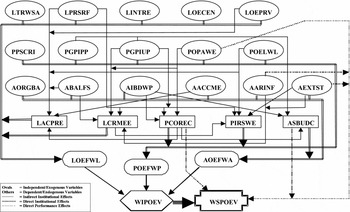
The system model unravels the monolithic relationship both to distinguish the underlying layers of institutional and performance linkages and to capture their structural properties. The institutional linkages and their structural properties can be traced in terms of the functional relationships evident among the institutional and performance variables as depicted in Figure 1.Footnote 20 Of the 26 variables in Figure 1, five are performance variables – four related to water institution and its three components, and one related to water sector. The remaining 21 are institutional variables. Of them, only 16 are truly independent and these variables are in the ovals placed in the first three rows of Figure 1. The remaining five institutional variables, which are dependent on subsets of the 16 institutional variables, are in rectangles placed in the fourth row. The impacts that the 16 independent variables have on the performance of relevant institutional components are channeled both directly (as indicated by double-line paths) and indirectly (as indicated by single-line paths). Notably, the dependent institutional variables also have an interaction among them (as indicated, again, by single-line paths).
Institution-Performance Interaction: Layers of Linkages and Channels of Impact Transmission.

All performance variables are obviously dependent. Thus, the three variables representing the performance of institutional components (in rounded rectangles) depend on the effectiveness of both the independent and dependent institutional variables. The three performance variables determine the variable representing the overall performance of the water institution (in hexagon), which, in turn, affects the ultimate dependent variable, i.e. water sector performance (in cross). In addition to their indirect effects on water sector performance via institutional performance, some of the institutional variables also have direct effects on water sector performance (as indicated by dotted-line paths). These variables include both the independent ones (POPAWE, AARINF, and AXTST) and the dependent ones (PCOREC and ASBUDC). Notice that their indirect effects are in terms of their institutional influence, whereas their direct effects are in terms their role as proxies for national/regional level economic, fiscal, information, and technology trends.Footnote 21
With the identification of the layers of institutional and performance linkages as well as the multiple channels through which their impacts are transmitted within the system, it is straightforward to represent Figure 1 in terms of the following set of inter-related equations:










As to the basis for the specification of these equations, the rationale for equation (B10) was already explained. The rationale for equations (B6) to (B9) is straightforward as they simply state how institutional performance depends on the effectiveness of the constituent institutional components and aspects. But, the first five equations are postulated based on theoretical and practical considerations. For instance, equation (B1) postulates how the effectiveness of conflict resolution is influenced by water rights, user participation, other sectoral policies, functional specialization, information, and technology. All variables will have a positive effect, except other sectoral policies, which will have a negative effect due to sectoral conflicts possible from divergence in agricultural, energy, and environmental policies. Equation (B2) postulates how the scope for inter-sectoral/regional water transfers depends on water rights, conflict resolution mechanisms, user participation, and technology application. Although all variables can be expected to have a positive effect, the user participation can either be positive or negative, depending on whether it can resolve or create conflicts over water transfers. Similar reasoning can be extended to explain the specification of equations (B3) to (B5).
From their specification, it is clear that the first five equations capture the inter-institutional linkages that transcend individual institutional components. Thus, they capture the inter-dimensional institutional synergies within water institutions. The next three equations capture the intra-institutional linkages evident within each of the three institutional components. Since they have structural linkages with the first five equations, they also capture the effects of inter-institutional linkages. All these effects are transmitted by the institutional variables either directly via intra-institutional linkages or indirectly via inter-institutional linkages. The transmission of these linkages effects are captured first in equation (B9) in terms of the overall performance of water institutions and, then, in equation (B10) in terms of overall performance of the water sector. It is this structurally nested and sequentially linked feature of the system model that enables us to capture the intricacies of both institutional linkages and their performance impacts.
5. Empirical context: description and justification
The data needed for the empirical evaluation of the specified models were obtained from a sample of 127 water experts with considerable exposure and experience on multi-country water issues.Footnote 22 They include government officials (both in-service and retired), academics, researchers, consultants, and persons representing private and non-governmental bodies.Footnote 23 Of them, 48% are engineers and hydrologists, 32% are economists, 4% are lawyers, and the rest are sociologists and management specialists. This disciplinary classification cannot, however, discount their vast transdisciplinary knowledge gained from experience or learned through interaction. The choice of sample experts was almost random, more by chance than by design, due to the role of chance elements in getting the final sample from an initial sample of 278 experts. As to their geographic spread, these experts are from 43 countries/regions around the world.Footnote 24 These sample countries/regions together account for 52% of global land area, 68% of population, 63% of renewable water resources, 80% of irrigated area and freshwater withdrawal, and 60% of people below poverty line. The choice of these countries/regions is purposive to cover the diversity of economic, political, resource, and institutional contexts.
The use of perception-based data, though it appears to be less legitimate to support a more rigorous analysis of institutions, has strong empirical precedents, and some practical advantages. Apart from its ability to relax the constraints on many institutional and performance variables, perception as an empirical mechanism also has the capability to synthesize different types of information (i.e., objective conditions, subjective observations, and expected trends) and internalize some of the important but complicated concepts (e.g., performance, efficiency, and equity). The perception-based evaluation is also conceptually close to the Delphi and contingent valuation procedures being used in uncertain and missing market contexts. But, the overwhelming support comes from the institutional economics literature itself where the subjective features of institutions and the inevitability of subjective factors in their evaluation are clearly established. The subjective nature of institutions is implied when they are viewed as ‘settled habits of thought’ (Veblen, Reference Veblen1919), ‘behavioural habits’ (Commons, Reference Commons1934), ‘artefacts’ (V. Ostrom, Reference Ostrom1980), ‘acting through the medium of individuals’ (Douglas, Reference Douglas1987; Stein, Reference Stein1997), and ‘mental construct’ (North, Reference North1990). Articulating this point better, North says that ‘we cannot feel, touch, or even measure institutions’ and, therefore, proposes the ‘subjective model of individuals’ as a key factor in institutional change (1990: 107). Building further on this point, Saleth and Dinar (Reference Saleth and Dinar2004) have proposed a subjective theory of institutional change centred on the idea of perceptional convergence among stakeholders. This theory provides theoretical legitimacy for using stakeholder perception as an information source for institutional evaluation and analysis.Footnote 25
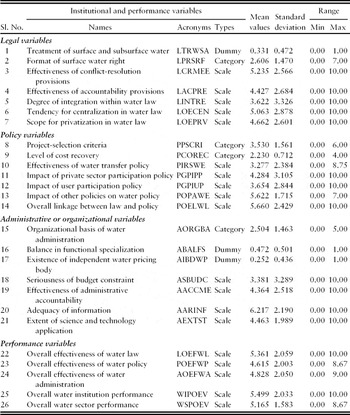
While perception-based information is legitimate, its aptness as the empirical basis for the present context, however, depends also on the comparability of information provided by different stakeholders. This comparability can be ensured only when the sample stakeholders have some common understanding of the institutional and performance variables and, more importantly, use a similar, if not the same, reference points for their evaluation.Footnote 26 The first condition is generally fulfilled, especially given the selection of internationally comparable institutional aspects and the international experience of sample stakeholders. Although the reference points of stakeholders can vary depending on their ideology and expectations, they can converge due to the influence of both objective factors (e.g., declared policy goals, best-practice cases, and observed achievements) and knowledge factors (e.g., interaction, learning, and theoretical results). As these factors are likely to have much in common for sample experts, it is reasonable to expect that their reference points would tend to be close, if not identical. This convergence also tends to internalize the possibility of multiple good or bad performances as well as the influence of cultural, historical, and other contextual aspects. With these underlying conditions and justifications for perception-based evaluation, a detailed questionnaire was administered to the sample stakeholders to generate the data set for the present analysis.Footnote 27 The basic characteristics of this data can be inferred from Table 1, which provides the descriptive statistics for all model variables.
Descriptive statistics for the perception-based institutional and performance variables

6. Results and discussion
Since the two models of institution–performance interaction defined in Section 4 are specified under different assumptions concerning the nature of institutional linkages, they have different structural properties. Since Model A assumes a monolithic relationship between water institutions and water sector performance, it has only a single and long equation. But, since Model B unscrambles the relationship to identify its underlying set of interrelated layers, it has a set of structurally nested and sequentially linked equations. As a result, the two models require different estimation procedures. Model A is estimated using the Ordinary Least Squares (OLS) procedure whereas Model B is estimated using the Three-Stage Least Squares (3-SLS) procedure.Footnote 28 However, for adding contrast, model B is also estimated with the OLS procedure. Since the latter estimation is performed by considering each equation separately, it assumes away the structural linkages within Model B. Thus, by comparing the 3-SLS results of Model B with its own OLS results and that of Model A, we can provide some econometric evidence for the existence, structural properties, and performance implications of institutional linkages.
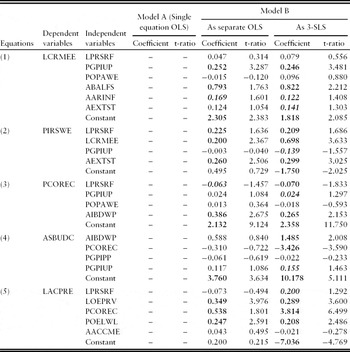
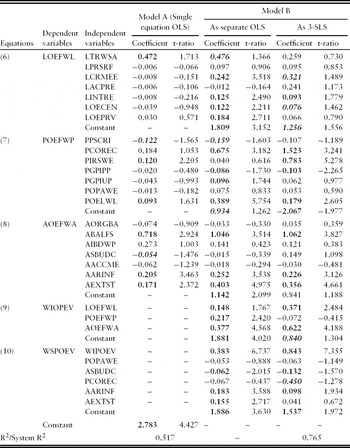
Although the model equations can be estimated with a variety of functional forms, for simplicity and convenience, they are estimated by assuming simple linear form and using the econometric package of SHAZAM (Version 8.0). Tables 2a and 2b present the estimates for the two models under different assumptions on institutional linkages and structural properties. Before proceeding, it is important to note three points. First, the results are reported in two tables only for presentational convenience. Second, all the estimates reported are standardized coefficients, i.e. the actual coefficient weighted with the ratio of the standard deviations for the concerned independent and dependent variables. This allows the comparison of coefficients both within and across equations and models. Third, as suggested by the χ2 and Breusch–Pagan test statistics, the results are largely free from the problems of autocorrelation and heteroskedasticity.
Estimates for Models A and B under different assumptions on institutional structure and linkages

Notes: a‘–’ indicates the absence of estimates as the single equation OLS model does not capture the linkages represented by equations (1) to (5).
bCoefficients in bold are significant at 10% or better whereas coefficients in bold and italics are significant at 20%. Since Model A does not recognize institutional inter-linkages, it does not have coefficients for the five equations (1) to (5).
Estimates for Models A and B under different assumptions on institutional structure and linkages

Notes: The notes listed in Table 2a are applicable here as well. Besides, we note that there is a separate R2 for each of the ten equations under the OLS estimation of Model B. The R2 for equations (1) to (10) are respectively: 0.14, 0.10, 0.10, 0.26, 0.19, 0.33, 0.36, 0.43, 0.37, and 0.52.
6.1. Institutional linkages and structural properties
Since the three sets of estimates reported in tables 2a and 2b reflect their underlying assumptions on institutional linkages and their structural properties, a comparison of them can obviously provide econometric evidence for these linkages and properties. Such comparison can be general, focusing just on the overall explanatory power of the models (in terms of simple or system R2), as well as more specific, considering also the relative importance of the institutional variables (in terms of the size and significance of their coefficients) across equations and models. While the R2 values for the OLS version of Model B lack comparison, the same for the OLS results of Model A and for the 3-SLS results of Model B can be compared. Although the underlying set of variables is, more or less, the same in these two cases, the system model has a higher explanatory power (0.765) than the monolithic model (0.517). Such a better performance of the system model is obviously due to its ability to capture both the direct and indirect effects of the variables. What is notable, however, is the fact that if the linkages among variables captured in the system model are true, then, the R2 for Model A is an exaggeration because of the existence of multicollinerity problems. Thus, the real explanatory difference between these models is much more than what is indicated by their R2 values.
We can also show the existence and impacts of institutional linkages by comparing the OLS and 3-SLS results of Model B in terms of the size and significance of the coefficients of variables, especially those having more linkages with and diverse effects on others. As the impacts of these variables are severely underestimated in OLS estimation, their coefficients will be smaller than those obtained in the 3-SLS results. As shown by the 3-SLS results, seven out of nine linkage variables, i.e. the dependent variables in one equation entering as independent variables in others, are statistically significant. The two exceptions are: LACPRE (effectiveness of accountability provisions) and POEFWP (overall effectiveness of water policy). However, as expected, all the remaining seven linkage variables have a substantially larger coefficient in 3-SLS results. The coefficient of WIPOEV (overall effectiveness of water institution) in equation (10) – the ultimate linkage variable capturing the total effects of institutional linkages in the system – provides the most dramatic instance as the size of its coefficient in the 3-SLS results (0.843) is far larger than that in OLS results (0.383). Although POEFWP is insignificant in equation (9), the multifarious effects of its underlying policy aspects such as PCOREC (cost recovery status) and PGPIUP (effectiveness of user participation policy) are captured widely within the system model. These results provide clear evidence for the existence and performance implications of institutional linkages.
6.2. Linkage effects and transmission channels
Let us now consider how the institutional variables transmit the linkage effects across the layers of institution–performance interaction. For this purpose, we use only the 3-SLS results to evaluate the three sets of structural linkages evident within the system, that is inter-institutional linkages (equations (1) to (5)), intra-institutional linkages (equations (6) to (8)), and institution–performance linkages (equations (9) and (10)).
Inter-institutional linkages
The first five equations are very important, as they are the building blocks for the institutional and structural linkages within the entire system. Their evaluation can, therefore, indicate the relative role and significance of different variables in the structural articulation and impact transmission of inter-institutional linkages. Starting with the first equation, the results show that the effectiveness of conflict-resolution mechanisms (LCRMEE) is strongly influenced by the statistically significant positive effects of four variables: user participation policy (PGPIUP), balanced functional specialization (ABALFS), information adequacy (AARINF), and technology application (AEXTST). Thus, the effectiveness of the legal aspect of conflict resolution is strongly linked with one policy aspect and three organizational aspects. Similar inter-institutional linkages are also evident in equation (1). Here, the effectiveness of water transfer policy (PIRSWE) depends on the statistically significant effects of two legal aspects (LCRMEE and water rights format LPRSRF), one policy aspect (PGPIUP), and one organizational aspect (AEXTST). All of them except PGPIUP have positive effects. Notably, the linkage variable LCRMEE has the largest effect. Notably, PGPIUP that has a direct negative effect on PIRSWE has an indirect positive effect via LCRMEE. But, both the direct and indirect effects of AEXTST are positive. The insignificance of LPRSRF in equation (1) and its significance in equation (2) suggest its indirect effect on PIRSWE to be insignificant, but its direct effect to be significant.
The results for equation (3) show that PCOREC depends on three statistically significant variables: the existence of independent water pricing body (AIBDWP), PPGPIUP, and LPRSRF. The positive effects of AIBDWP and PGPIUP are intuitive as autonomy in water pricing enhances the scope for rate revisions and user participation improves the scope for cost recovery. The negative effect of LPRSRF is also understandable because changes in water rates are often viewed by users as infringements on the real value of their water rights (Rosegrant and Binswanger, Reference Rosegrant and Binswanger1994). The substantially larger impact of AIBDWP than that of PGPIUP is an interesting result. It suggests the need to shift the focus from an exclusive focus on the micro and collection aspects of water pricing towards the macro and organizational aspects.
Turning to equation (4), the seriousness of budget constraint (ASBUDC) is affected by the statistically significant impacts from two policy variables (PCOREC and PGPIUP) and an organizational variable (AIBDWP). Although all these three variables are closely linked with pricing and cost recovery, PCOREC has a negative effect, but others have positive effects. The negative effect of PCOREC implies the obvious fact that improved cost recovery reduces the severity of budget constraint. This can also be interpreted as severe budget constraints creating compulsions for improving cost recovery. This interpretation also explains why AIBDWP and PGPIUP have positive effects; that is, severe budget constraints facilitate autonomous water pricing and promote user participation. Notably, the positive effects of these two variables are transmitted both directly and indirectly via the linkage variable of PCOREC.
As per the results for equation (5), the legal aspect of LACPRE is affected by the positive effects of two legal variables (LPRSRF and the legal provisions for private participation (LOEPRV)) and two policy variables (PCOREC and law-policy linkages (POELWL)). Of them, the linkage variable PCOREC transmitting the effects of all significant variables from equation (3) has the largest effect. This means that the effectiveness of accountability provisions depends also on the indirect positive effects of both AIBDWP and PGPIUP. Although the indirect effect of LPRSRF via PCOREC is negative, its direct effect is positive, though not as strong as the other three significant variables in equation (5). In any case, the positive effects of PCOREC and LPRSRF are obvious as cost recovery and water rights contribute to accountability. Similarly, the positive effects of LOEPRV and POELWL mean that the legal provisions for private participation and close operational linkages between water law and water policy can also promote both the enforcement and effectiveness of the accountability provisions.
Intra-institutional linkages
The intra-institutional linkages are pivotal not only in capturing the linkages effects generated both within and across the institutional components but also in transforming these effects into institutional and sectoral performances. Considering the intra-institutional linkage represented by equation (6), of the seven legal variables, only three are significant with positive impacts on the effectiveness of water law. These variables – listed by the absolute size of their coefficients – are: LCRMEE, degree of legal integration (LINTRE), and centralization tendency within water law (LOECEN). Since LCRMEE is a linkage variable, it transmits not only its own legal effects but also the positive inter-institutional effects of PGPIUP, ABALFS, and AARINF. Thus, the effectiveness of the legal component of the water institution depends on the direct effects of three legal aspects (LCRMEE, LINTRE, and LOECEN) and the indirect effects of one policy aspect (PGPIUP) and two organizational aspects (ABALFS and AARINF).
As per the results for equation (7), the effectiveness of the water policy depends only on four policy variables. These significant policy variables – listed by the absolute size of their coefficients – are: PCOREC, PIRSWE, POELWL, and privatization policy (PGPIPP). Of them, all but PGPIPP have positive effects suggesting that better cost recovery conditions, effective water transfer policies, and strong law–policy linkages are critical for the overall effectiveness of water policy. The negative effect of PGPIPP explains how failed water policies in the past create compulsions for privatization initiatives. As PCOREC and PIRSWE are linkage variables, they also transmit the indirect effects of other legal, policy, and organizational aspects. Thus, the effectiveness of water policy depends both on the direct effects of the four policy variables noted above and on the indirect effects of another six legal and organizational variables: LPRSRF, PGPIUP, AEXTST, AARINF, AIBDWP, and ABALFS, as conveyed via equations (2) and (3).
In equation (8), of the seven organization-related variables, only three are significant in determining the effectiveness of water organization. These variables – listed by the absolute size of their coefficients – are: ABALFS, AEXTST, and AARINF. Their positive coefficients suggest that the effectiveness of water organization improves with the functionally balanced staffing pattern, application of technology, and development of water-related information. Notably, as we have seen, these three variables also have a substantial indirect but positive role in determining the effectiveness of both water law and water policy due to their relationships with linkage variables. Similar is also the case with ASBUDC and AIBDWP having insignificant roles in equation (8). The insignificance of others (spatial nature of organization (AORGBA) and administrative accountability (AACCME)) means that organizational limitations can be countered with better functional capabilities, technology, and information. This suggests the scope for institutional substitutability.
Institution–performance linkages
The institution–performance linkages captured by the last two equations represent the penultimate and ultimate layers of institution–performance interaction. Hence, they can serve as a unified context for evaluating the ultimate performance impacts of institutional aspects, as routed through various layers of institutional linkages. The results for equation (9) show that only two of the three institutional components are significant, that is water law and water organization. Notably, the positive impact of water organization is dominant for the overall performance of water institutions. This can be expected in view of the pivotal role that water organization plays in translating, enforcing, and monitoring the legal and policy provisions at the field level. This point, taken with the fact that water policy is only a political economy replica or substitute of water law, explains why water policy is insignificant. In view of their linkage roles, the two significant institutional components also transmit both the direct and indirect effects of the significant institutional variables that they have captured in previous equations, that is the performance of water institutions depends on the following institutional aspects: effective conflict-resolution mechanisms, legal integration, a healthy dose of centralization, user participation policy, balanced functional specialization, information development, and technology application in management.
Equation (10) represents the ultimate performance linkage between water institution and water sector. It captures both the direct and indirect effects of the institutional aspects as routed through various layers of institutional linkages as well as the impacts of the overall policy environment as captured through a few proxy variables. As expected, the results show that the overall effectiveness of water institutions has the most significant and dominant positive effect on water sector performance. This result is a more convincing evidence for the roles of intra and inter-institutional linkages in enhancing the performance of both water institutions and the water sector. Among the proxy variables, only PCOREC, ASBUDC, and AARINF are significant, suggesting the importance of cost recovery commitment, fiscal health, and information status of the country for water sector performance. As we consider the significant institutional aspects behind the layers of institutional linkages and proxy variables, it is clear that the institutional aspects having either direct or indirect effects on water sector performance are: the four legal aspects (effective conflict-resolution mechanisms, legal integration, dose of centralization, and clear water rights), two policy aspects (cost recovery status and user participation), and five organizational aspects (functional specialization, severity of budget constraint, independent pricing body, information development, and technology application in management).
7. Conclusions and policy implications
This paper has developed a methodology using an analytical framework based on institutional decomposition and an empirical approach based on perception-based cross-country data. This methodology is applied to provide a quantitative analysis of institutional linkages and their performance implications in the generic context of global water sector. Since the attempt is based on a limited set of institutional variables and also made with some simplifying assumptions, it is unable to exhaust all possible institutional configurations, to cover the cultural, political, historical, and other contextual factors, and to account for multiple arrangements with similar performances. But, within country-specific and comparative contexts, the methodology can be extended to cover most, if not all, institutional aspects and exogenous factors.Footnote 29 Similarly, although the methodology is developed here for the context of water institutions, it can be generalized for evaluating institutions in other sectors and contexts, including individual irrigation projects as well as the joint context involving a set of development interventions.Footnote 30 But, it is to be noted that the approach is useful mainly for institutional evaluation from a long-term perspective and of little help for capturing short-term changes or for developing performance indicators because institutional and performance changes are too gradual to be noted instantly.
Despite the simplifying conditions and the fact that the institution–performance interactions being evaluated here are only a few of their many possible configurations, the results provide some convincing evidence for the existence and performance implications of institutional linkages. These evidences provide new perspectives and unique insights on the internal dynamics of the process of institution–performance interaction. Notably, the set of institutional aspects identified as having the dominant effects on the performance of water institutions and the water sector is consistent with the attention that they receive in current debate on water institutional reforms. This is not surprising, as the results are only an econometric representation of the consensus evident among the sample experts. In this sense, the relative size, sign, and significance of the coefficients for different institutional variables as well as the relative strength and significance of different linkages among these variables are essentially statistical representations of the nature and degree of perceptional convergence among sample experts on various functional and structural properties of water institutions.
Although the results and analysis reported in this paper focus mainly on the relative role and significance of institutional aspects both within and across the layers of institution–performance linkages, they have much larger implications for both theory and policy. As these results are based on a sequentially linked system of equations, it is possible to numerically evaluate the system-wide institutional and performance impacts associated with a marginal change in any of the variables in the model. Such a numerical analysis can shed light on various chains of institutional and performance variables involved in the capture and transmission of impacts in various layers of institution–performance interaction. The identification of the channels of impact transmission and the underlying chains of variables is very useful for the practical purpose of designing an institutional reform program.
Since the identification and evaluation of the institutional chains can enable us to rank institutional aspects in terms of their linkage effects, impact intensities, and path dependency properties, it is possible to prioritize, sequence, and package institutional aspects within a reform program.Footnote 31 With the same exercise, it is also possible to spot the weak and strong links within the impact transmission process. Such knowledge is very valuable for delineating reform tasks, setting institutional priorities, and, even, deciding on the scale and timing of reform. These reform design and implementation principles have strategic roles as they can exploit the path dependency properties of institutions and benefit from the scale and synergy effects of institutional linkages and, thereby, counter the technical and political constraints for reforms. Clearly, these principles and their strategic roles are rooted in the functional and structural linkages inherent in the process of institution–performance interaction. This explains why institutional linkages have such a special place in institutional economics and indicates how vital they are in future research on institutional theory and policy.