Introduction
Seventeen per cent of women of childbearing age (i.e., 18 to 44 years) smoked cigarettes between 2009 and 2011 in the United States (US), and more than 10 per cent of pregnant women continued smoking during their pregnancy (National Center for Health Statistics [NCHS], 2012). Maternal smoking during pregnancy is particularly concerning because of the elevated health risks for mothers and infants (Bailey et al., Reference Bailey, McCook, Hodge and McGrady2012; Jones et al., Reference Jones, Heil, Tuten, Chisolm, Foster, O’Grady and Kaltenbach2013; Slotkin, Reference Slotkin1998; Ness et al., Reference Ness, Grisso, Hirschinger, Markovic, Shaw, Day and Kline1999). Specifically, smoking during pregnancy increases the risk of ectopic pregnancy, spontaneous abortion, placental abruption, placenta previa and even infertility (Cnattingius, Reference Cnattingius2004). Adverse health effects for the foetus include intrauterine growth retardation (IUGR), which has been implicated in hypoglycemia and hypocalcemia, as well as increased risk of necrotising enterocolitis and death (Soothill, Nicolaides, & Campbell, Reference Soothill, Nicolaides and Campbell1987; Lin et al., Reference Lin, Moawad, Rosenow and River1980; Bernstein, Horbar et al., Reference Bernstein, Horbar, Badger, Ohlsson and Golan2000; Bernstein, Plociennik et al., Reference Bernstein, Plociennik, Stahle, Badger and Secker-Walker2000). In addition to the risks from maternal smoking during pregnancy, passive exposure to parental smoking following birth further increases the child's risk for sudden infant death syndrome, asthma, altered respiratory and cardiovascular function, infection, behaviour problems, sleep difficulties, and cancer (Langley et al., Reference Langley, Heron, Smith and Thapar2012; Neuman et al., Reference Neuman, Hohmann, Orsini, Pershagen, Eller, Kjaer and Bergstrom2012; Treyster & Glitterman, Reference Treyster and Gitterman2011; Yolton et al., Reference Yolton, Xu, Khoury, Succop, Lanphear, Beebe and Owens2010; Zhang & Wang, Reference Zhang and Wang2013). These risks are additional to broader health risks of smoking-related illnesses (U.S. Department of Health and Human Services [USDHHS], 2001).
Women who smoke during pregnancy are more likely to be young (Stueve & O’Donnell, Reference Stueve and O’Donnell2007); be born in the US (Haskins et al., Reference Haskins, Bertone-Johnson, Pekow, Carbone and Chasan-Taber2010; Ockene et al., Reference Ockene, Ma, Zapka, Pbert, Valentine Goins and Stoddard2002; Rugulies, Scherzer, & Krause, Reference Rugulies, Scherzer and Krause2008); be low-income (Weaver et al., Reference Weaver, Campbell, Mermelstein and Wakschlag2008); be less educated (Higgins et al., Reference Higgins, Heil, Badger, Skelly, Solomon and Bernstein2009; King et al., Reference King, Borrelli, Black, Pinto and Marcus1997); have previous births (Haskins et al., Reference Haskins, Bertone-Johnson, Pekow, Carbone and Chasan-Taber2010; Ockene et al., Reference Ockene, Ma, Zapka, Pbert, Valentine Goins and Stoddard2002); have a partner who smokes (Ockene et al., Reference Ockene, Ma, Zapka, Pbert, Valentine Goins and Stoddard2002); be highly addicted to nicotine (Haskins et al., Reference Haskins, Bertone-Johnson, Pekow, Carbone and Chasan-Taber2010; Ockene et al., Reference Ockene, Ma, Zapka, Pbert, Valentine Goins and Stoddard2002); be less likely to perceive risk to the foetus (Ockene et al., Reference Ockene, Ma, Zapka, Pbert, Valentine Goins and Stoddard2002); be under stress from intimate partner violence and other life events (Haskins et al., Reference Haskins, Bertone-Johnson, Pekow, Carbone and Chasan-Taber2010; Holden et al., Reference Holden, McKenzie, Pruitt, Aaron and Hall2012; Prusakowski et al., Reference Prusakowski, Shofer, Rhodes and Mills2011); and have psychiatric disorders (i.e., generalised anxiety, bipolar, depression, oppositional disorder, conduct disorder and attention deficit hyperactivity disorder; Flick et al., Reference Flick, Cook, Homan, McSweeney, Campbell and Parnell2006; Kodl & Wakschlag, Reference Kodl and Wakschlag2004).
In addition, substantial racial/ethnic disparities exist in smoking rates during pregnancy, with American Indian or Alaska Native (19.6 per cent), White (10.8 per cent), Black or African American (9.7 per cent), Hispanic (2.0 per cent), and Asian or Pacific Islander (1.6 per cent; NCHS, 2012). Prenatal smoking rates also differ tremendously within the American Indian or Alaska Native population, with more than 70 per cent in the Northwest Territories (Godel et al., Reference Godel, Pabst, Hodges, Johnson, Froese and Joffres1992), about 40 per cent in the Washington, Wisconsin and Minnesota states (Adams, Harvey, & Prince, Reference Adams, Harvey and Prince2005; Davis, Helgerson, & Waller, Reference Davis, Helgerson and Waller1992; Scott et al., Reference Scott, Fogarty, Day, Irving and Oakes2005), and 2 per cent in the New Mexico state (Schiff & Rogers, Reference Schiff and Rogers1999). Consequent diversity in the infant death rate has been observed with 16 per cent in the Northern Plains and 5 per cent in the Navajo Indian Health Service Area (Bulterys et al., Reference Bulterys, Morgenstern, Welty and Kraus1990). Although the overall smoking rate among pregnant Hispanic women is as low as 2 per cent, large disparities among Hispanic subgroups exist (i.e., 12.2 per cent for Puerto Rican, 7.1 per cent for Cuban, 1.4 per cent for Mexican, and 0.7 per cent for Central and South American; NCHS, 2012). The rate of preterm birth and low birth weight babies has decreased by 11 per cent during the 1990s, which was largely accounted for by improved prenatal care utilisation and smoking cessation (Schempf & Decker, Reference Schempf and Decker2010; Williamson et al., Reference Williamson, Serdula, Kendrick and Binkin1989).
Because of differential rates of smoking during pregnancy by racial/ethnic groups, adverse neonatal outcomes may also differ by racial/ethnic status. The term ‘minority’ will be used to indicate ‘racial/ethnic minority in the U.S’ for the rest of this paper. Pregnant African American and Hispanic women have a greater risk of delivering infants with low birth weight compared to White counterparts, partially attributable to maternal smoking (Moore & Zaccaro, Reference Moore and Zaccaro2000; Ngui, Cortright, & Blair, Reference Ngui, Cortright and Blair2009; Nkansah-Amankra, Reference Nkansah-Amankra2010). The proportion of infant deaths and babies with low birth weight attributable to maternal smoking is significantly higher among American Indian and Alaska Native women than other races/ethnicities (England et al., Reference England, Kim, Shapiro-Mendoza, Wilson, Kendrick, Satten and Callaghan2012; Salihu et al., Reference Salihu, Aliyu, Pierre-Louis and Alexander2003). Prenatal tobacco exposure was significantly associated with persistent asthma among children who are Mexican, Puerto Rican and Black (Akuete et al., Reference Akuete, Oh, Thyne, Rodriguez-Santana, Chapela, Meade and Tcheurekdjian2011).
Therefore, there is clear reason to target minority women for smoking cessation interventions and to tailor these interventions to meet their unique needs. Minority women are aware of the health risks associated with tobacco use and are often motivated to quit (USDHHS, 2001); however, differential rates of smoking among minority groups may be due to significant barriers to participating in tobacco cessation programmes or to gaining access to tobacco cessation resources particularly during pregnancy (Glasgow et al., Reference Glasgow, Whitlock, Eakin and Lichtenstein2000; King et al., Reference King, Borrelli, Black, Pinto and Marcus1997). These barriers may include: inaccessible healthcare providers, lack of insurance, lack of transportation, lack of child care, issues with immigration status, language barriers, cultural health beliefs, level of acculturation and other sociocultural barriers (English, Merzel, & Moon-Howard, Reference English, Merzel and Moon-Howard2010; King et al., Reference King, Borrelli, Black, Pinto and Marcus1997; Koh et al., Reference Koh, Oppenheimer, Massin-Short, Emmons, Geller and Viswanath2010).
Minority women also tend to be overrepresented by lower socioeconomic status, which is associated with greater rates of smoking during pregnancy and less access to treatment (American Psychological Association, 2013; King et al., Reference King, Borrelli, Black, Pinto and Marcus1997). Smokers of lower socioeconomic status are as likely to attempt to quit smoking as those of higher socioeconomic status; however, they are less likely to be successful in quitting because of limited access to smoking cessation resources and other psychosocial determinants (Fitzgerald, Reference Fitzgerald2012; Kotz & West, Reference Kotz and West2009).
A recent study showed that being advised to quit smoking by a health professional, use of nicotine replacement therapy (NRT), and having a complete home smoking ban were positively associated with successful cessation among minority smokers (Trinidad et al., Reference Trinidad, Perez-Stable, White, Emery and Messer2011). Racial/ethnic disparities existed among these variables. Asian/Pacific Islander smokers were the least likely among all of the minority groups to visit a physician (Tong et al., Reference Tong, Tang, Chen and McPhee2011) and receive advice to quit smoking (Chen & Hawks, Reference Chen and Hawks1995; Tong et al., Reference Tong, Tang, Chen and McPhee2011). African American, Hispanic and Asian/Pacific Islander smokers were less likely to use NRT, compared to White counterparts (Trinidad et al., Reference Trinidad, Perez-Stable, White, Emery and Messer2011), and the same applies to pregnant smokers of these minority groups (Gaither et al., Reference Gaither, Huber, Thompson and Huet-Hudson2009). African American smokers were the least likely to have a complete home smoking ban, while Hispanic and Asian/Pacific Islander smokers were the most likely to have a complete home smoking ban (Trinidad et al., Reference Trinidad, Perez-Stable, White, Emery and Messer2011).
The meta-analysis of interventions for pregnant smokers has been recently conducted (Lumely et al., Reference Lumley, Chamberlain, Dowswell, Oliver, Oakley and Watson2009); however, no review has focused on interventions for minority pregnant smokers. The purposes of the present study are 1) to systematically review controlled studies of smoking cessation during pregnancy that predominantly included minority women and 2) to suggest ways to expand studies on minority pregnant smokers and improve smoking cessation rates based on the findings.
Methods
Inclusion Criteria
All randomised and quasi-randomised controlled studies that were published in English and in peer-reviewed journals and met the following criteria were included for this review.
-
1. Studies that aimed at smoking cessation during pregnancy.
-
2. Studies that treated pregnant women who were smoking at the time of entering the study.
-
3. Studies that included minority pregnant smokers as more than 50 per cent of the participants.
-
4. Studies that included minority pregnant smokers in the US.
-
5. Studies that reported smoking cessation outcomes.
Smoking cessation outcomes included biochemically-verified smoking abstinence with breath, saliva or urine samples and/or self-reported smoking abstinence.
Search Methods
Two authors independently conducted the literature searches for this review in April 2013. The literature searches covered published studies in the following standard databases: PubMed, MEDLINE, PsycINFO and EBSCOhost; between 1946 and April 2013. We used a combination of keywords with minority identifiers: minority, American Indian, Alaska Native, Asian American, Black, African American, Hispanic, Latina, Native Hawaiian or Pacific Islander; pregnancy identifiers: pregnant or pregnancy; smoking identifiers: smoking, tobacco or nicotine; and cessation identifiers: cessation, reduction or abstinence. We adhered to the definitions of minority populations according to the U.S. Office of Management and Budget (Centers for Disease Control and Prevention, 2012). The authors compared their review results with each other and discussed any discrepancies in the results. An author with more experience in general clinical research and research on pregnant smokers (Y. W.) ultimately resolved the discrepancies to complete the review. Other investigators senior to the author (Y. W.) were available for consultation as needed.
Results
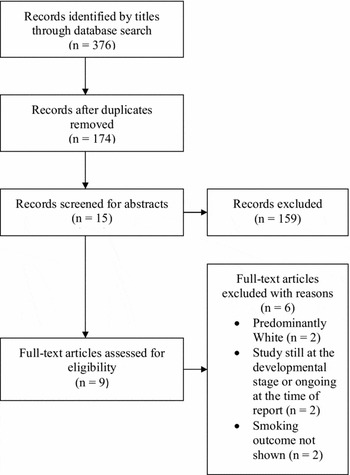
The database searches produced a total of 376 titles identified as relevant to the topic. Once duplicates were removed, a total of 174 titles remained for abstract screening. The abstracts were screened based on the above inclusion criteria leading to the removal of 159 abstracts and leaving 15 articles for full-text screening. We removed six of these articles after full-text screening because two of the six articles had predominantly White participants (i.e., > 50 per cent), and four did not report smoking cessation outcomes at the time of report (Figure 1).
Flow chart of the selection process for systematic review.

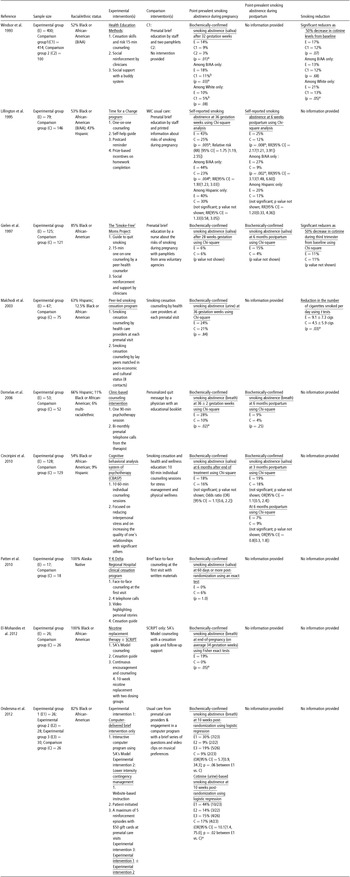
Table 1 shows nine reviewed studies in a chronological and alphabetical order. Six of nine studies included Black or African American pregnant smokers as more than 50 per cent of the participants (Cinciripini et al., Reference Cinciripini, Blalock, Minnix, Robinson, Brown, Lam and Karam-Hage2010; El-Mohandes et al., Reference El-Mohandes, Windsor, Tan, Perry, Gantz and Kiely2012; Gielen et al., Reference Gielen, Windsor, Faden, O’Campo, Repke and Davis1997; Lillington et al., Reference Lillington, Royce, Novak, Ruvalcaba and Chlebowski1995; Ondersma et al., Reference Ondersma, Svikis, Lam, Connors-Burge, Ledgerwood and Hopper2012; Windsor et al., Reference Windsor, Lowe, Perkins, Smith-Yoder, Artz, Crawford and Boyd1993), with one of them specifically targeting this group (El-Mohandes et al., Reference El-Mohandes, Windsor, Tan, Perry, Gantz and Kiely2012). Two studies included Hispanic pregnant smokers as more than 50 per cent of the participants (Dornelas et al., Reference Dornelas, Magnavita, Beazoglou, Fischer, Oncken, Lando and Gregonis2006; Malchodi et al., Reference Malchodi, Oncken, Dornelas, Caramanica, Gregonis and Curry2003), and the remaining study specifically targeted Alaska Native pregnant smokers (Patten et al., Reference Patten, Windsor, Renner, Enoch, Hochreiter, Nevak and Brockman2010). The following subsections will summarise findings on demographic characteristics of minority pregnant smokers and intervention components and relevant outcomes across nine reviewed studies.
Randomized trials for smoking cessation during pregnancy with 50 percent or more participants of racial/ethnic minorities

Note: a (a) - Statistical significance; CI - Confidence interval.
b Quit rates by race are not shown for the C2 group in Windsor et al. (Reference Windsor, Lowe, Perkins, Smith-Yoder, Artz, Crawford and Boyd1993).
Demographic Characteristics
A total of 1,233 Black or African American pregnant smokers, 416 Hispanic pregnant smokers, 35 Alaska Native pregnant smokers, and six mixed-racial/ethnic pregnant smokers were treated in the reviewed studies. The average age range of participants was 23.3‒27.9 years old and they entered treatment during the first and second trimesters (Cinciripini et al., Reference Cinciripini, Blalock, Minnix, Robinson, Brown, Lam and Karam-Hage2010; El-Mohandes et al., Reference El-Mohandes, Windsor, Tan, Perry, Gantz and Kiely2012; Gielen et al., Reference Gielen, Windsor, Faden, O’Campo, Repke and Davis1997; Lillington et al., Reference Lillington, Royce, Novak, Ruvalcaba and Chlebowski1995; Malchodi et al., Reference Malchodi, Oncken, Dornelas, Caramanica, Gregonis and Curry2003; Ondersma et al., Reference Ondersma, Svikis, Lam, Connors-Burge, Ledgerwood and Hopper2012; Patten et al., Reference Patten, Windsor, Renner, Enoch, Hochreiter, Nevak and Brockman2010; Windsor et al., Reference Windsor, Lowe, Perkins, Smith-Yoder, Artz, Crawford and Boyd1993). Most of the participants were not pregnant for the first time (79 per cent; Gielen et al., Reference Gielen, Windsor, Faden, O’Campo, Repke and Davis1997; Lillington et al., Reference Lillington, Royce, Novak, Ruvalcaba and Chlebowski1995; Patten et al., Reference Patten, Windsor, Renner, Enoch, Hochreiter, Nevak and Brockman2010); had education of 12 years or less (76 per cent; Cinciripini et al., Reference Cinciripini, Blalock, Minnix, Robinson, Brown, Lam and Karam-Hage2010; El-Mohandes et al., Reference El-Mohandes, Windsor, Tan, Perry, Gantz and Kiely2012; Malchodi et al., Reference Malchodi, Oncken, Dornelas, Caramanica, Gregonis and Curry2003; Patten et al., Reference Patten, Windsor, Renner, Enoch, Hochreiter, Nevak and Brockman2010); were unemployed (66 per cent; Cinciripini et al., Reference Cinciripini, Blalock, Minnix, Robinson, Brown, Lam and Karam-Hage2010; El-Mohandes et al., Reference El-Mohandes, Windsor, Tan, Perry, Gantz and Kiely2012; Malchodi et al., Reference Malchodi, Oncken, Dornelas, Caramanica, Gregonis and Curry2003); were Medicaid-eligible (68 per cent; Cinciripini et al., Reference Cinciripini, Blalock, Minnix, Robinson, Brown, Lam and Karam-Hage2010; El-Mohandes et al., Reference El-Mohandes, Windsor, Tan, Perry, Gantz and Kiely2012); were unmarried (83 per cent; Cinciripini et al., Reference Cinciripini, Blalock, Minnix, Robinson, Brown, Lam and Karam-Hage2010; Malchodi et al., Reference Malchodi, Oncken, Dornelas, Caramanica, Gregonis and Curry2003; Patten et al., Reference Patten, Windsor, Renner, Enoch, Hochreiter, Nevak and Brockman2010); and reported depression or other mood disorders (80 per cent; Cinciripini et al., Reference Cinciripini, Blalock, Minnix, Robinson, Brown, Lam and Karam-Hage2010; El-Mohandes et al., Reference El-Mohandes, Windsor, Tan, Perry, Gantz and Kiely2012). The range of the number of cigarettes smoked per day during pregnancy was 7.5‒13.3 (Cinciripini et al., Reference Cinciripini, Blalock, Minnix, Robinson, Brown, Lam and Karam-Hage2010; Gielen et al., Reference Gielen, Windsor, Faden, O’Campo, Repke and Davis1997; Malchodi et al., Reference Malchodi, Oncken, Dornelas, Caramanica, Gregonis and Curry2003; Ondersma et al., Reference Ondersma, Svikis, Lam, Connors-Burge, Ledgerwood and Hopper2012), and one study reported that the average number of cigarettes smoked at pre-pregnancy was 16.3, having decreased that number during pregnancy to 9.8 (Cinciripini et al., Reference Cinciripini, Blalock, Minnix, Robinson, Brown, Lam and Karam-Hage2010). At treatment baseline, participants had salivary cotinine levels ranging from 114 to 211 ng/ml (Gielen et al., Reference Gielen, Windsor, Faden, O’Campo, Repke and Davis1997; El-Mohandes et al., Reference El-Mohandes, Windsor, Tan, Perry, Gantz and Kiely2012; Patten et al., Reference Patten, Windsor, Renner, Enoch, Hochreiter, Nevak and Brockman2010; Windsor et al., Reference Windsor, Lowe, Perkins, Smith-Yoder, Artz, Crawford and Boyd1993).
All but two studies defined prenatal smoking based on self-reported smoking during pregnancy (Cinciripini et al., Reference Cinciripini, Blalock, Minnix, Robinson, Brown, Lam and Karam-Hage2010; Gielen et al., Reference Gielen, Windsor, Faden, O’Campo, Repke and Davis1997; Lillington et al., Reference Lillington, Royce, Novak, Ruvalcaba and Chlebowski1995; Ondersma et al., Reference Ondersma, Svikis, Lam, Connors-Burge, Ledgerwood and Hopper2012; Patten et al., Reference Patten, Windsor, Renner, Enoch, Hochreiter, Nevak and Brockman2010; Windsor et al., Reference Windsor, Lowe, Perkins, Smith-Yoder, Artz, Crawford and Boyd1993) or the week prior to becoming pregnant (Malchodi et al., Reference Malchodi, Oncken, Dornelas, Caramanica, Gregonis and Curry2003). Four studies excluded participants based on exclusive use of smokeless tobacco (Malchodi et al., Reference Malchodi, Oncken, Dornelas, Caramanica, Gregonis and Curry2003), a recent history of alcohol and substance abuse or dependence (Dornelas et al., Reference Dornelas, Magnavita, Beazoglou, Fischer, Oncken, Lando and Gregonis2006; El-Mohandes et al., Reference El-Mohandes, Windsor, Tan, Perry, Gantz and Kiely2012), or psychiatric illness or psychological instability (Cinciripini et al., Reference Cinciripini, Blalock, Minnix, Robinson, Brown, Lam and Karam-Hage2010; Dornelas et al., Reference Dornelas, Magnavita, Beazoglou, Fischer, Oncken, Lando and Gregonis2006; El-Mohandes et al., Reference El-Mohandes, Windsor, Tan, Perry, Gantz and Kiely2012).
Intervention Components
Seven of nine studies provided some form of brief intervention (El-Mohandes et al., Reference El-Mohandes, Windsor, Tan, Perry, Gantz and Kiely2012; Gielen et al., Reference Gielen, Windsor, Faden, O’Campo, Repke and Davis1997; Lillington et al., Reference Lillington, Royce, Novak, Ruvalcaba and Chlebowski1995; Malchodi et al., Reference Malchodi, Oncken, Dornelas, Caramanica, Gregonis and Curry2003; Ondersma et al., Reference Ondersma, Svikis, Lam, Connors-Burge, Ledgerwood and Hopper2012; Patten et al., Reference Patten, Windsor, Renner, Enoch, Hochreiter, Nevak and Brockman2010; Windsor et al., Reference Windsor, Lowe, Perkins, Smith-Yoder, Artz, Crawford and Boyd1993), three studies of which combined brief intervention with a more intensive approach, such as nicotine replacement therapy (i.e., nicotine patches; El-Mohandes et al., Reference El-Mohandes, Windsor, Tan, Perry, Gantz and Kiely2012) and use of financial incentives for completing homework to develop cognitive behavioural skills (Lillington et al., Reference Lillington, Royce, Novak, Ruvalcaba and Chlebowski1995) and maintaining smoking abstinence (Ondersma et al., Reference Ondersma, Svikis, Lam, Connors-Burge, Ledgerwood and Hopper2012). Two of nine studies provided an intensive intervention alone including cognitive behavioural therapy to reduce interpersonal stress and improve the quality of relationship with significant others (Cinciripini et al., Reference Cinciripini, Blalock, Minnix, Robinson, Brown, Lam and Karam-Hage2010) and psychotherapy with follow-up stress management training via telephone consultation (Dornelas et al., Reference Dornelas, Magnavita, Beazoglou, Fischer, Oncken, Lando and Gregonis2006).
Only one study (El-Mohandes et al., Reference El-Mohandes, Windsor, Tan, Perry, Gantz and Kiely2012) stratified participants by baseline salivary cotinine levels to adjust the dosage of trans-dermal nicotine patch. Two studies tailored the intervention to the culture of participants by employing peer counsellors from a similar socioeconomic background and creating a video with members from the same community (Malchodi et al., Reference Malchodi, Oncken, Dornelas, Caramanica, Gregonis and Curry2003; Patten et al., Reference Patten, Windsor, Renner, Enoch, Hochreiter, Nevak and Brockman2010). None of the studies provided a comprehensive psychosocial intervention to address individual psychosocial problems and needs such as with individually tailored psychosocial counselling, case management and community referrals.
Intervention Outcomes
Smoking outcomes
Smoking abstinence and reduction outcomes at the end of pregnancy and early postpartum are summarised in Table 1. All nine studies reported end-of-pregnancy smoking abstinence. Eight of nine studies reported biochemically verified point-prevalent smoking abstinence at the end of pregnancy either by cotinine level as nicotine metabolite via urine or saliva (Cinciripini et al., Reference Cinciripini, Blalock, Minnix, Robinson, Brown, Lam and Karam-Hage2010; Gielen et al., Reference Gielen, Windsor, Faden, O’Campo, Repke and Davis1997; Malchodi et al., Reference Malchodi, Oncken, Dornelas, Caramanica, Gregonis and Curry2003; Ondersma et al., Reference Ondersma, Svikis, Lam, Connors-Burge, Ledgerwood and Hopper2012; Patten et al., Reference Patten, Windsor, Renner, Enoch, Hochreiter, Nevak and Brockman2010; Windsor et al., Reference Windsor, Lowe, Perkins, Smith-Yoder, Artz, Crawford and Boyd1993) or by carbon monoxide level via breath (Dornelas et al., Reference Dornelas, Magnavita, Beazoglou, Fischer, Oncken, Lando and Gregonis2006; El-Mohandes et al., Reference El-Mohandes, Windsor, Tan, Perry, Gantz and Kiely2012; Ondersma et al., Reference Ondersma, Svikis, Lam, Connors-Burge, Ledgerwood and Hopper2012). Not all interventions showed significant point-prevalent smoking abstinence at the end of pregnancy or during postpartum. El-Mohandes et al. (Reference El-Mohandes, Windsor, Tan, Perry, Gantz and Kiely2012) showed significant treatment effects; however, the trend of salivary cotinine values over time was not significant in either condition (Experimental condition; p = .07).
Four studies reported postpartum point-prevalent smoking abstinence, varying in reporting time periods from six-week postpartum to six-month postpartum (Cinciripini et al., Reference Cinciripini, Blalock, Minnix, Robinson, Brown, Lam and Karam-Hage2010; Dornelas et al., Reference Dornelas, Magnavita, Beazoglou, Fischer, Oncken, Lando and Gregonis2006; Gielen et al., Reference Gielen, Windsor, Faden, O’Campo, Repke and Davis1997; Lillington et al., Reference Lillington, Royce, Novak, Ruvalcaba and Chlebowski1995). Three of these studies provided biochemically-verified outcomes, showing high postpartum relapse rates (Cinciripini et al., Reference Cinciripini, Blalock, Minnix, Robinson, Brown, Lam and Karam-Hage2010; Dornelas et al., Reference Dornelas, Magnavita, Beazoglou, Fischer, Oncken, Lando and Gregonis2006; Gielen et al., Reference Gielen, Windsor, Faden, O’Campo, Repke and Davis1997).
Reduction in smoking during pregnancy was reported in three studies defined as a 50 per cent decrease in cotinine levels from baseline to the end of pregnancy (Gielen et al., Reference Gielen, Windsor, Faden, O’Campo, Repke and Davis1997; Windsor et al., Reference Windsor, Lowe, Perkins, Smith-Yoder, Artz, Crawford and Boyd1993) or as decrease in the number of cigarettes smoked per day during pregnancy (Malchodi et al., Reference Malchodi, Oncken, Dornelas, Caramanica, Gregonis and Curry2003). Not all reports showed significant smoking reduction. Two studies reported results in continuous smoking abstinence during pregnancy either in the past 30 days (Ondersma et al., Reference Ondersma, Svikis, Lam, Connors-Burge, Ledgerwood and Hopper2012) or three-month and six-month post-treatment (Cinciripini et al., Reference Cinciripini, Blalock, Minnix, Robinson, Brown, Lam and Karam-Hage2010), both of which showed longer continuous abstinence in the experimental condition than in the comparison condition (E [23%] vs. C [21%] for three-month post-treatment & E [11%] vs. C [9%] for six-month post-treatment in Cinciripini et al., Reference Cinciripini, Blalock, Minnix, Robinson, Brown, Lam and Karam-Hage2010; E1 [26%] vs. C [4%; p = .04] & E1+E3 [22%] vs. E2+C [7%; p = .03] in Ondersma et al., Reference Ondersma, Svikis, Lam, Connors-Burge, Ledgerwood and Hopper2012).
Birth outcomes
Birth outcomes were reported in three studies, showing differences in birth weight (206g [p = .18] favouring the experimental condition in El-Mohandes et al., Reference El-Mohandes, Windsor, Tan, Perry, Gantz and Kiely2012; 448g [p ≤ .01] favouring quitters over heavy smokers [7+ per day] in Malchodi et al., Reference Malchodi, Oncken, Dornelas, Caramanica, Gregonis and Curry2003; 200g favouring quitters over smokers in Windsor et al., Reference Windsor, Lowe, Perkins, Smith-Yoder, Artz, Crawford and Boyd1993). Significant inverse correlations were found between birth weight and the number of cigarettes smoked per day (r = −0.295; p < .01) and carbon monoxide levels (r = −0.391; p < .001; Malchodi et al., Reference Malchodi, Oncken, Dornelas, Caramanica, Gregonis and Curry2003). One study also reported a significant difference in gestational age, favouring the experimental condition over the comparison condition (39.4 vs. 38.4 weeks; p = .02; El-Mohandes et al., Reference El-Mohandes, Windsor, Tan, Perry, Gantz and Kiely2012).
Other significant treatment effects
Ondersma et al. (Reference Ondersma, Svikis, Lam, Connors-Burge, Ledgerwood and Hopper2012) reported that computer-delivered brief intervention significantly increased the rate of talking to doctors and nurses about smoking (E1+E3 [61%] vs. E2+C [30%]; p = .02). Cinciripini et al. (Reference Cinciripini, Blalock, Minnix, Robinson, Brown, Lam and Karam-Hage2010) reported that cognitive behavioural therapy focused on interpersonal relationship significantly improved depression (p = 0 .04).
Characteristics of quitters
Quitters were significantly younger (24.3 vs. 28.4; p = 0.04), had fewer pregnancies (3.2 vs. 6.4; p = 0.0001), had less depressive symptoms (33% vs. 68%, p = 0.048), and had smoked fewer cigarettes per day during the past seven days (2.2 vs. 7.2; p = 0.0001; El-Mohandes et al., Reference El-Mohandes, Windsor, Tan, Perry, Gantz and Kiely2012). Participants were more likely to quit if they had made three or more quit attempts prior to treatment (quitters [48%] vs. smokers [28%]), had family support (quitters [61%] vs. smokers [33%]; p = 0.008), and had support from friends (quitters [43%] vs. smokers [21%]; p = 0.015; Gielen et al., Reference Gielen, Windsor, Faden, O’Campo, Repke and Davis1997).
Discussion
We systematically reviewed controlled studies that provided smoking cessation treatment to predominantly minority pregnant smokers. Only two of nine reviewed studies targeted specific minority pregnant smokers, one for African American pregnant smokers (El-Mohandes et al., Reference El-Mohandes, Windsor, Tan, Perry, Gantz and Kiely2012) and the other for Alaska Native pregnant smokers (Patten et al., Reference Patten, Windsor, Renner, Enoch, Hochreiter, Nevak and Brockman2010). Among seven studies which included a racial/ethnic-mix of pregnant smokers, only two studies showed a breakdown of smoking outcomes by racial/ethnic status (Lillington et al., Reference Lillington, Royce, Novak, Ruvalcaba and Chlebowski1995; Windsor et al., Reference Windsor, Lowe, Perkins, Smith-Yoder, Artz, Crawford and Boyd1993).
Demographic Characteristics
Demographic characteristics of pregnant smokers in this review match those found in the literature for Black or African American (B/AA) and American Indian or Alaska Native (AI/AN) pregnant smokers (Brownson et al., Reference Brownson, Jackson-Thompson, Wilkerson, Davis, Owens and Fisher1992; Hickman, Delucchi, & Prochaska, Reference Hickman, Delucchi and Prochaska2010; Masho et al., Reference Masho, Bishop, Keyser-Marcus, Varner, White and Svikis2013; Maxson et al., Reference Maxson, Edwards, Ingram and Miranda2012; Nguyen et al., Reference Nguyen, Subramanian, Sorensen, Tsang and Wright2012; Orr et al., Reference Orr, Newton, Tarwater and Weismiller2005; Orr, Blazer, & Orr, Reference Orr, Blazer and Orr2012; Pletsch, Morgan, & Pieper, Reference Pletsch, Morgan and Pieper2003 for B/AA; Eichner et al., Reference Eichner, Wang, Zhang, Lee and Welty2010; Geishirt-Cantrell et al., 2005; King et al., Reference King, Borrelli, Black, Pinto and Marcus1997 for AI/AN). Culturally specific characteristics have been also identified, that are unique to the B/AA and AI/AN populations, including stress based on experiences of racial discrimination (B/AA; Nguyen et al., Reference Nguyen, Subramanian, Sorensen, Tsang and Wright2012), tobacco sale as a major income venue (AI/AN; Hodge et al., Reference Hodge, Geishirt-Cantrell, Struthers and Casken2004), and ceremonial significance of tobacco (AI/AN; Hodge & Struthers, Reference Hodge and Struthers2006; King et al., Reference King, Borrelli, Black, Pinto and Marcus1997).
Only one of the studies reviewed targeted AI/AN pregnant smokers, and the efficacy to treat AI/AN pregnant smokers has not been established (Patten et al., Reference Patten, Windsor, Renner, Enoch, Hochreiter, Nevak and Brockman2010). The results were unfortunate given that much emphasis in the study was placed on considering cultural approach to tobacco among AI/AN populations and incorporating feedback from AI/AN pregnant women and that culturally adapted interventions are generally four times more effective than their counterparts (Griner & Smith, Reference Griner and Smith2006). Targeting AI/AN pregnant smokers is a public health priority considering their high prenatal smoking rate and significantly higher rates of pregnancy complications and adverse neonatal outcomes including sudden infant death (Bulterys, Reference Bulterys, Morgenstern, Welty and Kraus1990; Kim et al., Reference Kim, England, Dietz, Morrow and Perham-Hester2009 and Reference Kim, England, Dietz, Morrow and Perham-Hester2010; Patten et al., Reference Patten, Windsor, Renner, Enoch, Hochreiter, Nevak and Brockman2010; Petersen et al., Reference Petersen, Leonardson, Wingert, Stanage, Gergen and Gilmore1984). AI/AN populations are, in comparison with other Americans, at higher risk for a number of physical problems (e.g., diabetes, oral health diseases, unintentional injuries and trauma, certain infectious diseases), mental health problems (e.g., depression, posttraumatic stress disorder, suicide), and high levels of comorbidity among these problems (Beals et al., Reference Beals, Belcourt-Dittloff, Freedenthal, Kaufman, Mitchell, Whitesell and Walters2009; Gone, Reference Gone2007; Manson, Reference Manson and Roubideaux2001; Rhoades, Reference Rhoades2000). Geographically limited access to healthcare and receiving the fewest healthcare dollars per capita, compared to other vulnerable groups (e.g., veterans, Medicaid recipients, federal prisoners), may contribute to the highest risk for the health problems (Beals et al., Reference Beals, Belcourt-Dittloff, Freedenthal, Kaufman, Mitchell, Whitesell and Walters2009; Indian Health Service, 2002). We should not ignore, however, that a significant diversity exists within the AI/AN population. There are 562 federally recognised tribal governments (Bureau of Indian Affairs, 2002), which are located across 35 states. These tribal governments share 200 different languages (Fleming, Reference Fleming1992), resulting in a tremendous diversity in prenatal smoking rates and infant death rates (Adams et al., Reference Adams, Harvey and Prince2005; Bulterys et al., Reference Bulterys, Morgenstern, Welty and Kraus1990; Davis et al., Reference Davis, Helgerson and Waller1992; Godel et al., Reference Godel, Pabst, Hodges, Johnson, Froese and Joffres1992; Schiff & Rogers, Reference Schiff and Rogers1999; Scott et al., Reference Scott, Fogarty, Day, Irving and Oakes2005).
Potential barriers for accessing AI/AN pregnant smokers and gaining their family support include that AI/AN families tend to be larger than those of any other ethnic group (averaging 4.6 members; King et al., Reference King, Borrelli, Black, Pinto and Marcus1997), and AI/AN women are the central caregivers of the family and kin networks prioritising concerns of other family members more than their own (Jones et al., Reference Jones, Appel, Eaves, Moneyham, Oster and Ovalle2012; King et al., Reference King, Borrelli, Black, Pinto and Marcus1997), that families living on tribal lands were, in comparison with other Americans, more than ten times more likely to live in substandard housing lacking complete plumbing or complete kitchen facilities (U.S. Census Bureau, 2000), and that native communities tend to have an explicit commitment to cultural preservation and revitalisation partially due to insecure political, legal and economic relationships with the U.S. federal government (Gone, Reference Gone2007). More AI/AN young women smoke cigarettes compared to other racial/ethnic-minority groups, potentially contributing to severity in nicotine dependence and lower motivation to quit (Flores-Mateo et al., Reference Flores Mateo, Morchon Ramos, Masuet Aumatell, Carrillo Santisteve, Manchon Walsh and Ramon Torrell2005; Tong et al., Reference Tong, Tang, Chen and McPhee2011).
In case of Hispanic populations, pregnant residents of low socioeconomic, predominantly Hispanic neighbourhoods were less likely to smoke during pregnancy and, as a result, have improved birth outcomes, compared to those living in other low socioeconomic neighbourhoods (Shaw & Pickett, Reference Shaw and Pickett2010 and Reference Shaw and Pickett2013). The evidence indicates strong family and community influences on health behaviour and outcomes of pregnant women living in Hispanic cultures in the U.S. (Chalela, Velez, & Ramirez, Reference Chalela, Velez and Ramirez2007; Pletsch & Johnson, Reference Pletsch and Johnson1996; Pollak et al., Reference Pollak, Denman, Gordon, Lyna, Rocha, Brouwer and Baucom2010). Such positive family and community influences seem to dissipate as Hispanic pregnant women acculturate to other low-income minority groups, which tend to be more casual about smoking during pregnancy (Bethel & Schenker, Reference Bethel and Schenker2005; Fitzgerald, Reference Fitzgerald2012; Johnsen et al., Reference Johnsen, MacKirnan, Spring, Pingitore and Sommerfeld2002; King et al., Reference King, Borrelli, Black, Pinto and Marcus1997).
It should be also emphasized that large disparities in prenatal smoking rates exist among Hispanic subgroups in the US, with Puerto Rican women exceeding the overall Hispanic prenatal smoking rate by more than 10 per cent (NCHS, 2012). Family and community influences on pregnancy outcomes as described above do not apply to the health of Puerto Ricans, either (Turra & Goldman, Reference Turra and Goldman2007). Given that Hispanics remain the most populous minority group in the US, and the Puerto Rican population, which is at most risk of prenatal smoking, is the second largest Hispanic subgroup in the US (Ennis, Rios-Vargas, & Albert, Reference Ennis, Ríos-Vargas and Albert2011), targeting at-risk Hispanic subgroups such as Puerto Ricans may be critical in designing an intervention for minority pregnant smokers.
No study has focused on demographic characteristics of Asians or Pacific Islander pregnant smokers. While the A/PI prenatal smoking rate is the lowest compared to any other minority group, Pacific Islanders have a higher rate of using cigarettes, cigars and smokeless tobacco, compared to other Asian Americans (Wu et al., Reference Wu, Swartz, Burchett, Workgroup and Blazer2013). Lower perception of harm in smoking, perceived prevalence of peer cigarette smoking, peer approval of cigarette use, previous drug use, truancy and lower academic performance are all associated with smoking among A/PI adolescent populations (Yang et al., Reference Yang, Cheng, Ho and Pooh2013). Certain Asian immigrants may carry culturally specific trauma leading to smoking among pregnant women as a result of acculturating to the low socioeconomic culture in the US (King et al., Reference King, Borrelli, Black, Pinto and Marcus1997). Although the overall smoking prevalence among A/PI populations declined since the millennium (18.0 per cent in 2002 to 11.1 per cent in 2010), A/PI males are still at increased risk for using tobacco products than females (Wu et al., Reference Wu, Swartz, Burchett, Workgroup and Blazer2013). Despite the fact that A/PI populations are more likely to have a complete home smoking ban (Trinidad et al., Reference Trinidad, Perez-Stable, White, Emery and Messer2011), smoking by A/PI males would still put A/PI pregnant women at risk for second-hand smoke exposure. The literature delineates an importance of examining A/PI pregnant populations and intervening with A/PI smoking populations.
Interventions for Minority Pregnant Smokers
Treatment effects on the smoking outcomes of the reviewed studies were not consistently significant among the reviewed studies. Differences in inclusion and exclusion criteria for pregnant smokers in these studies might have also impacted on the smoking outcomes. Given that pregnant smokers with less severe smoking histories and fewer psychosocial issues benefited the most in treatment (Gielen et al., Reference Gielen, Windsor, Faden, O’Campo, Repke and Davis1997; El-Mohandes et al., Reference El-Mohandes, Windsor, Tan, Perry, Gantz and Kiely2012), an intervention may be required to adjust its intensity to more heavily dependent smokers and tailor to individual psychosocial and cultural needs.
Smoking during pregnancy is highly correlated with alcohol and other substance use during pregnancy (Cannon et al., Reference Cannon, Dominique, O’Leary, Sniezek and Floyd2012; Gaalema et al., Reference Gaalema, Higgins, Pepin, Heil and Bernstein2013; Passey et al., 2014; Tuten et al., Reference Tuten, Fitzsimons, Chisolm, Nuzzo and Jones2012) and, therefore, correlated with psychosocial characteristics and issues common among alcohol- and other substance-dependent pregnant women (Cannon et al., Reference Cannon, Dominique, O’Leary, Sniezek and Floyd2012; Chaudhury et al., Reference Chaudhury, Jones, Wechsberg, O’Grady, Tuten and Chisolm2010; Higgins et al., Reference Higgins, Heil, Badger, Skelly, Solomon and Bernstein2009; Holbrook & Kaltenbach, Reference Holbrook and Kaltenbach2012; Orr et al., Reference Orr, Blazer and Orr2012; Subramanian et al., Reference Subramanian, Katz, Rodan, Gantz, El-Khorazaty, Johnson and Joseph2012; Yoon et al., Reference Yoon, Higgins, Heil, Sugarbaker, Thomas and Badger2007). Prenatal alcohol and substance use and associated psychosocial problems have been addressed in the context of comprehensive and intensive prenatal interventions, with consistently significant improvements in both alcohol and substance abstinence/management during pregnancy and neonatal outcomes (Grant et al., Reference Grant, Ernst, Streissguth and Stark2005; Jones et al., Reference Jones, Martin, Heil, Kaltenbach, Selby, Coyle and Fischer2008; Jones et al., Reference Jones, Kaltenbach, Heil, Stine, Coyle, Arria and Fischer2010).
Culturally adapted interventions are generally four times more effective than their counterparts (Griner & Smith, Reference Griner and Smith2006). For example, Indigenous pregnant women outside of the US including New Zealand, Australia and Canada also mark a high smoking prevalence (25 per cent – 61 per cent; Butler et al., Reference Butler, Williams, Paterson and Tukuitonga2004; Gilchrist et al., Reference Gilchrist, Woods, Binns, Scott, Gracey and Smith2004; Heaman & Chalmers, Reference Heaman and Chalmers2005). Although efficacy has not been established yet, efforts to provide evidence-based treatments have been made, such as providing brief intervention combined with nicotine replacement therapy for Aboriginal and Torres Strait Islander pregnant smokers in Australia (Eades et al., Reference Eades, Sanson-Fisher, Wenitong, Panaretto, D’Este, Gilligan and Stewart2012). A recent survey of Indigenous pregnant smokers or ex-smokers in Australia revealed that family-based support, rewards on smoking abstinence, advice and support from health professionals are seen as potentially helpful for smoking cessation. Pregnant ex-smokers also thought that stress management and peer/community support are potentially helpful (Passey, Sanson-Fisher, & Stirling, 2013). Maori community workers in New Zealand highlighted that Maori ways of relating to each other, face-to-face interaction, family-oriented value and providing personal experiences of quitting smoking are considered critical to identify Maori pregnant smokers and build rapport and maintain communication with them for maximising treatment effects (van Esdonk, Glover, Kira, & Wagemakers, Reference van Esdonk, Glover, Kira and Wagemakers2013).
Intensive and comprehensive care for treating prenatal smoking typically costs more than a brief intervention approach (e.g., $65.32 per patient in intensive counselling vs. $9.70 in brief intervention; Dornelas et al., Reference Dornelas, Magnavita, Beazoglou, Fischer, Oncken, Lando and Gregonis2006; Windsor et al., Reference Windsor, Lowe, Perkins, Smith-Yoder, Artz, Crawford and Boyd1993); however, additional healthcare costs due to ongoing health problems resulting from prenatal smoking should also be taken into consideration. Prenatal smoking puts infants at risk for premature or low birth weight, costing up to $50,000 or more per baby during its first year of life (March of Dimes, 2012). The adjusted neonatal and first-year infant costs that are attributable to maternal smoking are between $1,538.09 and $1,838.20 (Miller et al., Reference Miller, Villa, Hogue and Sivapathasundaram2001). The adjusted smoking attributable expenditures for mothers are $4,780.89 from medical costs and lost productivity (Centers for Disease Control and Prevention, 2002). Mothers who continued smoking during pregnancy were significantly more likely to wean breastfeeding early (Higgins et al., Reference Higgins, Higgins, Heil, Badger, Skelly, Bernstein and Preston2010), costing healthcare services between $508.72 and $730.52 in 2013 dollars during the first year of life per infant (US BF Committee, 2002). As such, fairly immediate health cost-savings could be realised by providing intensive and comprehensive care for prenatal smoking in addition to long-term savings (e.g., due to asthma, altered respiratory and cardiovascular function, cancer, etc.). The following section will summarise future directions for intervening with minority pregnant smokers.
Future Directions for Intervening with Minority Pregnant Smokers
Minority groups
This review revealed that interventions for certain minority pregnant smokers, especially for American Indian or Alaska Native (AI/AN), Hispanic subgroups and Asians or Pacific Islanders (A/PI), have been under studied. Future studies on minority pregnant smokers could target under-studied minority pregnant smokers including AI/AN as a minority group with a highest smoking prevalence, a specific Hispanic subgroup such as Puerto Rican pregnant smokers with a relatively higher smoking prevalence and A/PI pregnant women at risk for prenatal smoking and second-hand smoke exposure. Potential studies for A/PI should not be limited to intervention studies on prenatal smoking and could include surveys and interviews to learn more about the unique psychosocial characteristics and needs for treatment and intervention on second-hand smoke exposure. Future studies on interventions for predominantly minority pregnant smokers could also show breakdown of smoking outcomes by racial/ethnic status.
Interventions for minority pregnant smokers
This review revealed that interventions for predominantly minority pregnant smokers may need to address more intensely smoking behaviour and psychosocial and cultural issues directly contributing to prenatal smoking via continuous motivational enhancement for smoking abstinence (e.g., feedback, financial incentives and pharmacotherapy) and intensive counselling for cognitive behavioural skills to stay abstinent from smoking, as has been the case with general pregnant smokers (Lumley et al., Reference Lumley, Chamberlain, Dowswell, Oliver, Oakley and Watson2009). This approach may also include stratifying minority pregnant smokers by severity in smoking rates and psychosocial and cultural issues to adjust the intensity of treatment. Making interventions tailored to individual needs may increase sensitivity to the cultural and socioeconomic barriers of minority pregnant smokers and reduce vulnerability, potentially contributing to treatment retention and effectiveness (Graham et al., Reference Graham, Francis, Inskip and Harman2006; Lumley et al., Reference Lumley, Chamberlain, Dowswell, Oliver, Oakley and Watson2009). Future studies on interventions for minority pregnant smokers may also include a component to analyse cost-benefit of the intervention.
Conclusion
The current study systematically reviewed nine studies that treated predominantly minority pregnant smokers. Demographic characteristics, intervention components and intervention outcomes of the studies were reviewed. Future studies to treat minority pregnant smokers could target under-studied minority groups such as American Indian or Alaska Native, Hispanic subgroups and Asians or Pacific Islanders, may need to directly and intensely target smoking behaviour, addressing cultural and psychosocial issues in an individualised and comprehensive manner, adjust the intensity of the intervention according to the severity and needs, and analyse the cost-benefit of an intervention.
Financial disclosure
The authors have no financial relationships relevant to this article to disclose.
Conflict of interest
The authors have no conflicts of interest to disclose.
Funding support
This study was supported by an NIH grant, 5P50DA027841.
Acknowledgement
We would like to thank Drs. A. Thomas McLellan and Michael G. McDonell for reviewing the manuscript. We would also like to thank Drs. McDonell, Gayle S. Morse, Joseph E. Trimble, and Julii Green for consulting on the American Indian/Native American populations.