Introduction
Accidental ingestion of button batteries by children is occurring more frequently, and has potentially severe and sometimes fatal consequences.Reference Litovitz and Schmitz1 Once impacted, a battery can rapidly cause local damage, with onset of necrosis and subsequent damage to surrounding structures, and sequelae including strictures, fistulation and perforation.Reference Hamilton, Schraff and Notrica2, Reference Samad, Ali and Ramzi3 The impaction of a button battery can also present with respiratory symptoms, including those associated with croup.
The presented case demonstrates how ingestion can present in this latter way, which may lead to a potentially fatal delay in treatment. This case also highlights important factors in cases of button battery ingestion, including predictors of poor outcome such as: a large, lithium-containing battery; young patient age; and long duration of impaction.Reference Yardeni, Yardeni, Coran and Golladay4
It is estimated in the US that the incidence of button battery ingestion is between 2 to 8 per million annually.Reference McLarty, Krishnan and Rowe5 There was a 6.7-fold increase in ingestions leading to major or fatal outcomes, comparing 1985 and 2009 figures.Reference Litovitz, Whitaker, Clarke, White and Marsolek6 Fortunately, most cases of button battery ingestion are clinically uneventful, and 90 per cent pass through the digestive tract spontaneously.Reference Litovitz7
A policy of conservative management is usually adopted for smaller, asymptomatic ingestions, due to this spontaneous passage.Reference Litovitz and Schmitz1 However, those button batteries that impact within the oesophagus can result in serious and sometimes fatal complications.Reference Litovitz and Schmitz1, Reference Yardeni, Yardeni, Coran and Golladay4, Reference Litovitz, Whitaker, Clarke, White and Marsolek6 Intervention is required for batteries lodged in the oesophagus, in patients with local symptoms or other gastrointestinal symptoms.Reference Litovitz and Schmitz1 Methods for removal include induced muscle relaxation, magnet retrieval,Reference McDermott, Taylor, Wyatt, MacKenzie and Hendry8 Foley catheter trawling,Reference Campbell and Davis9 rigid or flexible oesophagoscopy, and open surgery.
Due to the increasing incidence of button battery impaction, much work has been done in order to define distinct risk factors and develop clinical protocols.Reference McLarty, Krishnan and Rowe5 In this report, we describe a novel scenario of a symptomatic, chronically impacted oesophageal button battery in a young child presenting solely with respiratory symptoms mimicking croup.
Case report
An 18-month-old child was referred to the paediatric emergency department. Having been previously well, she had developed a three-month history of stridulous inspiration and wheeze following a choking incident prior to this. Initial consultation with her general practitioner had resulted in a diagnosis of croup, but the child's symptoms were refractory to steroid treatment.
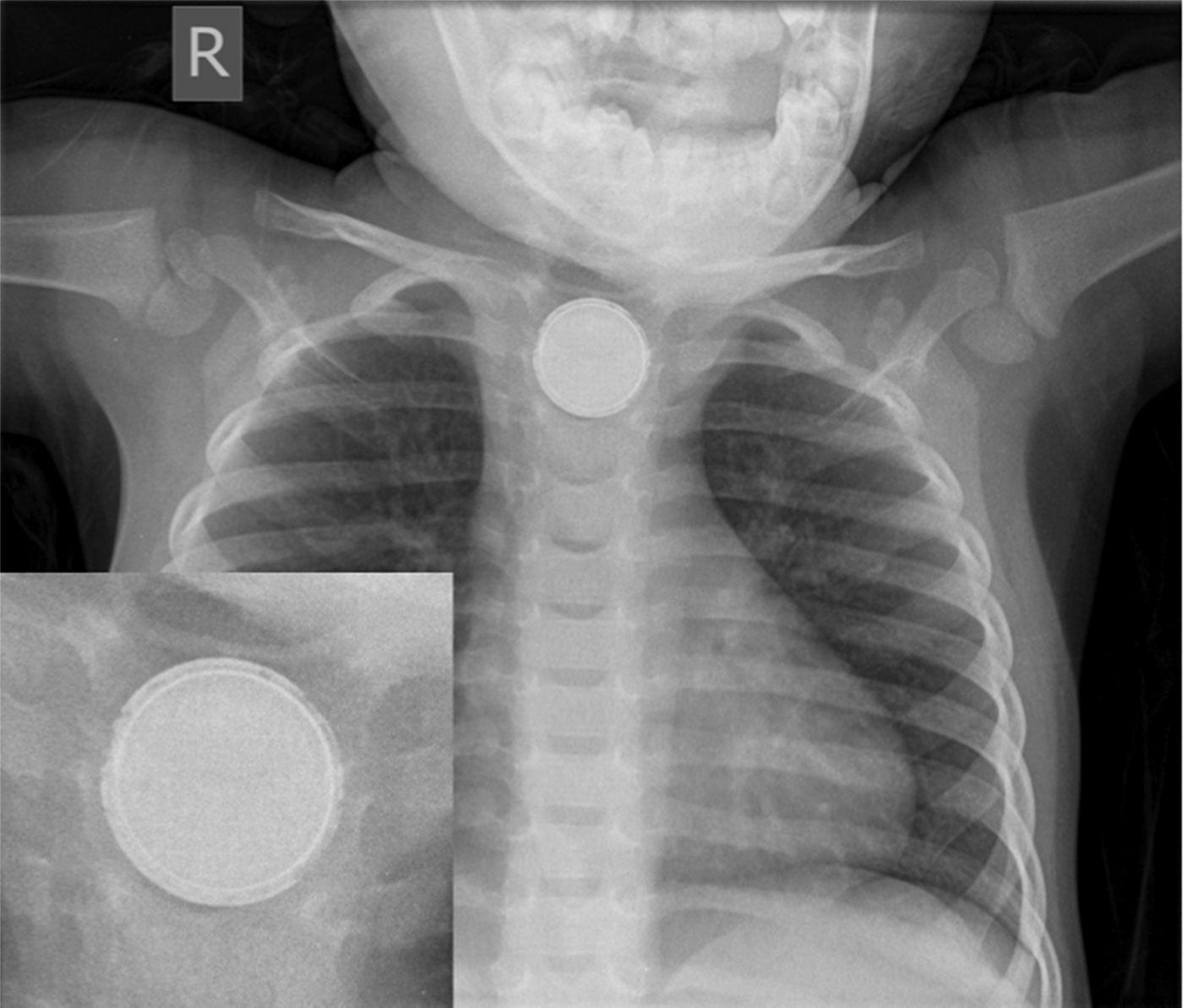
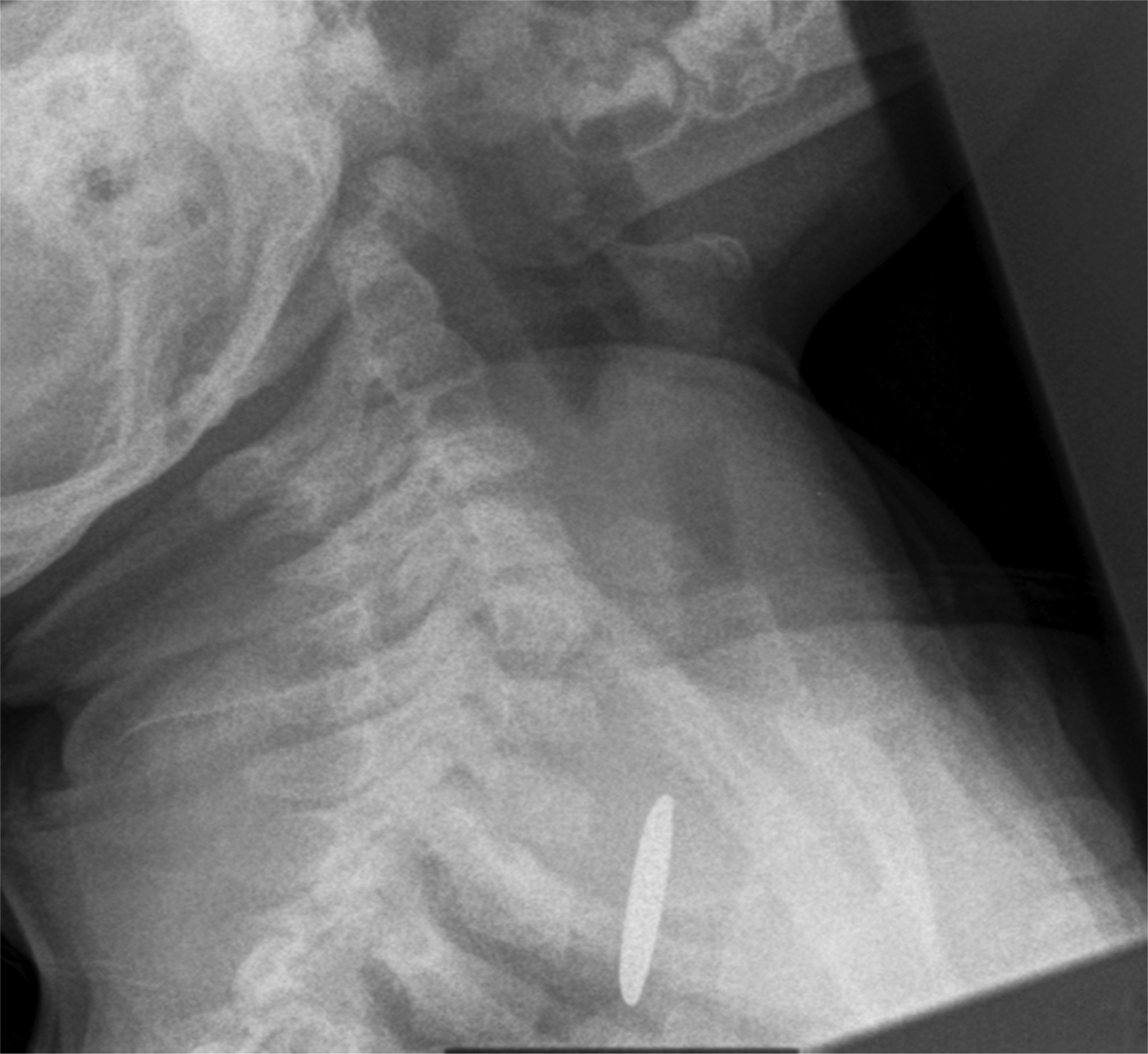
A chest X-ray revealed a circular, 20 mm opacity within the oesophagus at the level of the first and second thoracic vertebrae. The ‘halo’ (also known as ‘double-density’) and ‘step-off’ signs were both visible, suggesting the presence of a button battery (Figures 1 and 2).Reference Maves, Lloyd and Carithers10, Reference Kuhns and Dire11 At this stage, a surgical referral was sought. A careful history revealed that the child had developed a gradual onset of dysphagia to solids.
Frontal soft tissue chest X-ray taken on presentation, demonstrating the battery in the upper oesophagus. Inset shows magnified detail of the battery, demonstrating the ‘halo’ sign and corrosion of the casing. R = right

Lateral soft tissue neck X-ray showing the impacted button battery.

Rigid bronchoscopy and oesophagoscopy were promptly performed, and an intact button battery (CR2016 type, 20 mm diameter, 3 V, lithium cell) was retrieved from the superior third of the oesophagus (Figures 3 and 4). Signs of battery corrosion were evident, as well as mucosal oedema and irregularity. A direct visual assessment for tracheoesophageal fistula was undertaken but this was not detected. The concluding diagnosis was an impacted oesophageal button battery indenting the trachea anteriorly and causing airway compromise.
Oesophagoscopic view showing the impacted button battery.
Clinical photograph showing the retrieved button battery (a CR2016 type, 3 V, 20 mm diameter, lithium battery).
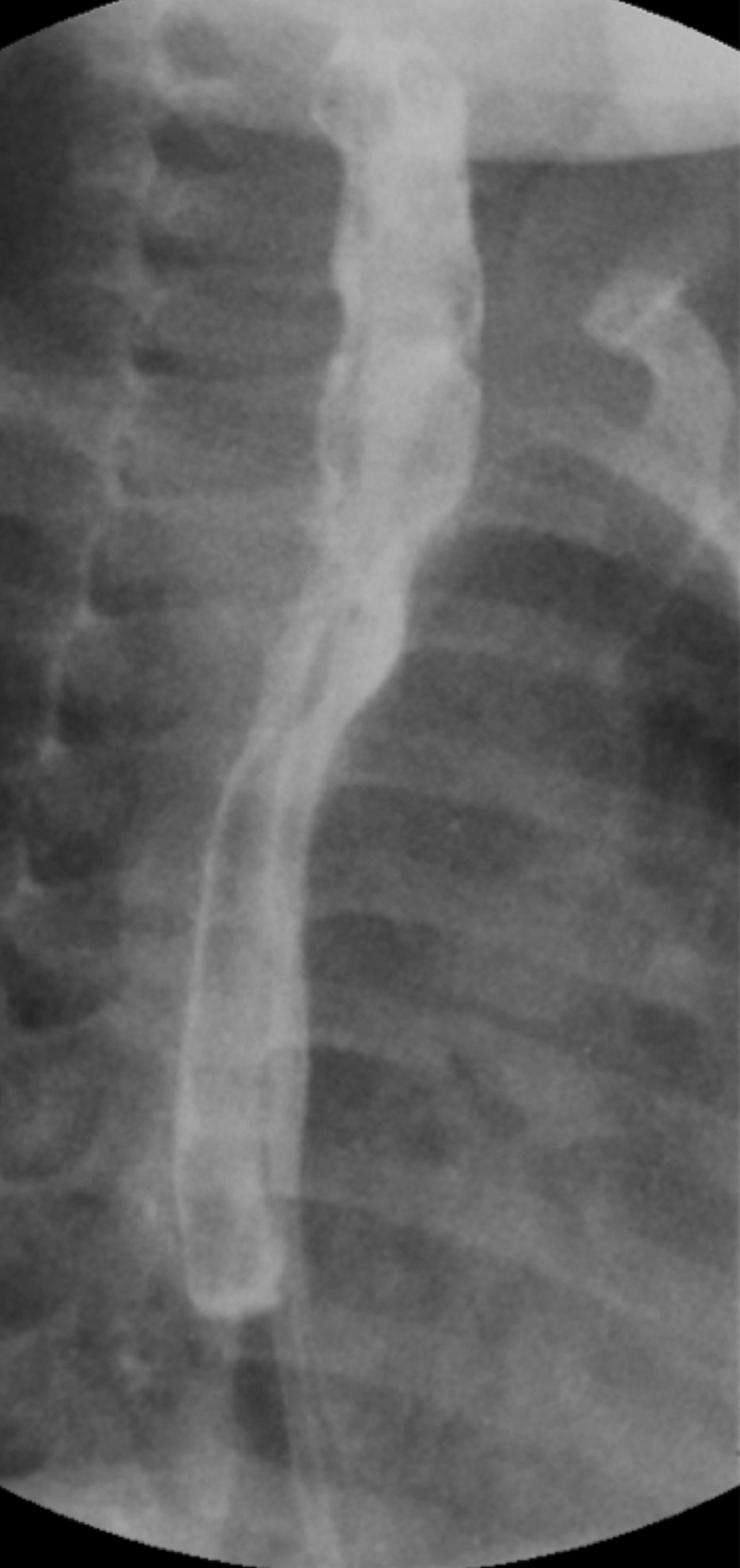
A course of corticosteroids and antibiotics was initiated. On day three, a normal upper-gastrointestinal contrast study excluded fistulation and occult perforation (Figure 5). The child was discharged on day four.
Upper gastro-intestinal contrast X-ray study performed on day three, showing a normal appearance.
At two-month review, she was noted to be feeding well. A repeated contrast imaging study excluded delayed stricturing and was otherwise unremarkable.
Discussion
The incidence of button battery ingestion is increasing. The healthcare community needs greater awareness of this event in order to facilitate correct diagnosis and management.
Button batteries are both small and powerful and are thus used widely around the household, including in numerous children's toys. They come in a variety of diameters: for example, from 9.5 to 30 mm for lithium cells. Yardeni et al. define large batteries as those greater than 15 mm in diameter, with a peak of incidents occurring with batteries of 20–23 mm diameter, due to the symptoms and sequelae of impaction.Reference Yardeni, Yardeni, Coran and Golladay4 The prevalence of ingestion of 20–25 mm batteries has increased greatly between 1990 and 2008, from 1 to 18 per cent, respectively.Reference Litovitz, Whitaker, Clarke, White and Marsolek6 Twenty millimetre cell batteries have been associated with the most severe outcomes, due to acute burns. Smaller batteries tend to be ingested more frequently but also to pass spontaneously.Reference Litovitz and Schmitz1
The voltage of these batteries ranges from 1.5 to 3.0 V when new. It has previously been shown in animal models that 3.0 V lithium batteries are associated with greater injury than the more frequently used 1.5 V cells.Reference Tanaka, Yamashita, Yamashita and Kajigaya12 This association has also been observed in cases of human ingestion.Reference Litovitz and Schmitz1
There are four distinct types of disc battery, depending on the chemical composition of the cell: mercury, manganese, silver and lithium.Reference McDermott, Taylor, Wyatt, MacKenzie and Hendry8 Lithium batteries are usually implicated, as in our case. They also tend to be larger and of greater voltage. Mercuric oxide batteries have a greater tendency to fragment. Previous cases of raised urinary mercury levels following battery ingestion have been documented, but are uncommon.Reference Bass and Millar13, Reference Kulig, Rumack, Rumack and Duffy14 One known case of renal failure following ingestion has been reported.Reference Studley, Linehan, Ogilvie and Dowling15
The duration of impaction is a predictor for risk of serious complications. Early studies on animal models showed mucosal damage and ulceration within 2 hours, with a seemingly intact battery. In human cases, burns at 4 hours and perforation at 6 hours have been described.Reference Litovitz and Schmitz1 In our patient, the degree of damage was fortunately minimal on examination and imaging.
Batteries are biologically unsealed and readily discharge their contents in moist environments. They pose the threat of damage through various mechanisms: (1) leakage of alkali, causing direct caustic injury to the mucosa; (2) tissue absorption of toxic substances; (3) pressure necrosis; and (4) external electrolytic current causing hydrolysis of tissue fluid and production of hydroxide at the cathode.Reference Litovitz, Whitaker, Clarke, White and Marsolek6, Reference Kulig, Rumack, Rumack and Duffy14, Reference Gordon and Gough16 Therefore, batteries must be promptly removed.
• Button battery impaction within the oesophagus can be a difficult diagnosis
• Children can present with croup-like symptoms
• The ‘double-density’ and ‘step-off’ radiological signs indicate a button battery
• Wrongly ascribing radiological findings to an inert object (e.g. coin) risks significant morbidity
• Local damage occurs within hours, so emergency removal is needed
Complications of button battery ingestion vary in severity. Initially, mucosal damage and burns may occur.Reference Litovitz and Schmitz1 Cases of subsequent oesophageal perforation have also been reported, usually treated conservatively rather than surgically.Reference Samad, Ali and Ramzi3, Reference Gordon and Gough16 Other reported complications include: oesophageal strictures; tracheoesophageal fistulation; aorto-oesophageal fistulation associated with major haemorrhage; aspiration; Meckel's diverticulum perforation; vocal fold paralysis; and death.Reference Hamilton, Schraff and Notrica2, Reference McLarty, Krishnan and Rowe5, Reference Litovitz, Whitaker, Clarke, White and Marsolek6, Reference Willis and Ho17, Reference Slamon, Hertzog, Penfil, Raphaely, Pizarro and Derby18 Given these risks, our patient was observed following removal, with a contrast swallow imaging study on day three.
Due to the risks associated with prolonged impaction of an ingested battery, it has been recommended that they be removed within 2 hours. The use of emetics and cathartics has been reported as ineffective, and the assessment of blood and urine mercury levels unnecessary. Endoscopic removal from the oesophagus is preferable as this enables direct visualisation of any injury (as opposed to Foley catheter trawl or magnet retrieval). Special attention should be paid to the mucosa facing the negative pole of the battery (i.e. the narrower end, without an imprint) as this pole causes greater direct damage.Reference Litovitz, Whitaker, Clarke, White and Marsolek6
Conclusion
A button battery impacted within a child's oesophagus can be a difficult diagnosis, and can present with croup-like respiratory symptoms. However, the radiological double-density and step-off signs indicate the presence of a button battery. Wrongly ascribing such radiological findings to a coin or other inert object risks significant morbidity for the patient.
Local damage can occur within hours of battery impaction, so removal should be undertaken as an emergency, without delay.Reference Maves, Carithers and Birck19–Reference Laugel, Beladdale, Escande and Simeoni21