Milk tampering may pose a threat to consumers health and unbalance fair trading of dairy products (Handford et al., Reference Handford, Campbell and Elliott2016). One of the most frequent adulterations is the addition of extraneous water, which can be accompanied by various ways to disguise it. Due to the multitude of substances used, changes in the physicochemical characteristics of milk are not always evident. This can be a limitation for the precise assessment of milk adulteration via the quality control testing that is routinely employed on the reception of raw milk in the dairy plants (Azad and Ahmed, Reference Azad and Ahmed2016). For that reason, alternative methods to detect extraneous substances in milk can complement routine tests, increasing speed, accuracy and providing more reliable results (Poonia et al., Reference Poonia, Jha, Sharma, Singh, Rai and Sharma2017). X-ray diffraction (XRD) is a technique of micro-structural characterization based on scattering X-rays to collide with the analyzed sample (Bunaciu et al., Reference Bunaciu, UdriŞTioiu and Aboul-Enein2015). Regarding milk and dairy products, XRD is mainly used to understand the crystallization processes in lactose, which directly influences food pharmaceutical products and food technology (Masum et al., Reference Masum, Chandrapala, Adhikari, Huppertz and Zisu2019). In our previous work with XRD, it was possible to conclude that the ratio between the polymorphisms of lactose could be useful to control the alcohol stability of any dairy product containing ethanol and lactose (Fagnani et al., Reference Fagnani, Battaglini, Beloti, Urbano and de Camargo Bronzol2016). Other dairy components such as triglycerides, casein, organic and inorganic salts were also explored by X-ray diffraction (Thachepan et al., Reference Thachepan, Li and Mann2010; Bugeat et al., Reference Bugeat, Perez, Briard-Bion, Pradel, Ferlay, Bourgaux and Lopez2015). In addition, XRD can also provide detailed information about the chemical composition of the sample (Bunaciu et al., Reference Bunaciu, UdriŞTioiu and Aboul-Enein2015). On this basis, we aimed to determine if X-ray diffraction is a suitable tool to chemically identify unknown substances used for milk adulteration.
Material and methods
Two unknown substances were sent to our laboratory by employers linked to the dairy chain, who claimed privately that the substances were added directly in milk prior to water addition by truck drivers who transport milk from farm to processing plant.
The sample ‘A’ was an odorless and homogeneous white powder. The sample ‘B’ was a translucent gel. Each sample were diluted 1 : 10, 9 : 100, 8 : 100, 7 : 100, 6 : 100, 1 : 20, 1 : 25, 3 : 100, 5 : 1 and 1 : 100 (w/w) with distilled water to a final weight of 200 g. The dilutions were analyzed for freezing point using a Hortvet cryoscope (MK 540; ITR, Esteio, Brazil), density at 15 °C, detection of starch, hypochlorite, chloride, hydrogen peroxide, formalin and sucrose. All physicochemical analyses were performed in duplicate as outlined by the Brazilian Ministry for Agriculture, Livestock and Supply (Brasil, 2006).
In parallel, the unknown substances (without dilutions) were analyzed directly in a diffractometer (Panalytical, X'Pert PRO MPD) using a copper tube, graphite monochromator and ionization detector, at a range of 5° to 70°, 2θ, with a step size of 0.05°/s for sample A; and at a range of 5° to 50°, 2θ, with a step size of 0.005°/s for sample B. The X-ray diffraction patterns were analysed using X'Pert HighScore Plus software and the crystallographic profile of the samples was collected in relation to the similarity in the intensity and location of the peaks.
To evaluate if X-ray diffraction can detect extraneous substances already mixed in milk, fresh raw milk samples were prepared with the addition of the most common types of adulterant (urea, sodium hydroxide, sodium citrate and sucrose) at a ratio of 0.05, 0.1, 0.25, 0.5 and 1 ml/dl (Nascimento et al., Reference Nascimento, Santos, Pereira-Filho and Rocha2017). An extra ratio of 5 ml/dl was made only for sucrose.
Then, 20 ml of each sample was frozen (−18 °C for 48 h) and lyophilized in a rotating device (Speed Vac SC110, Savant Instruments Inc., USA) for 24 h. Finally, the freeze-dried samples were analyzed using a diffractometer as described above, at a range of 5° to 60°, 2θ, with a step size of 0.05/s.
The diffractograms were also analyzed using X'Pert HighScore Plus software and the crystallographic profile of the adulterated samples was visually compared to a standard diffractogram, which was obtained from the sum of diffractograms from 20 samples of fresh raw milk. A sample of raw bovine milk (200 ml) from the farm bulk tank (4 °C) within 24 h from milking was used to build the standard curves for X-ray diffraction.
Results and discussion
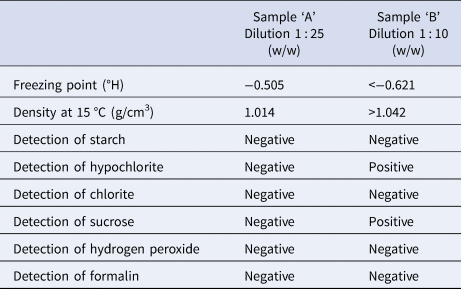
Among all the dilutions, only 1 : 25 for sample A and 1 : 10 for sample B allowed results within the measurement range for most physicochemical analyses. In the diluted sample A, the freezing point was −0.505 °H; and in the diluted sample B the freezing point was lower than −0.621 °H (exceeding the minimum measurement range (Table 1)). Both substances showed a powerful ability to decrease the freezing point, and this fact makes it possible to disguise water addition in milk. Indeed, the freezing point depression from a raw milk with initial freezing point of −0.537 °H and after adulteration with 1 : 10 solution A or solution B remained within the statutory limit of −0,530 °H (i.e. changing from −0.537 °H to −0.533 °H). In other words, milk tampering with this foreign solution may limit the analytical sensitivity of the freezing point, and ultimately, disguise the fraudulent addition of water to milk. The density of both solutions was higher than water, which means that the substances had an ability to increase the lactometer reading by maintaining the density of diluted milk. In our tests, it was possible to increase about 10% the volume of milk without exceeding the density tolerance level of 1.032 g/cm3 for both solutions.
Physicochemical characteristics of two aqueous solutions (Sample ‘A’ and ‘B’) composed of unknown substances used for economically motivated adulteration of raw milk

From these physical results regarding density and freezing point, it is possible to infer the supposed chemical composition of the substances, leading us to suspect some water-soluble components, such as sodium chloride, ammonium sulphate, sucrose, phosphate and/or citrate salts. Actually, sucrose was detected in sample B. This kind of adulteration is quite common and increases profits by increasing the lactometer reading and decreasing the freezing point to mask adulteration with water (Handford et al., Reference Handford, Campbell and Elliott2016). However, the chloride detection was negative for both substances, rejecting the hypothesis that they were composed by chloride salts.
We were also able to discard organic materials of a starchy nature, such as flour or maize starch, since their addition would not decrease the freezing point (Botelho et al., Reference Botelho, Reis, Oliveira and Sena2015). Indeed, the starch detection was negative for both substances.
Regarding the detection of preservatives to increase the shelf life of the milk, hydrogen peroxide and formalin were not detected in both solutions. However, hypochlorite residues were spotted in sample ‘B’. The presence of hypochlorite may have been deliberate or merely due to contamination from residual cleaning chemicals remaining from poor rinse steps (Singh and Gandhi, Reference Singh and Gandhi2015). Since the sample was collected directly from isothermal tank for the milk transportation, neither hypothesis can be ruled out.
When undergoing X-ray diffraction, each sample produced a unique diffractogram, with the peaks identifying sodium citrate for sample A and sucrose for sample B (Fig. 1). It is also possible to note a high relative crystallinity for both samples, with no amorphous area in the diffractograms. The crystallographic patterns of the samples elucidated the results of the physicochemical analyses. Sodium citrate is a casein stabilizer regulated for UHT fluid milk in Brazilian dairy plants. Obviously, when used before industrialization, its intention is to mask the dilution with water, maintaining the density and the freezing point of diluted milk and characterized as an illegal addition of foreign chemical substance. Similarly, the sucrose has the same physicochemical effects and its identification by X-ray diffraction was also in agreement with its ability to increase the density, decrease the freezing point and finally, to be positive for sucrose in the resorcinol qualitative test.
Diffractograms of substances used for economically motivated adulteration of raw milk. The silver lines indicate standard peaks of: sodium citrate in sample A; sucrose in sample B; and monohydrate lactose crystals in a standard milk sample.

This is the first report of diagnosis of extraneous substances in milk by X-ray diffraction; two of the most recent reviews regarding milk adulteration do not cite this technique (Nascimento et al., Reference Nascimento, Santos, Pereira-Filho and Rocha2017; Poonia et al., Reference Poonia, Jha, Sharma, Singh, Rai and Sharma2017).
We evaluated if X-ray diffraction can detect extraneous substances already mixed in milk. When undergoing crystallographic analysis, each sample of fresh raw milk produced a similar diffractogram, with the peaks mainly identifying monohydrate lactose crystals, however without detecting any extraneous substances at any percentage. Differently from samples A and B, the standard milk and the milk tampered with adulterants showed a diffractogram with fewer sharp peaks of lower intensities under an amorphous background, which may have contributed to the absence of detection of adulterants when diluted in milk (Nijdam et al., Reference Nijdam, Ibach, Eichhorn and Kind2007). In other words, the molecularly dispersed properties (polymorphism) of milk are likely to influence the crystallinity of urea, starch, citrate and sodium hydroxide and can consequently negatively influence the sensitivity of X-ray diffraction towards an accurate detection of extraneous substances in milk. Finally, when the diffractogram of each adulterated sample was visually compared to the crystallographic profile of the standard milk, no changes were detectable from 5° to 60° (i.e. range of angles analyzed by X-ray diffraction)
In conclusion, this is the first report concluding that we can reject X-ray diffraction as a suitable tool to detect extraneous substances in milk. However, X-ray diffraction can be useful when applied to identify substances used for adulteration prior to its dilution in milk. Our positive results describe how an alternative method can complement routine tests, increasing speed, accuracy and providing more reliable results.