Towards the end of Henrik Ibsen’s 1867 drama Peer Gynt, the aged title hero is confronted by ‘A Sighing in the Air’, the gathering of his songs unsung; buried in his heart for too long, they now threaten to undo him. Yet during his adventurous life, Peer Gynt had not stifled all songs. Just one act previously, in the Moroccan desert, he had devoted two ditties to the alluring Bedouin girl Anitra: one in the classical pose of a nocturnal lover with lute, the other to prove his youthfulness and virility with a doting little dance. The fact, however, that he intoned both songs in the garb of an Arab prophet indicated that they did not express his real self, and therefore could not exculpate him in the end. By contrast, Peer Gynt dons no such guise in Werner Egk’s eponymous operatic adaptation of Ibsen, premiered by the Berlin State Opera in November 1938. Instead, I will argue, Egk endowed his hero with multiple musical allusions – ones that complicate this already equivocal character as well as potential political readings of the opera as a whole.
While Ibsen’s first stage song fulfils a traditional operatic topos, Egk adopted only the first stanza of the second one, and almost verbatim. This might seem surprising, not just because Egk elsewhere bolstered monologues by condensing texts from across the play in his libretto, but also because of the crude lines themselves:
In Ibsen’s drama, the equivalent stanza concludes a string of bird metaphors with which Peer appeals to Anitra, perhaps befitting the exotic wilderness Peer had earlier contemplated: in his first song, he compares himself to a fast-moving bird and evokes the nightingale; before the second song, he talks of ‘two naughty birds’ and of Anitra as a ‘bold little woodpecker’.Footnote 3 But Egk’s Peer delivers his sole song in a harbour tavern in the American South (where all his foreign adventures are transplanted), urged on by the lascivious dancer he seeks to seduce. Instead of the outdoor ambience, his lyrics are motivated by a cockcrow heard earlier during his advances, right after he renounces his previous love and life – that is, the pure Solveig awaiting him at home. (The biblical link between cockcrow and betrayal is not lost on the innkeeper, who henceforth withdraws.) A non sequitur in Peer’s language, the image of the cockerel thus doubly unmasks the wrongness of his pursuit, while the latter is simultaneously undermined by the diminutive Hähnchen – a subtle but telling change in the libretto. Indeed, Egk’s stage directions indicate that Peer ‘makes himself utterly ridiculous’ with his ditty.Footnote 4
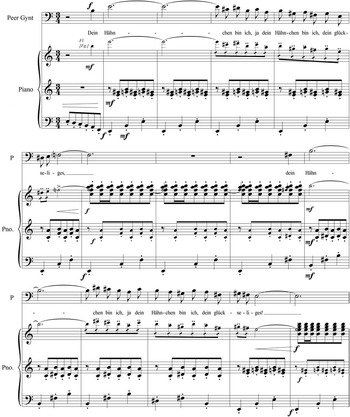
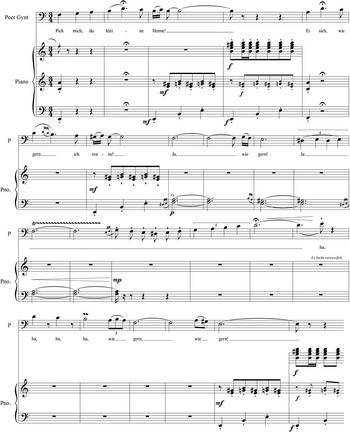
Musically, then, it may seem ironic that this song becomes the only memorable aria within Peer’s mostly declamatory idiom, and one of the few integrated set pieces of the entire three-act opera.Footnote 5 And yet its apparent simplicity only emphasises its inauthenticity. Starting abruptly, it turns out a brisk fandango, driven by snappy castanet rhythms and oompah-pah pizzicato accompaniment (see Ex. 1). The four-bar antecedent and consequent phrases both set Peer’s first verse (with internal repetition of its opening statement) to a basic I–V harmonic pattern spiced with modal mixtures, a flat supertonic and tonic pedals; and this period is immediately repeated. Egk thus parades the rooster image eight times before using the middle verses for a lyrical – if fragmented – contrasting section of twenty bars. Abandoning any regular phrase structure, this middle section offers a smorgasbord of well-worn exotic markers (see Ex. 2): extended high notes, rhythmically nuanced melismas, augmented seconds, trills and acciaccaturas unfold over repeated shifts to the flat supertonic – precisely the harmonic effect Verdi had employed in Act II, scene 2 of Don Carlos for the cadenza of Eboli’s Spanish ‘veil song’ (which deals, not coincidentally, with erotic betrayal). That not all is well with Peer’s hyperbolic Spanish guise, however, becomes obvious even to him: at the cadenza’s climax, he ‘laughs desperately’ and quickly steers back to his opening phrase, which the dancer now punctuates with exclamations of ‘enough!’ and finally cuts short. Peer’s audible, emotional breakdown amid a calculatedly regular tune again evokes Verdi, along with another Spanish tavern: in Act II, scene 1 of La forza del destino, the vindictive Don Carlo di Vargas delivers a catchy ballade to feign innocence and foster his false identity as a student.Footnote 6 Egk’s Peer, in short, displays borrowed musical idioms just like Ibsen’s hero sports varying regional costumes. Small wonder that his tavern song would not qualify as one welling forth from his heart.
Egk, Peer Gynt, Act II, scene 6, opening verse of Peer’s stage song (by kind permission of Schott Music, Mainz).

Egk, Peer Gynt, Act II, scene 6, middle section of Peer’s stage song (by kind permission of Schott Music, Mainz).

Yet I would suggest that, more than Eboli or Don Carlo, the dramaturgical model for Peer’s performance is Beckmesser, that notoriously ill-fated suitor of Wagner’s Die Meistersinger. Like Peer, Beckmesser dares to sing publicly (in Act V) in order to court a younger woman; and if Peer seeks refuge in foreign stylistic traits, Beckmesser uses someone else’s song tout court. Both accompany themselves, and both use their instrumental introductions to prepare for their feat and boost their courage, Peer’s apology – ‘Ich such nur erst den rechten Ton!’ (‘I just need to find the right tone first’) – synthesising Beckmesser’s protracted rehearsing in aptly Wagnerian language.Footnote 7 Musically, both singers resort to triple meter and ample top notes of their baritone registers (both songs are also in E). Both struggle with matching the poetic prosody with the musical rhythm, dwelling in awkwardly emphasised syllables. Both dabble in a fixed form (a Bar form and a ternary form, respectively); and both use etude-like figurations to propel and expand their tunes – scalar descending thirds for Peer and those notoriously clumsy fourths for Beckmesser. Finally, both increasingly despair of their singing, and in the end incur their worst humiliations: Beckmesser is laughed off the stage, not to be seen again; Peer is thoroughly fleeced by the dancer. It is this ultimate disgrace, triggered by his only stage song, which makes Egk’s Peer decide to return home.Footnote 8
What might this Beckmesserisation of Peer mean – particularly in late 1930s Germany? It seems tempting to speculate about an anti-Semitic inflection. As has been argued, Egk’s musical portrayal of the trolls’ realm in Act I, scene 3 could be heard as a caricature of everything the Nazi Party deemed musically ‘degenerate’, by dint of its exaggerated jazzy and Weill-influenced cabaret style as well as its grotesque satire of Offenbach’s famous cancan.Footnote 9 From this perspective, the Beckmesser allusion in Act II might highlight Peer’s resulting corruption through his illicit contact with the (Jewish, modernist, cosmopolitan) world of the trolls; indeed, the latter’s lasting influence on Peer is emphasised in the opera through the resemblance of the troll king to the innkeeper and of his daughter to the dancer (they are each performed by the same singers). As David B. Dennis has shown, however, Beckmesser was not then commonly considered a Jewish character; contemporary readings of Die Meistersinger mostly focused on Hans Sachs as Germanic hero.Footnote 10 Moreover, Egk’s protagonist echoes various Wagnerian males from the very beginning of the opera, in scenes or phrases that have no model in Ibsen. For instance, after being rejected in the opening wedding scene of Act I by three girls (not four, as in Ibsen), Peer curses them as ‘Gelichter und Geschmeiss’ (‘rabble and vermin’), the idiosyncratic first term lifted directly from the analogous opening scene of Das Rheingold.Footnote 11 When Peer beholds Solveig for the first time, he ponders, Holländer-like, the familiarity of her face, which appears ‘as if I had seen her image long ago’.Footnote 12 And, following his stage song, he hallucinates about the spiteful dancer as dominatrix taming five little clownish men – a symbolic pantomime redolent of that in the Parisian Venusberg scene of Wagner’s Tannhäuser, Act I, veiling backdrop and all.Footnote 13 The fact that Peer’s homecoming in Act III evokes the equivalent act opening of Götterdämmerung – with Egk’s three black birds merging the forewarnings of both Norns and the RhinemaidensFootnote 14 with the guise of Wotan’s ravens, and even the ‘Unbekannte’ recalling Wotan as Wanderer – hardly mitigates the impression that Egk’s Peer conjures in turn some of Wagner’s most unappetising or troubled characters: like Tannhäuser in the Venusberg, the Teutonic Siegfried is at this point a fallen man, ensnared in intrigues and betrayals.
Did Egk intentionally compromise the Nordic yet ambivalent figure of Peer Gynt through such sombre Wagnerian resonances, thereby (further) problematising a drama that counted among the popular foreign plays during the Nazi era (despite some official misgivings)?Footnote 15 Or, on the contrary, did Egk seek to fortify the wavering Scandinavian protagonist through a healthy dose of Wagnerian infusions, no matter their provenance and associations? Or was the Wagnerian treatment intended less for the character of Peer Gynt than for Peer Gynt the opera, bringing it closer in line with the desires of some ideologists for a new German Volksoper? We will never know. To be sure, Egk later singled out Peer’s stage song for the ‘intoxicating’ effect its creator Matthieu Ahlersmeyer regularly achieved with it.Footnote 16 But, as in Ibsen’s drama, the song would hardly serve as evidence of the composer’s ‘true’ leanings, either during the Third Reich or after: too contradictory were its influences, allusions and ambiguities.