We previously reported increases of specific activities of plasmin and gelatinase B (MMP 9) in the milk of goats at late lactation stage and in the mammary secretion of drying-off cows when compared with regular milk (Weng et al. Reference Weng, Chang, Chen, Chou, Peh, Huang, Chen and Nagahata2006; Chen et al. Reference Chen, Weng, Chen, Peh, Liu, Yu, Chen, Naganata and Chang2007; Weng et al. Reference Weng, Yu, Chen, Peh, Liu, Chen, Nagahata and Chang2008; Chou et al. Reference Chou, Yu, Chen, Peh, Liu, Chen, Naganata and Chang2009). Significant correlation has been established between milk plasmin activity and the extent of caseinolysis (Weng et al. Reference Weng, Chang, Chen, Chou, Peh, Huang, Chen and Nagahata2006) as well as between milk gelatinase activity and lactation stage or somatic cell counts (SCC) (Chen et al. Reference Chen, Weng, Chen, Peh, Liu, Yu, Chen, Naganata and Chang2007). The appearance of peptides is spontaneous in milk of high endogenous proteinase activity and is partially responsible for the less desirable quality of dairy products processed from this kind of raw milk (Leitner et al. Reference Leitner, Krifucks, Merin, Lavi and Silanikove2006; Merin et al. Reference Merin, Fleminger, Komanovsky, Silanikove, Bernstein and Leitner2008; Wedholm et al. Reference Wedholm, Moller, Lindmark-Mansson, Rasmussen, Andren and Larsen2008). Native peptides in milk confer physiological implications and might directly exert biological activity. For example, some endogenous peptides were regarded an early marker of mastitis and innate immune response (Silanikove et al. Reference Silanikove, Merin and Leitner2006; Napoli et al. Reference Napoli, Aiello, Di Donna, Prendushi and Sindona2007). Nevertheless, studies on milk-borne peptides have focused much more on those released through fermentation by lactic acid bacteria or by gastrointestinal digestion (Chabance et al. Reference Chabance, Marteau, Rambaud, Migliore-Samour, Boynard, Perrotin, Guillet, Jolles and Fiat1998) than those generated in situ.
Peptidiomics study of dairy products provides clues to product origin, history and authenticity, also establishes linkage to biological activities, functional properties, allergenicity and sensory properties (Korhonen & Pihlanto, Reference Korhonen and Pihlanto2006). Matrix-assisted laser desorption/ionization time-of-flight mass spectrometry (MALDI-TOF MS) is a tool capable of rapidly profiling small species according to their mass and in a dynamic nature (Hortin, Reference Hortin2006). MALDI-TOF MS has been applied in proteomic/peptidomic studies on human plasma (Hortin, Reference Hortin2006), human early milk (Ferranti et al. Reference Ferranti, Traisci, Picariello, Nasi, Boschi, Siervo, Falconi, Chianese and Addeo2004), bovine mastitis milk (Napoli et al. Reference Napoli, Aiello, Di Donna, Prendushi and Sindona2007) and bovine milk with high SCC (Wedholm et al. Reference Wedholm, Moller, Lindmark-Mansson, Rasmussen, Andren and Larsen2008). It requires only simple and fast sample preparation step where no derivation is necessary, is relatively buffer- or salt-tolerable and with low degree of fragmentation. The profiling is reproducible, specific and of high sensitivity. MALDI-TOF MS could infer structural details of peptides if the mode of post-translational modification is specified (Delom & Chevet, Reference Delom and Chevet2006; Kang et al. Reference Kang, Toita, Jiang, Niidome and Katayama2006). However, since strong ion suppression effects might interfere with the analysis of complex mixtures by MALDI-TOF MS, a procedure of chemical fractionation before MALDI to obtain less complex fractions of peptides and proteins is considered advantageous and has been applied widely. For example, an acidic solution was applied to fractionate human early milk (Ferranti et al. Reference Ferranti, Traisci, Picariello, Nasi, Boschi, Siervo, Falconi, Chianese and Addeo2004); cows' whey was applied on RP-HPLC before MALDI (Wedholm et al. Reference Wedholm, Moller, Lindmark-Mansson, Rasmussen, Andren and Larsen2008) and a solvent precipitation followed by partitioning was applied to quarter milk of cows before MALDI (Napoli et al. Reference Napoli, Aiello, Di Donna, Prendushi and Sindona2007). Liquid chromatography-electrospray-ionization (LC ESI) MS/MS, on the other hand, is easily automated and therefore is especially suitable for complex mixtures. It could get matches to peptide sequences in the database from marginal MS/MS fragmentation information, which would otherwise be impossible for unambiguously de-novo sequencing (Eng et al. Reference Eng, McCormack and Yates1994). In the current study, MALDI-TOF MS was applied to provide peptide profile for mammary secretion of drying-off cows as compared with regular milk. Then, LC ESI MS/MS was applied for mapping peptides sequence in the database. In parallel, changes in casein abundance and whey composition of mammary secretion of drying-off cows as compared with regular milk were evaluated. Our study showed active neo-genesis of peptides from milk proteins after drying-off in cows; among them peptide sequences with confirmed neural, cardiovascular or immuno-modulatory bio-activity were recognized according to literature. The mode of in situ proteolysis in mammary secretion of drying-off cows is discussed.
Material and Methods
Sampling of stasis secretion from drying-off cows and regular milk
Twelve late-lactation Holstein cows were used that were born and raised in the experimental dairy farm of National Chung Hsing University (Taichung, Taiwan) and had complete production records. They were removed from routine milking when milk yield <5 kg/d at days in milk (DIM) 280±30 d and received an intramammary infusion of dry-cow therapy (China Chemical & Pharmaceutical Co., LTD, Taichung, Taiwan). These cows were diagnosed mastitis-free (SCC<3×10⁵/ml, total bacterial count <2×10⁴ cfu/ml, and CMT test negative) by City Bureau of Animal Disease Prevention and Diagnosis, Taichung, Taiwan. After the last milking (week 0), cows were transferred to dry stalls, where a conventional dry cow ration was supplied twice daily with freely accessible water and hay. Afterwards, collection of stasis mammary secretion was performed only for the purpose of the current study. Front udders of individual cows were milked every other week either at weeks 0 and 2 (n=6) or weeks 1 and 3 (n=6) post drying-off. Before evening feeding on the sampling day, teats were first cleaned and disinfected with 70% ethanol solution (v/v in H2O) and the collection was performed aseptically by hand. All materials and reagents used were sterile. After discarding the first few strips, a 20-ml raw sample was obtained from the composite udder secretion. A total of 24 samples of stasis secretion at 4 time points were obtained. Samples of regular milk were simultaneously obtained from 5 healthy lactating cows to serve as a contrast to stasis secretion. All samples remained constantly on ice after collection and during the 15-min transportation to the laboratory.
Skimming, decaseination, and ultra-filtration of samples
Skimming, decaseination and ultra-filtration were performed sequentially for each individual sample. Skimming was performed by centrifuging at 600 g at 4°C. Skimmed serum was aspirated avoiding contamination with fat or precipitates, some stored as aliquots at −20°C while the majority proceeded to ultracentrifuge decaseination at 100 000 g (Beckman XL-90, rotor type SW41-Ti, Beckman Instruments Inc., Fullerton, CA) at 4°C for 1 h. The recovered supernatant, also inferred as whey, was stored as aliquots at −20°C. Only milk samples and samples of week-1 stasis secretion were taken to the final ultra-filtration step, when whey was firstly pooled (n=5 for regular milk and n=6 for week-1 stasis secretion) then loaded onto the Amicon Ultracel 10k (Ultra-4 Centrifugal Filter Devices, Millipore Corp., Billerica MA, USA) and centrifuged according to the manufacturer's instructions. The permeates were stored as aliquots at −20°C for peptide mass analysis without prior trypsin digestion within a week.
Determining the percentage of casein of total protein for samples
Aliquots of skimmed serum and whey prepared as above were analysed for total protein content (Bio-Rad Protein Assay kit, Bio-Rad Laboratories, Inc., Hercules CA, USA). The decreasing protein content associated with the 100 000 g-ultracentrifuge procedure was defined as casein content.
SDS-PAGE for whey samples
Aliquots of whey (equivalent of 20 μg protein content) were resolved by 15% SDS-PAGE (Laemmli, Reference Laemmli1970) in duplicate. For every gel, a broad range, pre-stained standard (Bio-Rad Laboratories, Inc.) was applied in parallel to whey samples. At the end of electrophoresis, one of the gels was further processed as described in the next section while the other duplicate was immediately stained with Coomassie Brilliant Blue R (Sigma-Aldrich, St Louis MO, USA) and destained following the standard protocol for the visualization of component bands of whey.
Immunoblotting assay for casein-derived proteins of samples
After SDS-PAGE, gel was trans-blotted to a polyvinylidene fluoride membrane (PVDF, Millipore Chelmsford MA, USA) by 90 V at 4°C for 60 min in 0·10 m-Tris–glycine-methanol/H2O (1:4, v/v) buffer, pH 7·5. The PVDF membrane was then thoroughly blocked with 0·01m-Tris–HCl buffer, pH 7·5, containing 0·15 m-NaCl, 3% BSA, 10% chicken serum for 1 h at room temperature. Rabbit anti-bovine casein antibody (GeneTex, Inc., Irvine CA, USA) was appropriately diluted (1:1000 in blocking buffer) and added to PVDF for incubation at 4°C for 8 h. The hybridized PVDF membrane was, afterwards, washed 6 times with 0·05 m-Tris–HCl buffer, pH 8·0, containing 0·15 m-NaCl and 0·1% Tween 20 for 10 min. A goat anti-rabbit IgG antibody was appropriately diluted (1:2000 in blocking buffer) (Santa Cruz Biotechnology, Inc., Santa Cruz CA, USA) and added to the hybridized PVDF membrane for incubation at room temperature for 1 h, then was again washed 6 times with the washing buffer. A chemiluminescence enhancing kit (ECL kit, Amersham Biosciences, Buckinghamshire, UK) was applied onto the PVDF membrane before exposure to a high sensitive Kodak film in dark (30 s to 5 min) for visualization.
MALDI-TOF MS of week-1 stasis secretion from drying-off cows and regular milk
α-Cyano-4-hydroxycinnamic acid (5 mg/ml in 50% acetonitrile and 0·1% formic acid) was used as matrix. A 1-μl mixture of ultra-filtration permeates and matrix (1:1, v/v) was spotted on the sample plate and allowed to dry for 30 min at room temperature. A MALDI-TOF-MS instrument mode Voyager DE Pro (Applied Biosystems, Foster City CA, USA) (Proteomic MS Core Laboratory, National Chung Hsing University) was applied. This instrument was equipped with a nitrogen laser radiating at 337 nm, 3 ns pulse width, and the resulting gas-phase singly charged molecular ions (MH+) were analysed by the TOF analyser. No fragmentation was expected under the current analysis condition.
The spectra were acquired in reflector mode at an acceleration voltage of 20 kV, 74·2% grid voltage, 0·002% guide wire voltage, 110-ns delay and a low mass gate of 600 Da. Three-hundred laser shots were averaged for a typtical spectrum. The mass calibration of the spectra was obtained by using mixtures of three reference peptides (human angiotensin I, ACTH cilp 1–17 and ACTH cilp 7–38) covering the m/z 600–4000 range. To check the repeatability, samples were analysed in triplicate. Raw data were processed through peak de-isotoping, only mono-isotopic MH+ spectrum was displayed. The current MALDI-TOF MS methodology was not equipped for a quantification purpose.
LC-ESI/MS/MS of week-1 stasis secretion from drying-off cows and regular milk
An Agilent 1200 series LC system (Aglient Technologies, Santa Clara CA, USA) connected to a LTQ mass spectrometer equipped with a nanoelectrospray ion source was used (Thermo Scientific, San Jose CA, USA) (Proteomic MS Core Laboratory, National Chung Hsing University). Aliquots (9 μl) of ultra-filtration permeates were injected by the autosampler and desalted on a C18 trap column (5 μm×2 cm packing length, 200 Å, 100 μm×25 cm total length, in-house packing) for 10 min at a flow rate of 2 μl/min. The sample was subsequently separated by a C18 resolving column (5 μm×11 cm packing length, 100 Å, 75 μm×25 cm total length, in-house packing) at a flow rate of 250 nl/min. The mobile phases consisted of water with 0·1% formic acid (A) and 100% acetonitrile with 0·1% formic acid (B) respectively. Separation of the peptides was accomplished by using a linear gradient of 5 to 40% B over 35 min followed by 40 to 85% for another 5 min. The LTQ mass spectrometer was operated in the data-dependent mode in which first the initial MS scan recorded the mass to charge (m/z) ratios of ions over the mass range from 300 to 2000 Da, and then the three most abundant ions were automatically selected for subsequent collision-activated dissociation. All MS/MS data were searched against the database of NCBI and Swiss-Port using the BioWorks program (Thermo Electron Corp.). The following parameters were used for searching: no trypsin cleavage; oxidation of Met and carbamidomethylation of Cys; peptide mass tolerance±2·0 Da; fragment mass tolerance±0·5 Da. The current LC-ESI/MS/MS methodology was not equipped for quantification purposes.
Statistical analysis
Protein contents of skimmed serum and whey and the calculated casein content (g/l) were presented as mean±sem. Differences between parameters of stasis secretion collected at 0, 1, 2, or 3 weeks (n=6 each) after drying-off and those of regular milk (n=5) were compared using paired t test, one-way analysis of variance (ANOVA) and was considered significant when P<0·05.
Results
Changes in contents of total protein and casein of stasis secretion from drying-off cows as compared with regular milk
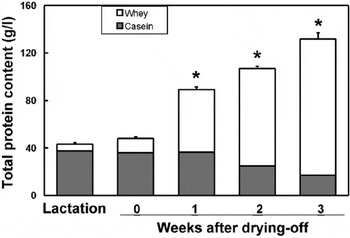
Contents of total protein and casein in skimmed serum of stasis secretions collected at 0–3 weeks after drying-off are presented in Fig. 1 with those of regular milk (Lactation) as a contrast. Protein content of last milk (week 0) (47·6±1·4 g/l) was not different (P>0·05) from that of regular milk (43·0±1·2 g/l), whereas the protein content of stasis secretion collected at week 1 (88·9±2·3 g/l), week 2 (106·7±2·1 g/l) and week 3 (131·6±5·3 g/l) after drying-off was significantly higher (P<0·05) than that of regular milk, respectively. Casein abundance, expressed as the percentage of casein content of total serum protein, of last milk (76·1±1·1%) was not different (P>0·05) from that of regular milk (87·2±0·5%) whereas casein abundance of stasis secretion collected at week 1 (41·2±1·7%), week 2 (24·0±1·0%) and week 3 (15·5±0·8%) after drying-off was significantly lower (P<0·05) than that of regular milk, respectively.
The contents of total protein and casein (g/l) of regular milk (Lactation) and stasis secretions collected at 0, 1, 2 and 3 weeks, respectively, after drying-off in cows.

Changes of whey composition of stasis secretion from drying-off cows as compared with regular milk
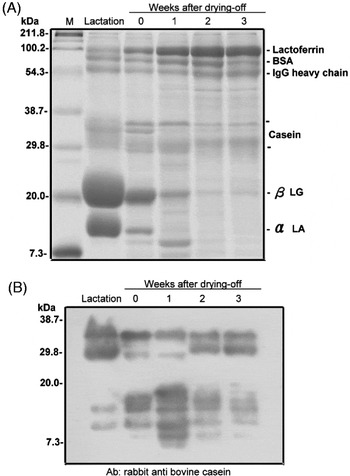
The pattern of whey composition of stasis secretions collected at 0–3 weeks after drying-off is reflected in a typical SDS-PAGE result (Fig. 2A) with that of regular milk (Lactation) as a contrast. In regular milk, β-lactoglobulin (β-lg) and α-lactoalbumin (α-la) are by far the most abundant components. Trace amounts of lactoferrin, BSA, IgG heavy chain, and soluble caseins are also detected according to molecular size. However, the prevalence of β-lg, α-la and soluble caseins in stasis secretion obviously decreased with advancing weeks after drying-off, whereas the prevalence of lactoferrin, BSA and IgG heavy chain in stasis secretion obviously increased with advancing weeks after drying-off. No peptide smaller than 7·3 kDa was detected with the present SDS-PAGE methodology.
Whey composition revealed by 15% SDS-PAGE (A) and the presence of casein-derived proteins detected by immunoblotting against anti bovine casein antibody (B) of regular milk (Lactation) and stasis secretions collected at 0, 1, 2 and 3 weeks, respectively, after drying-off in cows. One typical result is shown.

Changes of casein-derived proteins of stasis secretion from drying-off cows as compared with regular milk
The presence of casein-derived proteins in stasis secretion collected at 0–3 weeks after drying-off is reflected in a typical immunoblotting result against anti-bovine casein antibody (Fig. 2B) with that of regular milk (Lactation) as a contrast. In regular milk, antibody-reactive bands are densely distributed between 25 and 30 kDa while a band <20 kDa is barely detected. On the contrary, in all stasis secretions, antibody-reactive bands <20 kDa obviously increases while antibody-reactive bands between 25 and 30 kDa decrease in a seemingly reciprocal manner, especially for week-1 stasis secretion. Similarly to the SDS-PAGE results, species <7·3 kDa was not detected under the current immunoblotting methodology. As a consequence, week-1 stasis secretion, as well as regular milk, was used in the subsequent MALDI-TOF MS and LC-ESI MS/MS analyses.
MALDI-TOF MS of week-1 stasis secretion from drying-off cows as compared with regular milk
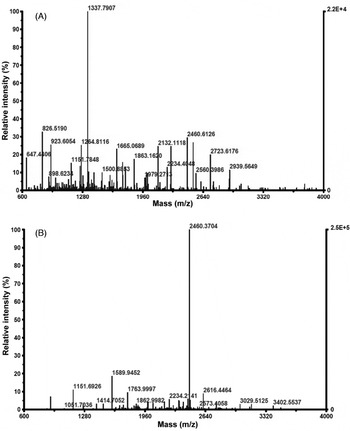
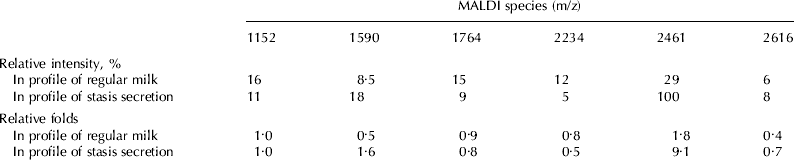
MALDI-TOF mass spectra of the 10-kDa filtrates prepared from week-1 stasis secretion (Fig. 3B) is displayed in contrast to that of regular milk (Fig. 3A). These two MALDI-TOF profiles appear very different in both species type and intensity. Upon closer examination, at least 6 species are commonly present in stasis secretion and regular milk, those are m/z ~1152, ~1590, ~1764, ~2234, ~2461 and ~2616. On the other hand, species m/z ~827, ~924, ~1265, ~1337, ~1665, ~2132 and ~2723 are present only in regular milk but not in stasis secretion. To estimate the variation in quantity of those common species, the relative intensity of each species in individual profile is transformed into folds with respect to that of species m/z ~1152 and the folds for each species in stasis secretion is contrasted with that in regular milk (Table 1). The results show that species m/z ~1590 and ~2460 are present as 1·6 and 9·1 folds, respectively, with respect to that of species m/z ~1152 in stasis secretion, while in regular milk the folds are 0·5 and 1·8, respectively. Other species remain stable in stasis secretion compared to regular milk. Estimation of the absolute quantity of species with current MALDI is not feasible.
Typical MALDI-TOF mass spectrum of regular milk (A) and stasis secretion collected at 1 week after drying-off in cows (B). The 10 kDa-filtrates were prepared and pooled for regular milk (n=5) and stasis secretion (n=6), respectively. MALDI TOF MS was repeated 3 times.

Relative distribution of six MALDI-TOF MS species commonly present in regular milk and stasis secretion collected at week 1 post drying-off in cowsFootnote †
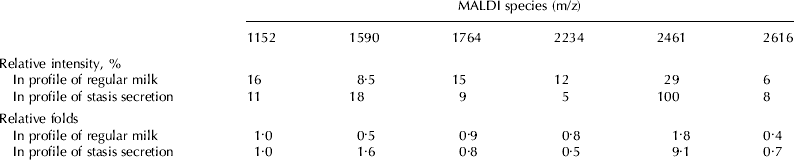
† The 10 kDa-filtrates was prepared and pooled for regular milk (n=5) and for stasis secretion (n=6), respectively, before analysis
LC-ESI MS/MS of week-1 stasis secretion from drying-off cows as compared with regular milk
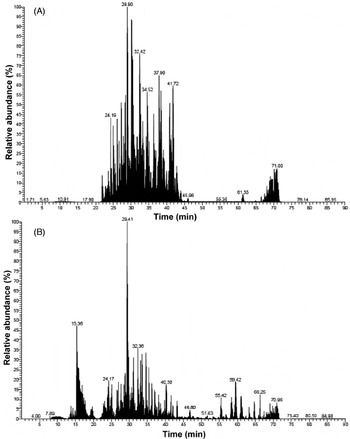
The first MS scan of total ion chromatogram of LC-ESI MS/MS is displayed for 10-kDa filtrates of week-1 stasis secretion (Fig. 4B) in contrast to that of regular milk (Fig. 4A). The x-axis of these chromatograms is the resolution time on C18 column and the base peak is shown in order to have a better baseline. Apparently different profiles were seen between stasis secretion and regular milk. It is obvious that species in stasis secretion encompass a relatively broader spectrum of polarity compared with those in regular milk.
The base peak ion chromatograms of C18 column in LC-ESI/MS/MS for regular milk (A) and stasis secretion collected at 1 week after drying-off in cows (B). The 10 kDa-filtrates were prepared and pooled for regular milk (n=5) and for stasis secretion (n=6), respectively, before analysis.

Mapping peptide sequence for week-1 stasis secretion from drying-off cows as compared with regular milk
Mapping MS/MS fragmentation pattern to sequences in database by Mascot search server was restricted to no-trypsin, no-phosphorylation to improve searching efficiency and the results are summarized in Table 2. Far more mapped peptides were found derived from β-casein than from other casein types or whey proteins. Among the mapped β-casein peptides, 34 are commonly found in regular milk and stasis secretion while 30 and 202 are unique for regular milk and stasis secretion, respectively. No sequence deriving from other casein types was found either in regular milk or in stasis secretion. Mapped sequences deriving from whey proteins includes 5 and 4 β-lg peptides, respectively, in regular milk and stasis secretion, and 2 and none BSA peptides, respectively, in regular milk and stasis secretion.
Number of matched peptides based on LC-ESI/MS/MS results that are derived from milk proteins of regular milk and stasis secretion collected at week 1 post drying-off in cowsFootnote †

† The 10 kDa-filtrates was prepared and pooled for regular milk (n=5) and for stasis secretion (n=6), respectively, before analysis
Cleavage positions on β-casein of week-1 stasis secretion from drying-off cows as compared with regular milk
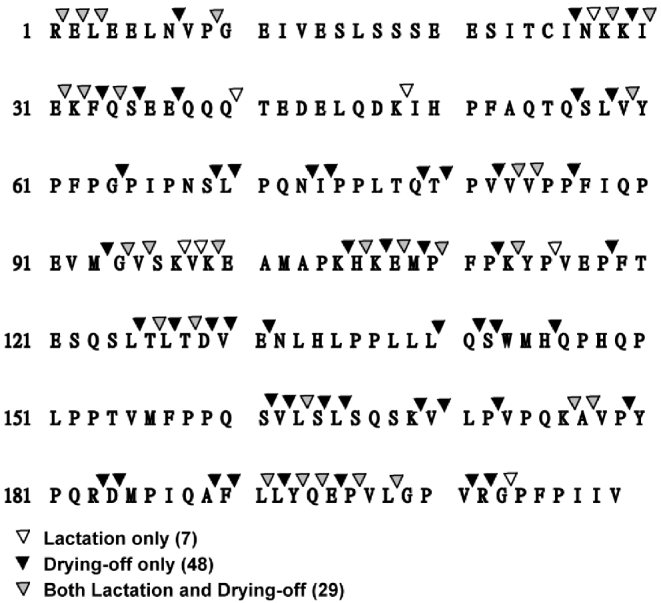
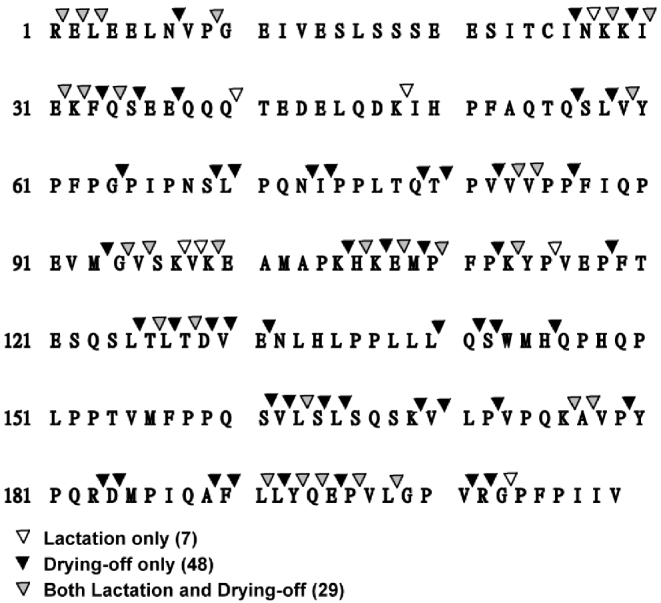
To compare the difference in cleavage positions on β-casein of stasis secretion and regular milk, cleavage sites were assigned based on the above successfully mapped β-casein peptides. Nevertheless, gaps were found between C-terminal end of the up-stream sequences and N-terminal end of the down-stream sequences in both stasis secretion and regular milk. Missing sequences in stasis secretion are β-casein 11–26, 42–56, 67–69, 138–140 and 175–176, and in regular milk are β-casein 11–27, 47–48, 56–59, 67–83, 91–94, 105–106, 125–126, 133–163 and 189–191. For only N-terminal cleavage sites, 36 and 77 locations are assigned on β-casein of regular milk and week-1 stasis secretion, respectively (Fig. 5), among the 77 cleavage positions on β-casein of stasis secretion, 48 are novel compared with those of regular milk.
N-terminal cleavage positions on β-casein of regular milk (Lactation) and stasis secretion collected at 1 week after drying-off in cows (Drying-off) based on mapped peptides from LC-ESI/MS/MS.
Discussion
In the present study MALDI-TOF MS and LC ESI MS/MS, in combination with the more popular biochemical approaches, were applied with the attempt to qualitatively characterize the nature of peptide generation within the mammary gland of drying-off cows. Moreover, the particle-based MS technology (Hortin, Reference Hortin2006) was supplementary to the mass-based SDS-PAGE and immunoblotting. The results of biochemical methodologies showed a reciprocal change in the prevalence of whey and casein in stasis secretion as compared with regular milk (Fig. 1). Major whey proteins of stasis secretion also switched from β-lg and α-la of regular milk to those with more physiological implications (lactoferrin, IgG and BSA) (Fig. 2A). Immunoblotting assay (Fig. 2B) indicated that extensive caseinolysis is, at least, partially responsible for the decrease of casein abundance in stasis secretion. The decreased production of casein, β-lg and α-la in drying-off cows also supports the presumption that their milk synthesis capacity is in a resting state. Our MALDI-TOF MS revealed vastly different peptide profiles for stasis secretion and regular milk (Fig. 3 and Table 1). Since the relative intensity of MALDI-TOF MS species strongly depends on the composition of the analysed peptide mixture, direct comparison of the abundance of a specific peptide between different mixtures would not be feasible. The emergence of new quantitative proteomic methods for dairy products (Gagnaire et al. Reference Gagnaire, Jardin, Jan and Lortal2009) might help solve the quantity issue of MALDI-TOF MS in the future.
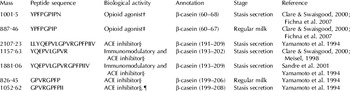
Our LC ESI MS/MS results showed β-casein to be the parent protein of the majority of peptides recognized in stasis secretion (Table 2). Despite the fact that α-casein is more abundant than β-casein, an indigenously preferential hydrolysis of β-casein over α-casein in bovine and human milk has been reported (Nielsen, Reference Nielsen2002; Ferranti et al. Reference Ferranti, Traisci, Picariello, Nasi, Boschi, Siervo, Falconi, Chianese and Addeo2004). Furthermore, α-casein is more extensively phosphorylated than β-casein. Our failure to identify any peptide derived from α-casein in either regular milk or stasis secretion might be at least partly attributable to the current confining searching condition. Still, five β-casein-derived peptides found in stasis secretion share the sequences of known bioactive peptides (Table 3). Among them, β-casein peptides 60–68 share the C-terminal end of traditional opioid peptides (Clare & Swaisgood, Reference Clare and Swaisgood2000; Fichna et al. Reference Fichna, Janecka, Costentin and Do Rego2007). Also, the C-terminal end β-casein peptides 191–209, 193–209, 199–208 and 193–202 are reported to play roles in ACE inhibition (Yamamoto et al. Reference Yamamoto, Akino and Takano1994) and/or immuno-modulation (Meisel, Reference Meisel1998; Clare & Swaisgood, Reference Clare and Swaisgood2000; Sandre et al. Reference Sandre, Gleizes, Forestier, Gorges-Kergot, Chilmonczyk and Leonil2001). It has long been suspected that local factors contribute coordinately to the dramatic and efficient transformation of cow mammary glands after drying-off. Israeli scientists have proposed some physiological functions for casein-derived peptides based on cellular, organ and animal studies, including the stress down-regulation of milk production, the disruption of glandular tight junction during involution and the eradication of bacterial infection of mammary quarters (Silanikove et al. Reference Silanikove, Shamay, Shinder and Moran2000; Shamay et al. Reference Shamay, Shapiro, Mabjeesh and Silanikove2002; Shamay et al. Reference Shamay, Shapiro, Leitner and Silanikove2003; Silanikove et al. Reference Silanikove, Iscovich and Leitner2005). Our results suggest that stasis secretion is a promising source of novel bioactive peptides and a more focused exploitation is warranted.
Peptides identified in regular milk or stasis secretion of cows with homologous sequence to known bioactive peptides

† Two residues longer in the carboxyl-terminal than the opioid peptide
‡ One residues longer in the carboxyl-terminal than the opioid peptide
§ ACE is an abbreviation of angiotensin 1-converting enzyme
¶ Two residues longer in the carboxyl-terminal than the known bioactive peptide
Attribution of MALDI-TOF MS species to LC ESI MS/MS mapped peptides is not practical currently. First, different ionization technologies of these two MS generated different ionization populations. Second, mass of MALDI-TOF MS species should include the various post-translational modifications, whereas LC ESI MS/MS in our study mapped only peptides without phosphate modification. According to the literature, far more casein-derived bioactive peptides are reported as non-phosphorylated than as phosphorylated, with the exception that casein-derived phosphopeptides might participate in calcium transport (Cross et al. Reference Cross, Huq, Bicknell and Reynolds2001) and disruption of mammary tissue tight junction (Shamay et al. Reference Shamay, Shapiro, Mabjeesh and Silanikove2002). Without the restricted searching condition, many more peptides would be expected to be identified in our study, but the huge number of possible combinations of sites and numbers of phosphorylation would render the searching procedure extremely painstaking. A function-directed, screening step should always be applied prior to MS in order to reduce the size of database and, therefore, the complexity of mapping procedure, as was done by Pihlanto et al. (Reference Pihlanto, Virtanen and Korhonen2010).
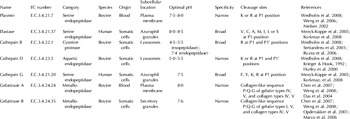
Efforts to identify the milk proteinases responsible for the peptides generated in stasis secretion resulted in the putative list in Table 4. Known milk proteinases belong to different categories, including serine- (plasmin, elastase, cathepsin G), cysteine- (cathepsin B), aspartic- (cathepsin D), and metallo- (gelatinases A and B) proteinases, and show broad pH-preferentiality from slightly acidic (cathepsins B and D), neutral (cathepsin G and gelatinase B), to slightly alkaline (plasmin, elastase and gelatinase A). Most milk proteinases are principally derived from somatic cells (elastase, cathepsin family and gelatinase B) some of humoral origin (plasmin and gelatinase A). Plasmin is a trypsin-like proteinase with a high specificity towards lysine (K) and arginine (R). From our marked cleavage positions on β-casein (Fig. 5), every lysine and arginine residue is cleaved and all except lysine 48 have more than 2 clustered cleavage sites surrounding lysine or arginine, mostly down-streamed. There are 6 new plasmin cleavage sites in β-casein of stasis secretion, but not in β-casein of regular milk, including lysine 29, lysine 105, lysine 107, lysine 169, arginine 183 and arginine 202, and 6 new lysine or arginine clustered cleavage sites. These altogether 12 new cleavage sites account for one-fourth of the total of 48 new recognized cleavage sites on β-casein of stasis secretion (Fig. 5). This observation could be easily explained by our previous report of high plasmin activity in stasis secretion (Weng et al. Reference Weng, Chang, Chen, Chou, Peh, Huang, Chen and Nagahata2006; Chou et al. Reference Chou, Yu, Chen, Peh, Liu, Chen, Naganata and Chang2009). The role of plasmin in casein hydrolysis is widely acknowledged. Ferranti et al. (Reference Ferranti, Traisci, Picariello, Nasi, Boschi, Siervo, Falconi, Chianese and Addeo2004) proposed a detailed proteolysis pathway in early human milk, starting with the action of plasmin, followed by endopeptidases and exopeptidases including aminopeptidases and carboxypeptidases. Our observations of clustering cleavage surrounding lysine or arginine imply that plasmin is apparently the starting enzyme then exopeptidases follow. Because there are more down-stream cleavages than up-stream cleavages, we propose that in stasis secretion aminopeptidases are more actively involved in β-casein cleavage than carboxypeptidases. Since the proteinases listed in Table 2 are all endopeptidases with the exception of cathepsin B under certain circumstances, the properties and sources of milk exopeptidases are ill-defined in the literature and therefore warrant more advanced research. Owing to the lack of adequate information especially with respect to the bovine, the other proteinases and their spectrum of specificity are still disputable. Our report of gelatinase activity towards caseins beyond the extracellular matrix is still in want of confirmation from other studies. Finally, the progressive generation of peptides in stasis secretion might involve many more physiological factors other than proteolytic enzymes and the exposure time, and warrants further investigation.
Traits of major milk proteinases

In conclusion, the current study using different methodologies directly demonstrates extensive caseinolysis and active generation of peptides in stasis secretion of drying-off cows. The current LC ESI MS/MS identifies at least 202 new β-casein peptides in stasis secretion and recognizes 5 sequences of known bioactive peptides. The generation of peptides in stasis secretion involves the action of milk proteinases and possibly other physiological factors. Our study could serve as a base for identifying more novel bioactive peptides in stasis secretion.