

Introduction
Polish konik horses, also named Polish primitive horses (Equus caballus gmelini Antonius form silvatica Vetulani), are the primitive horse breed originating directly from the tarpans (E. ferus ferus), which lived on the steppes of south-east Europe and Asia (West Siberia) (Pruski, Reference Pruski1959; Pruski and Jaworowska, Reference Pruski and Jaworowska1963; Kownacki, Reference Kownacki1984; Pasicka, Reference Pasicka2013). By the end of the 19th century, the original breed was completely extinct. The last tarpan, an 18-year-old stallion, died in the Moscow Zoological Garden in 1884. A Polish zoologist, Professor Tadeusz Vetulani, took great interest in primitive horse breeds, and in the early 1930s he started restoration of the tarpan. In small farms of eastern Poland, he had found primitive horses that bore a strong resemblance to their wild ancestors. In 1939, a population of 40 tarpans lived already in the Białowieża Reserve (east of Poland, close to the Belarus border). Tarpans are of gray color and bear a short mane and a dark stripe along the back.
This semi-wild breed of horse is a natural relic and a precious part of Polish and European heritage. Due to the small population of these horses, they are classified as an endangered breed and have been included in the program for protection of threatened local breeds (Jaworski, Reference Jaworski2007). Analysis of data collected in 2010 documented the national population of Polish konik horses to be 150 mares and 40 stallions in state breeding centers as well as 550 mares and 130 stallions under natural conditions (Jezierski et al., Reference Jezierski, Jaworski, Kaproń, Łukomski and Słomiany2012).
Polish konik horses are maintained under three management systems: stabled, free-ranging, and semi-free (Jezierski and Jaworski, Reference Jezierski and Jaworski2008). The stabled system is traditional – the horses are kept and fed in stables or on small paddocks. In the free-ranging system, horses are kept in natural reserves under nearly natural conditions without human care (Jaworski, Reference Jaworski2007). The semi-free conditions are characterized by keeping the horses in large reserve areas, the horses are periodically in contact with people, moved onto small paddocks, and can be used for various types of work (Jaworski and Jezierski, Reference Jaworski and Jezierski2006; Jezierski and Jaworski Reference Jezierski and Jaworski2008). In each management strategy horses spend most of time on pastures or paddocks (Jaworski and Jaszczyсska, Reference Jaworski and Jaszczyсska2004).
The population of Polish konik horses consists of closely related individuals, which can affect the health and immunity of these animals. Threats to the health of the horses include viral, bacterial, and parasitic diseases.
The purpose of this review is to describe the present knowledge of the parasite fauna of the Polish konik horses (E. caballus gmelini Ant.), based on the publications of various scientific centers that have conducted parasitological studies on these animals, including those living in free-ranging populations, as well as species bred in captive breeding reserves. This review embraces the classical meaning of the word ‘parasite’, thus including representatives of protozoa and tissue stages of Diptera parasitizing horses at least throughout one phase of parasite development. It does include viruses and bacteria, being the subject of microbiological studies, or short feeding blood-sucking flies, such as Tabanidae and Culicidae, for which the konik is a food source. Likewise, commensal and phoretic mites, nematodes and insects that feed on the konik are included. For publications, PubMed, ISI Web of Science, Scopus, and Google Scholar were searched with search terms associated with the review subject (e.g., Polish primitive horse, konik, E. caballus gmelini Ant., and names of parasite species). Moreover, older papers, which are not included in databases, were used. The results presented in this review come from the published studies.
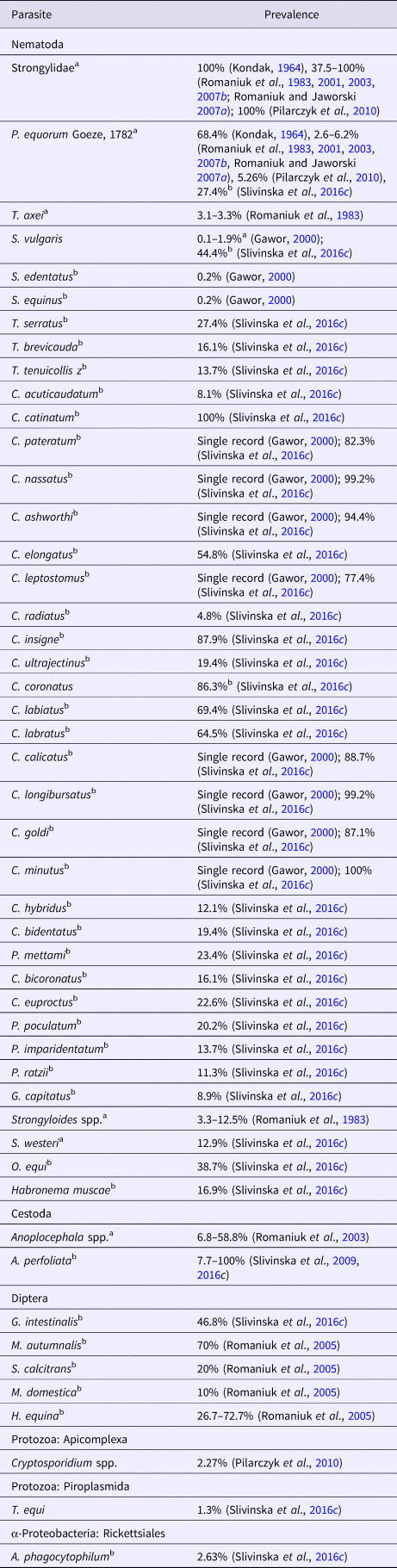
During 53 years of investigation conducted by various centers, a total of 46 species of parasites in the Polish konik horses were revealed. The most numerous group was nematodes, with 37 species. The full list of parasite species is presented in Table 1.
The list of parasites with the prevalence noted, recorded in Polish konik horses

a Mean prevalence based on the detection of eggs per gram.
b Mean prevalence counted after the collection of the specimens of parasites after treatment.
Gastro-intestinal parasites
The first investigations of infection by internal parasites in Polish konik horses were conducted during the second half of the last century. The intensity and season dynamic of egg production by Strongylidae and Parascaris equorum were evaluated of horses from the reservation of tarpans in Białowieża (Kondak, Reference Kondak1964). The author showed that egg production by Strongylidae was low in spring, increased in summer, and gradually decreased in autumn and winter. Egg production by P. equorum did not depend on the season. An analysis of the relationships between the age of horses and the number of nematode eggs excreted was done at first for Polish konik horses. Accordingly, the infection of tarpans with Strongylidae increased with the age of animals and infection with P. equorum decreased with the age of tarpans (Kondak, Reference Kondak1964).
The next investigations of internal parasites of Polish konik horses were carried out in the 1980s. Romaniuk et al. (Reference Romaniuk, Bugajak and Lawrynowicz1983) performed a comparative epidemiological study of the endoparasite infections in the Polish konik horse breed under free forest and stall breeding systems at the breeding center of the Polish Academy of Sciences (PAS) in Popielno (near Olsztyn). Fecal samples were examined using Fülleborn's flotation and Baermann larvoscopy methods. Grass and fecal samples were collected in the forest and examined using the Baermann method. The nematodes found included Strongylus edentatus, S. equinus, S. vulgaris, Cyathostominae spp., Strongyloides westeri, P. equorum, and Trichostrongylus axei. It was first noted that coprophilous fungi and coprophilic insects of the families of Diptera and Coleoptera were an important link in the spread of parasitic nematodes of horses, under both breeding systems.
Romaniuk et al. (Reference Romaniuk, Jaworski and Snarska2001, Reference Romaniuk, Jaworski and Snarska2002, Reference Romaniuk, Jaworski, Golonka and Snarska2003, Reference Romaniuk, Reszka and Lasota2004, Reference Romaniuk, Jaworski and Golonka2007b) and Romaniuk and Jaworski (Reference Romaniuk and Jaworski2007a) conducted investigations of different gastrointestinal parasites and their dynamics in Polish konik horses by breed, under free forest and stall breeding systems at the breeding center of the PAS in Popielno. The main conclusions were that nematodes belonging to the Strongylidae (Trichonema, currently Cyathostominae, and Strongylus), Ascaridae (P. equorum), and tapeworms (Anoplocephala spp.) occurred during every season of the year.
However, Anoplocephala spp. and P. equorum infections were still found to decrease during the winter. The infections were mainly revealed in foals and mares, while strongylids were more prevalent in the harem stallions and mares.
In domestic Polish konik horses, Pilarczyk et al. (Reference Pilarczyk, Smugala, Binerowska, Tomza-marciniak, Bakowska and Tylkowska2010) used coproscopic examination with Willis-Schlaf and McMaster methods to observe Strongylidae (100%), Cyathostominae (100%), and P. equorum (5.26%) in horses imported from the Netherlands.
In the aforementioned studies, gastrointestinal parasite infection was evaluated on the basis of fecal examination. Occurrence of adult specimens of Strongylidae in Polish konik horses from Popielno involved collecting worms after ivermectin treatment (Gawor, Reference Gawor2000). Twelve cyathostome species and one large strongyle (Strongylinae: Strongylus edentatus) were collected from the feces of two stabled horses. In the order of abundance, cyathostomins found were: Cyathostomum catinatum, C. pateratum, Cylicostephanus longibursatus, Cylicocyclus nassatus, Coronocyclus coronatus, C. ashworthi, C. minutus, C. goldi, C. calicatus, C. labiatus, C. labratus, and C. leptostomus. It was found that the five most abundant species made up 97.7% of total cyathostomes in two horses examined (Gawor, Reference Gawor2000).
Several studies of gastrointestinal parasites in Polish konik horses from different reserves in Poland were conducted, using the diagnostic deworming method after anthelmintic treatment (Slivinska et al., Reference Slivinska, Gawor and Jaworski2009, Reference Slivinska, Wróblewski and Gawor2013, Reference Slivinska, Wróblewski and Gawor2016a, Reference Slivinska, Kharchenko, Wróblewski, Gawor and Kuzmina2016b). Thirty-five nematode species, one cestode (Anoplocephalidae: Anoplocephala perfoliata), and one species of botfly larvae (Gasterophilidae: Gasterophilus intestinalis) were observed. The list of gastrointestinal parasites was supplemented with five species of Strongylinae (S. vulgaris, Triodontophorus serratus, T. brevicauda, T. tenuicollis, and Craterostomum acuticaudatum) and 13 species of Cyathostominae (C. elongates, C. radiatus, C. insigne, C. ultrajectinus, C. hybridus, C. bidentatus, Parapoteriostomum mettami, Cylicodontophorus bicoronatus, C. euproctus, Petrovinema poculatum, Poteriostomum imparidentatum, P. ratzii, and Gyalocephalus capitatus). Two new nematode species for Polish konik horses were recorded, the threadworm S. westeri, and the pinworm, Oxyuris equi. The authors indicated influences of age, sex, and management strategy on the parasite community. The highest species diversity (n = 30–31) was observed in the free-ranging horses, the lowest (n = 15) in stabled horses (Slivinska et al., Reference Slivinska, Víchová, Werszko, Szewczyk, Wróblewski, Peťko, Ragač, Demeshkant and Karbowiak2016c).
Ectoparasites
Studies on external parasites in Polish konik horses have been performed by different researchers. Szymaniuk et al. (Reference Szymaniuk, Mikołajczyk and Romaniuk1995), for the first time, recorded ectoparasites from horses of Popielno. These parasites include Ixodes spp. ticks and different Diptera, including Gasterophilus spp., Lipoptena spp., and flies of the Tabanidae and Culicidae families. The occurrence of horse botfly, G. intestinalis, eggs on hairs of mares, suckling colts, and young mares and colts of Polish konik horses was observed by Romaniuk and Snarska (Reference Romaniuk and Snarska2002). The total number of eggs examined on hair was the greatest on young mares, and the least on suckling foals. In the next study, Musca autumnalis, M. domestica, Stomoxys calcitrans and Hippobosca equina were found on Polish konik horses in August (Romaniuk et al., Reference Romaniuk, Szymborska, Kal and Karpińska2005).
Biochemical and morphological changes in the blood of Polish konik horses infected with Gasterophilus spp. larvae were analyzed by Snarska and Romaniuk (Reference Snarska and Romaniuk2005a, Reference Snarska and Romaniuk2005b) and Pawlas-Opiela et al. (Reference Pawlas-Opiela, Soltysiak and Gorczykowski2010). These studies demonstrated opposite results. On the one hand, metabolic disturbances caused by horse botfly led to a decrease of activity of several enzymes and electrolytes (Snarska and Romaniuk, Reference Snarska and Romaniuk2005a), a decrease in the red blood cell count, and average hemoglobin concentration in blood cells (Snarska and Romaniuk, Reference Snarska and Romaniuk2005b). The other study showed that botfly larvae which colonize the gastrointestinal tract have relatively insignificant influence on the basic hematological and biochemical parameters of horse blood (Pawlas-Opiela et al., Reference Pawlas-Opiela, Soltysiak and Gorczykowski2010). However, significant differences between horses at early and late stages of invasion were found in terms of erythrocyte parameters (Pawlas-Opiela et al., Reference Pawlas-Opiela, Soltysiak and Gorczykowski2010).
Parasitic protozoa and bacteria
The protozoan gastrointestinal parasite, Cryptosporidium spp. (Apicomplexa) was found in 2.27% of domestic Polish konik horses using a modified Ziehl-Neelsen staining method (Pilarczyk et al., Reference Pilarczyk, Smugala, Binerowska, Tomza-marciniak, Bakowska and Tylkowska2010).
A protozoan blood parasite, Theileria equi (Piroplasmidae) and a bacterium, Anaplasma phagocytophilum (Rickettsiales) were detected with a molecular technique (i.e., nested PCR) in foals of Polish konik horses breeding under free-ranging conditions in the Biebrzanski National Park (Slivinska et al., Reference Slivinska, Víchová, Werszko, Szewczyk, Wróblewski, Peťko, Ragač, Demeshkant and Karbowiak2016c). This was the only report of a molecular survey of tick-borne pathogens in Polish konik horses.
Summarizing the publications available, the parasite fauna of Polish konik horses is well described. Most reports are based on horses from different types of management strategies.
Despite the fact that Polish primitive horses are well known for their strong disease resistance, parasitic infections may influence their health and breeding. On the basis of publications describing parasitological studies, it is possible to note that, the external factors such as breeding conditions affect the infection levels much more than internal factors (sex and age). Surveyed horses under free-ranging breeding conditions with the high helminth diversity were associated with low intensity of infection. The free-ranging horses had higher levels of strongylid infection. This finding was primarily associated with infrequent or absent anthelmintic treatments. In contrast, more frequent deworming in stabled horses resulted in a lower eggs per gram values and poorer species biodiversity of the intestinal parasites. In the analysis of species, composition of the strongylid communities was recorded that stabled horses harbored the lowest number of species of these nematodes (15), while the highest species biodiversity (31) was documented in free-ranging horses (Slivinska et al., Reference Slivinska, Wróblewski and Gawor2016a).
Considering these results, it appears that the occurrence and clinical significance of internal and external parasites should be taken into account in expansion of breeding programs on Polish konik horse farms.
Acknowledgments
The authors thank Prof. Eugene Lyons from the Gluck Equine Research Center, University of Kentucky, USA for his comments and corrections to the paper.