In comparisons of health care systems and delivery, the United States and the United Kingdom tend to be cast as opposing polar models. At one end of the spectrum there is the United States, lacking anything that might resemble a coherent system of delivery and spending more than any other country even while failing to ensure that all its citizens have the right of access of health care. At the other end of the spectrum, there is the United Kingdom, with a centrally funded and controlled National Health Service (NHS) that is conspicuously parsimonious by international standards even while guaranteeing the right of access to health care to all its citizens. While incentives in US medicine are to do too much, incentives in UK medicine are to do too little. In popular imagination, the original sin of the United States is technology driven waste while the original sin of the United Kingdom is rationing as symbolised by waiting lists.
The polar models are accurate as far as they go. As of 2008, health care spending accounted for 16% of the Gross Domestic Product in the United States as against only 8.7% in the United Kingdom. In 2009, there were over 46 million uninsured people in a recession hit United States (Davis, Reference Davis2010), while the blanket of NHS protection covered the whole, equally recession hit UK population. Cutting or at least containing costs by eliminating waste has been a long standing, ever-optimistic theme in US policy making, most recently revived by the Obama Administration (Marmor et al., Reference Marmor, Oberlander and White2009). Rationing is indeed a feature of the NHS, as it is of most health care systems: in recent years rationing by delay has diminished as waiting lists have shrunk but rationing by excluding specific procedures or drugs from the NHS menu and by tightening the criteria for access to treatment continues, with the National Institute for Clinical Excellence (NICE) playing a leading role in deciding what the NHS should or should not offer (Klein and Maybin, Reference Klein and Maybin2012).
To avoid caricature, and to provide a comparative context for the articles that follow, it is however important to qualify the neat antithesis. Both countries are in the process of change. The Obama reforms will, when eventually implemented, extend coverage dramatically; the NHS's mimic market, with money following patients, is shifting the balance of incentives. And switching the focus of attention from the headline figures of spending and coverage to a more disaggregated analysis of medical care in the two countries reveals a more complex picture, even if we use only the most easily accessible statistics [drawn from the 2010 Organisation for Economic Co-operation and Development (OECD) data base, unless otherwise stated]. Important differences between the two countries remain, of course. But the data also offer hints of convergence, throw up some intriguing puzzles and underline the limitations of relying exclusively on country-level statistics in comparative studies.
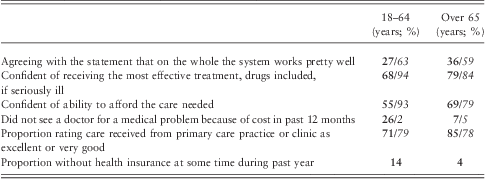
The first point to note is that the most obvious contrast between the two countries applies with much less force to the elderly – and thus to end of life issues – than to the rest of the population. In contrast to the working population, there is no great gap between the United States and the United Kingdom in the coverage enjoyed by the over-65s. The combination of Medicare and Medicaid (for long-term care) means in effect that the over-65s in the United States are assured medical care, much as in the United Kingdom. Important differences remain in the degree and depth of protection: for example, the NHS offers free pharmaceuticals to the over-65s, while requiring the working population to pay prescription charges. But, as Table 1 confirms, the over-65s in the United States are emphatically better protected than the rest of the population: thus only 4% of those interviewed in a 2010 Commonwealth Fund survey reported that they had lacked health insurance in the previous year, compared with 14% of those aged between 18 and 64 years. Further, only 7% of the over-65s, as against 26% of the 18–64 population, reported that they had not seen a doctor for a medical problem during the previous 12 months because of the cost.
The United States and United Kingdom views about health care by age group
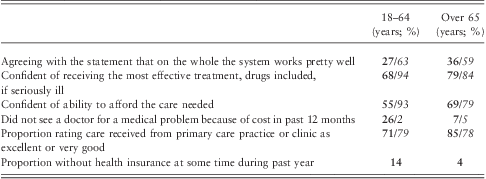
The figures for the United States are in bold type; those for the United Kingdom are in italics.
Source: The 2010 Commonwealth Fund survey of 11 countries: How Health Insurance Design Affects Access to Care and Costs. I am grateful to the Commonwealth Fund for providing me with unpublished tables disaggregating the data by age group.
Unsurprisingly, Table 1 also shows that – across all ages – there were fewer worries about affordability in the United Kingdom across all age groups. And satisfaction with the health system was much higher, too. But, puzzlingly, while in the United States confidence about and satisfaction with medical care was higher among the over-65s than in the 18–64 group, the same was not true of the UK respondents. Thus, while 94% of the younger group in the United Kingdom were confident that they would receive ‘the most effective treatment, including drugs’ if seriously ill, only 84% of the over-65s shared this optimism. In contrast, while optimism levels in the United States were lower than in the United Kingdom across the board, they rose with age. One possible explanation could be that the drivers of satisfaction in the two countries differ. In the United Kingdom, access to health care is taken for granted, while in the United States it is contingent on insurance coverage. Thus, relief at reaching the safe haven of Medicare in the United States may have a halo effect on perceptions of the quality of care received. Alternatively, of course, it could mean that the over-65s in the United Kingdom do relatively worse than the rest of the population – in terms of the quality of treatment – than their counterparts in the United States. We return to this point below.
One sliver of evidence suggesting that the over-65s in the United States might indeed be better off relative to the rest of the population in the United States than in the United Kingdom is provided by mortality statistics. Life expectancy at birth in the United Kingdom is higher than in the United States: 77.3 as against 75.4 years for men, 81.7 as against 80.7 years for women. The United States also does much worse than the United Kingdom in terms of amenable mortality: 88.6 per 100,000 as against 74.0. But the older cohort in the United States catches up. Life expectancy at 65 is much the same in the two countries: 17.4 years for men in both the United Kingdom and the United States and 20.1 and 20.3 years, respectively, for women. It is an intriguing puzzle, and it would be a mistake to make too much of it. But it is at any rate consistent with the fact that US medical care is much more technology-intensive (and malpractice suit driven) than the NHS and the widespread perception of over-zealousness in using that technology to prolong lives, irrespective of the quality of those lives (Callahan, Reference Callahan1990). For example, the number of Computed Tomography (CT) examinations and revascularisation procedures per capita are about four times higher in the United States than in the United Kingdom (2007 or latest available figures).
In both these instances the United States and the United Kingdom are indeed at opposite ends of the international spectrum. The US figures are double the OECD average, while those for the United Kingdom are half the OECD average. Only Germany and Belgium are more zealous than the United States in carrying out revascularisation procedures. But in some other respects, there appears to be convergence on what might be called an Anglophone model of organising care. The United States and the United Kingdom are remarkably similar in the number of doctors per 1000 population (2.4 and 2.5, respectively, as against an OECD average of 3.1), in the number of hospital beds for acute care per 1000 population (2.7 and 2.6, respectively, as against an OECD average of 3.8) and in the number of hospital discharges per 1000 population (126.3 and 125.5, as against an OECD average of 157.8).
In both countries, too, there is anxiety about the quality of care received by the elderly, reflecting perhaps the fact that caring for the elderly at the end of their lives is peculiarly challenging due to co-morbidities and of less interest to physicians trained to prevent rather than ease death. Thus, in the United States there is much discussion of ‘age discrimination’ (Williamson, Reference Williamson2010). And there is a large body of evidence about the wide variations in the quality of care (Leatherman and McCarthy, Reference Leatherman and McCarthy2005; Jha et al., Reference Jha, Oray and Epstein2011). In the United Kingdom the issue has perhaps an even higher profile. Anxiety has been reflected in, and reinforced by, a series of official reports. Thus, in 2009 the Government commissioned a report on age discrimination (Carruthers and Ormondroyd, Reference Carruthers and Ormondroyd2009), which highlighted, among other issues, age specific criteria in cancer screening and treatment. The following year a report by the National Confidential Inquiry into Patient Outcomes and Deaths (2010) identified a series of shortcomings in the treatment of elderly surgical patients: for example, clinically significant delays between admission and operation in over 20% of cases, evidence of malnutrition and poor pain assessment. And in 2011 the Health Service Commissioner (2011) or Ombudsman published a report, based on cases investigated following complaints, which gave “a picture of NHS provision that is failing to meet even the most basic standards of care” for the elderly. “NHS has failed the elderly, says damning report” was the front page headline in one usually sober newspaper (The Guardian, 15 February 2011). No wonder that, as noted above, the over-65s in the United Kingdom are relatively less confident about the quality of care they are likely to receive than their US counterparts. Nor is the use of QALYs (Quality Adjusted Life Years) by NICE, in making its adjudications, calculated to diminish apprehension: QALYs, it is often argued, discriminate against the elderly.
There is also much common ground between the United States and the United Kingdom on an issue with a direct bearing on end of life care. Survey evidence in both countries shows strong public support for the proposition that doctors should be allowed to end the lives of patients with an incurable illness. In the United Kingdom, 82% of respondents endorsed the proposition in a recent survey (Park et al., Reference Park, Curtice, Thomson, Phillips, Clery and Butt2010). In the United States, an earlier survey reported that 75% of respondents supported for a similar proposition (Gallup, 2005). Responses seem to be sensitive to the precise wording of the question but successive surveys in both countries suggest that support for some form of assisted death has solid, majority support. But majority support does not necessarily translate into legislative action. In the United Kingdom although a succession of Bills have been introduced in Parliament to legalise assisted death, they have invariably failed to win sufficient support from legislators. The issue is an instructive example of the ability of intense, organised minorities – in this case religious groups – to block change supported by a diffuse, less committed majority. And in a centralised State, like the United Kingdom, that is the end of the matter. But in the United States three States – Oregon, Montana and Washington – have legalised physician-assisted suicide.
The contrast raises an intriguing question. When it comes to analysing the capacity for policy change, the United States and United Kingdom are seen conventionally and correctly as being yet again at opposite ends of a spectrum. Bringing about change at the national level in the United States means overcoming a series of legislative, legal and other hurdles: witness the decade long struggle over health care reform. Contrast that with the ability of UK governments to drive change through parliament even in the face of widespread opposition: witness the all too frequent reorganisations of the NHS in recent decades. But when it comes to social and moral issues, which national governments may be reluctant to tackle, the United States appears to have the advantage, allowing States to experiment and set up what are in effect pilot projects, which may subsequently be adopted nationally. The example of banning smoking in public places is a case in point, where a movement that started in the West coast States eventually spread across the country (Marmor and Lieberman, Reference Marmor and Lieberman2004).
To note variations within a country is to identify also what all too often is a missing dimension in comparative studies. The standard practice and ease of comparing national data risks exaggerating differences (Baldwin, Reference Baldwin2009) in as much as it does not allow for the possibility that countries that in aggregate appear to be very different, may in fact have subordinate jurisdictions with shared characteristics. In short, contrasting institutional arrangements and political rhetoric at the national level may mask the complex pattern of differences and similarities at the local level. So, for instance, the United States and United Kingdom feature as polar opposites in the regulatory literature. But a comparative study of nursing home regulation (Day and Klein, Reference Day and Klein1987) found that while there were indeed sharp differences between the style of regulators in the United Kingdom and in New York State, Virginia's regulators were close cousins of their counterparts in the United Kingdom.
In health care, geographical differences in practice and provision are gross, as just a few examples illustrate. Consider the accepted picture of the United Kingdom as a low technology health economy compared with the United States. Aggregate national statistics conceal the fact that within the United Kingdom there is a threefold variation in the rate of CT activity and a fourfold variation in Magnetic Resonance Imaging (MRI) activity per 1000 population in different geographical areas (NHS Atlas, 2010). Or take cancer care. A Dartmouth Institute report (Goodman et al., Reference Goodman, Fisher, Chang, Morden, Jacobson, Murray and Miesfeldt2010) showed that there was a sevenfold variation in the proportion of cancer patients admitted to intensive care units during the last month of life – and a 25-fold variation in the number of days they spent in those units. In the United Kingdom, a Parliamentary Committee reported (Public Accounts Committee, 2011) that there were “wide variations in …the extent of emergency admissions, the use of urgent referrals, cancer screening coverage, the use of radiotherapy machines and chemotherapy treatment.” And an earlier report (Department of Health, 2008) showed that the range of spending on health and social care per death was fivefold (from £320 to £1684) in different geographical locations. So it is conceivable that in parts of the United Kingdom American-style health care is delivered, while in parts of the United States British style medicine is practised.
The point would hardly need labouring – we know that variation in the delivery of health care is the norm in all systems – if it were not so often skated over in comparative studies. In an ideal world, conclusions about the performance of different countries would be qualified by an analysis of the probabilities of getting good care (however defined) and the risks of getting inadequate care (however defined) in their health care systems. The data for such comparisons may be difficult to generate. However, the data that we have got suggests that even polar models may have pools of similarity and that in comparing them we should be aware of overlaps as well as contrasts. And while this conclusion may have been prompted by a discussion of end of life care, it clearly applies across the board. It suggests that cross-national comparisons of health care systems could usefully adopt a twin track strategy of mapping both differences and similarities by geographical regions and domains of health care.