Introduction
The cognitive spectrum ranges from normal aging to Alzheimer’s disease and other types of dementias, with mild cognitive impairment (MCI) being the transitional state between the two continuum states (Petersen, Reference Petersen2004). Although individuals with MCI experience memory deficits, they do not demonstrate any impairments to their activities of daily living, unlike those with dementia (Petersen, Reference Petersen2004). While many individuals with MCI go on to develop dementia, this is not necessarily true for everyone, as some individuals show no progression in cognitive impairment and some return to normal cognition over time (Petersen et al., Reference Petersen, Roberts, Knopman, Boeve, Geda, Ivnik, Smith and Jack2009). Timely diagnosis of MCI and knowing the risk of conversion to dementia is critical for ensuring patient-centered care planning, with the provision of the most appropriate interventions to reduce or mitigate conversion risk.
In Canada, the majority of individuals with memory concerns are assessed and managed by geriatric/dementia specialists, with family physicians referring upwards of 82 per cent of patients presenting with cognitive symptoms to specialists (Pimlott et al., Reference Pimlott, Siegel, Persaud, Slaughter, Cohen, Hollingworth, Cummings, Drummond, Dalziel, Sylvius, Pringle and Eliasziw2006). However, there is a critical shortage of geriatric specialists, with wait times to access specialists of up to 12 months and sometimes longer (Borrie et al., Reference Borrie, Cooper, Basu, Kay, Prorok and Seitz2020; Massoud et al., Reference Massoud, Lysy and Bergman2010). Primary care-based Multi-specialty Interprofessional Team (MINT) memory clinics have been developed to address capacity limitations and delays in accessing specialist assessments for cognitive disorders (Lee et al., Reference Lee, Hillier, Heckman, Gagnon, Borrie, Stolee and Harvey2014; Lee, Hillier, et al., Reference Lee, Hillier, Molnar and Borrie2017; Lee et al., Reference Lee, Hillier, Stolee, Heckman, Gagnon, McAiney and Harvey2010). Primary care can play an important role in managing dementia as it has the advantage of established and long-standing relationships between primary care providers and patients and families. Primary care can offer timely assessment and person-focused care, referrals to community support services early in the disease process to reduce crises that can lead to increased health service utilization and care costs, and can increase equitable access to more appropriate services, with improved health outcomes (Starfield et al., Reference Starfield, Shi and Macinko2005). Despite being well-positioned to assess and manage dementia, there is a high prevalence of missed and delayed diagnoses in primary care, highlighting the need to support early diagnosis of dementia in primary care to ensure access to interventions that can delay decline, prevent crises, ease caregiver stress, and delay institutionalization (Aminzadeh et al., Reference Aminzadeh, Molnar, Dalziel and Ayotte2012; Feldman et al., Reference Feldman, Jacova, Robillard, Garcia, Chow, Borrie, Schipper, Blair, Kertesz and Chertkow2008).
Designed to address dementia care challenges in primary care, MINT memory clinics have been developed to build capacity for high-quality dementia care at the primary care level. MINT clinics are supported by dedicated specialists (geriatricians, geriatric psychiatrists, cognitive neurologists) who provide consultative support through virtual case discussion or direct patient referral for the most complex of cases (Lee, Hillier, et al., Reference Lee, Hillier, Molnar and Borrie2017; Lee et al., Reference Lee, Hillier, Stolee, Heckman, Gagnon, McAiney and Harvey2010). Within this shared care approach, multidisciplinary perspectives manage the complex medical, cognitive, and psychosocial issues associated with dementia, and in particular to manage changes in disease trajectory (Grand et al., Reference Grand, Caspar and Macdonald2011). There is increasing interest in the implementation of the MINT memory clinic care model across Canada as an opportunity to support the person-centered, continuous, comprehensive, and coordinated care that is the hallmark of primary care (Starfield et al., Reference Starfield, Shi and Macinko2005). Over 118 memory clinics have been established in urban, rural, and remote practice settings across Ontario, British Columbia, Alberta, Saskatchewan, New Brunswick, and Nova Scotia. While overall MINT memory clinic outcomes have been reported (Lee, Hillier, et al., Reference Lee, Hillier, McKinnon Wilson, Gregg, Fathi, Sturdy Smith and Smith2018; Lee, Slonim, et al., Reference Lee, Slonim, Hillier, Lu and Lee2018; Sheiban et al., Reference Sheiban, Stolee, McAiney and Boscart2018), very little has been published on the profile of patients seen within these primary care-based clinics and their trajectories over time.
The time to conversion from MCI to dementia is not well known or understood (Zhang et al., Reference Zhang, Li, Song, Li, Lu and Shan2024). The prognosis for those with MCI may vary according to the underlying cause, with some patients demonstrating stability or improvement while others may progress to dementia. The prognosis of MCI may also vary depending on the setting. In a longitudinal study of cognitive aging in France, subjects meeting criteria for MCI were recruited from a general practice network, with physicians trained to diagnose MCI in a standardized fashion (Artero et al., Reference Artero, Petersen, Touchon and Ritchie2006). Depending on the criteria, progression to dementia was 18 per cent over 3 years (6%/year), or 14 per cent over 2 years (7%/year) (Artero et al., Reference Artero, Petersen, Touchon and Ritchie2006). In specialty clinics, the prognosis for progression is higher; generally, 15 per cent/year progression is reported (Feldman et al., Reference Feldman, Jacova, Robillard, Garcia, Chow, Borrie, Schipper, Blair, Kertesz and Chertkow2008; Petersen et al., Reference Petersen, Roberts, Knopman, Boeve, Geda, Ivnik, Smith and Jack2009; Roberts et al., Reference Roberts, Knopman, Mielke, Cha, Pankratz, Christianson, Geda, Boeve, Ivnik, Tangalos, Rocca and Petersen2014). In a community-based study of 4,102 older adults, cognitive assessments conducted every 4 years over a 24-year period found that an annual conversion rate from MCI to dementia was 5.9 per cent; conversion rates increased with age (Gao et al., Reference Gao, Unverzagt, Hall, Lane, Murrell, Hake, Smith-Gamble and Hendrie2014). Conversion rates were highest in a hospital-based sample, with a rate of 18.4 per cent over 1 year (Thaipisuttikul et al., Reference Thaipisuttikul, Jaikla, Satthong and Wisajun2022). A study examining the differences in MCI to dementia conversion rates and time to conversion between patients diagnosed in speciality clinics and community outreach settings found a mean time to conversion of 2.2 years, with annual conversion rates of 13 per cent and 3 per cent for clinic and community samples, respectively (Farias et al., Reference Farias, Mungas, Reed, Harvey and DeCarli2009). Baseline functional impairment was the strongest predictor of conversion to dementia in this study (Farias et al., Reference Farias, Mungas, Reed, Harvey and DeCarli2009). Understanding the likelihood of progression from MCI to dementia among individuals seen in primary care-based memory clinics may provide critical insight into the value of identifying MCI in primary care as an opportunity to introduce interventions aimed at reducing the risk of cognitive decline. The primary objectives of this paper are to investigate the 5-year trajectory of patients with an initial diagnosis of MCI, determine the risk for progression to dementia incorporating age, sex, and cognitive test scores as covariates, and to calculate an annual rate from MCI to dementia for patients assessed in a MINT memory clinic. Secondary objectives are to describe the demographic characteristics of patients referred to the MINT clinic, describe tests ordered, and referrals to specialists and home care services.
Methods
Study design and setting
This study examined a 5-year longitudinal cohort of patients assessed in a MINT memory clinic between June 2006 and May 2019, and who had data available for their initial visits and any follow-up visits within 5 years. Data were abstracted for all patients during the accrual window via retrospective chart review.
MINT memory clinics are family physician-led and specialist-supported clinics formed within primary care practice settings using existing multidisciplinary health human resources, or teams created through partnerships with community agencies and services, to accept referrals for patients rostered within the practice or from within a geographic region (Lee et al., Reference Lee, Hillier and Gregg2019; Lee et al., Reference Lee, Hillier, Heckman, Gagnon, Borrie, Stolee and Harvey2014; Lee et al., Reference Lee, Hillier, Stolee, Heckman, Gagnon, McAiney and Harvey2010). Figure 1 provides a flow diagram of the MINT clinic assessment process. Family physicians refer patients with memory concerns and their caregivers to the memory clinic for a comprehensive assessment conducted synchronously by the different disciplines within the initial visit. There are no specific criteria for referrals to the clinics; physicians can refer any adult patients who are experiencing memory concerns. The assessment includes a review of medical conditions, ordering of relevant laboratory tests, and cranial imaging to rule out reversible causes, and targeted physical and neurological examination by the trained MINT Clinic family physician. Cranial imaging is ordered to support diagnosis, except in cases when recently completed and available, or patient refuses, or in advanced stages where it is unlikely to affect management. Cognitive screening tools include the Montreal Cognitive Assessment (MoCA), intersecting pentagons, animal list generation, CLOX, Go-No-Go, months backwards, Luria hand sequence test, apraxia screening, and others, as outlined in Figure 1. Validated tests are used to evaluate important aspects of care, such as caregiver stress, health-related quality of life, behavioural concerns, neuropsychiatric symptoms home safety, and the need for home care and community supports are completed by social workers, occupational therapists, and representatives from the Alzheimer Society and home care services, as available. Patients are also screened for frailty using gait speed and grip strength tests (Lee, Patel, et al., Reference Lee, Patel, Costa, Bryce, Hillier, Slonim, Hunter, Heckman and Molnar2017). When clinically indicated, additional testing, such as language screening, is administered to identify speech apraxia, semantic knowledge, and sentence comprehension. The comprehensive MINT clinic assessment has been reviewed and approved by supporting specialists and is described in detail elsewhere (Lee, Hillier, et al., Reference Lee, Hillier, Molnar and Borrie2017; Lee et al., Reference Lee, Hillier, Stolee, Heckman, Gagnon, McAiney and Harvey2010). Multiple evaluative studies of the MINT memory clinic care model have demonstrated patient, and family physician satisfaction with care provision, improved quality of life, improved access to community services, delayed long-term care placement, and reduced health system utilization (Health Innovations Group, 2019; Lee & Hillier, Reference Lee and Hillier2016; Lee, Hillier, et al., Reference Lee, Hillier, McKinnon Wilson, Gregg, Fathi, Sturdy Smith and Smith2018; Lee, Hillier, et al., Reference Lee, Hillier, Molnar and Borrie2017; Lee et al., Reference Lee, Hillier, Stolee, Heckman, Gagnon, McAiney and Harvey2010; Lee, Slonim, et al., Reference Lee, Slonim, Hillier, Lu and Lee2018; Sheiban et al., Reference Sheiban, Stolee, McAiney and Boscart2018; Wong et al., Reference Wong, Lee, Walker, Lee, Patel, Hillier, Costa and Sinha2023). The provision of high-quality medical care in these memory clinics has been confirmed through geriatrician audit (Lee et al., Reference Lee, Hillier, Heckman, Gagnon, Borrie, Stolee and Harvey2014; Lee et al., Reference Lee, Hillier, Stolee, Heckman, Gagnon, McAiney and Harvey2010).
Flow diagram of the MINT clinic model of care.
MBI-C = Mild Behavioral Impairment Checklist; NPI-Q = Neuropsychiatric Inventory Questionnaire.
*Although all clinic teams consist, at a minimum, of physicians, nurses, and social workers, some teams also include other disciplines, most commonly pharmacists, occupational therapists, and representatives from the local Alzheimer Society and community agencies offering home care services. The inclusion of these disciplines/ services is dependent on available resources.
**The occupational therapist is, consistent with their scope of practice, able to assume many of the same functions as a registered nurse in conducting frailty, functional, and cognitive assessments. In some cases, as for example when an occupational therapist is not available, home care services can conduct the home functional abilities assessment.

This study focuses on patients assessed within the Centre for Family Medicine (CFFM) Family Health Team memory clinic, the flagship clinic from which all other MINT clinics have been trained. CFFM clinic is located in an urban setting with a population of 5,23,894 (Statistics Canada, 2016). The clinic serves 19 urban and rural medical practices within a Family Health Team setting and has a patient base of 28,420, of which 5.3 per cent (N = 1,518) are 75 years or older.
Measures
The memory clinic assessment includes commonly used standardized measures for cognitive impairment, depression, and caregiver burden. The MoCA scores range from 1 to 30; scores of 26 or higher on this multidomain cognitive test are considered within normal limits (Nasreddine et al., Reference Nasreddine, Phillips, Bedirian, Charbonneau, Whitehead, Collin, Cummings and Chertkow2005). The MoCA has demonstrated high validity and accuracy in measuring change in cognition over time (Bernier et al., Reference Bernier, Gourdeau, Carmichael, Beauchemin, Voyer, Hudon and Laforce2023). The MoCA is used as a screening tool, not a diagnostic tool; the MoCA score and areas of impairment identified within the MoCA are used to support or refute the physician’s clinical diagnosis, which is made based on careful, corroborated history, physical examination findings, cognitive test results from several screening tools, cranial imaging, and other investigations to exclude a reversible cause. The Cornell Scale for Depression in Dementia scores range from 0 to 38, with scores of 8 or higher being indicative of depression (Alexopoulos et al., Reference Alexopoulos, Abrams, Young and Shamoian1988). The 4-item Zarit Caregiver Burden Inventory scores range from 0 to 16, with scores of 8 or greater indicative of caregiver stress (Bédard et al., Reference Bédard, Molloy, Squire, Dubois, Lever and O’Donnell2001). Data abstracted from patient records included age, sex, MoCA scores, Cornell depression scale scores, Zarit Caregiver Burden Inventory scores, assessment diagnoses, diagnostic investigations, and referrals to geriatric specialists and community services. Due to changes in which data were collected over time, Cornell Scale for Depression scores were only reported for initial visits from 2011 and later, while Zarit Caregiver Burden Inventory scores were only reported for the same time period and only among patients diagnosed with dementia.
Based on the cognitive test findings, careful corroborated history, neurological examination findings, and investigations, a diagnosis of subjective cognitive decline, MCI, dementia, or other causes of cognitive dysfunction is made. In some cases, the diagnosis may remain unclear, and further investigations or referral to a MINT clinic supporting specialist may be needed. Dementia diagnoses included subtypes such as Alzheimer’s dementia, mixed dementia, vascular dementia, Lewy body dementia, frontotemporal dementia, and Parkinson’s disease dementia. Diagnosis within this care model is based on results of evidence-based assessment tools and comprehensive interviews with patients and caregivers, using a structured clinical reasoning approach (Lee et al., Reference Lee, Hillier, Stolee, Heckman, Gagnon, McAiney and Harvey2010; Lee, Weston, et al., Reference Lee, Weston and Hillier2018). While there is generally no agreed upon method for diagnosing MCI (Chertkow, Reference Chertkow2007), in MINT memory clinics, the MCI diagnosis is made based on the results of multidomain cognitive tests, an assessment of functional ability, identification of impairment in one or more specific cognitive domains (executive function, memory, language, or visuospatial), absence of significant functional decline in instrumental or basic activities of daily living, a thorough history from patients and caregivers, and the exclusion of reversible causes (Lee et al., Reference Lee, Hillier, Stolee, Heckman, Gagnon, McAiney and Harvey2010; Petersen, Reference Petersen2004). A diagnosis of dementia is made when progressive impairment is identified in one or more cognitive domains, significant functional, social, or occupational impairment with decline from the previous level of functioning that is severe enough to interfere with independence, and a reversible cause has been excluded. Diagnostic processes and criteria are described elsewhere (Lee, Hillier, et al., Reference Lee, Hillier, Molnar and Borrie2017; Lee et al., Reference Lee, Hillier, Stolee, Heckman, Gagnon, McAiney and Harvey2010; Lee, Weston, et al., Reference Lee, Weston and Hillier2018). Diagnostic accuracy in MINT memory clinics has been demonstrated by dual geriatrician chart audits (Lee et al., Reference Lee, Hillier, Heckman, Gagnon, Borrie, Stolee and Harvey2014; Lee et al., Reference Lee, Hillier, Stolee, Heckman, Gagnon, McAiney and Harvey2010); specialist support from a cognitive neurologist, geriatrician, and/or geriatric psychiatrist serves to support ongoing quality assurance for diagnosis and management.
Data analysis
We used SAS® 9.4 software to generate descriptive statistics (frequencies, means, medians). Baseline characteristics were tabulated for all patients at their initial visit. Patients with an unclear diagnosis on the initial visit were further investigated, and their first definitive diagnosis on a follow-up visit was reported.
We reported the initial MoCA score of patients who were ultimately diagnosed with dementia, their MoCA scores at the time of diagnosis, the number of days between their initial visit and diagnosis, and the number of visits until dementia diagnosis. We plotted the 5-year MoCA score trajectory of patients who had an initial diagnosis of MCI, classified by their ultimate diagnosis. We plotted the mean MoCA score at each time point for each group of patients, in which we imputed missing MoCA scores using a linear fit line to each patient’s longitudinal data until there was no follow-up (Jahangiri et al., Reference Jahangiri, Kazemnejad, Goldfeld, Daneshpour, Mostafaei, Khalili, Moghadas and Akbarzadeh2023). Reasons for the absence of follow-up data include transition to long-term care, referral to a specialist clinic for follow-up, return to the referring primary care provider for follow-up, and discharge.
For the patients diagnosed with MCI on first visit, we performed a survival analysis on time until dementia diagnosis, with patients censored at no follow-up or at 5 years. We used the Kaplan–Meier estimator to calculate the proportion of patients who would be diagnosed by the end of each year of follow-up and calculated the average annual conversion rate over 5 years. We further performed a Cox proportional hazards regression to examine the association between age, sex, and baseline MoCA score and the rate of dementia diagnosis over 5 years. We reported hazard ratios with 95 per cent CI and investigated model assumptions using graphical methods.
This study was approved by the Hamilton Integrated Research Ethics Board, McMaster University.
Results
The cohort included 751 patients with initial memory clinic assessments. The median age was 75 years, and 54 per cent of the cohort was female (Table 1). The majority (70%) of patients had MoCA scores of 25 or less, and 37 per cent had scores of 20 or less. The most common diagnosis on initial assessment was MCI (37%), followed by dementia (21%). The majority of patients (73%) received a diagnosis at the first visit. For those 27 per cent of patients whose diagnosis was unclear at the first visit, pending further information or investigations (N = 205), the median visit number at which patients received a diagnosis was the second clinic visit; nearly half (48%) received a diagnosis at this time. Median time to diagnosis from the initial assessment was 306 days (10 months; range = 185–592 days).
Patient characteristics at initial memory clinic visits

Note: Percentages may not sum to 100 per cent due to missing values.
Abbreviations: CT = computed tomography; ECG = electrocardiogram; MCI = mild cognitive impairment; MoCA = Montreal Cognitive Assessment; MRI = magnetic resonance imaging; MTO = Ministry of Transportation (government agency).
a This scale was introduced in 2011 and thus is only available for those patients assessed after it was introduced.
b This scale was introduced in 2011 and was used with patients who had an available caregiver and a diagnosis of dementia.
c Mixed dementia is defined as dementia having features of Alzheimer’s disease and vascular dementia or Alzheimer’s disease with significant vascular risk factors, with or without confirmation radiologically of vascular involvement.
d Includes medication-related cognitive effect, post-concussive syndrome, and delirium.
e First diagnosis identified during follow-up visits.
f Patients lost to follow-up before a diagnosis could be confirmed.
Magnetic resonance imaging (MRI) was the most common test ordered (29%), followed by computed tomography (CT) scans (17%). Few patients required a specialist referral (N = 59; 7.8%); 4 per cent of patients were referred to a geriatrician, 3 per cent to a neurologist, and 1 per cent to a psychiatrist.
Trajectory of patients with MCI on initial diagnosis
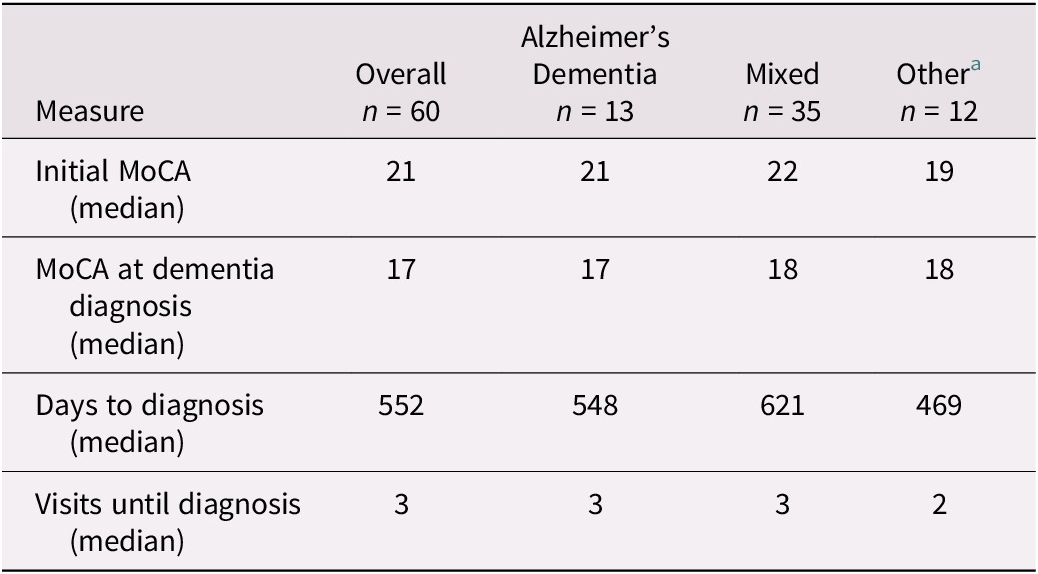
Of the 275 patients with an initial diagnosis of MCI, 214 had at least one additional visit; 182 had no follow-up before 5 years. The median visit interval was 245 days (Q1 = 138, Q3 = 383), roughly three visits every 2 years. Of those 214, 60 (28%) received a diagnosis of dementia on a later visit. Of these 60, 13 (22%) were diagnosed with Alzheimer’s dementia, 35 (58%) with mixed dementia, and 12 (20%) with other dementias (Lewy body, Parkinson’s Disease, frontotemporal dementias). The median MoCA score at initial visit for the patients who ultimately progressed to dementia by year five was 21, which declined to 17 by the time of their diagnosis (Table 2). For those who progressed to dementia, the median visit number at which dementia was diagnosed was the third clinic visit, with a corresponding median progression time of 552 days (1.5 years). MoCA scores and time to diagnosis were similar among patients with Alzheimer’s and mixed dementia. Patients with other dementias tended to have lower MoCA scores on initial visit and were diagnosed sooner.
Montreal Cognitive Assessment (MoCA) scores at initial and dementia diagnostic visits and time to diagnosis of dementia for patients with MCI who progressed to dementia

a Includes vascular, frontotemporal, and Lewy body dementias.
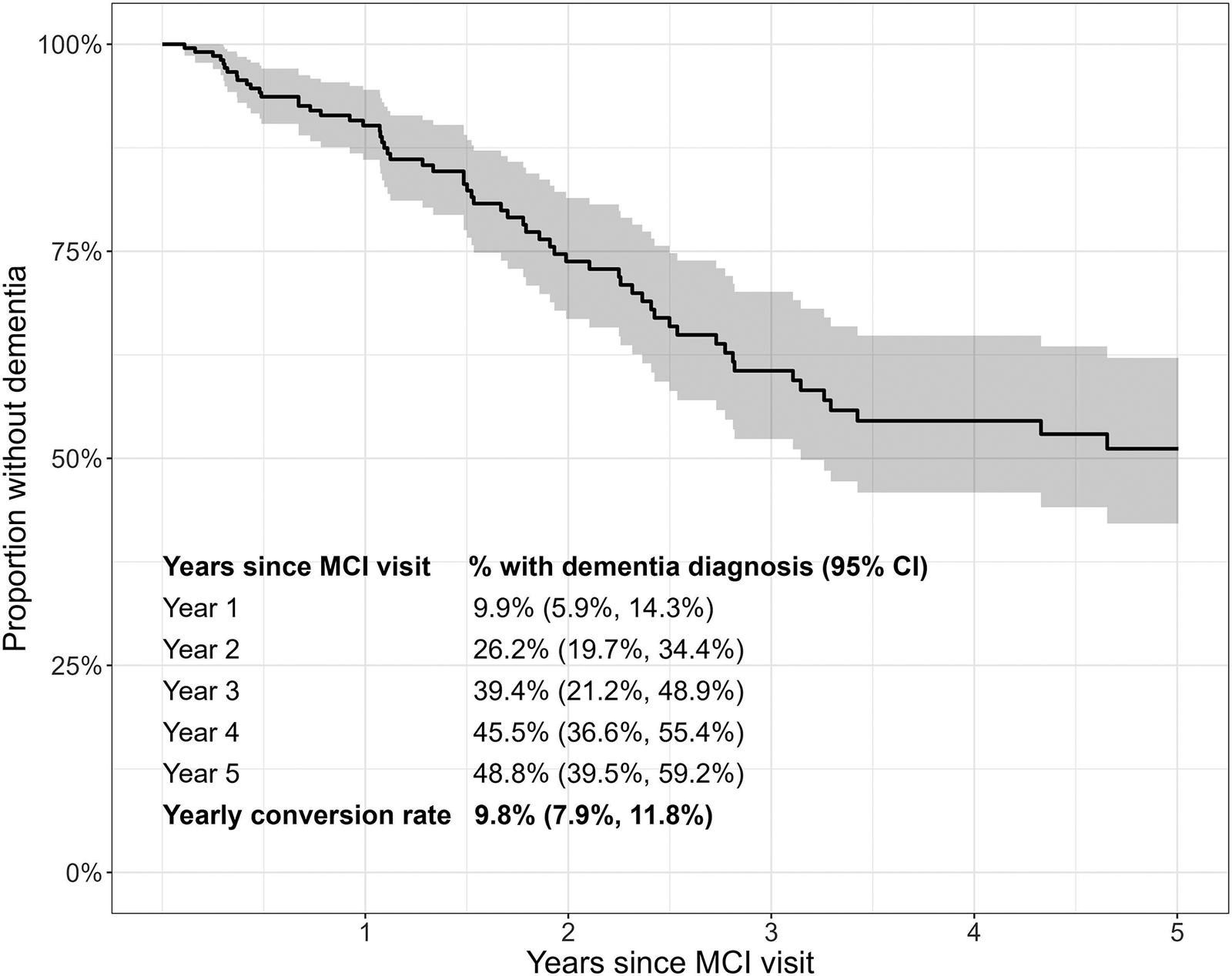
MoCA scores for patients with MCI who did not receive a dementia diagnosis within 5 years were initially higher than the scores of patients with other diagnoses, and remained stable across the 5 years (Fig. 2). Patients who were eventually diagnosed with dementia experienced a decline in MoCA scores across the 5 years, with patients with different types of dementia experiencing roughly similar trajectories. In the survival analysis, Kaplan–Meier estimates indicated that an estimated 48.8 per cent (39.5%, 59.2%) of patients with an initial visit of MCI would be diagnosed with dementia in 5 years, which is an average annual conversion rate of 9.8 per cent (3.9%, 5.9%; Fig. 3).
Trajectory of Montreal Cognitive Assessment (MoCA) scores in patients diagnosed with Mild Cognitive Impairment (MCI) at first visit by ultimate diagnoses at 5 years.

Kaplain-Meier curve of conversion from Mild Cognitive Impairment (MCI) to dementia with per-year conversion rates.

In the adjusted Cox model (Fig. 4), age was significantly associated with a higher risk of a dementia diagnosis within 5 years, with each 5-year increase in age associated with a 37 per cent increase in risk (adjusted hazard ratio (aHR): 1.37, 95% CI: 1.12–1.67). Higher MoCA scores on the initial visit were significantly associated with a lower risk of conversion to a dementia diagnosis over the 5-year follow-up. Each one-point increase on the MoCA at the initial visit was associated with a 10 per cent lower rate of conversion to dementia (aHR: 0.90, 95% CI: 0.85–0.96) during the follow-up period. Sex was not significantly associated with risk of a dementia diagnosis over time.
Adjusted hazard ratios from cox regression of age, sex, initial Montreal Cognitive Assessment (MoCA) score on conversion from Mild Cognitive Impairment to dementia within 5 years.

Discussion
With the increasing adoption of the MINT memory clinic care model across Canada, this study contributes to our understanding of the patients assessed and managed within these clinics and how their condition progresses over time. The majority of patients (70%) presented to the clinic had an initial MoCA score of 25 or less; 37 per cent had a MoCA score of 20 or less, as reflected in common diagnoses of MCI and various types of dementia, most commonly mixed dementia, Alzheimer’s dementia, and vascular dementia, and subjective cognitive decline. The relative proportions and types of diagnoses made in this study population are consistent with those reported across other MINT memory clinics (Lee et al., Reference Lee, Hillier and Gregg2019; Lee et al., Reference Lee, Hillier, Heckman, Gagnon, Borrie, Stolee and Harvey2014; Lee, Hillier, et al., Reference Lee, Hillier, Molnar and Borrie2017). In this study, half of the patients with an initial diagnosis of MCI did not progress to dementia and, compared to those who transitioned to dementia, tended to have higher MoCA scores on presentation at the clinic and were younger. It has been reported that 60 per cent of community-dwelling people with MCI receive a dementia diagnosis, with one study noting that 80 per cent of patients with MCI will progress to dementia within 6 years (Petersen, Reference Petersen2004). The transition from MCI to dementia occurred with a median MoCA score of 17, within a median time frame of 1.5 years from the time patients first accessed MINT memory clinic care. The 10 per cent/year progression rate results from the primary care-based MINT memory clinic lies between these progression estimates of 7 per cent/year in a community-based study and 13 per cent–15 per cent/year from a specialty clinic (Artero et al., Reference Artero, Petersen, Touchon and Ritchie2006; Farias et al., Reference Farias, Mungas, Reed, Harvey and DeCarli2009; Roberts et al., 2014). Similarly, another study conducted in primary care found that after 1 year, 10 per cent of patients diagnosed with MCI transitioned to dementia (Olazarán et al., Reference Olazarán, Torrero, Cruz, Aparicio, Sanz, Mula, Marzana, Cabezón and Begué2011). The cause for the different progression rates is not clear and requires further study. The context in which patients are assessed, including where and how they are assessed, may influence the rate of progression from MCI to dementia. For example, Farias and colleagues found that a community sample had a 3 per cent conversion rate compared to 13 per cent in a clinic sample (Farias et al., Reference Farias, Mungas, Reed, Harvey and DeCarli2009). This disparity may be due to factors such as the inclusion of individuals who were not actively seeking evaluation, the use of the Mini-Mental State Examination (MMSE), which is known to be less sensitive to early memory loss than the MoCA (Pinto et al., Reference Pinto, Machado, Bulgacov, Rodrigues-Júnior, Costa, Ximenes and Sougey2019), and a relatively short follow-up period of 2 years (Farias et al., Reference Farias, Mungas, Reed, Harvey and DeCarli2009). A longer follow-up time period may have yielded a different conversion rate. In contrast, our study highlights the importance of identifying MCI in the primary-care-based memory clinic context, demonstrating a much higher conversion rate in a community-based setting. In contexts where a more sensitive measure such as the MoCA screening tool is used, the population includes symptomatic individuals seeking evaluation, and the follow-up period exceeds 2 years, rates of MCI progression to dementia may closely resemble those seen in specialist clinics (Farias et al., Reference Farias, Mungas, Reed, Harvey and DeCarli2009; Roberts et al., Reference Roberts, Knopman, Mielke, Cha, Pankratz, Christianson, Geda, Boeve, Ivnik, Tangalos, Rocca and Petersen2014). As such, the same interventions and monitoring provided in specialist clinics are applicable to primary care-based memory clinics. As well, as disease-modifying treatments become available for those with MCI, they may be important for those diagnosed in both specialist and in primary care.
Our study confirmed the findings of other studies that suggest that in persons with MCI, advancing age increases the risk for progression to dementia (Panpalli Ates & Yilmaz Can, Reference Panpalli Ates and Yilmaz Can2020; Roberts et al., Reference Roberts, Knopman, Mielke, Cha, Pankratz, Christianson, Geda, Boeve, Ivnik, Tangalos, Rocca and Petersen2014). Identifying individuals at earlier stages of cognitive loss, such as subjective cognitive decline and MCI, provides an opportunity for interventions that might help to reduce the risk of progression. These interventions include optimal management of vascular risk factors, alcohol reduction, and lifestyle interventions such as adherence to a Mediterranean Diet, regular physical exercise, social engagement, cognitive stimulation, adequate sleep and treatment of obstructive sleep apnea, and good oral hygiene. Individuals with MCI, particularly those whose MoCA scores are less than 20 and Memory Index Score (MIS) scores are less than 7, may be at greater risk of progression to Alzheimer’s dementia (Julayanont et al., Reference Julayanont, Brousseau, Chertkow, Phillips and Nasreddine2014).
For those patients with MCI who transitioned to dementia, the short time frame for this transition highlights the need for timely access to assessment, diagnosis, and intervention. In Canada, wait times to accessing specialist care can be upwards of 12 months (Health Innovations Group, 2019; Massoud et al., Reference Massoud, Lysy and Bergman2010), which can create missed opportunities for emerging disease-modifying therapies that may be targeting persons at the MCI stage and interventions such as lifestyle modifications that may have a protective effect on cognition early on and that may be less effective when dementia is more advanced (Widera et al., Reference Widera, Brangman and Chin2023). In contrast, wait times to access MINT clinic care is relatively short, with the majority of patients being seen within 2 months of referral, providing earlier access to diagnosis and intervention (Health Innovations Group, 2019; Lee et al., Reference Lee, Hillier, Heckman, Gagnon, Borrie, Stolee and Harvey2014; Lee et al., Reference Lee, Hillier, Stolee, Heckman, Gagnon, McAiney and Harvey2010). The majority of patients (73%) received a diagnosis at the first visit. For those who did not get a diagnosis at their first visit, the median time to diagnosis from the initial visit of 10 months is longer than preferred and reflected health system related issues associated with delays in accessing cranial imaging, such as MRI, required in the diagnostic work-up and in some cases, patient related delays due illness, hospitalization, or winter sojourns in warmer climates. The efficiency of this model is further demonstrated in this study with the median number of three clinic visits over 1.5 years for those who were identified as progressing from MCI to dementia. This compares favorably to other clinic models, which report upwards of 13 clinic visits over 18 months. This low visit rate is attributed to the MINT Clinic’s shared-care model with the patient’s own family practitioner, and combined with the very low rate of specialist referrals (8%), contributes to the cost-effectiveness of this care model as evidenced by a cost effectiveness analysis that demonstrated net cost savings of $51,500 CAD per patient journey, and with improved quality of life, as compared to usual care in Ontario, Canada (Wong et al., Reference Wong, Lee, Walker, Lee, Patel, Hillier, Costa and Sinha2023).
MINT memory clinics have an important role to play within the system of care for neurocognitive disorders. These clinics serve as an intermediate level of care between primary care and secondary care. Referrals from a patient’s primary care provider are specifically for the assessment and management of memory concerns; the clinic does not provide primary care unrelated to their memory disorder. One key advantage is significantly shorter wait times compared to specialist-led memory clinics in secondary or tertiary care settings. In this study, the 8 per cent referral rate to specialists is consistent with that of other MINT memory clinics, which typically have a less than 10 per cent referral rate (Health Innovations Group, 2019; Lee et al., Reference Lee, Hillier, Heckman, Gagnon, Borrie, Stolee and Harvey2014; Lee, Hillier, et al., Reference Lee, Hillier, Molnar and Borrie2017). This low rate of referrals to specialists suggests that standardized training and multidisciplinary team approaches to care, within the MINT memory clinic model specifically, provide a significant opportunity for building capacity for dementia care at a primary care level, leveraging Canada’s strong infrastructure of primary care practitioners. In turn, this makes highly efficient use of limited specialist resources, enabling specialists to focus on more complex diagnoses and interventions. Moreover, being able to meet the needs of 90 per cent of patients and their care partners without the need to travel to specialists not only builds capacity for dementia care, given the shortage of geriatric specialists, but also improves equitable access to dementia care for those living in rural, remote, and underserved communities where geographic distance is a barrier to care. Additionally, access to specialist care is improved, as the clinics can consult with geriatricians, geriatric psychiatrists, and/ or cognitive neurologists to assist in managing cases that, while not necessarily straightforward, may still be appropriate for primary care. Referral to specialist care is typically reserved for patients with atypical presentations, rapidly progressing disease, diagnostic uncertainty, such as in cases involving multiple potential etiologies contributing to cognitive symptoms, or for those requiring additional resources such as specialist-level imaging or biomarker analysis. The emergence of disease-modifying therapies may also prompt referral. MINT clinics can play an important role in supporting specialists and system capacity building when disease-modifying therapies for Alzheimer’s disease become available in Canada. By leveraging already existing integrated collaborative relationships between MINT Clinics and their supporting specialists, MINT clinics could offer timely access to assessment and diagnosis of Alzheimer’s disease in early stages of the illness and streamline to specialists those who are interested and eligible for these treatments based on established criteria (Cummings et al., Reference Cummings, Apostolova, Rabinovici, Atri, Aisen, Greenberg, Hendrix, Selkoe, Weiner, Petersen and Salloway2023).
Limitations
The patient profile presented here is based on findings from one MINT memory clinic and may not be representative of all clinics. The CFFM MINT clinic is well established; other clinics may be more recently formed and may serve different patient populations. ApolipoproteinE (ApoE) has been linked with the progression from MCI to dementia; however, we are unable to comment on its association with MCI trajectories as we do not collect this or other biomarkers (Giannisis et al., Reference Giannisis, Al-Grety, Carlsson, Patra, Twohig, Sando, Lauridsen, Berge, Grøntvedt, Bråthen, White, Kultima and Nielsen2022). Information on biomarkers will likely become more relevant to collect as a necessary requirement for disease-modifying therapies, when they become available in Canada. Similarly, we are unable to examine how clinic interventions (e.g., medication optimization, lifestyle modifications) relate to outcomes; this is an area in need of more research. Diagnoses are based on MCI as a clinical construct, not based on neuropathological findings, and thus our study results may differ from studies using these constructs; this would be consistent with real-world clinical practice in primary care, not patients selected for research studies. In the MINT memory clinic, the MoCA score and areas of impairment identified within the MoCA are used to support or refute the physician’s clinical diagnosis, but because the physicians making the diagnoses were aware of the MoCA scores, their diagnostic decisions may have been influenced by that information. This may have introduced incorporation bias, which could artificially inflate the apparent association between a screening test and a diagnosis, making the test appear more highly associated or important than it actually is. Finally, a substantial number of patients did not have MINT clinic follow-up within 5 years of their initial assessment due to transition to other clinical services. As a result, the observed conversion rate of MCI to dementia is likely underestimated. We attempted to address this limitation by providing an estimated conversion rate that accounts for the group without follow-up. As noted, only a small proportion of the sample had Cornell Scale for Depression and Zarit Caregiver Burden Inventory scores, so it was not possible to include these measures in the Cox regression for conversion. Depression is an important predictor of dementia (Ebrahim et al., Reference Ebrahim, Ghahremani, Camicioli, Smith and Ismail2023); we intend to include it in future analyses.
Conclusion
Study findings highlight the important need for timely access to diagnosis and interventions that may have protective effects on cognition for those diagnosed with MCI. Care models such as the MINT memory clinics have an important role to play in building capacity in primary care for early diagnosis and early multidisciplinary interventions to manage changes in disease trajectory over time, in collaboration with their supporting specialists. Understanding the patient characteristics and disease trajectories of patients seen in MINT memory clinics can inform policy development and health care planning to address the need for dementia care capacity building within primary care.
Acknowledgements
This study was supported by the Centre for Family Medicine Family Health Team.