

I. Introduction
In this article I will look at the three broad concerns of international politics that Fierke articulates in her Introduction to this special issue. The first addresses challenges to state sovereignty in ‘post-colonial’ regions such as Asia that suffered due to Western imperialism during the nineteenth and early twentieth centuries. As an important example, China’s history is marked by its former status as an empire, its suffering at the hands of colonial powers, and its current status as a rising power. The reasons why sovereignty and autonomy occupy central positions in Asia – especially for China and its four ‘frontier areas’ of Tibet, Xinjiang, Hong Kong and TaiwanFootnote 2 – cannot be properly understood without considering past colonial experiences. For example, China applies the ideas of sovereignty and independence to an assumed Chinese civilisation which includes Tibet, Xinjiang, Hong Kong and Taiwan as one of many efforts to resist interference on the part of former colonial powers. In other words, China is using the concepts of sovereignty and independence as weapons for ‘protecting’ Chinese civilisation rather than offering them as replacements for ‘backward practices’. This idea touches on a second concern of this special issue: China’s perceptions of its colonial losses (i.e., Taiwan to Japan, Hong Kong to the UK, the 1888 British invasion of Tibet, and Russia’s partial occupation of Xinjiang) muddy the meanings of self-determination, independence, and autonomy as applied to the four frontier areas. From a socialist perspective, self-determination, independence, and autonomy only exist in contexts marked by imperialist oppression;Footnote 3 therefore the ‘autonomous regions’ of Xinjiang and Tibet must be analysed as self-governing regions in need of protection from Han chauvinism.Footnote 4 At the same time, calls for independence in any of the four areas are usually described as acts of interference by external imperialist forces. Last of all, Fierke refers to a contestation between the individualist ontology of modern international relations and a relational ontology. Consistent with this idea, I argue that China’s long-held tianxia world view, based on relational considerations, did not disappear after the end of the Qing dynasty, neither was it replaced by an individualist world view or the nation-state practices offered by Chinese intellectuals in the Republican era. Instead, both tianxia relationality and Westphalian individualism help contextualise current interactions between China and the four frontier areas, in contrast to the argument that the latter has replaced the former.
Motivated by these concerns, I use China’s rising power and its uneasy relationships with Tibet, Xinjiang, Hong Kong and Taiwan as examples of the hybridity of traditional/modern and local/global processes, and attempt to clarify the practical and contesting notions of nation state, sovereignty, independence, and autonomy as understood by both China and the four frontier areas. The Chinese government, which has dealt with strong separatist challenges from Tibet, Xinjiang, Hong Kong and Taiwan since Xi Jinping assumed power in 2012, has never come even remotely close to allowing citizens in those locations to hold referendums, preferring instead to grasp tightly to its ‘one-China’ policy or President Xi’s ‘Chinese Dream’.Footnote 5 Beijing clearly fears that any compromise of the one-China principle will signal weakness to both internal separatists and the West. In response, an increasing number of individuals and politicians in the four frontier areas are accusing Beijing of disrespecting autonomous rights that are supposedly protected by the Chinese constitution, at least according to the discursive logic of Westphalian sovereignty. Today’s confrontations are clearly due to a lack of shared identity. China’s failure to procure positive responses from the four entities raises questions about why they fail to ‘appreciate’ what China considers beneficial to both sides. China regularly expresses disbelief over the refusal of the four frontier areas to share a sense of national and cultural pride, as well as their lack of interest in contributing to China’s rise as a major power, from which they might benefit in terms of protection and development. The responses of the four entities contradict the logic of the ‘bandwagon effect’, as discussed in the IR realist literature.Footnote 6
My argument is that the four frontier areas, even when viewed as weaker powers, challenge China’s attempts to impose a unilateral consensus by denying Chinese-initiated political/economic actions. However, as an emerging power, China is more in tune with the modern Westphalian system, while still using language that implies a romanticised revival of tianxia.Footnote 7 Any unilateral consensus must be viewed as representing a prior negotiating style characterised by materially beneficial concessions. Considering the conflicting identity issues faced by Beijing and the four frontier areas, a unilateral consensus is increasingly unlikely, which may magnify the potential for confrontation regardless of claims that it is in the best interests of the four entities to cooperate. I do not see confrontation as inevitable, given that a unilateral negotiating style is less likely to produce conflict between China and non-Han ethnicities in a tianxia context than a Westphalian one. A tianxia context emphasises balanced relationsFootnote 8 between the Chinese centre and the so-called yi (‘foreign’ or ‘uncivilised’ outsiders) along the periphery – note the Chinese adage ‘tianxia wuwai’, which means that there is nothing outside tianxia. By contrast, within the Westphalian system, freedom to shape one’s relationship with the Chinese centre is constrained regardless of which ethnicity one belongs to, since there is an expectation that all ethnic groups are united ‘inside’ the territory in defending the Chinese nation (an indivisible entity according to Westphalian thinking) from ‘outside’ foreign imperialist forces.
In what follows, I investigate China’s particular approach to unilateral consensus and concessions and its historical application to frontier areas within the contexts of both tianxia and Westphalian governance. I discuss differences and similarities in the ways that Tibet, Xinjiang, Hong Kong and Taiwan react to and resist China’s calls for greater unity within a hybrid form of Westphalian individualist and tianxia relational ontology which reflects the identity concerns of the powerful centre and the four weaker frontier entities.
II. A unilateral consensus approach
Chinese scholar Yin Jiwu is credited with coining the term ‘unilateral consensus’,Footnote 9 which refers:
to a kind of strategic thinking that an actor holds in the process of interacting with another party in order to deal with political, strategic and military questions. That is, since an actor considers its own rational strategy (such as calculating strategic benefits, domestic politics, or the ability to solve problems) or considers the factor of one’s cultural identity (such as habits of cognition, emotion, and consideration of one’s status), one party or both have a tacit mutual understanding to accept a consensus and a strategy to solve problems that include many different understandings of the problem. Neither of the two sides publicly refutes the existence of such a consensus, and neither side refutes the consensus in public.Footnote 10
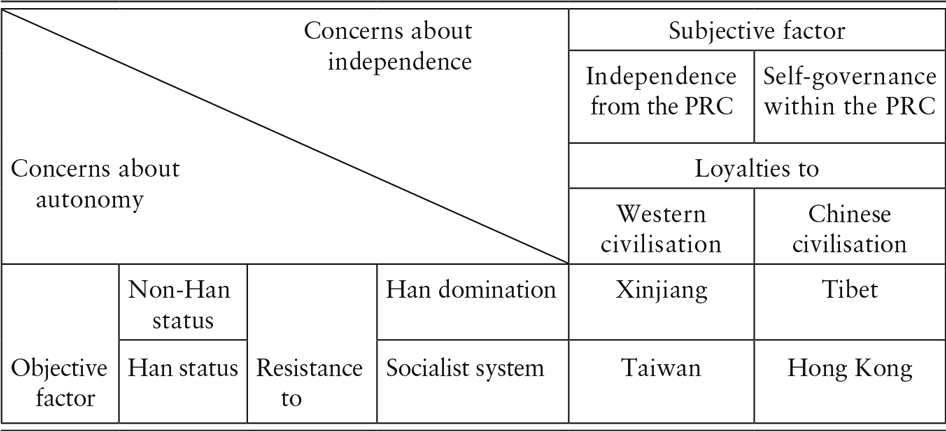
As the oxymoron implies, a ‘unilateral consensus’ is dominated by one party, resulting in cosmetic agreements or statements that neither side believes. China’s relations with Tibet and Xinjiang are two examples. By contrast, Taiwan is an example of a ‘mutual consensus’ in which two parties agree to participate in what externally appears to be a bilateral relationship thus, the Chinese Nationalist Party (Kuomintang, or KMT) which has held power for most of the last six-plus decades, has expressed acceptance of the ‘one China’ idea, but with ‘respective interpretations’.Footnote 11 The Hong Kong case sits somewhere in-between, with Hong Kong residents claiming neither religious nor ethnic differences with the Han-dominated Mainland, and expressing greater willingness than the Taiwanese to describe themselves as part of the People’s Republic of China. China’s current imposed-consensus negotiation style (defined in terms of unchallengeable Chinese sovereignty) is apparently driven by a perceived need to resolve moment-to-moment disagreements. What differentiates the responses of Tibet, Xinjiang, Hong Kong and Taiwan are non-strategic issues concerning religion, ethnicity, economic systems, and legitimacy, respectively.Footnote 12 According to this view, China’s unilateral consensus approach implies concern about possible attempts at intervention by Western/other foreign entities to block independence and autonomy. In this context, Tibet, Xinjiang, Hong Kong and Taiwan must decide whether to continue to accept each false consensus in the face of pressure not only from China, but also from the West, the Han majority, and the socialist system (Table 1). Clearly the arguments underlying each unilaterally imposed consensus involving the four frontier areas cannot be understood simply as products of a stronger power’s compulsory imposition on minority groups or weaker powers. Instead, such relations are better viewed as preliminary visions or first steps toward long-term goals of mutual consensus. Accordingly, any unilateral action taken by China against the four frontier areas implies an intention to initiate processes that associate China with a higher level of greater self (i.e., a shared Chinese civilisation or nation) or collectivism,Footnote 13 which are reflections of the relational ontology mentioned earlier.
Concerns of the four ‘frontier areas’ in light of China’s unilateral consensus strategy.

Yin Jiwu uses the unilateral consensus concept to explain China’s particular way of applying its identity or intentions to asymmetrical power relationships with the United States, Vietnam, and others. I will extend the concept to include the idea that according to China’s tianxia world view, differences between it and others are not based on territorial boundaries that separate domestic and international politics, but on physical and/or psychological distance from the centre of the ‘Middle Kingdom’ – Zhongyuan, or ‘central plains’, the place where tianzi (‘Son of Heaven’) is supposed to live. Thus, China claims that its relations with Tibet, Xinjiang, Hong Kong and Taiwan constitute domestic issues, while a Sino-centric view renders the four frontier areas as similar to foreign entities. Note that a unilateral consensus approach does not imply a naïve belief that China can simply impose its views on others. According to Yin, a unilateral consensus strategy is best used to enhance the potential for cooperation and dialogue between China and other parties. However, it has at least one serious drawback: ‘Looking at the long term, it may produce unintended outcomes such as one’s sincerity being taken for granted, or setting aside [issues] that become worse, and so on.’Footnote 14 In other words, China’s reliance on the unilateral consensus approach as a temporary tactic for dealing with sensitive issues may break down when it comes time to transform a false consensus into a true mutual/bilateral consensus. As we are currently witnessing, the unilateral consensus idea is being challenged in all four frontier areas by individuals who do not automatically accept Chinese intentions as positive.
III. From tianxia to Westphalian governanceFootnote 15
Those who worry about potential threats tied to China’s rise often point to the country’s history as a ‘Middle Kingdom’ power enforcing an imperial tributary system.Footnote 16 Fewer are willing to acknowledge the significance of symbolic and ritual practices associated with the tributary system, or to understand that asymmetrical power relations between China and its frontier neighbours are less important than the extent to which China and its neighbours respect and follow symbolic practices that define proper and/or moral behaviour within bilateral relationships. However, it is also important to remember that the Republican era destabilised all bilateral relationships between China and its frontier neighbours in the interest of building a modern nation-state, which required multilateral relationships among the Han, Manchu, Mongol, Hui and Tibetan ethnicities.Footnote 17 Whereas Qing dynasty rulers institutionalised bilateral relationships according to tianxia principles, Republican leaders attempted to institutionalise multilateral relationships along lines that we now recognise as Westphalian. In the Chinese context, the two governance types carry very different meanings in terms of independence and autonomy.
Under Manchu rule, the Qing leaders established a ‘Ministry Ruling the Outer Provinces’ (Lifanyuan), whose task was to oversee three major rituals expected of inner Asian populations: pilgrimage to the Chinese emperor (chaojin), the imperial hunt (weilie), and tribute (chaogong).Footnote 18 In the first, inner Asian nobles were expected to travel to the Qing court to express their respect, loyalty, and willingness to put themselves under the aegis of the Chinese empire. The primary function was to create and maintain intimate and trusting relationships between the Qing court and various Asian groups. Invitations to partake in such pilgrimages represented a desire on the part of the court to establish relations that were reserved for ‘inside’ subjects but not ‘outside’ lords. Acceptance and participation was viewed as a willingness to be part of Chinese civilisation. Obviously, the pilgrimage ritual served as an alternative to force and coercion as a means of maintaining sustainable relationships. Refusal to fulfil this duty was considered a criminal act requiring a military response.
Weilie consisted of a hunting activity involving nobles and leaders from outside groups and the Chinese court. Similar to many inner Asian groups, the Manchus were nomads accustomed to riding horses and hunting for survival, as opposed to the agricultural lifestyle led by most Han Chinese. During the period when they controlled the Chinese court, they regularly held imperial hunts to demonstrate their appreciation for nomadic culture, thus expressing loyalty to their past while ruling over a distinctly agricultural population. Further, there was no concept of ‘minority group’ during the Qing because the Manchus ruled a majority Han population. An important difference between the nomadic Manchus (and other Inner Asian groups) and the agricultural Han was the extent to which they practised rituals and presented symbolic gifts. According to such practices, ‘Chinese civilization under Manchu rule no longer kept its old and strict line between the intensive agricultural life within and extensive nomadic one without.’Footnote 19
It would be incorrect to describe weilie hunts as statements of intent to pursue military training or competition, or as forms of entertainment for visitors. Ning Chia quotes the Chinese emperor Qianlong as saying:
In fact, going kouwai [‘outside the bounds of China proper’] for hunting was the imperial ancestor’s system. Its significance went well beyond military purposes; it was intended to signify to the Mongols that the emperor was sensitive to them and their culture.Footnote 20
The third practice, tribute, is the one that most contemporary Western scholars refer to when discussing China’s recent ascendance.Footnote 21 Unfortunately, they have shown a tendency to emphasise the power dimension of hierarchical relations between China and its neighbours, which clearly differs from the contemporary view of understanding international relations in terms of balances of power and equality.Footnote 22 The Qing tribute practice actually served two functions: economic exchange and symbolic connection. Inner Asian nobles used the Lifanyuan to present material gifts to the Qing court during the last month of the Chinese lunar calendar. The Chinese emperor gave gifts in return based on the ranks of the tributaries. Ning Chia notes that the Lifanyuan:
executed the policy to emphasise the ritual significance of the inner Asian tribute by stressing the symbolic character of the material exchange, while at the same time reducing its economic significance by issuing an ever-increasing number of regulations to limit the amount of tribute goods and the number of people in tribute missions.Footnote 23
Accordingly, the Chinese court did not exclusively use its relations with inner Asian groups for reasons of trade or economic development, as has often been the case in the history of relations among modern nation-states. Similarly, it was not the Chinese court’s sole purpose to use its economic relations with inner Asian groups to control them unlike many of today’s relationships, in which concerns about economic dependency are associated with decreasing political autonomy. Instead, in the tianxia context of the Qing court, the tribute ritual was only one of several acts of acknowledgment of Chinese imperial authority within supposedly harmonious bilateral relationships. It is important to note that historically, the Mongol chiefs and Xinjiang Uighur begsFootnote 24 enjoyed both pilgrimage and tribute (gift-giving) relations with the Qing court, while Tibetan officials were limited to tribute relations.
All three forms of rituals support a more specific version of Zhao Tingyang’s comment about the ‘spirit of all-under-heaven’Footnote 25; that is, according to the spirit of tianxia, a country cannot be ruled by force. The Qing rituals were aimed at establishing consensus and were not based on military force, although force was clearly an option for ensuring that both sides honoured the constraints of their bilateral relationship. In the spirit of all-under-heaven, a political system must justify its existence by contributing to the common well-being, meaning that the Qing court had to refrain from treating inner Asian groups as profit centres. According to Ning Chia, most of the gifts given by the Qing court to inner Asian groups were much more valuable than those going the other direction. Last, the spirit of ‘all-under-heaven’ dictated that harmonious relations between nations and cultures had to be based on the mutual acceptance of a shared political system, meaning that the three rituals were perceived (correctly or not) as indicators that both sides had achieved a certain degree of unilateral consensus. This is important to our understanding of China’s relations with Xinjiang and Tibet: China’s unilateral intentions to establish bilateral relationships with inner Asian groups constitute a uni-bilateral style of tianxia governance, as opposed to the multilateral frameworks found in many of today’s international organisations. In a tianxia system, the empire is not simply Sino-centric (as in John King Fairbank’s classic description of the Chinese tribute system), but also sensitive to multiethnic issues. Further, the willingness of Qing China to use military force to control inner Asian groups did not mean that China was inclined toward armed conflict (as Alastair Iain Johnson might argue based on his view of cultural realism), since China only exercised that force when symbolic rituals were clearly being violated or ignored. In the context of Qing tianxia governance, there were no problems associated with ‘separatist’ or independence movements in the sense of Westphalian sovereignty, since the inner Asian groups had that period’s equivalent of sovereignty before they accepted or joined the Chinese family.
Challenges from ‘outside’ Western powers have changed not only the Chinese regime, but also relationships between the Chinese centre and its frontier areas. Chinese Republicans accepted the idea that a nation state’s sovereignty must be focused on defending territory and rejecting foreign invasions and occupations. This conflicts with the standard Western view of sovereignty based on the assertions of Hobbes and Locke that the task of sovereignty is to protect the survival or property rights of individual citizens. From the perspective of Chinese Republicans in the early twentieth century, the fundamental motivation for sovereignty was a sense of collectivism that prioritised the Han-based Chinese civilisation over individual interests. The Republican era was marked by three events: (a) Dr. Sun Yat-sen’s establishment of the Republic of China and his promise to ‘drive out the Manchus and recover the state of the Chinese’,Footnote 26 (2) conflict over self-reforms and efforts by Chinese intellectuals to forge a new national identity based on a Western model, and (3) a long and painful period of civil war that lasted until the Chinese Communist Party (CCP) established the People’s Republic of China (PRC) in 1949. All three events shared common concerns in the form of perceived threats coming from Western civilisation and the formation of a new national identity based on ethnic group unification. Unlike the authors of the American Declaration of Independence, who proclaimed a new union as a means of securing certain unalienable rights for individual citizens,Footnote 27 Dr. Sun emphasised unification in terms of territory, government, ethnic groups, and Chinese society for purposes of protecting China from imperialist and colonialist outsiders.Footnote 28
While the purpose of the post-1949 ‘New’ China was to overthrow all feudal traditions, it shared a historical legacy with the ‘Old’ China, especially regarding memories of ‘a century of humiliation’ at the hands of Western countries. Mao Zedong used Westphalian concepts when stressing the importance of the second concern:
The principle of the foreign policy of the People’s Republic of China is the protection of the independence, freedom, integrity of territory and sovereignty of the country, upholding of lasting international peace and friendly co-operation between the peoples of all countries, and opposition to the imperialist policy of aggression and war.Footnote 29
‘The imperialist policy of aggression’ in this quote refers directly to ‘the century of humiliation’. Even today, PRC leaders sometimes describe China as a ‘victim nation’, thereby encouraging hypersensitivity to sovereignty issues among the Chinese populace.Footnote 30 In addition to encouraging the Chinese government to downplay the value of individual human rights for the sake of collective rights or national stability, this sensitivity affects Chinese relations with other countries, especially those perceived as being parties to long-term territorial/border disputes.
Regarding nationalities and ethnicities (now referred to as ‘national minorities’), both Sun’s Republic of China (ROC) and Mao’s PRC policies were aimed at making all ethnic groups equal and autonomous within the boundaries of a newly established nation state. In this view, a consensus regarding a unified Chinese nation state must be achieved before talking about ethnic autonomy and equality, not the other way around. Thus, Chinese Republicans talked about mobilising minority groups to work with the Han majority to defend national sovereignty against foreign forces. Should Chinese national sovereignty be defeated by imperialist forces one more time, it would be difficult to give ethnic groups ‘autonomy’ or ‘equality’ in a collective sense. By contrast, tianxia did not entail a need to unite all ethnic groups to defend a single nation from foreign intrusion, thus injecting a strong notion of independence into the meanings of autonomy and equality. A clear understanding of the transformation from Qing tianxia governance (free from the concept of territorial separation) to a Republican Chinese Westphalian style (including territorial integrity to protect ethnic group autonomy) is required to grasp inconsistencies in China’s calls for other countries to respect its sovereign rights, as well as its intolerance of similar calls made by ethnic groups within the country’s current territorial boundaries.Footnote 31
There is currently a revival of tianxia thinking in policy circles and among Chinese intellectuals. Deng Xiaoping’s use of the term ‘Chinese characteristics’ in his opening speech at the Twelfth National Congress of the Chinese Communist Party (1982) inspired (or perhaps required) Chinese cadres and intellectuals to rethink questions regarding distinct Chinese qualities in support of long-term policy formulation, thus providing guidance for foreign policymaking and establishing a new Chinese international consciousness.Footnote 32 In one speech promoting the idea of a ‘Chinese Dream’, Xi Jinping emphasised China’s history of subjugation, arguing that:
the Chinese nation [has] suffered so greatly and sacrificed so much. However, the Chinese people never surrendered, and relentlessly fought. Finally the Chinese people gained control of our destiny, started the great progress of constructing our own country, and fully demonstrated great national spirit based on patriotism.Footnote 33
Xi Jinping has since modified his Chinese Dream idealism to a practical ‘One Belt, One Road’ strategy that includes unilaterally promised ‘gifts’ such as unconditional support for development projects. Consistent with the actions of Chinese emperors under the tianxia system, the goal of this strategy is to (re)establish China’s relations with old and new friends.
The pursuit of ‘Chinese characteristics’ has motivated intellectuals to take a long and detailed look at China’s past and its cultural and historical resources. Rethinking Chinese characteristics has also inspired them to debate the larger question of ‘What is China?’. A growing number of Chinese intellectuals feel a strong need to define and clarify China’s status as a developing country, great power, or socialist regime. For some it is incongruous for China to not have its own world view – Wang Yizhou argues that China’s status as a great nation is not due to its huge territory or population, but to its cultural genes, the development of its political structure, and its specific historical resources.Footnote 34 Thus, Chinese scholars are currently addressing the possibility of making their own Chinese IR theory, that is, a ‘Chinese IR school’.Footnote 35 Qin Yaqing, an important figure in this effort, is actively trying to identify and apply what he considers traditional political thought and world view (including Daoism, Confucianism, and tianxia) to the making of core Chinese theory.Footnote 36 Finally, the use of the ‘peaceful rise’ concept since 2003 has encouraged Chinese intellectuals to defend the idea from a Chinese perspective. Philosopher Zhao Tingyang was one of the first to analyse tianxia in both a systematic and theoretical manner. His original motivation was to prove the impossibility of Immanuel Kant’s ‘perpetual peace’ concept in the current nation-state system, as opposed to the potential for perpetual peace with tianxia.Footnote 37 Zhao describes tianxia as a system that considers peace from a global perspective based on global needs, rather than the needs of individual nation states. Some Chinese scholars have noted that the revival of tianxia thinking has been wrongly criticised as justifying Chinese expansionism, leading some to coin new terms such as ‘new-tianxiaism’ (xin tianxia zhuyi) and ‘new-worldism’ (xin shijie zhuyi) to overcome the limitations of old terminology.Footnote 38
For now, at least two world views supporting China’s self-recognised ‘proper behaviour’ in the region or in the international community have emerged. One is a more flexible and ideal type of tianxia thinking, the other a more assertive and rationalist type of Westphalian thinking. Both have been appropriated by Chinese policymakers when responding to different challenges. For example, China’s hypersensitivity to the slightest evidence of foreign interference in matters involving Tibet, Xinjiang, Hong Kong or Taiwan is often explained by some analysts in terms of China’s geopolitical concerns for security or economic interests. However, rather than expressing rationalist concerns, the PRC government is using arguments based on historical or cultural links, or the idea of external imperialism, to defend its actions in those four areas. Although China is exposing itself to charges of hypocrisy, its foreign policy is driven by a combination of tianxia and Westphalian thinking, each with its own constraints. This inconsistency and ambiguity has resulted in the four frontier areas neither understanding nor trusting China’s true intentions.
IV. Separatist calls from China’s four ‘frontier areas’
China’s claims of territorial integrity and sovereignty involve unilateral promises of ‘devolving power/rights and conceding benefits’ (fangquan rangli). Under the banner of its one-China principle, the CCP has attempted to nurture recognition of Beijing’s political authority by the four frontier areas, similar to what the Qing court wanted from inner Asian groups. Calls to reject the one-China principle are already strong in Tibet, Xinjiang, Hong Kong and Taiwan, triggering unilaterally imposed strategies from Beijing such as promises of economic development and political status. Other promises include the creation of autonomous regions, districts, and counties, ostensibly in the name of cultural preservation.Footnote 39 Central government officials have funded infrastructure and industry projects in Tibet and Xinjiang for the dual purposes of integrating the three mainland frontier areas into the national economy, while concurrently encouraging the adoption of a greater China identity by minority groups.Footnote 40 In the fourth, China continues to use various means to convince the Taiwanese that the ‘one country, two systems’ policy can benefit them, yet refuses to renounce its willingness to use military force should Taipei declare outright independence. One carrot that Beijing has offered is to allow Taiwan to retain a larger share of profits from cross-Strait economic exchanges, a reflection of China’s self-proclaimed status as an ‘elder brother’.Footnote 41 Unfortunately (at least in the eyes of the CCP), significant numbers of individuals in all four areas refuse to follow the script that Beijing has unilaterally written – an action akin to refusing participation in symbolic rituals.
Four instances of resistanceFootnote 42
It is commonly assumed that calls for autonomy or independence by the four frontier areas are more similar than not. For example, some researchers emphasise the point that all four are in asymmetric power relationships with China, therefore from a simple power perspective it is tempting to predict that a rising China will eventually assert its control. Others argue that the four areas should continue to apply liberal values regarding their ‘right’ to claim autonomy or independence, and to reject all interventions. However, such claims are at best instrumental, since each area relies to some degree on external support, which undermines the meaning of ‘autonomy’ and ‘independence’. Certain groups in all four areas describe their problems and frustrations in terms of excessive reliance on China, which interferes with their wishes to maintain bilateral rather than uni- or multilateral relationships with Beijing under the umbrella of the one-China principle. Other important differences among the four include the ethnic features and religious traditions of Tibet and Xinjiang compared to those in Hong Kong and Taiwan, and Xinjiang’s increasingly radical calls for independence versus Tibet’s request for autonomy. Further, unlike Tibet and Xinjiang, Hong Kong and Taiwan have large ethnic Han majorities, shared Confucian cultural values, and strong influences from Western liberal democracies. However, Hong Kong residents care more about institutional autonomy,Footnote 43 while Taiwanese are more concerned about national identity.Footnote 44 Due to differences in their respective scenarios, a detailed examination is required to understand how a tianxia approach based on a bilateral relational ontology is possible (or not) in each case within the context of the current international system.
Tibet’s call for greater autonomy
Very different perceptions of the historical association between China and Tibet represent a major factor in their strained relationship. Beijing claims that Tibet has been part of China since the Yuan dynasty (1271–1368), when it was under the rule of Mongol nomads and not Han Chinese. In support of this assertion, in 1992 the Chinese government published a white paper entitled ‘The Belongings of Tibet’s Sovereignty and Tibet’s Human Rights Condition’.Footnote 45 Beijing ascribes the problem of Tibetan independence to foreign forces, Western imperialist intervention, and conspiracies, thereby making it a Westphalian ‘national security’ concern rather than a cultural/ethnic/institutional issue. One year later, the Department of Diplomacy and Public Information of the Tibetan government-in-exile published ‘To Use Facts to Prove Tibet’s Truth’ in order to ‘re-correct’ wrong understandings of Tibet’s independent status and historical relationship with China.Footnote 46 Based on the report, China at most had a suzerain relationship with Tibet, with nominal or symbolic recognition of China’s authority from the then-Tibetan empire. A close examination of the document reveals a discourse that resembles the relationship practised on the basis of a tianxia style of governance, with Tibet participating in rituals and benefiting from unequal economic exchanges. At one time, Tibet had considerable power and influence in the region and during the Tang dynasty (618–907) it was considered strong enough to convince the Tang emperor to offer two or more daughters for marriage to Tibetan leaders in order to reduce the potential for being invaded.Footnote 47 According to one of the most influential Han Chinese writers on minority topics, Wang Lixiong, Tibet has justifiable reasons for claiming that its relationship with China was never as a local region within Chinese territory, but as an independent political entity within the Chinese court, although one with very low status.
Beijing and the CCP describe themselves as having done everything a country should do for one of its regions by ‘emancipating’ Tibetans from an ancient feudal system and providing financial support for regional development, but they have received nothing but animosity from ‘a few’Footnote 48 ungrateful Tibetans who prefer to give their allegiance to an exiled government under the Dalai Lama. Wang Lixiong believes that a major reason for this incongruity is that daily life in Tibet is ruled more by religious beliefs than by secular concerns:
What can be sure is that [factors causing ethnic conflict in Tibet] cannot be resolved by material or economic means, nor by ‘development’ … I believe the fundamental reason is that Beijing is taking an antagonistic position toward the Dalai Lama. The Dalai Lama is not simply a man – he represents a Dalai pedigree and Dalai system that holds together Tibet’s past five hundred years of history. In the Tibetan view of reincarnation, to be the enemy of a single Dalai is the same as being the enemy of the entire Dalai lineage, as well as against Tibetan religion and Tibetan ethnicity.Footnote 49
As both the political and religious leader of the exiled Tibetan government, the 14th Dalai Lama has repeatedly stated that he only wants greater autonomy for Tibet, and could agree to Chinese control as long as Tibetan culture is preserved.Footnote 50 On the surface, Chinese officials neither believe nor trust the Dalai Lama, and consistently accuse him of colluding with foreign powers in the long-term goal of Tibetan separatism.Footnote 51 Whether one side or the other ‘owns’ the truth is immaterial; the two sides use different governance concepts in their dialogues, thus rendering the issue almost impossible to resolve. The Chinese government uses Westphalian logic to justify its claims of sovereignty and foreign intervention. This top-down attempt to convince the Tibetans to accept the importance of a united China is a Han Chinese concern that can be traced to the Republican era. Tibetans seem intent on convincing the Han Chinese government that their major concern is fear and frustration over assimilation and Han Chinese discrimination.Footnote 52 Beijing’s tianxia method of giving economic benefits in exchange for further Tibetan acceptance of Chinese authority is made more complex by the unequal power relationship between the two, which makes it very hard for Tibetans to interpret Beijing’s unilateral consensus or its economic promises as anything more than new forms of humiliation tied to Han assimilation.
Xinjiang’s call for an independent East Turkistan
The religious and cultural confrontations between Han Chinese and both Turkic and Uyghur Muslims in Xinjiang share some similarities with those between Tibetans and Han Chinese. Uyghurs reject the name ‘Xinjiang’ as something that was forced upon them by the Qing emperor Guangxu in 1884 in recognition of China’s success in taking back the territory from Russia. The Uyghurs consider that return as a humiliating example of subjugation at the hands of Han Chinese and part of a long-term sinicisation plan that eventually led to brutal repression under the provincial government leadership of General Wang Zhen in the 1950s. Since then, Beijing has supported the movement of large numbers of Han Chinese to Xinjiang, and since 2000 it has enacted and executed a Western Development Plan.Footnote 53 The Han-dominated central government describes its sinicisation programmes as efforts to ‘emancipate’ ethnic minorities through social and economic programmes designed to foster equality, unity and cooperation among all ethnic groups, especially between Uyghurs and Han Chinese.Footnote 54 Xinjiang Uyghurs are more likely to use terms such as ‘ethnic massacre’ and to describe Beijing-created social and economic development programmes as examples of the exploitation of natural resources for Han Chinese development – perceptions that have fuelled additional economic and social inequality and ethnic conflicts,Footnote 55 and that are viewed as contributing to several uprisings in 2009, an incident in Tiananmen Square in 2013, and the attack at the Kunming train station in 2014.Footnote 56
Turkic Muslims, who represent the largest population in Xinjiang, perceive themselves as having strong cultural affinities with Turkic Muslims in neighbouring central and western Asian countries. Historically, these affinities have never been translated into calls for building a nation state (unlike the current Xinjiang independence movement), but have instead produced ‘oasis identities’ emerging from individual regions, cities, and villages.Footnote 57 A nationalist movement in 1933–34 resulted in the brief appearance of the Turkish-Islamic Republic of East Turkistan, which was overthrown first by Russia, and then by a regional Chinese warlord. Another independent state known as the East Turkistan Republic was established between 1945 and 1949 before being taken over by the Chinese. The ‘East Turkestan Islamic Movement’ (ETIM) established in 1993 has been identified by the Chinese government as conducting several terrorist attacks in Xinjiang, Yunnan, Shanghai and Wenzhou.Footnote 58 Talk about an independent state is currently limited to an ‘East Turkistan’ rather than a large-scale ‘Greater Turkistan’ that would include Uzbekistan, Kazakhstan, Kyrgyzstan and Tajikistan. Regardless of political borders, the region is filled with examples of strong ethnic affinity in terms of spoken and written language, religion, and cultural customs.Footnote 59 These are being used by separatists in Xinjiang (especially Turkic Muslims in the province’s southern section who moved there due to the influx of Han Chinese immigrants in the north) to establish an ‘imagined community’,Footnote 60 and to make claims involving human rights violations to justify a broad Westphalian discourse that refutes China’s unilaterally imposed national identity. Even though Turkistan nation states were short-lived and the ETIM is regarded as representing a small minority of Turkic Muslims, they reflect long-held feelings of frustration with and fear of Han Chinese challenges.
According to an anonymous leader of a Xinjiang independence movement, the province’s relationship with the rest of China is problematic for reasons that transcend economic issues. He notes that the Chinese government has taken a complex mix of national and ethnic emotions, bonds, and feelingsFootnote 61 and reduced it to expressions of extremist violence and terrorist activities. Supporters of Xinjiang independence interpret the movement’s use of force as instances of self-defence against Han Chinese repression.Footnote 62 In the eyes of the Chinese leadership, the resurgence of ethnic separatism in both Xinjiang and Tibet threaten their official policy of a harmonious society and the integrity of China’s sovereignty and core interests. The two movements have also been described as reflections of a Western strategy to internationalise China’s domestic issues, and to contain Chinese power by drawing attention to human rights concerns.Footnote 63 Wang Lixiong has observed that:
In the eyes of the Chinese Communist Party, the causes of the Xinjiang problem are always external, either from a conspiracy of international force, or from the instigation of local ethnic extremists. The Party never considers itself as having responsibility. But the truth is, Xinjiang problems made by the Party are greater in number than one might expect.Footnote 64
Hong Kong self-governance
Britain took control of Hong Kong following the First Opium War (1839–1842). In 1984 it agreed to return the colony to China in 1997; as part of that agreement, the Chinese government agreed to let Hong Kong maintain its capitalist system for at least another 50 years within the constraints of its ‘one country, two systems’ policy. However, as it was in the British government’s interest to maintain ongoing political and economic influence after 1997, the last British governor, Christopher Patten, tried to promote a representative electoral system, which the British themselves never used in Hong Kong during its 100 years of colonial control. This required negotiations with and concessions by Beijing to establish the 1990 Basic Law for Hong Kong, which established a system of direct and indirect elections. Chinese officials continue to describe Patten’s efforts as an attempt to interfere with Hong Kong’s development after Britain relinquished control, and they blame the UK for today’s conflicts between Mainland China and Hong Kong citizens.
At least two voices have emerged. One demands that the Chinese government give Hong Kong the privilege of self-governance (zi zhi); the other wistfully calls for a return to a British style of governance. Both voices reflect dissatisfaction with the ways that China has enacted its ‘one country, two systems’ policy, which is another example of an imposed unilateral consensus. While Hong Kong residents appear to be willing to give the policy a chance to work, they have gradually become more assertive in challenging what they believe to be its significant shortcomings. A growing number of residents are openly expressing their aversion to being called Chinese, preferring instead to describe themselves as ‘Hong Kongese’ – a clear response to what they perceive as an imposed identity. Others openly express a preference for British citizenship, which they seem to believe signifies a kind of cultural superiority. To a significant number of Hong Kong residents, China’s unilaterally imposed ‘one country, two systems’ policy is too centralised. While the Hong Kong government is described as having the authority to make autonomous decisions, it is clear that all decisions require approval from Beijing.Footnote 65 Accordingly, Hong Kong activists believe that they are only demanding the self-governing autonomy that they have been promised. Other concerns relate to practical issues regarding quality of life, living expenses (especially housing), and other day-to-day matters rather than identity issues. Clearly, being anti-Beijing in Hong Kong has a very different meaning from being anti-China in Tibet or Xinjiang.
Chen Yun, one of the most vocal leaders of the self-governance movement, argues that there is no need for Hong Kong to have a close political or economic relationship with China, since the city has sufficient resources to exist independently. A similar point was recently made by the Scottish National Party (SNP), which led the campaign for a referendum on whether Scotland should renounce its status as part of the United Kingdom. During the months preceding the referendum, the SNP argued that ‘Independence will mean the people who care most about Scotland – the people who live in Scotland – will be making the decisions about our future.’Footnote 66 However, there are clear differences in the relationship between the two entities calling for independence or self-governance and the countries that they would break away or distance themselves from should they succeed. According to the SNP campaign, an independent Scotland would ‘keep the Queen as our Head of State and the pound as our currency. There will continue to be close links with the rest of the UK, and we will remain part of the same family of nations.’Footnote 67 In other words, the SNP did not advocate breaking the identity or symbolic consensus that Scotland shares with Britain. In contrast, many members of the self-governance movement in Hong Kong do not visualise an equal partnership with China, but a relationship built on a sense of superiority that challenges the Chinese government’s lack of a democratic culture.Footnote 68 In this view, China’s imposed unilateral consensus regarding ‘one country, two systems’ must be discarded as false. Some members of the Hong Kong self-governance movement are clearly uninterested in the symbolic meaning of being part of ‘one China’. In this regard, Hong Kong residents share an important similarity with people living in Tibet and Xinjiang in the sense that while they may not outwardly refute the one China principle, they also never show any interest in being part of one China, or in helping to construct a single China in the future.
However, in terms of ethnicity and cultural affiliation, Hong Kong residents still maintain Chinese traditions regarding food, raising children, language, and family values, among many others. As news analyst Chen Yishan has observed,
Hong Kong has never been a frontier place of under-developed civilization. Hong Kong began its [democratic] election process in the late period of British governance; its rule of law surpasses most Asian countries. Since the Cold War, this place has been the freest place among all Chinese societies.Footnote 69
The lives of Hong Kong residents are filled with significant challenges. For example, housing prices in Hong Kong are skyrocketing, which many locals view as evidence of Beijing’s tolerance of collusion between local zaibatsu (‘conglomerates’) and government bureaucrats.Footnote 70 Further, many Hong Kong residents believe that China’s ‘free individual travel’ policy, which allows Mainlanders to visit Hong Kong with few restrictions, has resulted in further constraints on living space and sharp increases in commodity prices. Perhaps most important is the perception that government corruption has become much more serious since Hong Kong returned to Chinese control. These problems are easily attributed to the central Chinese government, thereby supporting Hong Kong residents’ assertions of undemocratic, backward, corrupt, and coarse Chinese governance,Footnote 71 as opposed to newly idealised images of British governance as lawful, progressive, incorruptible, and sophisticated.
Significant differences can be found in the ways that Hong Kong residents and the Chinese government view sovereignty (zhu quan) and governance (zhi quan), with the former treating them as separate issues and the latter treating them as one. Therefore, when Hong Kong protestors emphasise independent governance, Beijing views such demands as violations of Chinese sovereignty.Footnote 72 There is little hope of major conflict being avoided when Hong Kong residents resist central government intervention in the 2017 chief executive election, since Beijing refuses to consider the possibility of any candidate who might support decisions that are in any way inconsistent with its major policy positions; all aberrations will be considered national security threats.Footnote 73 Thus, while Beijing’s ‘one-China, two systems’ principle is inspired by a tianxia overlapping of self-governance and sovereignty, in practice relations with Hong Kong are dictated by national security concerns regarding perceived interference by foreign forces. Since Hong Kong residents do not share the same concerns, they cannot accept having a chief executive who rubber-stamps decisions passed down from the CCP or Central Committee. For a significant number of Hong Kong residents, ‘national sovereignty’ refers to diplomatic relations and national defence issues – both well out of the realm of responsibility for a Hong Kong chief executive. But Beijing is clearly worried that Hong Kong’s independent-mindedness will serve as a springboard for demands for ‘human rights’, ‘citizen rights’, ‘political participation’ and ‘self-determination’ – four concepts that it associates with interventions by ‘external powers’.Footnote 74 Once again, Beijing is trying to spin its policies as sincere unilateral concessions in support of an outlying population, concessions that it believes deserve respect and appreciation. In the minds of Hong Kong residents, China’s unilateral actions represent oppression and control.
Taiwan’s growing anti-Chinese nationalism
Until the mid-1990s, Taiwan’s relationship with Mainland China was framed by divisions between the CCP and KMT. Both parties claimed to be the legitimate government of all China, therefore when Taiwanese political leaders talked about independent sovereignty, they meant ROC sovereignty, which entailed decisions made by a National Unification Council and Guidelines for National Unification. According to those guidelines, the ROC government asserted that both the mainland and Taiwan were parts of Chinese territory, and that establishing a democratic, free and equitably prosperous China was a responsibility shared by all Chinese people.Footnote 75 According to this view, claims of ROC independence were not aimed at separating Taiwan from China, but bringing together the two entities without the CCP being in control. A bilateral consensus exists today because the two sides have accepted the idea of one China, but they disagree on who should represent it.
Starting in the late 1990s, the Lee Tenghui-led KMT government began constructing a new Taiwan identity based on anti-Mainland sentiments. During this period, he worked with the opposition Democratic Progressive Party (DPP) to revise the ROC constitutionFootnote 76 so as to allow direct presidential elections – a revision that China viewed as a conspiratorial movement toward national independence. Lee described Taiwan’s link with China as a special state-to-state relationship. He also referred to the KMT as an ‘alien’ authority, changed ‘Republic of China’ to ‘Republic of China on Taiwan’, and promoted ‘New Taiwanese’ awareness and community.Footnote 77 Based on these changes, Taiwan began treating the previously cherished KMT version of the one-China policy as an externally imposed idea to be replaced with an indigenous approach belonging to the Taiwanese people. Beijing viewed these changes as violations of a shared one-China policy and evidence of foreign intervention. During this period, the US altered its cross-Strait policy from one of passively preventing crises to actively intervening in response to China’s rising power.Footnote 78 Also during this period, right-wing organisations in Japan convinced their government to use relations with Taiwan to balance China’s rising power in the region.Footnote 79 Both pro-independence and pro-unification Taiwanese continued to express their willingness to join a US–Japan alliance to compensate for their concerns over unequal power with China. This reliance on foreign powers reflects two needs on the part of Taiwan. The first is the need to bolster its bargaining power. There are some similarities with the ways that the Tibetan government-in-exile has tried to establish and maintain international relationships. The second is to use a democracy discourse to construct an identity of difference so that Taiwanese (along with Hong Kong residents) can portray themselves as undeniably different from Mainland Chinese. Identities of difference are much easier to express in Tibet and Xinjiang due to their respective ethnic compositions.
After the repatriation of Hong Kong, China expressed great confidence that its one country, two systems policy would be accepted as a model for Taiwan reunification.Footnote 80 This unilateral confidence was based on three factors: China’s belief that Taiwanese would feel a sense of national pride;Footnote 81 its success in making room for a non-communist system in Hong Kong; and the belief that due to geographic location, Taiwanese investment in China would help create a shared economic community. In the minds of central Chinese government officials, these factors should be sufficient to convince Taiwan that reunification would only bring benefits. What they did not expect was the lack of acceptance of the one country, two systems idea.Footnote 82 That policy holds little attraction for Taiwanese, who also view themselves as being very different from Hong Kong residents, especially in terms of Taiwanese democratisation efforts, which are perceived as being free from Beijing’s control.Footnote 83
Under its unilateral unification principle, China is currently using two approaches to lure Taiwan into a bilateral relationship. The first is adherence to the ‘92-consensus’ that China wants to use to create a greater sense of shared Chinese identity. This ‘consensus’ refers to a meeting of non-official representatives of China and Taiwan held in 1992. The motivation behind the meeting was to side-step political disputes in support of practical business and economic concerns that were unresolved at the time due to the lack of official contact – another example of a false (perhaps in this case temporary) ‘unilateral consensus’ on issues outside of economic exchanges. Pro-independence supporters in Taiwan do not accept the existence of such a consensus, an idea they ascribe to Su Chi, the former Minister of Mainland Affairs. Su Chi has since admitted that he created the term ‘92-consensus’ on his own in 2000.Footnote 84 Based on the belief that acceptance of the idea implies acceptance of the one-China principle, pro-independence Taiwanese (especially members of the DPP) have completely rejected the concept. In contrast, the KMT insists that the 92-consensus is a valid idea, but it also argues that the one-China principle is open to interpretation and discussion. In the minds of the most conservative KMT members, ‘one China’ still refers to the Republic of China. It remains to be seen how this particular issue plays out following the election of a DPP candidate as President. Tsai Ingwen made no mention of the ‘one China’ idea in her inauguration speech, and has previously proclaimed adherence to a ‘status quo’ policy of cross-Strait relations while playing down the idea of the 92-consensus. It will be interesting to see how the DPP modifies its cross-Strait relations policy in a way that acknowledges Taiwan’s de facto independence while de-emphasising the idea of a bilateral consensus.Footnote 85
Beijing’s other approach is to expand current economic exchanges in order to make unilateral economic concessions that help to create a foundation for later bilateral exchanges. Two theoretical arguments support this uni-bilateral approach. The first is the possibility of establishing ‘common governance’, based on the principle of equal status and driven by non-state actors. According to this view, cross-Strait relations leading to common governance (gongtong zhili) can emerge from low-level cooperative efforts. According to Liu Guoshen, common governance by definition should not be constrained by high-level political issues, since governance (zhili) ‘is a model through which government, citizens, and some civil social organisations manage their relations through cooperation and negotiation, whereas government (tongzhi) uses its political authority to govern, and thus has greater limitations’.Footnote 86 A second theoretical argument is based on the regionalisation concept of economic spillover: common interests that emerge from economic integration ultimately create pressure for two sides to make decisions that support their long-term protection. Since political separation may be costlier than political integration in the long run, integration may eventually become the best choice for both sides. In the cross-Strait situation, both governments hope to take advantage of the impacts of economic relations on political relations to increase trust and promote cooperation.Footnote 87 However, China’s attempts to improve relations by unilaterally initiating bilateral economic exchanges are not encouraging Taiwan political parties to make any significant policy changes in support of the one-China principle. Instead, they appear to be discouraging one of the main parties, the KMT, from altering its position regarding China due to the strong sense of anti-Chinese nationalism being expressed by the Taiwan electorate.Footnote 88 It is unknown whether the Chinese leadership is also taking that electorate into consideration when formulating its unilateral approach.
V. Conclusion
A primary motivation for this article is to show that the survival of ‘the Chinese Empire’ from the Qing dynasty, to the Republic of China, to Communism can be conflated with temporal and spatial considerations that are reflected in the coexistence of traditional Chinese relational and modern IR individualist ontologies. In this discussion of China’s failure to procure positive responses from four ‘frontier areas’ during a period of rising political and economic power, I analysed China’s unstable bilateral relationships with the four entities in terms of a long-term unilateral consensus approach with roots going back to at least the Qing dynasty, which was characterised by a relational ontology involving a tianxia governance world view. However, the period immediately following the end of the Qing was marked by calls for learning from the West in order to protect the then-weak Chinese civilisation from further intervention by foreign powers. The influence of the tianxia ideal did not die during this transformation. Instead, the tianxia and Westphalian discourses continue to coexist and exert different impacts on relationships between Beijing and the four frontier actors.
The coexistence of tianxia thinking and Westphalian sovereignty concerns opens the door to the largely unexplored question of how Beijing has tried (and often failed) to manage its relations with peripheral areas. I tried to show how, in the context of tianxia thinking, frontier areas are supposed to have more flexibility for negotiating their individual bilateral relationships with the ‘Chinese emperor’, as long as both sides continue to practise symbolic rituals. According to such a scenario there is no need for united territories, diplomacy, joint security policies, or unified economic systems as required by a Westphalian approach. In a Westphalian context, all frontier areas must participate in a multilateral framework headed by China to protect the country against security threats, mostly from Western imperialist forces. However, coexisting tianxia and Westphalian thinking can easily lead to confusion in negotiations with each of the four frontier areas, as China tries to use unilateral methods of devolving power and conceding material benefits to encourage the four frontier areas to accept a one-China policy.
As China continues to follow a ‘unilateral consensus’ approach requiring cooperation, growing numbers of younger citizens and ethnic minorities in the four frontier areas are expressing dissatisfaction and refusing to be constrained in a multilateral framework built around the one-China principle. Analysed in terms of these constraints, the question ‘What is China?’ must continue to be interpreted in relation to different ethnic, religious, institutional and identity concerns. In Tibet and Xinjiang such concerns involve sentiments of resistance and detachment from Han Chinese culture; in Hong Kong and Taiwan they involve perceptions of superiority and purposeful distancing. Pro-independence supporters in Xinjiang and Tibet tend to identify the unequal relationship between Han Chinese and ethnic minorities as a major motivation, while pro-independence supporters in Hong Kong and Taiwan tend to use Beijing’s lack of support for democratic principles to justify separation. Xinjiang and Taiwan are much more forceful in terms of considering full independence, while Tibet and Hong Kong focus on political autonomy and reduced interference from Beijing. The relationships of all four with China must be examined in terms of coexisting tianxia and Westphalian principles rather than a Westphalian context alone.