Introduction
Obsessive–compulsive personality disorder (OCPD), also known as anankastic personality disorder, is characterized by a pervasive pattern of perfectionism, excessive orderliness, and rigid conformity to rules and procedures, at the expense of psychological flexibility and efficiency. Like other personality disorders, OCPD starts to become evident during late adolescence or early adulthood. Due to the preoccupation with detail, individuals with OCPD tend to lose the major point of activities. Furthermore, extreme perfectionism may result in tasks being delayed or not being completed. An excessive devotion to work and over-conscientiousness often come at the cost of leisure time and friendships. Rigidity and stubbornness are characteristic, also in terms of how moral principles are applied. There is difficulty to delegate tasks, with individuals with OCPD often insisting that things be done in a specific way. As a consequence of their socially maladaptive behaviors, OCPD results in distress and reduced quality of life. 1 It is the most prevalent personality disorder in the general population with a lifetime incidence of 3% to 8%.Reference Diedrich and Voderholzer 2 There have been a number of studies of the neuropsychology, neuroanatomy, neurochemistry, and neurogenetics of OCPD in recent years. However, there are few contemporary reviews on this disorder,Reference Diedrich and Voderholzer 2 - Reference Stein, Lochner, Grant, Pinto and Chamberlain 5 and none that focus exclusively on neurobiological underpinnings. Furthermore, few integrated models of the psychobiology of OCPD have been proposed.
We undertook a systematic review of research on the neurobiology of OCPD. We addressed the question whether there are sufficient data to formulate a comprehensive model of the neurobiology of this condition at this time.
Methods
Peer-reviewed, full-text, electronic journal articles for the following databases were considered: PUBMed, Scopus, EBSCOhost (Medline and Academic Search Premier), and Google Scholar. English language papers published between 2005 and 2020 were considered for inclusion. Reference lists of selected articles were also consulted to check for important earlier papers. Keywords included were “obsessive–compulsive personality disorder,” “neurobiology,” “neuropsychology,” “neuroimaging,” “neurochemistry,” “personality dimensions,” “genetics,” and “evolution.” For this review, a total of 1059 article titles were retrieved. Of these, 87 were selected for abstract screening, resulting in a final selection of 49 articles focusing on neurobiological investigations relevant to OCPD.
Results and Discussion
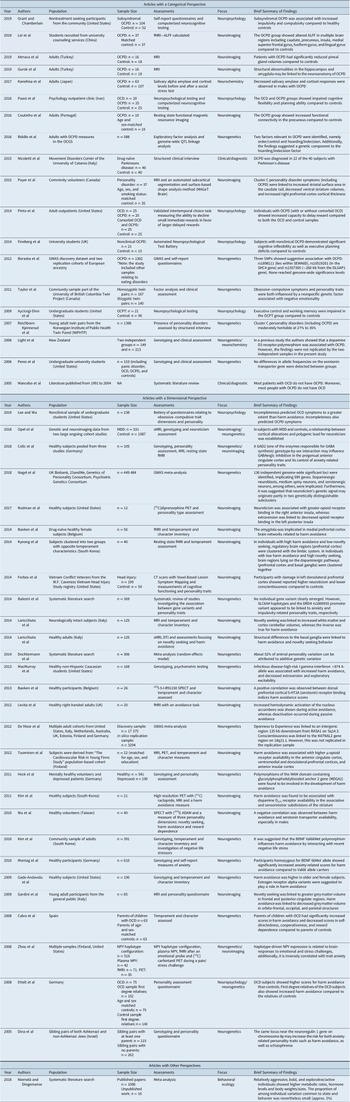
Like other forms of psychopathology, OCPD can be considered from both a categorical and dimensional perspective. A categorical approach organizes disorders into exclusive categories, whereas a dimensional approach emphasizes that symptoms or traits contributing to the disorder lie on a continuum.Reference Kessler 6 The results from our literature search are presented accordingly; we first report research on OCPD as a diagnostic category and then report the literature on relevant trait dimensions. Finally, we touch on emerging perspectives to assess whether these might contribute to an integrative model of the neurobiology of OCPD. Table 1 provides a summary of the 49 articles that were included in this review.
Overview of the Articles Selected for Inclusion in This Review (n = 49)

Abbreviations: ALFF, amplitudes of low-frequency fluctuation; BDNF, brain-derived neurotrophic factor; CT, computed tomography; DTI, diffusion tensor imaging; fMRI, functional magnetic resonance imaging; GABA, gamma aminobutyric acid; GWAS, genome-wide association study; MDD, major depressive disorder; MRI, magnetic resonance imaging; NPY, neuropeptide Y; OCD, obsessive–compulsive disorder; OCGS, OCD Collaborative Genetics Study; OCPD, obsessive–compulsive personality disorder; OCPT, obsessive–compulsive personality trait; PET, positron emission tomography; QTL, quantitative trait locus; sMRI, structural magnetic resonance imaging; SNP, single nucleotide polymorphism; SPECT, single photon emission computed tomography.
OCPD as a category
Categorical approaches are binary in nature: someone either has a mental disorder or they do not. Providing a specific threshold for diagnosis is useful for clinical decision-making, and in the research context, it provides the basis for prevalence estimates.Reference Kessler 6 DSM-5 criteria for the category of OCPD have provided the basis for studies of the epidemiology, neurobiology, and treatment of this condition. Here, we describe investigations of neuropsychology, neuroimaging, neurochemistry, and neurogenetics, approaching OCPD from a categorical angle.
Neuropsychology
A series of studies from a single group of investigators has investigated whether the neuropsychological dysfunctions that characterize obsessive–compulsive disorder (OCD) are also observed in college students with obsessive–compulsive personality traits (OCPTs). Executive control and working memory were compared in students with OCPTs (where some OCPTs are present, but not enough to warrant a diagnosis), OCD symptoms (intrusive thoughts and accompanying compulsions), and healthy controls. A number of findings emerged. First, students with OCPTs showed impaired performance on tasks of executive control and working memory, whereas this was not associated with OCD symptoms. These authors speculated that OCPTs compensate for impaired executive control.Reference Aycicegi-Dinn, Dinn and Caldwell-Harris 7 Additionally, individuals with OCPTs showed impairments on a range of executive function assessments consistent with clinical symptoms. However, such impairments are not necessarily specific to OCPD as they are seen in other personality disorders as well.Reference Garcia-Villamisar, Dattilo and Garcia-Martinez 8 Second, the cohort with OCPTs had significant cognitive inflexibility and executive planning deficits, while decision-making was unaffected. This neuropsychological profile is similar to that seen in OCD and in relatives of people with OCD, possibly explaining the clinical symptoms of OCPD, such as perfectionism, slowness and behavioral rigidity.Reference Fineberg, Day and De Koenigswarter 9 Notably, individuals with OCD and comorbid OCPD have also been shown to present with even more cognitive inflexibility.Reference Fineberg, Sharma, Sivakumaran, Sahakian and Chamberlain 10
In a different study, comparison of subjects with OCD (without OCPD), subjects with OCPD, and healthy controls, indicated that both subjects with OCD and subjects with OCPD had reduced cognitive flexibility and planning ability.Reference Paast, Khosravi, Memari, Shayestehfar and Arbabi 11 These findings further support the hypothesis that OCD and OCPD lie on a spectrum of conditions. A number of additional cognitive–affective constructs have been investigated in OCPD. For example, compared to individuals with OCD and healthy controls, individuals with OCPD showed increased ability to delay reward.Reference Pinto, Steinglass, Greene, Weber and Simpson 12 This was associated with clinically significant rigidity and perfectionism. These data are consistent with the hypothesis that OCPD is characterized by undue self-control, and given similar findings in OCD, again support an hypothesis that these conditions are related.Reference Pinto, Steinglass, Greene, Weber and Simpson 12
In an investigation of 104 subjects with subsyndromal OCPD and 52 healthy controls, where groups were matched on age, sex, and education, OCPTs were associated with heightened impulsivity and compulsivity.Reference Grant and Chamberlain 13 Several investigators have emphasized that OCD itself is characterized by both impulsivity and compulsivity,Reference Fineberg, Chamberlain and Goudriaan 14 and so once again these findings support the hypothesis of a relationship between OCD and OCPD. Nevertheless, further comparisons of these constructs across different personality disorders would be needed to determine the extent to which these findings are specific to OCPD.
Neuroimaging
Although there is a body of work on neuroimaging in personality disorders, few have focused specifically on OCPD.Reference Ma, Fan, Shen and Wang 15 In one of these, individuals with cluster C personality disorders were found to have greater striatal surface areas in the caudate tail, reduced ventral striatum volumes, and increased cortical thickness in the right prefrontal cortex compared to controls.Reference Payer, Park and Kish 16 However, this study did not provide specific findings in relation to OCPD.
A resting state functional magnetic resonance imaging (rs-fMRI) study showed increased functional connectivity in the precuneus of individuals with OCPD. These findings may be consistent with the signature perfectionism and rumination of OCPD, as the posterior node of the default mode network is believed to be involved in self-reflection, as well as accessing past events for problem-solving and future planning.Reference Coutinho, Goncalves, Soares, Marques and Sampaio 17 Notably, rs-fMRI studies in OCD have not found precuneus involvement, suggesting that the functional neuroanatomy of OCD and OCPD differ. In 37 patients with OCPD, another study utilizing rs-fMRI, found altered spontaneous brain activity in multiple brain regions compared to age- and sex-matched healthy controls. Increased amplitudes of low-frequency fluctuation (ALFF) were detected in the caudate, precuneus, insula, and medial superior frontal gyrus, whereas decreased ALFF were detected in the fusiform gyrus and lingual gyrus. Speculatively, these spontaneous brain activity changes might reflect different characteristics of OCPD, including cognitive inflexibility, excessive self-control, lower empathy, and visual attention bias.Reference Lei, Huang and Li 18 Further work is needed to assess whether similar patterns of ALFF are present in OCD.
In a sample of 20 patients with OCPD and matched healthy controls, participants with OCPD had smaller hippocampus and amygdala volumes.Reference Gurok, Korucu, Kilic, Yildirim and Atmaca 19 In another study, pineal gland volumes of subjects with OCPD were significantly smaller compared to healthy controls, even when controlling for covariates, while there were no differences in whole brain or gray and white matter volumes.Reference Atmaca, Korucu, Caglar Kilic, Kazgan and Yildirim 20 Structural imaging studies of OCD have noted a number of differences from healthy controls, but these three areas were not consistently implicated, suggesting that the structural neuroanatomy of OCD and OCPD may differ.
Increased prevalence of OCPD in Parkinson’s disease (PD) has led to the speculative suggestion that dopaminergic and striatal circuitry may play a role in OCPD.Reference Nicoletti, Luca and Luca 21 However, to date, there is no direct evidence available to support this suggestion.
Neurochemistry and neurogenetics
According to an early study assessing serotonergic function by means of prolactin response to fenfluramine, males with OCPD had significantly blunted responses compared to males with noncompulsive personality disorders and healthy controls.Reference Stein, Trestman, Mitropoulou, Coccaro, Hollander and Siever 22 Additionally, the total number of OCPTs positively correlated with impulsive aggression scores and showed an inverse relationship with prolactin responses in the combined patient group. These findings suggest that impulsive and compulsive symptoms have a complex interaction, and both may correlate with serotonergic dysfunction. In another older study, individuals with major depressive disorder (MDD) with underlying OCPD responded better to fluvoxamine, a serotonergic antidepressant compared to the individuals with MDD without OCPD, also implicating a role for serotonin in the pathophysiology of OCPD.Reference Ansseau, Troisfontaines, Papart and von Frenckell 23
In males with OCPD, lower levels of salivary cortisol and alpha-amylase were detected after performing the Trier Social Stress Test (TSST) compared to healthy controls, possibly indicating altered sympathetic activity in OCPD.Reference Kanehisa, Kawashima and Nakanishi 24 These data seem too limited, however, to reach definitive conclusions about the role of neurotransmitter or neuroendocrine systems in OCPD.
There is some evidence to suggest a genetic contribution. OCPD was found to be more common in relatives of cases compared to controls.Reference Bienvenu, Samuels and Wuyek 25 Additionally, parents of children with OCD may be more likely to have OCPD.Reference Mancebo, Eisen, Grant and Rasmussen 26 A twin study found the heritability of OCPD to be 27%.Reference Reichborn-Kjennerud, Czajkowski and Neale 27 Findings indicating that OCPD has an important heritable component are consistent with data on other personality traits and disorders. Factor analysis of OCPD in families where a sibling had been diagnosed with OCD identified two factors associated with the disorder; that is, orderliness/perfectionism, and hoarding/indecision. For hoarding/indecision a significant sibling–sibling correlation was observed, as well as some linkage to a region on chromosome 10.Reference Riddle, Maher and Wang 28 In addition, in monozygotic and dizygotic adult twins, obsessive–compulsive symptoms and traits appear etiologically related, with the same nonspecific genetic factor influencing negative emotionality underlying both symptoms and traits.Reference Taylor, Asmundson and Jang 29 However, in the absence of data on OCPD without OCD, it is premature to assert a genetic relationship between OCD and OCPD.
Preliminary studies of dopaminergic and serotonergic gene variants have failed to provide evidence of involvement in OCPD.Reference Light, Joyce and Luty 30 , Reference Perez, Brown, Vrshek-Schallhorn, Johnson and Joiner 31 While genome-wide association studies (GWAS) of childhood OCPTs showed no significant hits, three single nucleotide polymorphisms (SNPs) did meet a threshold of P < 10−5. The first two were in Semaphorin 6D (SEMA6D) (a gene from the large semaphorin family and involved in central nervous system neural wiring) and Src Homology 2 Domain Containing Adaptor Protein 4 (SCH4) (a gene that has been linked to depression), while the third SNP lies lose to Disks Large-associated Protein 1 (DLGAP1) (a gene plays an important role in glutamatergic function). Glutamatergic genes have also emerged as important in GWAS studies of OCD.Reference Boraska, Davis and Cherkas 32
The dimensions of OCPD
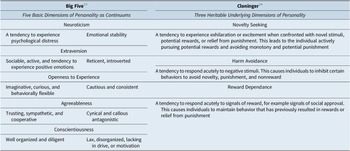
Dimensional approaches are continuous in nature; that is, psychological distress is measured on a scale without designated thresholds to separate those with and those without a particular mental disorder.Reference Kessler 6 Recently, the value of dimensional research in clinical neuroscience has been highlighted by the Research Domain Criteria (RDoC) framework, an initiative of the National Institute of Mental Health (NIMH).Reference Insel, Cuthbert and Garvey 35 In addition, the big five model of personalityReference Costa and McCrae 33 , Reference De Fruyt, De Clercq, De and Van Heeringen 36 gave impetus to a large body of research on the dimensions of neuroticism, conscientiousness, agreeableness, extraversion and openness to experience,Reference Costa, Samuels, Bagby, Daffin, Norton, Maj, Akiskal, Mezzich and Okahsa 37 and Cloninger’s personality frameworkReference Cloninger 34 led to research on the dimension of harm avoidance (see Table 2). The dimensions of neuroticism and harm avoidance may be particularly relevant to OCPD,Reference Lee and Wu 38 - Reference Samuels, Nestadt and Bienvenu 40 and so are briefly discussed below. Other dimensions relevant to OCPD include compulsivity and impulsivity.Reference Grant and Chamberlain 13 These constructs prompt the question of whether OCPD should fall within the spectrum of OCDs.Reference Fineberg, Sharma, Sivakumaran, Sahakian and Chamberlain 10 In this section, we describe studies focused on neuroimaging, neurochemistry, and neurogenetics, approaching OCPD from a dimensional angle.
The Big Five Model of Personality vs Cloninger’s Personality Framework

Neuroimaging
As noted earlier, the dimensions of neuroticism and harm avoidance may be relevant to OCPD. Individual differences in the neurocircuitry involved in the perception of, and cognitive control over negative stimuli may contribute to neuroticism. Specifically, decreased connectivity between left amygdala and anterior cingulate cortex may be linked to reduced extinction of the amygdala response to anxiety-provoking stimuli.Reference Ormel, Bastiaansen and Riese 41 These findings are congruent with neuropsychological data indicating that neuroticism is linked to a negative bias in attention, a negative bias in interpretation and recall of information, as well as increased reactivity and poor coping.Reference Ormel, Bastiaansen and Riese 41 Neuroticism has also been linked to increased opioid receptor binding in the right anterior insula.Reference Rodman, Deckersbach, Chou, Kong, Gollub and Dougherty 42 Links to fronto-amygdala activity in harm avoidance have also been noted.Reference Baeken, Marinazzo and Van Schuerbeek 43 , Reference Kyeong, Kim, Park and Hwang 44
fMRI work on avoidance in healthy adults found increased activation of the nucleus accumbens (NAcc) in active avoidance and enhanced deactivation during passive avoidance. The NAcc may therefore play a role in emitting and withholding responses to avoid harm.Reference Levita, Hoskin and Champi 45 Neuroticism and/or harm avoidance have also been linked to variations in several other brain regions, including the basal ganglia, dorsolateral prefrontal cortex, and cerebellum.Reference Forbes, Poore, Krueger, Barbey, Solomon and Grafman 46 - Reference Gardini, Cloninger and Venneri 50
Neurochemistry and neurogenetics
Molecular imaging studies have found that harm avoidance correlated negatively with the availability of the dopamine D2/3 receptor in striatal regionsReference Kim, Son and Kim 51 and with serotonin transporter availability in the midbrain.Reference Wu, Lee and Yeh 52 Furthermore, harm avoidance correlated positively with 5-HT2A receptor binding indices in prefrontal regions,Reference Baeken, Bossuyt and De Raedt 53 as well as with μ-opioid receptor availability in a number of regions.Reference Tuominen, Salo and Hirvonen 54 These studies are, however, characterized by small sample sizes.
Recent reviews of the neuroanatomy and neurochemistry of compulsivity and impulsivity have suggested that these two constructs are underpinned by both overlapping and discrete neural substrates. The serotonergic and dopaminergic neurotransmitter systems, for example, play a role in both compulsivity and impulsivity, but have different roles in each.Reference Fineberg, Chamberlain and Goudriaan 14 , Reference Fineberg, Potenza and Chamberlain 55 These reviews do not specifically cover patients with OCPD, however.Reference Diedrich and Voderholzer 2
In parents of children with OCD, the dimensions of hoarding, perfectionism, and preoccupation with details, which are characteristic of OCPD, were also significantly more frequent.Reference Calvo, Lázaro, Castro-Fornieles, Font, Moreno and Toro 56 Meta-analyses of personality trait heritability, including neuroticism and harm avoidance, show modest heritability across species.Reference Dochtermann, Schwab and Sih 57 , Reference Sallis, Smith and Munafò 58
Candidate gene studies focusing on serotonergic and dopaminergic genes in harm avoidance have yielded inconsistent results, with analyses likely underpowered.Reference Balestri, Calati, Serretti and De Ronchi 59 Other candidate genes that have been linked to neuroticism or harm avoidance include BNDF (encoding brain-derived neurotrophic factor),Reference Kim, Cho and Jang 60 , Reference Montag, Basten, Stelzel, Fiebach and Reuter 61 NPY (encoding neuropeptide Y),Reference Zhou, Zhu and Hariri 62 GAD2 (encoding a GABA synthesis related enzyme),Reference Colic, Li and Demenescu 63 IFNG (encoding the cytokine, gamma-interferon),Reference MacMurray, Comings and Napolioni 64 the estrogen receptor gene,Reference Gade-Andavolu, MacMurray, Comings, Calati, Chiesa and Serretti 65 the neuroregulin 1 gene,Reference Dina, Nemanov and Gritsenko 66 and the MAM domain containing glycosylphosphatidylinositol anchor 2 gene (MDGA2 or MAMDC1).Reference Heck, Pfister and Czamara 67
Several GWAS studies of neuroticism or harm avoidance have recently been conducted.Reference Sallis, Smith and Munafò 58 A large GWAS (n = 449 484) of neuroticism found 136 genome-wide significant loci. Analysis showed involvement of specific cell types, such as dopaminergic neuroblasts (P = 3.49 × 10⁻⁸), serotonergic neurons (P = 1.37 × 10⁻⁷) and medium spiny neurons (P = 4.23 × 10⁻⁸).Reference Nagel, Jansen and Stringer 68 Higher PRS for neuroticism are associated with reduced cortical surface area in brain regions believed to be involved in internally focused cognition (including the inferior parietal cortex and precuneus).Reference Opel, Amare and Redlich 69 In a GWAS of conscientiousness, KATNAL2 (Katanin Catalytic Subunit A1 Like 2) reached significance. This gene is believed to be involved in cellular microtubule organization and has been associated with autism.Reference De Moor, Costa and Terracciano 70 It would be interesting to see if these variants also emerged in a GWAS of OCPD.
Emerging perspectives
Finally, biological accounts of personality disorders such as OCPD should not only explain the proximal mechanisms applicable to a specific phenotype (eg, underlying molecular mechanisms), but also more distal mechanisms (ie, the evolutionary factors that have allowed these personality traits to persist). Several evolutionary theorists have claimed that different personality traits may be beneficial under different environmental conditions, resulting in a wide range of personality traits enduring in the population.Reference Buss 71 - Reference Segal and MacDonald 76
The life history framework in evolutionary theory, for example, juxtaposes slow and fast life strategies. A slow strategy entails low reproduction rates with greater parental investment in progeny, whereas a fast strategy entails the opposite.Reference Macarthur and Wilson 77 Multiple other variables are associated with life strategy across species. For instance, slow life strategies are associated with greater birth weight, longer maturation time, and a longer lifespan.Reference Stearns 78 Both strategies have advantages and disadvantages and involve certain trade-offs.
This evolutionary framework can also be used to account for individual differences such as personality traits.Reference Del Giudice 79 Impulsive personality traits, for example, can be linked to a fast life strategy,Reference Brüne 80 whereas compulsive personality traits are more consistent with a slow life strategy. HertlerReference Hertler 81 suggests that the latter framework is applicable to OCPD, as a key characteristic of the disorder, conscientiousness, is a highly notable personality marker of a slow life strategy. He also suggests that other features of OCPD such as delayed gratification, hoarding, and harm avoidance, are all compatible with a slow life strategy.
Successful application of the life history conceptual framework to personality traits would need empirical support from both animal and human investigations. Although there is a growing literature in this area,Reference Niemelä and Dingemanse 82 it is too preliminary to provide solid support for a neurobiological model of OCPD.
Conclusion
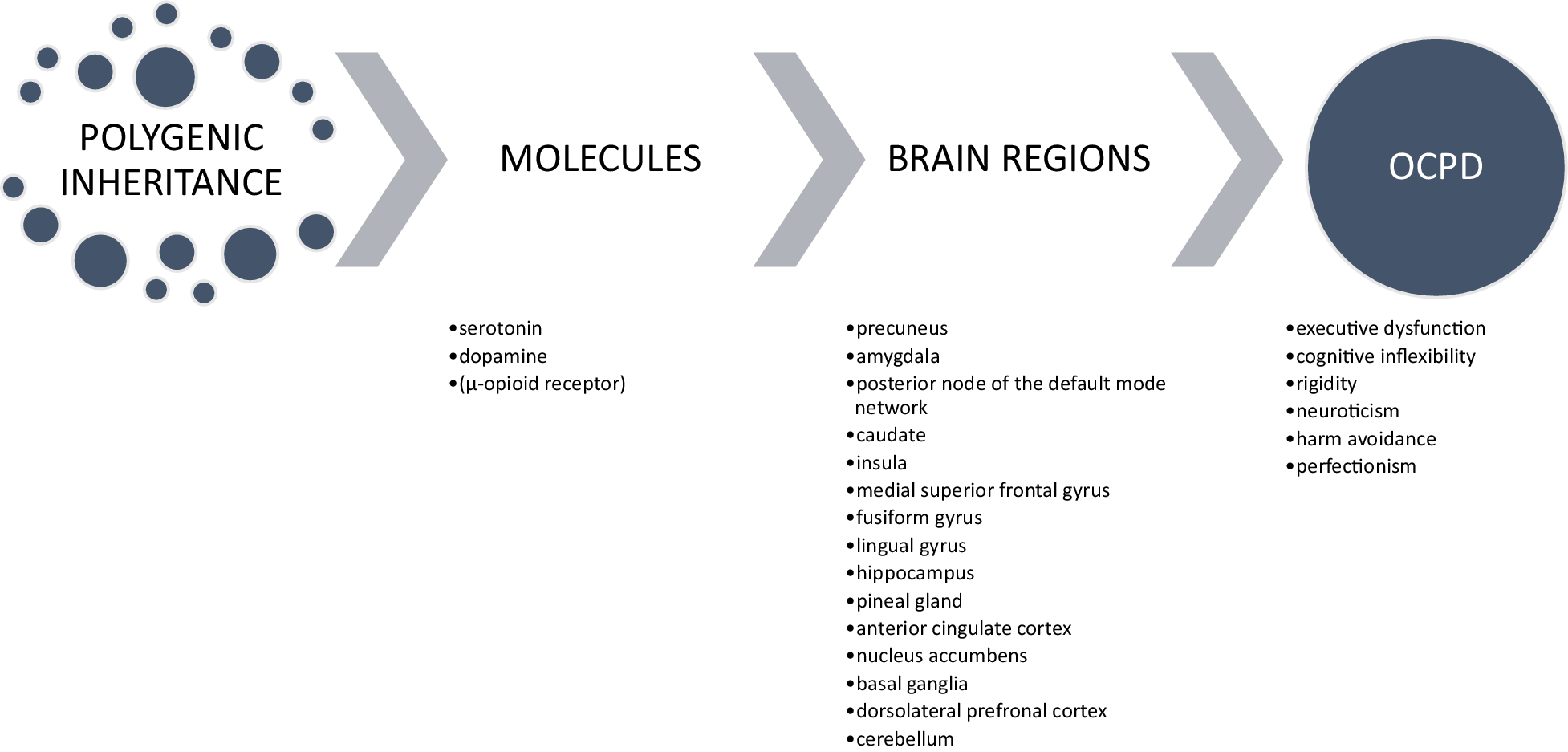
This systematic review aimed to collate existing studies of OCPD, to see whether there are sufficient data to formulate an integrated model of its neurobiological underpinnings (Figure 1). There is a growing set of studies on the neuropsychology, neuroimaging, neurochemistry, and neurogenetics of OCPD and both categorical and dimensional approaches have been employed. Impaired executive function and cognitive inflexibility are common neuropsychological traits in OCPD, suggesting that OCD and OCPD may lie on a continuum. However, neuroimaging studies of OCPD have to date not provided sufficient support for the hypothesis that OCPD and OCD fall on a continuum.Reference Coutinho, Goncalves, Soares, Marques and Sampaio 17 - Reference Gurok, Korucu, Kilic, Yildirim and Atmaca 19 , Reference Ormel, Bastiaansen and Riese 41 , Reference Baeken, Marinazzo and Van Schuerbeek 43 , Reference Kyeong, Kim, Park and Hwang 44 , Reference Opel, Amare and Redlich 69 Neuroimaging studies have however pointed to striatal and amygdalar involvement in OCPD as well as Cloninger’s personality dimension of harm avoidance.Reference Payer, Park and Kish 16 , Reference Gurok, Korucu, Kilic, Yildirim and Atmaca 19 , Reference Baeken, Marinazzo and Van Schuerbeek 43 , Reference Kim, Son and Kim 51 Multiple other brain regions have also been implicated where there have not always been overlap. From a neurochemistry perspective, serotonergic and dopaminergic systems may be implicated in categorical and dimensional research relevant to OCPD.Reference Nicoletti, Luca and Luca 21 , Reference Light, Joyce and Luty 30 , Reference Kyeong, Kim, Park and Hwang 44 , Reference Kim, Son and Kim 51 - Reference Baeken, Bossuyt and De Raedt 53 , Reference Nagel, Jansen and Stringer 68 However, neither of the approaches has yielded conclusive findings to date. Neurogenetic research emphasizes the heritability of OCPD as well as its underlying personality dimensions,Reference Riddle, Maher and Wang 28 , Reference Boraska, Davis and Cherkas 32 , Reference Kim, Cho and Jang 60 , Reference Heck, Pfister and Czamara 67 , Reference Nagel, Jansen and Stringer 68 yet candidate genes have not been clearly identified and data on involvement of genetic variants that impact neurotransmission or other brain functions, are very preliminary.Reference Fineberg, Chamberlain and Goudriaan 14 , Reference Nicoletti, Luca and Luca 21 , Reference Kim, Son and Kim 51 , Reference Fineberg, Potenza and Chamberlain 55
Summary of results. A summary of the results from categorical and dimensional research between 2005 and 2020, relevant to the neurobiology of OCPD.

This systematic review indicates that while knowledge in this area has advanced, it is premature to attempt a detailed and comprehensive model of the neurobiology of OCPD. By emphasizing a number of the limitations of, and gaps in the current literature, this review has also pointed to potential areas for future research. Future collaborative networks, and the meta- or mega-analyses of single center datasets, should these be obtained, may be useful in addressing the limited statistical power of research on OCPD to date.Reference Thompson, Dennis and Gutman 83 The field may also benefit from hypothesis focused translational research, as exemplified in the RDoC framework.
Acknowledgment
The authors would like to thank their colleagues at the South African Medical Research Council (MRC) Unit on Risk & Resilience in Mental Disorders for their continued support.
Disclosures
The authors do not have any disclosures.
Funding
Dan J. Stein and Christine Lochner are supported by the Medical Research Council (MRC) of South Africa.
Author Contributions
Conceptualization: C.M., C.L., D.J.S.; Writing—original draft: C.M., C.L., D.J.S.; Writing—review and editing: C.M., C.L., D.J.S.