Introduction
To what extent do a mother’s socialization practices impact the intellectual ability of her children? The results of recent genetically informed studies suggest that the maternal socialization influence is negligible or at best inconsistent across measures (Beaver et al., Reference Beaver, Schwartz, Al-Ghamdi, Kobeisy, Dunkel and Van der Linden2014; Boccio & Beaver, Reference Boccio and Beaver2016). Using a large nationally representative sample of adolescents Beaver et al. (Reference Beaver, Schwartz, Al-Ghamdi, Kobeisy, Dunkel and Van der Linden2014) found a non-significant association between maternal behaviour and adolescent vocabulary. Likewise, Boccio and Beaver (Reference Boccio and Beaver2016) found that maternal behaviours were unrelated to performance on memory tasks measured when the participants were young adults.
The results of Beaver et al. (Reference Beaver, Schwartz, Al-Ghamdi, Kobeisy, Dunkel and Van der Linden2014) can be contrasted with those from a recent book by Flynn (Reference Flynn2016). Flynn (Reference Flynn2016) introduced a new method to examine the possible role of family environment in developing individual differences in intelligence by analysing data reported in IQ test codebooks. The method relies upon differences in the distribution between a child’s cognitive ability and his or her home environment. Although correlated, the child’s cognitive ability and the stimulation offered by his home environment will not be perfectly matched. The mismatch will be especially evident at the tails of the distribution. High cognitive ability individuals will most likely be reared in a home with an environment below their ability level, thus lowering their intelligence, while individuals with low cognitive ability are most likely to reap the benefits of a home environment that provides stimulation greater than the environment they may actively choose later in development.
However, it is not the method that is important for the current investigation, but the litany of findings that were revealed when applying this new method. Flynn’s (Reference Flynn2016) findings not only suggest that familial environment has a significant impact on developing intelligence, but he also reports a number of additional more nuanced findings. Three of these additional findings are especially pertinent. First, the effect of familial environment on intelligence is more pronounced for verbal intelligence relative to performance intelligence. Second, while the influence of the familial environment diminishes with age, familial environment still accounts for a substantial amount of variance in verbal ability (≈5% of the variance) at the critical juncture in development of ages 17–18. Third, familial influences have a greater effect for those at the lower end of the intelligence distribution.
Whence the discrepancy between Beaver et al. (Reference Beaver, Schwartz, Al-Ghamdi, Kobeisy, Dunkel and Van der Linden2014) and Flynn (Reference Flynn2016)? One possibility can be found in the scales used by Beaver et al. (Reference Beaver, Schwartz, Al-Ghamdi, Kobeisy, Dunkel and Van der Linden2014) to measure parental influence. The scales (save maternal and paternal level of education) were all based on the adolescent’s self-report of their emotional relationship with their mother and father. The scales included measures of disengagement, attachment, involvement and permissiveness. Perhaps because the outcome variable is cognitive ability, a measure of maternal sensitivity in the context of teaching would produce a stronger effect than measures more closely aligned with general maternal affection and nurturance.
The current investigation is an attempt to test Flynn’s (Reference Flynn2016) findings using the Block and Block (Reference Block and Block2006a, Reference Block and Blockb) data with a measure of maternal sensitivity in the context of teaching. The Block and Block study has been used to examine various aspects of the development of individual differences in intelligence both as the study was ongoing (e.g. Funder & Block, Reference Funder and Block1989) and more recently by re-analysing archived data (e.g. Dunkel & Murphy, Reference Dunkel and Murphy2014). The Block and Block data set (Reference Block and Block2006a) includes data from the 30-year longitudinal study (Block & Block, Reference Block and Block2006b) with the first wave of data collection beginning when participants were in preschool, and with the last wave of data collection occurring when participants were beginning middle age. For the purposes of the current study data from waves corresponding to ages 3, 4, 5, 7, 11 and 18 were utilized.
The Block and Block longitudinal study is unique in both the breadth and depth of its testing and assessment of participants. Not only, for example, were IQ tests administered in data collection waves when participants were 4, 11 and 18, but multiple trained experts observed and rated various personality and familial aspects of each participant. These intensive observational methods may yield especially good indicators of the underlying constructs and the breadth of assessment allows for statistical controls for various alternative hypotheses.
Thus following an assessment of the bivariate relationships between maternal sensitivity and intelligence additional analyses were conducted controlling for possible confounds. The covariates reflect demographics (participant sex, ethnicity and socioeconomic status (SES)), participant dispositional characteristics (two aspects of temperament and IQ as measured at age 4) and maternal characteristics (maternal level of education and maternal nurturance). Statistically controlling for these variables allows for the control of possible spurious correlations in which, for example, lower SES causes both a reduction in participant intelligence and less effective maternal cognitive socialization. Of special interest are the covariates of IQ measured at age 4 and maternal nurturance. The IQ at age 4 can be used as a baseline, allowing for an assessment of the association of maternal cognitive socialization with intelligence above and beyond this assessment. Controlling for maternal nurturance permits the isolation of the effect of maternal sensitivity as observed in a teaching context, which may explain the different results of Beaver et al. (Reference Beaver, Schwartz, Al-Ghamdi, Kobeisy, Dunkel and Van der Linden2014) and Flynn (Reference Flynn2016).
Reiterating, the fundamental hypothesis is that maternal sensitivity as rated during mother–child dyadic cognitive tasks will be predictive of the children’s future intelligence (H 1); and this association between maternal sensitivity and intelligence will be found up to age 18 (H 2). The association between maternal sensitivity and general intelligence will remain after controlling for several possible confounds, including the demographic variables of participant sex, ethnicity and SES, the dispositional variables of childhood temperament and general intelligence, and the maternal variables of years of education and nurturance (H 3). There are also secondary and more exacting hypotheses which also follow from Flynn’s (Reference Flynn2016) analysis. The effect of maternal sensitivity on intelligence will be more pronounced for verbal intelligence than it is for performance intelligence (H 4). Likewise, the effect of maternal sensitivity on intelligence will be stronger for participants with lower initial intelligence (H 5).
Methods
Participants
Data and documentation files for the Block and Block study (Reference Block and Block2006a) were obtained electronically from the Henry A. Murray Research Archive. Due to attrition and incomplete data the sample size and composition varies across analyses. Because the focus of this study was on the effects of maternal sensitivity, the base sample composition of participants with maternal sensitivity data is reported. The base sample for maternal sensitivity included 117 participants (59 male), 77 of which were White, 32 Black, five Asian and three ‘other’.
Measures
Maternal sensitivity
Mothers and their children completed four structured cognitive tasks when the children were 5 years of age. The tasks and how maternal behaviour was assessed in these tasks is described by Block and Block (Reference Block and Block2006a) and also Kremen and Block (Reference Kremen and Block1998): ‘At age 5, the sample members were observed interacting with each of their parents in a series of standardized situations. Each parent taught a battery of four cognitive tasks to his or her child. Two parallel versions of the battery were administered in a counterbalanced design to control for order and task effects, and sex of child and sex of parent effects as well. Mothers and fathers were seen by different examiners in sessions separated by at least five weeks. The tasks included in the battery were selected to be of interest to both parents and children, to be sufficiently difficult so that children would require parental assistance yet sufficiently easy for quick comprehension by parents, and to require minimal explanation by examiners to parents.’
The four tasks were the construction of squares or posts (child instructed to make squares out of an assortment of shapes), a matrix task, a maze completion task and the instances task (name as many items in a category as possible). After the session, an examiner completed the 49-item Teaching Strategies Q-Set (TSQ). The TSQ was developed to describe parent–child interactions in circumstances when the parent was teaching the child. Subsequently, a second rater viewed the videotapes and independently completed the TSQ. A composite TSQ was formed from the two TSQ scores. The average item inter-rater reliability between the two raters was 0.70, as reported by Kremen and Block (Reference Kremen and Block1998).
Dunkel et al. (Reference Dunkel, Mathes, Kesselring, Decker and Kelts2015) transformed the aggregated ratings from the two independent raters into a measure of maternal sensitivity by first creating a Q-sort template of the TSQ items reflecting sensitivity. The template was created by averaging Q-sorts of three raters charged with the task of arranging the TSQ items in order to represent sensitivity at one pole of the Q-sort distribution and insensitivity at the opposite pole of the Q-sort distribution. The templates between the three raters correlated between r=0.59 to r=0.82. The TSQ items indicative of sensitivity included: ‘parent and child converse with each other’, ‘parent praises the child’ and ‘parent gives child reasons and explanations’. The TSQ items representative of insensitivity included: ‘parent lacks pride in child, ashamed of child’, ‘parent is hostile’ and ‘parent intrudes physically in tasks’. Next, the aggregated ratings were correlated with the template. This correlation indicates how closely maternal behaviour matches the sensitivity template and the resulting correlational coefficient is used as the maternal sensitivity score.
Performance and verbal intelligence
The criterion variables included scores on the performance and verbal sections of the Wechsler Intelligence Scale for Children (WISC), which was administered to participants at age 11, and scores on the Wechsler Adult Intelligence Scale (WAIS), which was administered to participants at age 18.
Covariates
Eight covariates were included. The three demographic variables that acted as statistical controls were sex, ethnicity (dichotomized as White and non-White due to small sample size) and SES. At age 4 the participants’ SES was measured using Warner’s Socioeconomic Index (1949).
Three childhood dispositional variables were included. The childhood dispositional variables included two aspects of temperament and, most importantly, childhood general intelligence. Temperament was measured at ages 3, 4 or at both ages. The California Child Q-set (CCQ; Block, Reference Block1978) was used to measure the temperamental dimensions of ego-control and ego-resiliency (e.g. Funder et al., Reference Funder, Block and Block1983; Kremen & Block, Reference Kremen and Block1998; Letzring et al., Reference Letzring, Block and Funder2005). Ego-control is similar to impulse control with high scores representing over-control and low scores representing under-control. Ego-resiliency is the ability to modify control to appropriately match the situational demands (Letzring et al., Reference Letzring, Block and Funder2005). The participants’ preschool teachers rated the participants using the CCQ. Some participants were rated only at ages 3 or 4 and some were rated at both ages. If participants were rated at both ages the average of their two scores was used. The Wechsler Preschool and Primary Scale of Intelligence (WPPSI) was used to measure childhood general intelligence. The WPPSI was administered when participants were 4 years of age.
The two maternal variables controlled for were maternal education and maternal nurturance. When participants were 7 years of age their mothers reported their total years of education and this was used as the measure of maternal education. Maternal nurturance was measured using the Child-Rearing Practices Report (CRPR; Block, Reference Block1965). The CRPR is a 91-item Q-set that mothers used to rate their own maternal behaviour when the participants were 3 years of age. Dekovic´ et al. (Reference Deković, Janssens and Gerris1991) developed a measure of nurturance that uses eighteen items of the CRPR. This measure has been used with the Block and Block data (Reference Block and Block2006a), as Chopik et al. (Reference Chopik, Moors and Edelstein2014) recently used it to examine the development of attachment. Note that all of the covariates, save for mother’s level of education level, were measured prior to maternal sensitivity.
Results
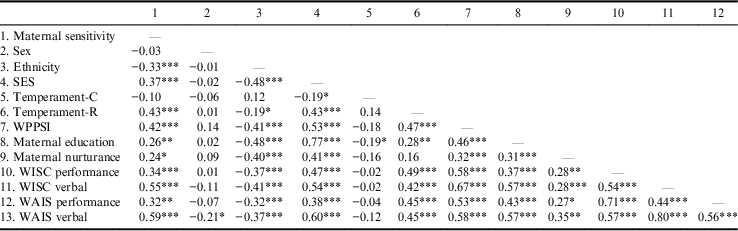
Prior to analyses participant sex (male=1 and female=2) and ethnicity (White=1 and non-White=2) were dummy coded. Correlations between the study variables can be seen in Table 1. Most relevant to the hypotheses, significant positive correlations were found between maternal sensitivity and each measure of intelligence: WPPSI total, WISC performance, WISC verbal, WAIS performance and WAIS verbal. Next, four separate hierarchical regression analyses were calculated. A separate regression was run for each of the four predicted indices of intelligence: WISC performance, WISC verbal, WAIS performance and WAIS verbal. In each regression variables were entered in the same sequence. In order to isolate the effect of the demographic variables from the other covariates and maternal sensitivity, sex, ethnicity and SES were entered in Step 1. In Step 2, the childhood characteristics of ego-control, ego-resiliency and WPPSI were entered. In Step 3 the maternal characteristics of educational level and maternal nurturance were entered. Finally, in Step 4 maternal sensitivity was entered.
Correlations amongst study variables
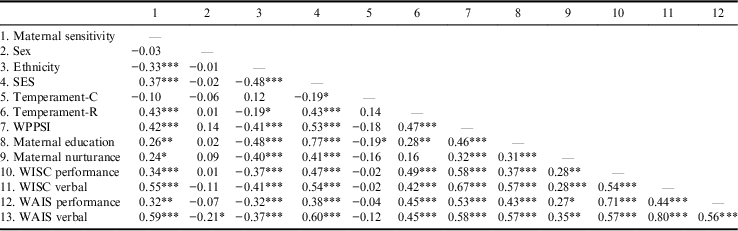
R=ego-resiliency. C=ego-control.
*p<0.05; **p<0.01; ***p<0.001. For all variables N=81–159. For the maternal sensitivity variable N=84–117.
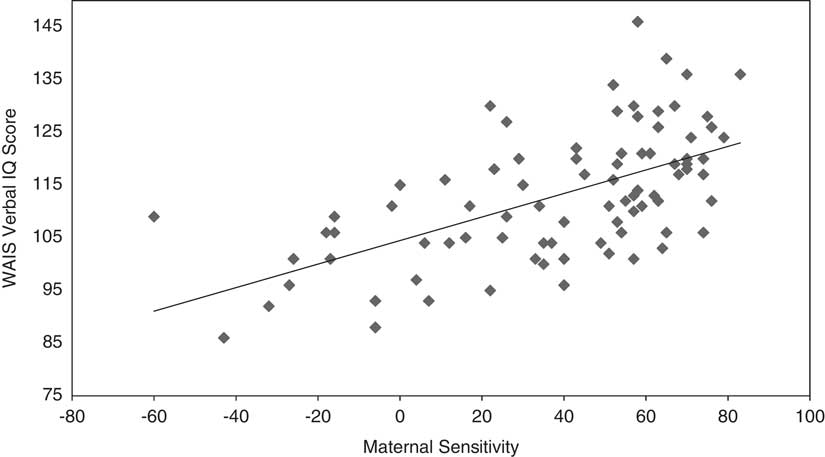
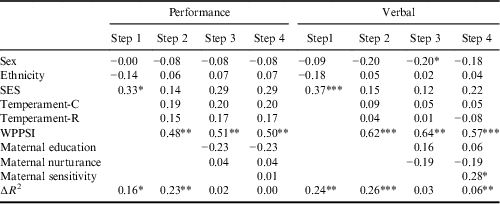
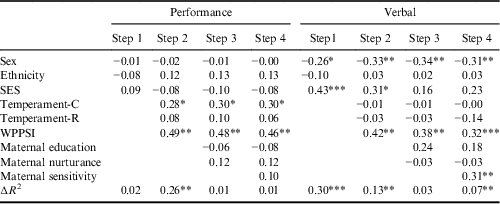
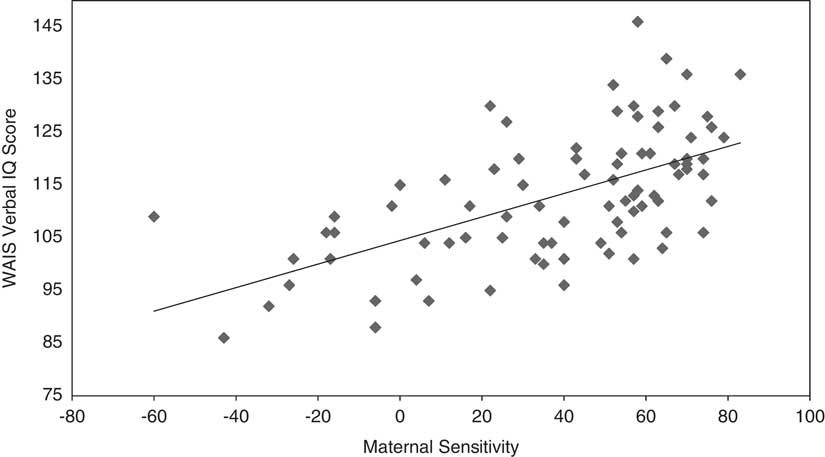
The results for both the WISC performance and verbal scores can be seen in Table 2. In the table it can be seen that for the WISC performance score, the WPPSI was the only significant predictor. Also in Table 2 it can be seen that for the WISC verbal score the WPPSI was also a significant predictor, but maternal sensitivity was also a significant predictor and explained an additional 6% of the variance in the WISC verbal score when it was entered in Step 4. The results for both the WAIS performance and verbal scores can be seen in Table 3. For the WAIS performance score the WPPSI was again the strongest predictor, but the temperamental aspect of control was also a significant predictor such that participants with greater control had higher WAIS performance scores. For the WAIS verbal score participant sex (males scored higher), WPPSI and maternal sensitivity were all significant predictors. When entered in Step 4 maternal sensitivity explained an additional 7% of the variance in the WAIS verbal score. Across the analyses the most compelling findings concern the association between maternal sensitivity and the WAIS verbal scores. Therefore, a scatterplot (see Fig. 1) is provided representing the distribution of scores between these two variables.
Scatter plot for WAIS verbal IQ scores by maternal sensitivity.
Hierarchical regression analyses predicting WISC performance and verbal IQ at age 11
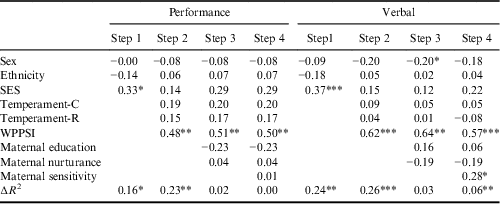
R=ego-resiliency. C=ego-control.
*p<0.05; **p<0.01; ***p<0.001. N=62.
Hierarchical regression analyses predicting WAIS performance and verbal IQ at age 18
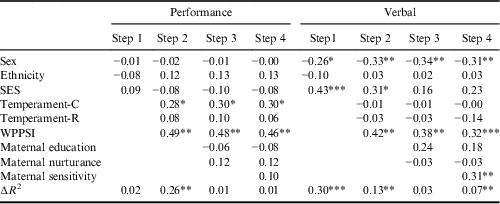
R=ego-resiliency. C=ego-control.
*p<0.05; **p<0.01; ***p<0.001. N=62.
To test the hypothesis that maternal sensitivity has a greater effect on individuals at the lower end of the IQ distribution, and that this effect is more pronounced for verbal intelligence, analyses using the continuous parameter estimation model (CPEM; Gorsuch, Reference Gorsuch2005) were conducted for the WISC performance, WISC verbal, WAIS performance and WAIS verbal scores. While Flynn (Reference Flynn2016) tested the hypothesis that family influence is greatest for those at the lower end of the IQ distribution by splitting the samples based on standard deviations, CPEM allows one to avoid splitting the sample. It is best not to split samples if it can be avoided (MacCallum et al., Reference MacCallum, Zhang, Preacher and Rucker2002). Alternatively to splitting the sample, CPEM allows for the strength of the correlation between two variables to be measured across the full range of values of a third variable. In the current analyses the strength of the relationship between maternal sensitivity and each of the intelligence outcome variables (WISC performance, WISC verbal, WAIS performance, WAIS verbal) can be examined across the range of the WPPSI scores. Based on the results reported by Flynn (Reference Flynn2016) it is expected that as WPPSI scores increase the association between maternal sensitivity and the WISC and WAIS scores weakens and that this weakening is more pronounced for the verbal scores.
Following the CPEM procedure four products were made by multiplying the standardized value of the maternal sensitivity scores with the standardized scores for the WISC performance, WISC verbal, WAIS performance and WAIS verbal scores. These four products were then correlated with the WPPSI scores. The results were as follows: WPPSI-maternal sensitivity×WISC performance, r (77)=−0.15, p=0.19; WPPSI-maternal sensitivity×WISC verbal, r(78)=−0.25, p=0.03; WPPSI-maternal sensitivity×WAIS performance, r(75)=−0.06, p=0.60; WPPSI-maternal sensitivity×WAIS verbal, r (75)=−0.22, p=0.060.
Discussion
Based upon the results reported by Flynn (Reference Flynn2016) the following hypotheses were tested: maternal sensitivity would be positively associated with intelligence (H 1); the effect of maternal sensitivity on intelligence would continue to age 18 (H 2); the effect of maternal sensitivity on intelligence would remain after controlling for several alternatives (H 3); the relationship between maternal sensitivity and intelligence would be stronger for verbal than performance intelligence (H 4); and maternal sensitivity will have a greater effect for individuals at the lower end of the intelligence distribution (H 5). Some support was found for all of these hypotheses.
Maternal sensitivity and all of the measures of cognitive ability exhibited positive and significant associations, although the effect size for maternal sensitivity was stronger for verbal, relative to performance, ability. Likewise, the significant associations remained after controlling for several other variables (most importantly IQ at age 4 and maternal nurturance), but only for verbal, not performance, ability. Also, the patterns were similar for the WISC, which was administered at age 11, and the WAIS, which was administered at age 18. Thus, following Flynn (Reference Flynn2016) the effect remained up to age 18. However, in contrast to Flynn (Reference Flynn2016) the effect was not reduced from age 11 to age 18. It is possible that the influence of maternal sensitivity is stable while other familial influences dissipate. Finally, CPEM analyses gave some indication of replicating Flynn (Reference Flynn2016): that the effect of maternal sensitivity on cognitive ability was not evenly distributed across the IQ distribution. The result of each CPEM analysis was in the expected direction, yet the effect was only significant for verbal ability as measured at age 11.
It is notable how well the results align with those of Flynn (Reference Flynn2016). The findings suggest that a mother’s behaviour can impact her children’s intelligence, with several caveats. The effect is more pronounced for verbal ability and children of lesser overall ability (garnered some support in the current results), and probably diminishes with time (although this was not found in the current results). However, as emphasized by Flynn (Reference Flynn2016), an effect of several points on an IQ proxy test such as the SAT, which is most often taken in late adolescence, may make an important difference in college admittance.
Although maternal sensitivity was predictive of offspring subsequent cognitive ability, the results do not delineate between the role that maternal sensitivity may play in early development from the continued influence of maternal sensitivity. It is appropriate to expect that mothers that exhibit sensitivity when the participants were age 5 would be more likely to continue to exhibit sensitivity later in development. But because sensitivity was only measured once, at age 5, the effect of maternal sensitivity in early development cannot be separated from its possible continued influence. Likewise, the cognitive tests used in the analyses precluded the examination of how maternal sensitivity may affect the slope of children’s subsequent cognitive development.
Another limitation was that the study was not genetically informed. While the inclusion of multiple covariates allowed for the statistical control of several alternative hypotheses, because it was not a genetically informed study it is possible the maternal sensitivity–child cognitive ability correlation is genetically mediated. Yet recent genetically informed studies are consistent with the results (Kendler et al., Reference Kendler, Turkheimer, Ohlsson, Sundquist and Sundquist2015; Loehlin et al., Reference Loehlin, Hansell, Wright and Martin2016). Using an adoption design, Kendler et al. (Reference Kendler, Turkheimer, Ohlsson, Sundquist and Sundquist2015) found an effect for parental education on the cognitive ability of 18- to 20-year-olds roughly equal to four IQ points. They did not report separate results for verbal and performance measures. Using a large sample of adolescent twins Loehlin et al. (Reference Loehlin, Hansell, Wright and Martin2016) found that the shared environment accounted for some variance in adolescents’ verbal as opposed to performance ability. Thus, the results are consistent in suggesting that familial environment is accounting for some variance in adolescent verbal ability and they provide direction for further investigation into familial influences. Lastly, it is suggested that future research address the limitation of a small sample size. With covariates added to the regression model the sample was reduced to 62. It is important to try and secure a larger sample.
Acknowledgments
This project was made possible by the Henry A. Murray Research Archive, which is housed by the Institute for Quantitative Social Science at Harvard University. The data employed in this study were derived from a 30-year longitudinal study begun with 128 3-year-old girls and boys, planned and conducted by Jack and Jeanne H. Block, involving a sequence of nine independent assessments based on personality and cognitive Life, Observational, Test, and Self-report (LOTS) measures.
Ethical Approval. The authors assert that all procedures contributing to this work comply with the ethical standards of the relevant national and institutional committees on human experimentation and with the Helsinki Declaration of 1975, as revised in 2008.
Conflicts of Interest. The authors have no conflicts of interest to declare.
Funding. This research received no specific grant from any funding agency, commercial entity or not-for-profit organization.