Sickness presenteeism, defined as going to work while ill (Karanika-Murray et al., Reference Karanika-Murray, Biron, Hervieux, Whysall, Chen, Wall, Cooper and Brough2021), is a concept whose interest has increased exponentially in recent decades due to the negative impact that health conditions have on individual work productivity (Johns, Reference Johns2010). Although prior studies have already examined the effects of different sickness presenteeism antecedents, family domain impacts have only recently begun to be studied (e.g., Cicei, Reference Cicei2012; Ferreira et al., Reference Ferreira, Mach, Martinez, Brewster, Dagher, Perez-Nebra and Lisovskaya2019). Indeed, some efforts have already been made to better understand how presenteeism impact employees’ work-family conflict (WFC) levels (Ferreira et al., Reference Ferreira, Mach, Martinez, Brewster, Dagher, Perez-Nebra and Lisovskaya2019). However, the literature does not appear to include any studies that have explained how aspects of workers’ family domain can influence their presenteeism behaviors despite researchers’ growing interest in studying these issues. This includes impacts on work productivity when employees have health problems and how the clear gender inequalities that are still present not only at work (Simpson, Reference Simpson1998) but essentially at home (Rodrigues et al., Reference Rodrigues, Cunha and Wall2015) take their toll.
Truly, with the ongoing growth of women’s involvement in the labor force, the challenges of balancing the demands associated with work and family domains became prevalent among them. Achieving work-life balance for women continues to be challenging, specifically because, in addition to their work role, women are still expected to have a high performance in their traditional gender roles, i.e., those of mother and wife (Biernat & Wortman, Reference Biernat and Wortman1991; Martinez & Ferreira, Reference Martinez and Ferreira2012), where they still contribute the most (e.g., Rodrigues et al., Reference Rodrigues, Cunha and Wall2015).
Thus, answering this lack of research, for a better understanding of sickness presenteeism antecedents and the relationships between roles played by individuals in different life domains such as family and work (Clark, Reference Clark2000), this study aims to investigate how specific aspects from the family domain may impact work productivity despite sickness presenteeism among heterosexual couples. In particular, we sought to fill a gap in the literature by studying the potential buffering effects of specific resources (i.e., conscientiousness and perceived partner support) on work productivity loss due to sickness presenteeism, and therefore extend existing presenteeism models (e.g., Johns, Reference Johns2010) by providing evidence for the inclusion of the family domain as critical presenteeism antecedent. To this end, we examined the potential contributions of the Job Demands-Resources (JD-R) model (Bakker & Demerouti, Reference Bakker, Demerouti and Cooper2014) to explain these relationships. Drawing on this theoretical approach, we propose that, at home, resources may emerge as attenuators of housework demands, with the power of promoting engagement with housework tasks and thus increase work productivity despite sickness. This may happen since individuals who engaged in their housework, according to JD-R motivational path assumption (Bakker & Demerouti, Reference Bakker, Demerouti and Cooper2014), may feel an energetic connection with their domestic tasks and feel able to deal in positive ways with the demands associated with these duties. Based on this assumption, in order to explore the applicability of the JD-R framework to the home domain, we adapted the concept of engagement to the specific context of housework and conceptualized it as a positive, fulfilling, affective-motivational state of housework-related wellbeing (i.e., the positive affective results of performing household tasks). By doing so we considered it as a crucial missing link to explain the relationship between couples’ resources and work productivity despite presenteeism. Since women continue to be largely responsible for most of the housework and family care (Rodrigues et al., Reference Rodrigues, Cunha and Wall2015), we believe that this energetic state might be more prevalent among them, if they have certain resources that encourage it (such as high conscientiousness and partner support).
Hence, as in previous studies we considered conscientiousness personality trait as a personal resource (e.g., Barrick & Mount, Reference Barrick and Mount1991). We chose conscientiousness due to its potential power of helping individuals, especially women, to maintain high levels of work performance despite sickness presenteeism. By doing so, we sought to fill a research gap in this area, since, according to Johns (Reference Johns2010), any theory of presenteeism must include personality traits. Also, we follow prior studies calls that acknowledge that conscientiousness plays a vital role in the understanding of WFC (e.g., Wayne et al., Reference Wayne, Musisca and Fleeson2004; Witt & Carlson, Reference Witt and Carlson2006). To this end, by specifically focus our research on the explicative potential of women conscientiousness (Weisberg et al., Reference Weisberg, DeYoung and Hirsh2011), our paper aims to consolidate the integration of personality traits as important individual resources of the JD-R Model (Bakker & Demerouti, Reference Bakker, Demerouti, Diener, Oishi and Tay2018) with the power of boosting women’ housework engagement and, consequently their and their partners’ productivity despite sickness.
Moreover, we included perceived partner support as a social resource. This construct gains importance based on the assumption that social support networks, in this case, based on partners, are associated with both increased psychological wellbeing and physical health, as well as attenuated stress and strain levels resulting from high demands in different life domains (Walen & Lachman, Reference Walen and Lachman2000). Thus, in the present investigation, perceived partner support was considered an important housework-related social resource, due to its potential capabilities of impacting engagement with housework by boosting it, and, consequently, foster work productivity despite sickness.
Overall, our research provides support for the applicability of the motivational branch of the JD-R framework (Bakker & Demerouti, Reference Bakker, Demerouti and Cooper2014) to the house domain, showing that the family domain can entail the potential of creating positive spirals into work when couples’ members – especially women - when they detain certain resources that allow them to create and maintain those positive spirals. By considering this novel perspective we enhance current literature by showing that the permeability between work and family domains may differ between men and women and that the positive spillover of what happens at home to what happens at the work domain may not only occur at the individual level but also at the couple level, with women having a major influence on their partners’ work life.
Literature Review
Gender and Productivity Losses Associated with Sickness Presenteeism
All health conditions related to sickness presenteeism lead to reductions in productivity levels (Shamansky, Reference Shamansky2002). This happens because, when individuals slow down their recovery from less severe health conditions, these can evolve into potentially more severe diseases. Working sick reduces individual performance, requiring workers to make an extra effort in order to achieve performance levels closer to those they would have without diseases.
In addition to the type of disease and as defended by Johns (Reference Johns2010), in the present study, gender emerges as a key factor and is considered a personal factor whose relationship with sickness presenteeism is of special interest due to the productivity losses associated with employees who go to work when sick. Studies have shown that women tend to report higher levels of presenteeism than men (e.g., Martinez & Ferreira, Reference Martinez and Ferreira2012; Sendén et al., Reference Sendén, Schenck-Gustafsson and Fridner2016). This reality may be due to the existence of presenteeism cultures dominated by male managers that encourage individuals, especially women, to work long hours even when sick as a way to demonstrate a visible commitment to work and maximize career opportunities (Simpson, Reference Simpson1998). This may mean in certain moments that individuals are present at work when they should be sick at home recovering, or that they are overworked and no longer productive. Another possible explanation for these findings is given by Sendén et al. (Reference Sendén, Schenck-Gustafsson and Fridner2016), which revealed that the relationship between gender and sickness presenteeism is mediated by WFC. Their findings showed that women reporting higher levels of WFC tend to go to work more often when they are sick, showing that the study of the relationship between sickness presenteeism and factors from the family domain is worth further exploration.
Given this preliminary evidence, Johns (Reference Johns2010) emphasizes the need to systematically study the association between sickness presenteeism and gender since this has not been a central focus in the literature. Inspired by this call for research, our study used a dyadic sample of heterosexual couples to test the JD-R conceptual model (Bakker & Demerouti, Reference Bakker, Demerouti and Cooper2014). This model is a crucial framework to disclose the relationships between both demands and resources and productivity associated with sickness presenteeism across family and work domains. However, although this model comprises considerable potential for explaining sickness presenteeism, the relationship between this and job/family demands, and resources have only recently begun to be studied (e.g., McGregor et al., Reference McGregor, Magee, Caputi and Iverson2016). The use of this framework is thus worth further exploration.
The Applicability of the JD-R Framework to Housework and Sickness Presenteeism
The JD-R emerges as a theoretical framework that proposes processes through which aspects of the work domain affect workers’ energy, health, and motivation (Bakker et al., Reference Bakker, Demerouti and Sanz-Vergel2014). In this study, we consider the JD-R (Bakker & Demerouti, Reference Bakker, Demerouti and Cooper2014) a crucial framework to explore how aspects from the family domain may impact positively work productivity despite sickness presenteeism among heterosexual couples. On the grounds of this, and following prior studies (e.g., Sarti, Reference Sarti2014), we examined the potential contributions of this framework by focusing on its motivational process and mainly considering a resources perspective. Considering the explanatory potential of both personal and social resources, we drew our theoretical proposal for the applicability of the JD-R motivational path to the home domain and defend that when couples – women in particular -, detain certain resources they may be able to sustain positive spirals between home and work domains and maintain high-performance levels even when working whilst sick.
As in the work domain, we strongly believe that this proposed relationship may be explained by engagement. For this reason, in this research we proposed describing housework engagement as a positive, fulfilling, affective-motivational state of housework-related wellbeing, this is, a positive affective state associated with the performance of household chores, capable of buffering their potential negative effects and preventing negative spillovers from the home domain to the work domain.
The exploration of these relations among heterosexual couples is of special interest since women continue to engage in more non-traditional gender roles than men (Perrone et al., Reference Perrone, Wright and Jackson2009; Rodrigues et al., Reference Rodrigues, Cunha and Wall2015). Indeed, the literature already pointed evidence of differences between genders in levels of distress experienced concerning work-family stress (e.g., Martins et al., Reference Martins, Eddleston and Veiga2002). A study with dual employed couples found that work-family conflicts affected career satisfaction for both men and women, but women felt more distressed by work-family conflicts than men (Martins et al., Reference Martins, Eddleston and Veiga2002), which highlighted the higher permeability between the two life spheres for women. Nonetheless, the impacts of the home domain on productivity despite presenteeism remain unstudied.
Recent studies point that the JD-R framework offers valuable contributions to explain sickness presenteeism behavior. For example, a study conducted by McGregor et al. (Reference McGregor, Magee, Caputi and Iverson2016) revealed that burnout and work engagement mediate the relationship between work demands and resources and presenteeism. Still, despite the interesting results found, the authors have only focused on both demands and resources from the work domain, ignoring the potential positive effects that the home domain may entail in reducing productivity losses associated with presenteeism. These relationships thus constitute possible gaps in the literature.
Therefore, based on the above-mentioned evidence and exploring the applicability of the JD-R framework to the work domain, this study by studying heterosexual couples will allow us to address a gap in the literature about how specific resources may help couples to maintain high levels of work productivity despite sickness presenteeism, as well as explore the role of housework engagement as a missing link to explain this relationship.
Conscientiousness as a Personal Resource
The JD-R framework (Bakker & Demerouti, Reference Bakker, Demerouti and Cooper2014) posits that personal resources are psychological characteristics or aspects of individuals generally associated with resiliency, which refer to their ability to control and shape their environment successfully (Hobfoll et al., Reference Hobfoll, Johnson, Ennis and Jackson2003; Schaufeli & Taris, Reference Schaufeli, Taris, Bauer and Hämmig2014). Conscientiousness - a personality trait - can be considered a personal resource since key features of this trait are related to resiliency (Barrick & Mount, Reference Barrick and Mount1991). Also, is linked to individual differences in planning, organizing, and performing tasks, with individuals with higher levels of conscientiousness being determined, punctual, reliable, organized, full of willpower, and generally achieve professional success (Costa & McCrae, Reference Costa, McCrae, Boyle, Matthews and D.H.2008). According to a resources’ perspective personality traits, such as conscientiousness, emerge as key personal resources because of their effects on both increasing work-related engagement (Mäkikangas et al., Reference Mäkikangas, Feldt, Kinnunen, Mauno and Bakker2013) and reducing burnout (e.g., Alarcon et al., Reference Alarcon, Eschleman and Bowling2009).
Previous studies have already pointed that personality traits -conscientiousness in particular- emerge as critical in the understanding of WFC in both directions (e.g., Friede & Ryan, Reference Friede, Ryan, Kossek and Lambert2005; Wayne et al., Reference Wayne, Musisca and Fleeson2004; Witt & Carlson, Reference Witt and Carlson2006). For example, according to Wayne et al. (Reference Wayne, Musisca and Fleeson2004), more conscientious individuals tend to manage more effectively their time, responsibilities, tasks, and conflicts that arise between work and family domains. Because of this, these individuals are less likely to report WFC in both directions. Thus, high levels of conscientious may reduce role pressures, stress, and tension, as well as conflicts between roles (Wayne et al., Reference Wayne, Musisca and Fleeson2004), and, consequently, conserve energy and reduce the exhaustion associated with health problems and heavy work demands (Perry et al., Reference Perry, Witt, Penney and Atwater2010).
Nonetheless, contradictory results arise from Witt and Carlson’s (Reference Witt and Carlson2006) research, which shows that more conscientious individuals may reduce efforts in the work domain to avoid a loss spiral of resources resulting from high family-work conflict. Specifically, they conceptualize conscientiousness, as a resource that helps individuals to cope with the loss of further resources (Hobfoll et al., Reference Hobfoll, Halbesleben, Neveu and Westman2018). In this sense, their results revealed that the relationship between family-work conflict was weaker among low-conscientiousness individuals (Witt & Carlson, Reference Witt and Carlson2006).
When considering presenteeism, according to Johns (Reference Johns2011), individuals with high levels of conscientiousness are less likely to engage in sickness presenteeism and report fewer productivity losses due to it. This evidence supports that conscientiousness act as a personal resource both in the JD-R framework (Bakker & Demerouti, Reference Bakker, Demerouti and Cooper2014) and from the theoretical perspective of resource conservation, emphasizing its importance in avoiding burnout and exhaustion (Hobfoll et al., Reference Hobfoll, Halbesleben, Neveu and Westman2018) and allowing to maintain high-performance levels. Altogether, the above-mentioned literature inspired us to further analyze the impacts of conscientiousness on productivity despite presenteeism.
Besides this association between one’s personality traits and individual and occupational outcomes, our study tries to address the following question: “Can a spouse’s personality also influence one’s workplace performance?” by focusing on conscientiousness specific role. Indeed, one possible way through which the family domain can influence the work domain is through the personality of one’s spouse or partner. Still, currently, very little is known about whether people’s stable individual differences (e.g., personality) influence their spouses’/partners’ work performance and success. Most of the research on the influence of partner personality has focused on relationship outcomes, such as relationship satisfaction (e.g., Dyrenforth et al., Reference Dyrenforth, Kashy, Donnellan and Lucas2010; Solomon & Jackson, Reference Solomon and Jackson2014b); or one’s life satisfaction (e.g., Russell & Wells, Reference Russell and Wells1994) and physical health (e.g., Roberts et al., Reference Roberts, Smith, Jackson and Edmonds2009).
Nonetheless, Solomon and Jackson (Reference Solomon and Jackson2014a) unfolded that more conscientious partners tend to perform more household chores, display more pragmatic behaviors that their spouses are likely to emulate, and promote a more satisfying home life, allowing their spouses to focus more on the work domain. Overall, their results showed that personal characteristics of one’s partner can influence important aspects of one’s professional life.
Regarding conscientiousness gender differences, these are not consistent across cultures and, typically, are not significant. However, Weisberg et al. (Reference Weisberg, DeYoung and Hirsh2011) report that women tend to have higher levels of conscientiousness than men, especially with regard to accountability and self-discipline. Also, a recent study by Averett et al. (Reference Averett, Bansak and Smith2018) showed that a spouse’s personality may contribute to his/her affinity towards housework. Specifically, the results unfold that for men it does appear that a conscientious wife might free up her husband from housework, which increases his working capacity on the job. In other words, women’s conscientiousness allows their partners to do less housework and potentially work more at their jobs. For the women, the results were not significant.
Based on the above-mentioned literature, we propose that by showing higher levels of conscientiousness, women may be more prone to manage their time and housework demands in a more effective manner (Rodrigues et al., Reference Rodrigues, Cunha and Wall2015), which may decrease the amount of energy and hours spent by their partners or spouses performing household tasks, allowing them more time for recovery. In other words, we propose that women’s levels of conscientiousness may facilitate their partners to maintain high levels of performance at work (Demerouti et al., Reference Demerouti, Bakker, Geurts and Taris2009). Thereby, we posit the following hypothesis:
Hypothesis 1a: Women’s level of conscientiousness is positively associated with their work productivity despite sickness presenteeism.
Hypothesis 2: Women’s level of conscientiousness is positively associated with men’s work productivity despite sickness presenteeism.
Perceived Partner Support as a Psychosocial Resource
In this study, we considered perceived partner support a social resource in the family domain capable of mitigating the effects of housework demands. We defined perceived partner support as a set of global beliefs developed by individuals about the extent to which their partner values their contributions to housework and cares about their overall wellbeing. Perceived partner support emerges as an important family social resource in this research because this support may attenuate the demands and exhaustion associated with housework, promote work engagement and, consequently, work productivity despite health problems. This idea may be explained by the fact that social support networks, namely spouses or partners, are usually associated with increased psychological wellbeing and physical health, generally having beneficial effects on individuals (e.g., reduced stress and tension) (Walen & Lachman, Reference Walen and Lachman2000).
Social networks and social support research have also produced evidence regarding gender differences in network characteristics. For instance, Gove et al. (Reference Gove, Hughes and Style1983) showed that support in the marital relationship has more significant psychological effects for women than for men. Women tend to report receiving less support (w.r.t., quantity and quality) from their spouses than men (e.g., Xu & Burleson, Reference Xu and Burleson2001). Furthermore, a study of American couples conducted by Lawrence et al. (Reference Lawrence, Bunde, Barry, Brock, Sullivan, Pasch, White, Pasch and Adams2008) points to partner support as a key antecedent of marital outcomes such as marital satisfaction, with wives being particularly concerned about providing adequate support to their husbands. However, the authors call for research exploring the influences of partner support in different samples, as the extent to which men and women provide support to their partners may vary across cultures (e.g., high-vs.-low-masculinity cultures).
Indeed, when considering sickness presenteeism effects, a study conducted by Martinez et al. (Reference Martinez, Ferreira, Nunes, Cooper and Lu2018) in Portugal showed that family-work conflict reveals a lower correlation with productivity losses due to presenteeism than in countries with high masculine cultural values. This might be explained by the fact that individuals working in feminine cultures (such as Portugal) are more oriented toward interpersonal relationships, quality of life, and value for their families. Following this reasoning, and considering our sample characteristics, we expect that Portuguese citizens, regardless of their gender, will have fewer productivity losses due to sickness presenteeism, since they culturally tend to provide more support to their partners, by esteeming their relationships and being moved by values such are consensus, cooperation, concession and participation (Hofstede et al., Reference Hofstede, Hofstede and Minkov2005). In other words, we expect that when men and women perceive high levels of partner support, this support will impact positively their work productivity, despite health problems, increasing it. Thus, we postulate the following hypothesis:
Hypothesis 3a: Men’s perceived partner support is positively associated with their work productivity despite sickness presenteeism.
Hypothesis 3b: Women’s perceived partner support is positively associated with their work productivity despite sickness presenteeism.
The Mediating Role of Housework Engagement
Work engagement is a widely studied topic that has recently started to be related to sickness presenteeism (e.g., McGregor et al., Reference McGregor, Magee, Caputi and Iverson2016; Martinez et al., Reference Martinez, Ferreira, Nunes, Cooper and Lu2018). However, in research focusing on the family domain, housework engagement has not been studied yet. By including this novel concept in the study of productivity associated sickness presenteeism, we sought to contribute to a better understanding of the antecedents of this behavior, as well as the relationship between roles played by individuals in different domains of their life.
Considering, housework engagement portrayed by a strong identification with housework, we propose that when people are more engaged in their housework, they feel higher identification with their house role, and consequently, they will be more motivated to effectively manage demands between family and work, without affecting negatively their work performance, even when they work sick. We suggest that this energetic state might be more prevalent if individuals possess the necessary resources to boost it.
Based on this assumption, we propose that personal resources, such as conscientiousness, may contribute positively to high levels of housework engagement. Additionally, since Averett et al. (Reference Averett, Bansak and Smith2018) results revealed that women’s personality traits play a key role, revealing positive links between spousal personality and self-reported housework, we expect that when women show high levels of conscientiousness, they will show more engagement with their house tasks which will result, not only in increased work productivity, despite the existence of health problems, for themselves but also their spouses/partners. In other words, we propose that women’s levels of conscientiousness may facilitate their partners to maintain high levels of performance at work (Demerouti et al., Reference Demerouti, Bakker, Geurts and Taris2009) and that this will happen because housework engagement will work as a buffer, relieving fatigue associated with it. Therefore, we propose the following hypotheses:
Hypothesis 4: The relationship between women’s level of conscientiousness and their work productivity despite sickness presenteeism, is mediated by their housework engagement.
Hypothesis 5: The relationship between women’s level of conscientiousness and men’s work productivity despite sickness presenteeism, is mediated by women’s housework engagement.
As tends to occur in the work domain, the availability of resources such as social support has motivational effects, triggering positive emotions, making individuals feel valued, thus generating high levels of engagement (McGregor et al., Reference McGregor, Magee, Caputi and Iverson2016). In other words, when individuals feel valued and that their wellbeing is considered, they tend to develop higher levels of engagement. Shifting to the family domain and drawing upon the resource perspective from the JD-R model (Bakker & Demerouti, Reference Bakker, Demerouti and Cooper2014), we propose that perceived partner support emerges as an important family social resource with the power of boosting housework engagement. Specifically, we suggest that, when experienced, perceived partner support may have the power to mitigate the potential negative effects of housework demands and increase individuals’ levels of engagement with housework, which in turn will result in increased work productivity, despite sickness presenteeism. As mentioned before, this may happen because housework engagement, as an explanatory link between perceived partner support and work productivity, will present motivational buffering effects, relieving the fatigue associated with housework (Demerouti et al., Reference Demerouti, Bakker, Geurts and Taris2009). Additionally, we base our assumption on cultural factors since Portugal is a country with high feminine cultural values (Hofstede et. al., Reference Hofstede, Hofstede and Minkov2005). Thus, we expect that Portuguese individuals will experience fewer productivity losses due to presenteeism since they culturally provide more support to their partners, which will consequently enhance their housework engagement. Thus, we hypothesized the following partner effects:
Hypothesis 6a: The relationship between men’s perceived partner support and their work productivity despite sickness presenteeism, is mediated by their housework engagement.
Hypothesis 6b: The relationship between women’s perceived partner support and their work productivity despite sickness presenteeism, is mediated by their housework engagement.
The model of the above research hypotheses outlines the indirect relationships between personal and social resources (i.e., conscientiousness and perceived partner support) and work productivity despite sickness presenteeism through the motivational path of housework engagement, as presented in Figure 1.
Model of Hypotheses

Method
Sample
The present research collected data from 180 Portuguese heterosexual couple dyads—married and unmarried— recruited using convenience sampling. The participants’ mean age was 42 years old for men, mean (M) = 41.97; standard deviation (SD) = 9.76; min. = 19; max. = 62), and 40 years old for women, M = 40.31; SD = 9.33; min. = 18; max. = 61. Regarding work, on average, the number of hours worked per week was 42.29 hours (SD = 11.06) for men and 40.39 (SD = 10.04) for women. On average, in the last six months, male participants worked 11.89 days (SD = 34.50) and female participants worked 14.4 days (SD = 36.73) when they were sick or not feeling well.
Procedure
Data were collected using a snowballing sampling method. To this end, self-report questionnaires were distributed through the research team’s networks. Couples that agreed to participate were asked to indicate other potential couples from their network. Participants responded to the self-report questionnaire in one of two versions—online or paper — based on their preference. Data were gathered from two genders (i.e., men and women) to analyze the interdependence between couple members. We also chose this method to reduce the errors associated with completing self-report measures, such as social desirability, consistency, and acquiescence (Grandey et al., Reference Grandey, Cordeiro and Crouter2005). Hence, each couple was asked to complete the same version of the questionnaire, but each questionnaire was completed individually, without interference from the other couple member. In order to match the couple’s data, couples were asked to create a couple code. Both members of the couple entered the same code at the beginning of their questionnaires. The use of couple codes also allowed us to ensure that the surveys remained anonymous.
Additionally, to guarantee an ethical investigation, this study complied with the Ethical Principles of Psychologists and Code of Conduct of the American Psychological Association (2010) and the Ordem dos Psicólogos Portugueses (Portuguese Psychologists Association) (2011). Before filling out the questionnaire, participants were provided with information about the study’s objectives, completion instructions, voluntary participation, and ensured confidentiality and anonymity of the data collected. The data were inserted in a database and analyzed using Statistical Package for the Social Sciences and Analysis of Moments Structures (AMOS) software, both in version 25.
Measures
Productivity loss due to sickness presenteeism was assessed using the Stanford Presenteeism Scale (SPS–6; Ferreira et al., Reference Ferreira, Martinez, Sousa and Cunha2010). The scale measures individuals’ self-rated work performance while affected by sickness presenteeism so that higher scores mean that the participants’ work is less affected by sickness presenteeism. Participants answered the six items on a 5-point scale ranging from 1 - strongly disagree to 5 - strongly agree. Examples of items are as follows: “Because of my health problems, the stresses of my job were much harder to handle” and “My health problems distracted me from taking pleasure in my work”. The scale revealed an adequate internal consistency (α = .70).
Housework engagement was measured using an adaptation of seven items from the Utrecht Work Engagement Scale (UWES–9; Schaufeli et al., Reference Schaufeli, Bakker and Salanova2006). Participants answered on a 7-point scale ranging from 0 - never to 6 – always, so that higher scores mean that participants have higher levels of housework engagement. Two sample items are: “I felt happy when I worked intensely in my household chores” and “I’ve been immersed in my household chores”. This scale’s psychometric quality showed good internal consistency (α = .91).
Conscientiousness was measured using four items of the Big Five Inventory (BFI–54; John et al., Reference John, Donahue and Kentle1991). Participants answered on a 5-point scale ranging from 1 - strongly disagree to 5 - strongly agree, and higher scores mean that participants have higher levels of conscientiousness. Two sample items are: “I see myself as someone who: is thorough in the tasks he/she performs” and “I see myself as someone who: perseveres until the task is finished”. The internal consistency coefficient for this scale was adequate (α = .67).
Perceived partner support (PPS) was assessed with an adaptation of the Portuguese version of Perceived Organizational Support scale (SPOS–8; Santos & Gonçalves, Reference Santos, Gonçalves, Eisenberger and e Sowa2010). Participants answered the 8-items on a 7-point scale ranging from 1 - strongly disagree to 7 - strongly agree, so that higher scores mean that participants perceive higher levels of partner support. The adapted SPOS–8 used in this study comprises two dimensions: Affective perception of partner support and cognitive awareness of partner support. Examples of items are as follows: “Even if I did the best job possible at home with household chores, my partner would fail to notice” and “My partner fails to appreciate my efforts at home”. The Cronbach’s alpha showed good internal reliability (α = .80).
Translation/back-translation procedures (Brislin, Reference Brislin1970) were applied to create the Portuguese adaptations of housework engagement, conscientiousness, and perceived partner support.
Also, in line with previous research (e.g., Martinez et al., Reference Martinez, Sawyer, Thoroughgood, Ruggs and Smith2017), we opted not to include control variables in this study. Our decision was based on several authors’ recommendations of caution when considering the inclusion of controls as well as on the fact that there was no reason to believe that other demographic characteristics measured in our survey would cause spurious relations between our study variables (Carlson & Wu, Reference Carlson and Wu2012; Spector & Brannick, Reference Spector and Brannick2011).
Measurement Model and Common Method Bias
To test the validity of the variables included in this study (i.e., conscientiousness, perceived partner support, housework engagement, and work productivity despite sickness presenteeism), a Confirmatory Factor Analysis (CFA) for the total sample was conducted in AMOS v. 25. The measurement model showed a good fit to the data, χ2(df) = 489.35 (261), p < .001, χ2/df = 1.875, CFI = .95, TLI = .94, RMSEA = .05, SRMR = .07 (Hair et al., Reference Hair, Black, Babin and Anderson2010). To address concerns of common method variance (Podsakoff et al., Reference Podsakoff, MacKenzie, Lee and Podsakoff2003), Harman’s single-factor test was conducted, i.e., the four factors combined into a single factor.
The results revealed that a single-factor model showed a poor fit to the data, χ2(df) = 2970.52 (276), p < .001, χ2/df = 10.763, CFI = .35, TLI = .29, RMSEA = .17, SRMR = .17; Δχ2 (df) = 2,481.17 (15), p < .001 (Hair et al., Reference Hair, Black, Babin and Anderson2010).
To better serve this study’s purposes, we combined the dimensions of the bi-factorial scales productivity loss due to sickness presenteeism and PPS. This decision was made based on two conceptual assumptions. First, we based our decision on previous studies that argue that overall SPS–6 allows to assess the losses of organizational productivity due to physical and psychological symptoms (Ferreira et al., Reference Ferreira, Martinez, Sousa and Cunha2010). Second, our decision of using PPS (i.e., an adaptation of the original SPOS–8) as a unidimensional measure was based on previous studies that have consistently shown evidence for the high internal reliability and unidimensionality of the scale (e.g., Rhoades & Eisenberg, Reference Rhoades and Eisenberger2002).
Finally, separate indexes (i.e., mean scores) were created for both couple members.
Methodological Strategy and Statistical Analysis
To test our hypotheses, we based our analyses on the Actor-Partner Interdependence Model (APIM; Kenny, Reference Kenny1996) through structural equation modeling (SEM) using SPSS and AMOS software, both in version 22. The APIM is a dyadic relationship model that integrates a conceptual view of interdependence in the relationship between two individuals (Cook & Kenny, Reference Cook and Kenny2005). The APIM has been used in several studies to evaluate two distinct effects: Actor effects and partner effects. By actor’s effect, we refer to how the results of an individual in a certain predictive variable influence the outcome variable. On the other hand, by partner’s effect, we refer to the way in which the results of an individual in a certain predictive variable influence the outcome variable of another individual. To test the proposed model, we divided the analyses into two distinct phases. First, we tested one APIM model to assess the direct effects of the conscientiousness and perceived partner support predictor variables on work productivity despite sickness presenteeism for both men and women. Second, we tested one APIM mediation model to assess the indirect effects of housework engagement on the relationships between predictor variables and work productivity despite sickness presenteeism for both men and women. To this end, the data were organized in a dyadic form, that is, variables were created for each member of the couple (i.e., male and female). Path analysis was used to test the formulated hypotheses.
Results
Table 1 shows the descriptive analyses and intercorrelations of the variables under study.
Ms, SDs and Pearson’s Correlations between Variables under Study

Note.
* p < .05.
** p < .01.
*** p < .001.
Structural Invariance across Genders
We have tested measurement invariance for both direct effects and mediation effects tested. We specified a Multi-Group Confirmatory Factor Analysis (MGCFA) to test for the structural invariance across genders (women vs. men). Changes in CFI (ΔCFI) values were used to compare nested values. As the models became more restrictive, ΔCFI < .01, it is expected that the data fit would not change substantially (Cheung & Rensvold, Reference Cheung and Rensvold1999). These results are presented in Table 2. Model 1 (i.e., unconstrained) was the initial model, in which no constraint was imposed across the studied samples (women vs. men). When constraining the structural weights invariance (Model 2), the measurement intercepts invariance (Model 3), the comparison between women and men samples revealed that the variance remained almost unchanged (ΔCFI = .003 and ΔCFI = .006 respectively). These results support the structural invariance for women and men.
Structural Invariance of Variables across Samples

Note. Model 1 = Configural invariance (unconstrained model); Model 2 = M1 + measurement weights invariance; Model 3 = M3 + measurement intercepts invariance.
APIM Hypotheses Testing
This section presents the results for the two models tested through and verification of the hypotheses formulated regarding the relationships between conscientiousness, perceived partner support, and work productivity despite sickness presenteeism.
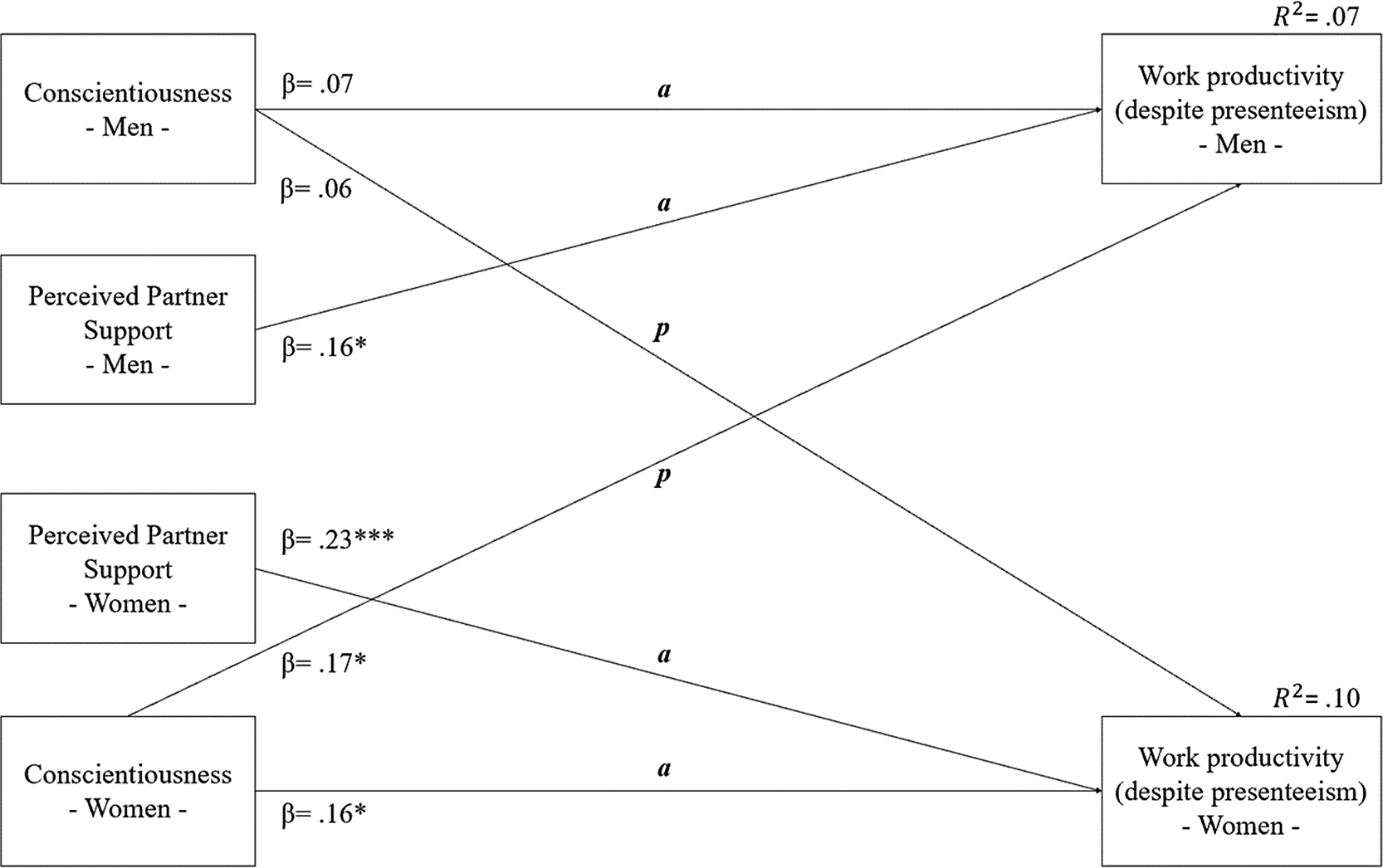
The results concerning the first structural model (APIM 1) tested are depicted in Figure 2. The statistics indicate that the model shows good adjustment: χ2(2) = .50; p = .0.68; χ2/df = .25; CFI = 1.00; TLI = 1.00; and RMSEA = .00.
Structural Model of Relationships between Conscientiousness, Perceived Partner Support, and Work Productivity despite Sickness Presenteeism
Note. p = partner effect; a = actor effect.
* p < .05. ** p < .01. *** p < .001.

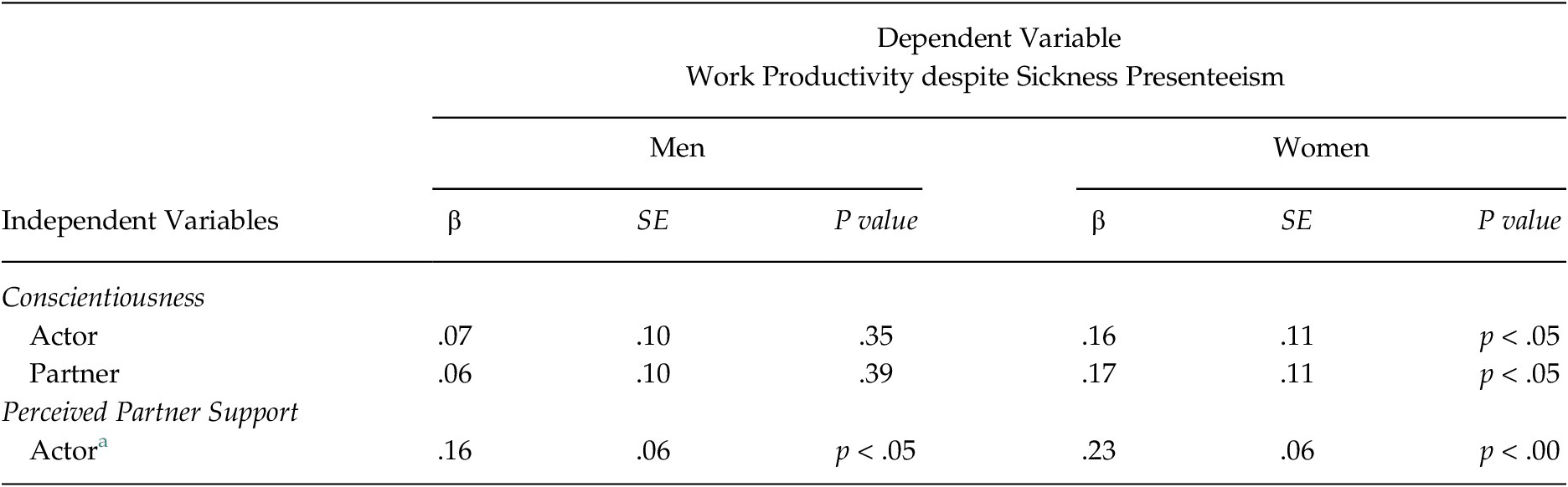
The adjusted model reflects the degree to which work productivity despite sickness presenteeism is due to the levels of conscientiousness and perceived partner support. The model explains 7%, coefficient of determination (R 2) = .07, of the variation of men’s work productivity despite sickness presenteeism and 10% (R2 = .10) of women’s work productivity despite sickness presenteeism. Table 3 summarizes the effects tested.
The APIM 1 Demonstrating the Actor and Partner Effects of Conscientiousness and Perceived Partner Support on Work Productivity despite Sickness Presenteeism

Note.
a Actor perception about partners (other dyad member) support.
Starting by analyzing conscientiousness as a personal resource and considering the women’s actor effect, our results confirm H 1 showing that women’s degree of conscientiousness is significantly and positively associated with their work productivity despite sickness presenteeism (β = .159; p < .05). Shifting to the analysis of women’s partner effects, findings showed that women’s degree of conscientiousness is significantly and positively associated with men’s work productivity despite sickness presenteeism (β = .17; p < .05). The same was not true for men’s partner effects, since their degree of conscientiousness was not significantly associated with women’s work productivity despite sickness presenteeism (β = .06; p = .39). These results led us to confirm H 2.
Although not hypothesized, we tested the same actor and partner effects for men’s conscientiousness. Our results strengthened our rationale proposal showing that the men’s degree of conscientiousness is neither significantly associated with their work productivity despite presenteeism as with their partners’ work productivity.
Concerning perceived partner support, the results confirm hypotheses H 3a and H 3b showing that that perceived partner support is significantly and positively associated with work productivity despite sickness presenteeism for both couple members, men’s actor effect: β = .16; p < .05; and women’s actor effect (β = .23; p < .001). This means that the greater the perceived partner support, the greater the level of productivity is at work despite presenteeism for both men and women.
Figure 2 presents the structural model with the standardized estimates of the regression coefficients for the model and the variability of work productivity despite sickness presenteeism due to the levels of conscientiousness and perceived partner support.
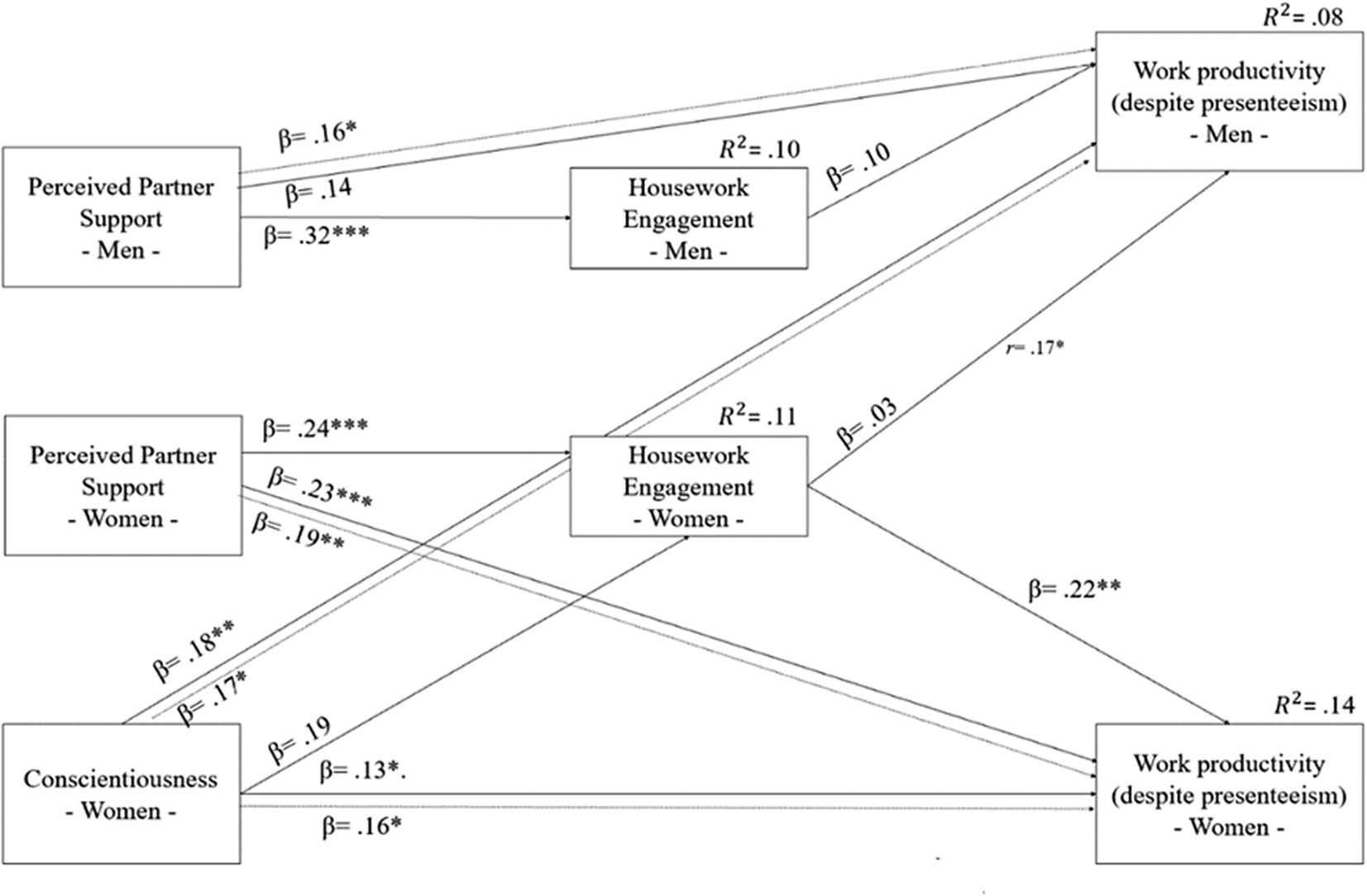
The results for the second structural model (APIM 2) are shown in Figure 3 and measure the mediating effect of housework engagement on the relationship between conscientiousness, perceived partner support, and work productivity despite sickness presenteeism. In the first model, for men, the actor effect of conscientiousness on work productivity despite sickness presenteeism (β = .07; p = .35) and the partner effect of conscientiousness on women’s productivity despite sickness presenteeism (β = .06; p = .39) were not significant. So, these two paths were eliminated in the second and final model. The fit statistics of the resulting model indicate an adequate fit: χ2(6) = 4.13; p = .66; χ2/df = .69; CFI = 1.00; and RMSEA = .00.
Structural Model of Mediation of Housework Engagement in the Relationship between Conscientiousness, Perceived Partner Support, and Work Productivity despite Sickness Presenteeism
Note. Dashed lines indicate values of direct effects without the presence of the mediator variable.
* p < .05. ** p < .01. *** p < .001.

The adjusted model explains 8% (R2 = .08) of the variation of men’s work productivity despite sickness presenteeism and 10% (R2 = .10) of the variation of men’s housework engagement. The model also explains 14% (R2 = .14) of the variation of women’s work productivity despite sickness presenteeism and 11% (R2 = .11) of the variation of women’s housework engagement.
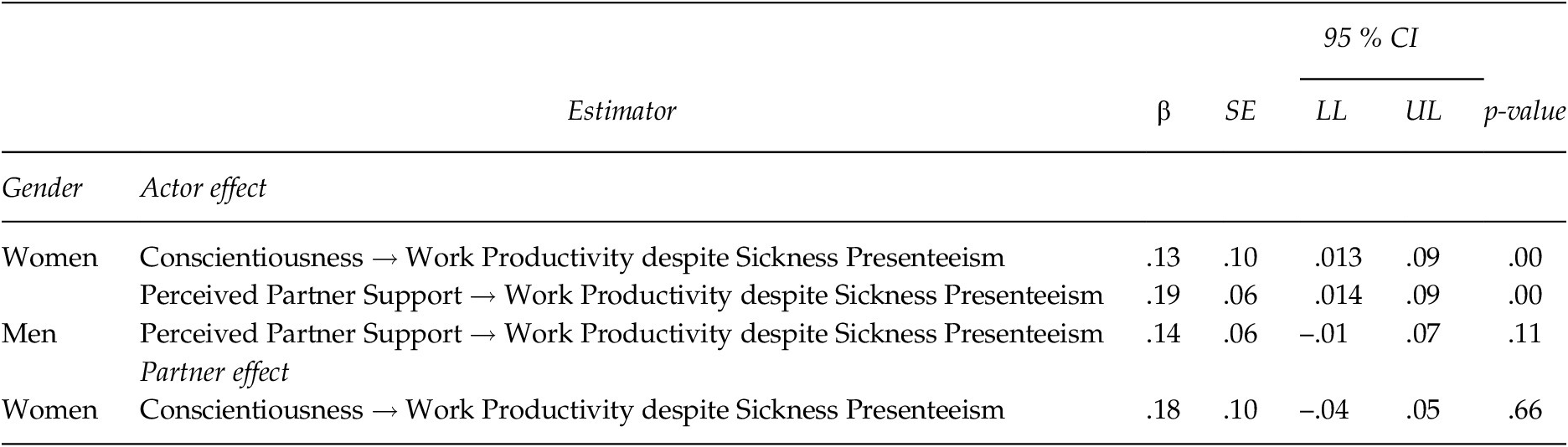
Starting with the women’s actor effects analysis, the indirect effect of conscientiousness on work productivity despite sickness presenteeism through housework engagement was positive (β = .04; p < .001) and, according to the bootstrap resampling method applied, significant with a confidence interval (CI) of 95%—with limits of .01 and .09. Thus, the results confirm hypothesis H 4.
Analyzing women’s partner effects, and focusing on conscientiousness, the indirect effect of women’s conscientiousness on men’s work productivity despite sickness presenteeism through women’s housework engagement was positive (β = .01; p = .66) and, according to the bootstrap resampling method applied, not significant with a confidence interval (CI) of 95%—with limits of –.04 and .05. These results indicate the inexistence of a mediation, not confirming hypothesis H 5.
Also, for men, the indirect effect of perceived partner support on work productivity despite sickness presenteeism through housework engagement was positive (β = .03; p = .11) and, according to the bootstrap resampling method applied, not significant with a CI of 95% and limits of –.01 and .07. Thus, the results reject hypothesis H 6a.
Finally, for women, the indirect effect of perceived partner support on work productivity despite sickness presenteeism through housework engagement was positive (β = .05; p < .001) and, according to the bootstrap resampling method applied, significant with a CI of 95% and limits of .01 and .09. These results confirm the effect described in hypothesis H 6b. Table 4 summarizes the mediation effects tested.
The APIM 2 Demonstrating the Actor and Partner Indirect Effects of Conscientiousness and Perceived Partner Support on Work Productivity despite Sickness Presenteeism

Discussion
It is known that individuals who experience conflicts in different life domains might be prevented from enjoying work and other life aspirations and responsibilities, mostly due to stress (Karanika-Murray et al., Reference Karanika-Murray, Duncan, Pontes and Griffiths2015). Gosselin et al. (Reference Gosselin, Lemyre and Corneil2013) describe this as a psychological health condition with a major influence on sickness presenteeism and the productivity associated with it. Thus, conflicts and tensions between family and work spheres are expected to impact negatively on work productivity associated with presenteeism, as individuals tend to experience less engagement, mainly due to increased stress and reduced psychological well-being (Martinez et al., Reference Martinez, Ferreira, Nunes, Cooper and Lu2018). Thereby, the present study’s findings comprise a breakthrough in the literature enhancing current sickness presenteeism theoretical models (e.g., Johns, Reference Johns2010) that have neglected the explicative role of the family domain, by extending the resource perspective from the JD-R model (i.e., motivational branch) and exploring how specific resources may reduce the negative impacts of family-work interferences and impaired health on couples work productivity. Indeed, besides constituting one of the first attempts to study gender differences in a sample of couples in the sickness presenteeism literature, our findings provide support for the applicability of both JD-R and APIM models to housework. Specifically, they demonstrate that the availability of personal resources and social resources can enable individuals - especially women - to deal with demanding tasks and to complete them successfully, and consequently achieving the desired balance between family and work domains. We will discuss in greater detail our study’s theoretical contributions in the next paragraphs.
First, our findings add to the presenteeism literature by introducing conscientiousness as a personal variable. Indeed, prior research already had pointed that any theory of presenteeism must include personality traits (Johns, Reference Johns2010). The present study thus contributes to the literature by introducing conscientiousness as a personal variable in the study of presenteeism. Currently, most studies in the field view sickness presenteeism as a negative phenomenon for organizations and individuals. The present study’s results indicate the possibility of a positive side of presenteeism, especially for more conscientious individuals whose productivity is less affected when they go to work despite minor health problems (Johns, Reference Johns2010). Specifically, our findings showed that women with high levels of conscientiousness may be more prone to manage their time and housework demands effectively which enables them to accomplish their roles with less inter-role conflict (Clark, Reference Clark2000) which allows them to achieve high levels of productivity despite sickness. This evidence suggests that, for women, conscientiousness may result in greater boundary separation of work and family domains.
Second, our study is one of the first attempts to understand how the family domain can influence the work domain, focusing on the understudied nature of the associations between stable individual differences (e.g., personality) and their spouses’ work performance and success (Solomon & Jackson, Reference Solomon and Jackson2014a). Our findings add to the literature by continuing to answer the question: “Can a spouse’s personality also influence one’s workplace performance?”, showing the powerful role of women’s conscientiousness on their spouses’ work productivity, even when they work sick. Our results are consistent with recent studies that show more conscientious partners tend to perform more housework, allowing their spouses to focus more on the work domain (Solomon & Jackson, Reference Solomon and Jackson2014a). And also provide similar results to Averett et al. (Reference Averett, Bansak and Smith2018), showing that women’s conscientiousness allows their partners to decrease the amount of energy and hours spent performing household tasks, and allows them to recover more from their work and potentially work more and be productive at their jobs. These results, therefore, enrich effort-recovery theories showing that when individuals can recover, on a daily basis, from both work and housework demands, they can maintain high levels of wellbeing and job performance (Demerouti et al., Reference Demerouti, Bakker, Geurts and Taris2009).
Thus, our research shows that personal characteristics of one’s partner can influence important aspects of one’s professional life, and that is particularly true when focusing on women’s levels of conscientiousness. Although our results revealed a positive and significant relationship between women’s conscientiousness and men’s work productivity despite sickness presenteeism, our results show that housework engagement does not explain this relationship. This result may be due to the complexity of the house chores performed. Nevertheless, the relationship between women’s conscientiousness and men’s work productivity despite sickness presenteeism may be explained by other factors (e.g., perceived adequacy of the support received, e.g., Lawrence et al., Reference Lawrence, Bunde, Barry, Brock, Sullivan, Pasch, White, Pasch and Adams2008).
Third, this study adds to the JD-R model (Bakker & Demerouti, Reference Bakker, Demerouti and Cooper2014) by introducing perceived partner support as an important social resource in the family domain. Indeed, our results corroborate previous research that shows that social exchanges from one’s partner are consistently a significant predictor of well-being and health (Walen & Lachman, Reference Walen and Lachman2000), which may result in less productivity loss due to sickness presenteeism. Our results are also in line with our sample cultural values, since Portuguese individuals, as part of a feminine culture (Hofstede et al., Reference Hofstede, Hofstede and Minkov2005), tend to be more oriented toward relationships, quality of life, and their families. Thereby, our results contribute to the literature by providing evidence of partner social support being a potential social key resource of housework that may buffer family-work conflict, which was revealed to explain a percentage of productivity losses due to presenteeism in Portugal (Martinez et al., Reference Martinez, Ferreira, Nunes, Cooper and Lu2018).
When considering the mediation effect of housework engagement on the relationship between perceived partner support and productivity despite sickness presenteeism, our results showed significant results for females but not for male couple members. These results are in line with previous research that shows that support in marital relationships has more significant psychological effects for women than for men (e.g., Gove et al., Reference Gove, Hughes and Style1983; Lawrence et al., Reference Lawrence, Bunde, Barry, Brock, Sullivan, Pasch, White, Pasch and Adams2008; Xu & Burleson, Reference Xu and Burleson2001). This indicates that when women perceive more partner support related to their housework, they have more engagement with it by successfully managing housework demands, and, consequently, this affects positively men’s productivity at work. The same results were not found for men, and these findings might be related to gender inequalities in the distribution of housework, where women continue to do most (Rodrigues et al., Reference Rodrigues, Cunha and Wall2015).
Overall, our research supports the applicability of the resource’s perspective and the motivational branch of the JD-R framework (Bakker & Demerouti, Reference Bakker, Demerouti and Cooper2014) to the home domain, showing that the factors from the family domain have the potential to create positive spirals at work when members of the couple - especially women- hold those resources. In this sense, our study additionally offers a valuable contribution to gender psychology by answering calls for systematic research on the association between sickness presenteeism and gender, mainly regarding the roles of women and men in both work and family domains (Simpson, Reference Simpson1998). Our research once more sheds light on traditional and non-traditional gender roles as well as on the associated gender inequalities that still exist in the 21st century in terms of time and demands’ allocation. In our study we unveil the importance of promoting housework engagement to reduce productivity losses associated with presenteeism, contributing to gender role theories by explaining that the link between housework and work productivity despite being sick is a reality for women, from whom are still required high levels of performance both at work and at home (Martinez & Ferreira, Reference Martinez and Ferreira2012).
This study’s results have several practical implications. The first relates to the adaptation of two measurement instruments—perceived organizational support and work engagement—for the family domain. These adaptations, in turn, were essential to the adjustment of the motivational process described in the JD-R model to fit home environments. Given the present results, these could be useful tools for future studies that seek to study the family domain using this model.
The second implication is related to the fact that his study addressed the possibility of “good” presenteeism since it shows that in the presence of high levels of conscientiousness and perceived partner support, it is possible to have high levels of performance despite the incidence of illness. Thus, according to Johns (Reference Johns2010) when dealing with sickness presenteeism, managers and supervisors need to focus not only on the productivity losses associated with it but also on the productivity gains compared to absenteeism. Hence, management teams should be conscious of the fine line between positive and possible negative outcomes that might derive from sickness presenteeism, especially in the long run. Indeed, according to Karanika-Murray et al. (Reference Karanika-Murray, Biron, Hervieux, Whysall, Chen, Wall, Cooper and Brough2021), this kind of presenteeism behavior, where individuals continue to show up for work despite minor health problems and being able to maintain high levels of performance it is designated as overachieving presenteeism. According to the authors’ definition, overachieving presentees are people who are able to “adjust, recover and maintain a good performance” (p. 238). However, in the long run, maintaining presenteeism behavior can endanger one’s wellbeing by damaging mental and physical health and creating enhanced levels of exhaustion and sickness absenteeism (Demerouti et al., Reference Demerouti, Bakker, Geurts and Taris2009; Kivimäki et al., Reference Kivimäki, Head, Ferrie, Hemingway, Shipley, Vahtera and Marmot2005). In this sense, managers should offer support and be responsible for creating work adjustments that support recovery, realize health limitations and moderate performance expectations until recovering has been achieved, as well as promote work cultures that promote healthy work behaviors (Karanika-Murray et al., Reference Karanika-Murray, Biron, Hervieux, Whysall, Chen, Wall, Cooper and Brough2021), instead of creating the shared perception that sickness absenteeism is illegitimate (Ruhle & Süß, Reference Ruhle and Süß2020).
The third implication is related to the positive mediation effects of housework engagement on the relationship between conscientiousness and perceived partner support found in our research. Given the positive effect of conscientiousness on housework engagement and, consequently, on work productivity despite presenteeism, organizations can manage key characteristics associated with this personality trait to achieve positive organizational results. Training sessions in areas such as time management and goal orientation (Lin et al., Reference Lin, Ma, Wang and Wang2014) could increase not only housework engagement but also work engagement. Managers and supervisors could also encourage the use of appropriate coping strategies to deal with heavy work demands (Lin et al., Reference Lin, Ma, Wang and Wang2014) in both family and work domains. In addition, organizations can invest in strategies that support workers not only at the individual level but also at the family level since the present study also confirmed the importance of partner support, especially for women. Organizations could, for example, promote services that help couples to cope with some house responsibilities, such as daycare (Bures et al., Reference Bures, Henderson, Mayfield, Mayfield and Worley1996) or laundry services. By doing so, organizations enhance employee’s possibilities to achieve a healthy balance between their work and family domains, by giving them some extra tools to manage the challenging demands associated with both roles.
Despite constituting an advance in the literature, the present study is not without limitations. First, the sample size and convenience sampling method used can be considered limitations, suggesting cautious interpretations are needed regarding external validity. Future research also needs to study different cultures, especially a broad range of masculine or feminine cultures in which the social roles and power allocated to men and women differ drastically (Hofstede et. al., Reference Hofstede, Hofstede and Minkov2005) and have implications for the work performed in both family and work domains.
Second, we acknowledge as a limitation that our study was based on a cross-sectional design with self-reported data collected at only one-time point which may constrain our capability to infer causal relationships among study variables as well may mean that our data may suffer from common method bias. However, we have applied specific statistical procedures such as Harman’s one-factor test (Podsakoff et al., Reference Podsakoff, MacKenzie, Lee and Podsakoff2003) that ensured us that common method bias was not a risk in our study. Also, according to Johns (Reference Johns2010), one of the most challenging aspects of measuring work productivity losses due to presenteeism is the potential for common method variance stemming from questionnaires that ask people to self-diagnose their health and then estimate the impact of this on their own productivity. This could mean that the impact of health on work productivity may be exaggerated. Nonetheless, analysis of the SPS–6 scale between both genders shows that the means were not extremely high (M men = 3.69 and Mwomen = 3.65) indicating that unrealistically positive estimations of productivity losses associated with presenteeism were not observed in our study. Still, we advise future researchers to use longitudinal designs and include others-ratings of performance (e.g., colleagues or supervisors) as ways of reducing these limitations and to learn more about cause-and-effect relationships (Bakker & Xanthopoulou, Reference Bakker and Xanthopoulou2009).
Finally, our study reveals an overall positive role of conscientiousness on both housework engagement and work productivity despite sickness presenteeism for women. Although our study enriches the presenteeism literature by pointing the positive buffering effects of conscientiousness on productivity losses due to presenteeism, previous studies have shown that conscientiousness may also be related to increased stress-related illnesses, such as burnout (e.g., LePine et al., Reference LePine, LePine and Jackson2004), as well as low performance due to intentional reduced efforts at work as a way of conserving remaining resources (e.g., Witt & Carlson, Reference Witt and Carlson2006), revealing a dark side of conscientiousness. Thus, we suggest that future studies further analyze the relationship between conscientiousness and both burnout and engagement with house chores, especially for women. Also, as pointed before, we acknowledge the importance of supervisor’ support in creating healthy work environments that do not sustain sickness presenteeism climates and cultures (Karanika-Murray et al., Reference Karanika-Murray, Biron, Hervieux, Whysall, Chen, Wall, Cooper and Brough2021; Ruhle & Süß, Reference Ruhle and Süß2020). To this end, we advise future studies to explore the moderation effect of supervisor support in our proposed models.
Despite the limitations, the present study’s results contribute to the existing literature by showing that housework engagement mediates the relationship between conscientiousness and work productivity despite presenteeism for women and between perceived partner support and work productivity despite presenteeism for both males and females couple members.
This study emerges as one of the first to investigate the effects of housework engagement on work productivity despite sickness presenteeism and to explore how specific resources - personality traits and gender differences – may buffer housework demands negative impacts, among couples. As expected, the study’s findings reveal that the higher the degree of women’s conscientiousness, the greater their and their partners’ level of productivity despite sickness presenteeism. Also, results showed that when individuals perceive high levels of partner support, they present high levels of work productivity, even when working sick. Surprisingly, this study also confirms that housework engagement mediates the relationships between both conscientiousness and perceived partner support and work productivity despite health problems, for women, but not for men.
Overall, this study contributes to the literature by continuing to unveil the impacts of the family domain - especially of engagement with housework, a novel construct in the literature - on individuals’ work domain. By studying conscientiousness and partner support as buffering resources this study demonstrates that housework demands can play a positive role on women’s work productivity and health, and how their characteristics may influence important aspects of their partners’ professional life.