Introduction
Resistance to insecticides has been a common phenomenon among arthropod pest species with various negative impacts on integrated pest management (IPM). Therefore, the Insecticide Resistance Action Committee (IRAC) (http://www.irac-online.org/about/resistance/management/) has proposed various strategies to delay resistance selection. Among these strategies, the integration of multiple control methods is one, and it includes the conservation of biological control. Conservation and enhancement of action by natural enemies is exciting, but hard to adopt due to the common lack of compatibility between biological and chemical control methods. Pest control in row and vegetable crops require insecticides from different modes of actions to target different pest species. A complex of pest species infests these crop fields simultaneously or successively during the crop phenology. Therefore, insecticides with low impact on natural enemies or natural enemies resistant to insecticides will greatly contribute to the success of integrating biological and chemical control methods (Croft, Reference Croft1990; Johnson & Tabashnik, Reference Johnson, Tabashnik, Bellows and Fisher1999; Torres, Reference Torres2012; Liu & Huang, Reference Liu and Huang2013; Martin et al., Reference Martin, Reineking, Seo and Steffan-Dewenter2013).
Integration of natural enemies and insecticides for pest control required understanding of this interaction. Thus, various testing methodologies were developed under the scrutiny of the IOBC (International Organisation for Biological and Integrated Control) (Hassan et al., Reference Hassan, Bigler, Blaisinger, Bogenschütz, Brun, Chiverton, Dickler, Easterbrook, Edwards, Englert, Firth, Huang, Inglesfield, Klingauf, Kühner, Ledieu, Naton, Oomen, Overmeer, Plevoets, Reboulet, Rieckmann, Samsoe-Petersen, Shires, Stäubli, Stevenson, Tuset, Vanwetswinkel and Van Zon1985) to produce practical data for biological control and IPM practitioners. Based on standard guidelines, studies were carried out to classify the major pesticide groups regarding their impact on model natural enemies. Despite the extensive list of insecticides tested worldwide with models and other natural enemies, few synthetic insecticides have been categorized as having low impact on natural enemies (Theiling & Croft, Reference Theiling and Croft1988; Croft, Reference Croft1990; Johnson & Tabashnik, Reference Johnson, Tabashnik, Bellows and Fisher1999; Talebi et al., Reference Talebi, Kavousi and Sabahi2008). These data, however, have been expanded recently with new insecticide groups such as pyridine azomethine, diamides, and spynosins (Lovell et al., Reference Lovell, Wright, Gard, Miller, Treacy, Addor and Kamhi1990; Roubos et al., Reference Roubos, Rodriguez-Saona, Holdcraft, Mason and Isaacs2014; Barros, Reference Barros2015; Mills et al., Reference Mills, Beers, Shearer, Unruh and Amarasekare2015).
In addition to differences in toxicity of insecticides to pests and natural enemies detected by IOBC methodologies, survival of natural enemies to non-selective synthetic insecticides has also been determined for predatory insects. Field-evolved resistance in lacewings (Pathan et al., Reference Pathan, Sayyed, Aslam, Razaq, Jilani and Saleem2008; Abbas et al., Reference Abbas, Mansoor, Shad, Pathan, Waheed, Ejaz, Razaq and Zulfiqar2014), hemipterans, rover beetles, dermapterans (Whalon et al., Reference Whalon, Mota-Sanchez, Hollingworth and Duynslager2016), and especially lady beetles (Head et al., Reference Head, Neel, Sartor and Chambers1977; Graves et al., Reference Graves, Mohamad and Clower1978; Ruberson et al., Reference Ruberson, Roberts and Michaud2007; Kumral et al., Reference Kumral, Gencer, Susurluk and Yalcin2011; Rodrigues et al., Reference Rodrigues, Torres, Siqueira and Lacerda2013a, Reference Rodrigues, Ruberson, Torres, Siqueira and Scottb; Barbosa et al., Reference Barbosa, Michaud, Rodrigues and Torres2016) has been reported lately. The data gathered on lady beetles have focused on Hippodamia convergens Guérin-Méneville and Eriopis connexa (Germar). The earlier species has been characterized as resistant to λ-cyhalothrin and owing cross-resistance to dicrotophos for one North America population collected from cotton fields (Rodrigues et al., Reference Rodrigues, Ruberson, Torres, Siqueira and Scott2013b; Barbosa et al., Reference Barbosa, Michaud, Rodrigues and Torres2016). The mechanism of the resistance involves knockdown response and enzymatic detoxification of the insecticide with knockdown effect being recessive and linked to the X-chromosome (Rodrigues et al., Reference Rodrigues, Ruberson, Torres, Siqueira and Scott2013b). The later species and focus of our study, the neotropical species E. connexa, has been recently recorded exhibiting resistance to λ-cyhalothrin by Rodrigues et al. (Reference Rodrigues, Spíndola, Torres, Siqueira and Colares2013c). This population's mechanism of resistance was determined to be metabolically driven with carboxylesterase type B involvement (Rodrigues et al., Reference Rodrigues, Siqueira and Torres2014). The resistance trait is autosomally inherited and incompletely dominant, influenced by a major gene with possible influence of secondary genes (Rodrigues et al., Reference Rodrigues, Torres, Siqueira and Lacerda2013a). According to these data, E. connexa is prone to be selected under field conditions for pyrethroid resistance. Therefore, this broad field survey may corroborate how the resistance can be common in this lady beetle species.
Lady beetles (Coleoptera: Coccinellidae), both larvae and adults, exhibit intense foraging behavior on the plant canopy; hence, it is expected that they have pronounced contact with applied insecticides via ingestion of contaminated food (prey and plant products such as nectar and pollen), insecticide droplets, and dried residue. Moreover, adult lady beetles commonly disperse across the landscape, which exposes them to dried residues of different chemical groups targeting different pest species, especially in the mosaic of vegetable crop species. Across the landscape, lady beetles such as E. connexa attack small softy-bodied arthropods such as psyllids, aphids, whiteflies, and mites. Most of these pest species are not targeted by pyrethroids. Pyrethroid formulations are widely recommended against defoliators (Agrofit, 2016); therefore, the mortality caused to pest populations by pyrethroids and E. connexa may be complementary (Spíndola et al., Reference Spíndola, Silva-Torres, Rodrigues and Torres2013; Torres et al., Reference Torres, Rodrigues, Barros and Santos2015). The remaining aphids not killed by pyrethroids and reduction of competition with other predators susceptible to pyrethroids (Torres & Ruberson, Reference Torres and Ruberson2005), furnish prey, and free space to surviving lady beetles carrying alleles for resistance. Therefore, our hypothesis is that field-evolved resistance in E. connexa may be common and it may contest the food source limitation hypothesis (Georghiou, Reference Georghiou1972). According to this hypothesis, resistant natural enemies may survive in the sprayed crops, but the lack of food resources would limit their frequency. Thus, based on previous data for susceptibility and resistance of E. connexa to λ-cyhalothrin, this study determined the susceptibility to λ-cyhalothrin in 20 populations of E. connexa from different locations and cultivation conditions. Among the insecticide formulations in Brazil, more than 70% include pyrethroids as the active ingredient (Agrofit, 2016), where λ-cyhalothrin is one of 14 active ingredients used, and it accounts for about 16% of the overall pyrethroid market (Wirtz et al., Reference Wirtz, Bala, Amann and Elbert2009). Therefore, it is our expectation that E. connexa has been exposed to λ-cyhalothrin and may exhibit high levels of resistance.
Material and methods
Insect collections
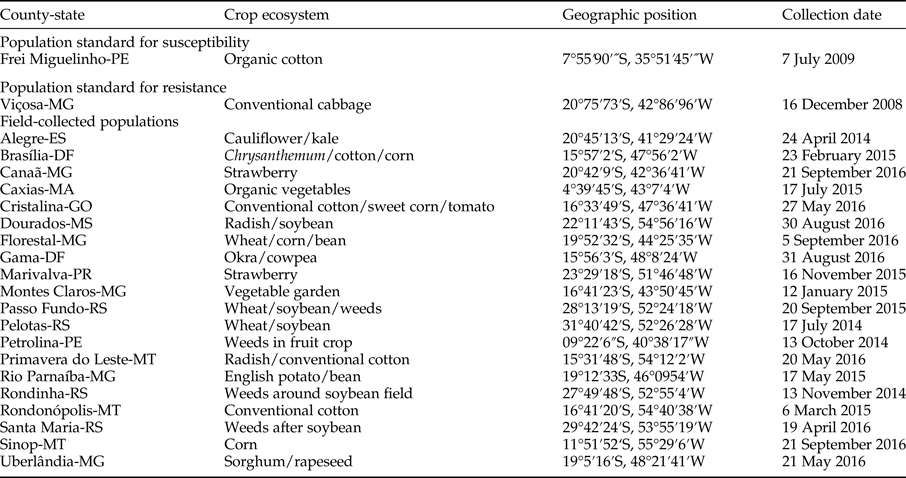
Adult beetles were hand-collected with the aid of an aspirator in the field on the plant canopy or on the ground over a variety of habitats represented by different crop species and pest management (table 1). Under laboratory conditions, a first generation of these beetles was obtained. After collecting a batch of sufficient eggs to guarantee the next generation, a sample of 60–100 adults from the first generation in the laboratory were used to initiate the tests with the discriminatory lethal doses (LDs). Two discriminatory doses regarding susceptibility (LD50S) and resistance (LD50R) to λ-cyhalothrin were used to put the field-collected populations into a continuum from susceptible to resistant. The population standard for resistance was collected from conventional cabbage fields located in Viçosa County, Minas Gerais State (coordinates: 20°75′73′S and 42°86′96′W) in December 2008. The population standard for susceptibility was collected from organic cotton fields located in Frei Miguelinho County, Pernambuco State (coordinates: 07°55′90.1″S and 35°51′45.6″W) in July 2009. Bioassay of dose–mortality response with these two populations produced LD50 of 0.108 and 0.005 µg a.i./insect, respectively (Rodrigues et al., Reference Rodrigues, Torres, Siqueira and Lacerda2013a), which produced 21.6-fold resistance ratio (RR).
Field data on the tested population of Eriopis connexa indicating major crop species composing the ecosystem, geographic locations and collection date.

Insect rearing
The field-collected insects were kept in plastic containers for adult rearing and egg collection, and late larvae and pupae were all reared as described in Torres et al. (Reference Torres, Rodrigues, Barros and Santos2015). Rearing was conducted at the Biological Control and Insect Ecology Laboratory of the ‘Universidade Federal Rural de Pernambuco (UFRPE)’, and lady beetle colonies were maintained at 25 ± 2°C with a photoperiod of 12:12 h (L:D). Eggs of Anagasta (=Ephestia) kuehniella (Zeller) (Lepidoptera: Pyralidae) ordered from the commercial insectary (PROMIP, Campinas, São Paulo) were provided ad libitum as factitious prey to larvae and adults of E. connexa. Adult lady beetles were also given a paste of honey and yeast (50:50%) as a complementary food source.
Insecticide
Technical grade λ-cyhalothrin (99.5%; Chem Service, West Chester, Pennsylvania, USA) was used in the bioassays to determine survival when submitting adults to topical application of discriminatory LD50S and LD50R (Rodrigues et al., Reference Rodrigues, Torres, Siqueira and Lacerda2013a), and for performing the dose–mortality assays to find resistance levels across the tested populations. λ-Cyhalothrin in the commercial formulation Karate Zeon® 50 CS (λ-cyhalothrin 5% w/v – 50 gl−1, Syngenta S.A., São Paulo, Brazil) was used to determine survival of adults to dried residues of the lowest and highest recommended field rates (100 and 400 ml ha−1 diluted in 150 l of water).
Response to discriminatory doses
Initially a standard dose of 30 g a.i. l−1 of technical grade λ-cyhalothrin was prepared using acetone and stored in a freezer at −10°C. Later, doses expected to cause 50% mortality with the application of 0.5 µl/insect of the dilutions either for susceptible beetles (LD50S = 0.005 µg a.i./insect) or for beetles exhibiting any level of resistance (LD50R = 0.108 g a.i./insect) (Rodrigues et al., Reference Rodrigues, Torres, Siqueira and Lacerda2013a) were prepared. These doses were used to conduct the first set tests to sort of each population into susceptible or resistant categories based on these doses.
Adults at 5–8 days old from the first generation reared in the laboratory (offspring from field-collected adults) of each population were used in this test. These adults were treated with either LD50S or LD50R through topical application of 0.5 µl of the insecticide dilution on the abdominal venter using a 25-μl Hamilton™ syringe. Between 30 and 50 adult individuals were used per LD, split into six to ten replications of five beetles each. After the treatment, insects were placed in 100 × 15 mm Petri dishes (Precision®, Diadema, São Paulo) lined with filter paper and fed with A. kuehniella eggs and a honey and yeast paste (50:50%) smeared on the inner surface of the dish lids. Mortality was assessed 48 h after treatment of the adults. The criterion for mortality was the inability of an individual to turn upright after being placed on its dorsum.
Based on the number of live insects and the number of insects treated per LD, the survival percentage was calculated for each replication, followed by acquisition of the mean survival per LD and its 95% fiducial limits (FL). Statistical significance for the mean survival relative to the 50% expected survival for either LD50S or LD50R was determined using the overlap rule for the 95% FL of survival (Di Stefano, Reference Di Stefano2005). When the mean survival or its 95% FL bars cross the expected survival line, there are no differences between the observed survival and the 50% expected survival for each LD.
Dose–mortality responses of surviving LD50R populations
The doses (μg active ingredient/insect) used in the bioassay were previously determined and prepared by serial dilution of the standard dose (30 g a.i. l−1) of technical grade λ-cyhalothrin in acetone to fit the doses used for each tested population. Preliminary assays with two to three doses were performed to define the final doses that would produce a response near 0 and 100% mortality. The tested doses varied from 0.0025, 0.005, 0.015, 0.03, 0.05, and 0.105 µg a.i./insect for the population with the lowest LD50 (Alegre-ES) to 0.105, 1.00, 2.00, 4.00, 5.0, and 12.5 a.i. μg/insect for the population with the highest LD50 (Gama-DF), across the ten populations previously hypothesized as resistant by exhibiting similar or greater survival than the 50% expected survival under topic application of the LD50R. Adult beetles at 5–8 days old from second or third generation reared in the laboratory were randomly divided into equal numbers per dose, each containing no fewer than 30 insects per dose with a range of five to seven doses per population (sample size shown in table 2). Each individual was topically treated with 0.5 µl of the insecticide dilution applied to the ventral abdomen with a repeating dispenser equipped with a 25 µl Hamilton™ syringe (Hamilton Company, Reno, Nevada, USA). Treated insects were placed into 100 × 15 mm Petri dishes lined with filter paper, and maintained and evaluated in a similar fashion to the previous discriminatory response test.
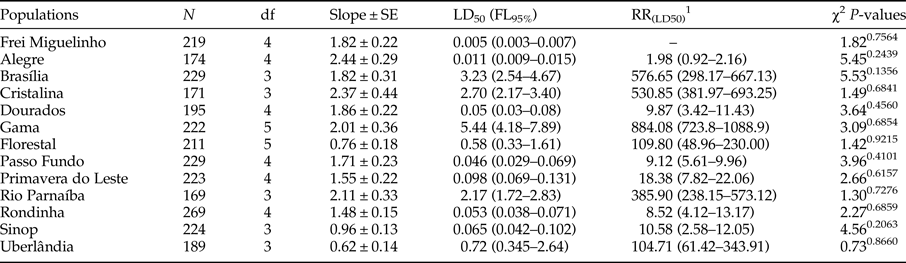
Toxicity of technical grade λ-cyhalothrin to different populations of Eriopis connexa under tropic treatment of adult beetles.

n, number of treated insects; df, degree of freedom; LD, lethal doses (μg a.i./insect); FL, fiducial limits; χ2, goodness-of-fit χ2 test.
1 Resistance ratio (RR) means the relationship between LD50 for the tested and the population standard for susceptibility (Frei Miguelinho) calculated according to Robertson & Preisler (Reference Robertson and Preisler1992) and respective 95% fiducial limits (FL).
The numbers of dead or alive individuals at 48 h post-treatment were recorded for each assay to calculate the LD for each population. The LDs (μg a.i. of λ-cyhalothrin/insect) were obtained from dose–mortality estimated lines using the Probit analysis (Finney, Reference Finney1971) performed by Proc Probit Log10 of SAS (SAS Institute, 2002), and by using the χ2 tests for fitted models with significance set at 0.05. The laboratory-reared population from Frei Miguelinho was defined as standard for susceptibility as previously described, and it was used for estimating the RR of the field-collected populations. The RR was calculated according to the method of Robertson & Preisler (Reference Robertson and Preisler1992). These indices were considered to be statistically significant when the FL at 95% did not include the value 1.0 (Robertson et al., Reference Robertson, Russel, Preisler and Savin2007).
Survival to field rates of λ-cyhalothrin
All collected populations were subjected to dried residue of λ-cyhalothrin to associate the detected resistance levels of surviving individuals. Thus, adult survival was determined by exposing them to dried λ-cyhalothrin residues of the lowest and highest field rates (ca. 100 and 400 ml ha−1) for spraying cotton fields, which include most recommended rates and variations for field rates for other crops (except 600 ml ha−1 for cutworms and whitefly in corn and common beans, respectively).
λ-Cyhalothrin dilutions were prepared using distilled water with a spray volume of 150 L ha−1 (Agrofit, 2016) plus WillFix® (Charmon Destyl Indústria Química Ltda, Campinas, São Paulo) at 0.01%, which served as a surfactant. Treatments were applied to the inner surfaces of 100 mm–diameter × 12 mm–tall glass Petri dishes (Precision®, Diadema, São Paulo). The dilutions were applied using a metal glass atomizer sprayer with 25-ml capacity (Casa do Laboratório, Recife, Pernambuco, Brazil) at a rate of 2 ml per Petri dish, split into 1 ml on the bottom and 1 ml on the cover. Then, Petri dishes were allowed to dry under laboratory conditions of 25°C and ~70% R.H. for about 4 h. After that, three treatments were set up considering the two field rates and control without insecticide using adult beetles 5–8 days old without distinction of sex. Five beetles were placed in each Petri dish (replication) with four replications and up to ten replications per treatment depending on the availability of beetles. During the exposure period, A. kuehniella eggs were offered as food plus a honey and yeast paste (50:50%) smeared on the inner surface of dish tops.
Adult mortality was assessed 48 h after caging the beetles in the treated and untreated dishes. The criterion for mortality was the inability of an individual to turn itself upright after being placed on its dorsum. No mortality was observed in the untreated dishes or concentrations lower than 3%; therefore, no further corrections and analysis were considered. Because the bioassays for different populations were carried out at different times, direct parametric comparisons could not be made across populations. Furthermore, the survival percentage for each replication, mean survival per treatment (i.e. the lowest and the highest field rates), and its 95% FL were calculated. The data are presented as survival instead of mortality, because we are interested in survivors, who can contribute to pest control. Thus, for converting mortality in survival based on IOBC pesticides classification (Hassan, Reference Hassan1992; Boller et al., Reference Boller, Vogt, Ternes and Malavolta2005), for populations exhibiting survival >70% (i.e. mortality up to 30%), 30–69%, 2–29%, and lower than 2%, we considered that the λ-cyhalothrin was harmless, slightly harmful, moderately harmful, and harmful to the studied populations, respectively. Statistical significance for the mean survival relative to these classifications was determined using the overlap rule for the 95% FL of survival (Di Stefano, Reference Di Stefano2005) as previously described.
Results
Response to discriminatory doses
Twenty field-collected populations plus one population considered standard for susceptibility, reared in the laboratory, were assayed. These populations originated from 20 collections sites in 11 Brazilian states covering different crop habitats or weeds in or around fields after the cropping season (table 1). The straight-line distance between collections sites ranged from 35.2 km (Brasília-DF and Gama-DF) to 3562 km (Pelotas-RS and Frei Miguelinho-PE). Based on the LD50R, six populations exhibited survival >50% when treated with LD50R, with three of these populations (Gama, Cristalina, and Brasília) presenting 100% survival (fig. 1). Four other populations exhibited mean survival and 95% FL crossing the 50% expected survival under treatment with the LD50R, and were also categorized as resistant. Three populations exhibited survival exceeding 20%, but statistically lower than the expected 50% survival; while eight populations including the population standard for susceptibility (i.e. Frei Miguelinho) did not survive or exhibited survival lower than 10%, being considered susceptible (fig. 1). Regarding the treatment with the LD50S, all tested populations responded as expected with survival similar to or >50%, except the population Alegre-ES, which was considered the most susceptible among the field-collected populations and similar to the population standard for susceptibility.
Adult survival [+95% FL (Fiducial limits)] of Eriopis connexa under discriminatory treatment with 0.5 µg/insect of technical grade λ-cyhalothrin of LD50 previously calculated for population standard for susceptibility (LD50S) or population standard for resistance (LD50R) with a resistance ratio of 21.6-fold. The dashed line indicates 50% expected survival.

Dose–mortality responses of surviving LD50R populations
The mortality data obtained across all dose–mortality bioassays for different populations fit the Probit model (P > 0.05). Thus, LD50 values were calculated for each population and varied from 0.011 to 5.44 µg a.i./insect (table 2), respectively. The RR varied from 8.52- to 884.08-folds (table 2); while the population standard for susceptibility Frei Miguelinho-PE was statistically similar to Alegre-ES. The RR of the remaining 11 populations categorized as resistant according to Robertson et al. (Reference Robertson, Russel, Preisler and Savin2007). For six populations in particular the RR was >100-fold.
Survival to field rates of λ-cyhalothrin
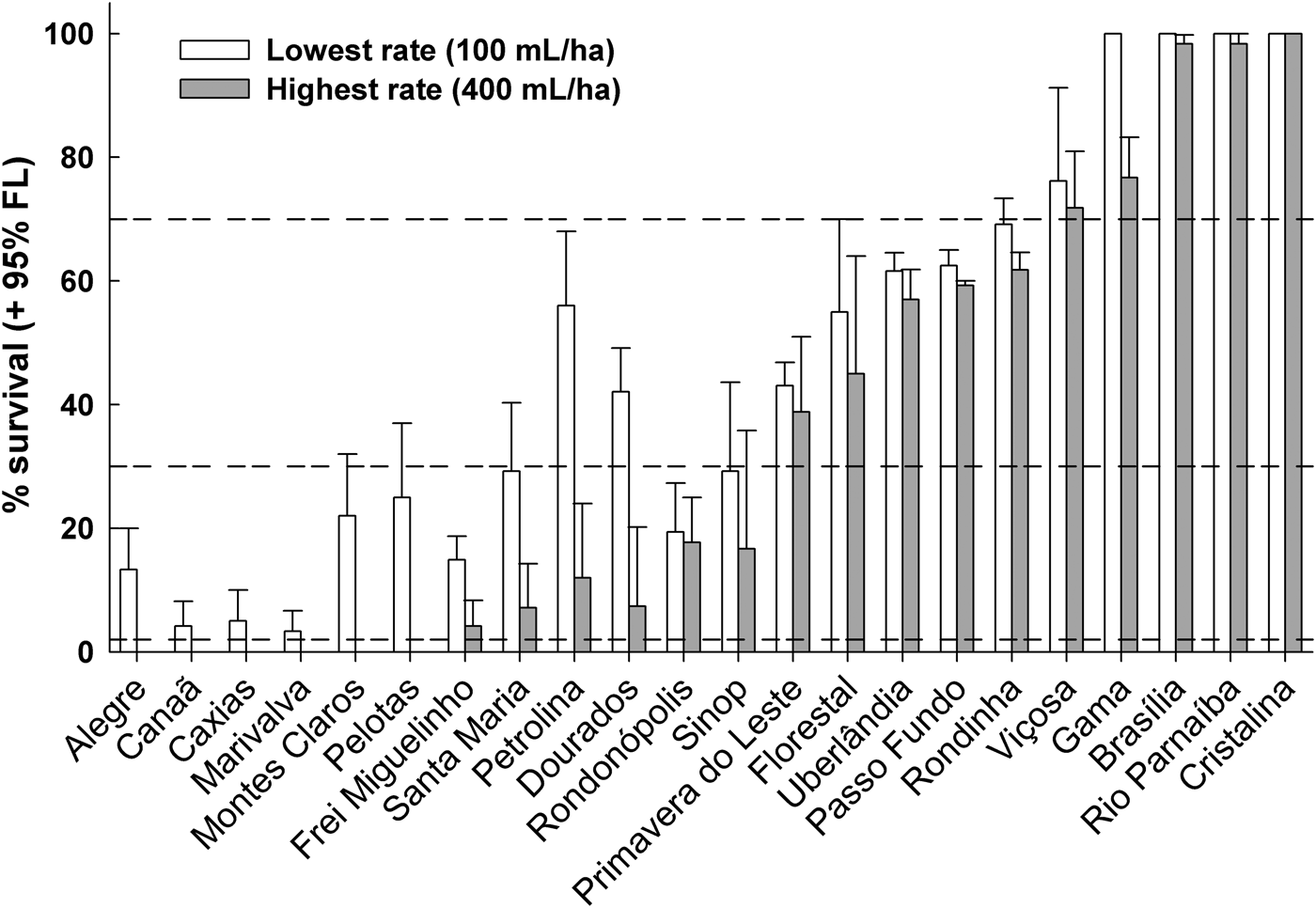
The survival outcome across the 22 tested populations varied as a function of the tested field rates (fig. 2). Six populations out of 22 tested did not survive when exposed to the highest field rate; while six other populations including the population standard for susceptibility (i.e. Frei Miguelinho) exhibited survival lower than 29%. Thus, based on the survival observed at the highest field rate, λ-cyhalothrin is moderately harmful (e.g. Frei Miguelinho, Santa Maria, Petrolina, Dourados, Rondonópolis, and Sinop) to harmful (Alegre, Canaã, Caxias, Marivalva, Montes Claros, and Pelotas). Furthermore, the mean survivals for these populations were variable and most of them were lower than 29% (dotted line, fig. 2) when exposed to the lowest field rate, which confirms their high susceptibility to λ-cyhalothrin.
Adult survival of Eriopis connexa confined on dried residue of commercial λ-cyhalothrin diluted in water and applied to the inert surface using either the lowest or the highest field rates recommended to control cotton pests. Dashed lines indicate survival below 2% (harmful), 3–29% (moderately harmful), 30–69% (slightly harmful), and >70% (harmless) according to IOBC.

On the other hand, the mean survivals of the next five populations (i.e. Primavera do Leste, Florestal, Uberlândia, Passo Fundo, and Rondinha, fig. 2) exposed to the highest and to the lowest field rates varied from 38.8 to 61.7% and from 43.1 to 69.1%, respectively, characterizing an overall slightly harmful outcome. Statistically, among these five populations, only the population from Rondinha, RS, treated at the lowest field rate exhibited mean survival (+95% FL) exceeding the expected 70% survival, ranked in the harmless categorization at the lowest field rate. Finally, the next four field-collected populations (Gama, Brasilia, Rio Parnaiba, and Cristalina) and the population standard for resistance (Viçosa) exhibited mean survival >70% at both field rates, revealing a harmless effect of λ-cyhalothrin to these populations (fig. 2).
Discussion
About 50% of the tested populations exhibited significant levels of resistance to λ-cyhalothrin, and this resistance guaranteed substantial survival when exposed to the highest recommended field rate (fig. 2), with resistance levels that varied up to 464.82-fold. Therefore, our hypothesis that field-evolved resistance in E. connexa to λ-cyhalothrin may be common is confirmed. Naturally evolved resistance of natural enemies to insecticides allowing them to survive after applications may significantly contribute to pest control. This is especially true when the action of the natural enemy complements the control of the insecticides, as expected with lady beetles and pyrethroids, which targets distinct groups of pests such as small softy-bodied sap-sucking and defoliator pest species, respectively.
One explanation for differences in resistance levels across field-collected populations of E. connexa could be the amount of insecticides used in the fields and in the surrounding collection sites (Hoy, Reference Hoy, Roush and Tabashnik1990; Onstad & Carrière, Reference Onstad, Carrière and Onstad2013). Because resistance occurs through physiological and behavioral changes in a population level driven by repeated exposures to insecticides, the historical use of insecticides has been considered a feasible explanation (Barbosa et al., Reference Barbosa, Michaud, Rodrigues and Torres2016). However, a clear pattern of early exposure in terms of adult lady beetle resistance is difficult to describe, because they are highly mobile at adult stage and a collection site does not necessarily indicate their background exposure. Lady beetles, especially species of Coccinellinae that preferentially feed on erratic prey species such as aphids, are not restricted to one habitat. They have to explore different habitats to sustain their populations (Evans & Richards, Reference Evans and Richards1997; Sicsú et al., Reference Sicsú, Macedo and Sujii2015), and are often located with aphid infestations (Evans & Toler, Reference Evans and Toler2007; Genung et al., Reference Genung, Crutsinger, Bailey, Schweitzer and Sanders2012). Adults of these beetles might disperse and be exposed to different sprays applied to different crops in the landscape (e.g. mosaic of vegetables). These environmental and ecological traits may partially explain the relationship between crop and resistance levels found in our study. Despite this, collections of lady beetles in conventional cotton ecosystems (Head et al., Reference Head, Neel, Sartor and Chambers1977; Graves et al., Reference Graves, Mohamad and Clower1978; Ruberson et al., Reference Ruberson, Roberts and Michaud2007; Rodrigues et al., Reference Rodrigues, Ruberson, Torres, Siqueira and Scott2013b; Barbosa et al., Reference Barbosa, Michaud, Rodrigues and Torres2016), cabbage (Rodrigues et al., Reference Rodrigues, Spíndola, Torres, Siqueira and Colares2013c), and landscapes composed of a mosaic of vegetables, as found in this study, indicates a high probability of detecting high levels of field resistance in E. connexa.
The most resistant populations originated from areas of intensive cultivation of vegetables and row crops in Central-West Brazil (Gama, Cristalina, and Brasília). Furthermore, the other two populations exhibiting high levels of resistance (Rio Parnaíba and Uberlândia) were also collected in potatoes and sorghum/rapeseed fields from areas with intense cropping systems such as those with two or three crop cycles per year including common beans, corn, and vegetables such as tomato and potato (Rio Parnaíba), and corn, soybean, sorghum, and other minor crops (Uberlândia). All these five areas where these populations originated are widely cultivated using pivot irrigation systems and receive various cycles of different crops per year; hence, there are many host plants, pest infestations, and insecticide applications. Furthermore, landscapes composed of a mosaic of crops under irrigation usually require multiple insecticide applications to mitigate pest infestation, which may favor resistance selection to other insecticides as well resulting in possible multiple and cross-resistance. Cross- (Torres et al., Reference Torres, Rodrigues, Barros and Santos2015) and multiple resistance (Barbosa et al., Reference Barbosa, Michaud, Rodrigues and Torres2016) is possible and has been detected in lady beetles; however, we did not test this hypothesis in our collected populations.
In the other five populations also exhibiting significant levels of resistance (Florestal, Rondinha, Passo Fundo, Dourados, and Primavera do Leste), the first three populations were collected in areas that usually do not receive heavy pyrethroid spraying such as wheat and soybean fields; while the latter two populations came from areas with a minimum of two cropping cycles per year with soybean, corn, and cotton. Surprisingly, populations from areas in the Midwest (Rondonópolis and Sinop), which also have intensive row crops cultivation (e.g. soybean, corn, and cotton), exhibited low survival. The intensity of cropping and the susceptibility of the crop species, which indicates the frequency of insecticide use, offer a history of exposure and are used to explain the resistance selection for herbivorous species (Silva et al., Reference Silva, Siqueira, Oliveira, Torres, Oliveira, Montarroyos and Farias2011; Bass et al., Reference Bass, Puinean, Zimmer, Denholm, Field, Foster, Gutbrod, Nauen, Slater and Williamson2014). However, other factors such as the local temperature that promotes different numbers of generations, the availability of prey to produce large populations, and background exposure related to the insecticide usage in a crop/area can influence the selection of natural enemies for resistance. Thus, for natural enemy populations, resistance may be slow to develop because non-agricultural or non-sprayed habitats serve as refuge for insecticide-susceptible populations, especially because the diversity of aphids, the major prey of E. connexa, may become available in various non-agricultural or non-sprayed surrounding areas. Therefore, we do not expect to always detect resistance for populations collected either in intensive crop areas or in low insecticide input habitats. Thus, the statement that reasonable association between insecticide resistance selection and abundance of any specific crop may not hold for polyphagous herbivore species that are exposed to variable mosaics of crops, insecticides, and pesticide-free refuges in the ecosystem (Huseth et al., Reference Huseth, Petersen, Poveda, Szendrei, Nault, Kennedy and Groves2015), is also valid to generalist natural enemies.
Detection of resistance in pest species is always a concern and requires mitigation measures to deal with the problem. However, how should resistance of natural enemies to insecticides be dealt with? As stated before, natural enemy resistant to insecticide can be considered a beneficial phenomenon because previously susceptible populations to an insecticide become non-susceptible, allowing simultaneously control of the target pest and the conservation of the natural enemy. The shift in susceptible to non-susceptible status fits the physiological selectivity, and therefore is an interesting naturally evolved trait exhibited by the natural enemy that has been not exploited in pest control. The stability of resistance levels to pyrethroids in E. connexa in the absence of selection pressure is under investigation. However, the release or natural presence of the resistant population in the field, even when crossing with wild susceptible individuals, produce F1 offspring, which are also resistant due to the autosomal mode of resistance inheritance to λ-cyhalothrin (Rodrigues et al., Reference Rodrigues, Torres, Siqueira and Lacerda2013a). These offspring also present enhanced biological performance due to reduced adaptive cost in the F1 offspring (Lira et al., Reference Lira, Rodrigues and Torres2016). Therefore, it may be feasible to conserve the resistant trait or rear the resistant population to be released into restricted sites, such as protected crops in greenhouses, or specific sites, such as those composed of vegetable crops that are simultaneously infested by aphids and defoliators.
Acknowledgements
The authors are grateful to the ‘Conselho Nacional de Desenvolvimento Científico e Tecnológico e (CNPq)’ and the ‘Coordenação de Aperfeiçoamento de Pessoal de Nível Superior’ (CAPES Foundation, Brazil) for their financial support and grants. The authors also express their gratitude to many people who saved them the half of the field trips to different locations to collect specimens for the study: Cristina S. Bastos (Brasília, DF), Lessandro Gontijo (Florestal, MG), Felipe Colares (Canaã, MG), Vitor Zuim (Alegre, ES), Amarildo Pasini (Marivalva, PR), Alberto Massaro Jr (Passo Fundo, RS), Germano L.D. Leite (Montes Claros, MG), Marliton Barreto (Sinop, MT), Marcus V. Sampaio (Uberlândia, MG), Clérison Perini (Santa Maria, RS), Martin D. Oliveira (Petrolina, PE), Nayara C.M. Sousa (Cristalina, GO), Dori E. Nava (Pelotas, RS), Aline F. Spindola (Rondinha, RS), and Flávio F. Sales (Rio Parnaíba, MG).