1. INTRODUCTION
When Thomas Hall died in 1694, he had amassed a modest fortune of a few feather beds, more than two pounds worth of pewter and an equal value in linen. He had a glass case, a silver tumbler and decorative cup, and two small looking glasses so he and his family could inspect their appearance.Footnote 1 He was about 90 when he died, but in his youth Thomas had been a Newcastle keelman: a labourer paid by the job to shift coal in a keelboat from the banks of the Tyne out to ships a few miles downriver.Footnote 2 When historians write about wage labourers, Thomas Hall's is not the usual story that we tell. On the face of it, his relative wealth stood in contrast with the majority of Newcastle's keelmen who, in Joyce Ellis's phrase, formed the ‘vast quasi-proletarian multitude of the poor’.Footnote 3 Only a small number, no more than one in ten, left estates that justified a probate inventory, but Hall was not alone in his late seventeenth-century comfort.Footnote 4 Richard Pearson had six pictures decorating his walls when he died in the 1680s. On his deathbed, Richard credited his wife Alice ‘by and through whose care and industry’ he had been able to purchase two houses and fill them with consumer goods. Turning to her, he said ‘take thou … all the estate I have, for I will never make another will after this; do with it what thou wilt’.Footnote 5
So how had Hall and the Pearsons become (relatively) rich? Perhaps they were at the top end of an English labour force that was well paid by comparative international standards. Real wages have made a return to the historical agenda, and the implications of this disputed international wage gap are often seen as profound. Robert Allen has argued that it was the English ratio of the cost of labour to the cost of fuel – much higher even than in other western European countries – that is the key to explaining the British Industrial Revolution, because it encouraged labour-saving innovation.Footnote 6 This has important implications for welfare as well as innovation, of course, but Allen's real wage figures have been questioned on two separate fronts: that the wage series are distortions, or that the baskets of goods used to calculate price changes are inadequate. Jane Humphries, in particular, has offered a head-on assault to Allen's assumptions about the size and composition of households.Footnote 7 Judy Stephenson has challenged the typical use of London builders' wages to compile indices, as these tended to include a contractor's fee on top of the wage actually paid to the worker.Footnote 8 And Eric Schneider recently sought to adjust the family size assumptions using demographic data to create a detailed household-level model that predicts, and compensates for, additional calorie requirements for families with children living at home, and pregnant and nursing women.Footnote 9
There has yet to be a determined assault on a third unsteady component of real wages: even when we have a good idea about labourers' daily wages, we still know very little about how many days they worked each year. Allen's model offers a standard 250-day working year to compare to his goods baskets, a figure that is based on an educated guess in the absence of other clear evidence. Donald Woodward, in his study of northern English building workers, approaches this absence of evidence from the opposite direction. Rather than presuming a constant number of days, Woodward considers the working year according to how many days would have been required to feed a family. He concludes that between the sixteenth and mid-seventeenth centuries ‘those at least partially dependent on wage earning for their support had to work an increasing number of days a year in order to sustain life’.Footnote 10 A similar idea underpins Jan de Vries's industrious revolution, which seeks to explain growing levels of consumption by an increasing orientation of time within the household towards the market.Footnote 11 In both cases direct evidence is scarce. Records of work were usually generated from the perspective of the employers who had little interest in naming individuals. Just occasionally a particularly officious employer generated and archived a pocket of evidence that can help to reconstruct individual earning patterns. Sir Richard Newdigate kept a minute record of the individuals working on his estate near Nuneaton, and Steve Hindle reveals a seasonally varied and low amount of work available on the estate, but that workers were recompensed by perks and subsidised rent alongside their wages.Footnote 12
The richness of Newdigate's archive is virtually unrivalled for the seventeenth century, a period of important economic change in England, particularly in the structure of work. The century saw urbanisation and specialisation that created growing numbers of labourers working in towns and in rural industrial areas.Footnote 13 Rapid growth in London and eastern England required a transportable fuel source, which it found in coal supplied by the mines of north-east England and shipped down the east coast: heavy-duty, laborious work at every stage.Footnote 14 The trade was controlled by Newcastle's coal merchants, known as ‘hostmen’, who jealously guarded their privileges over the Tyne and kept transportation rooted within the town.Footnote 15 The hostmen made a fortune, but the effect of coal was felt across Newcastle because it needed to be moved from staithes on the riverbanks out to waiting colliers, which often could not venture further up the River Tyne than Shields just in from the rivermouth. This required a huge workforce to move the coal (before mechanisation was introduced much later), which the hostmen contracted through sub-merchant employees known as ‘fitters’. Typically, four keelmen would shift 21 tons of coal from a riverside staithe onto a keel, sailing or rowing it out to colliers, which they loaded through portholes before returning to Newcastle hours later, ideally with help from the rising tide.Footnote 16 In line with the rapid expansion of coal shipments, keelmen grew from fewer than one in ten fathers recorded on baptisms at the beginning of the seventeenth century to more than a quarter by the end, the largest single group by some distance.Footnote 17 Newcastle, in the process of precocious industrialisation brought about by the demand for coal, had become a heavily proletarian town. The hostmen left no systematic record of keelmen's work patterns, but the fact that coal had become so dominant in the local economy offers a different way into the problem of converting wage rates into incomes. In place of sources that directly measure the use of labour, we can work backwards from output to estimate the work that would have been required to move that quantity of coal, giving a new perspective on the scale and seasonality of early industrial earnings.
Newcastle is no typical case on which to test seventeenth-century living standards, but as a precociously industrial town it is an important one. Even though keelmen lived in modest housing, usually with a single hearth, a number had built up a living that boasted comforts as well as necessities.Footnote 18 Many others were able to settle in Newcastle for the first time and start families, even if they could not afford these additional comforts. In part, this was possible because, on average, their incomes rose by the 1680s. But just as importantly, it was possible because they came to understand that a lack of winter work would not normally lead to destitution and starvation. Mitigating the risks of a fickle seasonal industry was crucial in creating a more stable life for Newcastle's workers. This was a collaborative effort including merchants, magistrates and tradesmen across the town who, by the late seventeenth century, had come to understand that their fortunes were intricately bound to the coal trade and therefore the keelmen. We turn first to the estimation of annual real wages from output, and later to the strategies employed by both the keelmen and their bosses to counteract seasonal variations in a nationally vital trade that that required a large and flexible workforce to stay in motion.
2. FROM COAL SHIPMENTS TO ESTIMATED REAL INCOME
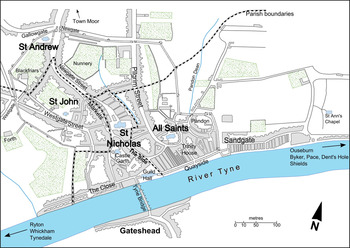
Keelmen's wages were a complex and ardently negotiated matter. They varied according to the changeable length and difficulty of work dictated by the position of ships on the Tyne (see Figure 1). Whereas a trip past the giant Pace sandbank to Shields took more than 12 hours and could put a crew in peril at the mouth of the river, a ship moored near the Quayside or only at the mouth of the Ouseburn, just east of the town, demanded a third of the time and a fraction of the risk. The standard rates of pay varied accordingly, although by the early seventeenth century it is clear that most ships moored near the rivermouth, kept at bay by debris clogging the river.Footnote 19 Prevailing rates of pay were set out in a petition to magistrates in early 1678 complaining that shipmasters were using loopholes to avoid full payment. Current rates, they said, were:
Every keel of coales cast aboard of any vessel above the [Ouse]Bournes mouth, 6s 4d
Betwixt the Bournes mouth and lower end of Byker Shoare 7s 4d
In Dent's Hole, 7s 10d
From thence to the lower end of the Bill Ratch, 8s 4d.
For every keel laid aboard of any ship casting ballast at any of the shoares below the Pace 13s 4d., and onely for ships casting their ballast on any of the shores above the Pace 10s 4d.Footnote 20
This payment schedule originated in wage disputes in the mid-1650s that largely escaped the notice of the town's records but were reported in London: ‘we have had a great stop of Trade by our Keel-mens pretence of too small wages from their Masters; they al as one man stood together and would neither worke themselves, nor suffer others’.Footnote 21 Magistrates managed to settle with an additional 3s per keel above the 10s 4d fee for a long journey. Coal was in unprecedentedly high demand in London, where it had become the fuel of the poor and there were fears that low supply would lead to riot.Footnote 22 Both hostmen and keelmen understood this, and in the context of a particularly sharp rise in food prices, the hostmen were willing to order a substantial pay hike. Despite many more strikes in the eighteenth century, the 1650s settlement would stand as the basic rate of pay until 1809.Footnote 23
Map of Newcastle upon Tyne, c. 1720, showing the four parishes. Source: Adapted from the map in Henry Bourne, The history of Newcastle upon Tyne (Newcastle, 1736), before p. 1, which was itself based on a map drawn by James Corbridge in 1723. Note: Parish boundaries are estimated using addresses recorded on the parish baptism registers in 1700–1705.

These sums were paid per keel tide (per job), and unfortunately there is no evidence that spells out the division of pay among the typical crew of four – a skipper, two keelmen and a boy, or four men.Footnote 24 Hypothetically, and roughly in line with the division of pay that went on in the building sites of Woodward's study, if we assume that the two ‘ordinary’ keelmen took a share twice as large as that of the boy, and that the skipper took half as much again, this represents a very substantial wage for a single day's work. For full tides, a keelman received twice as much as a Newcastle building craftsman and more than three times the wage of a building labourer – 35d as against 18d or 10d a day respectively.Footnote 25 It was similar to the 3s that skilled shipwrights were paid for their ‘tidework’ repairing ships at the rivermouth.Footnote 26 It also compares favourably with London docker and waterman wage rates of between 2s and 2s 6d a day recorded in the 1650s.Footnote 27 Yet this seemingly high wage was irregular, reflecting the numbers of colliers in the river as well as the rate at which coals arrived by wagon and mule. This makes it a critical task to determine how many journeys or ‘tides’ a keelman would have made a year. Only then can we attempt to reconstruct their earned income over a longer period.
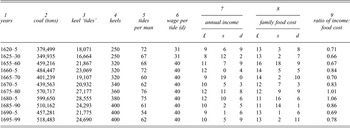
Contemporary assessments of the number of keels in operation can be used in conjunction with the quantity of coal taxed in the chamberlains’ and customs accounts to estimate the use of each keel. The total tonnage of coal is divided by one keel's capacity of 21 tons to give the number of keel tides, or individual journeys, in any given period.Footnote 28 The coastal coal trade alone required between 14,000 and 28,000 individual keel tides per year to load the ships. This is then divided by the reasonably reliable contemporary estimates of the number of keels in operation, which suggest about 250 keels in the 1620s, rising to 320 in 1655, and 400 by 1700.Footnote 29 These figures imply a plausible annual average of between 54 and 75 individual tides per boat, or shifts per man, which is supported by the Company of Hostmen's calculations of keel usage. A 1605 order declared that each keel furnished by a hostman would give him a minimum vend of sixty full keels of coal.Footnote 30 Similarly, accounts from the Stella colliery in 1675–1683 suggest that their hired keels made about 85 full journeys every year, compared to my estimated average of 75 for all keels on the Tyne in the same very busy period.Footnote 31 Whether these tides would have been divided evenly among the working keelmen is, like the division of pay within crews, an open question, although in 1630 keelmen were reported to have agreed to ‘load their keels by turn to make their wages equal’.Footnote 32 Assuming an even distribution, we can build in the standard rates of pay to suggest an annual income per keelman from the coastal coal trade alone of anywhere between about £10 and £13 (see Table 1, column 7).Footnote 33
Estimated available work and income for a Newcastle keelman with a family of five, 1620–1700

Sources: Col. 2: John Hatcher, The history of the British coal industry, Volume I, before 1700: towards the age of coal (Oxford, 1993), 487–94. Col. 3 = Col. 2 ÷ 21. Col. 4: See endnote 29. Col. 5 = Col. 3 ÷ Col. 4. Col. 6: J. M. Fewster, ‘The keelmen of Tyneside in the eighteenth century’, Durham University Journal 19 (1957–58), 15–18. Col. 8: Donald Woodward, Men at work: labourers and building craftsmen in the towns of northern England, 1450–1750 (Cambridge, 1995), 282. Col. 9 = Col. 7 ÷ Col. 8.
Notes: Wage per tide in Col. 6 is 1/4 of the fee paid to a whole boat for a long tide (10s 4d before 1655; 13s 4d after). Family food costs in Col. 8 are based on Woodward's standard family of man, wife and three children, but include an additional 3,010 calories for each keel tide worked.
Adjusting these wages by prices runs into further difficulty because Newcastle's threadbare municipal records offer little hope of constructing a price series for the seventeenth century. Instead, we can use Woodward's prices from Hull. There is no clear indication that this would differ substantially from Newcastle: beef and beer prices, where records have been obtained from around 1600 and 1700, were within 10 per cent, so the trend was similar.Footnote 34 Following Woodward, this series assumes a standard adult male diet of 2,850 calories of bread, cheese, beef, oats, peas and other essentials. The wife and first and second children are assumed to consume the equivalent of 75 per cent of the adult male diet, and further children are assumed to consume half.Footnote 35 Needless to say, these are heroic assumptions, and most likely too low for a comfortable and productive level of sustenance.Footnote 36 That said, research into energy use and work allows me to make one important adjustment. Keelmen, like other heavy labourers, would surely have required a much higher calorie intake on workdays. The rest of the family may well have adapted their own food intake according to the father's needs and their own level of activity, but this could not have compensated for the additional energy requirement of shovelling coal. A report from the Food and Agriculture Organization of the United Nations considers ‘shovelling coal’ to be 4.6 times more energetic than the minimum resting energy requirement.Footnote 37 If, hypothetically, a keelman worked for ten hours shovelling on one tide (not unrealistic, given the requirement to move four to five tons each, even if they had help from other crew), this work would have required at least 3,010 additional calories, roughly 6,000 in total on working days, which has been incorporated into the annual food costs.Footnote 38
In line with national trends, the cost of feeding a Hull or Newcastle family followed an upward national trend from the early seventeenth century to the 1650s, easing back in the 1680s, before rising again into the 1690s (Table 1, column 8).Footnote 39 This pattern ran counter to the rising incomes already shown. When these two estimates are brought together in Table 1, column 9, they suggest a substantial increase in real incomes between the 1620s or the 1650s (which, as we have seen, prompted industrial action), and the 1680s. At the lowest point, one keelman's earnings would have covered barely half of the basic family food bill. The second half of the century appears to have been considerably easier, though far from comfortable. The cost of food fell by nearly a quarter by the 1680s, and the work available grew as the seventeenth-century coastal coal trade hit its peak in the same decade. More tides worked meant increased income, and a better standard of living. The result was that the work of a single keelman could now just about sustain the basic family food costs on a single wage, though this fell back again as trade eased in the 1690s.
3. DRINK AND COAL SWEEPINGS
In addition to their cash wages, early modern labourers could anticipate non-monetary payment, usually food and drink, plus other work-related benefits. Money wages formed part of a suite of ‘exchange entitlements’, in Leonard Schwarz's words, which could boost a basic wage up to a more comfortable level.Footnote 40 Newcastle was no different. Perquisites of food and drink sometimes appeared in institutional accounts, though it can be difficult to generalise from isolated instances. When an extraordinary effort was required for a job, labourers would often be compensated in liquid form. In 1574, half a barrel of beer was given by the Newcastle mayor ‘to those that were helping the ship that was sunk’.Footnote 41 The hostmen's accounts, in the middle of a pressing building project in 1612, record ‘for drinke and candells to the workmen 22d’.Footnote 42 By the eighteenth century this allowance could be given in money instead: ‘failing beer we expect one shilling and four pence’ said a 1719 petition, confirmed in about 1740: ‘if any master of a ship does not give the keelmen employed in loading his ship the usuall quantity of beer then such keel shall be allow in liew thereof 1s 4d’.Footnote 43 As an allowance for three or four men, this is similar to that set by the shipwrights’ company, who in 1674, in response to a complaint from customers, limited their wage demands for ‘tidework’ in the river to 3s (per man), plus ‘6d more … in lieu of their drinke’.Footnote 44 It would have bought a gallon and a quarter of ale in 1703, or between two and three gallons of beer in the 1660s and 1670s.Footnote 45 This arrangement was not ideal. A complaint from keelmen in the mid-eighteenth century suggested poor quality and service: ‘we have not the same liquor as the other customers but a certain other liquor is brew'd for us which they call savage beer, or beer for savages’.Footnote 46 Parsimonious fitters preferred to control the keelmen's drinking money, and the implication was that they made some of the money back by providing poor-quality beer, sometimes brewed in their own households.Footnote 47
Other perquisites were related to the work being done. Craftsman and labourers could customarily remove ‘surplus’ raw material for their own use. Durham miners were normally given coal free of charge; tailors could keep waste cloth; and weavers accumulated ‘thrums’.Footnote 48 Woolwich dockworkers and shipwrights struck in 1665 to protect ‘their privilege of chips’, which extended to all the royal docks. Some of this acquisition was sanctioned; some was shadier. In 1601 the ‘fifteenth act’ of Newcastle Company of Hostmen limited the extent to which keelmen could collect from the coal they transported: ‘From henceforth there shall no Coles att all be brought … whatsoever, except that be the sweepings, and that not to exceed in any one Keell or Lighter above two smale maunds or pannyers full’.Footnote 49 Despite an adjacent order against ‘delyver[ing] or sell[ing] Coles’ the practice of illicit coal sales seems to have been continuing. The temptation must have been very strong, especially for the wealthier and more powerful skippers, to ‘fit’ boats themselves – that is, to deal directly with the shipmasters, cutting the hostmen out of the bargain. Seven keelmen were blacklisted in 1653 for ‘tak[ing] fitt tickets … without their owners consent’, in other words, delivering unauthorised coal.Footnote 50 The Company was forced to repeatedly reissue the order, appointing a beadle in 1658 to confiscate any coal ‘over and above the quantities and measures allowed in the Fifteenth Act’.Footnote 51 The small number of men presented for breaking company rules must only be the tip of a larger mass of illicit sales suggested by inventories. Gylbert Errington died with a relatively modest stock of 2s of coals; Thomas Dods had a good deal more: ‘a parcell of Coles’ valued at £3, which at prevailing prices could have been five tons.Footnote 52
Coal ‘sweepings’ were a valuable supplement to the household incomes of law-abiding keelmen, too. The hostmen must have understood that the upper limit set by the fifteenth act would become self-fulfilling – that two panniers of ‘sweepings’ would be lost from every keel. This was true at Lincoln Cathedral, where the Master of Fabric concluded in the 1660s that defining the size of ‘chips’ meant that a carpenter ‘may cut what wood he pleaseth to that shortness, and then take it for his fee’.Footnote 53 On the keels, this was counterbalanced by a practical reason to allow ‘sweepings’: broken, small and poor quality coal was worth little and it would have taken inordinate time and effort on a rocking keelboat to remove the final coals from the hull and shovel them on to a collier. This was a job to be done back in Newcastle: ‘the wives and daughters’, explained the eighteenth-century historian John Brand, ‘who sweep the keels, and have the sweepings for their pains, are called Keeldeeters’.Footnote 54 Quite how ‘sweepings’ were divided between the crew of a boat can never be known. But even if the skipper retained a captain's share, the proceeds from sixty annual tides could still have been substantial for the other crew: possibly as much as 20 bushels a year, heading towards a ton, though precision is impossible.
Some coal ‘sweepings’ and drink or the equivalent were evidently expected on top of other wages, even if Newcastle fitters expanded their profit margin by providing substandard beer, even if it was nominally worth over a shilling by the early eighteenth century, and even though they prove impossible to quantify adequately. Perquisites were, of course, another form of income that depended on a full year's work. Fewer tides for a keelman brought in lower wages, but it also meant less drinking money or beer-in-kind, as well as fewer ‘sweepings’ and a colder winter. Thus the slightly increased workload in the 1670s and 1680s, in combination with low food prices, generated a standard of living for Newcastle's labourers that was markedly higher than earlier decades, and also higher than the eighteenth century when their nominal wages were frozen and perquisites chipped away.Footnote 55
4. ‘A HARD AND TEDIOUS WINTER’
That keelmen enjoyed rising real incomes in the final third of the century does not indicate a suddenly easy life. A key structural problem remained. The winter, when work was thin, always threatened Newcastle families. In 1718 a group of keelmen and skippers pleaded that ‘your petitioners have had a hard and Tedious winter wherein many of their Familys have been almost starved for want of necessarys yet they being in hopes of a prosperous Trade in summer, suffered these hardshipps with the more patience’.Footnote 56 The hostmen put the blame squarely on the men themselves:
the skippers and keelmen imployed in the keels … in the River of Tine have for many yeares by sad experience found that their great miseries and wants suffered and endured by them and their poor families have been occasioned by their improvidence in not laying up and making provision out of what they earn and get by their labours in sumer time to subsist themselves in winter…Footnote 57
This problem was exacerbated when the weather, acts of war, or other disruptions caused a slowdown in trade. In these years, the problems of poverty and hunger in the eastern maritime suburb of Sandgate were unusually acute, and petitioning from the keelmen to the town's authorities, and from the hostmen to Parliament, intensified.Footnote 58
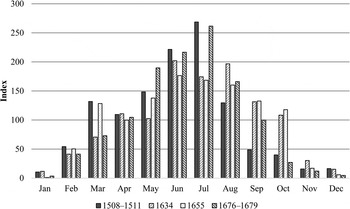
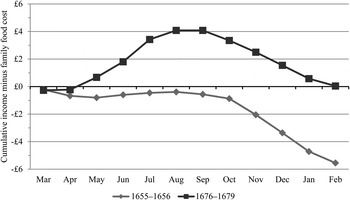
Even in ‘normal’ years, work was heavily seasonal. On the supply side, this was in part due to the difficulty of keeping mines open through the winter months of freezing and flooding. More significantly, there were much greater risks to shipping. In an anonymous dialogue from 1708, a servant explains to an inexperienced coal owner that ‘I have heard good saylers say, they had rather run the hazard of an East-Indie voyage, then be obliged to sail all the winter between London and Newcastle’.Footnote 59 Masters and investors stood to lose all of a substantial investment if the ship sank, and ultimately the threat of losing everything held most masters back from throwing caution to the wind.Footnote 60 There was some trade in the cold months, but masters that chose to enter the Tyne knowingly took on a degree of risk. Overall, the chamberlain's accounts and customs records show a seasonal pattern that changed very little in the seventeenth century: there were few sailings between November and February, more in the spring and autumn, and a pronounced peak in the summer, with up to ten times as many colliers embarking in July as in the winter (see Figure 2).Footnote 61 This must have severely affected household budgets from month to month, and we can visualise the impact by combining coal shipment data with the figures already estimated for the real income of keelmen. In the absence of any clear evidence to the contrary, overall food costs are assumed not to have varied significantly across the year.Footnote 62 It is also problematically assumed that all keelmen stayed in Newcastle for the entire year, and that they shared work equally between them. In fact, a lower number of keelmen sharing the available winter work would have boosted individual real incomes; conversely higher grain and fuel prices might have depressed them. Neither of these factors can be precisely estimated, making the extent to which they cancelled one another out uncertain. Nonetheless, the nature, if not necessarily the scale, of the annual winter crisis is immediately clear in Figure 3, showing the cumulative monthly surplus of income, after food costs have been deducted.
Seasonality of coastwise coal shipments and exports from Newcastle and Sunderland, 1508–1679. Sources: Hatcher, Coal, 477; J. U. Nef, The rise of the British coal industry, 2 vols. (London, 1932), II, 389. Notes: 1508–1511, 1634 and 1655 are coastwise shipments from Newcastle; 1676–1679 come from Sunderland. Seasonal index is calculated such that 100 would be the expected value in a randomly distributed year – that is, (total shipment ÷ 365.25) x number of days in the month x 100. February is assumed to have 28.25 days.

Estimated cumulative monthly real income for a keelman with a family of five. Sources: As Table 1 and Figure 2: Hatcher, Coal, 477, 487–94; Nef, Coal, II, 389; Fewster, Keelmen, 15–18; Woodward, Men at work, 282. Notes: Calculated from position previous month plus monthly wage minus food cost. Monthly wages are based on estimated number of work days derived from the quantity of coal shipped that month. Food costs include a 3,010-calorie premium per keel tide worked. Year begins in March, reflecting the customary start of the coal-trading season.

The two periods illustrated offer contrasting pictures of the impact of the seasonal pattern of income. During the 1650s, food costs soared and the family economy was under most pressure. It was at this low point that Newcastle aldermen resisted attempts to impress the keelmen because they were too poor to serve. Former mayor George Dawson found that ‘scai[r]se any one of them hath more cloathes then is on his backe, and if he have one shirt he hath not annother to shift whereby he keepe his bodye in a condition to be amongst others at sea’.Footnote 63 In the early 1650s, the family income model never achieved overall surplus at all, and the picture for the winter is very bleak. In the late 1670s, by contrast, real incomes were close to their highest in the century but the winter would still have caused severe financial difficulties for families that principally relied on the father's wage. The model is approximate, but the pattern clear. After a long summer of work the family enjoyed a cash surplus, but as the winter arrived, work dried up and the surplus was whittled away to zero or below. The process then started again with the new coal-trading season from March. In the early 1650s, a family solely reliant on one wage would have been deep in debt; in the 1670s the picture is still tough but less grim.
The seasonal nature of shipping influenced all areas of Newcastle society. It has long been conventional wisdom among local historians of the north-east that seasonal labour demands created an itinerant population that usually stayed only during the coal season. Some written sources suggest a seasonal ‘subsistence’ migration, although their statements usually had transparent political motivations. In 1712 Daniel Defoe, living at the time in Gateshead, picked up the case of the keelmen, complaining that:
strange accounts have been given to the House of the numbers of keelmens hands, obtained by the Magistrates to join their said request, which have been sometimes called a thousand, sometimes eight hundred. But … it is well known the whole number of Keelmen is within 1600, near one thousand whereof have put their hands to this petition, 400 are them are yet in Scotland whither they go always in the winter to their families…Footnote 64
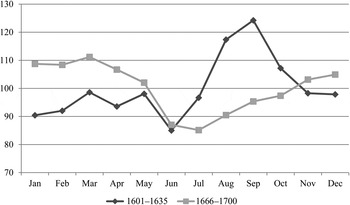
Newcastle's demography hints at a more varied story, stressing the workers that stayed rather than those who moved away. During the period of fastest sustained growth (1600–1635) burials were consistently low in the winter and peaked in late summer and autumn.Footnote 65 This contrasted with the second half of the century (1666–1700), when the peak in burials climbed through December, January and February which, although other exogenous factors may also be in play, could suggest a higher winter population than earlier (Figure 4).Footnote 66 This later period shows a similar burial seasonality to most other parishes with stable populations in England, reflecting a seasonal spike in disease and relatively low nutrition in the winter and early spring.Footnote 67 By the 1670s, more keelmen considered themselves settled in Newcastle. No longer were they necessarily young men: when they grew too old to work many would not move away, and when a keelman died, the widow and children would often remain. In fact, Daniel Defoe wrote again that the keelmen ‘were exceedingly burthensome to the parishes where they lived, for the support of their poor, such as by reason of age, or accident, were past labour, and the widows and children of such as were dead’, notwithstanding the brand new keelmen's hospital, which was intended to relieve the same group.Footnote 68 Newcastle was home to these families, even if they had originally migrated into the town from elsewhere. They demanded to be buried in its churches, and they recognised both their new neighbours and their home-village kin in their wills.Footnote 69
Seasonality of burials in all Newcastle parishes, 1601–1635 and 1666–1700. Source: All Saints’ Parish Registers: Tyne and Wear Archives, Newcastle upon Tyne, MF 249/250. Note: Seasonal index using the same method as Figure 2.

The familes of keelmen who had married and settled in Newcastle by the latter part of the seventeenth century had some local political clout. When the town was resisting keelmen impressment in 1653, Dawson argued that ‘it falls sadly upon the eldest married men, that have greatest charge of children’.Footnote 70 Captain Yates, who had 50 men, said he was forced to immediately discharge them, not because of their own actions but ‘in respekte of the mightye clamor of theyre wives’.Footnote 71 In December 1666, in the period immediately following the plague and fire in London, as well as the threat of Dutch men-of-war in the second Anglo-Dutch War, Richard Forster, a Newcastle merchant, wrote to London complaining that residents had driven ‘the colleckters of the ha[r]th money out of Sandgate …; none but women to be seane, they are the keall-mans wiffs’.Footnote 72 It is clear that Newcastle's ruling classes could, when it suited them, seek to emphasise, either the indigent, temporary nature of Newcastle's mobile workforce, and the dangers that implied, or they could emphasise that Newcastle's industrial workers were in fact settled in the town and putting a severe charge on parish relief and the town when work was hard to come by. Both statements were true, describing different sections of the workforce; but the balance was shifting towards a stable population by the end of the seventeenth century.
The threat of winter under-employment remained and this instability applied to other forms of labour. Even if we cannot be precise about the quantity or frequency of work available, the Common Council's accounts demonstrate a range of ad hoc jobs that implies a large unskilled and semi-skilled workforce. A tranche of work could suddenly be made available by a particular event, such as two spectacularly grisly religious executions in the 1590s. They racked up expensive wage bills, requiring payments among others ‘to 2 labourers for making a rome for the making of the fier, 12d’ and ‘for hjinginge up the 3 quarters and head of the preiste, 9d’. A mason's servant was paid 6s ‘for putting the pinicle for hinging the preists head of[f] the bridge 6s’.Footnote 73 The threat of the plague offered other macabre opportunities: two men were paid 8d ‘for going 4 hours aboute the towne to cause all new comers into the towne latelie, to avoide’. Work could be outstandingly mundane, too. In 1655, Trinity House hired two labourers for ‘a day counting bricks and piling them’.Footnote 74 Others swept and cleaned the municipal buildings or the drains.Footnote 75 A group of men worked in three shifts around the clock, every day of the year (including Sundays), to drain the town's colliery with a treadmill pump.Footnote 76
Some of this casual labour seems to have been commissioned as part of a work scheme for seasonally under-employed keelmen. With regard to poverty, the interests of the town's government aligned closely with those of the hostmen, not least because so many hostmen also served as aldermen. A complaint from the Mayor to the newly-minted Hostmen's Company in 1604 accused the hostmen of combining to ‘abridge’ keelmen's wages ‘to their extreame impoverishment and excessive charge of the Towne’.Footnote 77 The Mayor, Thomas Riddell, was a hostman himself and one of the initial sheriffs of the company, so this was an attempt to set out the respective responsibilities of the company and the town for poorer workers.Footnote 78 These men's interests coincided in their attempts to relieve unemployment by providing additional work directly. Such jobs had to be possible in winter, such as clearing the Tyne, something that was helped by the slowdown in other river traffic over the cold months. Burgeoning trade had generated both an excess of sand ballast and, not coincidentally, a number of shipwrecks. Certainly in the 1650s, but probably at other unrecorded times as well, the town ‘pressed’ a number of keels into service to remove this wreckage in the winter months, which must also have involved the employment of the crews.Footnote 79 In the early eighteenth century, keelmen petitioned to standardise the rates of pay for towing keels to one shilling plus beer for the men who were working.Footnote 80 The town also regularly offered work to poor men and women shifting ballast on their heads at 4–5d a ton onto the ballast hills, to the east of the town, which both created employment and helped to keep the river clear.Footnote 81
Such work could never fully make up for the stoppage of trade, and the hostmen looked to provide credit to bridge the gap. The ‘bonds’ by which keelmen signed up to work for their fitters provided a clause for a winter loan to keep the men's families solvent until the summer. According to the only original surviving bond from 1787, the fitter Anthony Hood ‘has given [the] skippers … [the] sum of twenty shillings apiece for the binding of them and their said men …, and has lent unto the said skippers … [the] sum of twenty shillings’ to be repaid on 11 June.Footnote 82 Whether this practice went back into the seventeenth century is uncertain, since the hostmen's records provide no evidence of the type of contracts that existed between fitters and keelmen. It certainly went back to the 1720s, when hostman George Liddell described how the keelmen ‘get their binding money at Christmas’.Footnote 83 This arrangement was no accident. The hostmen and the town had constructed a system whereby keelmen, in a normal trading year, had enough money or credit to survive the low period in work.
A charitable observer might have ascribed this complex arrangement to benevolence on the part of the hostmen. Coal-owner Sir Charles Montagu's personal correspondence reveals a desire to pay his workers well – and to be seen to do so. ‘It is my design and desire to give as good wages for everything as any gent does, who pays well and has work well done’.Footnote 84 But in reality, the provision of winter work or the advancing of loans were motivated by more than paternalism. Satisfying demand for sea coal was paramount to the fortunes of both rich and poor in Newcastle. The hostmen-controlled coalfields of Tyneside, in order to be at their most profitable, had to be rapidly responsive to the demand for coal in other ports, principally London. Sometimes this meant keeping a number of keels on standby on the Tyne, even in the middle of winter. Organised, convoyed winter sailings, such as the 400 colliers that arrived in 1673, were a recurrent if irregular event, particularly when war or external circumstances had created pressure on the coal supply to London.Footnote 85 In the crisis of the Second Anglo-Dutch War and the London plague in 1665, numerous attempts were made to launch a convoy of ships up to Newcastle, despite shipmasters’ misgivings. In the end it took a personal threat from Charles II for a convoy to leave Ipswich for Newcastle in November 1665.Footnote 86 In the meantime, Newcastle's fitters had to be on hand, with a workforce ready to load the ships. Speed, skill and experience were all necessary to make money from this sort of job. In comparison with losing further ground to competitors in the metropolitan coal trade, the cost of bridging loans or the provision of winter labour looked relatively slight.Footnote 87
This economically rational charity or credit was in evidence elsewhere in the North Sea world. Christiaan van Bochove and Ton van Velzen interpret the system of monthly payment letters and transport letters operated by the Dutch East India Company as something akin to modern payday loans, which are implicitly guaranteed against future earnings rather than assets.Footnote 88 In theory, the letters would have taken months to come back to sailors’ home ports, but in practice, the families of seamen could borrow against the earnings of expected future letters. Officials understood the pressures that a situation of uncertain income put on households and the town itself; their demand for labour and the need to relieve poverty outweighed concern about default on the loans. Writing in 1698, William Waller suggested that hard-hearted mine-owners might, through generosity to their retired workers, bring not only ‘a blessing from heaven on your undertakings’, but also generate loyalty, ‘encourag[ing] the most skilfull miners (and at the lower rates) to resort to that work’, to the great advantage of ‘all the partners concerned’.Footnote 89 Similar thinking was also evident in late seventeenth-century London. Daniel Defoe's retrospective novel, A journal of the plague year, observed that ‘All kinds of handicrafts in the city … [were] out of employ’, causing them to dismiss ‘an innumerable number of journeymen and workmen’. The stagnation would have been much worse:
but that the master-workmen, clothiers and others, to the uttermost of their stocks and strength, kept on making their goods to keep the poor at work, believing that soon as the sickness should abate they would have a quick demand in proportion to the decay of their trade at that time.Footnote 90
Defoe suggests that wealthier craftsmen who could afford to keep workers on did so because they knew that, if they could survive a period of trade depression when others did not, they would be in a stronger economic position when demand picked up again.
A similar economic awareness about offset future earnings underpinned lenient terms of credit offered by the tradesmen of Newcastle to their keelmen neighbours over the winter. Small-time credit was certainly to be found with local tradesmen, although the extent is as yet unclear. The majority of plaintiffs in cases of debt in King's Lynn were from relatively humble backgrounds, frequently modest urban traders, and they sued people from across the social spectrum.Footnote 91 The probate inventories that record debts in Newcastle hint at a pattern that was not dissimilar. Among the butcher Christofor Prierman's extensive collection of debts – which reached King's Lynn and Colchester and encompassed the spectrum of Newcastle society – were a number of identified keelmen.Footnote 92 Their debts ranged from a few pence to a few shillings, and were likely incurred through the provision of food. In King's Lynn the poorest defaulters, widows and labourers, were sued less frequently than their wealthier neighbours, which Craig Muldrew attributes to the virtuous ‘quality of mercy’ as against the strictures of the common law.Footnote 93 In Newcastle's inescapably seasonal local economy, there was a further reason for traders to let debts slide: tradesmen knew that they could not realistically recoup their debt in the winter. Moreover, to attempt such an unlikely debt collection was to risk provoking the collective displeasure of Sandgate's consumers. The keelmen together made up the chief portion of demand in the area, so over the entire year, they would have made the difference between a successful and a failed business. When the keelmen fully exerted their collective buying power the damage could be severe. In one case, the men reacted to an ‘affront given to one of them by a person who kept a public house’:
The keelmen that was injured went and spit upon a stone near the house and renounced any further connection with it, and the rest that were of his mind performed the same ceremony. And they kept religiously to their vow that the people were obliged to quit their house for want of business.Footnote 94
The sheer number of workers that the coal trade brought to Newcastle's markets made their custom irreplaceable.
When credit ran dry, backup could come from the expanding system of parochial relief, which grew in size and economic significance across England from the end of the sixteenth century, and could often provide a crucial intervention in family economies. Unfortunately, the historian's view of poor relief in Newcastle is undermined by an absence of accounts over the entire century: none of the parish books contain any records of relief before the mid-eighteenth century at the earliest. We cannot be certain how far keelmen could rely on parish relief, but some sources are suggestive. Already in 1591, the Council ordered the ‘making [of] 137 badges … for the poore folke which shall be allowed to goe in the towne to aske almes’.Footnote 95 Seventeenth-century legislation further narrowed the terms on which more mobile members of the population could claim relief outside their home parish, crystallising the need for claimants to demonstrate industry, sobriety and settlement in the parish.Footnote 96 Similar restrictions applied to individually funded charities such as that of Mrs Frankland, or the money given by Richard Hudleston of St Nicholas’ parish ‘to be distributed amongst the poor and indigent house-keepers and not amongst the common vagrant Beggars’.Footnote 97 The least settled of the keelmen – those who were dissenting migrants, those in lodgings, those with no families – would have struggled to persuade overseers of their worthiness for relief, but it seems that many more stable families could. One of the concerns raised by the first of Defoe's pamphlets in 1711 was that the families of skippers and keelmen ‘were exceedingly burthensome to the parishes where they lived, for the support of their poor’.Footnote 98 Again in 1758, a committee consisting of hostmen and burgesses was formed ‘to inquire into the great increase of the Poor Rate in All Saints’ Parish, occasioned as said by the great number of poor people in Sandgate imployed as Keelmen’.Footnote 99 The hostmen and town authorities were aware at all times of the cost and necessity of providing relief. It was a religious and civic duty, but it was also economically necessary to maintain their keelmen housed around Newcastle.
Most families, in most years, did survive the winter with assistance from the structural protections that had been put in place. But there was always the threat of an exogenous shock, which could collapse the finely balanced system. This happened in 1638, when crosswinds, pirates and men-of-war conspired to put men out of work who, with their families, ‘must suffer greatly through their necessities’. The solution proposed by the hostmen was to ‘incourage the shipmaisters that they may goe into Newcastle againe this winter’.Footnote 100 In 1665/6, the hellish combination of war, plague and fire meant that by December the keelmen and colliers were broke and ‘there is many of them alreddy goinge abagine’.Footnote 101 Only after Christmas was the fleet able to sail and the problem began to ease.Footnote 102 Again, the early decades of the eighteenth century saw a triangular dispute between the monopsony coal buyers, the hostmen and the shipmasters. In 1729 George Liddell, one of the hostmen's governors, objected not only for the sake of his own pocket but for the welfare of his men and their families:
What must become of the poor keelmen? They are a sort of unthinking people that spend their money as fast, nay generally before they get it. They give over work the beginning of November and many of them had not then a shilling beforehand. They live upon credit and a little labouring work till they get their binding money at Christmas. That money goes to their creditors and they borrow of their fitters to buy provisions and have credit with the runners for a little drink, and so they put off until about Candlemas [2 February]. Now if they are not to begin until about Ladyday [25 March], half of them will be starved, for as their time of working will be so much shorter trades people will not trust them their being no prospect of being repaid.Footnote 103
A similar dispute in the previous decade had provoked the ‘hard and tedious winter’ petition we saw earlier, and unsurprisingly the keelmen laid the blame on the hostmen's unscrupulous trading practices for putting them out of work, rather than their ‘unthinking’ behaviours. The winter was bad, they said:
But now Tradeing is begun, Which is the Time wherein your petitioners hoped not only to procure themselves present maintenance, But alsoe a reserve of something for their winters subsistence, But your said Petitioners are entirely frustrated of their expectation and in all probability their Familys must starve if not some provision be made for them …, for the Coaleowners Fitters and Shippmasters have Combined together in a Contrait … by which our keeles are not onely Confined to lye by for one halfe the year Idle.Footnote 104
This was life on a knife-edge, where a few weeks difference at the start of the season, or a continual crosswind, or the eruption of war, or an outbreak of illness, could make the difference between cold hunger and relative comfort – between a shopkeeper's wary welcome and a slammed door. Work, the town's magistrates and hostmen knew, was the only true solution. In the meantime, to secure their profits, they facilitated a whole host of stopgaps that filled in the seasonal insecurities inherent in the coal trade.
5. CONCLUSION
The interests of the keelmen and the hostmen coincided when they concerned workers’ welfare in such a seasonal business. In ‘normal’ years there was a matrix of relief in operation to keep manual labourers and keelmen alive, and available, in Newcastle throughout the year. There was the combination of additional work, which came from the town council and the hostmen; the provision of poor relief from All Saints’ parish, in which the principal ratepayers would have been the wealthiest fitters, hostmen and shipwrights; and the flexible extension of credit from shopkeepers and tradesmen who, again, had an overriding commercial interest in the coal trade. None of this came cheap. Just after Christmas 1656 the mayor informed the Common Council that a ‘great want of money in the Hutch’ had forced him to borrow £500 in London to pay the ‘poore of cloathing, the poore in ordinary, and the ministers stipend…and other the Townes necessary disbursements’.Footnote 105 The system of relief might be ascribed to a paternal instinct towards the town's workers, and indeed Christian virtue and charity were entwined with self-interest and economic ‘rationality’ in early modern England.Footnote 106 It was fundamentally in the economic interests of the powerful to maintain this flexible workforce. Their instincts that protected the keelmen from impressment, that appeased their demands for higher wages, and that capitulated over the expulsion of the ‘chimney men’ from Sandgate, were the same instincts that knew where the profit lay in coal. They needed a large and flexible workforce as much as the keelmen themselves needed the work.
The result was, in normal years, a relatively comfortable life for most working families in the later seventeenth century. John Baillie remarked in 1801 that Sandgate was populated by ‘a hardy and laborious race of men’ who ‘live almost entirely upon flesh-meat and flour, of the best kinds, which the strong exertions in their employment require’.Footnote 107 The same could have been said 130 years before. As with Sir Richard Newdigate's labourers, ‘at the end of [a] long hard week, they arguably enjoyed a standard of living which just might, from the perspectives either of their grandparents or their grandchildren, have seemed enviable’.Footnote 108 The incremental growth in wages and working hours estimated here allowed John Hughson and his wife their £4 suits and cloaks, Thomas Hall his silver and glass, and Thomas Roper a glass pot in which to relieve himself.Footnote 109 The improving standard of living also allowed hundreds of other families to settle in the town when their predecessors had migrated in and out with the seasons. These gains in living standards were a combination of wages and prices, of sweepings of coal, and of other seasonal perks. Some of these things are easy for historians to count, some much harder; but the unquantifiable benefits were no less important to the workers who received them.
This relative prosperity was still a precarious one for those who lived it. Working lives in Newcastle frequently lacked consistency. In the summer months, keelmen were flush with money but incomes quickly froze in winter, and by December they were reduced to borrowing money from their employers to pay off their creditors and to relying on what little parochial relief was available. This made living from year to year a fundamentally uncomfortable experience. Such concerns regarding the stability of income are shared by labourers of the modern developing world, yet they are still poorly understood by the classical theories on which much of economic history, as well as economics, is based. Many parents in developing countries would prefer their children to take government or factory work rather than become entrepreneurs or film stars.Footnote 110 These jobs are only moderately well paid, but what really appeals to the parents is their security: a wage comes regularly, and an absence of work is unlikely. So it was in seventeenth-century Newcastle. In the absence of any reliable mechanism to save money, the keelmen struggled to get by in low-work years. It was the lack of regular work, rather than low wages, that could cause real economic devastation. Real standard of living gains came not only from wage-hikes and free coal, but also in the unlikely form of bridging loans, the provision of temporary work and the forgiveness of winter debts, which offered a relative social and mental stability that was otherwise lacking for this rapidly expanding wage-labour force. Just sustaining a living in early modern England has been described as ‘a Herculean task’, but in the later seventeenth century we glimpse a moment when the scales were closer to balanced.Footnote 111
ACKNOWLEDGEMENTS
I am grateful to the ESRC and the Leverhulme Trust for funding the research, to the Editors and anonymous referees for valuable comments, to Adrian Green, Alex Brown, Amy Erickson, and Andy Wood, and to seminar audiences at Cambridge, Swansea/Cardiff, Durham, Leicester, Northumbria and the IHR.