Introduction
The prevalence of allergy among youth appears to have increased in the past decade with a current prevalence estimated at between 6% and 12% among school-aged children in the United States (Carey & McDevitt, Reference Carey and McDevitt1978; Oberklaid et al. Reference Oberklaid, Prior, Golvan, Clements and Williamson1984; Robinson et al. Reference Robinson, Mattes, Oddy, Pennell, van Eekelen, McLean, Jacoby, Li, De Klerk and Zubrick2011; Dyer & Gupta, Reference Dyer and Gupta2013). Allergy is associated with school days lost, poorer academic performance and increased healthcare costs for youth.
In recent years, there has been growing interest in the relationship between allergy and mental health. Several epidemiologic studies have shown an association between allergy and depression (Bell et al. Reference Bell, Jasnoski, Kagan and King1991; Hashiro & Okumura, Reference Hashiro and Okumura1998; Cuffel et al. Reference Cuffel, Wamboldt, Borish, Kennedy and Crystal-Peters1999; Centanni et al. Reference Centanni, Di Marco, Castagna, Boveri, Casanova and Piazzini2000; Goethe et al. Reference Goethe, Maljanian, Wolf, Hernadez and Cabrera2001; Timonen et al. Reference Timonen, Jokelainen, Hakko, Silvennoinen-Kassinen, Meyer-Rochow, Herva and Räsänen2003a ; Goodwin et al. Reference Goodwin, Castro and Kovacs2006), and, to a lesser extent, between allergy and anxiety disorders (Cuffel et al. Reference Cuffel, Wamboldt, Borish, Kennedy and Crystal-Peters1999; Goodwin, Reference Goodwin2002) among adults. In early studies using selected samples, a relationship between allergy and behavioral inhibition among youth, which is thought to be closely linked with internalizing problems, was documented (e.g., Bell et al. Reference Bell, Jasnoski, Kagan and King1990). More recent clinical studies have found an association between parent-reported physician diagnosis of allergy and internalizing symptoms among clinically referred youth (Chang et al. Reference Chang, Seo, Kim, Kwon, Kim, Kim, Lee, Jang, Song, Kim, Shim, Kim, Park, Cho, Lee, Shin and Hong2013). A small number of epidemiologic studies have also found links between allergy/atopy and panic attacks (Kovalenko et al. Reference Kovalenko, Hoven, Wu, Wicks, Mandell and Tiet2001), personality traits (Gregory et al. Reference Gregory, Caspi, Moffitt, Milne, Poulton and Sears2009), depression (Timonen et al. Reference Timonen, Jokelainen, Silvennoinen-Kassinen, Herva, Zitting, Xu, Peltola and Räsänen2002, Reference Timonen, Jokelainen, Hakko, Silvennoinen-Kassinen, Meyer-Rochow, Herva and Räsänen2003a , b), and suicidal behavior (Timonen et al. Reference Timonen, Viilo, Hakko, Särkioja, Meyer-Rochow, Väisänen and Räsänen2004; Qin et al. Reference Qin, Mortensen, Waltoft and Postolache2011; Brundin et al. Reference Brundin, Erhardt, Bryleva, Achtyes and Postolache2015; Crawford et al. Reference Crawford, Galobardes, Jeffreys, Smith and Gunnell2015). In sum, while there have been numerous studies on parent-reported allergy and internalizing disorders (depression, anxiety) among youth, several issues have remained unaddressed and therefore relatively little is known about the links between atopy and the range of mental health problems among youth.
As such, several questions about the relationship between atopy and mental health among youth remain unanswered. First, it is unclear whether and to what degree there is a relationship between allergy and mental health problems among youth in the community, as previous studies have primarily included either clinical samples or those conducted in representative samples have mainly included adults. Second, there is little information on the specificity of these relationships as most prior studies have focused only on internalizing disorders and very few have looked at externalizing disorders. Third, part of the difficulty in examining the relationship between allergy and mental health among youth in the community is that evaluation of allergy is complex. It is not easily performed in a survey study as it requires some degree of invasive testing. Self- or parent report of allergy without biological confirmation is not considered reliable. Similarly, objective or biological evidence alone is not sufficient as a positive result here without clinical/subjective report of symptoms on exposure can reflect sensitivity to various allergens, rather than true allergy. To our knowledge, few studies in the world exist with information on both self-report/parent report of allergy and objective biological data in an unselected, community-based sample. Fourth, a potential relationship between allergy and mental health problems would be vulnerable to confounding by a wide range of factors, such as parental mental health problems and family functioning. Little is known about the possible pathways explaining a relationship between atopy and mental health problems among youth (e.g. the role of confounders, potential mediators, common causal risk factors). To our knowledge, no prior study on atopy and child mental health has been able to measure or control for those factors.
The goals of the current study are to begin to address this gap in knowledge. Using a birth cohort study that includes measures of parent-report allergy, sera IgE and well-validated measures of mental health problems among youth, as well as a wide range of potentially confounding factors, this study investigated the relationship between early life atopy and mental health problems in childhood and adolescence.
Method
Participants
The Western Australian Pregnancy Cohort (Raine) Study, initially established between 1989 and 1992, consists of 2868 children from Perth, Western Australia, who have been followed from birth. The study first began as a pregnancy cohort in which 2900 women were enrolled (representing 90% of eligible women approached to take part in the study), approximately 100 women per month for 3 years, at around the 18th week of gestation (Newnham et al. Reference Newnham, Evans, Michael, Stanley and Landau1993). The women were enrolled from the antenatal booking clinics at King Edward Memorial Hospital (KEMH), the principal tertiary obstetric hospital in Perth, Western Australia. The criteria for enrolment were gestational age between 16 and 20 weeks, sufficient proficiency in English to understand the implications of participation, an expectation to deliver at the hospital, and an intention to remain in Western Australia so that follow-up through childhood would be possible. Mothers were not selected on the basis of any asthma or atopy criteria. As KEMH is the only specialist obstetric care center in Western Australia, the initial sample was at moderate obstetric risk, and the participating mothers reflect the population obtaining obstetrical care in this region. Thus this is a community-based cohort representing about 20% of all live births in Western Australia, with exclusions only for very-low birthweight or birth defects. The population was 84% Caucasian, 4% Aboriginal and 12% other (primarily Asian); reflective of the population in Western Australia at the time. All children were examined at birth and extensive antenatal data were collected regarding maternal sociodemographic characteristics, including age and education. Informed consent was obtained at the time of enrolment in the study and at every subsequent follow-up and study protocols were approved by the Human Ethics Committees at KEMH and Princess Margaret Hospital for Children in Perth, Western Australia.
The cohort attended follow-up visits throughout childhood at ages 1, 2, 3, 5, 8, 10, 14 and 17 years, consisting of comprehensive behavioral and physical health questionnaires completed by the primary caregiver (usually mother). At the 17-year follow-up, 1754 study adolescents and their families completed all or part of the follow-up (414 deferred participation, 184 were unable to be traced, 480 had withdrawn and 36 were deceased). The sociodemographic characteristics of the retained cohort compared with the original cohort has been published elsewhere (Tearne et al. Reference Tearne, Robinson, Jacoby, Li, Newnham and McLean2015). There were complete mental health data available for 1368 adolescents at the 17-year follow-up, representing just over 47% of the original cohort.
Atopy – parent report
At the 5-year follow-up parents were asked some simple questions about their child's atopic profile, including whether the child suffers from rhinitis (or blocked nose) or an itchy rash. The study also asked a general question as to whether the child had an allergy. Positive responses to either rhinitis, itchy rash or general allergy were counted as a case for parent-reported atopy. We created a binary variable where 1 = positive, 0 = negative (i.e. no to all).
Atopy – sera IgE
At the age of 5 years, blood samples were collected allowing for the analysis of serum IgE data. Subjects were defined as atopic if they had total IgE ⩾ 300 kU/l or had specific IgE ⩾ 0.35 kU/l for any of the following allergens: HDM (Dermatophagiodes pteronyssinus), rye grass pollen (Lolium perenne), cat, couch grass (Cynodon dactylon), mould mix-2 (Penicillium notatum, Cladosporium herbarum, Aspergillus fumigatus, Candida albicans, Alternaria alternata, Helminthosporium halodes), peanut or food mix-5 (egg white, milk, fish, wheat, peanut and soybean). We created a binary variable where 1 = positive, 0 = negative.
Mental health problems
The 118-item Child Behavior Checklist for Ages 4–18 (CBCL/4-18) was administered at the 5-, 8-, 10-, 14- and 17-year follow-ups and completed by the primary caregiver (Achenbach, Reference Achenbach1991).The CBCL demonstrated good sensitivity (83% overall) and specificity (67% overall) to a clinical psychiatric diagnosis and good test–retest reliability in a Western Australian clinical calibration (Zubrick et al. Reference Zubrick, Silburn, Gurrin, Teoh, Shepherd, Carlton and Lawrence1997). The CBCL/4-18 produces a raw score that was transformed into T scores (standardized by age and sex) for six problem scales using the CBCL DSM-Oriented Scales (Achenbach & Rescorla, Reference Achenbach and Rescorla2001). The problem scales are considered to map well against the diagnostic criteria of the Diagnostic and Statistical Manual of Mental Disorders Fourth Edition (DSM-IV) for affective problems (e.g. major depression, dysthymia), anxiety problems (e.g. generalized anxiety disorder), somatic problems (e.g. somatization disorder), attention deficit hyperactivity problems (e.g. inattentive or hyperactive-impulsive type disorders), oppositional defiant problems (e.g. oppositional defiant disorder) and conduct problems (e.g. conduct disorder) (APA, 2000). For this study, we applied the recommended clinical cut-off scores (by age and sex) to obtain a binary variable indicative of clinically significant affective, anxiety, somatic, attention deficit hyperactivity disorder (ADHD), oppositional defiant and conduct problems. The clinical cut-offs were as specified by the CBCL DSM-Oriented Scales, and applied to raw scores normed for age and sex (T ⩾ 65). The term ‘clinically significant’ refers to maladaptive behavior that falls within a defined clinical range for behavioral problems (Achenbach, Reference Achenbach1991).
Covariates
Demographic data regarding family income, maternal age and education level were collected at 18 weeks gestation. Mothers were also asked at 18 and 34 weeks gestation whether or not they had experienced any of 10 major life stress events selected from the 67-item life stress inventory developed by Tennant & Andrews (Reference Tennant and Andrews1976). These included: pregnancy problems, death of a close friend or relative, separation or divorce, marital problems, problems with children, job loss (involuntary), partner's job loss (involuntary), money problems, residential move or other stressful event. The question on the 18 weeks gestation questionnaire asked whether any of the events had been experienced since becoming pregnant and, on the 34 weeks gestation questionnaire, whether any of the events had been experienced within the last 4 months, ensuring that the same event was not counted twice. As with previous studies, responses were recorded as ‘yes’ or ‘no’ in order to maximize effective recall (Carmichael et al. Reference Carmichael, Shaw, Yang, Abrams and Lammer2007) and the total number of stressful life events reported in pregnancy was summed. Information was retrospectively collected at the 8-year follow-up as to whether the mother had ever been treated for an emotional or mental health problem, and this was classified according to yes or no responses.
Maternal allergy
Mothers provided self-reported of their own lifetime allergy status at the 5-year follow-up assessment. This information was categorized as a binary variable representing whether the mother had any allergy (yes) or no allergy at all (no).
Family functioning
We used the parent-report General Functioning Scale (GFS) from the McMaster Family Assessment Device (FAD) administered at the 5-year follow-up as a measure of family functioning (Epstein et al. Reference Epstein, Baldwin and Bishop1983). This short-form scale consists of 12 statements that were derived from an item analysis of the complete 60-item scale, including questions on problem solving, family communication, affective responsiveness, and behavior control. The GFS has excellent reliability [r (Gutman split-half = 0.83) and internal consistency (Cronbach's α = 0.86)] (Byles et al. Reference Byles, Byrne, Boyle and Offord1988).
Data analysis
Frequency data were compared for all covariates according to child allergy status. We used a logistic regression model to examine the relationship between allergy confirmed by parent report only, sera only and both parent report and sera data and changes in T scores reflecting clinically meaningful differences in affective, anxiety, ADHD, oppositional defiant and conduct problems from ages 5–17 years (i.e. a score above the relevant clinical cut-off point for age and sex). The logistic regression model accounted for loss of independence due to repeated observations of the same individuals over time by incorporating generalized estimating equations with a first-order autoregressive [AR(1)] working correlation matrix structure. IBM SPSS v. 23.0 (IBM Corp., USA) was used for the analyses.
Results
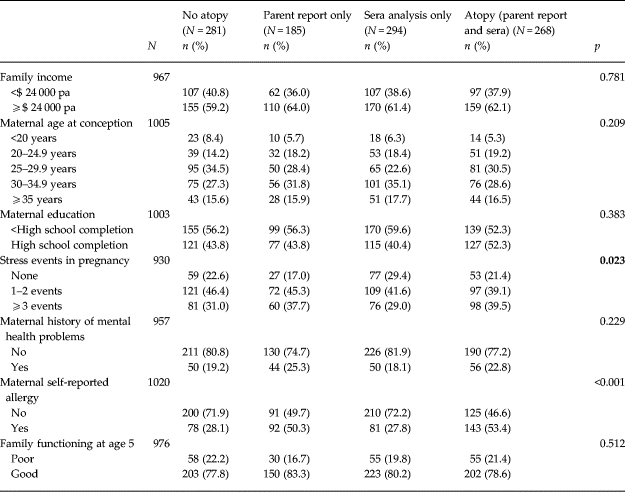
Data on atopic status were available for 1028 children at age 5. Of these, 27.3% (281) were classified as having no allergy from both parent-report data and sera analysis, while 18.0% (185) had a parent-reported allergy that was not confirmed by sera analysis and 28.6% (294) had a sensitivity identified by sera analysis that was not reported by parents. There were 26.1% (268) subjects with an allergy confirmed by both parent report and sera analysis (Table 1).
Frequency data by atopy by parent report and/or sera analysis (N = 1028) a

a Column percentages presented, missing data not presented.
Demographic characteristics and childhood allergy
We observed a significant relationship between the number of stressful life events experienced during pregnancy and later allergy status, where an increasing number of stressful life events was associated with a higher likelihood of parent-reported allergy and of both parent-reported and sera-confirmed allergy (p = 0.023). Mothers’ own self-reported allergy status (yes) was also associated with an increased chance of parent report and combined parent- and sera-reported allergy in the child (p < 0.001).
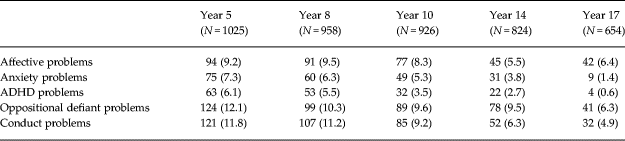
The percentages of participants with DSM-IV scale problems at ages 5, 8, 10, 14 and 17 are presented in Table 2. We observed more problematic behaviors in the earlier years of follow-up (5–10 years) than the later years, with affective, conduct and oppositional defiant problems being the most common problems in this sample.
Percentage of participants with DSM-IV scale problems at each follow-up with data available for atopic status (n = 1028) a

ADHD, Attention deficit hyperactivity disorder.
a Sample size represents those with data for atopic status and DSM-IV scale problems, percentages represent those participants with problems compared with those without problems at each follow-up.
Values given are n (%).
Childhood mental health problems and childhood allergy
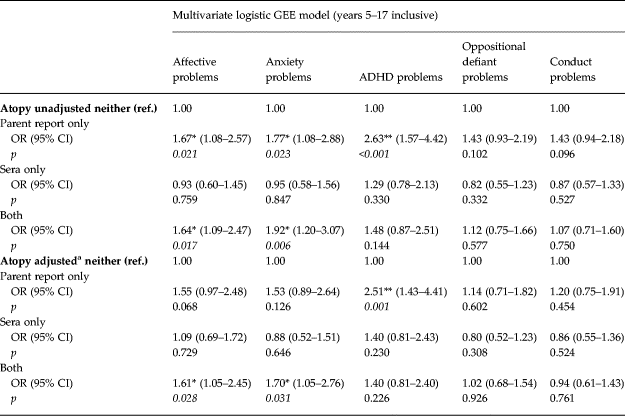
In the univariate logistic regression analyses, allergy at age 5 confirmed by parent-report only was associated with an increased risk for affective (OR = 1.67, 95% CI: 1.08, 2.57), anxiety (OR = 1.77, 95% CI: 1.08, 2.88) and ADHD (OR = 2.63, 95% CI: 1.57, 4.42) problems from ages 5 through to 17 (See Table 3). Allergy status reported by both parents and sera analysis showed only affective (OR = 1.64, 95% CI: 1.09, 2.47) and anxiety (OR = 1.92, 95% CI: 1.20, 3.07) problems as significantly related to allergy at age 5. After adjusting for prenatal stress exposure and mothers' own self-reported allergy status, childhood allergy reported by parents and confirmed with sera analyses was linked with a greater likelihood of developing an affective (OR = 1.61, 95% CI: 1.05, 2.45) or anxiety (OR = 1.70, 95% CI: 1.05, 2.76) problem between the ages of 5 and 17 years.
Relationship between child allergy by parent and/or sera analysis and CBCL/DSM-IV problems from ages 5–17

CBCL, Child Behavior Checklist; GEE, generalized estimating equation; ADHD, attention deficit hyperactivity disorder; OR, Odds ratio; CI, confidence interval.
a Adjusted for mother's own self-reported allergy and number of stress events in pregnancy.
*p < 0.05, **p < 0.005.
Discussion
The goals of this study were to investigate the relationship between atopy in early life and risk of mental health problems in childhood through adolescence. Our results suggest that atopy in early life may be associated with increased risk of affective and anxiety problems in childhood and adolescence, compared with youth without atopy; this relationship was only observed when information on atopy came from both parent report and positive IgE sera, rather than either alone. Positive sera without parent report was not associated with mental health. Parent-report atopy without positive sera was associated with ADHD. To our knowledge, this is the first study to investigate the relationship between atopy, measured both by objective blood test and positive parent report, and mental health problems in a representative, prospective study. These findings will be discussed in the context of existing literature and future directions for research and clinical work below.
Our results are consistent with earlier findings in clinical samples of higher levels of anxiety symptoms among youth with allergies (Teufel et al. Reference Teufel, Biedermann, Rapps, Hausteiner, Henningsen, Enck and Zipfel2007; Flokstra-de Blok et al. Reference Flokstra-de Blok, Dubois, Vlieg-Boerstra, Oude Elberink, Raat, DunnGalvin, Hourihane and Duiverman2010). Early studies have suggested that allergy was associated with behavioral inhibition. Yet, prior studies have been plagued by methodological barriers. Specifically, earlier studies have primarily relied on parent report of allergic status with an absence of biological confirmation or objective data. Additionally, objective measures alone are not sufficient for the diagnosis of a true allergy (v. allergen sensitivity). The current study is able to address and overcome this challenge with assessments of atopy confirmed by both parent report and IgE level. Our results are fairly consistent with previous clinical and epidemiologic studies suggesting an increased prevalence of affective and anxiety problems among youth with atopy.
Several explanations for the associations between atopy and later mental health problems can be considered. First, it is conceivable that parents who believe their children have atopy in the first 5 years of life behave differently in their parenting style (e.g. a tendency toward overprotectiveness) and that these changes may influence the types of mental health problems to which these youth are vulnerable. There is a need for heightened precautions on several fronts when managing a child's allergy, which could be considered overprotective behavior. Yet, overprotectiveness is thought to increase anxiety in children in some cases, although this could be due to the anxiety in the parent, which may directly increase anxiety in the child. We found no association between history of maternal mental health problems and atopy in the child, which reduces this likelihood. Second, it is plausible that there are shared predispositions to both atopy and anxiety problems/disorder, which result in increased odds of this co-occurrence. This is consistent with the body of literature showing links between atopy and depression and anxiety problems (Wamboldt et al. Reference Wamboldt, Weintraub, Krafchick and Wamboldt1996; Goodwin et al. Reference Goodwin, Wickramaratne, Nomura and Weissman2007). Some evidence has suggested that there could be a common genetic vulnerability to allergy/atopy and depression (Wamboldt et al. Reference Wamboldt, Hewitt, Schmitz, Wamboldt, Rasanen, Koskenvuo, Romanov, Varjonen and Kaprio2000). Further work is needed to understand the pathways underlying these relationships.
It is of interest that parent-report-only allergies were associated with ADHD. There has been growing interest recently in associations between atopy and ADHD (Chen et al. Reference Chen, Su, Chen, Hsu, Huang, Chang, Chen and Bai2014; Genuneit et al. Reference Genuneit, Braig, Brandt, Wabitsch, Florath, Brenner and Rothenbacher2014; Yang et al. Reference Yang, Lee, Liang, Lin, Fu and Chen2014). Our results suggest that the nature of this association requires closer inspection. ADHD is a disorder that depends substantially on parent report of symptoms, to a degree that is not the case with other mental health issues in childhood. It is of interest that had we relied solely on parent report or biological evidence alone, our findings would not have provided a full picture of the data. This highlights the challenges and importance of measuring allergic status accurately. Using parent-report data, atopy at age 5 was associated with a higher risk for ADHD; however, when we looked at the sera data the ORs appeared to be in the opposite direction but it is not statistically significant. It may be that, as already presented, parents who believe their children have a problem with allergies may differ from other parents in their parenting style (e.g. overprotective style) which may lead to an increased risk for child behavior problems or to a different perception of child behavior. However, if we use a biological measure of allergen sensitization alone, there does not appear to be any relationship between atopy and mental health problems.
It is conceivable that children whose parents reported allergy that biological verification did not confirm did have a true allergy at a young age (1–3 years) which was then outgrown by age 5 years. This is extremely common with many allergies. As such, there could be a link between these early life allergies and increased development of ADHD behaviors, even though the allergy is outgrown by age 5 and does not persist (and therefore appears negative to testing at age 5). There is also some evidence linking allergy and ADHD and suggesting that the rising prevalence of each may be related (Chang et al. Reference Chang, Seo, Kim, Kwon, Kim, Kim, Lee, Jang, Song, Kim, Shim, Kim, Park, Cho, Lee, Shin and Hong2013; Yang et al. Reference Yang, Lee, Liang, Lin, Fu and Chen2014). As such, the lack of biological verification at age 5 should not necessarily be offered as evidence that these were not true allergies at some point, and future work is needed here to tease this apart.
The pathway underlying these observed relationships is not known; there are several possibilities. The association between atopy and affective and anxiety problems is consistent with prior work showing a link between parent-/child-reported allergy and depression, anxiety and behavior inhibition, but prior studies have not combined and/or disentangled the contributions of parent report/self-report and biological verification in a single study. This is useful toward efforts to understand the potential social, biological or psychological pathways underlying atopy and mental health problems. It is conceivable that there is some biological pathway underlying the link. Animal studies have suggested behavioral differences associated with IgE responsiveness/allergy and behavior inhibition/anxiety-like behaviors (Basso et al. Reference Basso, Pinto, Russo, Britto, de Sa-Rocha and Palermo Neto2003; Nautiyal et al. Reference Nautiyal, Ribeiro, Pfaff and Silver2008). This is not inconsistent with our findings in that behavioral inhibition is commonly considered a precursor to anxiety, which is linked with atopy in the current study. Yet, there was no relationship between elevated sera IgE alone and mental health problems, suggesting it seems unlikely to be operating primarily via a direct biological link between mental health and IgE levels. As such, it is conceivable that having a disorder (as indicated by both parent report and positive sera IgE) from an early age that requires compliance and cooperation, to some degree, with either medications or behaviors in order to remain safe/healthy may increase the likelihood that youth develop anxiety and/or depressive symptoms as they may be taught from an early age that certain behaviors or lack of caution could compromise their well-being. As the type of allergy is not delineated here (e.g. environmental, food), it is difficult to speculate broadly on whether this it may or may not have impacted early experiences.
It is also conceivable that an association between allergy and affective/anxiety problems could emerge as a result of exposure to a prenatal or early life factor that increases the risk for both. We adjusted for several such factors (e.g. prenatal stress) and, in this study, they do not appear to have an impact on these relationships, calling into question whether this pathway is likely to explain the link. Further work is needed to understand the pathways underlying these relationships. Future studies that can use clinical diagnoses of allergy (with combined parent-report/self-report, objective biological data and clinical information) in an unselected sample would be an important next step in understanding these relationships and potentially elucidating the pathways underlying these links on time.
This study has several limitations and therefore replication is needed. First, we did not have data related to the severity of allergy, treatment for allergy, or what they child's history of symptoms on exposure was. Further, if the child had experience severe reactions, we did not have information on how frequently and how recently an anaphylactic reaction had occurred. A history of this experience (e.g. using an epi-pen, going to the emergency room, being hospitalized) and its recency could influence results and therefore we cannot draw conclusions about how atopy and mental health may influence each other over time. Second, we did not have complete family history of mental health problems or allergy. Third, our measures of maternal allergy were without biological verification. More detailed investigation into mental health of parents of youth with allergy seems worthwhile both with respect to the association we found, and to examine whether and to what degree the experience of having a child with a persistent and potentially life-threatening condition may impact parents’ mental health. As numerous studies have documented decreased quality of life among parents and youth with allergy, this deserves further study (Le et al. Reference Le, Flokstra-de Blok, van Hoffen, Lebens, Goossens, Dubois, Bruijnzeel-Koomen and Knulst2013; van der Velde et al. Reference van der Velde, Dubois and Flokstra-de Blok2013; Howe et al. Reference Howe, Franxman, Teich and Greenhawt2014).
Conclusion
Our results suggest atopy in early life may be associated with increased vulnerability to affective and anxiety problems in childhood and adolescence. Future studies that can confirm this and elucidate the pathway would be useful toward shedding light on the etiology of both as well. In addition, more data on links between atopy and specific types of affective and anxiety problems would be informative. For instance, if atopy is associated with some types of anxiety (e.g. separation anxiety disorder) and not others (e.g. generalized anxiety disorder/worry), or the reverse, this may be informative about possible etiological pathways. If our findings are replicated, and a causal relationship is found, early prevention programs could be more widely implemented to help youth and their families adjust and cope effectively with allergy without compromising mental health.
Acknowledgements
All phases of this study was supported by the University of Western Australia, which played no role in the design and conduct of the study; collection, management, analysis, and interpretation of the data; and preparation, review, or approval of the manuscript; and decision to submit the manuscript for publication.
Declaration of Interest
None.