1. Introduction
Until recently, economic historians seeking to reconstruct the evolving occupational structure of the British economy in the key period of the eighteenth and early-nineteenth centuries have been hampered by the apparent paucity of data available before the 1841 census.Footnote 1 The Cambridge Group for the History of Population and Social Structure (Campop) sought to plug this gap by constructing a ‘census’ of male occupations c.1817, using data on fathers’ occupations extracted from all 11,364 parish registers of England and Wales for the period 1813–1820.Footnote 2 Occupations were classified according to the PST system of primary, secondary and tertiary sector employment and the resulting adult male occupational structure has been mapped at the level of 1851 registration districts.Footnote 3 Coupled with new estimates of the male occupational structure c.1710, Campop's findings have radically reshaped our understanding of the structural change in employment during the eighteenth and early-nineteenth centuries. The economy now appears more industrial at the beginning of the eighteenth century. Shaw-Taylor and Wrigley found a fairly modest growth in adult male secondary sector employment from 37.2 per cent c.1710 to 42.1 per cent c.1817. More recent refinements by Keibek suggest an even slower growth, from 41.7 to 42.7 per cent over the same period.Footnote 4 A lower growth in labour inputs implies that the rise in secondary sector labour productivity during the eighteenth and early-nineteenth centuries must have been substantially greater than previously thought. This would add weight to the case for an ‘industrial revolution’ but call into question the timing of productivity improvements in agriculture. Keibek's new estimates also suggest a notable rise in tertiary sector employment, from 11.7 per cent c.1710 to 16.1 per cent c.1817.
The ‘census’ database of adult male occupations now affords the opportunity for an initial investigation of regional economies c.1817. This study looks at Wales. But first, we must investigate the representativeness of the Campop data where a significant proportion of baptisms are missing from parish records due to religious nonconformity.
Parish baptism records provide the most comprehensive source available for measuring adult male occupations c.1817 but as Snell and Ell have pointed out, they are an Anglican source.Footnote 5 With the rapid expansion of nonconformity during the Evangelical religious revival, at its height from 1790 to 1840, the absence from parish registers of children baptised in dissenting chapels becomes a potential source of error. This was especially noticeable in the ‘census’ data for Wales, where Anglican baptisms were only 75.6 per cent of the English level. Moreover, there was considerable variation between Welsh counties, the highest rates of ‘missing’ baptisms occurring in rural Merioneth, and in the south Wales counties of Carmarthenshire, Glamorgan, Brecknock and Monmouthshire, which included the rapidly industrialising coal-mining and metal-working areas associated with the industrial revolution in Wales.Footnote 6
This raises the question whether Anglican fathers’ occupations can safely be scaled up to compensate for missing nonconformists, or whether nonconformists pursued significantly different occupations. Previous studies on the social class of nonconformists have reached mixed conclusions about the extent of occupational differences, but demonstrated that a substantial volume of nonconformist records containing fathers’ occupations is available.Footnote 7 These can now be compared to the Campop data to identify whether there were significant differences between Anglican and nonconformist occupations, and hence whether we can continue to rely solely on Anglican parish records to give a fair picture of the early nineteenth-century adult male occupational structure of England and Wales.Footnote 8
This study uses a sample of seven Welsh hundreds plus the borough of Carmarthen, which collectively covered 14 per cent of the Welsh population in 1821, to assess the adequacy of nonconformist records for identifying occupations and discover whether there were significant differences between Anglican and nonconformist occupations over the period 1813–1820, and to paint an initial broad picture of the Welsh economy c.1817.Footnote 9 The article is in nine parts. Section 2 explores the nature of nonconformist baptism sources, the findings and methodological problems of previous research on nonconformist occupations. Section 3 outlines the method used to assess what proportion of birth and baptism records are extant for nonconformist chapels and circuits in existence before 1820, and to develop a methodology for comparing nonconformist and Anglican data. Findings on the availability and adequacy of nonconformist records are described in Section 4. Section 5 assesses whether nonconformist fathers’ occupations were significantly different from Anglicans in the same area, and whether there were differences between nonconformist denominations. Section 6 evaluates the impact of nonconformist occupations for the occupational structure of Wales, and assesses the potential variance caused by missing data. The new estimates of adult male occupations are then used to paint an initial picture of the Welsh economy c.1817. Finally, the main conclusions are summarised, with implications for further research.
2. The records and social structure of nonconformity
Until the advent of civil registration in 1837, only records of baptism, marriage and burial kept by the Church of England were recognised as valid by the courts. There was no requirement for dissenting chapels to keep registers, though some chapels did so during the eighteenth century.Footnote 10 The requirement to record a father's occupation in parish baptism registers was introduced by the Parochial Registers Act 1812, often known as Rose's Act after its promoter, George Rose. Although the act applied only to Anglican baptisms, some nonconformist denominations adapted their baptism registers to ensure a similar record of father's occupation. The Wesleyan Methodists generally adopted the new Church of England printed register.Footnote 11 Welsh Calvinistic Methodist baptisms took off gradually after the denomination's break with the Church of England in 1811, recorded in the denomination's printed baptism register which included father's occupation. The chapels of the other major Welsh denominations, the Independents/Congregationalists and Baptists, were essentially self-governing, so the format of their registers remained largely at the discretion of the congregation or baptising minister. Although Baptists advocated the adult baptism of believers so did not practice infant baptism, some chapels began to keep a register of the births of members’ children, but few include the father's occupation.
Agitation for reform of the registration laws gathered momentum, and Parliament finally agreed to a system of civil registration of births, marriages and deaths for England and Wales in 1836.Footnote 12 With the introduction of civil registration in 1837, the opportunity was taken to retrospectively recognise non-parochial registers. Most pre-1837 nonconformist baptism registers were handed in to the new General Register Office, which issued certificated extracts when needed for legal purposes. These registers now form The National Archives’ RG 4 series, together with later deposits in the RG 8 series and are available online via Ancestry.Footnote 13 Additional registers not handed in to the General Register Office have since been deposited in county record offices or denominational repositories.Footnote 14
Historians of nonconformity have long been interested in the occupational structure of nonconformity, albeit largely from a perspective of social class.Footnote 15 A theoretical framework for the types of rural community where dissent flourished was first proposed by Everitt, who suggested that they were usually marked by an unusual degree of freedom such as many small freeholders, self-employed craftsmen and tradesmen, or were situated well away from the nearest parish church and in many cases far from any manor house. Such communities included new centres of rural industry like the mining parishes of Cornwall or industrial villages.Footnote 16 Historians have made extensive use of the pre-1837 non-parochial registers to test Everitt's characterisation, and to evaluate how far the evangelical denominations succeeded in their objective of bringing a more vital religion to the poor, less educated or remoter populations largely left out by the Established Church.Footnote 17 However, most evince a number of methodological problems.
Gilbert pioneered the analysis of non-parochial registers at a national level to argue that the success of evangelical nonconformity in early-nineteenth century England depended largely on its appeal to the artisan classes. He concluded that whereas the proportions of tradesmen, merchants and manufacturers were similar among English nonconformists and the wider society, the proportions of farmers and labourers was considerably lower, but that of artisans was between two and three times as high. Handloom weavers and members of dangerous occupational groups including miners, quarrymen and fishermen were notably more likely to be nonconformist. Nonconformist adherence was therefore concentrated in the middle of the social spectrum, and largely excluded both the gentry and those at the bottom of the social scale.Footnote 18
In Wales by contrast, nonconformist denominations grew more rapidly over the period 1800–1837 to embrace a much higher proportion of the population than in England. By 1851, 44 per cent of the population of Wales was estimated to have attended nonconformist worship.Footnote 19 To attain this level of allegiance, Welsh nonconformist denominations recruited from a wider range of occupational groups than their English counterparts, becoming the religion typical of tenant farmers and agricultural labourers.Footnote 20
Gilbert's study evinced several methodological shortcomings. Firstly, aggregating baptisms from 1800 to 1837 was problematic in a period of rapid population growth and changing occupational patterns. Furthermore, the rising proportion of nonconformists, especially in Wales, resulted in data disproportionately dominated by occupational patterns towards the end of the period, which obscures the changing composition of nonconformist congregations over time. Research on the Caernarfonshire hundred of Nantconwy, where nonconformity arrived relatively late, identified a differential uptake of nonconformity over the period 1813–1837. Secondary sector workers were early adopters, nearly twice as likely as average to be nonconformist in the period 1813–1820. The proportion of nonconformist farmers and slate quarrymen increased during the 1820s; labourers were late adopters in the 1830s while tertiary sector workers remained more strongly Anglican throughout the period.Footnote 21 Secondly, Gilbert's study also suffered from what might be termed ‘geographical bias’. Because fathers’ occupations were more frequently listed in the Methodist registers of northern England than in the Independent and Baptist records of the south, Gilbert's national sample overstated the proportion of artisans and underestimated that of labourers.Footnote 22 Several subsequent local studies concluded that the occupational structure of nonconformist chapels mainly reflected the locality in which they were situated.Footnote 23
Watts therefore attempted to provide a firmer statistical analysis of the social basis of nonconformity, by analysing all English and Welsh non-parochial registers for the period 1790–1837. Results for each decade after 1800 were presented by county to avoid geographical bias, using Watt's own eleven-fold social class classification and compared with the wider population using the 1841 census. The study confirmed that as evangelical nonconformity expanded in the first four decades of the nineteenth century, it moved down the social scale. Although Watts found some support for Gilbert's thesis that artisans were overrepresented in nonconformist congregations, his findings revealed a more complex and nuanced picture. Some major groups, often those whose earnings became depressed by the 1830s and 1840s, featured as strongly nonconformist, though represented by different denominations in different areas: weavers in Lancashire and Yorkshire (Baptist), framework knitters in Leicestershire and Nottinghamshire (Baptist, Primitive Methodist and Methodist New Connexion), shoemakers in Northamptonshire, and potters in Staffordshire (Wesleyan and Methodist New Connexion). Above all, Watts concluded that nonconformity had a special appeal amongst miners.
Nevertheless, in many rural counties there was little difference between nonconformist occupations and the population at large, except that very few gentlemen and professional men were dissenters, while the proportion of nonconformist labourers varied considerably between counties.Footnote 24
For the six Welsh counties partially included in this study (Caernarfonshire, Carmarthenshire, Denbighshire, Flintshire, Glamorgan and Montgomeryshire), Watts’ analysis of nonconformist occupations 1810–1819 suggested some significant differences in the social structure of Welsh denominations, notably a higher proportion of farmers and weavers among Calvinistic Methodists and of colliers and miners among Independents and Wesleyans. However, his data classification system is incompatible with the PST system used by Campop. A major methodological shortcoming was his use of partial occupational data from chapels where many fathers’ occupations were not recorded. This can lead to ‘missing occupational data bias’ – explored further in Section 4 – which is likely to result in the proportion of craftsmen being over-estimated and agricultural workers under-estimated. Even so, Watts’ figures showing a median percentage of nonconformist labourers for English counties of 15.7 per cent, compared to the 29.5 per cent of Anglican labourers in the Campop study, is surely suggestive.
Above all, previous attempts to map the social and occupational basis of nonconformity have been hampered by a lack of contemporaneous data for the general male population.Footnote 25 The Campop occupational database 1813–1820 now enables Anglican and nonconformist occupations to be compared for the same time and place, providing a clearer answer to how far male nonconformist occupations differed from the population at large.
3. Method
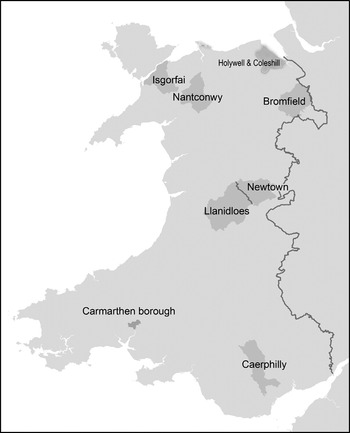
This study is based on the seven Welsh hundreds of Bromfield, Caerphilly, Coleshill (including Holywell town), Isgorfai, Llanidloes, Nantconwy and Newtown, plus the borough of Carmarthen (Figure 1), which collectively accounted for 14 per cent of Welsh population in 1821. These areas are not a random sample but were chosen to exemplify the major sectors of the Welsh economy – agriculture, mining, slate quarrying, metal working, woollen manufacturing and a major county town – as well as districts of differing denominational strength.Footnote 26 Reliable statistics of denominational membership are not available before 1851: at this date, Old Dissent predominated across most of south Wales, while Calvinistic Methodism was strongest in north and west Wales, having grown rapidly from small beginnings after secession from the Anglican Church in 1811. There was greater diversity among nonconformists in the mid-Wales hundreds of Newtown and Llanidloes.Footnote 27 In the 1810s, Flintshire in the north east had the lowest level of nonconformity of all Welsh counties.Footnote 28
Study areas.

Bromfield hundred in east Denbighshire was a thriving industrial district with coal, lead and ironstone mining and iron manufacturing, which included Wrexham, the major market town for north Wales. It had been a Puritan stronghold during the Civil War and Old Dissent – Baptists and Independents – remained the predominant nonconformist denominations before 1820.Footnote 29 By 1813, Welsh Calvinistic Methodism was also well established and Wesleyan Methodism had a growing presence. Caerphilly in Glamorganshire included the fast-growing industrial town of Merthyr Tydfil dominated by iron industries and coal; it too was a historic stronghold of Old Dissent. Carmarthen borough was a county town noted in the eighteenth century as one of two provincial capitals of south Wales where country gentlemen had their townhouses. It provided a wide range of traditional crafts and services and had a high level of nonconformity, again dominated by Old Dissent. Coleshill hundred and the town of Holywell in Flintshire formed one of the major Welsh mining districts for lead and coal. Holywell was also a beacon of modern water-powered industry, including cotton spinning, copper and brass manufacturing. Isgorfai included the county town and small port of Caernarfon, with an expanding slate-quarrying industry in its rural hinterland. Nantconwy was a predominantly hill-farming area in south-east Caernarfonshire. Newtown and Llanidloes in Montgomeryshire formed the centre of the Welsh woollen industry, though major parts of both hundreds remained largely agricultural.Footnote 30 Although Calvinistic Methodists were the largest denomination here in the 1851 Religious Census, there was also a significant Wesleyan and Baptist presence.
The study's unit of analysis is broadly the hundred, the grouping used for population censuses from 1801 to 1831. Welsh hundreds were based on the medieval commote structure, comprising a number of townships which did not always coincide with parish boundaries.Footnote 31 Part parishes have therefore been excluded from the analysis.Footnote 32 Wherever possible, the study follows the methodology established in Campop's ‘census’ of Anglican occupations, though some modifications were required. For example, nonconformist ‘gathered’ churches drew their congregations from areas which did not necessarily coincide with parish boundaries, and Wesleyan baptismal registers were often kept on a circuit basis, covering a number of congregations over a wide area. Fortunately, nonconformist registers usually stated the parish of birth or parents’ abode.
To allow comparison with Anglican occupations in the same parish however, this study analyses nonconformist births or baptisms by parish of birth or parents’ abode. Data was collected for all nonconformist chapels or congregations with surviving records situated within the sample hundreds for the period 1813–1820, and entries for births or parents’ abode outside the hundred were then excluded. Data was also collected for chapels in parishes outside the hundred which baptised children born within the study area. Anglican data came from the Campop database.
The first task was to assess what proportion of nonconformist birth and baptism registers are extant, by comparing the surviving nonconformist birth/baptism registers for the study areas with the number of nonconformist chapels established by 1820, identified using the 1851 Census of Religious Worship, the National Library of Wales’ Capeli Cymru database, and the Royal Commission on Ancient and Historic Monuments of Wales’ Coflein catalogue.Footnote 33
The Campop database of Anglican baptismal records excluded registers where less than 95 per cent of fathers’ occupations were listed. The same standard was adopted in this study for comparing Anglican and nonconformist occupations, although this led to the exclusion of valuable data, discussed in Section 5. For comparisons between nonconformist denominations, a 90 per cent standard was used. Kitson et al. found that less than 0.5 per cent of Anglican baptismal register entries gave fathers more than one occupation, and for their initial study, only the first occupation was analysed.Footnote 34 Because by-employment was significant in some remoter parts of Wales, this study gives equal weight to each multiple employment: thus a farmer/quarryman is counted as 0.5 farmer and 0.5 quarryman.Footnote 35
Fathers’ occupations were coded using Campop's PST definition and lookup tables to form a database of nonconformist fathers’ occupations.Footnote 36 There has been a thorny debate on how to allocate labourers to appropriate sectors, because the type of labouring undertaken is rarely specified in baptism registers.Footnote 37 Keibek estimated that for Wales as a whole c.1817, 85 per cent of labourers were employed in agriculture, 14 per cent in the secondary sector, and one per cent in the tertiary sector.Footnote 38 These proportions are used in this study to assess the impact of nonconformist baptisms on the male occupational structure of Wales but would produce inaccurate results at local level. Labourers are therefore shown as a separate category for most of the ensuing analysis.Footnote 39
The significance of differences between Anglican and nonconformist occupations, for both the whole sample and for each hundred, was tested at the 95 per cent confidence level. In testing for occupational differences between nonconformist denominations, another potential source of bias is the lack of occupational data both from chapels without surviving registers, or whose registers did not include useable occupational data. In urban parishes especially, fathers’ occupations could differ from chapel to chapel within the same denomination, reflecting the occupational mix of the neighbourhood.Footnote 40 To avoid any ‘missing chapels’ bias, comparisons were only made for hundreds with virtually complete records for at least two denominations.
4. Adequacy of records
The study identified 116 nonconformist chapels/congregations or Wesleyan circuits extant in the study areas during the period 1813–1820, with two further possible cases. Identifying a chapel's commencement date is by no means straightforward. Both the 1837 General Register Office's form accompanying the deposit of non-parochial registers and the 1851 religious census asked for each chapel's commencement date, but this was not always given, and the two records frequently differ. Uncertainty arose partly because congregations often met in cottages or barns before becoming sufficiently established to build their first chapel. The names of meeting houses and chapels could also change as congregations out-grew their early meeting houses and sometimes rebuilt on a new site or were given a new biblical name to distinguish them from later chapels built in the same area.
Baptisms for children born in the study areas also took place in eleven chapels or Wesleyan circuits situated outside the hundred. This was particularly prevalent among the Independents, where nearly a sixth of chapels were outside the hundred, often in a neighbouring market town. In Nantconwy for example, 38 per cent of nonconformist baptisms were recorded by Tabernacle Independent Chapel in the local market town of Llanrwst, Denbighshire.
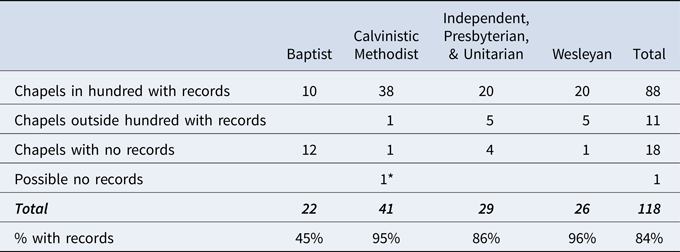
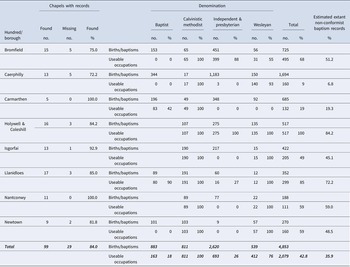
Baptism or birth registers were traced for 99 chapels, 84 per cent of those identified as in existence (Table 1). Of those extant, ten had not been deposited with the Registrar General.Footnote 41 The registers provided 4,853 nonconformist baptisms between 1813 and 1820, compared to 16,342 Anglican records. Baptist chapels predictably constituted the majority of those with no records: birth registers survive for less than half the 22 chapels in existence before 1820. This affected the industrial districts most – in Bromfield and Caerphilly where Baptists were strong, a quarter of chapels had no surviving register. In the textile districts of Llanidloes and Newtown, around 17 per cent of registers were missing, though in Carmarthen and Nantconwy records survive for all chapels (Table 2).
Number of chapels with 1813–1820 baptism/birth records by denomination

Sources: Bromfield Hundred: The National Archives [hereafter TNA] RG 4/1722, 2523, 3445-6, 3487, 3490, 3492, 3527, 3648-9, 3777, 3863, 3868-9, 4126, 4131; Bangor University Archives [hereafter BUA] BMSS/39315; Clwyd Family History Society, ‘Cefn Bychan Welsh Baptist Chapel’; National Library of Wales [hereafter NLW] MS 7125B. Caerphilly Hundred: TNA RG 4/1106, 3498, 4118, 3500-1, 3888-9, 4090, 4094-5, 4188; Glamorgan Archives DBAP53/1, DXFP/1; NLW Cardiff 4.593. Carmarthen borough: TNA RG 4/1685, 3817, 3942, 4437, 4442. Isgorfai Hundred: TNA RG 4/2254, 3833, 3838, 3873, 4025-6, 4116. Llanidloes Hundred: TNA RG 4/2550, 3907, 3910, 3958, 4068, 4098; NLW CMA 27502. Nantconwy Hundred: TNA RG 4/3444, 3448, 3462, 3775, 3778, 3836, 3871. Newtown Hundred: TNA RG 4/3909, 4099; Montgomeryshire records MR/C/01, 05; Powys Archives M/NC/3. For nonconformist chapels established by 1820 without extant records, see text.
Note: *Evidence is contradictory on whether two chapels existed before 1820, so counted as one missing chapel.
Proportion of nonconformist birth/baptism records in chapels recording occupations for 95 per cent of fathers, by Welsh sample hundred, 1813–1820

Source: For chapels with records see Table 1. For chapels with missing records see text.
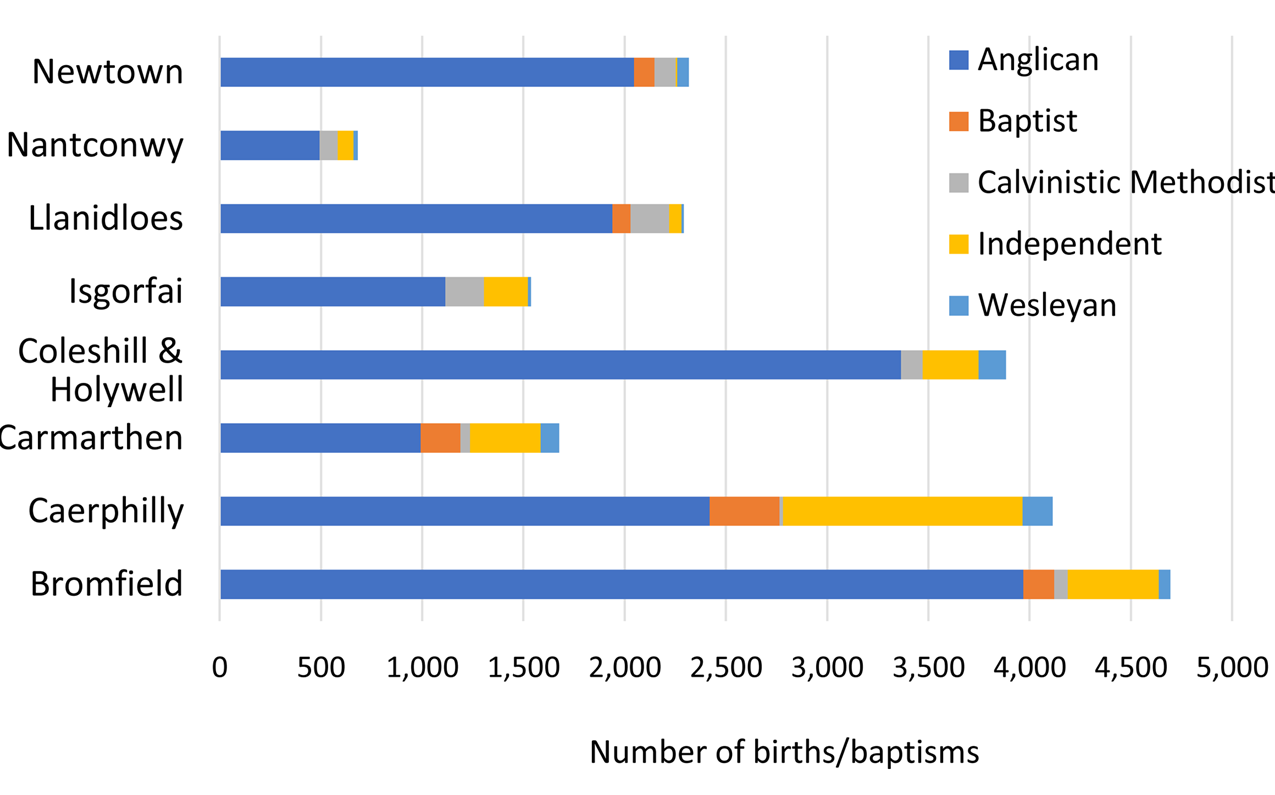
The surviving nonconformist registers account for 22.9 per cent of all Anglican and nonconformist births/baptisms in the study areas. Allowing for the 16 per cent of chapels without surviving records, this implies that around 27 per cent of all baptisms took place in nonconformist chapels. This figure is reassuringly close to the average for Wales, estimated at around 28 per cent of all Welsh baptisms.Footnote 42 Nonconformity had penetrated to the greatest extent in the south Wales industrial heartland of Caerphilly, where 41 per cent of recorded births and baptism records were already nonconformist (Figure 2). Given that records were missing for 28 per cent of Caerphilly nonconformist chapels, the overall proportion of nonconformist births/baptisms in the hundred c.1817 may have been nearer 57 per cent.Footnote 43 In Carmarthen, 41 per cent of births and baptisms were nonconformist, while in the two Caernarfonshire hundreds of Isgorfai and Nantconwy, the estimated level was around the average for Wales. Anglicans were strongest in the remaining four districts, accounting for 85–88 per cent of surviving birth and baptism entries.
Number of birth/baptism records by denomination and hundred, 1813–1820.
Source: see Table 3.

Even within hundreds, there were major differences in the proportion of nonconformist baptisms in different parishes, with Anglicanism retaining a monopoly in some largely agricultural areas. In Isgorfai for example, nonconformist baptisms constituted over half in Llanbeblig parish, which included the county town of Caernarfon, whereas there were none in the small rural parish of Bettws Garmon. The speed of proselytising also affected the strength of nonconformity, which had barely penetrated the remote mountainous parish of Llanberis by 1820, accounting for less than 2 per cent of baptisms despite a growing population of slate quarrymen – an occupation associated strongly with dissent after 1820.
The proportion of useable nonconformist baptisms from chapels which met the test of over 95 per cent of entries recording the father's occupation was 43 per cent. Taking account of chapels with no surviving registers, this means that overall, occupational data is available for around 36 per cent of estimated nonconformist births and baptisms in the study areas. Again, there were major differences between denominations (Table 2). Virtually all Welsh Calvinistic Methodist chapels adopted the denomination's official form of register, so fathers’ occupations were uniformly recorded, and over three quarters of Wesleyan baptism records included the father's occupation.
With no set form of baptismal registers, recording of fathers’ occupations among Independents/Congregationalists and Presbyterians was much patchier. Just over a quarter of Independent and Presbyterian registers met the criterion of over 95 per cent of entries recording the father's occupation. Nine chapels did not record occupations at all, or only occasionally. Usually this occurred if the father had a position of status such as minister or surgeon and should therefore be excluded to avoid bias. A further six chapels recorded occupations for half to four fifths of baptisms. Given the shortage of useable records for this major denomination, it is worth examining more closely whether including these records would also result in bias. In Isgorfai for instance, most nonconformist baptisms took place in the hundred's two Independent chapels. Fathers’ occupations were recorded in 54 per cent of cases at Bethel Chapel, Llanddeiniolen, and in 67 per cent at Bangor Street, Caernarfon. In Llanddeiniolen, occupations were generally mentioned when the father was a quarryman or pursued a craft or trade, while other fathers were recorded by address, mostly in the countryside. This suggests that the fathers were probably engaged in farming – a clear case of missing occupational data bias. There was less evidence of bias in Caernarfon, and because a different pattern of occupations was evident among Independent fathers, this is commented on separately below. If over 5 per cent of fathers’ occupations are absent, the data can still be used to demonstrate that some occupations were strongly nonconformist but cannot be used to show the under-representation of nonconformists in other sectors, notably agriculture.
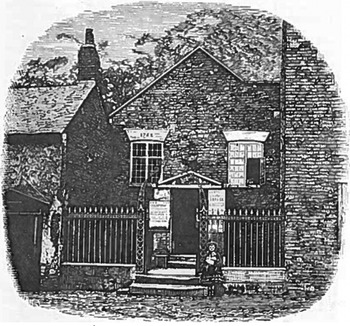
Where Baptists kept birth registers at all, these rarely included fathers’ occupations and only two chapels, in Carmarthen and Llanidloes, provided useable records. Although Baptist chapels with birth registers accounted for a fifth of nonconformist births or baptism recorded in the study areas, they yielded only eight per cent of fathers’ occupations. (See Figure 3 for an example.) Moreover, the absence of occupational data for Baptist and all but one Independent and Presbyterian chapels in Caerphilly meant that occupational data covered only seven per cent of nonconformist baptisms in this important industrial area.
The Old Meeting House, Chester St., Wrexham, one of many Baptist chapels which did not record fathers’ occupations.

5. Anglican and nonconformist occupations
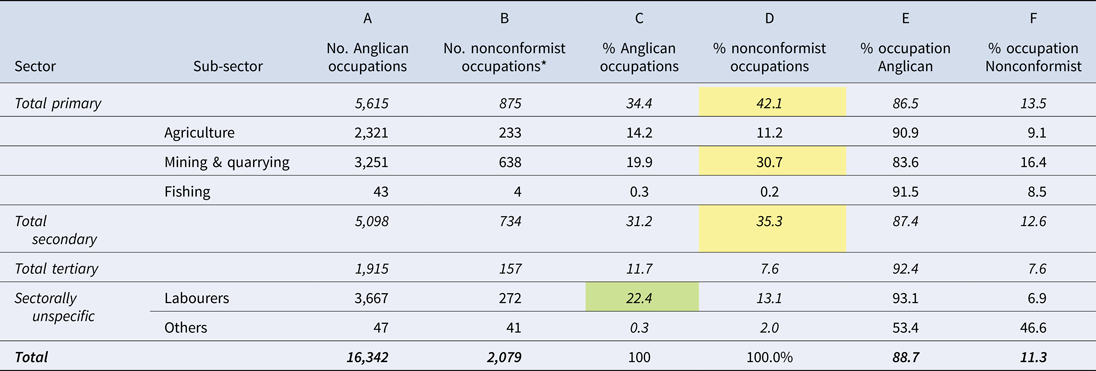
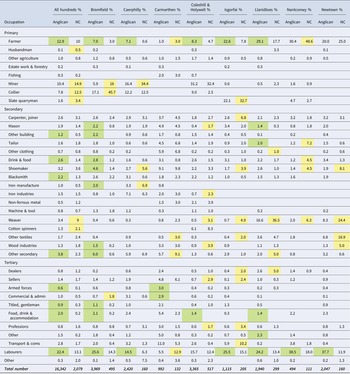
Analysis of the 2,079 useable nonconformist birth and baptism records confirms that there were significant differences between Anglican and nonconformist fathers’ occupations (Tables 3 and 4). There are two ways of comparing Anglican and nonconformist occupations. Religious historians have usually contrasted the distribution of nonconformist occupations with some measure of occupational distribution in the area under analysis (Table 3, columns C and D). This compensates for the absence of occupational data for many nonconformists but can lead to geographic bias if results are aggregated. An alternative method is to compare the percentage of Anglican and nonconformist baptisms within each occupation to the average proportion of Anglican and nonconformists for all occupations in the area concerned. Although the proportion of nonconformists in each occupation is underestimated wherever any chapel registers or occupational data are missing, this method makes it easier to identify occupations where fathers were disproportionately nonconformist (Table 3, columns E and F).
Proportion of Anglican and nonconformist fathers’ occupations by sector in eight Welsh districts, 1813–1820*

Source: Campop database of Anglican fathers’ occupations 1813–20; database of nonconformist fathers’ occupations – see text.
Note: *From chapels with occupational data for 95 per cent of fathers.
Key:  Anglican significantly higher than nonconformist at the 95 per cent confidence level.
 Nonconformist significantly higher than Anglican.
Proportion of Anglican and nonconformist births/baptisms by hundred, 1813–1820

Source: As Table 3.
Key:  Anglican significantly higher than nonconformist at the 95 per cent confidence level.
 Nonconformist significantly higher than Anglican.
Across all eight areas, useable nonconformist birth and baptism records constituted 11.3 per cent of combined Anglican and nonconformist occupational data. Nonconformists were somewhat under-represented in agriculture, 91 per cent of farmers and other clearly identified agricultural workers being Anglican. This higher Anglican propensity among farmers was significant in five hundreds, reflecting the fact that dissent was still gaining strength in many rural areas of Wales. In Nantconwy by contrast, farmers accounted for 30.4 per cent of Anglican but half of nonconformist baptisms. This hundred had the highest proportion of useable nonconformist occupational data, at 18.3 per cent of all baptisms. Dissent could hardly have made such inroads without attracting a substantial proportion of farmers, the largest occupational group in the area after labourers.
As suggested by Gilbert and Watts, miners and colliers proved significantly more likely than average to be nonconformist: these two occupations accounted for 62 per cent of nonconformist baptisms in Bromfield, but only 23 per cent of Anglican, while in Caerphilly the relative proportions were 47 per cent and 29 per cent. Miners and colliers initially appear to be more strongly Anglican in Coleshill and Holywell, constituting 40 per cent of Anglican but only 35 per cent of nonconformist baptisms, though missing Wesleyan data may have skewed this finding.Footnote 44 Slate quarrymen were also significantly more likely to be nonconformist in Isgorfai, despite the late spread of nonconformity to the large quarrying parish of Llanberis.
Secondary sector workers were slightly more likely than average to be nonconformist, constituting 35.3 per cent of nonconformist compared to 31.2 per cent of Anglican baptisms; the difference was significant in Carmarthen, Coleshill and Holywell, Isgorfai, Llanidloes, Nantconwy, and Newtown. Weavers in particular were over twice as likely to be nonconformist than other craftsmen and industrial workers: 25.1 per cent of weavers were nonconformist compared to an average of 12.6 per cent for male secondary sector workers as a whole. While handloom weavers were to be found in all areas, the major concentration of male textile workers, including carders, spinners, dyers, fullers and manufacturers, occurred in the woollen industry districts of Newtown and Llanidloes. In both hundreds, textile workers accounted for over 41 per cent of nonconformist baptisms, compared to 15.1 per cent of Anglican in Newtown hundred and 20.2 per cent in Llanidloes. Caernarfonshire supported a small woollen industry serving a local market, as well as providing yarn for the Merioneth woollen industry and to the female hand knitters of Nantconwy.Footnote 45 Nonconformists constituted a majority of textile workers in Isgorfai, and 41 per cent of weavers in Nantconwy, but there was no significant difference in the religious affiliation of cotton spinners in Coleshill and Holywell. Secondary sector workers therefore emerge as more strongly nonconformist in areas dominated by woollen textile manufacturing, or where nonconformity was fairly strong overall, as in Carmarthen, Isgorfai and Nantconwy.
There was considerable variation in the religious affiliation of other trades. Blacksmiths and workers in drink and food showed an Anglican propensity across the whole sample, though differences were not usually significant at hundred level. Shoemakers featured as disproportionately nonconformist in four of the hundreds. There were many localised differences, such as a higher percentage of nonconformist ironworkers in Caerphilly, and among iron, lead and copper workers in Coleshill and Holywell than in Bromfield. The apparent Anglican strength among Bromfield ironworkers may however have resulted from missing data for three quarters of the nonconformist chapels in the iron-working area. These localised differences in the strength of dissent in particular occupations might therefore reflect the occupational pattern in towns where Old Dissent and Wesleyan Methodism had gained a foothold, allied to the later spread of nonconformity into remoter rural areas, or could be affected by missing records or occupational data.
Tertiary sector workers constituted a significantly higher proportion of Anglican baptisms in Bromfield, Caerphilly and Nantconwy. Across the whole study area, gentlemen, those in the armed forces or engaged in the hospitality trades, were disproportionately Anglican. Professions emerged as more strongly nonconformist, largely due to the number of nonconformist ministers and schoolmasters. Dealers too were more likely to be nonconformist: these were mainly drapers associated with the mid-Wales woollen industry and Caernarfon merchants. Sailors around the port of Caernarfon in Isgorfai, were also strongly nonconformist, associated with the town's earliest dissenting chapel, Bangor Street Independent. Data from this chapel was excluded from the main analysis because less than 95 per cent of fathers’ occupations were recorded, but they do show that at least 44 per cent of Isgorfai mariners, and all its ships’ captains, used nonconformist baptism. This case also highlights how certain groups might cluster in particular chapels, resulting in some important occupations being under-counted where records of those chapels are missing or do not adequately record fathers’ occupations.
Labourers were significantly more likely than any other occupation to be found in parish registers at this period, comprising 22 per cent of Anglican baptisms but only 13 per cent of nonconformist. This reinforces earlier findings from Nantconwy that Welsh labourers tended to be late adopters of nonconformity.Footnote 46
5.1. Denominational differences
The relatively low proportion of useable nonconformist occupational records, especially for Baptists and Independents who constituted an estimated 77 per cent of nonconformist baptisms but yielded only 41 per cent of occupational data, means that to derive an estimate of the total occupational structure, we still need to make assumptions about ‘missing’ nonconformist fathers’ occupations. But should these be extrapolated from known Anglican plus nonconformist baptisms, from known nonconformist baptisms, or by some other method? This could be influenced by whether there were significant differences between denominations with a high proportion of occupational records (Calvinistic Methodists and Wesleyans) and those with a low proportion (Baptists and Independents).
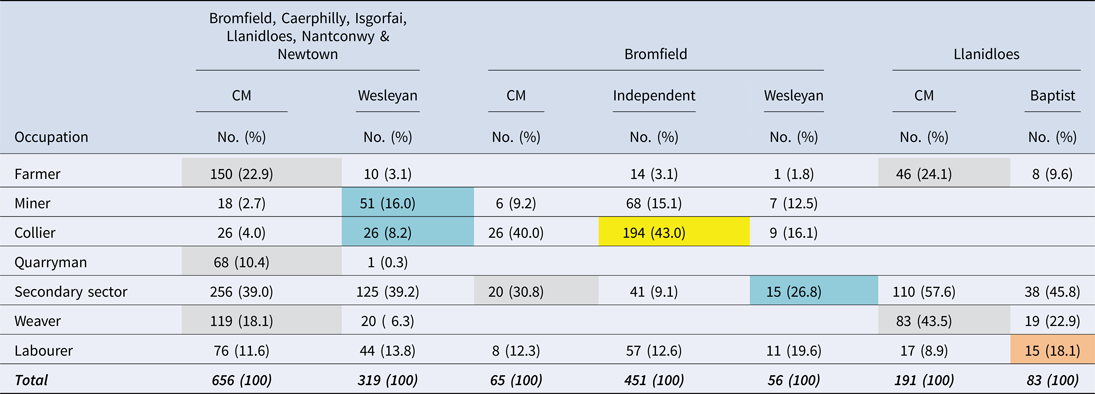
To test the significance of denominational differences, three groupings met the requisite criteria of no missing chapels and virtually complete occupational records. Calvinistic and Wesleyan Methodists could be compared across six hundreds; Baptists with Calvinistic Methodists in Llanidloes, and Independents with Calvinistic Methodists and Wesleyans in Bromfield (Table 5).
Differences between nonconformist denominations for major occupations, 1813–1820

Source: database of nonconformist fathers’ occupations.
Note: shaded denomination significantly higher proportion of baptisms than other denomination(s) at 95 per cent confidence level.
The results supported Watts’ finding that Welsh farmers were significantly more likely to be Calvinistic Methodist members or adherents. Weavers and quarrymen were also more likely to be Calvinistic Methodist than Baptist or Wesleyan. Miners and colliers on the other hand were more likely to be Wesleyan than Calvinistic Methodist, but were strongest among the Independents of Bromfield, though we do not know their strength among the Baptists. In Bromfield, Independents were significantly less likely to work in the secondary sector than Calvinistic Methodists and Wesleyans. In Llanidloes hundred, labourers were more likely to be Baptist than Calvinistic Methodist, but elsewhere, denominational differences in the proportion of labourers were not significant.
The implications of these denominational differences are that while extrapolating from known nonconformist data may not give a completely accurate picture, differences between Anglicans and nonconformists are likely to be confirmed, or if anything under-estimated. The low proportion of farmers among Baptists and Independents implies that this occupation may have been even more strongly Anglican than the study suggests. The strong tendency for miners and colliers to be Independents in Bromfield suggests that they were probably more heavily nonconformist than the available data reveals. The propensity for weavers to be Calvinistic Methodist (the denomination with very good occupational records) reinforces the finding that this occupation was strongly nonconformist, while the general absence of significant differences between denominations among labourers tends to confirm their strong Anglican bias. Extrapolation for missing nonconformist data has therefore been calculated based on known nonconformist data.
6. Impact of missing nonconformist occupational data
Because occupational data was available for only 36 per cent of estimated nonconformist baptisms and occupations differed to some extent between denominations, two checks were undertaken to evaluate the potential impact of the missing data. Firstly, an attempt was made to reconstruct missing occupations for Nantconwy hundred, where occupations were known for 61 per cent of nonconformist fathers but were missing for most Independent baptisms. Nominal record linkage using earlier Anglican baptisms, land tax, estate rentals, manor court records, and the 1841 census established firm or probable occupations for 83 per cent of missing records.Footnote 47 This increased the proportion of nonconformist occupations in Nantconwy to 92 per cent.
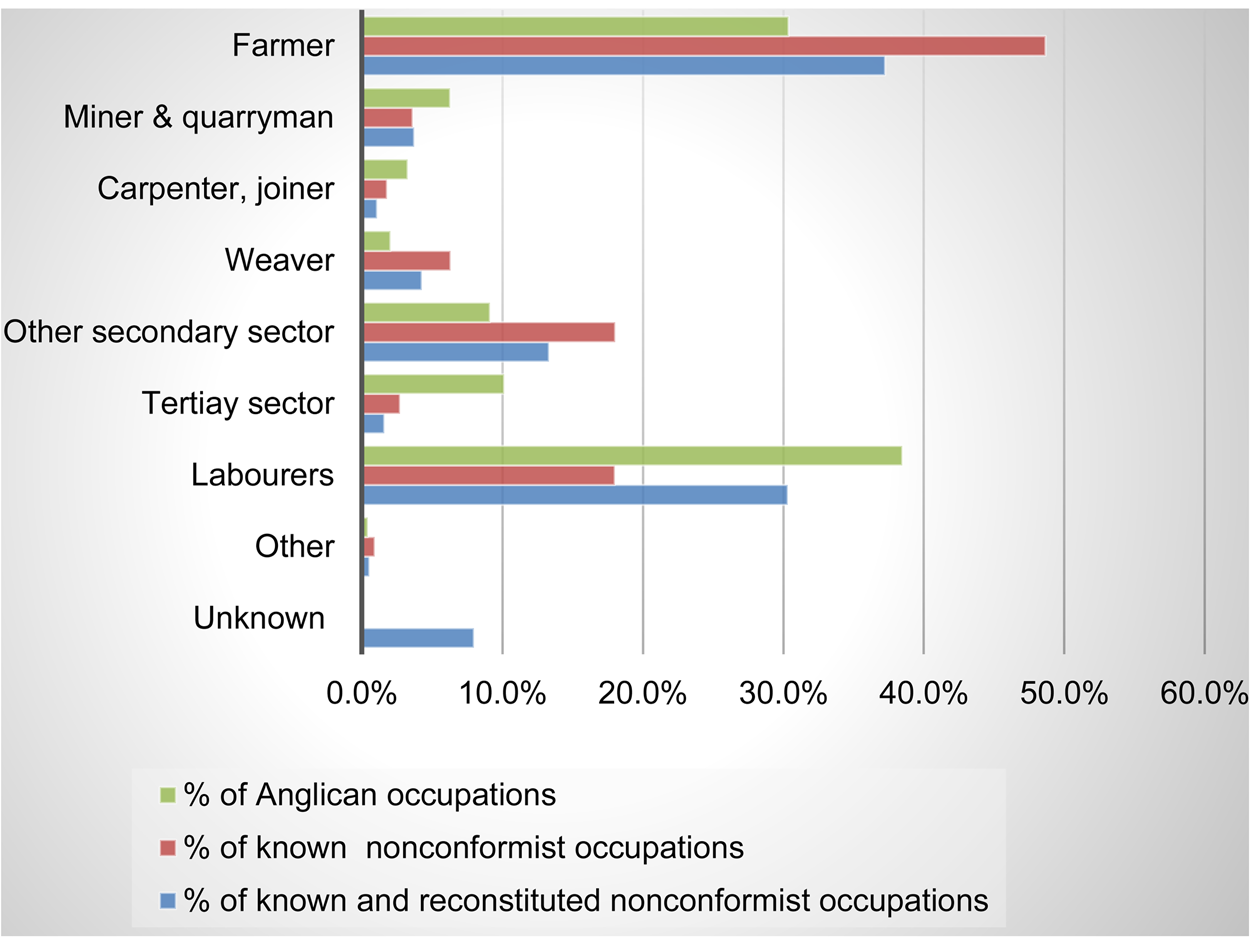
The impact of adding reconstructed Independent occupations was that differences between Anglican and nonconformist occupations were generally in the same direction but were less marked (Figure 4). Most notably, the proportion of nonconformist farmers decreased – a product of their greater strength among Calvinistic Methodists – and the proportion of labourers, who were more strongly Independent, increased. Nevertheless, tertiary sector workers and labourers remained significantly more likely to be Anglican. It is not clear whether Nantconwy's experience would have wider implications – in Bromfield for example, the proportion of labourers did not differ significantly between Independents, Calvinistic Methodists and Wesleyans (Table 5).
Impact of Nantconwy reconstructed occupations.
Source: See Table 1 for Nantconwy nonconformist chapel records; for reconstructed occupations, 1841 census and see endnote 48.

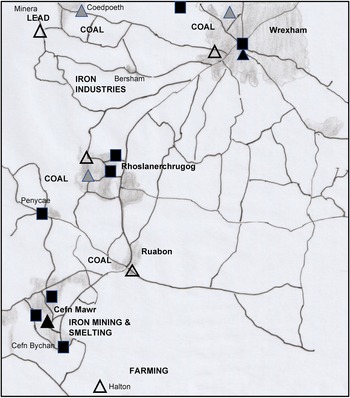
The second check involved mapping the geographic distribution of chapels without useable occupational records, to see whether they were located in areas likely to have a different occupational structure from other denominations. This was done for Bromfield, where occupational records for Calvinistic Methodists, Independents and Wesleyans were fairly good, but there was no data for Baptists who constituted around a third of the hundred's nonconformists. Figure 5 shows nonconformist chapels concentrated in the centre of the market town of Wrexham and in the outlying mining and industrial districts, with only one small chapel in an agricultural area of the hundred. Baptist chapels were largely in the same areas as other nonconformist chapels, although the denomination predominated in the south-western iron mining and smelting area around Cefn Mawr.
Distribution of nonconformist chapels in Bromfield hundred.
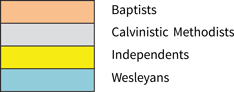
Key: Chapels with occupational records:  Calvinistic Methodist,
 Independent,
 Wesleyan Chapels without occupational records:
 Baptist.

This geographic distribution implies that the strength of nonconformity among colliers and miners may have been even higher than the known occupations suggest – 25 per cent of men in these occupations were nonconformist compared to 11 per cent of fathers overall. If for example the proportion of miners and colliers was the same among Baptists as for other nonconformists, the initial Campop estimate based on scaling up Anglican occupations would under-estimate the number of miners and colliers in Bromfield by about a quarter. Conversely, farmers and labourers were likely to emerge as even more strongly Anglican and therefore be over-estimated in Campop estimates. Furthermore, the absence of Baptist data probably resulted in a significant under-estimation of the strength of nonconformity and overall number of men employed in the iron-working district.
In the case of Nantconwy therefore, addition of ‘missing’ Independent fathers’ occupations reduced but did not eliminate the differences between Anglican and nonconformist occupations. In Bromfield on the other hand, it appears from the location of Baptist chapels that their missing occupations would have increased differences between Anglicans and nonconformists. The area most lacking in occupational data was Caerphilly hundred, where although around 60 per cent of baptisms were nonconformist, only 9 per cent had records of father's occupation. Dissenting chapels in the hundred were clustered in the coal and ironworking districts in and around Merthyr Tydfil, so it is likely that the missing occupations would have reinforced the tendency for miners and ironworkers in Caerphilly to be nonconformist.
7. Potential impact on the adult male occupational structure of Wales
Given the finding that there were indeed significant differences between nonconformist and Anglican adult male occupations c.1817, it is worth assessing how the occupational structure of Wales as a whole might be affected if the ratios of nonconformists to Anglicans in each occupation were similar throughout the country to those in the sample areas. To demonstrate the potential impact of adding nonconformist occupations to Campop's Anglican data, two working assumptions were made: firstly that missing nonconformist data from the study area followed the same pattern as known nonconformist occupations. The second assumption is that the proportion of nonconformists in different occupations across Wales was similar to the sample.Footnote 48 This estimate of nonconformist occupations equalled the 24 per cent of baptisms missing from Anglican registers across Wales. It should be stressed however that these are very broad estimates, given the uncertainties described above about how missing nonconformist occupations might vary from the known.
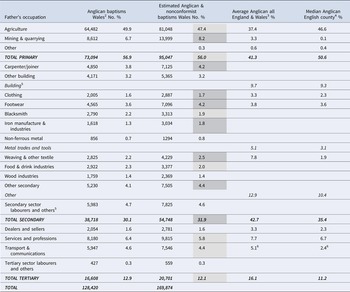
Summary results are shown in Table 6. The main impact of including nonconformists was to increase the share of mining and quarrying from 6.7 per cent to 8.2 per cent of adult male occupations for the whole of Wales. Mining copper, iron, lead or coal was widespread across north-east and south Wales, Cardiganshire, Anglesey, and the Conwy valley. By contrast, the significant proportion of nonconformist weavers and other textile workers made comparatively little difference to the occupational structure of Wales as a whole because textiles employed relatively few men outside the sample hundreds of Newtown and Llanidloes. The other main change, stemming from labourers being generally late adopters of nonconformity, was to reduce the proportion of labourers from 32.4 per cent of Anglicans to 28.8 per cent of all fathers. It is estimated that 86 per cent of Welsh labourers worked in agriculture.Footnote 49 As the proportion of men unambiguously working in agriculture (mainly farmers) remained unchanged by adding nonconformist data, the lower proportion of nonconformist agricultural labourers resulted in the overall proportion of men working in Welsh agriculture being lower than Anglican data alone would imply.
Potential differences to Welsh adult male occupational structure 1813–1820 with inclusion of nonconformist baptisms and comparison with all England and Wales1

Source: Palmer, Wrexham.
Notes: 1Labourers and others allocated to sectors using Keibek's estimation for Wales of 85% of labourers in agriculture, 14% in the secondary sector, and 1% in the tertiary sector.
2 Campop database of Anglican fathers’ occupations 1813–20.
3 Keibek, ‘Male occupational structure’, 152.
4 Ibid., Appendix B.
5 Keibek allocated secondary and tertiary sector labourers to more detailed occupational groups. Nearly half of secondary sector labourers were in building.
6 Keibek excluded sailors.
Key:  Estimated Anglican and nonconformist baptisms significantly lower than Anglican figures at the 95 per cent confidence level.
 Estimated Anglican and nonconformist baptisms significantly higher than Anglican figures at the 95 per cent confidence level.
8. Initial outline of the Welsh economy c.1817
So, what can the estimated figures for Anglican and nonconformist adult male occupations tell us about the Welsh economy in the 1810s? Of course, baptism and birth records tell us nothing about the employments of unmarried men, youths, women, or children, so afford only a partial portrayal of the whole economy. It is nevertheless worth taking stock, not least because previous economic, county and local histories often draw attention to new or unusual sectors but may underplay the level of continuity.Footnote 50
The picture that emerges is of a largely traditional economy dominated by agriculture and local crafts, with some locally important proto-industries and the beginnings of a modern industrial sector in a few compact areas. At first glance, comparisons with England suggest a less developed economy. However, average occupational shares for the whole of England are often dominated by a few districts: for example, Lancashire and Yorkshire West Riding for textiles, Leicestershire and Nottinghamshire for clothing (especially framework knitting), the Black Country for metalwork and tools, or London for dealers and sellers, services and professions. Median county figures afford a more generalised picture of the economy of England c.1817 (Table 6). On this comparator, Wales exhibited less regional specialisation than English counties. Agriculture remained the dominant Welsh sector, employing an estimated 47.4 per cent of the adult male population, close to the median English county. Welsh mining and slate quarrying were growing in importance, employing an estimated 8.2 per cent of adult men. This was as yet a lower proportion than major English mining areas such as Cornwall, the north-east, or the north-west midlands: Welsh coal-mining had yet to reach the dominant position achieved in the second half of the nineteenth century, while slate quarrying which became a prominent industry in north west Wales was still in its infancy.
The Welsh secondary sector employed a lower proportion of men than in England, though its share was higher than a third of English counties. The modern industrial sector was still very small in the 1810s. The basic metal industries often regarded as synonymous with the industrial revolution in Wales – iron, copper and tinplate manufacturing – were at the forefront of technological improvement.Footnote 51 But metal manufactures as yet employed only 4.5 per cent of Welshmen, of which traditional blacksmiths accounted for 1.9 per cent. Holywell in Flintshire was an isolated beacon of industrialisation. In addition to its coal and lead mines, the parish made use of an inexhaustible stream issuing from St Winifred's Well to drive four cotton-spinning factories, two copper-rolling mills, brass-making works and foundry, a copper-wire mill and a copper forge.Footnote 52 242 baptisms were for fathers working in the cotton industry, mostly as spinners using Arkwright's water frame or Compton's mule, though the number of women and children employed by the Holywell cotton mills was around eight times the number of men – a reminder that adult male employment does not always convey the full importance of some industries.Footnote 53
Proto-industry – manufacturing for national or international markets before factory industrialisation – provided significant male employment in some areas. Although weavers, who constituted 3.4 per cent of Anglican and 9 per cent of Nonconformist fathers’ occupations, were found in 418 parishes throughout both urban and rural Wales serving local markets, Montgomeryshire and south Denbighshire were the major centres for the proto-industrial production of woollen cloth. By the late-eighteenth century, more independent weavers were seeking to make a living from woollen manufacture, especially flannels, rather than manufacture as an adjunct to farming. In the 1810s, Montgomeryshire was home to 31.7 per cent of Wales’ weaver fathers, with a further 6.4 per cent in Denbighshire. The transition to factory industrialisation which began with the water-powered mechanisation of willying, carding, slubbing and spinning in the 1790s, can be traced in the baptism records as men to some extent ousted women in spinning work through the introduction of larger spinning jennies.Footnote 54 There were 192 male spinners and slubbers throughout Wales in the Anglican baptism records 1813–1820, (and probably another third nonconformist), over three quarters of whom worked in Mongomeryshire, and most of the rest in the Merioneth and Denbighshire. Outside the main woollen manufacturing districts, spinning remained largely a female hand occupation.
The Welsh secondary sector in the 1810s was largely dominated by traditional craftsmen, mostly serving local markets. Carpenters and joiners formed the largest and most widespread group, found in 72 per cent of parishes and representing an estimated 4.2 per cent of both Anglican and nonconformist baptisms. Shoemakers came a close second, also employing an estimated 4.2 per cent of fathers and present in 68 per cent of parishes, though higher proportions were often found in county towns and the more fashionable market towns. The new Welsh mining, industrial and their related transport sectors created additional opportunities for certain crafts such as blacksmiths and masons, while county and larger market towns acted as centres for more specialist production including clothing. There was some limited evidence for the regional centres of expertise – hats in Carmarthen and Monmouth, boots at Narberth, Haverfordwest, and Lampeter, stockings and other knitwear at Bala, and pottery in Swansea – mentioned in the 1896 Report of the Royal Commission on Land. The report claimed that ‘sixty or seventy years ago most of the chief towns of Wales had some special industry of their own that gave employment to a large proportion of their inhabitants’.Footnote 55 The numbers involved turn out to be modest: concentrations of hatters were indeed found in Carmarthen (5 per cent of fathers), as well as Narberth, Pembrokeshire (6 per cent). Swansea had developed a small pottery industry which was organised on similar lines to Wedgewood in Staffordshire but accounted for just 48 Anglican baptisms from 1813 to 1820.Footnote 56 But the locally important stocking-knitting proto-industry around Bala in Merioneth and extending into south-east Caernarfonshire left few traces in the baptism records, as knitting was mainly undertaken by women and children, or by men as a by-employment, while dealing was largely dominated by ‘Welsh hosiers’ from England.Footnote 57
The Welsh tertiary sector was considerably less well developed than its English counterpart. The proportion of Welsh dealers and sellers (1.6 per cent) was well below the median English county (2.3 per cent), evidence of the late growth of shops in Wales given its low level of urbanisation.Footnote 58 It appears that many customers still bought much of their food in the market, and shoes, clothing and other goods direct from local craftsmen and women. The under-development of professional services reflected the continued dominance of English border towns and cities – Bristol, Shrewsbury and Chester – in serving a Welsh clientele.Footnote 59 Transport was dominated by mariners, a product of Wales’ long coastline, the importance of coastal shipping for both agriculture and commerce, and the additional demands created by the emerging mining and industrial sectors.
9. Conclusions and discussion
This study has developed a new methodology for estimating the number of nonconformist births and baptisms and fathers’ occupations, taking into account chapels without surviving records or where occupations were not consistently recorded. It reveals that by 1813–1820, births and baptisms to nonconformist fathers formed a significant proportion of all Welsh baptisms, constituting around 27 per cent in the eight study areas, close to the estimated average for Wales. It has revealed significant differences between the occupations of Anglican and nonconformist fathers in major sectors of the Welsh economy. Confirming earlier findings by historians of nonconformity, colliers, miners, weavers and other textile workers emerge as strongly nonconformist, while labourers and most tertiary sector workers formed a significantly higher proportion of Anglican fathers. By only taking account of Anglican records, the Campop occupational ‘census’ c.1817 therefore over-estimates the proportion of Welshmen working in agriculture and the tertiary sector, and under-estimates mining and secondary sector employment, especially the woollen industry. If results from this 14 per cent sample held good across Wales, the major differences would be to increase adult male employment in mining and quarrying from 6.7 to 8.2 per cent, and to reduce the proportion of labourers by 3.7 per cent. At a local level, the impact of nonconformists missing from parish records is considerably greater. The number of weavers and other textile workers in Newtown and Llanidloes hundreds may for example have been under-estimated by some 15 per cent, and miners and colliers in Bromfield by a quarter.
These findings demonstrate the importance of supplementing occupational data from parish records with estimates of nonconformist births and baptisms. This is especially important in Wales where the level of nonconformity was considerably higher than in England but is also relevant in English areas of high nonconformity. For example, Old Dissent was strong in west country woollen manufacturing areas and across much of the east midlands and southern East Anglia, including several areas of low Anglican baptismal rates, while Methodism took root in important mining and industrial areas such as Cornwall, Cheshire, Derbyshire, Durham, Northumberland and Yorkshire.Footnote 60 Further research complementing this study for areas of high nonconformity in England would therefore be highly desirable. Inclusion of nonconformist occupations is particularly important in studies of sectors with a strong tradition of dissent, such as mining and woollen textiles. Given that labourers formed the largest group of adult male workers (29.5 per cent of Anglican fathers in England and Wales), this study's confirmation that labourers formed a significantly lower proportion of nonconformists has important implications for the occupational structure of England, suggesting that agricultural employment here was also lower than the Anglican figures alone would suggest.
This study also prompts some wider questions about English demographic studies based on Anglican parish registers. For example, in calculating the population history of England, Wrigley and Schofield made some allowance for missing nonconformist baptisms, especially after 1780, based on nonconformist registers deposited with the Registrar General. For the 1810s, they estimated that nonconformist baptisms were 5.45 per cent of Anglican baptisms.Footnote 61 This estimate can now be seen to make insufficient allowance for missing nonconformist registers, especially among Baptists. Ten per cent of the nonconformist birth and baptism registers found for this study had not been deposited with the Registrar General, while a further 16 per cent of chapels had no surviving register. If a similar proportion of English nonconformist chapels had not deposited a register with the Registrar General, the proportion of nonconformist baptisms could increase to around 7.2 per cent of Anglican baptisms, implying a higher birth rate than previously estimated. From a religious history standpoint, a combined Anglican and nonconformist occupational ‘census’ also has the potential to shed important new light on the geographical and social diffusion processes involved in the growth of nonconformity.
The quality of nonconformist baptism data poses a number of challenges however. Although baptism registers were extant for 84 per cent of chapels in the sample areas, occupational data was much better for Welsh Calvinistic and Wesleyan Methodists than for Baptists and Independents. The absence of useable occupational data for nearly two thirds of nonconformist baptisms means that to estimate total occupational structure, occupations of ‘missing’ nonconformist fathers still need to be extrapolated from known data. Extrapolating from combined Anglican and known nonconformist occupations would give undue weight to Anglican employment patterns. Extrapolating from known nonconformist data might also produce inaccuracies, given differences in occupational structure between nonconformist denominations. As the Baptist and Independent chapels with missing data were heavily clustered in coal mining and iron-working areas however, it is more likely that their fathers’ occupations resembled those of known nonconformist than of Anglican fathers.
Several factors appear to have influenced differences in the occupational structure of the four major Welsh nonconformist denominations. Old Dissent – Baptists and Independents – initially built their chapels mainly in towns, where they appealed to some groups of secondary sector workers, and later in industrial districts. In 1813–20, nonconformity was still gaining ground in Wales, with Calvinistic Methodists the newest but fastest-growing denomination. Their strength was mainly in the countryside, where they filled a gap left by Old Dissent, appealing initially to rural weavers, quarrymen and some farmers. Labourers were the last major group to be converted to nonconformity, with relatively little difference between denominations. The findings suggest a pattern of diffusion outward from urban centres, with nonconformity not yet established in all rural areas.
The occupational structure of the Baptists, Calvinistic Methodists, Independents and Wesleyans in different areas of Wales thus reflects a combination of the underlying economy, the propensity of some types of workers to adopt nonconformity before others, the urban and rural strengths of different denominations, and the stage of proselytisation achieved. The paucity of nonconformist occupation data for the industrial heartland of south Wales is regrettable. But despite this, the adult male occupational structure of Wales reveals a more industrialised economy for the period 1813–1820 than previously thought, once nonconformist occupations are taken into account.