Cohen Kadosh & Walsh (CK&W) revive a twenty-year-old proposal in numerical cognition, according to which our capacity for abstract mathematical thought results from a complex interaction of multiple concrete notation-specific codes (Campbell & Clark Reference Campbell and Clark1988). Their conclusions, unfortunately, result from discarding of solid empirical evidence supporting a convergence of notation-specific representations onto a shared representation of numerical magnitude, in favor of weak evidence for notation effects. Thus, their article consists in a catalogue of findings in which any difference or interaction involving number notation is taken as strong support for the notation-specific view. In this commentary, I first return to the evidence for notation-independent representations, then discuss interesting reasons why notation occasionally influences brain and behavior.
Evidence for notation-independent number processing
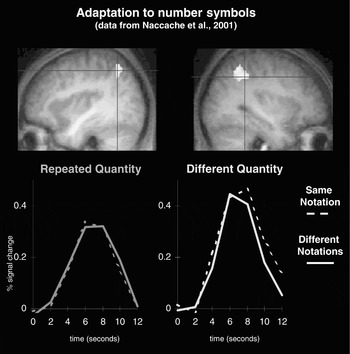
CK&W cite, but do not seem to draw conclusions from, the many functional magnetic resonance imaging (fMRI) studies that have observed shared fMRI activations across different notations for numbers. Most important, are studies showing cross-notation fMRI adaptation, because they cannot be dismissed as just showing activation overlap, or as resulting from artifacts of response selection (Jacob & Nieder Reference Jacob and Nieder2009; Naccache & Dehaene Reference Naccache and Dehaene2001a; Piazza et al. Reference Piazza, Pinel, Le Bihan and Dehaene2007). As an example, extending earlier work by Piazza et al. (Reference Piazza, Pinel, Le Bihan and Dehaene2007), Jacob and Nieder (Reference Jacob and Nieder2009) recently demonstrated that after adaptation to a fraction expressed with Arabic numerals (e.g., 1/2), anterior intraparietal sulcus (IPS) shows a distance-dependent transfer of adaptation to number words (e.g., half). As a second example, Figure 1 replots the data in Naccache and Dehaene (Reference Naccache and Dehaene2001a), showing that IPS activation is reduced whenever the same numerical quantity is repeated, regardless of whether notation is changed (Arabic digits vs. number words). Note that in this experiment, the first presentation of the number was subliminal, and yet the results showed clear cross-notation convergence. In general, it is surprising that CK&W do not cite the extensive behavioral literature on subliminal priming demonstrating clear notation-independent effects (e.g., Dehaene et al. Reference Dehaene, Naccache, Le Clec'H, Koechlin, Mueller, Dehaene-Lambertz, Van de Moortele and Le Bihan1998b; Reynvoet & Brysbaert Reference Reynvoet and Brysbaert2004; Reynvoet et al. Reference Reynvoet, Brysbaert and Fias2002). Even cross-modal subliminal priming was recently demonstrated, from a subliminal Arabic numeral to a conscious spoken numeral (Kouider & Dehaene, in press). These effects argue directly against CK&W's proposal that when numerical representations are probed implicitly, convergence across notations does not occur.
Evidence for cross-notation subliminal priming and access to a shared representation of Arabic and verbal numerals. Naccache and Dehaene (Reference Naccache and Dehaene2001a) presented a subliminal prime prior to each target number in a number comparison task. Using whole-brain fMRI, repetition suppression was observed only in bilateral intraparietal cortex: Trials in which the primes and targets corresponded to the same quantity yielded reduced activation compared to trials in which the quantities differed. Response times were also accelerated by subliminal repetition. In both fMRI and behavior, it made no difference whether the prime and the targets appeared in the same or different notations. Reynvoet et al. (Reference Reynvoet, Brysbaert and Fias2002) later expanded this work by showing that the amount of priming in response times varies continuously as a function of the numerical distance between the prime and target.

Equally impressive are electrophysiological studies showing that some single neurons, particularly in prefrontal cortex, respond identically to symbolic and various non-symbolic displays of number, with the same exact tuning curve across the interval of numbers tested (Diester & Nieder Reference Diester and Nieder2007; Nieder et al. Reference Nieder, Diester and Tudusciuc2006). Astonishingly, CK&W dismiss these beautiful data with the claim that the animals are using a “similar response strategy,” for example, for digit 1 and dot 1 compared to other numbers – not acknowledging the fact that their interpretation would require as many putative strategies as there are numbers!
Returning to fMRI, another method that is likely to play a strong role in the coming years is multivariate decoding, which probes fMRI activation for the presence of decodable patterns and their generalization to novel experimental conditions. Using this technique, with Evelyn Eger (Eger et al., submitted), we recently demonstrated that human IPS signals can be used to decode which number a participant is temporarily holding in mind. When trained with Arabic numerals, the IPS decoder generalizes to dot patterns, indicating the presence of an underlying notation-independent neuronal population. Likewise, with André Knops (Knops et al. Reference Knops, Thirion, Hubbard, Michel and Dehaene2009), we found that a classifier trained with posterior IPS activation during left versus right saccades could spontaneously generalize to a classification of subtraction versus addition trials, whether these calculations were performed with non-symbolic sets of dots or with symbolic Arabic numerals.
The concept of “abstract representation” is never defined by CK&W, and here the Knops et al. (in press) findings point to an important theoretical point: A representation may be shared across numerical notations, and yet rely on a spatial, non “abstract” format of representation. Knops et al. show that the putative human homolog of monkey area LIP, a retinotopic region involved in attention and eye movement, is partially co-opted for symbolic and non-symbolic arithmetic on the number line – a clear instance of “cortical recycling” of a sensorimotor area for a more abstract mathematical use (Dehaene & Cohen Reference Dehaene and Cohen2007).
Interesting reasons why number notation occasionally influences brain and behavior
If numbers presented in various notations contact unified representations of magnitude and space, then why are significant notation effects occasionally observed? Several explanations can be proposed, none of them requiring a hasty dismissal of notation-independent representations.
1. Numerical precision. Neural network simulations suggest that the introduction of symbolic representation can lead to a refined precision of the tuning curves for number (Verguts & Fias Reference Verguts and Fias2004). Importantly, according to this view, the same neurons remain responsive to both symbolic and non-symbolic presentations – only their accuracy changes. Mathematical developments of this theory (Dehaene Reference Dehaene, Haggard and Rossetti2007) suggest that it has the potential to explain many of the known effects of education to symbols on mental arithmetic, including the linearization of number-space mappings (Dehaene et al. Reference Dehaene, Izard, Spelke and Pica2008; Siegler & Opfer Reference Siegler and Opfer2003), the improved accuracy with which Arabic numerals can be compared or combined into calculations, and the spontaneous competence of young children when symbols are first introduced (Gilmore et al. Reference Gilmore, McCarthy and Spelke2007) – an effect hard to explain without assuming cross-notation convergence.
2. Speed and automaticity. There is no reason to expect all number notations to be equally fast and automatic in accessing the shared magnitude representation. On the contrary, identification is slower for number words than for Arabic numerals. In number comparison, interactions between the distance effect and the verbal versus Arabic notation of the targets can be attributed to a word-length effect unique to written words (Dehaene Reference Dehaene1996). Education and over-training also play a role – as children get older, increasingly automatic effects of numerical magnitude are seen, particularly with Arabic numerals (Girelli et al. Reference Girelli, Lucangeli and Butterworth2000). These notation effects occur at a perceptual or transcoding level and are largely irrelevant to the existence of a shared central representation for number.
3. Neural machinery for transcoding. In the course of converting from a notation-specific neural code to a numerical magnitude code, it is likely that the brain requires special neural machinery, possibly including neurons that are attuned to both quantity and notation. Indeed, in parietal cortex, neurons with a joint sensitivity to multiple parameters (e.g., eye position and retinal location) are frequently recorded and are thought to play a compulsory role in transcoding to and from pure representations of each parameter (Pouget et al. Reference Pouget, Deneve and Duhamel2002). Similarly, neurons simultaneously tuned to both numerical magnitude and notation (e.g., simultaneous dots vs. serial flashes [Nieder et al. Reference Nieder, Diester and Tudusciuc2006]; or dots versus Arabic symbols [Diester & Nieder Reference Diester and Nieder2007]) may play a key role in accessing a common magnitude representation via different routes. Identifying the numerosity of a set of dots may require special neural machinery for summing size-invariant representations of object locations (Dehaene & Changeux Reference Dehaene and Changeux1993), potentially explaining both the existence of neurons monotonically tuned to non-symbolic numerosity in area LIP (Roitman et al. Reference Roitman, Brannon and Platt2007) and the specific form of behavioral priming observed with dots compared to Arabic numerals (Roggeman et al. Reference Roggeman, Verguts and Fias2007).
Conclusion
Considerable evidence points to a notation-independent representation of number in the monkey and human IPS. It would, however, be wrong to think of this representation as a “module.” First, it does not involve a dedicated area, but only a fraction of IPS neurons, highly distributed in the IPS, and intermingled with other representations of extent, time, location, and other continuous parameters (Pinel et al. Reference Pinel, Piazza, Le Bihan and Dehaene2004; Tudusciuc & Nieder, Reference Tudusciuc and Nieder2007). Second, it is not “encapsulated,” but communicates broadly with other areas, thus allowing humans to attach arbitrary spoken and written symbols to it. Because it acquires its “abstract” character, in large part, through education to number symbols, it is not surprising that notation effects are occasionally seen. Such effects should not divert from the incontrovertible fact that arithmetic, like much of mathematics, consists in the manipulation of internal conceptual representations that abstract away from the specific format of input.