INTRODUCTION
Invasive species play an important role in the ecosystem function and structure. The ecological and economic impact generated is often irreversible and its severity generally increases throughout time (e.g. Raaymakers, Reference Raaymakers2003). In the last few decades, the species introduction rate has increased worldwide causing dramatic effects in biological diversity, productivity, habitat structure, fisheries, aquaculture and agriculture extending its effects to socio-economic impacts (Carlton, Reference Carlton, Sandlund, Schei and Vicken1999; Bax et al., Reference Bax, Carlton, Mathews-Amos, Haedrich, Howarth, Purcell, Rieser and Gray2001; Doelle et al., Reference Doelle, McConnell and VanderZwaag2007). Displacement of native species through competition, predation and alteration of the invaded habitat are among the main effects of a biological invasion (e.g. Carlton et al., Reference Carlton, Thompson, Scheme and Nichols1990). The invasive organisms can alter the diversity and abundance of associated species, generate refuges (e.g. Jones et al., Reference Jones, Lawton and Shachak1997), and in aquatic environments, produce hydrodynamic alterations that influence the food supply and larvae recruitment (Witman & Dayton, Reference Witman, Dayton, Gaines, Bertness and Hay2001).
The introduction of benthic algae is a frequent phenomenon in marine coastal ecosystems (Nyberg & Wallentinus, Reference Nyberg and Wallentinus2005; Williams & Smith, Reference Williams and Smith2007). They generate an additional three-dimensional habitat that would favour the development of other organisms by protecting them from predators and physical stress. It also increases the abundance and diversity of associated species (Menge, Reference Menge1976; Eckman et al., Reference Eckman, Duggins and Sewell1989; Bertness, Reference Bertness1999; Buschbaum et al., Reference Buschbaum, Chapman and Saier2006). On the other hand, invasive macroalgae can compete with native flora for light and substrate causing its decrease or even local extinction (De Wreede, Reference De Wreede1996; Schaffelke & Hewitt, Reference Schaffelke and Hewitt2007).
The brown kelp Undaria pinnatifida (Harvey) Suringar is one of the five most dangerous invasive seaweed species due to its ecological and economic impact (Walker & Kendrick, Reference Walker and Kendrick1998; Nyberg & Wallentinus, Reference Nyberg and Wallentinus2005). This species range has expanded globally in temperate waters. Native on Japanese, Korean and Chinese coasts, this species has spread to the Atlantic and Mediterranean coasts of Europe (Castric-Fey et al., Reference Castric-Fey, Girard and L'Hardy-Halos1993; Fletcher & Manfredi, Reference Fletcher and Manfredi1995; Curiel et al., Reference Curiel, Bellemo, Marzocchi, Scattolin and Parisi1998; Zenetos et al., Reference Zenetos, Çinar, Pancuci-Papadopoulou, Harmelin, Furnari, Andaloro, Bellou, Streftaris and Zibrowius2005), to New Zealand (Hay & Luckens, Reference Hay and Luckens1987; Russell et al., Reference Russell, Hepburn, Hurd and Stuart2008) and Australia (Sanderson, Reference Sanderson1990; Campbell & Burridge, Reference Campbell and Burridge1998; Valentine & Johnson, Reference Valentine and Johnson2004). In Argentina, U. pinnatifida was introduced in 1992 on the Nuevo Gulf (northern Patagonia, 42°45′S 64°65′W; Casas & Piriz, Reference Casas and Piriz1996) by an unknown vector. It is now expanding rapidly to diverse localities of the Patagonian coast (Casas et al., Reference Casas, Scrosati and Piriz2004; Martin & Cuevas, Reference Martin and Cuevas2006) and is likely producing ecological damage to the diversity of the native flora (Casas et al., Reference Casas, Scrosati and Piriz2004). It also affects the regional economy since the intertidal and subtidal accumulation of seaweed interferes with recreational beach uses (Piriz et al., Reference Piriz, Eyras and Rostagno2003), and the practice of SCUBA diving centred around coastal reef fish communities (A.J. Irigoyen, personal communication). Direct competition between U. pinnatifida and canopy-forming marine algae such as Macrocystis pyrifera (Linnaeus) C. Agardh, Ecklonia radiata (C. Agardh) J. Agardh and Carpophyllum maschalocarpum (Turner) Greville, is likely to favour established species in stable environments (Stuart, Reference Stuart2003). However, U. pinnatifida may be able to cohabit with, or even exclude such species in environments that are subject to regular storm events or moderate grazing pressure. Furthermore, the establishment of a dense canopy of U. pinnatifida would likely lead to the exclusion of plant subcanopy and undercanopy species and a reduction in biodiversity (Stuart, Reference Stuart2003).
On the Patagonian coasts, U. pinnatifida has annual cycles with maximum growth and production during spring–summer (Casas & Piriz, Reference Casas and Piriz1996). Macrocystis pyrifera is perennial in much of the southernmost localities (Kühnemann, Reference Kühnemann1970; Hall & Boraso de Zaixso, Reference Hall and Boraso de Zaixso1979), but in Cracker Bay (42°56′S 64°27′W; Nuevo Gulf, Argentina), near the northern limit of the species distribution (Kühnemann, Reference Kühnemann1970), it shows seasonal cycles of 7–8 months with recruitment in winter and massive detachments in early autumn. The complete loss of sporophytes of M. pyrifera in Cracker Bay determine a particular annual kelp population, characterized by sporophytes that in summer become all fertile, but with smaller sizes than other southern M. pyrifera populations of the Argentinean coast (sporophytes mean total length in Cracker Bay is 3–4 m; Eyras & Boraso de Zaixso, Reference Eyras and Boraso de Zaixso1994; in Camarones Bay, 44°48′S is 5–8 m; Hall & Boraso de Zaixso, Reference Hall and Boraso de Zaixso1979 and in Tierra del Fuego, 53°18′S is 6–10 m; Plana et al., Reference Plana, Mansilla, Palacios and Navarro2007).
Both U. pinnatifida and M. pyrifera have a heteromorphic life history that includes a microscopic gametophytic stage with the potential to act as a perennial seed stock. Thus, kelps' interactions are not limited to the sporophytic stage. Some laboratory experiments suggested that the establishment of each new generation of sporophytes kelps would be influenced by the interactions of spores and gametophytes (Chapman, Reference Chapman2005). Despite the annual population of M. pyrifera in Cracker Bay is not ecologically or functionally comparable to typical kelps it represents a natural situation where U. pinnatifida gametophytes are not growing under the dense canopy of perennial sporophytes of M. pyrifera. In addition, these annual cycles allow the evaluation of the same age-class sporophytes in both kelp species.
In Cracker Bay, the M. pyrifera population has been invaded by U. pinnatifida since 2001 (A.J. Irigoyen, personal communication). This invasion is likely to be in an intermediate stage but, in a later stage, U. pinnatifida may displace M. pyrifera either partially or completely, thus also affecting the associated biodiversity.
In relation to the communities associated with both M. pyrifera and U. pinnatifida, the pattern of colonization of an invasive seaweed by the local epifauna constitutes a great opportunity to study the degree of specialization, in host utilization in these marine systems. The study of the colonization by epifaunal species may provide insights into the ecology and evolution of plant–herbivore interactions. The degree of host-plant specificity will, moreover, determine the local impact of the invasion on the epifaunal assemblages (Viejo, Reference Viejo1999). Few data are available on the relationship between U. pinnatifida and the associated fauna. Among the principal herbivores, sea urchins and gastropods are the most common, while crabs and fish are found in lesser numbers (Kittaka et al., Reference Kittaka, Nishimura, Yamada and Hayakawa1983; Sinner et al., Reference Sinner, Forrest and Taylor2000; Valentine & Johnson, Reference Valentine and Johnson2003; Thornber et al., Reference Thornber, Kinlan, Graham and Stachowicz2004). Communities associated with M. pyrifera have been thoroughly studied in diverse places of the world (Coyer, Reference Coyer1984; Moreno & Jara, Reference Moreno and Jara1984; Ojeda & Santelices, Reference Ojeda and Santelices1984; Vásquez, Reference Vásquez1993). The holdfast of the kelps has ecological relevance because it gives refuge to the fauna that inhabits them (e.g. protecting the fauna from the tidal impact and predators) and it constitutes recruitment areas (Andrews, Reference Andrews1945; Bayne, Reference Bayne1964; Moore, Reference Moore1978).
Given this background, our general objective is to evaluate the possible effect of the invasion of U. pinnatifida on the M. pyrifera kelp located in Cracker Bay. The specific objectives were: (a) to estimate the density of U. pinnatifida and M. pyrifera sporophytes in the study area; (b) to compare the length and the biomass of M. pyrifera sporophytes in the presence of U. pinnatifida; (c) to establish if each species has a different biodiversity of the fauna and the flora associated with their holdfast; and (d) to compare the biodiversity associated with the bottom in areas where both species have different spatial arrangement.
MATERIALS AND METHODS
Study area
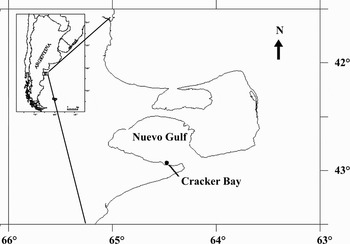
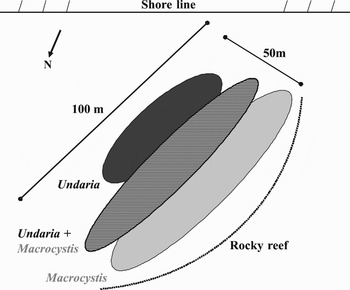
Cracker Bay M. pyrifera forest (Figure 1), is located on top of a high relief rocky reef, and its proximal limit is an area covered by sediments or sand. Mean depth in this area is 8 m (Barrales & Lobban, Reference Barrales and Lobban1975). In summer, the temperature and salinity are around 15°C and 33.7‰ respectively (Campaña Oceanográfica, 1982). An exploratory sampling was made in December 2003 when three areas of spatial distribution of the sporophytes were differentiated, one represented by M. pyrifera (M), other intermediate by M. pyrifera and U. pinnatifida (M+U), and another one that was prevailing U. pinnatifida (U). The surface taken by both kelps was approximately 100 m long and 50 m wide (Figure 2).
Study area. Localization of Cracker Bay in Nuevo Gulf (Argentina).

Spatial distribution areas of Macrocystis pyrifera and Undaria pinnatifida kelps.

Sample design
The sampling was made in March 2004, when most sporophytes of both kelps were at the end of their reproductive cycle. A total of 27 quadrats of 1 m2 (9 in each M, M+U and U areas) were randomly obtained, and all M. pyrifera and/or U. pinnatifida sporophytes attached to the bottom were manually collected by SCUBA divers. Following extraction, the holdfast of each plant was placed in cotton cloth bags in order to avoid the loss of associated fauna and flora. Another 0.25 m2 quadrat was placed between sporophytes into each 1 m2 quadrat and all the organisms attached to the bottom were removed. For both kelps, population, and qualitative–quantitative parameters of fauna and flora associated with the holdfasts and with the bottom were determined. In all statistical analyses the parametric test assumptions were verified first and when they did not comply with the assumptions, non-parametric statistics were used according to recommendation provided by Zar (Reference Zar1999).
Comparison between kelps
Spatial distribution of U. pinnatifida and M. pyrifera in the M, M+U and U areas was determined by sporophytes density per m2. Dry biomass (g m−2) of each species (without holdfast) was determined after drying at 60°C to constant weight. The null hypothesis of no difference in the density and biomass m−2 of the sporophytes of each species between areas was evaluated by the non-parametric Kruskal–Wallis test, and when differences arose, a multiple comparisons test was used (Conover, Reference Conover1980).
Length (cm) of each sporophyte (TL) was measured without holdfast. The null hypothesis of no difference in TL of M. pyrifera and U. pinnatifida sporophytes in the different areas was analysed by the t-test for homogeneous variances (Zar, Reference Zar1999). Size of each holdfast was determined by the total volume (TV), which was estimated by the water volume (ml) displaced by the holdfast (including associate fauna, flora and substratum) wrapped in an auto-adherent PVC film. The null hypothesis of no difference in holdfast size of each species in the different areas and between two species was evaluated by a t-test for homogeneous variances (Zar, Reference Zar1999).
Holdfast and bottom biodiversity
The qualitative analysis of the biodiversity associated with the holdfasts of both kelps and to the bottom was made by the taxonomic identification of individuals. For the quantitative analysis of the flora, the dry weight of each taxon was determined. In the case of the fauna, the abundance (number of individuals) of every taxon above 1000 µm in size was determined.
Species richness (S) was determined for each kelp species as the number of taxa presents in all the existing holdfasts in the 1 m2 quadrat. The abundance of each species was determined by the number of individuals in the case of the fauna and, in the case of the flora, dry biomass (g) of every taxon was recorded. Diversity for each quadrat was determined using the Shannon–Wiener (H′) index (Begon et al., Reference Begon, Harper and Townsend1996). Evenness or uniformity (J) is the tendency towards equality in the individual's distribution of the different species of the community and it was calculated with the Lloyd & Ghelardi expression (Reference Lloyd and Ghelardi1964).
To evaluate the null hypothesis of no difference in the richness, abundance and diversity of the fauna and flora associated with the holdfasts of each species in the different areas and between species the t-test was used (Zar, Reference Zar1999). In cases where it was not possible to use a parametric test, the non-parametric Mann–Whitney U-test was used (Conover, Reference Conover1980). In the case of the bottom biodiversity, the null hypothesis of no difference in richness, abundance and diversity of the fauna and flora associated to each area was evaluated by the non-parametric Kruskal–Wallis test and then by multiple comparisons (Conover, Reference Conover1980).
RESULTS
Comparison between kelps
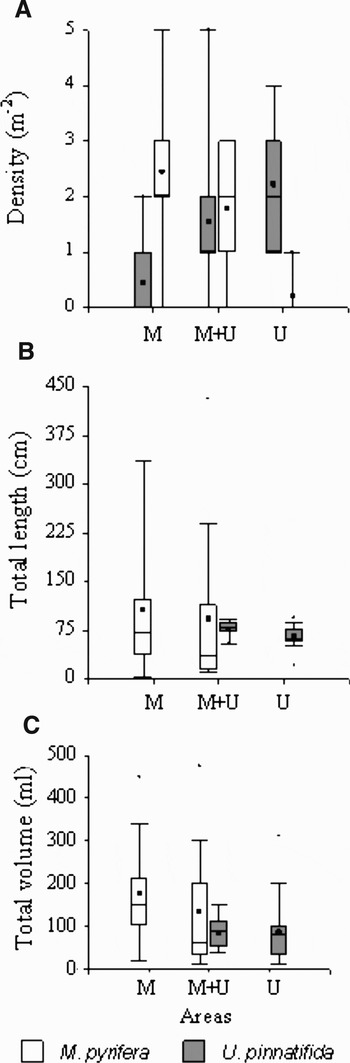
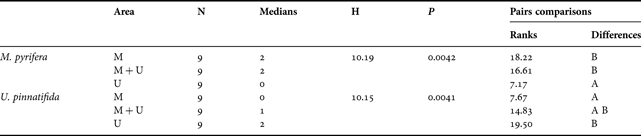
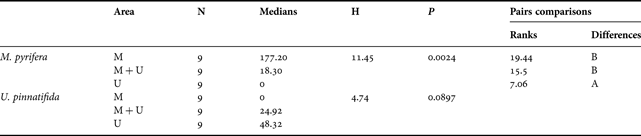
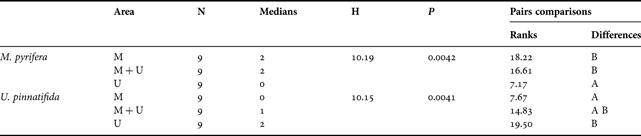
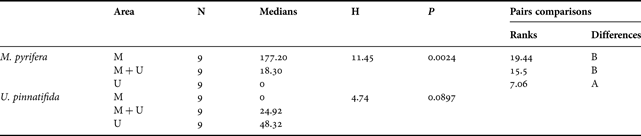
Density of both kelps diminished progressively from its predominant area (Figure 3A). Neither density nor dry biomass of M. pyrifera showed differences between the M area and the M+U area, when it coexists with U. pinnatifida (Kruskal–Wallis test; Tables 1 & 2). Likewise, the density and dry biomass of U. pinnatifida did not differ in presence of M. pyrifera (Kruskal–Wallis test; Tables 1 & 2). Once the three areas of spatial distribution of both kelps were confirmed, only those in which each species was dominant (M or U) and the intermediate (M+U) were analysed, in order to avoid having a low number of samples (Tables 1 & 2; Figure 3A).
(A) Sporophytes density; (B) total length of sporophytes; and (C) holdfast total volume in Macrocystis pyrifera (M), M. pyrifera and Undaria pinnatifida (M+U) and U. pinnatifida (U) areas. Box plot: bars represent standard deviation; the box 75% of the values; the dot inside and the line across the box are the mean and median, respectively and the points outside the box the outliers.

Sporophytes density individuals (m−2) in the areas of Macrocystis pyrifera (M), M. pyrifera and Undaria pinnatifida (M+U) and U. pinnatifida (U) by non-parametric Kruskal–Wallis test (H: statistic of the test, P: α = 0.05) and multiples comparisons. Different letters indicate significant differences between ranks.
Dry biomass (g m−2) of sporophytes in Macrocystis pyrifera (M), M. pyrifera and Undaria pinnatifida (M+U) and U. pinnatifida (U) areas by non-parametric Kruskal–Wallis test (H: statistic of the test, P: α = 0.05) and multiples comparisons. Different letters indicate significant differences between ranks.
The sporophytes of M. pyrifera did not vary their total length (TL) neither did their holdfast size (TV) in the M area compared to the M+U area (TL: t = 0.4; df = 15; P > 0.05; Figure 3B; TV: t = 1.16; df = 26; P > 0.05; Figure 3C). In the case of U. pinnatifida similar results were found when comparing these parameters between the U area, and the intermediate M+U area (TL: t = 1.37; df = 16; P > 0.05; Figure 3B; TV: t = 0.18; df = 25; P > 0.05; Figure 3C). On the other hand, the M. pyrifera holdfasts (x = 157.68; SD = 127.5; N = 28) were larger in size than those of U. pinnatifida (x = 85.67; SD = 64.96; N = 27; t = 2.29; df = 47; P = 0.026).
Holdfast and bottom biodiversity
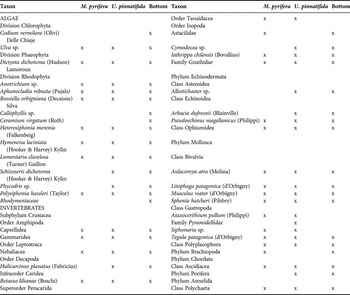
The identification of the fauna and flora showed that the majority of the taxa that were found associated with the holdfasts of both kelps, were also associated to the bottom (Table 3). In the case of the flora most abundant taxa associated with the holdfasts of both species were Bossiella orbigniana and Ulva sp., meanwhile nebaliacea, gammarid amphipods, the bivalve Aulacomya atra and polychaeta were in the case of the fauna.
List of taxa of the flora and fauna associated with the Macrocystis pyrifer a and Undaria pinnatifida holdfast and to the bottom.

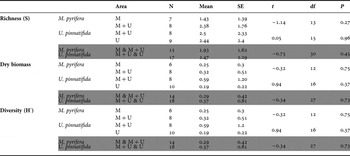
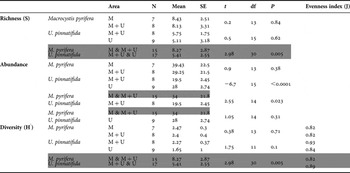
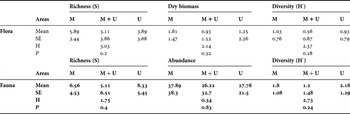
Species richness, dry biomass and diversity of the flora associated with the M. pyrifera holdfasts as well as to those of U. pinnatifida (Table 4) did not differ among the areas where each species dominated and coexisted with the other. The comparison of these parameters between kelps did not show differences. The richness, abundance and diversity (Table 5) did not vary in the different areas where the fauna associated with the holdfasts of each one of the kelps was compared. Nevertheless, the comparison between kelps showed that these parameters were greater in M. pyrifera than in U. pinnatifida whereas evenness was similar.
Comparison by t-test of the richness, dry biomass and diversity of the flora associated to the holdfasts of Macrocystis pyrifer a (located in M and M+U areas) and of Undaria pinnatifid a (located in U and M+U areas). The grey shades correspond to the comparison between kelps species grouping the areas where there were no significant differences.

1M, area represented by M. pyrifera; 2M+U, area intermediate represented by M. pyrifera and U. pinnatifida; 3U, area represented by U. pinnatifida.
Comparison by t-test of the richness, abundance and diversity of the fauna associated with the holdfast of each species in the different areas and between species. The grey shades correspond to the comparison between kelps species grouping the areas where there were no significant differences. In the case of abundance, the Undaria pinnatifida areas are separately compared in the species comparison.

The three sampling areas presented similar richness, dry biomass-abundance and diversity as far as the flora and fauna associated to the bottom were concerned (Table 6). Evenness in the different areas did not show any differences except for the case of the flora, which was greater in the U. pinnatifida (U) area.
Richness, dry biomass/abundance and diversity of the flora and fauna of the bottom in the different areas by the non-parametric Kruskal–Wallis test.

DISCUSSION
Results obtained show that M. pyrifera sporophytes in Cracker Bay did not vary their density, biomass and length in the presence of U. pinnatifida. The flora and fauna associated with the bottom were similar in the different sampling areas. The flora associated with the holdfast of both kelps was similar but the diversity of the fauna associated with M. pyrifera was greater.
Comparison between kelps
The strategy of U. pinnatifida as invasive species is based in a high population growth rate, short life cycle, high reproductive rate, and a great adaptability to the variation of environmental factors (e.g. Orians, Reference Orians, Mooney and Drake1986). Once the sporophytes have settled, their natural expansion rate ranges from 10 to 100 m year−1, although in a dispersal experiment, settlement was not further than 10 m from the spore-source and its number diminished with distance (Forrest et al., Reference Forrest, Brown, Taylor, Hurd and Hay2000).
In Cracker Bay, the area occupied by U. pinnatifida (U and M+U) in March of 2004 was approximately 30 m wide. Since 2001 when the introduction of this species was first recorded, the approximate expansion rate towards M. pyrifera kelp forest is 10 m year−1, which agrees with the report in the literature (Forrest et al., Reference Forrest, Brown, Taylor, Hurd and Hay2000; Sliwa et al., Reference Sliwa, Johnson and Hewitt2006). On the other hand, the U. pinnatifida invasion over the M. pyrifera kelp forest observed in December 2005, confirms that the three distribution areas initially observed, were due to the fact that the invasion was in an initial or intermediate phase, rather than by the influence of any limiting factor (e.g. temperature, nutrients and availability of substrate) that could impede its expansion.
In samplings made during February 1982 and 1983, before the invasion of U. pinnatifida to Cracker Bay, the density, biomass and length of the M. pyrifera sporophytes were similar to those obtained during the invasion (C. Eyras, unpublished observation). These findings suggest that the sporophytes of both kelps did not compete for resources such as substrate or light in that phase of the invasion.
Nevertheless, seasonal cycles need to be observed over several years to see if they are consistent (Farrell & Fletcher, Reference Farrell and Fletcher2006). These authors in a competition experiment carried out in man-made structures at a Devon marina (UK) found that, while U. pinnatifida increased their density, other kelps outstandingly diminished their number (Laminaria digitata (Hudson) J.V. Lamouroux and Laminaria saccharina (L.) J.V. Lamouroux) and 6 years later they were completely displaced. Besides, U. pinnatifida represents the greater threat for the native algae communities in Australia, such as those of M. pyrifera, due to its fast growth and its capacity to exclude the native species (Sanderson, Reference Sanderson1990). Other studies suggest that the most likely organisms to be affected by U. pinnatifida are similar annual macroalgae that occupy the same ecological niche (Sanderson & Barrett, Reference Sanderson and Barrett1989) and that U. pinnatifida had a low competitive ability, as shown by a low abundance of this species among large seaweeds (Brown & Lamare, Reference Brown and Lamare1994).
In Cracker Bay the presence of U. pinnatifida did not affect the morphological parameters of M. pyrifera population. These results could be related to the early or intermediate stage of the invasion. In this sense, considering the annual strategy of M. pyrifera in Cracker Bay, if U. pinnatifida continued its invasion, it could be able to outcompete with M. pyrifera and displace it either partially or completely.
Holdfast and bottom biodiversity
Flora associated with U. pinnatifida and M. pyrifera holdfasts were similar but proportionally smaller than the one associated to the bottom. In Cracker Bay, the holdfasts of these species constitute an unstable substrate since they detach at the end of the summer thus removing the algae settled on them. In this sense, the substrate hardness could affect the algal survival (Sanderson, Reference Sanderson1997). On the other hand, the greater diversity of flora associated to the bottom could be related to the availability of hard substrate. Our results suggest that if there is an increase in the density of U. pinnatifida that caused a decrease in the density of M. pyrifera, there will not be changes in diversity of the flora associated with the holdfasts. However, results from another site of the Nuevo Gulf show that U. pinnatifida is associated with a decrease in the richness and diversity of native flora (Casas et al., Reference Casas, Scrosati and Piriz2004). These differences are probably due to the invasion in a more advanced phase; U. pinnatifida may be able to cause an interspecific competition with the benthic algae associates with the bottom.
Regarding the fauna associated to invasive and native algae, there are comparative studies (Spain: Viejo, Reference Viejo1999; Scotland and Ireland: Trowbridge, Reference Trowbridge2004; Denmark: Wernberg et al., Reference Wernberg, Thomsen, Staehr and Pedersen2004) of epibiota community structure on both host species, which showed a similar composition with a labile association between seaweeds and the invertebrates inhabiting them. Also, the impact of the invasion on the epifauna depends on the degree of host-plant specificity of animals as well as on the effect of the invader on macroalgal assemblages (Viejo, Reference Viejo1999). In our study, faunal diversity associated with M. pyrifera holdfasts was greater than the one associated to U. pinnatifida. Nevertheless, evenness was similar because all faunal associated species are proportionally equal, represented in the holdfast of both algal species. This difference in diversity is caused by the abundance and richness of the species associated with M. pyrifera holdfasts, which are larger in size than those of U. pinnatifida and could provide better shelter availability. It has been shown that during the holdfasts colonization, the species richness increases while the holdfasts grow, consequently, the largest ones have highly diverse communities (Vásquez & Santelices, Reference Vásquez and Santelices1984). We conclude that however, the standing stock of epibiota is likely to have decreased in abundance if U. pinnatifida would displace M. pyifera kelp.
Even though the fauna associated with M. pyrifera holdfasts has been studied elsewhere, information on the fauna associated with U. pinnatifida holdfasts is scarce. In U. pinnatifida sporophytes found in the Deseado estuary (47°45′S 65°55′W; Santa Cruz, Argentina), molluscs, polychaeta, anemones, isopods, bryozoans and tunicates are referred to as some of the epibionts associated with their holdfasts (Martin & Cuevas, Reference Martin and Cuevas2006). Among the taxa found in M. pyrifera holdfasts as well as in those of U. pinnatifida, the most abundant were the crustacean nebaliacea, the bivalve Aulacomya atra, the polychaeta and the gammaridea amphipods. The presence of nebaliacea could be related to the availability of food, since these filter feeder organisms are usually associated to the algae rhizoids, where detritus is trapped (Modlin, Reference Modlin1996). Dynamics generated by kelp presence could cause a faster growth of Aulacomya atra under the canopy (Eckman & Duggins, Reference Eckman and Duggins1991), whereas the polychaeta abundance would be related to shelter, as well as food supply in those that are filter feeders.
Richness, abundance and diversity of the fauna associated to the bottom were similar in the different areas occupied by M. pyrifera and U. pinnatifida. Since it has been demonstrated in a study made on the macrofauna associated with M. pyrifera holdfasts in the nearby Deseado estuary, the composition of the holdfast associated community is highly influenced by neighbouring benthos composition (López Gappa et al., Reference López Gappa, Romanello and Hernandez1982). It was observed that most species associated to hard substrates on which M. pyrifera inhabits, are also found in the holdfast, although its relative abundance varies (López Gappa et al., Reference López Gappa, Romanello and Hernandez1982). In studies carried out in Chile, it was determined that the macroinvertebrates community associated with the holdfasts of the Laminariales was relatively similar (70% similarity) to the communities of their environment (Vásquez & Santelices, Reference Vásquez and Santelices1984; Vásquez et al., Reference Vásquez, Véliz, Pardo, Alveal and Antezana2001). Similarity of the fauna associated to the bottom in the three different areas, would support the fact that greater fauna diversity associated with the M. pyrifera holdfasts compared to those of U. pinnatifida, is due to their holdfast size rather than by differences in the specific composition of the fauna associated to the bottom.
In conclusion, our results did not provide evidence that at Cracker Bay the M. pyrifera population was affected by U. pinnatifida, given that the population and morphological parameters evaluated did not vary because of its presence. Nevertheless, taking into consideration that U. pinnatifida continued its expansion over the M. pyrifera forest and actually it has completely invaded all areas, U. pinnatifida density would generate an interspecific competition changing M. pyrifera density. Despite the fact that these inferences are restricted to a particular system, they are relevant for the base-line knowledge of this interaction. In this sense, most studies on the effects of U. pinnatifida on the native flora have been made on undercanopy species (e.g. Valentine & Johnson, Reference Valentine and Johnson2003; Casas et al., Reference Casas, Scrosati and Piriz2004). However, scarce information is available on the effects of this species on kelp forest of greater size and structural complexity such as M. pyrifera, which provide shelter and habitat for a great variety of marine vertebrates and invertebrates. In this study, there are no evidences that intraspecific competition has occurred but, if U. pinnatifida replaces partially M. pyrifera forest, we expect community changes, since we observe that density and diversity of the fauna associated with the holdfast of both species is different.
ACKNOWLEDGEMENTS
We would like to thank Lic Luciana Loto and Alberto Kowalik and the Nautical Area of the Centro Nacional Patagónico for field assistance, to Lic María Emilia Diez for laboratory assistance, to Lic María Luz Piriz and Dr Graciela Casas for the flora identification and useful comments during this work, and two anonymous referees for their observations and helpful suggestions on previous versions of this manuscript. We would also like to thank Dr Rodolfo Elías, Dr Juan José López Gappa, Lic Elena Gómez-Simes, Lic Fabrizio Scarabino and Dr José María Orensanz who helped with the taxonomic identification of the fauna. This project was partially supported by Universidad Nacional de Mar del Plata, Fundación Antorchas (13900-13), CONICET (PIP 2851, all granted to O.I.), Centro Nacional Patagónico (CONICET) and the Universidad Nacional de la Patagonia San Juan Bosco.