Introduction
Despite rapid advances in neurological imaging and cancer treatment technology, the median survival for patients with glioblastoma multiforme (GBM) remains poor, at less than 1 year from diagnosis.Reference Stupp, Gander, Leyvraz and Newlands1 Presenting symptoms include headache, seizures and neurological deficits associated with compression of the surrounding brain and raised intracranial pressure.2 The new World Health Organisation (WHO II) system classifies GBM as grade IV astrocytoma which is characterised by poorly differentiated cell type and prominent vascular proliferation or necrosis under the microscope.Reference Rees, Smirniotopoulos, Jones and Wong3
Current treatment options for GBM include surgical intervention to the maximum feasible extent, providing a histology sample for accurate disease staging and symptom relief of cranial hypertension. The infiltrative nature of GBM rarely permits full surgical resection and recurrence almost always occurs due to microscopic residual disease.Reference Rees, Smirniotopoulos, Jones and Wong3 Radiotherapy to localised fields with 60 Gy in 30 fractions is the standard adjuvant treatment for GBM. Alkylating chemotherapy agents such as carmustine (BCNU), procarbazine (PCB) or a combination of procarbazine and vincristine (PCV) have been traditionally administered with variable survival benefits and levels of toxicity reported.Reference Lonardi, Tosoni and Brandes4
Radiobiologically, GBM exhibits radioresistant characteristics, which may contribute to its incurability. Brain tissue has a high tolerance to conventionally fractionated radiotherapy and it corroborates that brain tumours are relatively radioresistant.Reference Bomford and Kunkler5 Tumour necrosis indicates presence of hypoxic cells that resist radiation damage due to the oxygen effect.Reference Horsman, Overgard and Steel6 The rationale for combining a chemical radiosensitiser with radiotherapy in the treatment of GBM is to enhance tumour response, by increasing radiation efficacy without exceeding normal-tissue tolerance.Reference Stewart, Bartelink and Steel7 Temozolomide (TMZ) is a novel agent that has been introduced into clinical practice with various treatment schedules over the last decade and has demonstrated promising improvements in survival for patients with GBM.
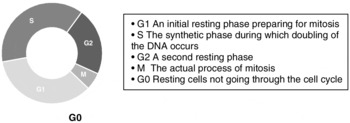
TMZ is distributed commercially as Temodal by Schering-Plough Ltd. in the UK and Europe.8 It is an alkylating chemotherapeutic agent that has excellent penetration into body tissues with almost 100% bioavailability, including penetration across the blood-brain barrier. It targets DNA by binding a methyl group to the DNA base (methylation), and causing a highly mutagenic lesion.Reference Newlands, Stevens, Wedge, Wheelhouse and Brock9 Ineffective cycles of mismatch repair may progressively lead to DNA strand breaks and ultimately, cell death.Reference van Rijn, Heimans, van den Berg, van der Valk and Slotman10 TMZ has also been shown to induce cell cycle arrest in glioblastoma cell lines at the G2/M interface,Reference Hirose, Berger and Pieper11 the most radiosensitive phase of the cell cycle (Figure 1).
The cell cycle. The active cell cycle involves four phases. G2 and M are radiosensitive, as cells in this phase don?t have sufficient time to repair radiation damage before entering the division phase. G1 and S stages are the most radioresistant, as there may be a greater chance of a matching sister template being available during the synchronisation phase to repair radiation damage.

The distinctive stability at acid pH levels means TMZ survives the strong acid of the stomach, allowing oral administration in tablet form. It is taken in a fasting state to maximise the drug’s absorption. The dose-limiting toxicity of TMZ is myelosuppression,Reference Brock, Newlands, Wedge, Bower, Evans, Colquhoun, Roddie, Glaser, Brampton and Rustin12 and other side effects include haematologic toxicity, nausea and vomiting.Reference Stupp, Dietrich and Kraljevic13 Early pre-clinical studies demonstrated enhanced activity in brain tumour surgical samples, prompting further investigation of its efficacy in combination with irradiation for high-grade glioma.Reference Newlands, Stevens, Wedge, Wheelhouse and Brock9
The following literature review will examine how TMZ in combination with radiotherapy was developed for use from pre-clinical studies to large-scale clinical trials for patients with newly diagnosed GBM. This paper aims to evaluate the evidence base including a review of cost implications, to put forth recommendations for future research.
Method
A systematic review of scientific articles published after 1996 was conducted using the PubMed database. The initial search strategy consisted of entering keywords ‘temozolomide’ and ‘glioblastoma’ or ‘glioma’, further refined by entering keyword ‘radiotherapy’. Papers were selected based on merit of the abstract and further relevant articles were extracted from reference lists.
Findings
Pre-clinical studies
Pre-clinical studiesReference Newlands, Stevens, Wedge, Wheelhouse and Brock9 were designed to establish the clinical significance of combining TMZ with irradiation, in high-grade glioma. In vitro research supported this hypothesis, revealing marked reduction of cell survival when treated with a combination of TMZ and irradiation, over each modality alone.Reference van Rijn, Heimans, van den Berg, van der Valk and Slotman10 The studies also identified a schedule-dependency for optimum TMZ activity. Radiation cytotoxicity in glioblastoma cell lines was enhanced with a continuous, fractionated schedule of administration rather than a single bolus infusion. The DNA repair enzyme O-6-methylguanine-DNA methyltransferase can form a mechanism of resistance to alkylating agents and may be gradually depleted through a prolonged exposure to TMZ.Reference Hegi, Diserens, Godard, Dietrich, Regli, Ostermann, Otten, Van Melle, de Tribolet and Stupp14 The same effect on cell survival was demonstrated whether TMZ was administered before or after radiation. Interestingly, grade III astrocytoma cell lines (anaplastic astrocytoma) did not demonstrate the same reduction in cell survival in vitro after treatment with TMZ and irradiation.Reference van Rijn, Heimans, van den Berg, van der Valk and Slotman10
Clinical trials
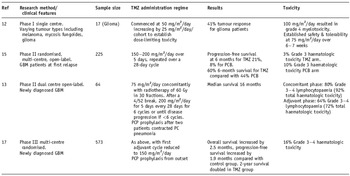
A Phase I clinical study determined a safe, tolerable, extended schedule of TMZ at 75 mg/m2/day over 6–7 weeks, using the dose-limiting toxicity of myelosupression.Reference Brock, Newlands, Wedge, Bower, Evans, Colquhoun, Roddie, Glaser, Brampton and Rustin12 The schedule was identified as a possible concomitant regime to combine with radical radiotherapy for high-grade glioma patients, who showed a 41% tumour response in the study. Yung et al.Reference Yung, Albright and Olson15 designed a larger Phase II study that implemented a TMZ schedule for GBM patients at first relapse of 150–200 mg/m2/day over 5 days, repeated over a 28-day cycle. Again, promising survival benefits (Table 1) were demonstrated in patients receiving TMZ compared to PCV agents, with acceptable levels of toxicity. The UK National Institute for Clinical Excellence supports this evidence and has licensed the use of TMZ for patients with recurrent malignant glioma who have failed first-line therapy.16 Based on the results of these initial studies, Phase II and III clinical trials were designed to further establish the role of TMZ for newly diagnosed GBM.
Characteristics of key clinical studies

One of the first Phase II trials to investigate the safety and tolerability of concomitant and adjuvant TMZ in patients with newly diagnosed GBM was published by Stupp et al.Reference Stupp, Dietrich and Kraljevic13 Patients enrolled in the study received TMZ to the dosing schedule previously recommended,Reference Brock, Newlands, Wedge, Bower, Evans, Colquhoun, Roddie, Glaser, Brampton and Rustin12 concomitantly with radical radiotherapy of 60 Gy in 30 fractions over 6–7 weeks. After a 4-week break, TMZ was administered adjuvantly at 200 mg/m2/day for 5 days every 28 days for 6 cycles,Reference Yung, Albright and Olson15 or until disease progression, if within 6 months. Prophylactic antiemetics were prescribed as required during concomitant therapy and routinely prescribed daily during adjuvant therapy. After two patients contracted pneumocystis carinii pneumonia (PCP) in the early stages of the trial due to immunosuppression, PCP prophylaxis was introduced. Favourable median survival figures of 16 months were achieved; however, a large number of patients experienced grade 3 or 4 lymphocytopaenia during the concomitant and adjuvant phases of TMZ administration (Table 1). The researchers acknowledged this high toxicity; however, they indicated that lymphocytopaenia was rarely associated with clinical sequelae. One patient died due to toxicity associated with TMZ overdose, after receiving adjuvant TMZ at 200 mg/m2/day for 30 days instead of 5 days. It is not clear how this miscalculation in dosage occurred; however, there is some potential for error associated with self-medication for these patients, who may be neurologically impaired due to their disease. One of the authors of this paper has witnessed clinically a patient taking his or her TMZ twice when attending for a hyper fractionated twice daily radiotheraphy treatment to compensate for a treatment interruption
From the Phase II results, the clinical benefit was found to be significant enough to enter Phase III testing and a multi-centre trial was co-ordinated by the European Organisation for Research and Treatment of Cancer and the National Cancer Institute of Canada.Reference Stupp, Mason and van den Bent17 Five hundred and seventy three patients were randomly selected to receive radiotherapy and TMZ or radiotherapy alone. The TMZ administration schedule was replicated from the pilot Phase II study, with the first adjuvant cycle of TMZ reduced to 150 mg/m2/day. Randomisation was performed centrally and was subject to some balancing to ensure equivalence of prognostic factors between the groups for each centre. The research had a primary endpoint of overall survival; however, progression-free survival was also reported. The results of this study are summarised in Table 1.
Stupp et al.Reference Stupp, Mason and van den Bent17 acknowledged that the study did not establish whether the greatest clinical benefit was associated with concomitant TMZ, adjuvant TMZ or the combination of both regimes. There is also no evidence to suggest that this study identified the optimum regime of TMZ and radiotherapy. These limitations have prompted other researchers to design other novel combinations of radiotherapy and TMZ.
Novel TMZ schedules
Chibbaro et al.Reference Chibbaro, Benvenuti and Caprio18 originally intended to investigate the value of TMZ as a first-line agent post surgery, in patients with newly diagnosed high-grade glioma. Probably due to low recruitment, a subgroup of patients with GBM receiving 60 Gy radiotherapy in 30 fractions followed by adjuvant TMZ was included. The authors utilised the adjuvant schedule of 200 mg/m2/day for 5 days over a 28-day cycle until disease progression (median nine cycles), and reported a complete or partial response rate of 31%, assessed by gadolinium-enhanced magnetic resonance imaging supported by neurological examination. Unfortunately, median overall survival for this subgroup was not given. Only 2.4% of patients experienced haemotologic toxicity, although the level of toxicity was not reported. The extremely small sample size of this subgroup (n = 13), limits the validity of any conclusions drawn; however, further investigation by the authors may have allowed clinical data to be collected on the contribution of TMZ in the adjuvant setting.
Combs et al.Reference Combs, Gutwein, Schulz-Ertner, van Kampen, Thilmann, Edler, Wannenmacher and Debus19 hypothesised that a lower dose of TMZ may reduce the incidence of grade 3 or 4 toxicity as reported in other studies. TMZ was administered concomitantly at 50 mg/m2/day over the five therapy days of radiotherapy to patients with GBM, with no adjuvant regime. The lower dosing schedule resulted in a maximum of grade 2 level of toxicity, with median survival of the cohort, 19 months. The unusually favourable survival figures may be influenced by a patient selection bias and the inclusion of a subgroup of patients who underwent stereotactic fractionated radiotherapy at recurrence. The results are therefore difficult to be extrapolated externally to centres where stereotactic radiotherapy is unavailable. Although the paper attempts to establish the value of TMZ in the concomitant setting, it highlights a limitation of reporting efficacy of TMZ and associated survival benefit in patients with GBM. The extremely high rate of recurrence indicates the use of one of many salvage therapies and there is currently no standard technique. In the Phase III trial,Reference Stupp, Mason and van den Bent17 management of the patient at recurrence was at the prescribing consultants’ discretion and may have included no treatment, further surgery, re-irradiation or chemotherapy using TMZ or other agents. It is difficult to establish explicitly whether TMZ with radiotherapy is responsible for the overall survival benefit or the contribution of the salvage therapy is just as significant. The length of progression-free survival may better represent the true value of the new agent.
To establish the usefulness of TMZ in patients who had previously responded during initial therapy, a retrospective analysis of patients treated with TMZ as a first-line agent and again at recurrence was performed.Reference Franceschi, Omuro, Lassman, Demopoulos, Nolan and Abrey20 Although limited by small sample size, the hypothesis that cumulative toxicity and/or increased chemo-resistance may occur with prolonged exposure to TMZ was not supported by the results of the review. The possible carcinogenic effect of prolonged exposure to TMZ as reported elsewhereReference Newlands, Stevens, Wedge, Wheelhouse and Brock9 is outweighed by the relatively short survival of patients with recurrent GBM, and therefore, withholding this treatment is not yet indicated.
Studies designed to assess efficacy of TMZ in the neoadjuvant setting for patients with newly diagnosed GBM may be considered controversial. Gilbert et al.Reference Gilbert, Friedman, Kuttesch, Prados, Olson, Reaman and Zaknoen21 studied clinical efficacy of TMZ pre-irradiation, with the hypothesis that paediatric patients may benefit from delay in radiation due to associated effects of late toxicity, although adult patients formed the majority of the patient dataset. A more recent study was designed to investigate efficacy of TMZ after biopsy only, hypothesising that surgery may confound assessment of tumour size (an indicator of response) on imaging.Reference Brada, Ashley and Dowe22 Ethical considerations arising from withholding proven gold standard treatments for patients with GBM include potential for disease progression and early death. For this reason, a safety net typical of a phase II clinical cancer trial should be implemented, allowing for early trial termination should the observed response rate be too low.Reference Jung, Lee, Kim and George23 Lack of control groups contribute to unreliability of results and any conclusions drawn in favour of these techniques clearly suffer from patient selection bias and are unrepresentative of the wider population.
Restrictions placed on patient eligibility as age <70 years in the Phase III trial may also not adequately represent the clinical incidence of GBM. Many researchers neglect to include elderly patients in studies; bias toward a younger age group may improve results. Any treatment demonstrating benefits associated with improved outcome should be offered to all (adult) patients meeting the clinical criteria and not withheld based on age alone.Reference Brandes, Vastola, Basso, Berti, Pinna, Rotilio, Gardiman, Scienza, Monfardini and Ermani24 An analysis of median overall survival based on known prognostic factors has established that poor performance status and failure to undergo surgical resection were the only statistically significant prognostic factors.Reference Stupp, Mason and van den Bent17 Further, TMZ studies on the elderly are warranted and are particularly appealing for patients in this age group due to tolerability and ease of administration.
Cost Implications
There is some debate in the literature questioning cost-effectiveness of supplying TMZ to patients with a known poor prognosis and the associated modest increases in median survival achieved. This argument may be particularly relevant in the UK with increasing deficits in the National Health Service (NHS) budget. Swiss researchersReference Wasserfallen, Ostermann, Pica, Mirimanoff, Leyvraz, Villemure and Stupp25 replicated the TMZ arm of the previously described published Phase II trialReference Stupp, Dietrich and Kraljevic13 and performed economic analyses on costs of radiotherapy with concomitant and adjuvant TMZ, which included hospitalisation, drugs, blood tests, imaging and personnel time. The costs associated with radiotherapy alone were simply extracted from the analysis. The TMZ arm of the trial was calculated to be an average of €20,952 (approximately £13,700) more expensive per patient; however, the lack of control group indicates that assumptions were made that patients receiving radiotherapy alone do not require other medical interventions. This may not realistically represent the clinical situation. The authors do acknowledge that during trial conditions, resources such as diagnostic imaging are utilised more frequently than in normal clinical practice in order to collect data, which increases costs. A Finnish study,Reference Martikainen, Kivioja, Hallinen and Vihinen26 using data from published studies, compared the cost-effectiveness of delivering TMZ against PCV to patients with recurrent GBM. They concluded that TMZ was more cost-effective than PCV and acknowledged that prolonged survival benefits associated with TMZ may further improve this ratio. The difficulty of interpolating costs from different healthcare systems prompted an NHS review to establish an economic model of the effectiveness of TMZ in the UK. The authors estimated the budgetary cost of supplying TMZ by the NHS to be relatively low, at £4 million per annum.Reference Dinnes, Cave, Huang, Major and Milne27 The Finnish and UK studies were performed for recurrent high-grade glioma and from the authors’ experience, it is accepted that progressive stages of the disease are more likely to require ongoing costly medical intervention. Further analyses are required for newly diagnosed GBM, including an accepted form of health-related quality-of-life study, which may demonstrate cost-effectiveness of a longer progression-free survival for patients. Research that has commenced on identifying genetic markers for predictive treatment response may assist in more wisely allocating future resources.Reference Xu, Mymryk and Cairncross28
Conclusions and recommendations
Current treatment options for patients with newly diagnosed GBM have made little impact on overall survival, largely due to the radiobiological features of GBM that contribute to its incurability. TMZ is a new alkylating agent that has the potential to manipulate these features to target this rapidly spreading fatal disease. A recently published Phase III randomised, multi-centre trial presents clinical evidence of improving overall survival by 2.5 months and doubling of 2-year survival with concomitant and adjuvant TMZ over radiotherapy alone. Other regimes of TMZ and radiotherapy with varying degrees of success have been published although limited by inadequate patient selection techniques, external validity and in some cases, ethical consideration.
With the relatively tolerable toxicity profile, investigation into optimal dosing schedules of TMZ and testing on all patient age groups is warranted. The continuation of adjuvant TMZ after six cycles may be beneficial when disease progression has not occurred. A study of quality of life to complement cost-effectiveness of increased progression-free survival of newly diagnosed GBM patients receiving TMZ compared to current chemotherapeutic agents should be performed. Exciting new research into genetic markers to predict treatment response may allow better future allocation of resources.