Introduction
Despite their rapid and assertive internationalization behavior, emerging economy multinationals (EMNEs) are facing growing pressure to address global grand challenges (Buckley, Doh, & Benischke, Reference Buckley, Doh and Benischke2017; Gutierrez, Montiel, Surroca, & Tribo, Reference Gutierrez, Montiel, Surroca and Tribo2022; van Zanten & van Tulder, Reference van Zanten and van Tulder2018). Among various types of EMNEs, emerging market state-owned enterprises (EM-SOEs) are particularly under the spotlight for research and public scrutiny (Mariotti & Marzano, Reference Mariotti and Marzano2020). They have evolved over time into a type of hybrid organization (Bruton, Peng, Ahlstrom, Stan, & Xu, Reference Bruton, Peng, Ahlstrom, Stan and Xu2015) where state owners coexist with other stakeholders such as institutional owners and private shareholders (Huang & Zhu, Reference Huang and Zhu2015; Panicker, Upadhyayula, & Sivakumar, Reference Panicker, Upadhyayula and Sivakumar2022). The complexity inherent in their ownership structure, their paradoxes in institutional and market economy, and concerns about their proximity to the state create the so-called liability of emergingness (Madhok & Keyhani, Reference Madhok and Keyhani2012) and liability of stateness (Cuervo-Cazurra & Li, Reference Cuervo-Cazurra and Li2021). The double hurdle (Thite, Wilkinson, & Shah, Reference Thite, Wilkinson and Shah2012), therefore, makes it challenging for EM-SOEs to fulfill sustainable development mandates as part of their internationalization strategies.
Corporate sustainability (CS) refers to business decision-making and corporate governance that not only meets the needs of stakeholders such as employees, clients, and shareholders but also builds the firm's capacity to meet the needs of future stakeholders (Dyllick & Hockerts, Reference Dyllick and Hockerts2002). This conceptualization implies a broader integration of economic sustainability (Fowler & Hope, Reference Fowler and Hope2007), ecological sustainability (DesJardins, Reference DesJardins1998), and social sustainability (Dyllick & Hockerts, Reference Dyllick and Hockerts2002; Sharma & Ruud, Reference Sharma and Ruud2003), similar to the triple bottom line framework (Elkington, Reference Elkington and Henriques2013). Established multinational firms (MNEs) are urged to play a positive role in ‘solving’ global problems such as climate change, poverty reduction, and reducing inequalities (Ghauri, Reference Ghauri2022; Kolk & van Tulder, Reference Kolk and van Tulder2010; Van Tulder, Rodrigues, Mirza, & Sexsmith, Reference Van Tulder, Rodrigues, Mirza and Sexsmith2021). Nevertheless, recent studies indicate that EMNEs may follow different trajectories in shaping their views and practices on these complex social, economic, and environmental problems (Tashman, Marano, & Kostova, Reference Tashman, Marano and Kostova2019). Despite empirical evidence on EM-SOEs' engagement in CS practices, such as coporate social responsibility (CSR) reporting or sustainability reports (Ordonez-Ponce & Talbot, Reference Ordonez-Ponce and Talbot2022; Tashman et al., Reference Tashman, Marano and Kostova2019), or reconciling sustainability with their strategic motivations (Ciasullo, Montera, Cucari, & Polese, Reference Ciasullo, Montera, Cucari and Polese2020) and marketing practices (Agnihotri & Bhattacharya, Reference Agnihotri and Bhattacharya2019), little is known about the motivations, mechanisms, and impacts of CS practices these new players have in international markets (Fernhaber & Zou, Reference Fernhaber and Zou2022).
Drawing upon a biomimicry-based perspective, we aim to unpack the ‘black box’ of CS practices and stakeholder management by EM-SOEs by addressing this research question: How do EM-SOEs manage stakeholder relationships and undertake their corporate sustainability practices in the host market to implement their international strategy? The term biomimicry, popularized since biologist Janie Benyus (Reference Benyus1997) coined the concept in her book Biomimicry: Innovation Inspired by Nature, refers to sustainable solutions inspired by nature. Applying the biomimicry perspective, we argue that EM-SOEs are part of the systems in which they live, adapt, and survive in coexistence and collaboration with a wide range of stakeholders, just as different organisms exist in nature (Benyus, Reference Benyus1997; Cui, Gao, Guo, & Ma, Reference Cui, Gao, Guo and Ma2022).
Based on a case study involving China Shenhua Energy Company (SE), a hybrid EM-SOE from China investing in the power industry in Indonesia, this article offers several contributions. Existing theories, such as transaction cost economies, the resource-based view, and institutional theory, typically adopt a firm-centric perspective. However, this orientation may be problematic when addressing the intricate nature of EM-SOEs' internationalization, characterized by hybridity and associated ‘liability of emergingness’ and ‘liability of stateness’ (Åkerman, Reference Åkerman2015; Chandra & Wilkinson, Reference Chandra and Wilkinson2017; Cuervo-Cazurra & Li, Reference Cuervo-Cazurra and Li2021; Ellis & Pecotich, Reference Ellis and Pecotich2001; Madhok & Keyhani, Reference Madhok and Keyhani2012). Nature serves as a potent source of metaphors, presenting an alternative perspective to spur new insights into the application of sustainable practices for strategy adjustment (Fernhaber & Stark, Reference Fernhaber and Stark2019). Although the biomimicry perspective has its application in organization and product innovation, scholarly work on CS and international business has not yet developed. In his review on biomimicry, Davidov (Reference Davidov2019: 35) calls for a better understanding of ‘how biomimicry is situated within the broader social, political, and economic context as both an epistemic paradigm and an economy of value’. Therefore, we contribute to advancing the theoretical understanding of the emerging biomimicry perspective in the IB discipline, shifting away from a firm-centric stance to provide a broader view of the strategic behavior of hybrid EM-SOEs during their internationalization process.
Practically, our research is relevant to SOE managers from emerging markets. These managers navigate complex systems (Casson & Li, Reference Casson and Li2022), while simultaneously addressing diverse institutional demands within hybrid structures (Dai, Tan, Tang, & Xiao, Reference Dai, Tan, Tang and Xiao2017; Pache & Santos, Reference Pache and Santos2013). Given the escalating pressure to embrace sustainability and corporate responsibility (Kolk & van Tulder, Reference Kolk and van Tulder2010; Park, Reference Park2018), they need to comprehend the intertwined linkages between their firm and stakeholders, especially in markets where higher uncertainties and costs prevail. Our findings demonstrate that stakeholder management unfolds at various levels within and beyond the hybrid EM-SOE. Furthermore, considering the industry context of our case, we provide nuanced insights into the potential role EM-SOEs can play in tackling the grand societal challenges such as renewable energy. The case firm illustrates its innovative effort from fossil fuel-based power generation to potential renewable sources by employing a long-term, value-driven strategy and fostering a mutually beneficial relationship with stakeholders. Our work therefore offers a distinct and valuable contribution to discussions on sustainable energy solutions, particularly within the context of the case study.
Lastly, our study aligns with the demand for ‘phenomenon-based research’ (Buckley et al., Reference Buckley, Doh and Benischke2017; Doh, Reference Doh2015) by undertaking an in-depth investigation of stakeholder management and CS practices in a developing country, focusing on the significant yet underexplored type – EM-SOEs. Gaining insights into their behavior can, in turn, inform policymakers to facilitate and support responsible business practices and sustainable development in both home and host markets.
Theoretical Background
Biomimicry Perspective
Learning from natural systems for innovation and organizations has been prevalent across disciplines over the past decades. Professions such as architects and designers draw inspiration from nature to address human needs and design problems (Aziz & El sherif, Reference Aziz and El sherif2016). In her book Biomimicry: Innovation Inspired by Nature, Benyus (Reference Benyus1997) asserted that after 3.8 billion years of evolution, nature has discerned what works, what is suitable, and what endures, establishing an ecological standard for innovations. Derived from the Greek bios (life) and mimesis (imitation), biomimicry refers to the philosophy and approach of applying nature's best practices or ideas for human use. By emulating the strategies and processes observed in the natural world, organizations can develop innovative and sustainable solutions to challenges in corporate settings. Nature-inspired innovation has become a crucial strategy for organizations (Bonser, Reference Bonser2006; Mead, Jeanrenaud, & Bessant, Reference Mead, Jeanrenaud and Bessant2020), exerting effective and positive impacts on stakeholders and organizations. For instance, Mead (Reference Mead2014) reviewed the application of biologically inspired innovation, advocating for its significant contribution to CS on a broad scale. We propose that the biomimicry perspective which acknowledges the dynamic and interconnected system within which EM-SOEs operate could provide an insightful explanation on the context of EM-SOEs.
First, the growing presence of EM-SOEs in international markets is a noteworthy phenomenon and their hybrid nature complicates their strategic decision process, organization structure, and stakeholder management (Pache & Santos, Reference Pache and Santos2013; Zhou, Reference Zhou2018). Their international strategies involve a substantial number of actors, from policymakers, civil servants, managers, employees, consumers to investors. These stakeholders, who advocate for ideas that may work to their own interest (Chen, Musacchio, & Li, Reference Chen, Musacchio and Li2019) inevitably shape the decision-making and behavior of an EM-SOE (Johanson & Vahlne, Reference Johanson and Vahlne2009). While seeking legitimacy in the new market is a natural quest for an EM-SOE when it is subject to the specific liabilities of emergingness (Madhok & Keyhani, Reference Madhok and Keyhani2012) and lack of legitimacy (Kostova & Zaheer, Reference Kostova and Zaheer1999), the entire complex system creates different governance systems for SOEs to achieve legitimacy. This implies cross-scale or cross-dimension interaction with stakeholders to foster legitimacy (Cosens, Reference Cosens2013).
Second, the market-based logic can cause challenges to EM-SOEs' operation overseas as they encounter distinct salient institutional logics. This is manifested in the interplay of the national interests of their home government (Lai, O'Hara, & Wysoczanska, Reference Lai, O'Hara and Wysoczanska2015), and the pressure from institutional investors and stakeholders at home and abroad (Panicker et al., Reference Panicker, Upadhyayula and Sivakumar2022). Prior research underscores the advantages of collaborative strategies for EMNEs, such as forming strategic alliances with other MNEs to enhance their resource position (Douma, George, & Kabir, Reference Douma, George and Kabir2006). Other research also shed light on the competitive dynamics between EM-SOEs and other firms, in the domains of market share, knowledge assets, and even talent pools (Ramamurti & Williamson, Reference Ramamurti and Williamson2019). In some instances, this competition may lead to international disputes (Shen, Zhang, Teng, & Du, Reference Shen, Zhang, Teng and Du2022). Understanding the nuanced relationship between EM-SOEs and other types of firms necessitates a comprehensive perspective that captures the dynamics of EM-SOEs' internationalization (Benito, Rygh, & Lunnan, Reference Benito, Rygh and Lunnan2016). Therefore, the biomimicry perspective aims to strike a balance between the competitive impetus for survival and the collaborative spirit observed in the natural world, offering a strategic view that can be insightful for EM-SOEs.
Prior research on EMNEs primarily investigated the emergence of EM-SOEs from the network perspective or institutional theory (Anderson, Håkansson, & Johanson, Reference Anderson, Håkansson and Johanson1994; Coviello & Munro, Reference Coviello and Munro1997; Hånell & Ghauri, Reference Hånell and Ghauri2016; Johanson & Vahlne, Reference Johanson and Vahlne2009; Wilkinson, Mattsson, & Easton, Reference Wilkinson, Mattsson and Easton2000), especially highlighting their nonmarket-based connections and linkages with state governments (Cuervo-Cazurra, Inkpen, Musacchio, & Ramaswamy, Reference Cuervo-Cazurra, Inkpen, Musacchio and Ramaswamy2014). While these studies provide a sophisticated understanding of the role of networks in firm strategies and performance, they fall short of capturing the complex hybrid nature of EM-SOEs (Chandra & Wilkinson, Reference Chandra and Wilkinson2017). As discussed previously, these firms integrate elements from different stakeholders and become a type of hybrid organization (Pache & Santos, Reference Pache and Santos2013; Panibratov & Klishevich, Reference Panibratov and Klishevich2023). Given the fact that they are under pressure from different stakeholders who represent their own strategic priorities and preferences (Bruton et al., Reference Bruton, Peng, Ahlstrom, Stan and Xu2015), the importance of the collective health of the system in which the firm is embedded on firm strategies and performance (Santos-Vijande, López-Sánchez, & Trespalacios, Reference Santos-Vijande, López-Sánchez and Trespalacios2012) should be emphasized.
Therefore, we resonate with the business ecosystem perspective (Iansiti & Levien, Reference Iansiti and Levien2004; Moore, Reference Moore1993, Reference Moore1996), which views the importance of the independence of economic agents for their collective success and survival (Peltoniemi, Reference Peltoniemi2005; Tsujimoto, Kajikawa, Tomita, & Matsumoto, Reference Tsujimoto, Kajikawa, Tomita and Matsumoto2018). While the business ecosystem perspective centers on economic relationships and organizational dynamics, the biomimicry perspective is firmly grounded in biological systems and their inherent sustainability (Mathews, Reference Mathews2011). This view represents a shift from linear processes that deplete resources to circular, regenerative systems inspired by nature's closed-loop cycles (Kirchherr, Yang, Schulze-Spüntrup, Heerink, & Hartley, Reference Kirchherr, Yang, Schulze-Spüntrup, Heerink and Hartley2023; Lebdioui, Reference Lebdioui2022). Furthermore, the biomimicry perspective places significant emphasis on diversity (Dicks, Reference Dicks2019; Fernhaber & Stark, Reference Fernhaber and Stark2019; Fewell, Reference Fewell2015), a concept extending beyond the scope of traditional business ecosystem theories. Integrating the diversity perspective into our research context captures the hybrid nature of EM-SOEs and their stakeholders, as well as the markets where they operate. In contrast to the focus which often is confined to specific types of ecosystems (Tsujimoto et al., Reference Tsujimoto, Kajikawa, Tomita and Matsumoto2018), we propose that the biomimicry perspective provides a comprehensive systems outlook. This approach aims to scrutinize the systems in which EM-SOEs exist, adapt, and thrive by managing diverse relationships, responding to conflicting institutional pressures behind state and private ownership, and shaping their international strategies and corporate sustainable practices in an adaptive and flexible manner (Benyus, Reference Benyus1997; Cui et al., Reference Cui, Gao, Guo and Ma2022).
Stakeholder Management and CS Practices From the Biomimicry Perspective: A Theoretical Framework
In the intricate landscape of EM-SOEs, the interplay between stakeholder management and CS practices is crucial. Their internationalization discourse is not a simple response to uncertainties and risks in the overseas market (Cuervo-Cazurra, Ciravegna, Melgarejo, & Lopez, Reference Cuervo-Cazurra, Ciravegna, Melgarejo and Lopez2018), but a process to confront complexities deeply embedded in the diversity of hybrid organization structure and of various stakeholders' interest and expectations (Jonsson & Vahlne, Reference Jonsson and Vahlne2023; Wu & Park, Reference Wu and Park2019).
In complex systems such as wildfires, countless individual interactions within the system hold control though the degree of control may vary. Similarly, the system in which an EM-SOE operates is defined through intricate interactions and connectivity among the actors (Chandra & Wilkinson, Reference Chandra and Wilkinson2017). In contrast to the existing works which treat the network structure as either unidirectional or bidirectional (Shen et al., Reference Shen, Zhang, Teng and Du2022; Wu, Wood, & Khan, Reference Wu, Wood and Khan2021), a system perspective acknowledges divergent institutional pressures from various stakeholders, which creates a complex web of expectations on EM-SOE's adaptive engagement strategies (Zhang, van Gorp, Ebbers, Zhou, & Kievit, Reference Zhang, van Gorp, Ebbers, Zhou and Kievit2022).
The hybrid nature of EM-SOEs denotes the plural logics (Pache & Santos, Reference Pache and Santos2013; Panibratov & Klishevich, Reference Panibratov and Klishevich2023) including state, corporate, and capital markets (Dai et al., Reference Dai, Tan, Tang and Xiao2017; Greve & Zhang, Reference Greve and Zhang2017). The dilemma for an EM-SOE is often discussed in its struggle between the duty to fulfill governments' policy and the response to the value creation request from shareholders. The multiple institutional pressures inevitably give rise to a dynamic interplay due to individual/group interest, power, and positions in a dynamic way (Avelino & Rotmans, Reference Avelino and Rotmans2011). Correspondingly, their distinctive interests and expectations shape the domain of CS (Dyllick & Hockerts, Reference Dyllick and Hockerts2002), to ‘demonstrate the inclusion of social and environmental concerns in business operations and in interaction with stakeholders’ (van Marrewijk & Werre, Reference van Marrewijk and Werre2003: 1). For example, in addition to economic sustainability addressing shareholders, recent work examines the wider impact on internal and external stakeholders and the sustainable environment from an ecological perspective (Gladwin, Kennelly, & Krause, Reference Gladwin, Kennelly and Krause1995; Sharma & Ruud, Reference Sharma and Ruud2003).
So, the question is, how would EM-SOEs respond to the diverse pressures and expectations from their stakeholders? While an EM-SOE tries to be viable in overseas markets, i.e. by acquiring market share and knowledge assets, building brand loyalty, dealing with labor relationships, and engaging in nonmarket strategies (Buckley, Munjal, Enderwick, & Forsans, Reference Buckley, Munjal, Enderwick and Forsans2016; Chidlow, Wang, Liu, & Wei, Reference Chidlow, Wang, Liu and Wei2021; Shi, Sutherland, Williams, & Rong, Reference Shi, Sutherland, Williams and Rong2021), these processes inevitably overlap with other players. Drawing from natural systems, the concept of symbiosis becomes critical; it emphasizes finding common ground among stakeholders with differing interests. Instead of ignoring conflicts or competitions, an EM-SOE is more likely to focus on the ‘territory’ that can coexist with others in a less hostile or even peaceful manner (Cuervo-Cazurra, Reference Cuervo-Cazurra2018). Departing from the traditional explanations that collaborative strategies contribute to knowledge learning (Lorenzen & Mudambi, Reference Lorenzen and Mudambi2012), legitimacy (Li, Cui, & Lu, Reference Li, Cui and Lu2014), and market performance (Elia, Kafouros, & Buckley, Reference Elia, Kafouros and Buckley2020), the concept of symbiosis entails a profound shift in perspective, emphasizing not only the transactional aspects of stakeholder partnerships but also the inherent interconnectedness and mutualistic relationship between an EM-SOE and divergent stakeholders (Chidlow et al., Reference Chidlow, Wang, Liu and Wei2021; Popli, Raithatha, & Ahsan, Reference Popli, Raithatha and Ahsan2021). Collaborative strategies, therefore, transcend organizational boundaries to become integrated and interdependent ecosystems that foster shared growth, resilience and sustained value creation for all parties involved (Lehtinen, Aaltonen, & Rajala, Reference Lehtinen, Aaltonen and Rajala2019). Not surprisingly, more overt forms of operation can be seen in this mutually beneficial relationship that the firm forms with its stakeholders. Inevitably, there will be more ‘veins and arteries’ adding to this system, and the more complex it becomes, the more cooperation the firm needs for proper functioning (Okhmatovskiy, Grosman, & Sun, Reference Okhmatovskiy, Grosman and Sun2022). For example, investors such as mutual funds, banks, and other development financial institutions are considered to create a long-term reciprocal relationship with an EM-SOE, resulting in improved resources to fund their international activities and extend their relationship to overseas lending institutions (Khanna & Palepu, Reference Khanna and Palepu2000). Corporate political connections and diplomatic relationships, manifested across central government, local government, and private firms, can influence the business environment an EM-SOE faces abroad. It could send a positive signal as home country policymakers help develop trusting relationships with host country governments that would facilitate corporate activities (Li, Meyer, Zhang, & Ding, Reference Li, Meyer, Zhang and Ding2018). Luo (Reference Luo2001) refers to it as a ‘social license’ that helps an EM-SOE to operate and increase its credibility in the eyes of the public.
To summarize, we draw insights from nature which fosters a holistic approach unique to EM-SOEs. Here, stakeholder management mirrors the diverse and interdependent relationships inherent in these markets – at internal and external levels, and CS practices through adaptive organizational structure and engagement with stakeholders emulate the regenerative and efficient systems observed in nature. Hence, Figure 1 provides a visualized model that depicts its CS practices from a multi-level and multi-dimensional systems' perspective.
A model of stakeholder management and corporate sustainability practices

As the biomimicry perspective holds, an EM-SOE is embedded in a hybrid and complex system where both internal and external stakeholders have their own interest and expectations. The internal system (top down box) includes both parent-level and subsidiary-level actors who reflect converging or diverging strategic rationales in determining the firm's CS practices. At the parent level, ownership holding (Bhaumik, Driffield, & Pal, Reference Bhaumik, Driffield and Pal2010) indicates the role the headquarters plays in decision-making, coordination of operations, support, and mobilization of resources, as well as performance monitoring. State ownership or control affects how an EM-SOE positions itself with the parent back home. The urge to fulfill national interest abroad, for instance, suggests a subordinating position in this headquarters–subsidiary relationship (Lai et al., Reference Lai, O'Hara and Wysoczanska2015). This position could bring benefit from its home institution. Beyond a general supporting ecosystem including economic infrastructure and financial backing, core organizational activities – such as the hiring and socialization process, governance system, incentive structures, marketing, and value chain activities (van Zanten & van Tulder, Reference van Zanten and van Tulder2018) – enable EM-SOEs to develop their sustainability in operations (Battilana & Lee, Reference Battilana and Lee2014). However, there could also be a ‘dark side’ particularly when stakeholders beyond the state demand transparent and accountable corporate governance of EM-SOEs. Consequently, CS practices at this level are inclined to prioritize parent and subsidiary interactions, striving to strike a delicate balance between economic and social (national interest) welfare, and the fulfillment of corporate integrity (Bruton et al., Reference Bruton, Peng, Ahlstrom, Stan and Xu2015).
Looking at the external system (top left box), there is no doubt that CS practices materialize through interactions involving both market-based and nonmarket-based actors who are expected to build symbiotic relationships. While CS practices are defined as the activities that concern social, environment, and economic aspects in their international operations and in interaction with their stakeholders at home and abroad (Dyllick & Hockerts, Reference Dyllick and Hockerts2002; van Marrewijk & Werre, Reference van Marrewijk and Werre2003), they inevitably introduce inherent tensions and pressures to EM-SOEs. Dealing with these diverse and sometimes conflicting demands necessitates a clear strategic view aimed at generating shared values for all involved parties, as seen in nature from a biomimicry perspective. CS practices also involve a myriad of stakeholders, including local employees, value chain partners, institutional stakeholders at both national and local levels, as well as local elites and grassroot citizens. These stakeholders play a significant role in the legitimacy-building process alongside the internationalization effort made by EM-SOEs (Boddewyn, Reference Boddewyn1995; Marano, Tashman, & Kostova, Reference Marano, Tashman and Kostova2017; Rana & Sørensen, Reference Rana and Sørensen2021). Managing these relationships, therefore, requires a nuanced approach, acknowledging the diverse interests and voices contributing to the complex landscape of CS practices. Stakeholder management aligns with CS practices that adopt a strategic vision. It involves engaging with a diverse array of stakeholders within internal and external systems to facilitate various levels and degrees of legitimacy in overseas markets, as shown in the middle column of Figure 1.
From this perspective, we propose that EM-SOEs' CS practices should be examined from both internal and external systems. This is in line with the structure and the function of the two systems which are built upon varying symbiotic relationships. Partners arising from the internal system or external system exhibit distinctive strategic agenda and preferences. For instance, CS practices related to internal stakeholders are more likely to manifest in sustainable innovation (Boons & Lüdeke-Freund, Reference Boons and Lüdeke-Freund2013; Mead et al., Reference Mead, Jeanrenaud and Bessant2020), human resources management (Mejía-Villa, Torres-Guevara, Prieto-Sandoval, Cabra, & Jaca, Reference Mejía-Villa, Torres-Guevara, Prieto-Sandoval, Cabra and Jaca2023), and supply chain management (Seuring, Sarkis, Müller, & Rao, Reference Seuring, Sarkis, Müller and Rao2008). On the other hand, an EM-SOE's socialization and interaction with heterogeneous external stakeholders in international markets can be viewed as a self-regulating system. Here, EM-SOE endeavors to establish managed boundaries, develop self-reliant adaptation, and achieve competitiveness in the market. While government relationships have been widely discussed in nonmarket and IB research, minority groups such as the local community remain relatively unexplored in this context. Mbalyohere, Lawton, Boojihawon, and Viney (Reference Mbalyohere, Lawton, Boojihawon and Viney2017) highlighted the importance of engaging with local communities, emphasizing that they constitute a crucial stakeholder group that demands active involvement. It is also critical to note that engaging with local communities involves a very fluid flow, requiring constant remapping and re-engagement particularly when conflicts and intense cultural differences arise from inappropriate business conduct (Giuliani, Nieri, & Vezzulli, Reference Giuliani, Nieri and Vezzulli2023).
Last but not least, we highlight the overlapping levels of legitimacy and robust CS practices with stakeholders for EM-SOEs as they not only mitigate liabilities and redefine their market image as legitimation outputs but also actively contribute to the three pillars of CS.
Research Methods
We introduce a phenomenological research paradigm into our research design with a single case study to capture the complexity and subtlety of CS practices and international operations (Ghauri, Grønhaug, & Strange, Reference Ghauri, Grønhaug and Strange2020; Jakobsen & Worm, Reference Jakobsen, Worm, Andersen and Torp2020; Khan & Lund-Thomsen, Reference Khan and Lund-Thomsen2011). Phenomenological research focuses on meanings, providing an opportunity for us to invite novel theoretical insights – the biomimicry perspective – that resonate with existing work on partnership in IB literature and explore the new empirical setting of a hybrid EM-SOE in addressing CS issues in its host markets. It is, therefore, well-suited to our research interest. Rather than seeking to generalize findings to the entire population (Ghauri, Reference Ghauri2004), we aim to provide rich descriptions, conceptualizations, and interpretations of novel empirical settings (Birkinshaw, Brannen, & Tung, Reference Birkinshaw, Brannen and Tung2011; Fu, Fu, Ghauri, & Khan, Reference Fu, Fu, Ghauri and Khan2024). Compared with the conventional positivist approach in the literature, phenomenological research offers a more interpretive perspective, generating insights into the context of key partnership management and CS activities (Jahansoozi, Reference Jahansoozi2006; Unterhitzenberger, Wilson, Bryde, Rost, & Joby, Reference Unterhitzenberger, Wilson, Bryde, Rost and Joby2021).
Indonesia provides a rich context for studying the stakeholder management and CS practices from this phenomenological research approach. The enactment of the 1999 decentralization law has created a rather peculiar power play across different levels, complicating its social-cultural, political, economic, and institutional situations. Recent work by Röell, Osabutey, Rodgers, Arndt, Khan, and Tarba (Reference Röell, Osabutey, Rodgers, Arndt, Khan and Tarba2022) particularly examined the social-political risk confronted by advanced economy MNEs at the subnational level, highlighting the complexity in managing nonmarket and market relationships at the local community level. Indonesia is administered by 34 provincial and 416 regency governments, all of which have the power to make their own rules (Rasyid, Reference Rasyid, Alm, Martinez-Vazquez and Indrawati2004). This rather fragmented political and social structure inherently causes significant challenges for stakeholder relationships between foreign investors and locals (Dang, Jasovska, & Rammal, Reference Dang, Jasovska and Rammal2020). In addition to the existing work on Western multinationals' investment in this market, this study offers the single case of an EM-SOE with the aim to delve into the novel biomimicry perspective and gain a deeper understanding of the topic (Dyer & Wilkins, Reference Dyer and Wilkins1991).
The case firm – China Shenhua Energy (SE) – is a subsidiary of the state-owned China Energy Group, the world's largest producer of coal, thermal power, and wind power. It was listed both on the Hong Kong Stock Exchange and Shanghai Stock Exchange back in 2005 and 2007 and has engaged in seven business segments, namely coal, electricity, new energy, coal-to-chemicals, railway, port handling, and shipping. The internationalization process of SE was in line with the development of international relationships between China and Indonesia under the Belt and Road Initiative (Cuervo-Cazurra & Li, Reference Cuervo-Cazurra and Li2021; Witt, Reference Witt2019). SE stands out as an exemplary case of the hybrid organization, a relatively recent phenomenon in IB literature (He, Eden, & Hitt, Reference He, Eden and Hitt2016; Panicker et al., Reference Panicker, Upadhyayula and Sivakumar2022). We took a fresh approach to understand the actual practices through SE's continuous partnership with local state and private Indonesian energy companies from 2008 to 2020. The temporal span allowed us to uncover the changing dynamics of stakeholder management from the interview data. To address validity concerns, we investigate this single case study with embedded units (Eisenhardt, Reference Eisenhardt1989; Yin, Reference Yin1994). Our method involved interviews with a variety of stakeholder groups and gathering data from diverse sources including company annual reports, government documents, newspapers, and archives from nonprofit organizations. Employing triangulation, we scrutinized the data at subunits, such as different stakeholder groups and the three joint venture operations of SE, all within the broader single case setting (Fu et al., Reference Fu, Fu, Ghauri and Khan2024). In this way, we addressed the validity and reliability concerns consistently throughout the data collection and analysis stages (Eisenhardt, Reference Eisenhardt1989; Elango & Fried, Reference Elango and Fried1997; Ghauri, Reference Ghauri2004; Reuber, Alkhaled, Barnard, Couper, & Sasaki, Reference Reuber, Alkhaled, Barnard, Couper and Sasaki2022).
Data Collection
We secured unique research access to the case study firm thanks to a longstanding relationship that our third coauthor maintains with the company. This exceptional connection afforded us the rare opportunity to conduct ‘elite interviews’ (He, Khan, Kyu, & Fallon, Reference He, Khan, Kyu and Fallon2019; Welch & Piekkari, Reference Welch and Piekkari2017) with key figures, including the top and senior management team, key engineers, government officials, and employees in both joint venture firms. Data collection in this phenomenological research is a reflective process that aims to tap into the insights of participants, representing a diverse array of stakeholders. Our aim is to unravel how they make sense of their experiences and positioning within the setting of stakeholder management and CS practices at SE. Departing from the conventional firm-centric perspective, this data collection method broadens and deepens our knowledge by exploring the systems that consist of these stakeholders. Our conversational interviews began with a ‘grand tour question’ – ‘How do you see yourself in the operations of SE's project in Indonesia’? This open-ended inquiry serves as the starting point for engaging participants in a meaningful conversation, encouraging them to share their perspectives and experiences based on their probity and personal significance. We guided the progress of the interview using prompts and unscripted questioning, fostering a natural dialogue with minimal intervention or control. This approach maximizes the potential for discovery as interviewees share insights and experiences that we had not predicted (Quinney, Dwyer, & Chapman, Reference Quinney, Dwyer and Chapman2016).
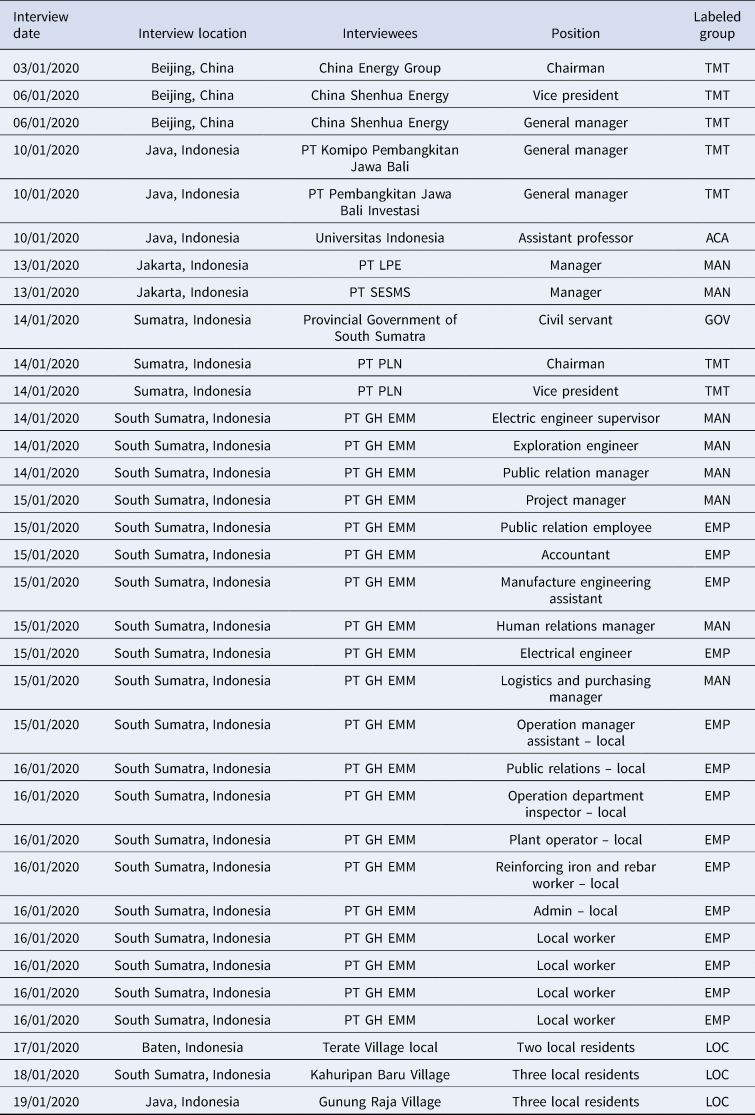
Thirty-seven face-to-face interviews were undertaken in January 2020, led by our third coauthor who has a longstanding personal and business connection in the energy sector. Initially, interviewees were identified through her personal connection at the Beijing headquarters allowing her to approach the top management team. Then, the snowballing strategy was subsequently employed, with the recommendations by the top management team in Beijing, to reach out to senior managers and lead engineers who were based in Indonesia, as well as local employees and residents. Altogether, we conducted 3 interviews with the top management team, 8 senior managers and lead engineers, 8 external partners, and 18 local employees and residents. Table 1 provides detailed information, as well as the abbreviations for labeled groups. For example, ‘GOV’ stands for governmental officials, ‘ACA’ for academics, and ‘TMT’ for top management team. On average, each interview lasted between 30 min and 1 hour. We recorded the interviews with the participants' consent. In the case where consent was not obtained, we used note taking during the interviews, which allows us to capture critical information in an efficient and prompt way and have control over the information being gathered. It also helps to identify the main concepts that emerged in the interviews in a real-time manner based on our theoretical framework, and to note down the linked key insights.
Interview details

After the interviews, we also engaged in follow-up email exchanges between the authors and interviewees to clarify ideas and emerging themes. The combination of recorded transcriptions and notes helped to increase construct validity and develop a deeper understanding of the application of the biomimicry perspective in the case study (Ghauri, Reference Ghauri2004; Yin, Reference Yin1994). The third coauthor who was responsible for the interviews also manually transcribed the interviews. Subsequently, the first author meticulously reviewed the transcription documents together with the interview notes, to ensure consistency in the details. We took a fresh approach to understand the actual practices through SE's continuous partnership with local state and private Indonesian energy companies from 2008 to 2020. The temporal span allowed us to uncover the changing dynamics of stakeholder management from the interview data. The internationalization process of SE was in line with the development of international relationships between China and Indonesia under the Belt and Road Initiative (Cuervo-Cazurra & Li, Reference Cuervo-Cazurra and Li2021; Witt, Reference Witt2019). SE stands out as an exemplary case of hybrid organization, a relatively recent phenomenon in IB literature (He et al., Reference He, Eden and Hitt2016; Panicker et al., Reference Panicker, Upadhyayula and Sivakumar2022). This case therefore allows us to contribute to knowledge gained in understanding how this particular type of EMNE adapts to peculiar institutional and market conditions to manage their stakeholder relationships and adjust their CS practices.
We take careful consideration regarding data saturation in our study, acknowledging the disadvantage with the snowballing sample (Saunders et al., Reference Saunders, Sim, Kingstone, Baker, Waterfield, Bartlam, Burroughs and Jinks2018). However, we contend that the ‘iterative process’ holds equal importance with data sample size in qualitative research (Hennink, Kaiser, & Marconi, Reference Hennink, Kaiser and Marconi2017). Given our research objective to provide comprehensive descriptions, conceptualizations, and interpretations of distinctive empirical settings (Birkinshaw et al., Reference Birkinshaw, Brannen and Tung2011), we are interested in capturing a wide range of issues within the context of stakeholder management and CS practices and developing the application of a biomimicry perspective into the context.
Despite having a single case, the richness of data derived from interview data, published documents from the headquarters, from third parties such as nonprofit organizations, offers a comprehensive understanding of the different perspectives of stakeholders. For example, the theme of training schemes is supported by data from interviews with local employees, the top management team, and the secondary data based on Annual Reports (2015–2017), 2017, and 2018 CSR Reports, as well as the Environmental, Social, and Governance Reports in 2019, 2020, and 2023. This cross-verification approach in data analysis allows us to identify commonalities across diverse data sets (Cheong, Lyons, Houghton, & Majumdar, Reference Cheong, Lyons, Houghton and Majumdar2023). Moreover, we maintained reflective documents to track the development of our understanding throughout the interviews and data analysis. This reflective process provides an additional layer to ensure that we do not assume theoretical saturation is completed (Saunders et al., Reference Saunders, Sim, Kingstone, Baker, Waterfield, Bartlam, Burroughs and Jinks2018). Last but not least, our theoretical framework with identified constructs provides preliminary guidance in investigating key and additional themes from the data. Meanwhile, it allows for flexibility in understanding the biomimicry perspective and its application based on the evidence emerging from the data (Lawrence & Tar, Reference Lawrence and Tar2013).
Data Analysis Procedure
We applied a systematic set of procedures to facilitate inductive and idiographic data analysis in this research (Smith & Osborn, Reference Smith, Osborn and Smith2008) as shown in Appendix I. We followed Hycner's (Reference Hycner1985) method of phenomenological analysis, in conjunction with Parry's (Reference Parry1998) framework for grounded theory development. Multiple sources of evidence, including company annual reports, websites, and business news, are searched and analyzed to confirm the reliability and validity of the phenomenological evidence, as well as enable the triangulation of the data and stronger corroboration of constructs (Hagen, Zucchella, & Ghauri, Reference Hagen, Zucchella and Ghauri2018; Yin, Reference Yin1994).
We initiated our analytical process by grouping the interview notes into five categories, including the top management team at the headquarters, the management team at the subsidiary, local employees, local communities, and the public sector. Through a careful reading and re-reading of the interview notes, we gained a preliminary understanding of the entire narrative and recollections of individual interviews, aiming to comprehend how they perceived themselves within the embedded systems. Reflective notes were also included in this process to identify emergent issues and topics. We then proceeded to construct our coding procedure to capture typologies and causation through a three-stage practice to elicit a data structure composed of first-order, second-order, and aggregate dimensions (Creswell, Reference Creswell2014; Saldana, Reference Saldana2012). This method has been largely adopted in inductive research to stimulate theoretical insights (Aguinis & Solarino, Reference Aquinis and Solarino2019; Gioia, Corley, & Hamilton, Reference Gioia, Corley and Hamilton2013). In so doing, the transcribed data are ordered into hierarchical categories, followed by key themes which emerged, and subsequently, aggregate theoretical dimensions. Figure 2 provides a detailed summary of our data structure.
Data structure

The final step was to condense the relationships between the key concepts into an emergent theoretical framework. This theoretical framework aims to provide explanations at a higher level of abstraction (Yin, Reference Yin1994) from the biomimicry perspective, yet with a specific goal of identifying a social process that explains the occurrence of the phenomenon under consideration (Creswell, Reference Creswell2014). In comparison to the proposed theoretical framework in Figure 1, this phase highlighted the important themes relating to the case of hybrid EM-SOEs drawing on our rich data. Notably, we are able to delineate the critical constructs across both internal and external systems embedded in hybrid EM-SOEs' stakeholder management and CS practices, resulting in the emphasis on legitimacy-building to deliver their multifaceted CS performance overseas.
Case Analysis
In the local Indonesian market, SE had three joint ventures with PT Energi Musi Makmur (PT EMM), PT Pembangkitan Jawa Bali (PT PJB), and PT Lion Power Energy (PT LPE), and invested over USD 31.18 billion to provide enough power for the national electricity company Perusahaan Listrik Negara (PLN) and the public. Since the partnership was incorporated in March 2008, PT Guohua Energi Musi Makmur (PT GH EMM) was the first joint venture invested in by SE to provide sufficient power for the national electricity company for the local Muara Enim Country of South Sumatra, a rather remote area which had suffered severe energy shortage in the past. It was subjected to many challenges since the incorporation, due to poor natural resources' endowments, complicated social structure, institutional clashes, communication barriers, and even threats of violence. With the financial support of USD 3.8 billion, the 2 × 150 MW coal plant was constructed and completed in two years. By February 2013, the plant was fully commercialized. SE continued to invest in Banten, Java, winning the open bid proposed by PT PJB, a subsidiary of state-owned PLN, in 2015.
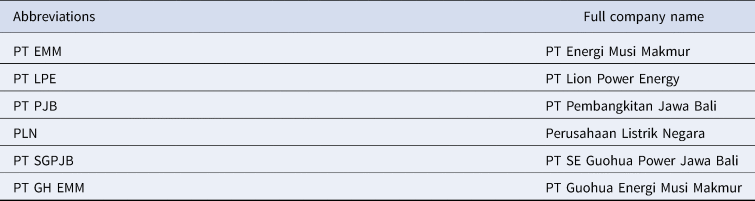
The newly incorporated joint venture (70%:30%) between SE and PT PJB was incorporated as PT SE Guohua Power Jawa Bali (PT SGPJB), dedicated to the construction of Java-7 power plant, another 2 × 1,050 MW with a total investment of USD 18.83 billion. The construction was developed in multiple phases from 2016, and completed sooner than expected in 2020, giving a capacity of 991 MW for Unit 1 and 991 MW for Unit 2. It is the largest overseas investment by SE, and the first ultra-supercritical power plant to operate in Indonesia with high efficiency of 45.04% to transform from coal supply to cleaner energy. PT SGLPE is the joint venture with PT LPE, a 75%:25% consortium, to undertake the Sumsel-1 power plant project. SE invested USD 8.576 billion in building two coal mining and coal-based power units each with a capacity of 350 MW. The project started in September 2020, after the on-site interview while the manager from PT LPE was interviewed back in January 2020. In the following section, we provide detailed evidence of how the partnership management in this joint venture worked and the CS issues that were addressed at PT GH EMM. In so doing, we seek to provide a comprehensive picture of the overall impact of the partnership management practiced by PT GH EMM. Table 2 provides the abbreviations for the involved stakeholder companies.
Abbreviations of involved stakeholders

Stakeholder management and CS practices
During the interviews, it is intriguing to examine the implications for CS practices in addressing the needs of various stakeholders. Traditionally, a firm-centered perspective is adopted to explore the performance outcomes of the firm, emphasizing its value creation possibilities by engaging external stakeholders (Harrison, Bosse, & Phillips, Reference Harrison, Bosse and Phillips2010; Kujala, Sachs, Leinonen, Heikkinen, & Laude, Reference Kujala, Sachs, Leinonen, Heikkinen and Laude2022; Scott & Lane, Reference Scott and Lane2000). A systemic view further enhances the understanding of the joint benefits and overall value created for the system (Meynhardt, Chandler, & Strathoff, Reference Meynhardt, Chandler and Strathoff2016), while also acknowledging the challenges and problems rooted in the system. Drawing upon the five interviewee categories, we examine both external and internal systems, which include two nonmarket stakeholders (high level/state level and local community/grassroot citizen level) and business partners as market stakeholders, as well as parent-level and subsidiary-level stakeholders in the internal system. In particular, the government (external system), local elites (internal and external system), and local grassroots citizens (external system) emerge as the most influential actors within the system, exerting a significant impact on SE's CS practices and stakeholder management.
External system
High level/state level
It is critical to understand the strategic objective of internationalization in this research context. As a hybrid SOE, undoubtedly, SE has the political agenda to contribute to the Belt and Road Initiative, especially the Maritime Silk Road part. Government or diplomatic relationships at the national, regional, and local levels play a salient role, especially in the early stage of investment. Home market support covered project licensing, financing, visa documents, labor risk, and resource coordination across different national bureaux and state councils, including the State-owned Assets Supervision and Administration Commission of the State Council, the Ministry of Commerce, China Banking and Insurance Regulatory Commission, and the Chinese Embassy in Indonesia.
It is exceptional that within six months of the contract of the Java-7 power plant coming into effect, financing was successfully concluded, and the entire pool of funds was fully secured within one and a half years. That is not possible without the support of the National Development Bank. (Gov_Ch4)
Additionally, the Indonesian government was quite supportive and welcoming, providing a favorable investment environment such as a preferable tax policy, speeding up the approval procedures, and coordinating across different bureaux throughout the project construction. Likewise, the Ministry of Energy and Mineral Resources, Ministry of State-Owned Enterprises, Indonesia Investment Coordinating Board, and Coordinating Ministry for Economic Affairs are all among the key government departments that provided support for the financing, registration, and approval of the project.
We look forward to strengthening collaboration with more Chinese enterprises under the ‘Belt and Road Initiative.’ The joint development in power supply between Indonesia and China is to be a role model. (Gov_In1)
The Java-7 Project holds profound significance for the national ‘Belt and Road’ initiative. Your firm set up such an exemplary case with commendable progress and high-quality execution. (Gov_In3)
It is without a doubt that the Java-7 Project embodies significant national strategic value; the successful completion and commissioning carry profound and extraordinary meaning to us. (Gov_Ch4)
In subsequent operations, the state/national government continued to play a constructive role, as evidenced by publicized statements from prominent government officials from the Ministry of Energy and Mineral Resources, Provincial Government of South Sumatra, etc.
Local elites
Local elites include individuals who interact with SE through construction contracts. They represent the categories of management team, technical experts, and joint venture partnership in Indonesia's coal power sector. They also have had experience in interacting with foreign investors in the past with rather negative perceptions. Early entrants were referred to as ‘cowboys’ due to their low technology standards, subpar quality, and apparent disregard for environmental and social issues in their operations. Under this background, SE encountered misunderstandings, disputes, and even violent attacks during the early stage of expansion in Indonesia. Therefore, it is quite evident that communication with these local elite stakeholders sets out a clear strategic tone in the way that SE was to rebuild and reshape the image of Chinese firms in the local market with key local stakeholders.
First, there is a strong emphasis on an innovative business model in the message conveyed to joint venture partners. Instead of the traditional contractual construction model, SE introduced the ‘build-own-operate-transfer’ model (BOOT), which enables one-stop and all-around integration from technology, capital, human resources, and operation to management of SE in Indonesia. An interesting exploration into the structure of the BOOT business model, similar to the way the natural forest works, also shows co-development with suppliers and partners. This ‘all-in-a-package’ structure means that all the equipment in constructing and running the plant is imported from highly reliable partners in China with mature and advanced technology not only in the infrastructure construction stage but also the operation periods with continuous technology and knowledge exchange. The reliability, therefore, is high; for instance, the production of the No.1 Unit ran for 302 days consecutively without shutting down.
This BOOT model allows us to collaborate with our local partners for the long run. In particular, we are able to achieve positive symbiosis, put co-value creation and co-development as the mutual strategic priority, invest with a long-term mindset, and localize our business and operation in Indonesia. (TMT_Ch1)
The narratives regarding the strategic plan were also quite clear upfront – to bring in innovative solutions to local coal power plant operations through effective knowledge transfer and exchange activities – ‘to seek the transition from the traditional power industry to renewable power (TMT_Ch2)’. Sharing the reliable and advanced supply chain from China for the specific power plant's products to local companies who might have the same demand provides joint benefits for all the parties involved in the investment projects, as well as the reliability of operations and energy supply to local consumers.
We really value our National Standards of the People's Republic of China (known as GB standard) and are confident about the quality we deliver. However, back to our first-ever project back in 2009, PLN required strictly the use of EN standardization and had no consideration at all about GB. It is fair enough as there was no previous collaboration between us. But this time, it is a totally different story. Our successful delivery of previous projects, and their visit to the power plants in China, convinced them that we could put GB in the contract of the Java-7 Project. (Man_Ch1)
Second, given the fact that previous and existing investors had used subcritical technology – the least advanced and cheapest for their plants, SE had to address the existing adverse impacts, including environmental issues, protests, incidents, and legal issues. One of the key practices was to set the priority of adopting advanced ultra-supercritical technology. The Java-7 project can achieve high efficiency of 45.04%, an indicator to measure the reduction of carbon emissions.
Consequently, managers from PLN and other local partners shared the view and commented on the positive impact on the local market.
The power plant commissioning at the Java 7 Project has provided a fundamental improvement in the stability of the Java-Bali power system. With its ultra-supercritical power generation technology, the project is positioned to serve as a benchmark in the Indonesian power industry. Leveraging advanced technology and cost-efficient practices, it is anticipated to generate substantial value and benefits for shareholders. Furthermore, the advanced engineering construction and operational management practices of the project are expected to serve as a valuable model for other power plants within the PLN network. (TMT_In1)
This is the first genuine independent power producer that innovatively utilizes low-quality coal to produce electricity. We cannot appraise highly enough the strategic value carried out in the Java-7 Project. This is impeccably important for our environmental protection and sustainable development. (TMT_In3)
SE was also committed to environmental preservation including belt coal conveyors and dissimulation technology for the coal jetty, water resources, and various other environmental actions. Notably, a dedicated area was established for the cultivation of mangroves along the coastal zone where the plant was constructed, showcasing a targeted effort to address and enhance the local ecosystem.
We really made our commitment to environmental conservation throughout construction and production. We actively constructed an earth embankment during the dredging process, not only with the strategic initiative to foster mangrove growth but also improve living conditions for seabirds and other wildlife species. Since the project's commencement, the mangrove area has experienced a significant 30% expansion. (Man_Ch1)
Third, the depth and width of the partnership with stakeholders extended to public sectors. In April 2019, Shenhua signed a Memorandum of Cooperation with the University of Indonesia to set up the teaching and research center for power generation systems. It was the first power generation simulation center in Indonesia and was launched in November 2019 with a total investment of up to 1.45 million RMB. Yet, apart from visits between the parent company and the Department of Electrical Engineering at the University of Indonesia, not much had been detailed, partly due to the impact of the pandemic. However, the faculty member acknowledged the importance of this linkage for future training and knowledge exchange so as to provide high-quality local expertise and talents.
The interaction between Chinese power companies (SE) and Indonesian universities has established a successful collaborative model. It is hoped that in the future, there will be more exchanges and cooperation between enterprises and universities of the two countries, continuously delivering high-quality talents for the development of Indonesia's power industry. (Aca_In1)
Local community/grassroots citizen level
Relationships with local grassroots citizens are indeed mixed and complicated compared with other stakeholders, and the narratives derived from interviews, when compared with secondary data, reveal considerable divergence. During SE's internationalization process, the voices of local public and grassroots citizens carried significant weight. While the national government and local elites showed predominantly positive sentiments toward SE, perceptions and actions of stakeholders at the local level were notably more varied and intricate. The growing influence of local grassroots citizens tends to play a pivotal role in shaping the legitimation procedure of SE in a different way.
In response to the concerns voiced by local citizens, the Public Relations (PR) Department mainly consists of local managers from PLN, tasked with overseeing security, public relations, and labor relations. These individuals are designated with clear responsibilities, including coordination across neighboring villages and counties, managing relationships with the police, the labor office, and immigration service. The PR Department actively employed legitimation practices by consistently communicating narratives that highlighted positive stories and experiences, engaging in cultural and educational initiatives and activities and environmental projects to demonstrate SE's commitment to the well-being of the local community.
Compared with conventional PR roles, which primarily focused on building positive relationships with local stakeholders and the public, the role of the PR Department in this case is quite distinctive. Their daily responsibilities centered around security and safety in operations. SE relied on a local team well-versed in the rules, policies, procedures, and practices to work intensively with the local communities. This localized social construction operates by leveraging existing norms that are believed, accepted, and normalized in the local market, in attempts to shape legitimacy beliefs. Narratives as well as behavioral practices are observed in the interviews and other published documents, so SE managed to strengthen its legitimacy through better conformance to the local market. Additionally, providing positive narratives to local communities invokes participation and enhances expertise and effectiveness in the process of legitimation.
It is our responsibility to make sure our local community knows what we are doing and appreciates what we do. We share individual success in their career development and even their life journey, in the villages. It is quite rewarding to see they feel the same way. (Emp_In3)
The infrastructure, like the newly constructed roads, connect us directly to the provincial highway. We can see more open accessible roads, more electricity supply, more factories and plants, and more farms. The villagers have now got more income, which was used to buy motorcycles, build new houses and other suppliers. (Loc_In1)
However, the subsequent Sumsel-1 power plant construction provoked environmental concerns as well as social and labor conflicts since 2016. The Global Atlas of Environmental Justice recorded this issue and the main concern related to pollution and compensation to the locals.
Since the existence of the South Sumatra PLTU I, the company has closed the tributary so that the water does not flow and affects the residents’ plantations. As a result, residents have difficulty getting the gardens to harvest, fertilize, and so on because they are filled with mud and waterlogged. (Archive)
The problem is, our land has not been compensated, but the rubber plantation above it, which is around eight years old, has been evicted so we can no longer use it. (Archive)
Labor disputes, including workplace discrimination, wages, nonpayment of overtime, safety measures, and redundancy policy were among the key negotiation issues with the local union. The local governor in the Muara Enim District was involved in resolving the disputes, and the Sumsel-1 project officially went into construction in September 2020.
Internal system
Parent level
Given the hybridity of strategic mission to invest overseas, the parent SOE has played a crucial role in directing the overseas operations from strategic and governance dimensions as well as injecting substantial financial investment into the local Indonesian market. As mentioned frequently about the earlier foreign investor's negative image and behavior, the top management team highlighted the difficulties in the early phase of investment.
Despite the brilliant sunshine at the Equator, we find ourselves navigating through the swampy terrain under the moonlight. (TMT_Ch1)
To change the public opinion and build up positive corporate image, policies on corruption and corporate social responsibility were firmly documented and circulated from headquarters to subsidiary. They also carried out the supervision and management of overseas operations in order to mitigate integrity risks. ‘Corruption and corporate social responsibility documents, together with control measures, are in place, in order to prevent ‘invisible’ and ‘unreachable’ blind spots overseas’ (TMT_CH1).
To this end, the parent firm has formulated and issued a series of detailed plans and established their inspection work method for overseas investment. This approach is considered to clearly set the goal of comprehensive inspections and ensures the continuous and healthy development in the host market. Along with the emphasis on corporate social responsibility, the top management team at headquarters highlights the importance of adopting a lean and efficient engineering procurement construction (EPC) model. By adopting this model, it brings together the leading power engineering design, equipment manufacturing, construction, and management operation from China. ‘Just to name a few contract partners in the Java-7 project, Zhejiang Thermal Power Construction and Shandong Electric Power Engineering Consulting Institute both of which belong to our Group; main machineries from Shanghai Electric Group and Beijing Babcock &Wilcox, who are the leaders in providing green facilities in this industry. We are so proud to bring them all together to deliver the project’ (TMT_Ch1).
Subsidiary level
Within the hybrid EM-SOE structure and the joint venture partnership with local Indonesian energy companies, we found an intriguing reflection from the natural order, where a diverse array of peripheral departments take charge of various business activities spanning construction, sourcing, innovation, production, and public relations. This multifaceted structure is designed to facilitate adaptation and survival, with a specific emphasis on achieving localization objectives in investing in a wide range of business functions including human resources, supply chain, and financial aspects. Within this, the technical and operational departments were highlighted in this localization objective for learning and capacity building. In the local market, the managers acknowledged the substantial knowledge from local staff, from a range of issues including public relations, finance and tax, and documentation for legal files. Meanwhile, the Indonesian counterpart caught up quickly on the technology and operational fields, with the aim to fully take over the plants after the handover. ‘There is so much we can learn from each other; our local staff definitely know the rule of the game, while we can provide our advanced technology to them, making sure that they are fully capable ultimately’ (Man_Ch2).
Back in China, SE set up two training centers in Shanhe and Taishan Power Station, both owned by the parent company. These centers delivered comprehensive training programs for Indonesian technical employees, ensuring that they were fully qualified to operate 350,000 and 1,000,000 kW generators. The intensive training efforts, evident in interviews, have significantly enhanced the technical skills of local employees, as the evidence showed over 180 visits from Indonesia to China for technology exchange and training. The different layers of knowledge exchange, through on-site experiences, visits, or a mix of experienced employees, fresh graduates, and local employees, not only contribute to technical proficiency but also shape the work ethics and loyalty of local employees. It also influences the organization's culture which emphasizes ‘localization’. The Environmental, Social, and Governance Report (ESG) (2023) shows that on average over 74% of the total number of employees were recruited locally for all the invested projects.
I joined the company in March 2009 without knowing too much. However, training at Shanhe and Xuzhou is a life changer. It helped me understand not only the paperwork and instructions but the hands-on experience in operating on sites. (Emp_In2)
SE operated even during the pandemic, with a strong focus on sustainability and reliability within the headquarters–subsidiary dimension. Despite the challenges, human resources from Indonesia and China, as well as across different plants in Indonesia were mobilized and coordinated to ensure the reliable and efficient operation of facilities, even in the face of staff shortages. In response to a power supply shortage in South Sumatra, PT GH EMM took responsibility for service checks and maintenance, safeguarding the ability to sustain uninterrupted power supply. Remote support measures were implemented to overcome travel restrictions imposed by the pandemic. Guohua Research Institute played a critical role by conducting diagnosis based on data uploaded to the real-time operating system (RTOS). Technical staff based in China assessed the data, engaged in remote discussions with their counterparts in Indonesia, and collaboratively worked out the options. This joint effort resulted in the resolution of 17 commissioning and trial production issues and 31 operational issues, with further technical advice provided by the Institute. With all the efforts, the No.7 Java project successfully transitioned from 168 hours of trial operation to full commercial operation.
Strategic vision and legitimacy building
The CS practices of the hybrid EM-SOE in our case are driven by its strategic vision. They are also shaped by a combination of the firm's distinctive corporate status, capabilities, and interdependence with partners. The case shows that establishing a symbiotic environment that contributes to the national interests of both home and host countries is a fundamental prerequisite. The Chinese top management team states that its investment core principle is deeply rooted in the long-term perspective on ‘ecological environmental protection and green development’ through continuous innovation. In so doing, they were confident about developing a positive image for its operations in the local market. Furthermore, they stress that this commitment to environmental conservation throughout construction and production phases fosters a ‘symbiotic relationship based on trust and shared responsibility’(TMT_Ch1). The Chinese management philosophy emphasizes fostering friendship so as to further reinforce the business relationship, such as ‘Do to others as you would have them to do you’ and ‘Mutual interest but make sure to put friendship first’. By investing with a long-term mindset and prioritizing co-value creation and co-development, SE and its local management team highly value a positive symbiosis with local stakeholders.
Guided by the corporate strategic vision, it is interesting to observe how the CS practices were undertaken, especially how these practices can be seen as an interactive process to change perceptions in the eyes of the stakeholders. Instead of considering the CS practices with diverse stakeholders merely to produce structured and formal legitimacy outcomes, they contributed to enhance the perception of SE's legitimacy pertaining to internal and external stakeholders – employees and partners respectively. As mentioned earlier, with the focus on a symbiotic relationship as the core principle of management, members within the firm, across the different departments and levels, gradually shape the consensual acceptance validation of this strategy. With a range of corporate culture-building activities in language, religion, and social activities, organizational members did enhance their belief in the commitment of the firm to deliver on its mission.
Meanwhile, employees also held a positive prospect about their personal development. One of the initial four recruited high school graduates has climbed up the career ladder and now holds the position of assistant manager in the operations department. The positive narratives are also shared externally with local communities to build up a more collective sense of aspirations.
We share individual success in their career development and even their life journey in the village. It is quite rewarding to see they feel the same way. (Emp_In3)
The emphasis on more normative and perceptual aspects of legitimacy-building is quite evident in our interview data. A spectrum of activities, from the initiation and completion of supply chains, staff training, and supporting schemes, to genuine down-to-earth communication and interaction with local citizens, were implemented to accomplish its subsequent operations and investment in the local market. This pragmatic involvement in building legitimacy relying on the interactions with salient stakeholder groups, both internally and externally, led to more positive recognition in the market, as well as enhanced relationship building with the stakeholders for better performance.
CS performance
The CS performance of SE in Indonesia does show a multifaceted feature, with multi-indicators across economic success, environmental stewardship, social responsibility, and continuous innovation aspects. From our data, the social, environmental performance, and innovation performance are highlighted as the key outcomes deriving from the stakeholder management activities and legitimacy-building during the course of its investment in the local market. The social performance mainly refers to the new job creation during the construction phase, the Java-7 and the Sumsel-1 Projects. It is acknowledged that overall, more than 1,500 direct jobs were created during the construction phase, and over 1,000 jobs created for operations, as well as over 5,000 indirect jobs during the different stages of the projects. Economic and innovation performance indeed are interwoven, given the nature of the investment in the energy sector. The positive outcome is closely linked with innovation-related production and operation. The knowledge transfer and application of advanced technology and innovation in the projects, such as design of infrastructure construction in response to climate conditions, patented technology on desalination applied in operations, led to the enhanced energy efficiency and power supply in economic terms. From the perspective of SE's management team, such positive economic performance is expected as they are pretty confident about the knowledge they bring into the Indonesian plants. Nevertheless, they commented that ‘we expect to deliver our projects in a positive way, not only for us but also for our counterparts as they can continue to operate in a highly reliable capacity in the long run’ (TMT_Ch2).
The environmental performance refers to the fulfillment of SE's environmental protection mission. For instance, the Java-7 Project took into consideration the mangrove protection in the construction and production phases. By the time the construction period was completed, the offshore mangrove forest coverage rate increased by more than 30% from the original basis, according to the published ESG report (2020). There are additional indicators of the environmental performance such as the integrated power system and the local emission standards during the operation of the invested plants. For instance, the Java-7 project is highly valued as ‘a highly efficient environmental protection power station with the largest installed capacity, the highest parameters and the most advanced technology applied in operation’ (Gov_In1).
Discussion
We have revealed the various stakeholder perspectives relating to the international operations of SE, an emerging economy hybrid state-owned enterprise. The multi-dimensional and multi-layered stakeholders in the local market shape the CS practices of the firm. Within the internal and external systems, three groups of stakeholders emerge as the key actors that interact with the hybrid EM-SOE, as shown in Figure 3. High-level or state-level stakeholders are considered to be the driving forces to secure the investment in the Indonesian markets, while local elites including the business partners and research partners facilitate the investment. Local grassroots at the external level play rather mixed roles in shaping the CS practices of SE, as the latter needs to take into account the social acceptance from the local communities where conflicts of interest did exist and the perception toward foreign investors was not always positive. On the other hand, local employees who are part of the internal system are able to provide positive narratives in our cases. The complexity of the stakeholders, as well as the interactions with them, strongly suggest that a systems approach is important to uncover the perceptions and judgement of multiple players who are embedded in the system that SE operates in Indonesia. Therefore, by using this approach, together with multiple sources of data through first-collected interviews and secondary data sources, we are able to establish a biomimicry-based understanding of stakeholder management and unravel the underlying relationship management process, which involves a chain of strategic planning and actions.
The modified model of stakeholder management and corporate sustainability practices

Theoretical Contributions
First, the concepts of ‘liability of emergingness’ and ‘liability of stateness’ are widely discussed (Bangara, Freeman, & Schroder, Reference Bangara, Freeman and Schroder2012; Madhok & Keyhani, Reference Madhok and Keyhani2012; Mariotti & Marzano, Reference Mariotti and Marzano2020; Zhang, Reference Zhang2022), yet there seems to be limited understanding of how EM-SOEs navigate an intricate relational ecosystem where multiple stakeholders evolve, collaborate, and compete. Existing work either focuses on the principal-agent perspective to discuss the conflicting objectives prioritized by politicians and managers in state-owned enterprises (Apriliyanti, Dieleman, & Randøy, Reference Apriliyanti, Dieleman and Randøy2024; Mi & Wang, Reference Mi and Wang2000), or uses proxies to quantify the level of state influence on managerial behavior (Liang, Ren, & Sun, Reference Liang, Ren and Sun2015). We, therefore, revisit the question of how EM-SOEs make their decisions and undertake their international operations in the new reality of complex relationships that they engage in both domestically and internationally.
We provide empirical evidence that the advantages associated with the state do influence EM-SOEs in a positive way. EM-SOEs often face challenges such as being unaware of local public sentiments, unfamiliar with local rules and practices, and encountering various labor issues, particularly during infrastructure construction stages (Mariotti & Marzano, Reference Mariotti and Marzano2020). These dark side effects could have impaired their internationalization effort. However, SE, from the outset, established a clear strategic priority: building a symbiotic relationship across its stakeholders. Three key principles of such a symbiotic relationship are observed: co-discussion ensures transparent communication across parties; cooperation ensures close collaboration with joint venture partners throughout the full life cycle of investment; and co-value creation emphasizes sustainable development in social, environmental, and economic dimensions. SE's strategic planning reflects traditional philosophical thinking, with the top management team adhering to principles such as ‘Do to others as you would have them do to you’ and ‘Do pursue mutual interest but make sure to put friendship first’ in these symbiotic relationships. Our case evidence demonstrates that higher levels of political and diplomatic relationships provide cascading support to firms' international investment (Li et al., Reference Li, Meyer, Zhang and Ding2018). Therefore, our findings demonstrate how an EM-SOE can fine-tune the demands from the market and the state. Rather than referring to ‘pressure’, our case firm views it as an ‘opportunity’ to intentionally integrate broader political agendas with market demand, an adept approach to address plural institutional logics (Pache & Santos, Reference Pache and Santos2013).
Second, our study sheds light on the EM-SOE's CS practices, which are impacted by the local governments and citizens across scales and dimensions. We find out that the most influential level of government administration – villages – significantly shapes daily lives of local citizens and, in turn, influences the relationship between SE and local grassroots citizens. This level of government impact, often overlooked, complements existing literature that primarily concentrates on home country government or political systems (Clegg, Voss, & Tardios, Reference Clegg, Voss and Tardios2018; Lane & Wood, Reference Lane and Wood2009). The hierarchical structure of host governments impacts differently, akin to the layers of a rainforest in the biomimicry perspective. Local villages, analogous to the forest floor, consist of communities with distinct social beliefs and customs. They provide local labor forces to SE, own lands proximate to SE's investment, and consequently, have quite complicated relationships with the EM-SOE. It is important to address these local pressures and demands, particularly when disputes and conflicts arise. In comparison, central government or provincial governments are generally more favorable, as shown in our case.
Local grassroots citizens, however, exhibit an idiosyncratic influence on CS practices (Becchetti, Ciciretti, & Hasan, Reference Becchetti, Ciciretti and Hasan2015). The complicated relationship between the firm and local grassroots citizens manifests in various ways. These CS practices contribute to community education (Eweje, Reference Eweje2006) through ongoing training schemes, infrastructure development related to power generation and supply to locals (Fordham & Robinson, Reference Fordham and Robinson2018), and economic welfare by offering employment opportunities and improving living conditions (Leigh & Neill, Reference Leigh and Neill2011). However, the alignment between CS practices and environmental protection is not perceived in a coherent way. While SE considers itself a provider of innovative and sustainable solutions to power supply in Indonesia, local environmental concerns are more at the individual level, focusing on issues such as compensation, land security, and the preservation of the local community. This divergence is quite evident in this case, underscored by the variance in data sources. Therefore, there is a pressing need for further research to incorporate diverse stakeholder perspectives to better comprehend the environmental dimension of firm performance.
Last but not least, the theme of the legitimacy of EM-SOEs is salient, which is anything but new as a topic well-explored in literature discussing the legitimacy challenges faced by EMNEs (Bangara et al., Reference Bangara, Freeman and Schroder2012; Zhang, Young, Tan, & Sun, Reference Zhang, Young, Tan and Sun2018). Firm characteristics such as their ownership advantages and disadvantages, financial disclosures, and entry modes are among the important factors that influence organizational legitimacy (Alcantara, Mitsuhashi, & Hoshino, Reference Alcantara, Mitsuhashi and Hoshino2006; Marano et al., Reference Marano, Tashman and Kostova2017; Rodgers, Stokes, Tarba, & Khan, Reference Rodgers, Stokes, Tarba and Khan2019). However, our findings from the perspectives of stakeholders underscore the influential role of stakeholders, highlighting their perspectives in shaping EM-SOEs' legitimacy (Deephouse, Bundy, Tost, & Suchman, Reference Deephouse, Bundy, Tost, Suchman, Greenwood, Oliver, Lawrence and Meyer2017).
Our findings emphasize the significance of individual perception and experience in influencing the legitimacy-building of the case firm, an aspect that has not received sufficient exploration in the current literature (Yang, Su, & Fam, Reference Yang, Su and Fam2012; Zhang, Reference Zhang2022). A symbiotic relationship proves particularly effective with local employees, who receive dedicated support to build their technical, operational, and managerial capabilities. They become key local influencers, shaping positive narratives to mitigate legitimation challenges (Brown, Reference Brown1998). Additionally, a collective aspect emerges in a more formalized arrangement (Weber & Roth, Reference Weber and Roth1978), exemplified by the local public relations team, predominantly composed of members from the local parent company. This team engages intensively in local villages, playing a pivotal role in dispute resolution, adherence to local rules, and shaping the attitudes and perceptions of the local public.
It is interesting to observe that SE adopts diverse behavioral practices adaptively and flexibly, with the national government, local elites, and local grassroots citizens, aligning with local rules, norms, and procedures. SE strategically leverages the high-level state relationship between China and Indonesia, leading the proactive role in providing enhanced energy services to the overseas market under the Maritime Silk Road Initiative, aligned with Indonesia's Energy Transition Plan. The interdependence between SE and its partners, including PLN and other private energy firms, is critical in this symbiotic relationship, emphasizing co-evolution and co-development across the downstream and upstream value chain partners SE has long worked with. The domestic-developed symbiotic relationship also extends to the supply chain in the host market, elevating standards and efficiency in SE's Indonesian projects and contributing to operational stability in local energy suppliers. In the face of the disputes with locals, SE establishes duty boundaries with their local partners, signaling a local-oriented approach to address legitimacy deficiencies (Gifford, Kestler, & Anand, Reference Gifford, Kestler and Anand2010). However, it could also imply that the local partner takes a stewardship role, managing less favorable responsibilities.
In conclusion, this study shifts the focus from the traditional boundaries of the focal firm to the broader ecosystem in which it operates, interacting with various stakeholder groups. We find that EM-SOEs thrive by navigating complex relationships, balancing the conflicting demands of state and private ownership, and adapting their international strategies and sustainability practices accordingly (Benyus, Reference Benyus1997; Cui et al., Reference Cui, Gao, Guo and Ma2022). By applying the biomimicry perspective, this research not only offers a novel approach to capturing the diversity and complexity of stakeholder management in hybrid organizations from emerging markets but also advances the theoretical understanding of how biomimicry can be leveraged to address the unique challenges faced by such organizations within the IB discipline.
Practical Implications
Practical implications drawn from this study include the importance of firms successfully incorporating broader principles into organizational practices. EM-SOEs need to revisit their organizational capabilities and resources for international operations. The supporting diplomatic relationship between states opens the door for international collaboration, but firms must reconfigure their capabilities and resources. Large EM-SOEs, especially hybrid SOEs, can provide additional value to the host market, facilitating knowledge transfer through various mechanisms. Governments and businesses in the host market should acknowledge the positive impact that EM-SOEs can bring or work closely to create a supportive environment. Notably, more attention should be paid to shaping legitimacy beliefs with local grassroots stakeholders, emphasizing a localized social construction practice to exploit prevailing norms for effective communication and interactions.
Limitations and Future Research
Despite the contributions of this study, there are limitations. SE and the market in which it operates have unique characteristics, not necessarily shared by other emerging economy firms. Multiple case studies can provide more insights into different contexts of EM-SOEs. The heterogeneity of firms, industries, societies, and governments plays a role in distinctive ways. Further studies could explore different state mechanisms of interference in firms to enrich our understanding of the complex systems firms operate in. We also invite more theoretical development on the biomimicry perspective, looking beyond single actors and considering the importance of various stakeholders in shaping CS practices undertaken by EM-SOEs. A systematic review on hybrid EMNEs and its CS practices can help to advance knowledge in this important topic. Furthermore, while we discuss the hybrid nature of EM-SOEs, future research can compare these with other types of EMNEs or advanced MNEs in their CS practices. We also invite longitudinal qualitative research, incorporating interviews, observations, focus groups, and other data collection methods to better capture the evolving dynamics in this research topic. Further methodological concerns regarding sample strategies should also be paid attention so as to provide a robust theoretical saturation in qualitative studies.
Conclusion
Our single case study of SE, a hybrid EM-SOE, offers rich insights into its interactions and engagements with multiple stakeholders across different scales. Adopting a biomimicry-based perspective, we shift the focus from the firm itself to offer an alternative lens, sparking new insights into understanding the complex system within which a hybrid EM-SOE operates. The wealth of data enables a comprehensive investigation of the intertwined linkages between the Chinese investor and its stakeholders in its Indonesian investments. A long-term, value-driven strategic objective with a strong emphasis on symbiotic relationship building is deemed crucial for investment and operations. This goes beyond delivering technology transfer and capacity building, aiming for efficient energy production and transformation and positive social and economic performance. Moreover, legitimation practices run parallel to CS practices, engaging three key stakeholder groups: government, local elites, and local grassroots citizens. Within the hierarchical structure of government administration in the local host market, it is crucial to emphasize the lowest but most influential level of administration in implementing CS practices and seeking legitimacy. Local citizens, particularly when better educated and trained, provided with employment opportunities and supported in personal development, can act as a supportive mechanism for legitimation.
Data availability statement
The data that support the findings of this study are available upon reasonable request from the first author, H. Zou. The data are not publicly available due to their containing information that could compromise the privacy of research participants.
Acknowledgments
We are deeply grateful to the editorial team at Management and Organization Review (MOR) and the guest editors of this special issue for their invaluable feedback and guidance throughout the review process. We also thank the three anonymous reviewers for their constructive comments, which have greatly enhanced this work.
Appendix I. The Five-Stage IPA Approach

Huan Zou (h.zou@soas.ac.uk) is a reader in international management at SOAS University of London (UK). Her research focuses on entrepreneurship, sustainable entrepreneurship, and the internationalization of emerging economy firms. Her work has been published in leading academic journals including the Journal of Business Venturing, Journal of World Business, Management International Review, International Journal of Small Business, and International Marketing Review. She has served the editorial boards of International Business Review, Management & Organizational Review, and International Small Business Journal.
Pervez Ghauri (p.ghauri@bham.ac.uk) is a professor of international business at the University of Birmingham, UK. He is the founding editor of International Business Review and the consulting editor for the Journal of International Business Studies. He is a fellow of the Academy of Social Sciences (FAcSS), Academy of International Business (AIB), and a fellow of the European International Business Academy (EIBA). He served AIB as Vice President during the period 2008–2010. Pervez has published more than 30 books and more than 150 articles in top level IB journals.
Mingxia Song (songmingxia@peopledigital.com.cn) is the director of the People's Daily Digital Communication Research Center and dean of the Carbon Neutrality Research Institute. She also serves in the expert panel for the Carbon Inclusive Cooperation Network under the Ministry of Ecology and Environment in China. Her research focuses on energy policy, circular economy, and sustainable development, especially in the field of China's energy sector reform and development and the growth of state-owned enterprises under the Belt and Road Initiative.