Introduction
The Royal College of Physicians, London (2003) believe that some 10–20% of patients who sustain a severe traumatic brain injury (TBI) remain in a low awareness state. Seel et al. (Reference Seel, Sherer, Whyte, Katz, Giacino, Rosenbaum and Zasler2010) review a number of scales for assessing disorders of consciousness and Bruno, Vanhaudenhuyse, Thibaut, Moonen and Laureys (Reference Bruno, Vanhaudenhuyse, Thibaut, Moonen and Laureys2011) argue that better assessment of patients with disorders of consciousness can improve medical care, diagnosis and prognosis. One of the tools developed to assess recovery from serious TBI is the Wessex Head Injury Matrix (WHIM) (Shiel, Wilson, McLellan, Horn, & Watson, Reference Shiel, Wilson, McLellan, Horn and Watson2000) and this has been used clinically to assess low awareness patients with other conditions (Wilson, Hinchcliffe, Kapur, Tunnard, & Florschutz, Reference Wilson, Hinchcliffe, Kapur, Tunnard and Florschutz2013). There are 62 behaviours on the WHIM; the first is ‘Eyes open briefly (less than 30 seconds)’, the last is ‘Out of post-traumatic amnesia’. Other behaviours include ‘smiling’, ‘selective response to preferred people’ and ‘tracks an object for 3–5 seconds’.
Most assessments of patients in states of reduced awareness take place while the patient is lying down in the supine position. In a previous study, the WHIM was used to assess differences in awareness in patients when lying or standing upright on a tilt table (Elliott et al., Reference Elliott, Coleman, Shiel, Wilson, Badwan, Menon and Pickard2005); 75% showed more behaviours when upright compared to the supine position. The authors concluded that positional changes could have a significant impact on behaviours in vegetative state (VS) and minimally conscious state (MCS) patients. The present study had two purposes: first, to see if it was possible to replicate the 2005 study and, second, to examine the effect sitting had on the behavioural repertoire of such patients.
Methods
We assessed 16 low awareness patients with the WHIM. The patients comprised several diagnoses. Those in the VS (n = 8) included four patients with hypoxic brain damage, two with traumatic brain injury (TBI), one with alcoholic poisoning and one with hypoglycaemic damage due to an overdose of insulin. Those in the MCS (n = 8) included five with TBI, one with renal salt wasting disease, one with a meningioma and one with AIDS-related dementia. Immediately prior to the WHIM assessment, patients received 10 minutes of traditional treatment (in the form of passive range of motion exercises to all upper limb joints) followed by sensory stimulation. Sensory stimulation was guided by the Sensory Modality Assessment and Rehabilitation Technique (SMART) (Gill-Thwaites & Munday, Reference Gill-Thwaites and Munday2004), so all five senses were tested (i.e., visual, auditory, tactile, olfactory and gustatory). Thus, if patients were unable to see and respond through the visual modality, they could respond through the other senses. Thirty seconds were allowed for the patient to respond. No fixed time was set for the WHIM assessment. We tried to assess at times when the patient was likely to be more alert. All patients were assessed in three positions: supine, sitting (in a wheelchair) and standing (Figure 1). No head support was provided as patients were closely supervised and we wanted to offer the maximum opportunity to respond (for example, to turn the head to show withdrawal from stimuli). The table was tilted at 90° unless the patient was unable to tolerate this, in which case we used 60°, 70° or 80°.
The three positions in which patients were assessed: A, supine; B, sitting (in wheelchair); C, standing (on tilt table).

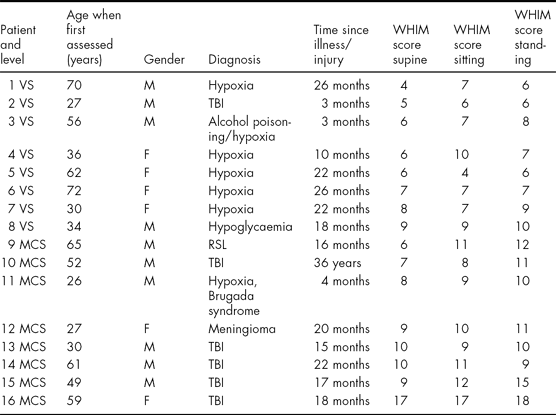
Patients were assessed at least three times in each position and the highest score in each position was the one recorded for this analysis. Patient details and scores are given in Table 1.
Patient Details and WHIM Scores
F, female; M, male; MCS, minimally conscious state; RSL, renal salt wasting disease; TBI, traumatic brain injury; VS, vegetative state.
Results
Twelve of our patients showed more behaviours when standing, compared to the supine position (75%, p < .05). Ten showed more behaviours when sitting compared to supine (63%, p = .32) and 11 patients showed more behaviours when standing compared to sitting (68.75%, p = .13). For people who had different sitting and supine scores, their higher score was more likely to be when sitting (p = .05). For people who had different standing and supine scores, their higher score was more likely to be for standing (p = .002). When data for the VS and the MCS patients are looked at separately, only four of the eight VS patients showed a higher standing compared to sitting score (p = 1.00), whereas seven of the eight MCS patients showed more behaviours when standing than when sitting (p = .07).
Figure 2 shows a comparison of scores for the VS and the MCS patients in each of the three positions. Figure 3 shows the mean scores and standard deviations for the VS and MCS patients in the three positions. The percentages of patients showing more behaviours in each of the three conditions are shown in Table 2.
Comparison of patients' scores in each position. MCS, minimally conscious state; VS, vegetative state.
Mean scores of minimally conscious state (MCS) and vegetative state (VS) groups (error bars = SD).
Percentage of Patients Showing More Behaviours in the Three Different Positions

MCS, minimally conscious state; VS, vegetative state.
Discussion
Our findings are similar to those seen in the Elliot et al. (Reference Elliott, Coleman, Shiel, Wilson, Badwan, Menon and Pickard2005) study. Both studies found that 75% of patients showed more behaviours when assessed in the standing position. The amount of difference found, however, was not as large as that seen in the Elliott et al. (Reference Elliott, Coleman, Shiel, Wilson, Badwan, Menon and Pickard2005) study, and this may well be because our patients were more chronic, with most sustaining their brain injury many months (or in one case 36 years) ago. Another possibility is that all people in the earlier study had sustained a TBI, whereas patients in the present study had several different reasons for their low awareness states. Nevertheless, our findings confirm that patients with disorders of consciousness are likely to be more responsive when assessed in an upright position.
The earlier study did not look at the effects of sitting and one question arising from those results asks whether there is a difference in responsiveness between lying, sitting and standing. We found that sitting increased the number of behaviours observed compared to lying down for 62.5% of the patients, while 68.75% of the patients were more responsive when assessed in the standing position compared to sitting. If we look at the difference between sitting and standing for the VS and MCS patients separately, we see that 50% of the VS patients and 87.5% of the MCS patients showed more behaviours when standing. It is important to ensure that it is safe to stand patients in low awareness states. For example, blood pressure readings should not contraindicate standing patients up. Nevertheless, where it is safe to do so, it may be wise to also observe patients in the sitting and standing positions so as to increase their level of awareness and to determine the best possible response for them.
Like Seel et al. (Reference Seel, Sherer, Whyte, Katz, Giacino, Rosenbaum and Zasler2010) and Bruno et al. (Reference Bruno, Vanhaudenhuyse, Thibaut, Moonen and Laureys2011) we strongly believe in appropriate assessment of patients in low awareness states. Based on results from the present study, we suggest that when patients are medically stable, an upright position will help to increase their level of alertness. Staff can gradually work on this during their therapy sessions. For example, feeding could commence with a semi-reclined position (45° angle); the tilt table could be used during grooming sessions and patients gradually taught to tolerate being upright. This would also give patients the opportunity to benefit from auditory and visual input through use of a mirror and spoken communication. It is very difficult to receive this input when being bed washed in a supine position. Use of verbal prompts and hand-over-hand guidance would add additional benefits in terms of tactile and proprioceptive feedback. In physiotherapy, patients could initially begin standing on a tilt table at 45° of inclination and then gradually progress up to 90°, depending on the level of tolerance. Adopting this approach would potentially enhance weight bearing and also help prevent the early onset of osteoporosis.
Conclusions
We have shown that 75% (p < .05) of patients score higher on the WHIM when assessed in the standing position compared to the supine position, thus confirming the findings of an earlier study. We also found that 62.5% of patients show more behaviours when assessed sitting (in a wheelchair) compared to being assessed in the supine position. Most VS (75%) and MCS (87.5%) patients in this study scored highest while in the standing position. Thus, when safe to do so, patients with disorders of consciousness are likely to be more responsive when they are not in the supine position.