Subsequent to the realization that anatomic repair was feasible, most institutions began to switch to the arterial approach over the 1980s because of its potential long-term benefits. In addition, mortality prior to repair was predicted to be decreased in those undergoing an arterial switch, since the operation was usually performed in the neonatal period. With the atrial switch, generally performed at several months of age, there was a small but important risk of sudden death and stroke while waiting for surgery. Early assessment of survival revealed that some institutions initially encountered higher mortality using the arterial switch, but the benefit in terms of survival of the atrial repair soon dwindled, such that by the late 1980s the arterial switch was almost universally the operation of choice for patients with transposition and intact ventricular septum.8 The Congenital Heart Surgeons Society reported on a large group of over 800 patients who had undergone surgery during the transition from atrial to arterial switch from 1985–1989.9 They found that survival improved over time. Importantly, the ongoing constant hazard for death was significantly less for those patients who had the arterial switch procedure. Survival after 17 years, however, was no different between the two groups.
The arterial switch operation, though not achieving complete anatomical correction, does effectively restore the cardiovascular physiology to a biventricular circuit in series, with a morphologically left ventricle as the systemic pumping chamber. The improved physiology, nonetheless, is achieved at the expense of transection of both great arterial trunks, incision into the neo-aortic sinuses and transfer of the coronary arteries, movement of the aorta posterior to the pulmonary trunk if using the LeCompte manoeuvre,10 and using the native pulmonary valve in the aortic position. Most early and mid-term follow up studies addressing systemic ventricular performance, the potential for the development of arrhythmias, and early sudden death after the arterial switch have established its functional advantages over atrial switch procedures.11–13 Despite these reassurances, the truly long-term outcome remains unknown. Past experience with other complex surgical procedures urges caution about final pronouncements, since the potential for later problems clearly exists.
The definition of long-term outcome is also variable, particularly when discussing congenital cardiac malformations, because most of the innovations in paediatric cardiac surgery have occurred only within the last fifty years. Patients who have survived the atrial switch are now reaching their fifth decade of life, while the oldest patients who have survived the arterial switch are now only entering their third decade. Thus, comparison between these two groups is generally not feasible, particularly with the knowledge that cardiovascular diseases afflicting adults, such as atherosclerosis and stroke, typically present in the fifth to sixth decade of life. Thus, some issues regarding the coronary arteries after arterial switch may not be truly apparent for several decades to come. It is clear that this population of patients may be vulnerable to morbidity, and potentially early mortality, as a result of the necessary but disruptive elements of the surgery.
Early complications of the arterial switch operation
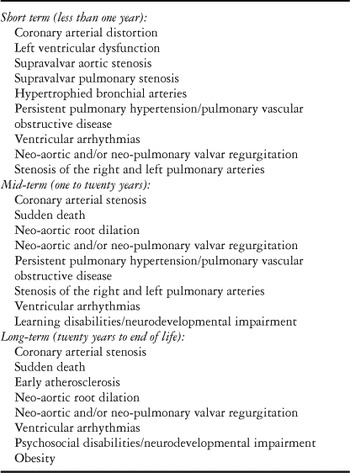
Though the focus of our review is long-term outcome, some of the short-term issues are also worthy of brief discussion. We will focus on the patients with transposition in the setting of an intact ventricular septum, as patients with ventricular septal defect often undergo other surgical procedures, such as the Rastelli operation. The short-term complications of the arterial switch operation are shown in Table 1. Though a good result is usual, there is a small risk for the development of obstruction at the suture lines of the newly constructed aorta and pulmonary trunk. These complications are typically identified early after surgery, within the first year of life, and can be treated with surgical revision, or in some cases of supravalvar pulmonary stenosis, by catheter-directed intervention.13 Early ventricular dysfunction is commonly seen in association with difficult coronary arterial transfer during the operation. Typical coronary arterial patterns associated with perioperative kinking or occlusion include single left or right coronary arteries, an intramural course, the mirror-imaged origin and course of the main arteries, or a retropulmonary course of the one of the major arteries.14, 15 Similarly, cases where the coronary artery arises superior to the sinutubular junction appear to be at higher risk for poor surgical outcome.16 As a result of the LeCompte manoeuvre, the long course of the pulmonary arteries as they pass anterior to the ascending aorta to the posterior pulmonary vascular bed may contribute to pulmonary arterial stenosis. Though usually mild, in some cases intervention is required to relieve this obstruction. In addition to these surgical complications, enlarged bronchial arteries can often be identified early after arterial switch, albeit having an unknown aetiology. Wernovsky et al.17 reported that slightly over half of patients had significantly increased bronchial flow one year after surgery. These dilated bronchial arteries may cause an undue volume load and eventual heart failure. There is also a subgroup of infants in whom the pulmonary vascular resistance never normalizes after birth. These children are at risk for the development of early pulmonary vascular obstructive disease and severe right ventricular dysfunction. Early mortality is common in this subset of patients.18
Table 1. Potential morbidity from the arterial switch operation.

General mid-term outcome
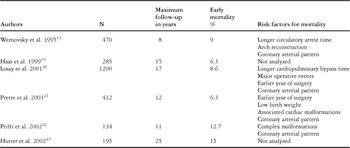
Since its initial acceptance as the primary treatment for transposition, mortality after the arterial switch procedure has been minimized by surgical experience, improved methods of coronary arterial transfer, and better pre-operative condition of the patients. In Table 2, we have listed studies that have assessed early mortality and its potential risk factors. These include coronary arterial pattern, complex anatomic combinations, longer periods of cardiopulmonary bypass and circulatory arrest, and earlier era of the procedure.13, 19–23 Despite acceptable early survival, the assessment of longer-term outcome over periods of 8 to 25 years in all of these studies reveals that there are some ongoing concerns, such as significant rates of re-operation for residual or recurrent obstruction to pulmonary flow, dysfunction of the neo-aortic valve and root, and coronary arterial obstruction, the latter often being identified only by coronary angiography (Table 1).
Table 2. Early mortality after the arterial switch operation.

Some would argue that prenatal diagnosis may improve overall survival and morbidity as a result of early recognition of critical disease with aggressive postnatal intervention. Bonnet et al.24 assessed such preoperative and postoperative morbidity and mortality in neonates with prenatal and postnatal diagnosis. They found that there was significant delay in admission in the infants diagnosed after birth, as well as an increased occurrence of metabolic acidosis and multi-organ failure in this group when compared to those diagnosed prenatally. Preoperative and postoperative mortality was also higher in those diagnosed after birth. Others have shown that mortality is not significantly decreased with prenatal diagnosis, but morbidity may be improved.25 These findings have significant implications not only with regard to early survival but because the perioperative morbidity associated with the arterial switch may impact on long-term neurodevelopmental outcomes.
Function of the neo-aortic root and valve
After the arterial switch operation, the pulmonary valve must function in the systemic position. In addition to the general concern that the pulmonary valve is not designed to perform as the neo-aortic valve, the arterial trunks are transected above the valvar complex, and two of the three sinuses are incised to accommodate the coronary arterial buttons. This complex suture line has potential deleterious implications with regard to vascular distensibility. In a very early report in the arterial switch experience by Sievers et al.,26 enlargement of the pulmonary root and diminished neo-aortic root distensibility was observed after the two-stage arterial switch operation incorporating previous banding of the pulmonary trunk. In this study, histologic examination of the neo-aortic wall revealed fragmentation and shortening of elastin fibers. More recently, Murakami et al.27 found decreased neo-aortic distensibility after the one-stage arterial switch, indicating that the procedure itself, and not previous banding, may lead to the abnormal dilation. Dilation of the neo-aortic root may impact on neo-aortic valvar function by altering regional stresses, possibly leading to valvar incompetence. Thus, neo-aortic regurgitation has also been investigated. In an early short-term study by Jenkins et al.,28 two-fifths of patients had neo-aortic regurgitation after a mean follow-up of 20 months.
Since these initial observations, dilation of the neo-aortic root and valvar regurgitation has been frequently reported in many longer term studies, such as that of Schwartz et al.29 They assessed 335 patients after a median follow-up of 5 years, and found that at 10 years only half were free from dilation of the neo-aortic root, defined as a z-score of greater than 3. Risk factors for dilation included previous banding, and a later time period during which the arterial switch was performed. Different surgical techniques, including excision of larger coronary arterial buttons, may account for the latter finding. For those few patients with severe dilation, defined as a z-score of greater than 8, multivariate predictors included presence of double outlet right ventricle, and the later time period for the operation. In Figure 1, we show the prevalence of neo-aortic regurgitation amongst the most recent long-term studies.30–34 In these studies, risk factors for root dilation include previous banding, presence of a ventricular septal defect, and anatomic subtypes such as Taussig-Bing anomaly.31–33 Predictors of neo-aortic regurgitation include the technique for coronary reimplantation, discrepancy in size between the arterial trunks, presence of ventricular septal defect, and rapid development of root dilation.31–34 In most of these studies, both neo-aortic root dilation and valvar regurgitation progress over time, and there have even been some reports of neo-aortic valvar repair or replacement after an arterial switch procedure.35, 36

Figure 1. Prevalence of neo-aortic valvar regurgitation in recent long-term studies after the arterial switch operation. Hutter et al.,30 144 patients, median follow-up of 8.6 years, Formigari et al,31 173 patients, median follow-up of 8.2 years. McMahon et al,32 119 patients, median follow-up of 5.4 years, Marino et al,33 number of patients not cited, median follow-up of 9.4 years, Hwang et al,34 103 patients, median follow-up of 6.4 years.
Outcome associated with the coronary arteries
One of the most significant concerns in the long-term after the arterial switch operation remains the fate of the coronary arteries. Potential mechanisms for coronary occlusion after any form of coronary translocation include anatomic distortion, extrinsic compression, stretching, and intimal proliferation. Early in the experience, it was recognized that the coronary arteries may become occluded. In a study that prospectively assessed the repair in 49 consecutive early survivors, two patients were found to have complete coronary occlusion, with adequate retrograde collateral perfusion of the myocardium.37 Tanel et al.38 reviewed the angiograms on 366 asymptomatic children, and found that 3 percent had previously unsuspected coronary arterial abnormalities, including occlusion, stenosis and fistulas. Of these patients, one died suddenly, but none of the others were symptomatic. Others have reported a prevalence of coronary arterial occlusion in almost one-tenth of children routinely undergoing cardiac catheterization after an arterial switch operation.39, 40 Though measures of myocardial perfusion using technetium and thallium-201 have been performed in several studies, the results have been quite variable, with some reporting significant perfusion defects even at rest.41–42 Acar et al.,43 for example, assessed myocardial perfusion compared to the gold standard of coronary angiography, and found that the perfusion study had a sensitivity of 78 percent and a specificity of 69 percent. Studies using positive emission tomography44, 45 have demonstrated that the reserve for coronary arterial flow may be decreased after the arterial switch, even in the absence of ischaemic symptoms. Since there may be no symptoms or evidence of left ventricular dysfunction in these children with coronary stenosis or occlusion, the prognostic significance remains unknown.
Innovative methods for detection of coronary arterial abnormalities have recently been reported, including multislice computed tomography, which appears to be quite accurate in detecting ostial and proximal coronary arterial stenosis.46 This method may become a good screening tool prior to cardiac catheterization. For now, selective coronary angiography remains the most accurate method with which to diagnose structural coronary arterial abnormalities, which are often identified in patients with no symptoms or significant risk factors for poor outcome.15, 47
The anatomical pattern of the coronary arteries is more variable in the setting of transposition than in many other congenital cardiac malformations.48 These variations, along with an already abnormal course, since almost always the aorta is anterior to the pulmonary trunk, make the surgical translocation of the coronary arteries all the more challenging. Several studies have assessed the impact of coronary arterial pattern on outcome. Early results of the arterial switch revealed that a single right coronary artery, or mirror-imaged pattern of the sinusal origins, appeared to be at higher risk for poor outcome.49 These patterns result in the arterial supply to the left ventricle passing posterior to the neo-aorta, with possible tension on the artery. Hutter et al.,47 however, did not find the coronary arterial pattern to be a predictor of early mortality or late morbidity in their series of 170 patients, but only two in the group had an artery with an intramural course. A recent meta-analysis of nine independent series,50 encompassing almost 2000 patients, showed that overall mortality for those with any variant coronary arterial pattern was almost twice that seen in patients with the usual pattern. Single coronary and intramural patterns were associated with significantly higher risk of death. Sachweh et al.51 addressed specifically the topic of an intramural course. Of their five patients with an intramural course who underwent an arterial switch, none died in the perioperative period, but three demonstrated coronary artery occlusion on follow-up angiographic studies. Exercise stress tests and myocardial scintiscans were also abnormal in these patients. Of the three, two underwent successful internal mammary arterial bypass.
In addition to the coronary stenosis and occlusion that has been observed after the arterial switch, some investigators have assessed coronary arterial function. From the literature reported on patients with Kawasaki disease, it is known that myocardial flow reserve can be diminished after regression of coronary aneurysms.52 Recently, this finding has also been demonstrated in children who have undergone the arterial switch operation. Gagliardi et al.53 found that epicardial coronary arterial dilation in response to intracoronary nitroglycerin, and coronary blood flow volume reserve, are significantly reduced compared to normal controls. Intracoronary ultrasound has also detected potentially ominous findings in the arteries of children after the arterial switch operation. In a recent report on 20 asymptomatic children who underwent cardiac catheterization along with intravascular ultrasound of the coronaries anywhere from 5 to 22 years after surgery, almost nine-tenths of the arteries assessed demonstrated variable degrees of proximal eccentric intimal proliferation.54 All children had affected arteries, and there was no particular risk factor associated with these findings, including age, original coronary arterial pattern, or duration of follow-up. These abnormal findings are concerning, because intimal proliferation is a known, early precursor to the development of atherosclerosis.55 In addition, coronary angiography may not detect intimal proliferation because the luminal patency is preserved.54 The impact of adult lifestyle, obesity, smoking, hypertension and hypercholesterolemia on patients who have had the arterial switch operation remains to be seen.
Growth and development
In general, children who have undergone the arterial switch operation have not demonstrated any delayed growth. In the Boston Circulatory Arrest trial,56 the mean height was 54th percentile and the mean weight was 59th percentile amongst 8 year old children. There is no published study regarding short stature in children with transposition, albeit that recent evidence suggests that obesity is quite prevalent in this population. Of 38 randomly selected outpatients who have undergone an arterial switch operation at The Children's Hospital of Philadelphia, one-quarter were either overweight or obese. This data is consistent with a larger study from Pinto et al.57 They showed that one-quarter of outpatients with congenital heart disease, at a mean age of 12 years, and who had undergone a biventricular repair, were either overweight or obese, this not being significantly different from the general population of children in the United States of America. In other countries, where obesity is not a major paediatric health problem, the prevalence of obesity in children with transposition may be lower.58 Massin et al.59 recently examined patterns of physical activity amongst children 7 to 14 years after the arterial switch operation. They found that these children were significantly less active than their healthy peers, with only one-fifth and one-quarter, respectively, engaging in moderate or vigorous activity daily. The observation that after an arterial switch operation, children are at risk for obesity, and have diminished physical activity, is particularly disturbing because of the potential for early atherosclerosis and abnormal coronary vascular reserve.
Neurodevelopmental outcome after the arterial switch has been an area of extensive investigation over the past two decades. This has been an ideal population to study because of the near normal post-operative physiology, nearly universal early recognition of the disease with neonatal repair, and low incidence of genetic or congenital neurological abnormalities. The Boston Circulatory Arrest Trial, which began in 1988, randomized children undergoing an arterial switch to predominantly circulatory arrest compared to predominantly low-flow cardiopulmonary bypass during the repair. Serial neurodevelopmental evaluations have been reported at periodic intervals60 up to the age of eight years, and testing is ongoing in adolescence. Assessment of patients at the age of four revealed that the group having circulatory arrest were more likely to have abnormal motor function, including gross motor, fine motor and speech skills, but not lower measured intelligence or the ability to perform cognitive tasks.61 Overall, the level of intelligence for the total cohort was lower than the normal population with performance scores lower than verbal scores. This same group was restudied at eight years of age, when academic achievement could be measured. Though both groups performed equally well in reading and mathematics, the group undergoing circulatory arrest performed worse in motor function activities such as manual dexterity, handwriting, and speech, while the group assigned to low-flow bypass had more difficulties in the areas of behaviour and attention.56 Others have assessed the neurodevelopmental state in children after the arterial switch, and found that risk factors such as preoperative acidosis and hypoxia predicts reduced motor function, while longer bypass time predicts global neurologic and speech abnormalities.62
Assessments of general health and quality of life have also been performed on this population. The overwhelming majority of children and adolescents who have undergone the arterial switch operation experience good overall health and quality of life that is not significantly different from their peers.58, 63, 64 Dunbar-Masterson et al.63 reported that, at eight years of age, the only risk factor for poor psychosocial health status was lower intelligence and academic achievement, while longer hospital course was associated with a worse state of physical health. They also found that the psychosocial state of health was worse in children after an arterial switch than in those with asthma or juvenile rheumatoid arthritis, but better than in those with attention deficit hyperactivity disorder. Parents reported a higher frequency of learning and attention problems as well as a higher rate of developmental delay than normal controls.63 In a study from the Congenital Heart Surgeons Society64 that examined quality of life of children with transposition undergoing various surgical repairs, the arterial switch was associated with higher scores in physical functioning, pain, mental health, self-esteem and general perceptions of health than those who had undergone either Rastelli or atrial switch operations. In this report, quality of life and health status as perceived by the children 11 to 15 years after repair was excellent overall when compared to normative data. Intriguingly, though the children perceive that they have good quality of life, their parents often report problems. Hovels-Gurich et al.,65 for example, assessed 60 children who had undergone the arterial switch operation using combined deep hypothermic circulatory arrest and low flow cardiopulmonary bypass at ages from 8 to14 years. They found that the children themselves reported good quality of life, but the parents reported significant behavioural problems, including anxiety and aggression. These children also tended to do worse in school, although on average they had normal intelligence. Reduced social competence was associated with neurological damage. In multivariate analysis, severe preoperative hypoxia was associated with social problems as reported by the parents. These studies generally show that quality of life after the arterial switch operation is quite good, and possibly better than that after the atrial switch, but psychosocial deficits are fairly common, with parental perception being worse than self-perception of the children. The prevalence of such psychiatric disorders as schizophrenia, manic depression, and depression remains to be seen, as these disorders often present in the third to fourth decade of life.
Conclusions
At present, we must conclude that the arterial switch operation is indeed as good as we thought it would be. It provides satisfactory postoperative haemodynamics, at a low early mortality, with few residual cardiac lesions, a small rate of re-operation, minimal significant arrhythmias, and overall a good quality of life. It must continue to be the operation of choice for children with simple and complex forms of transposition. Despite these reassuring results, there remain some areas of concern with regard to truly long-term outcome, in particular with respect to the coronary arteries and neo-aortic valve. As these patients enter their third decades and beyond, they should be counselled regarding healthy life-style, which will minimize the risk of coronary arterial disease, including diet, exercise, and the avoidance of cigarette smoking. Screening for hypertension will be particularly important, as this may impact both on risk for damage to the coronary arteries and neo-aortic valve. It must be emphasized to patients that no cardiac surgical procedure is truly corrective, and that life-long cardiovascular follow-up will be necessary to screen for known, and potentially unexpected, late complications of the repair.