Climate change poses significant new challenges to the humanitarian community. Global climate change is expected to bring not just gradual trends in temperature and rainfall patterns, but also more extreme and unusual weather events. This is likely to increase the need for humanitarian services, not only in terms of disaster response and recovery but also in terms of disaster preparedness, risk reduction, health, water and sanitation, food security, and shelter. Humanitarian organizations will need to review their operations, strategic planning, and the need for awareness-raising and communication. Despite the growing scientific evidence about observed and projected changes, a majority of extremely vulnerable people lack sufficient understanding of what climate change is, how it is likely to affect their lives and livelihoods, and what can be done to minimize the new risks. Much can be done, including by the Red Cross and Red Crescent Movement, to bridge the gap between knowledge and action, and to scale up implementation of strategies to manage changing climate risks.
This article reviews some of the efforts to address the changing risks in the context of the Red Cross and Red Crescent, specifically in disaster risk management. It focuses on recent experiences and insights derived from the use of scientific information in humanitarian practice: to anticipate climate-related hazards, and to link warnings across timescales with appropriate preparedness actions. This approach fits broader trends in the humanitarian sector, which is firmly moving towards more preventive approaches.
It should be noted that one responsibility of humanitarian organizations is to reflect on the humanitarian consequences of climate change and to highlight these in national and international climate-change policy processes, including in the context of the United Nations Framework Convention on Climate Change. This element is not addressed in detail in this article; instead we focus on the operational side: how can the impact of rising risks be reduced in humanitarian operations by making better use of climate information across different timescales?
The article is structured as follows: first we offer some background information on climate change and its implications for the Red Cross/Red Crescent. Then we present an approach to climate risk management that uses climate information across timescales to enhance preparedness and response. Thirdly, we suggest ways to integrate climate-related risks into Red Cross/Red Crescent work at community level. This is followed by an example illustrating how climate information across timescales, including seasonal rainfall forecasts, was used in humanitarian decisions in West Africa in 2008. The next section briefly discusses climate risk management as it relates to health. We then assess how more effective humanitarian work in all of these areas requires targeted capacity building, illustrated through the Preparedness for Climate Change programme for national Red Cross and Red Crescent Societies, and the partnership between the International Federation of Red Cross and Red Crescent Societies (IFRC) and the International Research Institute for Climate and Society, followed by a section exploring opportunities for stronger linkages between humanitarian organizations and knowledge institutes.
Climate change and impacts on humanitarian work
Evidence of climate change is being seen throughout the globe. People, particularly in vulnerable populations, are already being affected. Adapting to the climate as it changes over time, and as it is influenced by natural climate variability, requires that we stay informed of how risks might be changing, not just towards the year 2100 – the traditional focus of climate-change projections – but also in the next decades, years, months, weeks, and days ahead. For the Red Cross/Red Crescent, adapting to climate change is not a new, stand-alone activity, but something that requires a stronger focus on disaster-risk-reduction efforts, explicitly incorporating knowledge of changing risks, and capacity building to integrate new and changing climate-related risks into regular disaster-management, water and sanitation, health, and other programmes.
Global surface temperatures rose by over 0.7°C during the twentieth century – making it the warmest period in at least the last 1,300 years. Climate change is also accelerating: ‘January 2000 to December 2009 was the warmest decade on record’.Footnote 1 Along with the planet's rising temperature, known as global warming:
— Glaciers have been melting, increasing the risk of lake-burst floods and threatening the water supply of millions of people;
— Rainfall patterns have changed, including decreases in tropical, subtropical, and Mediterranean regions, and increases in average precipitation in temperate regions such as parts of North America, northern Europe, and central and northern Asia;
— The frequency and intensity of extreme rainfall and snowfall events have been rising, along with the number of droughts.Footnote 2
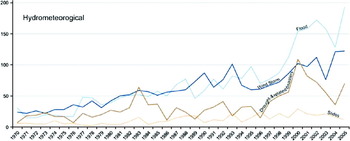
At the same time, there has been a large rise in the number of disasters (from between 200 and 250 in the period 1987–97 to about double that in the first seven years of the twenty-first century).Footnote 3 This rise in disasters is caused almost entirely by an increase in weather-related disasters (see figure 1). Disaster statistics also show that floods are not just occurring more often but also damaging greater areas than they did two decades ago. Moreover, these rises are accompanied by a rapid increase in socio-economic losses and in the number of people affected: on average 250 million people a year, up by more than 30% in just one decade. Although, since the 1970s, the number of people killed by natural disasters has decreased, largely due to better disaster preparedness, ‘in the past years, that decrease has been tapering off and even reversing’.Footnote 4 While this increase in disasters is largely due to other reasons, such as rising vulnerability and rising numbers of people and value of assets at risk, there is growing concern that climate change is already contributing to these growing humanitarian challenges.
Annual number of weather-related disasters. From International Strategy for Disaster Reduction, Disaster Statistics, Trends-Period 1991–2005, available at: http://www.unisdr.org/disaster-statistics/occurrence-trends-period.htm (last visited 28 September 2010).

Based on six scenarios of greenhouse gas emissions, the Intergovernmental Panel on Climate Change (IPCC) projects that by 2100 the earth's average temperature will have increased anywhere from 1.1°C–6.4°C.Footnote 5 Sea levels could rise by as much as one metre,Footnote 6 and an intensification of the hydrological cycle in a warmer atmosphere is expected to make floods and droughts more frequent and intense.Footnote 7 While no single weather event can be directly attributed to climate change, we do know that, on the global scale, different conditions in the climate are contributing to the rising risk of certain disasters.Footnote 8
Climate change is caused by the build-up of greenhouse gases in the atmosphere, and so far our current emissions of these heat-trapping gases are growing faster than the most pessimistic scenario used in IPCC projections. While cutting back our emissions is imperative to prevent the worst long-term consequences of climate change, we know that, even if all emissions stopped today, we would still have some climate change. The greenhouse gases already emitted will stay in the atmosphere for decades, trapping additional solar energy in the Earth's system. Therefore, we have to be ready to cope with climate-change impacts, which will disproportionately affect developing countries and poor people throughout the world.Footnote 9
Climate change clearly has implications for Red Cross/Red Crescent work related to disaster management, food security, livelihoods, health, water, sanitation, and support in times of social instability:
— Disaster management: the Red Cross/Red Crescent will need to respond to and help vulnerable populations prepare for new patterns of disasters such as floods, droughts, heatwaves, tropical cyclones, brush fires, and coastal inundation.
— Food security and livelihoods: while initial climate change is expected to have some agricultural benefits in cooler climates, increased temperatures, more conducive conditions for pests, changing rainfall patterns, and increased damage from floods, droughts, and storms are expected to have adverse consequences on agriculture in many parts of the world, particularly as climate change progresses and temperatures surpass productive thresholds for crop yields.Footnote 10
— Health: higher temperatures, changing rainfall patterns, and more intense rainfall events may increase water-borne and vector-borne diseases and bring them to new areas. Places that experience decreased food and water availability may suffer from health effects of poor nutrition and hygiene. An increase in extreme events, such as floods and heatwaves, will also have direct implications on health.
— Water and sanitation: water availability is likely to change in many areas, owing to changing rainfall patterns. Increased occurrence of rainfall extremes could result in a lack of water for proper sanitation during droughts, and the contamination of clean water sources during floods.
Using scientific information, bridging timescales
Although many of the worst climate-change projections are many decades away from being realized, evidence of climate change is becoming increasingly visible throughout the world. The most vulnerable groups are often worst affected by the rising risks. In order to address these rising risks, the best approach is not to focus solely on long-term projections of global warming, as often supplied by computer models used to study global climate change. Instead, part of the solution lies in reducing risk here and now, simply by enhancing resilience to a range of current and future risks, and improving our ability to anticipate and respond to risks when they occur. In those efforts, the Red Cross/Red Crescent can make use of relevant information – not primarily the projections for 2100, but the best information about the risks for the coming decade, year, season, month, day, or even hour, including both natural climate variability and the growing impact of global warming.
The use of predictions in disaster risk reduction is not a new concept. Weather forecasts for temperature, precipitation, and wind are commonly issued on short timescales of days to hours, informing Red Cross/Red Crescent offices and others when to anticipate extreme weather events such as floods and tropical cyclones. Thanks to advances in observational capacity, scientific understanding, and computer modelling of the climate system, there is also an increasing capacity to provide forecasts with longer lead times, of the order of several months ahead (albeit only for some parts of the globe). The information contained in such longer lead-time forecasts always has a degree of uncertainty, and is given in general terms. For instance, a seasonal forecast can predict the likelihood that a coming rainy season will be wetter or drier than normal, and thus be a helpful guide to anticipate impacts, for instance when reviewing seasonal contingency plans. However, when an alert for a heavy rainfall or storm season is issued, one of the key follow-ups will be to monitor forecasts on shorter timescales (such as monthly, ten-day, weekly, and daily weather forecasts) even more closely, to obtain more precise information regarding where and when extreme weather events might occur.
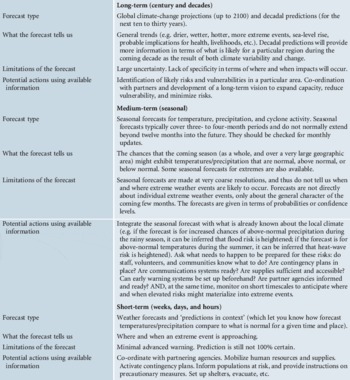
Monitoring forecasts across long, medium, and short timescales can allow co-ordinators of Red Cross/Red Crescent programmes, including disaster management, food security, water and sanitation, health, and livelihood support, to obtain an overall picture of the likelihood of various risks for advanced preparation, and then use forecasts on shorter timescales to anticipate impacts more precisely. Table 1 illustrates the different timescales of forecast information, indicating what the forecasts at various timescales can and cannot tell us, along with the different types of actions that could be triggered by the forecast information along the way.Footnote 11
Indications of types of forecast at different timescales.

These ideas are captured in the concept of ‘Early warning, early action’, defined by the IFRC as ‘Routinely taking humanitarian action before a disaster or health emergency happens, making full use of scientific information on all timescales’.Footnote 12
Incorporating climate change risks into community-level work
In addition to early warning systems and improved preparedness, the Red Cross/Red Crescent throughout the world carries out the important task of reducing disaster risk by making people aware of the hazards they face and helping them to reduce their own vulnerability. Climate change makes this work even more urgent. At the community level, many simple measures can be taken to reduce disaster impacts. The Vulnerability and Capacity Assessment (VCA)Footnote 13 used by the Red Cross/Red Crescent, is a comprehensive set of tools to help communities assess and address local risks, and many climate-related risks are already addressed through such community-based disaster-risk-reduction efforts. For example, if a country suffers from hurricanes and takes action to reduce the population's vulnerability to hurricanes through evacuation plans or better-constructed roofs and so forth, as an indirect benefit they will also be more resilient to increases in hurricane strength due to climate change.
By integrating climate-change information and ideas directly into the participatory process, VCAs can also facilitate opportunities for communities to adjust their risk-reduction efforts to manage new or increasing risks. For example, communities unaccustomed to heat waves, but projected to have them in the future, may want to develop plans to ensure that community members take precautions to stay cool and hydrated in case of unusually warm weather. Also, by addressing a current climate risk that is likely to continue or worsen in the future, community resilience can be built. In Bangladesh, knowing that more frequent and intense flooding events are likely to be part of a longer-term climate-change trend, Red Crescent volunteers started a nursery of trees to be planted along river banks and road sides. This simple measure aims to mitigate flood impacts by absorbing water and stabilizing soil.Footnote 14 Similarly, subsistence farmers in the Malawian village of Mphunga in southern Africa helped with an innovative approach to promote adaptation to climate change: in the context of a risk-management project involving the Malawi Red Cross and Meteorological Services, these farmers learned the basics of operating a video camera and structuring a script, and made a short film on how to manage climate-change risks. The video was screened in neighbouring communities and accelerated the dissemination of climate-adaptation measures.Footnote 15
Another example of integration between climate science and community-level work is illustrated by an innovative approach to bridging the gap between knowledge providers and local communities. With the support of the IFRC West and Central Africa Zone Office, the Climate Centre designed and facilitated an Early Warning, Early Action workshop in December 2009 in Saint-Louis (northern Senegal).Footnote 16 This four-day event convened thirty-five participants, including Senegal Red Cross staff working at various geographic scales (from headquarters to community volunteers); scientists who develop predictions of various climate-related hazards at different timescales, and who represent all geographic levels of forecasting (from global to district level); disaster managers from Benin, Burkina Faso, Mali, and Togo; and representatives from a nearby vulnerable community. Through a series of innovative activities, including learning sessions in very small groups, specially designed games,Footnote 17 and a visit to the flood-prone village of Doune Baba Dieye, this workshop helped to establish the foundations for three early warning systems addressing various threats in Senegal, as well as to improve the use of predictions for humanitarian decisions. A set of similar workshops is planned for 2010 in other regions.
Case study: early warning, early action in the 2008 West Africa flood season
One of the best documented efforts by the Red Cross/Red Crescent to implement early actions based on a seasonal rainfall forecast, comes from the IFRC West and Central Africa Zone (WCAZ) flood-preparedness efforts in 2008.Footnote 18
Floods across Africa in 2007 were the worst in several decades. Hundreds of thousands of people were displaced in nearly twenty countries. Nearly 300 died as a direct consequence of the flooding, which came in the wake of several relatively heavy flood seasons since 2000. This appeared to fit a pattern of increasing rainfall variability, possibly related to global warming, and clearly a concern for the Red Cross/Red Crescent in the region. However, long-term projections provide little guidance in this region – even annual average rainfall may go up or down. All the region could do was to be better prepared for a wider range of risks, and in particular to make use of information at shorter timescales – not merely waiting for more disasters to unfold. By 2008, the zone office was regularly monitoring seasonal climate forecasts. In May 2008, seasonal forecasts issued for West Africa showed enhanced probabilities of above-normal rainfall during the upcoming rainy season. After having been caught off-guard by devastating floods in 2007, the WCAZ Office decided to take action based on the seasonal forecast, to improve flood management and response in advance.
The first action that the WCAZ Office took was to hold a flood-preparedness meeting. A major outcome of this meeting was an action plan to develop country-specific risk maps, contingency plans, Early Warning Systems (EWS), partnerships, and better co-ordination for preparedness and mitigation of impacts. The WCAZ Disaster Management Coordinator also attended the forum for Seasonal Prediction in West Africa (PRESAO). By attending the forum, the WCAZ Office helped climate scientists to understand the needs of disaster managers for forecast information, and formed partnerships with producers of forecast information. These partnerships allowed forecast information to reach disaster managers directly, and also provided the WCAZ Office with technical support to interpret forecasts.
Additionally, the WCAZ Office held a training session for leaders of Regional Disaster Response Teams. Team leaders were equipped with coordination and management skills, including how to conduct rapid needs and impacts assessments, how to write flood-contingency plans and funding requests, and how to mobilize and manage human resources, as well as logistical, financial, and administrative procedures. Furthermore, team leaders learned how to monitor rainfall forecasts. Logistical preparations were also made, such as securing visas and medical insurance, so that deployment of team leaders to National Red Cross/Red Crescent Societies (National Societies) could be expedited.
In early July 2008, after receiving the updated seasonal forecast from the African Centre of Meteorological Application for Development, the WCAZ Office issued its first-ever emergency appeal to precede a probable disaster based on a seasonal rainfall prediction. Traditionally, emergency appeals provide funds for disaster response during and after the climate-related event that triggers the crisis. But, as a result of capacity-building efforts that heightened awareness of the potential of science-based information, a different approach was taken on this occasion. Based on the experience of past flood seasons, the WCAZ Office could anticipate the needs of flood victims. Floods cause people to be displaced from their homes and to require support through the provision of food, potable water, and household items. Therefore, the WCAZ Office knew that houses would have to be rebuilt or repaired, water sources would be contaminated, and sanitation facilities would be rendered inoperable. Crops would be ruined, and access to markets, health care, and other essentials would be minimal owing to collapsed or submerged roads and infrastructure. The risk of waterborne diseases and malaria would be heightened. The need for Red Cross/Red Crescent kits for water and sanitation, cooking, and shelter could be high. Knowing that relief supplies commonly take two to three weeks to arrive from the logistics unit in Dubai, the WCAZ Office sought funds to prepare to meet these needs in advance of the likely event of floods – the first time ever that an emergency preparedness appeal was issued based on a seasonal forecast.Footnote 19
While the donor community did not immediately respond to an appeal for funds for a disaster that had not yet struck, the WCAZ Office was able to access funds from the IFRC Disaster Relief Emergency Fund (DREF). This fund, intended for small-scale or rapid start-up of relief activities, can also fund operations on the basis of ‘imminent crises’,Footnote 20 in this case to initiate preparedness activities and pre-position the emergency stocks around the region. Non-food items such as blankets, kitchen sets, soap, water and sanitation kits, cholera kits, and tents were pre-positioned in three warehouses around the region – in Dakar (Senegal), Yaoundé (Cameroon), and Accra (Ghana). In 2008, pre-positioning stocks allowed beneficiaries' needs to be met within twenty-four to forty-eight hours, as opposed to waiting more than forty days for relief items in 2007. As a result, lives were almost certainly saved and suffering minimized by the substantially reduced waiting time for basic shelter, cooking supplies, water and sanitation, and so forth.
When forecasts for heavy rainfall indicated the possibility of excess water spillage from Bagre and Kopienga reservoirs in Burkina Faso, early action was taken downstream in Ghana to avoid a repeat of the dam spillage and flooding that occurred in 2007. A controlled release of the dam waters was agreed upon, and a two-week warning was issued prior to the release. The Ghana Red Cross Society (GRCS) took full advantage of this warning, mobilizing volunteers to raise awareness about potential risks, hazards, and vulnerabilities in advance of the Bagre dam release. GRCS volunteers informed communities not to go near the river banks during the scheduled spillage of the dam, significantly contributing to the reduction of lives lost to flooding, from more than thirty in 2007 to two in 2008.
In Togo, the National Society trained thirty-eight new disaster-management trainers to build capacity within its volunteer base. It also developed an early warning communication system, which enabled the small community of Atiégou Zogbédji (population 2000 people) to evacuate just before flooding. Owing to the early warning system, physical damage occurred without loss of life. The Gambia Red Cross Society also held its own training of trainers. As a result of this training and preparation, the Gambia Red Cross Society was able to perform a post-flood needs assessment and submit a funding request within two days of flooding.
Anecdotal evidence from WCAZ Office suggests that, in 2008, there was a lower reliance among National Societies on international support through the DREF, owing to the investments made in advance that enabled National Societies to mobilize local resources and be ready to respond quickly. A preliminary quantitative comparison between the cost of flood response alone (2006 and 2007) and the cost of flood response with early action (2008), showed a 33% lower cost per beneficiary when these early actions were taken.Footnote 21
Implications for health risk management
Climate change also affects health risks. For instance, diarrhoeal diseases are frequently triggered by either extreme rainfall and flooding, or degraded water quality in times of drought. Early warning systems can help to trigger precautionary measures related to water and sanitation. Better collaboration among staff working on disaster risk management, health, and water and sanitation can maximize the impacts of better use of climate information across timescales. Furthermore, stronger dialogues with national meteorological services can help enhance the provision of targeted and understandable climate information and operational early warnings for specific health applications.
Another example is vector-borne diseases. While the increases in dengue cannot be directly attributed to global climate change, dengue incidence clearly has a climate component (particularly the spread of mosquitoes), and a changing climate means changing risk of such diseases. Climate risk and dengue surveillance information can be applied to initiate and target community dengue-reduction programmes. In this case, the key notion is not just early warnings ahead of any dengue incidence but also early detection in particular. Improving surveillance systems to detect changing disease patterns can help to guide preventive interventions. Such measures at the community level in collaboration with local health authorities might include removal of mosquito breeding sites, or use of larvicide or guppy fish in water containers. Community awareness-raising can also help people take precautions to prevent mosquito bites and to identify dengue symptoms, so that they know when to seek care.
Enhancing capacity for better climate risk management
As described above, climate change poses new challenges to the Red Cross/Red Crescent, challenges that require new ways of working, including making better use of climate information across timescales, integrating changing risks in community-level risk assessments and disaster risk reduction, and assessing the health implications of climate change. Such efforts require new approaches for assessing and addressing risks in plans and programmes, use of new channels of knowledge, and new capacities of staff and volunteers. This section describes two initiatives to enhance the capacity for climate risk management in the Red Cross/Red Crescent: a programme to help National Societies assess and address changing risks in their plans and programmes, and an example of innovative partnerships with scientific institutions.
Preparedness for Climate Change in National Red Cross and Red Crescent Societies
A specific programme designed to build the capacity of National Societies to manage the increased risks and mitigate the humanitarian consequences of climate change is the Preparedness for Climate Change (PfCC) Programme offered by the Red Cross/Red Crescent Climate Centre.Footnote 22 From 2006 to 2009, thirty-nine National Societies participated in the first phase of the programme. In 2010, a second phase of the programme is enabling an additional twenty-five National Societies to participate. The programme offers a guiding framework for them to take the first step in identifying country-specific climate-change risks, vulnerabilities, partners, resources, and necessary actions.
The PfCC Programme involves four key elements:
a. organizing a workshop on the risks of climate change for Red Cross/Red Crescent staff;
b. assessing the risks of climate change in the country and the priorities and programmes of the National Society through production of a background document;
c. capacity building for climate-resilient Red Cross/Red Crescent programmes through exchanging experiences with other National Societies and partners in a regional workshop on climate change and disaster risk reduction;
d. developing climate-change-resilient Red Cross/Red Crescent plans and programmes.
The programme prioritizes participation by developing countries. In phases 1 and 2 of the programme, participation involved twenty-two countries in Africa, nineteen in Latin America and the Caribbean, sixteen in Asia and the Pacific, and seven from Europe, Central Asia, and the Middle East.
While each National Society takes a country-specific look at climate change impacts likely to occur, a survey of the risks identified in each region during phase 1 of the programme revealed consistent themes in terms of key categories of concern:
— Rising Temperatures
— Increased Rainfall Variability (more floods and droughts, less predictable rainfall patterns)
— Water Scarcity
— Impacts on Agriculture and/or Food Security
— Challenges to livelihoods
— Health Impacts
— Sea Level Rise/Damage to Coastal Communities and Infrastructure
— Stronger Storms and Hydro-meteorological Events
— Droughts, Desertification and Fires.Footnote 23
Initial ideas for action upon identifying these risks were unique to each National Society, but they also shared some common themes. Most commonly, National Societies recognized the need to work in partnership with government, knowledge centres, and stakeholders within relevant sectors to pursue climate-change adaptation projects and policies. The need to raise awareness about climate change among the public, vulnerable communities, and Red Cross/Red Crescent staff and volunteers was also frequently expressed by National Societies. The third most common area for action was capacity building and planning within the National Societies, to manage increased climate-related risks. Other shared ideas for action included a greater focus on: water and sanitation programmes, health programmes, vulnerability assessments, early warning systems, food security programmes, support for adaptive agriculture practices, protecting coasts, incorporating climate change into Red Cross/Red Crescent policies, and strengthening livelihood support programmes.Footnote 24
National Societies surveyed after phase 1 of the programme reported that they:
— are making changes to their work, programmes and policies as a result of going through the PfCC process;
— are making changes to plans and strategies after learning of the risks during the PfCC process;
— believe that the work they accomplished during the PfCC will be continued and sustained;
— need further external assistance;
— would recommend PfCC to other National Societies;
— would participate in the programme again if given the opportunity;
— have formed new partnerships with universities, NGOs, government agencies such as meteorological agencies and environment departments.Footnote 25
In response to feedback from phase 1 of the programme, innovative projects developed as a result of thinking about the implications of climate change for National Societies' plans and programmes. Designed to reward innovation and pilot approaches that can be studied and scaled up, the Innovations Fund recently awarded small grants to thirteen National Societies.Footnote 26
Partnerships with scientific institutions
An efficient flow of information and knowledge about new patterns of hazard and vulnerability is an essential part of the enabling environment that allows efficient allocation of scarce resources to people and regions that face higher threats. Red Cross/Red Crescent offices covering global, regional, national, and sub-national levels are beginning to form partnerships with scientific institutions with the aim of increasing their capacity to manage changing climate risks. These partners may vary from regional intergovernmental entities such as the African Centre of Meteorological Applications for Development (ACMAD) to national meteorological and hydrological services to university departments with sector- or country-specific climate-change expertise. Every partnership will look different depending on the needs of particular Red Cross/Red Crescent offices and the capacities of the scientific institutions.
One example of such a collaboration is the ‘Partnership to Save Lives’ that was formed between the IFRC and the International Research Institute for Climate and Society (IRI) at Columbia University's Earth Institute. The IRI supports the Red Cross/Red Crescent through three main components: online map rooms, IRI graduate student internships, and a help desk through which climate scientists provide rapid responses to questions from Red Cross/Red Crescent staff on matters related to forecasts, weather, and climate.
Map rooms with precipitation forecasts in context
In early 2008, the IRI designed an online map room specifically for use by the IFRC's Geneva headquarters, including incorporation into the IFRC Disaster Management Information System (DMIS). The map room was created as a first step in responding to the request for global predictions in context. Monitoring forecasts on the global level, it was difficult to know in Geneva whether a forecast for 200 mm of rainfall, for example, indicated normal or anomalous conditions for a given region during a specific time of year. In response, the IRI developed a map room that displays precipitation forecasts in the context of how the rainfall amount forecasted compares to typical rainfall for the given location and time of year. The tool also displays forecasts on multiple timescales: three-month periods and one- to six-day forecasts. Access to the map room is available through the DMIS.Footnote 27 When a forecast for extreme rainfall is detected, the relevant zone, regional, or national office, is encouraged to ask local meteorological and hydrological information providers for further information on the likelihood, timing, location, and severity of any threatening conditions.
A ‘Haiti Weather and Climate Risk’ website was also created, following the January 2010 earthquake in Haiti. Given Haiti's heightened vulnerability to rainfall, floods, and hurricanes, disaster managers wanted to know the seasonal outlook for Haiti and to have information that would inform the selection of locations for longer-term shelters, such as areas with high risk of floods, landslides, and strong winds affecting those at risk, including people in shelters. The IRI worked with the IFRC, the United Nations Office for the Coordination of Humanitarian Affairs, and numerous other partners to identify available information pertinent to disaster managers' needs, filter out overly technical products, provide explanatory text, and feature selected information in a central location for ‘one-stop-shop’ monitoring of forecasts and risks.Footnote 28
Internships
Graduate students from the Climate and Society masters programme at Columbia University are working to support Red Cross/Red Crescent offices to anticipate and manage climate-related risks. The twelve-month masters programme trains professionals and academics to understand and cope with the impacts of climate variability and climate change on society. The IRI has been central to both the design of the programme and the teaching of its students. To date a total of eighteen students have fulfilled their internship requirement by supporting the Red Cross/Red Crescent – and at least four of them continue to work on climate risks with various entities within the Red Cross/Red Crescent movement.
In 2009, ten of these students conducted surveys, interviews, meetings, and workshops over a two-month period in order, first, to better understand the humanitarian needs for, and current use of, weather and climate information; and, second, to formulate recommendations for information providers and Red Cross/Red Crescent users alike, so that forecasts across timescales can be communicated, interpreted, and utilized in a more effective and timely manner. Their findings and recommendations were presented at a side event at the 2009 World Climate Conference-3 in Geneva.Footnote 29 Thus, the internships have not only supported Red Cross/Red Crescent offices in climate risk management efforts, but have also contributed to global discussions on a framework for climate services.
Help desk
The IRI also provides the Red Cross/Red Crescent with support through a help desk, through which climate scientists respond within twenty-four hours to inquiries from Red Cross/Red Crescent staff regarding climate, weather, and forecasts. During its first full year of operation, the help-desk team responded to questions on a variety of topics including:
— Flood risk
— Climate change projections
— Sea level rise projections
— Interpretation of seasonal forecasts and guidance on appropriate action
— Recommendations of national/regional forecast and climate information providers
— Impacts from natural climate variability
— Whether observed changes can be attributed to climate change or natural climate variability
— Climate change and health
— Climate change and food security.Footnote 30
In May 2009, an initially weak and then moderate El Niño event developed. El Niño refers to unusual warming of the waters in the eastern equatorial Pacific Ocean. Scientists and society alike take note when an El Niño develops, because widespread warming of waters in this region can cause shifts in rainfall patterns. Knowing in advance if a given region is likely to experience too much or too little rainfall as a result can be a useful guide to prepare for that outcome.
During the rest of 2009, the IRI help desk received a number of inquires about potential El Niño impacts and worked with the Red Cross/Red Crescent Climate Centre to provide global guidance and address common questions. Since the El Niño brought even greater reason to monitor region-specific early warnings closely, these reports also contained resources and information on how to monitor and interpret seasonal rainfall forecasts, in combination with forecasts on shorter timescales to anticipate impacts. The Red Cross/Red Crescent Climate Centre also provided guidance to help navigate through the process of taking early actions based on probabilistic seasonal forecast information.
Academic partnerships: scholars for humanity
The collaboration with the IRI is a good example of how innovative partnerships between humanitarian organizations and knowledge institutes can yield immense benefits for the humanitarian community, as well as new insights and research outputs for academia. The essential components of the IRI–IFRC partnership were not only mutual interest, but also (a) a willingness to engage in a long-term dialogue, progressing over time; (b) the combination of tailored, formalized knowledge systems such as the map rooms with designated support structures such as the helpdesk; and finally (c) an investment in ‘human bridges’, often through the involvement of young scholars and interns.
This ‘bridging role’ provides immense opportunities beyond the IRI–IFRC partnership. Many advanced students in a wide range of disciplines may have skills to support climate risk management work in the field, as well as academic requirements that align with projects from humanitarian organizations. The institutional landscape of higher education has been changing markedly, in part thanks to a transition from discipline-based to integrated approaches, which has allowed humanitarian issues to become part of the learning, teaching, and research experience of scholars. By 2005, there were over 130 million students enrolled in higher education programmes worldwide.Footnote 31 Even if a very small fraction were willing and able to give a hand, this constitutes a vast, under-utilized pool of potential contributors to the knowledge-intensive tasks that humanitarian organizations need to tackle.
Since 2007, the Red Cross/Red Crescent Climate Centre has engaged dozens of students in fields ranging from climate science and environmental management to public health and even film studies. Most of them contributed their technical skills and enthusiastic minds not only for narrowly defined, predetermined tasks, but also through big-picture endeavours aimed at changing the way in which newly available tools are used by humanitarian staff and volunteers, all while fulfilling academic requirements and improving their curricula vitae. The basic idea of the ‘Young Scholars for Humanitarian Work’ programmeFootnote 32 is to align academia with Red Cross/Red Crescent needs on climate risk management. Examples of ongoing collaborations include:
— Climate science (Columbia University);
— Communication design and information management (Parsons School for Design);
— Disaster management (Kings College, London and University of Colorado at Boulder);
— Impact assessment and modelling (Massachusetts Institute of Technology);
— Environmental management and negotiations (Yale University and University of Iceland);
— Humanitarian Logistics (University of Lugano);
— Audiovisual tools (University of Miami);
— Monitoring and Evaluation (Brandeis University).
Conclusion
Climate change poses fundamental new challenges to the humanitarian community, challenges that will affect many areas of work. Yet the threat of changing risks is accompanied by a fundamental opportunity: better use of information.
While the tools are not yet perfect, science and technology have been rapidly expanding the frontiers of predicting natural hazards that lead to losses of life and livelihoods. Unfortunately, climate scientists and the humanitarian sector have only recently begun to work closely together – in part as a result of the inherent limitations of science-based predictions (i.e. probabilistic forecasts, lack of high spatial and temporal resolution) and the complexities involved in working across very different disciplines. Thus, many humanitarian organizations currently lack the structural ability to build institutional and stakeholder capacity to use newly available tools effectively. In this context, it is not enough simply to insert new information and tools into existing job descriptions and institutional structures. Capacity must be built so that the humanitarian sector can take advantage of the advanced lead time provided, when climate forecasts are monitored in conjunction with shorter-term weather forecasts to prepare for increasing extremes expected with climate change.
This article has outlined some innovations in climate risk management. The Red Cross/Red Crescent is beginning to invest time and resources in learning about and preparing for climate change. However, information providers and humanitarian organizations must work together to ensure that staff, volunteers, and vulnerable populations receive information about changing climate risks and impending threats so that action can be taken in advance to minimize the impacts of increasing climate-related risks.