Introduction
School bullying is a worldwide problem that affects about one-third of children, and approximately 11% are bullied on a regular basis (Craig & Harel, Reference Craig, Harel, Currie, Roberts, Morgan, Smith, Settertobulte, Samdal and Rasmussen2004). Bullying is defined as behaviour that takes place between individuals of the same age group and is intended to cause harm or distress (Olweus, Reference Olweus1996). A history of being bullied has been associated with feelings of depression and loneliness, lower levels of self-esteem (for a review, see Hawker & Boulton, Reference Hawker and Boulton2000) and a lower quality of life (Wilkins-Shurmer et al. Reference Wilkins-Shurmer, O'Callaghan, Najman, Bor, Williams and Anderson2003; Frisén & Bjarnelind, Reference Frisén and Bjarnelind2010). Moreover, school bullying has negative long-term effects on mental health (Allison et al. Reference Allison, Roeger and Reinfeld-Kirkman2009) and is found to be predictive of psychiatric disorders later in life (Sourander et al. Reference Sourander, Jensen, Rönning, Niemelä, Helenius, Sillanmäki, Kumpulainen, Piha, Tamminen, Moilanan and Almqvist2007).
Several authors suggest that being bullied can be considered a traumatic experience often resulting in responses of avoidance, intrusive thoughts, dissociative experiences and nightmares that persist for years (Mynard et al. Reference Mynard, Joseph and Alexander2000; Storch & Esposito, Reference Storch and Esposito2003; Newman et al. Reference Newman, Holden and Delville2005; Crosby et al. Reference Crosby, Oehler and Capaccioli2010).
A growing body of literature over the past decade has shown that early traumatic and stressful experiences are related to the development of psychotic symptoms later in life, across the continuum of psychosis, from non-clinical expressions of psychotic symptoms to psychotic disorder (Lardinois et al. Reference Lardinois, Lataster, Mengelers, van Os and Myin-Germeys2011). Patients suffering from psychotic disorders have often been exposed to a traumatic experience in childhood (for reviews, see Read et al. Reference Read, van Os, Morrison and Ross2005; Morgan & Fisher, Reference Morgan and Fisher2007; Bendall et al. Reference Bendall, Jackson, Hulbert and McGorry2008; Larkin & Read, Reference Larkin and Read2008). A high prevalence of trauma has also been reported in individuals at ultra-high risk of developing psychosis (Thompson et al. Reference Thompson, Kelly, Kimhy, Harkavy-Friedman, Khan, Messinger, Schobel, Goetz, Maalspina and Corcoran2009; Bechdolf et al. Reference Bechdolf, Thompson, Nelson, Cotton, Simmons, Amminger, Leicester, Francey, McNab, Krstev, Sidis, McGorry and Yung2010). In addition, general population studies have found that people with a history of childhood trauma have more non-clinical psychotic symptoms compared with people without a history of similar traumatic events (Janssen et al. Reference Janssen, Krabbendam, Bak, Hanssen, Vollebergh, de Graaf and van Os2004; Spauwen et al. Reference Spauwen, Krabbendam, Lieb, Wittchen and van Os2006).
To date, the most frequently reported traumas associated with psychotic symptoms are sexual and physical abuse (e.g. Read et al. Reference Read, van Os, Morrison and Ross2005; Bendall et al. Reference Bendall, Jackson, Hulbert and McGorry2008). The relationship between psychotic symptoms and bullying, however, has not received much attention until recently (e.g. Bebbington et al. Reference Bebbington, Bhugra, Brugha, Singleton, Farrel, Jenkins, Lewis and Meltzer2004; Lataster et al. Reference Lataster, van Os, Drukker, Henquest, Feron, Gunther and Myin-Germeys2006). Considering the high prevalence of bullying and its putative negative consequences for mental health, it is important to investigate the possible influence of being bullied on the development of psychotic symptomatology. The presence of an association underlines the importance of specific prevention and intervention programmes (Sourander et al. Reference Sourander, Rönning, Brunstein-Klomek, Gyllenberg, Kumpulainen, Niemelä, Helenius, Sillanmäki, Ristkari, Tamminen, Moilanan, Piha and Almqvist2009).
The aim of this review and meta-analysis was to answer the following question: Is being bullied in childhood related to the development of clinical or non-clinical psychotic symptoms? We did not include studies focusing on personality disorders or traits (e.g. schizotypical and schizoid personality disorder or traits). We aimed to provide an overview of the literature on the association between childhood bullying and psychotic symptoms and discuss the theoretical models concerning the relationship between bullying and psychosis. We focused, first, on the association between bullying and (non-clinical) psychotic symptoms in the general population, and second, on the association between bullying and psychotic symptoms in clinical samples.
Method
Search strategy
With the aid of a clinical librarian, we conducted searches in PubMed, PsycINFO, and EMBASE. We combined the following two sets of keywords:
(1) the keyword search terms bullying OR bullied OR bully [tw] OR bullies OR violence/psychology OR victimization [tw] or victimisation [tw] OR mobbing OR mob OR (peer group or peer rejection or peer acceptance or peer pressure) AND (adolescent OR adolescence OR child OR childhood OR children OR teen* OR boy* OR girl*); and
(2) the keyword search terms psychosis OR psychoses OR psychotic disorder OR ple [tw] or psychotic [tw] OR delusion OR schizoaffective disorder* OR depersonalization OR derealisation* OR paranoia or paranoid* OR illusion OR hallucination OR (‘schizophrenia’[MeSH Terms] OR ‘schizophrenia’[All Fields] OR ‘schizophrenic’[All Fields]) NOT ‘violence/psychology’[MeSH Terms]).
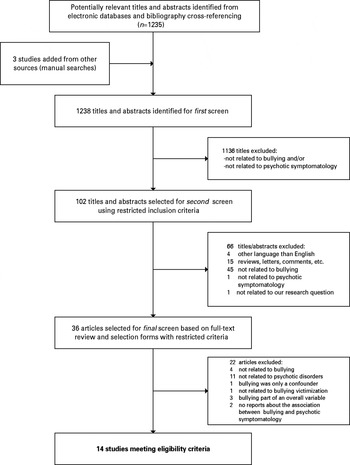
Our search covered articles that were available in the databases from 1806 to November 2011 and yielded an initial total of 1238 papers. We first screened manuscript titles to examine relevance. Then the abstracts were read. In the final screen the full text was read to validate inclusion. Included papers were cross-referenced to identify other potentially eligible papers (Fig. 1).
Selection of studies on bullying victimization and psychotic symptomatology.

Inclusion and exclusion criteria
We included only those papers that: (1) were original research papers; (2) were published in English; (3) reported information about psychosis outcome (i.e. non-clinical psychotic symptoms or psychotic symptoms or diagnosis of psychosis or the use of antipsychotics); and (4) reported any information about being bullied as the exposure variable. As the relationship between psychotic symptoms and bullying has not received much attention until recently, we retained papers even when the term bullying was not carefully defined. We excluded those papers in which: (1) bullying was only analysed as a confounding variable and (2) bullying was not analysed separately but was part of an overall variable (e.g. victimization). A distinction was made between non-clinical and clinical samples. Samples including individuals who had at least one contact with mental health services were defined as clinical samples. Non-clinical samples were those recruited from general populations.
Meta-analysis of the non-clinical sample studies
We carried out a meta-analysis including a subset of seven population-based studies with comparable study designs (Lataster et al. Reference Lataster, van Os, Drukker, Henquest, Feron, Gunther and Myin-Germeys2006; Kelleher et al. Reference Kelleher, Harley, Lynch, Arsenault, Fitzpatrick and Cannon2008; Nishida et al. Reference Nishida, Tanii, Nishimura, Kajiki, Inoue, Okada, Sasaki and Okazaki2008; Schreier et al. Reference Schreier, Wolke, Thomas, Horwood, Hollis, Gunnel, Lewis, Thompson, Zammit, Duffy, Salvi and Harrison2009; Arsenault et al. Reference Arsenault, Cannon, Fisher, Polanczyk, Moffit and Caspi2011; Mackie et al. Reference Mackie, Castellanos-Ryan and Conrod2011; van Nierop et al. Reference van Nierop, van Os, Gunther, Myin-Germeys, de Graaf, ten Have, van Dorsselaer, Bak and van Winkel2011). Two studies (Morrison & Petersen, Reference Morrison and Petersen2003; Campbell & Morrison, Reference Campbell and Morrison2007) were excluded from our meta-analysis because they made use of a different study design. Instead of calculating the risk of psychotic symptoms in a bullied versus non-bullied group, these two studies investigated the association between the predisposition to hallucinations and the experience of being bullied based on questionnaire mean scores. Therefore, they do not generate any numerator and denominator data from which risk ratios could be calculated. We selected the version of the study with the largest sample size when suitable studies reported findings from overlapping populations; for example, Lataster et al. (Reference Lataster, van Os, Drukker, Henquest, Feron, Gunther and Myin-Germeys2006) was selected as opposed to De Loore et al. (Reference De Loore, Drukker, Gunther, Feron, Deboutte, Sabbe, Mengelers, van Os and Myin-Germeys2007), both reporting on the Regional Profiles of Youth health (RPY) data. We decided not to include clinical-based sample studies in the meta-analysis because their designs were too heterogeneous.
First, we calculated an odds ratio (OR) for every study, and also an estimated variance by the formula: [(1/a) + (1/b) + (1/c) + (1/d)] (Rosenberg et al. Reference Rosenberg, Adams and Gurevitch2000). When studies lacked sufficient information for 2 × 2 contingency tables (numerators and denominators), authors were contacted to ensure accuracy and completeness of data. Analyses were conducted on a log scale to correct for the skewed distribution of effect sizes across studies. The potential for publication bias was assessed by examination of a funnel plot.
Analyses were first conducted under the fixed-effects model to examine whether there was one true effect size shared by all studies. The homogeneity statistic Q was calculated to test whether the variability of the effect sizes is larger than would be expected from sampling error alone. Because the homogeneity statistic was significant, the analyses were then conducted under the random-effects model, which assumes there are differences among the effect sizes as a result of variations in study characteristics. Analyses were performed with both unadjusted and adjusted ORs. For each study we selected the OR for the most persistent and definite symptoms. Meta-analytical calculations were carried out with MetaWin 2.0 statistical software (Rosenberg et al. Reference Rosenberg, Adams and Gurevitch2000).
Results
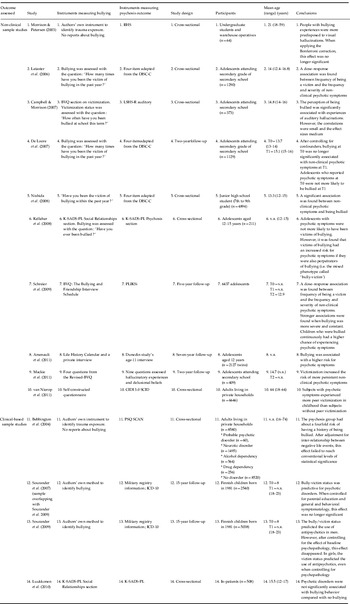
Fourteen studies met the inclusion criteria (Fig. 1). The features of the studies are described in Table 1.
Overview of studies

BVQ, Bully/Victim Questionnaire; K-SADS, Schedule for Affective Disorders and Schizophrenia for School-Age Children, Present and Lifetime; RHS, Revised Hallucination Scale; LSHS-R, Revised Launay–Slade Hallucination Scale; DISC-C, Diagnostic Interview Schedule for Children; PLIKSi, Psychosis-Like Symptoms Interview; CIDI, Composite International Diagnostic Interview; PSQ, Psychosis Screening Questionnaire; SCAN, Schedule for Clinical Assessment in Neuropsychiatry; PSRS, Psychotic Symptoms Rating Scale; n.r., not reported.
Bullying and non-clinical psychotic symptoms
Ten studies examined the relationship between being bullied and psychotic symptoms in non-clinical samples, eight of which found a significant association (Lataster et al. Reference Lataster, van Os, Drukker, Henquest, Feron, Gunther and Myin-Germeys2006; Campbell & Morrison, Reference Campbell and Morrison2007; Kelleher et al. Reference Kelleher, Harley, Lynch, Arsenault, Fitzpatrick and Cannon2008; Nishida et al. Reference Nishida, Tanii, Nishimura, Kajiki, Inoue, Okada, Sasaki and Okazaki2008; Schreier et al. Reference Schreier, Wolke, Thomas, Horwood, Hollis, Gunnel, Lewis, Thompson, Zammit, Duffy, Salvi and Harrison2009; Arsenault et al. Reference Arsenault, Cannon, Fisher, Polanczyk, Moffit and Caspi2011; Mackie et al. Reference Mackie, Castellanos-Ryan and Conrod2011; van Nierop et al. Reference van Nierop, van Os, Gunther, Myin-Germeys, de Graaf, ten Have, van Dorsselaer, Bak and van Winkel2011). The remaining two studies (Morrison & Petersen, Reference Morrison and Petersen2003; De Loore et al. Reference De Loore, Drukker, Gunther, Feron, Deboutte, Sabbe, Mengelers, van Os and Myin-Germeys2007) initially found a significant effect but this was diminished after adjustment for other negative life events.
In the studies that showed a significant association, bullied children had about a twofold risk of experiencing psychotic symptoms in adolescence (Lataster et al. Reference Lataster, van Os, Drukker, Henquest, Feron, Gunther and Myin-Germeys2006; Nishida et al. Reference Nishida, Tanii, Nishimura, Kajiki, Inoue, Okada, Sasaki and Okazaki2008; Schreier et al. Reference Schreier, Wolke, Thomas, Horwood, Hollis, Gunnel, Lewis, Thompson, Zammit, Duffy, Salvi and Harrison2009; Arsenault et al. Reference Arsenault, Cannon, Fisher, Polanczyk, Moffit and Caspi2011; Mackie et al. Reference Mackie, Castellanos-Ryan and Conrod2011) or adulthood (van Nierop et al. Reference van Nierop, van Os, Gunther, Myin-Germeys, de Graaf, ten Have, van Dorsselaer, Bak and van Winkel2011) compared to non-bullied children. One study examined the impact of frequency of being bullied (Lataster et al. Reference Lataster, van Os, Drukker, Henquest, Feron, Gunther and Myin-Germeys2006) and found that the risk of developing psychotic symptoms increased in a linear fashion with an increase in the frequency of being bullied.
Two studies compared the relationship between a history of being bullied and transient versus more persistent psychotic symptoms. Adolescents with more persistent symptoms reported having been bullied more frequently compared with adolescents with transient symptoms. Being bullied increased the odds of developing persistent symptoms by three to four times, suggesting a stronger association when longer-lasting psychotic symptoms were reported (Lataster et al. Reference Lataster, van Os, Drukker, Henquest, Feron, Gunther and Myin-Germeys2006; Mackie et al. Reference Mackie, Castellanos-Ryan and Conrod2011).
Furthermore, Schreier et al. (Reference Schreier, Wolke, Thomas, Horwood, Hollis, Gunnel, Lewis, Thompson, Zammit, Duffy, Salvi and Harrison2009) found that stronger associations were found when bullying was more severe and constant; children who experienced more than one form of bullying (overt and relational; e.g. kicking and gossiping) had approximately a twofold increased risk of developing psychotic symptoms compared with children who experienced only one form of bullying. No differences were found between overt versus relational bullying in the risk of developing psychotic symptoms. Moreover, children who reported being bullied at two time points (bullied at 8 and 10 years) had a greater chance of experiencing psychotic symptoms at a third time point (at 12 years), compared to children who were not bullied at both initial ages (Schreier et al. Reference Schreier, Wolke, Thomas, Horwood, Hollis, Gunnel, Lewis, Thompson, Zammit, Duffy, Salvi and Harrison2009).
Kelleher et al. (Reference Kelleher, Harley, Lynch, Arsenault, Fitzpatrick and Cannon2008) found that victims of bullying had an increased risk for psychotic symptoms if they were also perpetrators of bullying (i.e. the mixed phenotype called ‘bully-victim’). Half of all ‘bully-victims’ reported psychotic symptoms. However, those who were purely victims of bullying did not have an increased risk of psychotic symptoms.
Meta-analysis
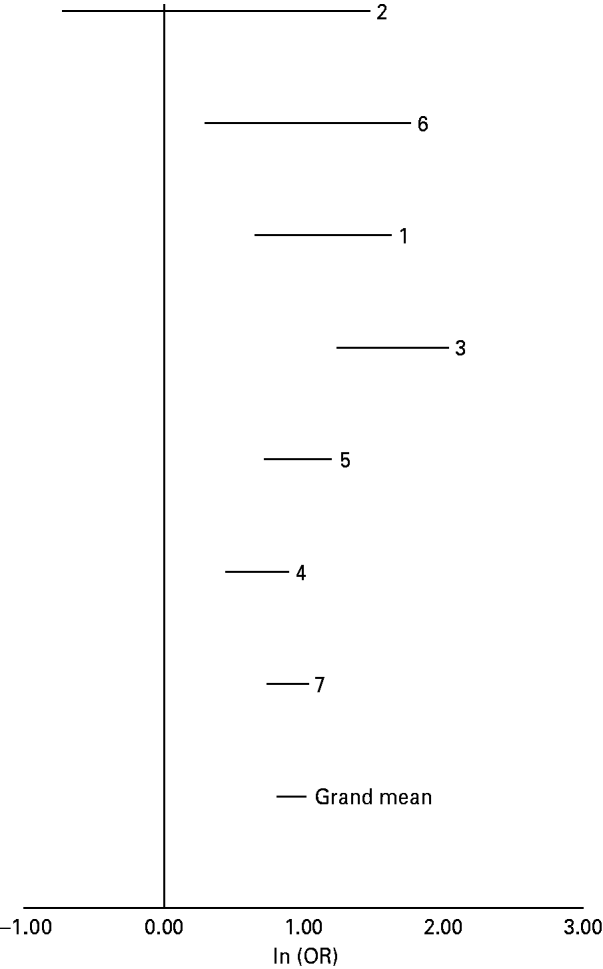
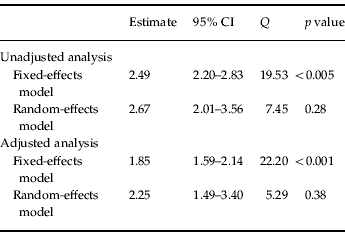
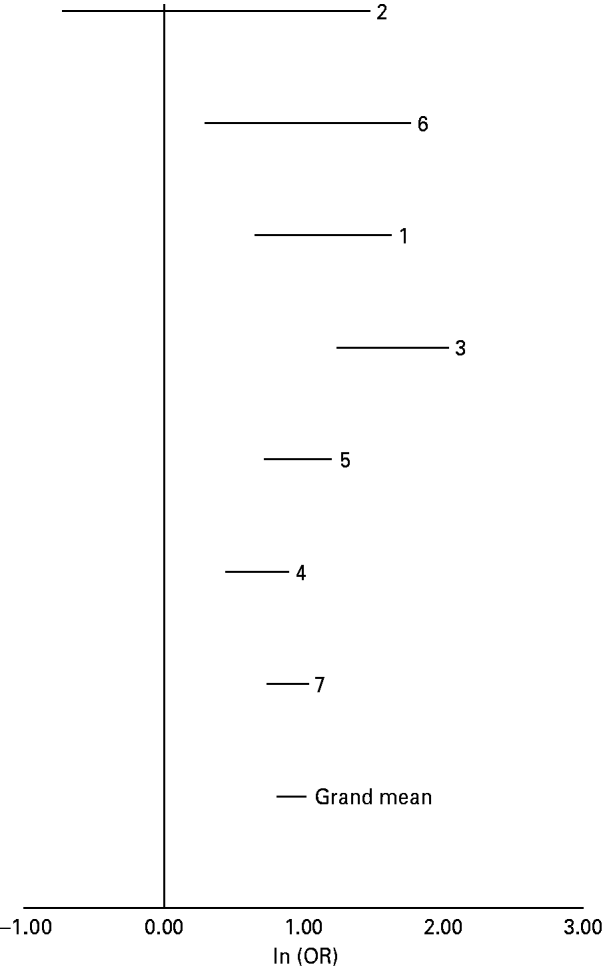
Our meta-analysis of seven population-based studies including unadjusted effect sizes yielded a mean-weighted OR of 2.7 (95% CI 2.0–3.6) for developing non-clinical psychotic symptoms for children being bullied compared to children not being bullied. The reviewed studies adjusted for various confounding variables (e.g. gender, age, and other negative life events). The analysis with adjusted ORs (six studies) yielded a mean-weighted OR of 2.3 (95% CI 1.5–3.4). The results of the meta-analysis are detailed in Table 2. Figure 2 plots the unadjusted log ORs associated with the studies that were entered into our analysis. We show the plot of the unadjusted ORs because it was impossible to calculate adjusted ORs for all studies. The funnel plot (not shown, available on request) was difficult to interpret because of the limited number of included studies, but did not suggest any evidence of publication bias.
Plot of mean effect sizes (log odds ratios) and confidence intervals for results from studies by: (1) Lataster et al. Reference Lataster, van Os, Drukker, Henquest, Feron, Gunther and Myin-Germeys2006; (2) Kelleher et al. Reference Kelleher, Harley, Lynch, Arsenault, Fitzpatrick and Cannon2008; (3) Arsenault et al. Reference Arsenault, Cannon, Fisher, Polanczyk, Moffit and Caspi2011; (4) Schreier et al. Reference Schreier, Wolke, Thomas, Horwood, Hollis, Gunnel, Lewis, Thompson, Zammit, Duffy, Salvi and Harrison2009; (5) van Nierop et al. Reference van Nierop, van Os, Gunther, Myin-Germeys, de Graaf, ten Have, van Dorsselaer, Bak and van Winkel2011; (6) Mackie et al. Reference Mackie, Castellanos-Ryan and Conrod2011; and (7) Nishida et al. Reference Nishida, Tanii, Nishimura, Kajiki, Inoue, Okada, Sasaki and Okazaki2008.
Results of the meta-analysis
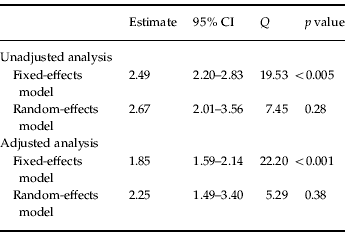
CI, Confidence interval.
Bullying and psychosis in clinical samples
Only a few studies have reported on the association between bullying and psychotic disorders (Bebbington et al. Reference Bebbington, Bhugra, Brugha, Singleton, Farrel, Jenkins, Lewis and Meltzer2004; Sourander et al. Reference Sourander, Jensen, Rönning, Niemelä, Helenius, Sillanmäki, Kumpulainen, Piha, Tamminen, Moilanan and Almqvist2007, Reference Sourander, Rönning, Brunstein-Klomek, Gyllenberg, Kumpulainen, Niemelä, Helenius, Sillanmäki, Ristkari, Tamminen, Moilanan, Piha and Almqvist2009; Luukkonen et al. Reference Luukkonen, Riala, Hakko and Räsänen2010). Bebbington et al. (Reference Bebbington, Bhugra, Brugha, Singleton, Farrel, Jenkins, Lewis and Meltzer2004) focused specifically on the association between bullying and psychosis, but did not report the time-frame of bullying. The three other studies did not have this specific focus. Moreover, these studies reported on different sample characteristics and outcome variables (e.g. psychotic disorders and the use of antipsychotics) and the results are, not surprisingly, inconclusive (see Table 1).
In the study of Bebbington et al. (Reference Bebbington, Bhugra, Brugha, Singleton, Farrel, Jenkins, Lewis and Meltzer2004), respondents with a probable psychotic disorder were compared with respondents without a psychotic disorder. The psychosis group was about four times more likely to report a history of being bullied. However, after adjustment for other negative life events, this effect disappeared.Sourander et al. (Reference Sourander, Jensen, Rönning, Niemelä, Helenius, Sillanmäki, Kumpulainen, Piha, Tamminen, Moilanan and Almqvist2007), using a sample overlapping with the sample of Sourander et al. (Reference Sourander, Rönning, Brunstein-Klomek, Gyllenberg, Kumpulainen, Niemelä, Helenius, Sillanmäki, Ristkari, Tamminen, Moilanan, Piha and Almqvist2009), found that the bully-victim status at age 8 years predicted psychotic disorders in early adulthood among men. However, when controlled for parental education and baseline general and behavioral symptomatology, this effect was no longer significant. Sourander et al. (Reference Sourander, Rönning, Brunstein-Klomek, Gyllenberg, Kumpulainen, Niemelä, Helenius, Sillanmäki, Ristkari, Tamminen, Moilanan, Piha and Almqvist2009) found an association between bullying and antipsychotic treatment in women. Antipsychotic treatment was arguably used as a proxy for an outcome measure of psychosis. However, the incidence of psychosis may well be discrepant from that of prescribed antipsychotic medication.
A recent study of Luukkonen et al. (Reference Luukkonen, Riala, Hakko and Räsänen2010) found that psychotic disorders were not significantly associated with bullying behavior compared with no bullying in adolescence.
Discussion
In this study we explored the literature on the association between childhood bullying and clinical psychotic disorder and non-clinical psychotic symptoms. The results of the population-based non-clinical studies support the role of bullying in the subsequent development of psychotic symptoms. Moreover, stronger associations are found with increased frequency, severity and persistence of bullying (Lataster et al. Reference Lataster, van Os, Drukker, Henquest, Feron, Gunther and Myin-Germeys2006; Schreier et al. Reference Schreier, Wolke, Thomas, Horwood, Hollis, Gunnel, Lewis, Thompson, Zammit, Duffy, Salvi and Harrison2009; Mackie et al. Reference Mackie, Castellanos-Ryan and Conrod2011). The evidence for a causal relationship is strengthened by the consistency across studies. Of note, members from other humiliated groups are also at increased risk for psychotic disorders, for example victims of sexual or physical abuse (Janssen et al. Reference Janssen, Krabbendam, Bak, Hanssen, Vollebergh, de Graaf and van Os2004; Shevlin et al. Reference Shevlin, Houston, Dorahy and Adamson2008) and migrants from developing countries experiencing discrimination (Selten & Cantor-Graae, Reference Selten and Cantor-Graae2005).
The results from the clinical studies, however, do not allow an unequivocal conclusion concerning the association between bullying and development of a psychotic disorder, which is not surprising given the heterogeneous methodological approaches.
How to explain an association between childhood bullying and psychotic symptoms?
There are several theories that could explain the possible association between childhood bullying and psychotic symptoms. First, a history of being bullied may be a developmental marker for the risk of psychosis but not an aetiological factor in itself (Murray & Fearon, Reference Murray and Fearon1999; Schreier et al. Reference Schreier, Wolke, Thomas, Horwood, Hollis, Gunnel, Lewis, Thompson, Zammit, Duffy, Salvi and Harrison2009). In some people with psychotic disorders, abnormalities in social adjustment and motor performance are present during childhood (Done et al. Reference Done, Crow, Johnstone and Sacker1994). A study by Cannon et al. (Reference Cannon, Jones, Huttunen, Tanskanen, Huttunen, Rabe-Hesketh and Murray1999), for example, found that children who later develop schizophrenia perform worse than their peers in sports. Children who show deviant behaviour or perform poorly in sports are more vulnerable to bullying (Schreier et al. Reference Schreier, Wolke, Thomas, Horwood, Hollis, Gunnel, Lewis, Thompson, Zammit, Duffy, Salvi and Harrison2009). The experience of being bullied may result from poor social adjustment and is not necessarily a causal factor in the development of the disorder. It should be noted that other forms of trauma also increase the risk for the development of (non-clinical) psychotic symptoms. The issue of reverse causation applies here too (Lataster et al. Reference Lataster, van Os, Drukker, Henquest, Feron, Gunther and Myin-Germeys2006; Schreier et al. Reference Schreier, Wolke, Thomas, Horwood, Hollis, Gunnel, Lewis, Thompson, Zammit, Duffy, Salvi and Harrison2009). However, it should be noted that even if bullying was a consequence of social awkwardness consequent on a pre-existing developmental risk for later psychosis, the additional impact of bullying may further contribute to risk of later symptoms and disorder. At present, the evidence does not allow these alternatives to be disentangled.
Second, the experience of being bullied may lead to the development of negative schemas of the self and the world (Gracie et al. Reference Gracie, Freeman, Green, Garety, Kuipers, Hardy, Ray, Dunn, Bebbington and Fowler2007). Crittendon & Ainsworth (Reference Crittendon, Ainsworth, Cicchetti and Carlson1989) argue that bullied children have a tendency to be hypervigilant to hostile cues in their environment. They may become suspicious of others' intentions, which in turn may predispose them to psychotic symptoms such as paranoia or ideas of reference (Morrison et al. Reference Morrison, Frame and Larkin2003).
Third, it has been hypothesized that traumatic events during childhood lead to a dysregulation of the hypothalamic–pituitary–adrenal (HPA) axis (Walker & DiForio, Reference Walker and DiForio1997). Dysregulation of this HPA axis may result in activation of dopaminergic circuits, which, in turn, may lead to the emergence of psychotic symptoms (Kapur, Reference Kapur2003). One of the few studies investigating the relationship between childhood bullying and activity of the HPA axis found hypersecretion of cortisol in boys and hyposecretion of cortisol in girls (Vaillancourt et al. Reference Vaillancourt, Duku, Decatanzaro, Macmillan, Muir and Schmidt2008), but further research is needed to validate this hypothesis (Fisher & Craig, Reference Fisher, Craig, Morgan, McKenzie and Fearon2008).
Implications for prevention and treatment
Although a causal relationship between a history of being bullied and the subsequent development of psychosis has not been established formally, there is sufficient reason to discuss methods to prevent children from being bullied and to treat the negative consequences.
It is important to note that non-clinical psychotic symptoms are a risk factor for the subsequent development of psychotic disorder (Poulton et al. Reference Poulton, Caspi, Moffit, Cannon, Murray and Harrington2000; Cougnard et al. Reference Cougnard, Marcelis, Myin-Germeys, de Graaf, Vollebergh, Krabbendam, Lieb, Wittchen, Henquet, Spauwen and van Os2007). This highlights the importance of early school-based interventions, designed to stop bullying. It could also be of importance to evaluate children who have been bullied for possible psychotic symptoms, because these symptoms may be early markers of clinical psychotic symptoms and, at that stage, may be subject to effective intervention. Furthermore, negative appraisals about self and others may be important subjects for discussion in the classroom to change existing cognitive schema, and in helping children to cope (Carney, Reference Carney2008) even when there would be no relationship between bullying and psychotic symptoms.
For clinical purposes it is important to ask people with non-clinical psychotic symptoms whether they have experienced bullying (Read et al. Reference Read, van Os, Morrison and Ross2005; Schreier et al. Reference Schreier, Wolke, Thomas, Horwood, Hollis, Gunnel, Lewis, Thompson, Zammit, Duffy, Salvi and Harrison2009), because psychological approaches may help to reduce the complaints (Read et al. Reference Read, van Os, Morrison and Ross2005) by changing the existing cognitive schema and thereby enable individuals to cope with their traumatic responses to bullying. Research has suggested that early detection and intervention for emerging psychotic symptoms may have the potential to change the course of early psychopathology (Marshall et al. Reference Marshall, Lewis, Lockwood, Drake, Jones and Croudace2005).
Methodological issues and future research
Prospective designs are essential for studying possible causal directions. Good examples are studies of Schreier et al. (Reference Schreier, Wolke, Thomas, Horwood, Hollis, Gunnel, Lewis, Thompson, Zammit, Duffy, Salvi and Harrison2009), Arsenault et al. (Reference Arsenault, Cannon, Fisher, Polanczyk, Moffit and Caspi2011) and Mackie et al. (Reference Mackie, Castellanos-Ryan and Conrod2011) showing that bullying experiences do play an important role in the development of non-clinical psychotic symptoms in later life. We recommend that future studies should assess bullying at an early age (e.g. primary school) to elucidate on time order in the causality of this association.
Furthermore, there is evidence that the mesolimbic dopamine system of psychotic patients is sensitized and that certain environmental factors (e.g. trauma) may cause this sensitization. Experimental social defeat in animals has been shown to cause dopamine sensitization in animals (Selten & Cantor-Graae, Reference Selten and Cantor-Graae2005). Consequently, the case for bullying as a causal risk factor for psychotic disorder can be strengthened by showing that the mesolimbic dopamine system of bully victims is sensitized.
With regard to distinguishing between genetic and environmental effects, it would be of interest to examine whether adopted children of biological parents with a psychotic disorder are more likely to be bullied at school than other children.
It is also of importance to establish a dose–response relationship between the severity of bullying experiences and the subsequent risk of developing psychosis.
The relationship between being bullied in childhood and the development of a psychotic disorder later in life is still equivocal. The research conducted so far is too sparse and may lack power to draw definitive conclusions. It is necessary to follow bullied and non-bullied children until early adulthood when the first expression of psychosis is expected, to clarify the direction and strength of this association.
Finally, we suggest that research should also focus on protective factors, such as perceived-self effectiveness of coping (Crosby et al. Reference Crosby, Oehler and Capaccioli2010) and the extent of social support. Both factors may play a role in the association between being bullied and the development of psychotic symptoms.
Strengths and limitations
This review assembles findings from a relatively large number of investigations on the relationship between psychotic symptoms and bullying in childhood. As the relationship between psychotic symptoms and bullying has not received much attention until recently, we conducted an extensive search and retained papers even when the term bullying was not carefully defined to ensure that all possible literature was included. Authors were contacted to ensure accuracy and completeness of data. Moreover, the narrative approach in addition to the straightforward quantitative summary gives an informative overview of more nuanced aspects adopted in some particular studies (such as those examining frequency of bullying or transient versus persistent symptoms).
One limitation is that the included studies varied widely in the type of population examined, type of measurement and duration of follow-up. A further limitation is the small number of pertinent studies. Consequently, it is difficult to draw a definitive conclusion about an association between bullying and psychotic symptomatology.
Acknowledgements
We thank J. Daarms for assisting with the database searches. We are supported by the European Union [European Community's Seventh Framework Program (grant agreement no. HEALTH-F2-2009-241909) (Project EU-GEI)].
Declaration of Interest
None.