





The authors apologise that, within the published article, two minor errors were identified. Neither error affects the simulations nor changes the main conclusions of the article. In particular, the correction of the experimental estimates of the radiated energy fraction in figure 4 results in improved agreement with the simulations for higher neon fractions.
Table 1: Number of injected neon atoms.
The estimated number of neon atoms
 $N_{\text{Ne}}$
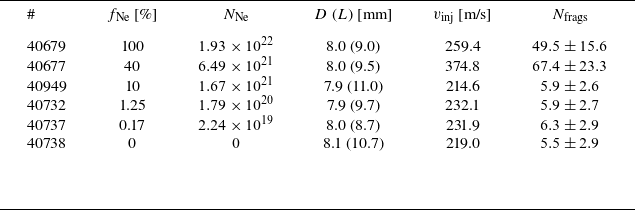
reported in table 1 is incorrect for pellets containing neon. This was a typographical error introduced when preparing the table; the simulations themselves were performed using the correct respective neon contents. As this quantity is also used for the lower horizontal axis in figure 4, the error additionally leads to a small shift of the data points along this axis. The corrected table and figure are given below.
(Corrected) SPI parameters used in the simulations of the considered AUG discharges, with corrected values for the number of injected neon atoms
 $N_{\text{Ne}}$
, replacing the original table 1.

Table 1 Long description
The table presents simulation parameters for various pellet injections in AUG discharges, focusing on neon content. It has six rows and six columns. The columns are labeled as follows: Number, f subscript Ne in percent, N subscript Ne, D in millimeters, v subscript inj in meters per second, and N subscript frags. Each row lists specific values for these parameters. For example, Row 1: Number 40679, f subscript Ne 100 percent, N subscript Ne 1.93 times 10 to the power of 22, D 8.0 millimeters, v subscript inj 259.4 meters per second, N subscript frags 49.5 plus or minus 15.6. The table provides detailed data on the number of neon atoms, pellet diameter, injection velocity, and number of fragments for each simulation scenario.
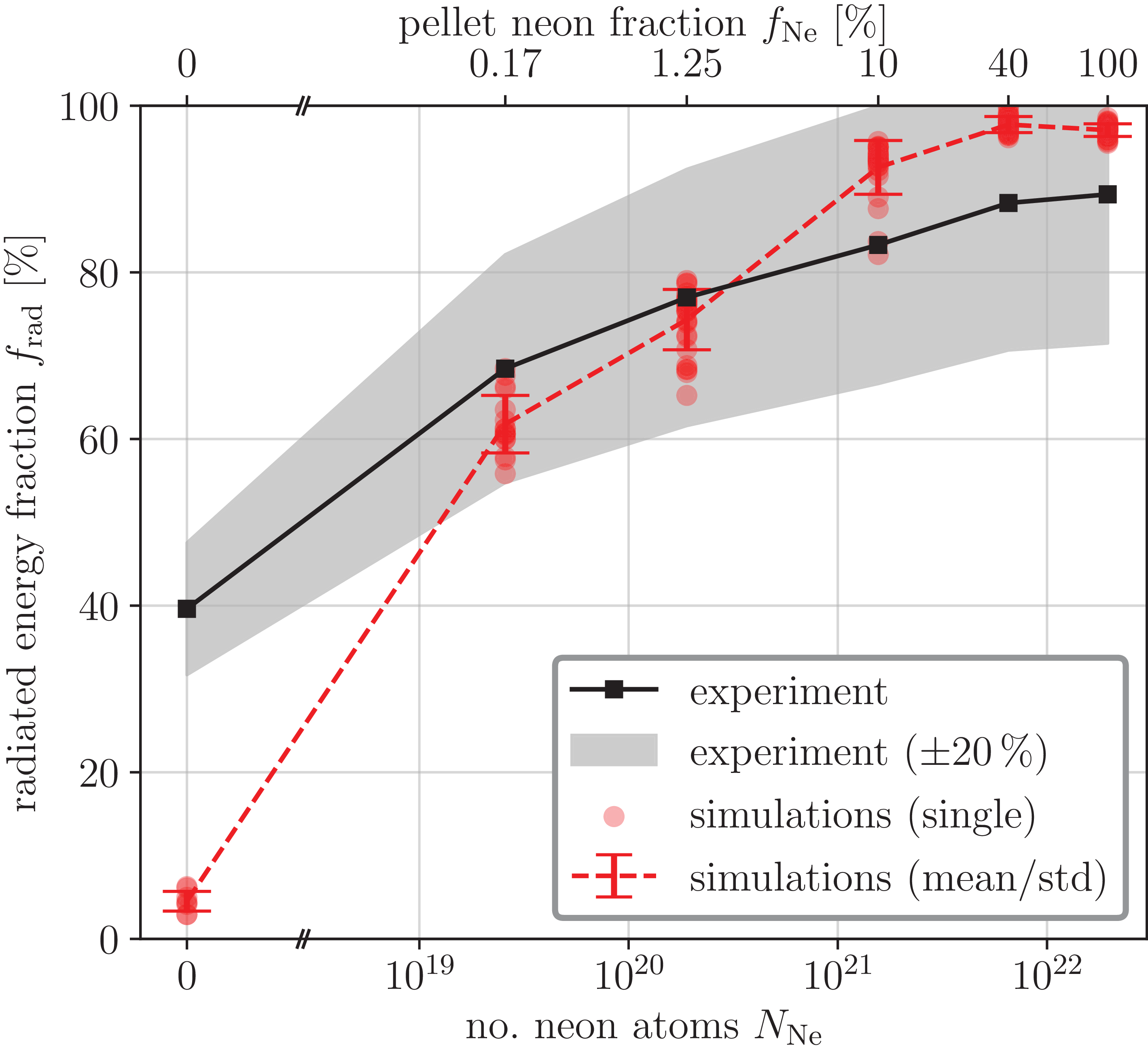
Figure 4: Experimental estimates of the radiated energy fraction.
A small inconsistency was identified in the analysis script used to compute the experimental estimates of the radiated energy fraction
 $f_{\text{rad}}$
shown in figure 4. The bug caused the external heating energy
 $W_{\text{ext}}$
to be overestimated because the relevant heating powers (see equation (6) by P. Heinrich et al., DOI: 10.1088/1741-4326/adcbc0) were integrated over the entire time interval of the signal retrieved from the AUG database, typically starting
 $\sim$
10 ms before the first fragments reached the plasma, rather than from the appropriate start time
 $t_{\text{start}}$
(when the first fragments reach the plasma). This resulted in a systematic overestimation of the external heating energy and consequently an underestimation of
 $f_{\text{rad}}$
of up to
 $\sim$
5 percentage points, with the largest effect for injections with short disruption times, such as those with high neon doping or pure neon pellets. As seen in the figure below, the corrected experimental points are now in closer agreement with the simulations and the expected trend.
(corrected): radiated energy fraction from simulations (red) and the corrected experimental estimates (black), replacing the original figure 4.

 NNe

 Open access

