Introduction
The prevalence of dementia is predicted to increase as populations age world-wide (Alzheimer's Disease International, 2015). Although providing care for family members can be considered rewarding and worthwhile, caregiving outcomes for the caregivers are generally negative, with high rates of burden and depression as well as social isolation, poor physical health, and financial hardship. Previous researchers found that caregivers were at high risk of developing dementia themselves, given the influence of chronic psychosocial stress from caregiving for someone with elevated adverse health outcomes including depression, anxiety, and cognitive decline (Norton et al., Reference Norton2010). Additionally, caregiver burden and poor caregiving experiences put the person with dementia at greater risk for poor outcomes and institutionalization (Gaugler et al., Reference Gaugler2010). Caregivers vulnerable to adverse outcomes and factors that ameliorate or exacerbate burden and depression need to be identified, as it is important for the caregiver and for the patient (Bleijlevens et al., Reference Bleijlevens2015; Park et al., Reference Park, Sung, Kim, Kim and Lee2015). Caregivers are not at equal risk for adverse outcomes. Researchers have identified considerable variability in individuals’ caregiving experiences (Pinquart and Sorensen, Reference Pinquart and Sorensen2007; van der Lee et al., Reference van der Lee, Bakker, Duivenvoorden and Dröes2014). Thus, understanding differences across caregivers may unveil reasons for different responses to similar caregiving situations.
Generally, personality is defined as characteristic patterns of thoughts, feelings, and behaviors a person displays over time and across situations. According to the five-factor structure of personality traits in Big Five Inventory (BFI), a widely accepted model of personality (Rammstedt and John, Reference Rammstedt and John2007), personality consists of neuroticism, extraversion, openness, agreeableness, and conscientiousness. Previous studies of non-caregiving people have provided strong evidence for links among personality, stressful experiences, and health (Taylor et al., Reference Taylor, Whiteman, Fowkes, Lee, Allerhand and Deary2009).
Research evidence for the health implications of personality in caregiving situations is relatively scarce. Most studies of caregivers have examined the link between personality and caregiver stress, although only a limited number of studies have explored personality and its implications for healthcare (Lockenhoff et al., Reference Löckenhoff, Duberstein, Friedman and Costa2011; Reference Löckenhoff, Terracciano, Ferrucci and Costa2012). Caregivers who score high on neuroticism are easily overwhelmed by stressful caregiving experiences (Jang et al., Reference Jang, Clay, Roth, Haley and Mittelman2004; Carter and Acton, Reference Carter and Acton2006; Kang et al., Reference Kang, Lee, Lee and Kim2007). On the contrary, highly extraverted people consistently appear to have high levels of sociability and tend to experience positive emotions and moods in stressful caregiving situations (Carter and Acton, Reference Carter and Acton2006; Kang et al., Reference Kang, Lee, Lee and Kim2007). Recent studies have found that people with high levels of conscientiousness are organized and self-disciplined, accounting for better caregiving experiences. Studies investigating openness and agreeableness are relatively scarce, but findings have suggested that people who score high on these variables adjust well to difficult situations, thereby promoting emotional and physical well-being (Malouff et al., Reference Malouff, Thorsteinsson and Schutte2005; Lockenhoff et al., Reference Löckenhoff, Duberstein, Friedman and Costa2011). Only a few previous studies supporting that personality traits align with caregiver outcomes have empirically examined possible mediators of the links between personality and a caregiver's well-being (Lockenhoff et al., Reference Löckenhoff, Duberstein, Friedman and Costa2011; Melo et al., Reference Melo, Maroco and de Mendonca2011).
Depressive symptoms and caregiver burden due to caregiving have been linked to declines in health outcomes among caregivers of persons with chronic disease (Alvira et al., Reference Alvira2015). Burden among caregivers is due not only to the restrictions in personal time but also to a sense of failure regarding hopes that that may often lead to an increase in depression. Highly neurotic individuals are more likely to report high caregiver burden and depression, whereas highly extroverted individuals express low caregiver burden and depression (Jang et al., Reference Jang, Clay, Roth, Haley and Mittelman2004; Melo et al., Reference Melo, Maroco and de Mendonca2011). The theoretical model of the caregiver stress process (Pearlin et al., Reference Pearlin, Mullan, Semple and Skaff1990) proposes several possible mediators, including coping strategies, social support, and stress. Only a few studies have examined their effects based on theoretical frameworks (Lockenhoff et al., Reference Löckenhoff, Duberstein, Friedman and Costa2011; van der Lee et al., Reference van der Lee, Bakker, Duivenvoorden and Dröes2014). Considering that burden and depression are frequently examined as aspects of stress, acknowledging that personality traits may affect sensitivity toward stressors that diverse outcomes would be produced from the same influence factor.
However, some limitations in previous research must be considered, including sample, assessment of personality, and outcome variables. Most previous investigations used a small sample of participants from a narrow range of backgrounds and were limited to caregivers of older persons, cancer patients, disabled adults, individuals raised in western cultures, and spousal caregivers (Melo et al., Reference Melo, Maroco and de Mendonca2011; van der Lee et al., Reference van der Lee, Bakker, Duivenvoorden and Dröes2014). In addition, previous studies focused on certain types of personality traits and symptoms, paying special attention to the inverse influence of neuroticism and the positive effects of extroversion (Jang et al., Reference Jang, Clay, Roth, Haley and Mittelman2004, Carter and Acton, Reference Carter and Acton2006; Kang et al., Reference Kang, Lee, Lee and Kim2007). Melo et al. (Reference Melo, Maroco and de Mendonca2011) examined the causal effects on caregiver burden, depression, and sleep problems of five traits of personality; however, they focused only on distress related to behavioral and psychological symptoms of dementia (BPSD). Previous research focused on mental health as a main outcome variable (Jang et al., Reference Jang, Clay, Roth, Haley and Mittelman2004; Kang et al., Reference Kang, Lee, Lee and Kim2007; Melo et al., Reference Melo, Maroco and de Mendonca2011). Traits of personality might differently affect mental health and physical health. Therefore, there is a need for deeper understanding of the influence of comprehensive personality traits on caregivers’ mental and physical health outcomes as they experience stress from caring for someone with dementia.
To address these concerns, the present study considers overall personality traits using well-validated personality measures with a large population of caregivers of persons with dementia in South Korea. In addition, the present study examines the difference between mental HRQoL and physical HRQoL in terms of the mediating effects of caregiver burden and depression on the link with personality traits. Thus, the present study contributes to the research regarding family caregivers’ personality and HRQoL in the context of dementia caregiving situations.
Method
Participants and setting
Study participants were primary caregivers of people with dementia in the CARE (Caregivers of Alzheimer's Disease Research) study. We recruited the participants from the earlier CREDOS (Clinical Research Center for Dementia of South Korea) study. The CREDOS study recruited primary caregivers of people with dementia and patients with cognitive impairment and dementia who visited participating centers. Details of the CREDOS study are described by Park et al., (Reference Park2011).
The primary caregiver identified was the family member who spent the most time caring for the patient with dementia. Care recipients had either Alzheimer's or subcortical vascular dementia, diagnosed by the Mini-Mental State Examination (MMSE) and Clinical Dementia Rating (CDR). Trained nurses conducted the baseline survey from June 2012 to February 2013. Caregivers were interviewed in the outpatient clinic or the caregiver's home; 476 caregivers completed the interview. A sample size of 476 was sufficient to provide statistical power at a 10:1 ratio (responses per parameter), the minimum recommended as a good rule of thumb for path analysis (Hair et al., Reference Hair, Black, Babin, Anderson and Tatham2010).
Ethical considerations
The study protocol was approved by the institutional review boards in each setting and the approval number was granted by the relevant Research Ethics Committee (AJIRB-MED-SUR-12-046). All participants received information about the study prior to giving consent, including their right to refuse to answer any question and to stop the interview at any time without consequence. All participants signed an informed consent form, assuring the preservation of their anonymity and confidentiality.
Assessments
The Korean version of the Big Five Inventory-10 (BFI-K-10; Kim et al., Reference Kim2010), a short form of the BFI with ten items, was used to measure the following five personality traits: extraversion, agreeableness, conscientiousness, neuroticism, and openness (Rammstedt and John, Reference Rammstedt and John2007). Each item is scored on a five-point Likert scale, ranging from 1 to 5. Scores of the five personality traits also ranged from 1 to 5 (calculating the mean of two items for individual traits). A high score indicates that the individual has a strong tendency toward that particular trait.
The Zarit Burden Interview (ZBI; Zarit et al., Reference Zarit, Reever and Bach-Peterson1980) was used to measure caregiver burden. The ZBI comprises 22 items measuring caregivers’ psychological health, finances, emotional well-being, social and family life, and degree of control over their life. Each item was scored on a five-point Likert-type scale, and scores on the item were summed. Total scores ranged from 0 (low burden) to 88 (high burden). Cronbach α was 0.938 in this study.
The caregivers’ HRQoL was assessed using the Korean version of the Short Form Health Survey (SF-36; Han et al., Reference Han, Lee, Iwaya, Kataoka and Kohzuki2004). This survey has 36 items that an eight-item health profile comprising the following scale: physical functioning, role-physical, bodily pain, general health, vitality, social functioning, role-emotional, and mental health. These eight scales are aggregated into two summary measures, the physical component summary (PCS) and the mental component summary (MCS). Individual health concepts are scored from 0 to 100, and higher scores indicate better health. In the current study, two of the most important measures, the PCS and the MCS, were calculated to obtain discrete scales of physical HRQoL and mental HRQoL. Cronbach α was 0.954 in this study.
The Beck Depression Inventory (BDI) is a 21-item, self-report tool that was designed to assess the existence and severity of depressive symptoms. Each item is scored on a four-point Likert scale, ranging from 0 to 3. Total scores can range from 0 to 63, with higher total scores indicating more severe depressive symptoms (Beck, Reference Beck1972). Cronbach α was 0.917 in this study.
Statistical analysis
The Statistical Package for the Social Sciences (SPSS 21.0, IBM, Chicago, IL, USA) and AMOS 20.0 (SPSS Inc.) was used to generate statistics in this study. Before exploring the direct and indirect pathways among the variables, we verified the absence of multicollinearity using Pearson's correlation coefficient, tolerance, and variance inflation factor (VIF). The statistics were within acceptable ranges (r < 0.8, tolerances ≥ 0.1, and VIF ≤ 10) that all variables had correlation coefficient below 0.8, tolerance level greater than 0.5 and VIF value below 1.8. Skewness and kurtosis were tested using Kolmogorov–Smirnov normality tests.
General characteristics were analyzed by descriptive statistics. For continuous variables, Pearson's correlation analysis was performed to examine the relationships among personality traits, caregiver burden, depression, and HRQoL. A p value of 0.05 or less was regarded as statistically significant. Path analysis was conducted to test the hypothetical causal effects of personality traits on HRQoL and the mediation effects of burden and depression.
Multiple measures can be used to evaluate the constructed model; these measures include the χ 2 test, goodness-of-fit index (GFI), adjusted GFI (AGFI), normed fit index (NFI), comparative fit index (CFI), standardized root mean square residual (SRMR), and root mean square error of approximation (RMSEA). If the p value resulting from a χ 2 test is greater than 0.05, the path model is considered to have a good fit. For the RMSEA, if the value is less than 0.10, the model is considered to have a good fit. If the GFI, AGFI, NFI, and CFI values are greater than 0.90, the model is considered to have a good fit. A value of the SRMR less than 0.10 is considered favorable.
The arrows in the model represent the direction of the hypothesized association. The strength of the path between variables was represented as path estimates, which were read as standardized regression coefficients. The standardized effects were calculated to yield path coefficients on a common scale ranging from −1 to 1, enabling comparison between variables. The direct coefficient represents the effect of an independent variable on a dependent variable after controlling for other predictors in the model, whereas the indirect coefficient represents the effect of an independent variable on a dependent variable that is mediated by variables on the path. The total effect is the sum of the direct and indirect effects connecting the two variables. Bootstrapped mediation analyses, recommended by Preacher and Hayes (Reference Preacher and Hayes2008), were performed, assessing statistical significance of the indirect effect. In this analysis, the bootstrap resampled the data 5,000 times and calculated the indirect effect for each sample. A bootstrapping procedure involves repeatedly drawing samples from the original sample to create an empirical approximation of the sampling distribution of the indirect effect. The bias corrected 95% confidence interval (CI) indicates significant indirect effects if it does not contain zero (Preacher and Hayes, Reference Preacher and Hayes2008).
Results
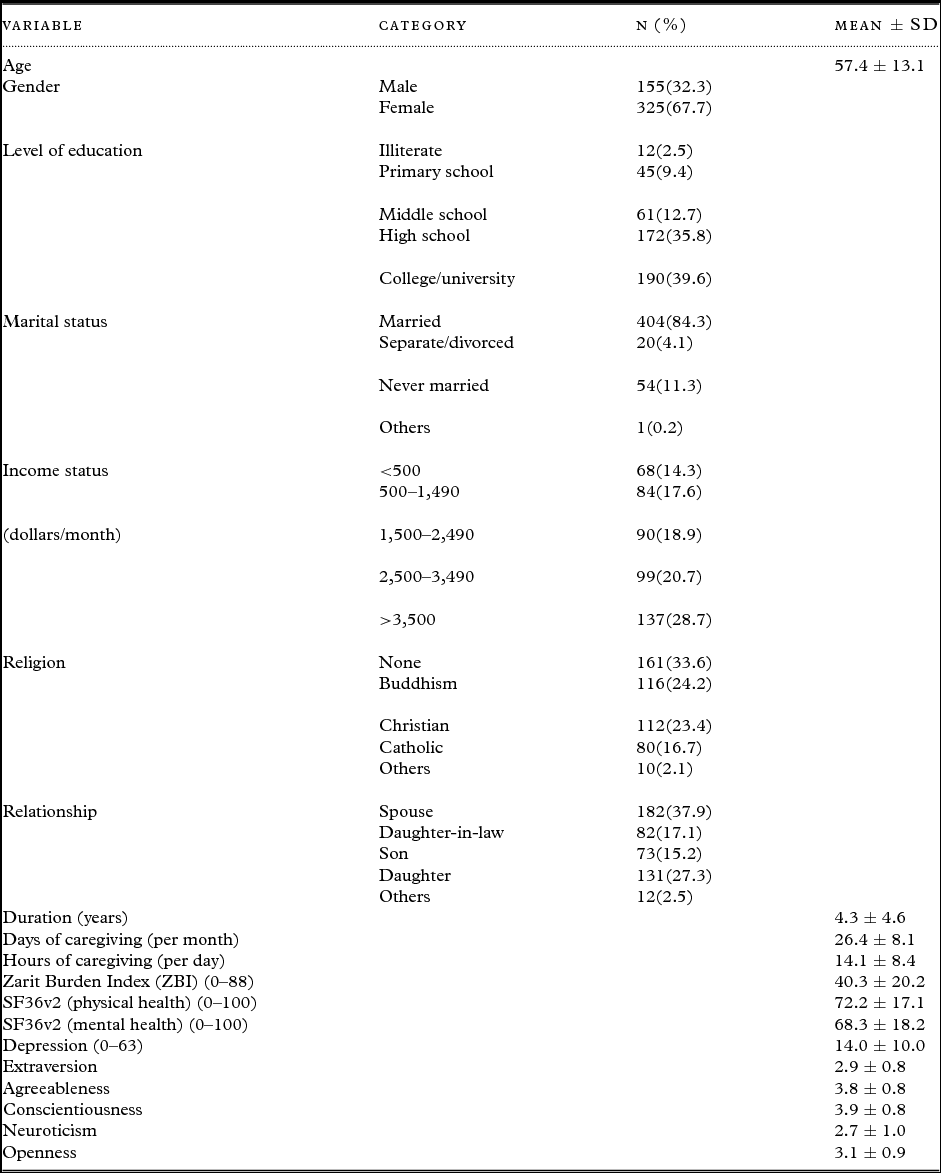
Table 1 provides characteristics of the family caregivers who participated in this study. The majority achieved a high school degree or higher, and their mean age was 57.4 ± 13.1. Approximately 67.7% of participants were female, and spousal caregivers accounted for 37.9% of the sample. Using the SF-36, the mean physical and mental scores were 72.2 ± 17.1 and 68.3 ± 18.2, respectively. Caregiver burden and depression were measured using the ZBI and BDI, with average scores of 40.3 ± 20.2 and 14.0 ± 10.0, respectively. The mean scores of the five personality traits were as follows: extraversion 2.9 ± 0.8, agreeableness 3.8 ± 0.8, conscientiousness 3.9 ± 0.8, neuroticism 2.7 ± 1.0, and openness 3.1 ± 0.9.
Sociodemographic characteristics of the study participants (N = 480)

Correlation matrix
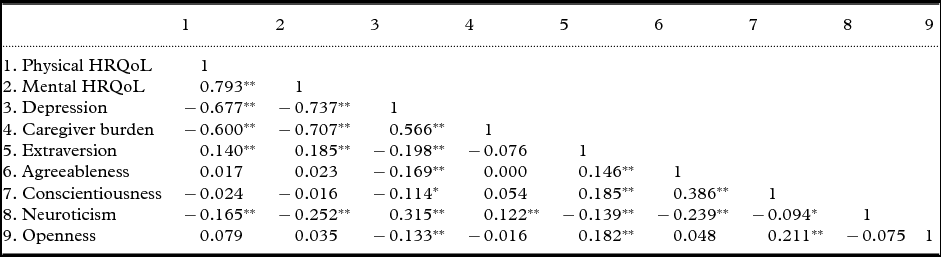
Pearson's correlation analysis was used to examine the relationships among personality, caregiver burden, depression, and HRQoL. The correlations among these variables are reported in Table 2. Significant negative correlations were found between caregiver burden and physical and mental health (r = −0.600, p < 0.01, and r = −0.707, P < 0.01 respectively). In contrast, caregiver burden had a significant positive correlation with depression (r = 0.566, p < 0.01) and neuroticism (r = 0.122, p < 0.01). Depression was negatively correlated with both the physical and mental health of caregivers (r = −0.677, p < 0.001, and r = −0.737, p < 0.01, respectively) and with all personality traits except neuroticism (r = 0.315, p < 0.01). Physical HRQoL showed significant correlations with two personality traits: extraversion showed a positive correlation (r = 0.140, p < 0.01), and neuroticism showed a negative correlation (r = −0.165, p < 0.01).
Correlation matrix of model variables

Note: *p < 0.05.
**p < 0.01.
Two personality traits showed significant correlations with mental HRQoL: extraversion showed a positive correlation (r = 0.185, p < 0.01), and neuroticism showed a negative correlation (r = −0.252, p < 0.01).
Path analysis model
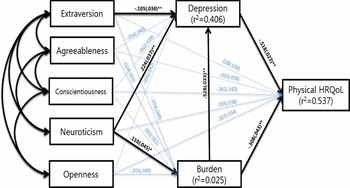
Two path models, shown in Figures 1 and 2, were developed in this study to test hypothetical associations between the personality traits and physical and mental HRQoL. The mediating effects of caregiver burden and depression were also examined. Paths were added among these variables, based on our theoretical model. Some modifications of the study model were made to reach an acceptable fit: two non-significant covariances (between neuroticism and conscientiousness, agreeableness and neuroticism) were deleted. An additional arrow (from caregiver burden to depression) was drawn based on modification indexes (MI), as it had the largest figure and the best model fit was achieved.
Model 1: path diagram demonstrating the impact of personality, caregiver burden, and depression on the mental HRQoL of caregivers.

Model 2: path diagram demonstrating the impact of personality, caregiver burden, and depression on the physical HRQoL of caregivers.

Model I: Mental HRQoL as outcome
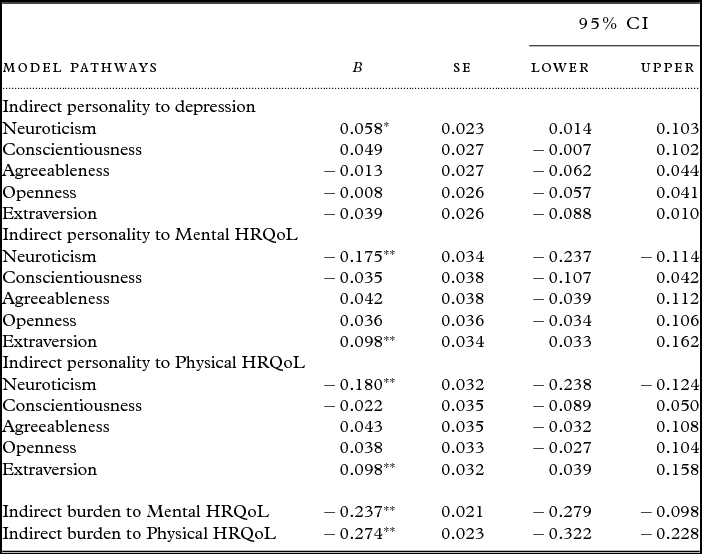
The best fit of the path model (Figure 1) was achieved with χ 2 = 2.895, df = 2, CMIN/DF = 1.448, p = 0.235, GFI = 0.998 CFI = 0.999, AGFI = 0.973, NFI = 0.997, SRMR = 0.0159, and RMSEA = 0.031. The constructed path model accounted for 2.5% of caregiver burden, 40.6% of depression, and 66.1% of mental HRQoL. In the path analyses, depression mediated the effect of neuroticism and extraversion, and caregiver burden mediated the effect of neuroticism on mental HRQoL (Table 3). Caregiver burden (direct effect = −0.442, total effect = −0.680) and depression (direct effect = −0.449) had statistically significant effects on mental HRQoL. Two personality dimensions directly influenced mental HRQoL: extraversion (direct effect = 0.070, total effect = 0.168) and neuroticism (direct effect = −0.056, total effect = −0.231).
Bootstrapping indirect effect and 95% confidence intervals (CI) for the final mediational model

Note: *p < 0.05.
**p < 0.01.
Model II: Physical HRQoL as outcome
The best fit of the path model (Figure 2) was achieved with χ 2 = 2.895, df = 2, CMIN/DF = 1.448, p = 0.235, GFI = 0.998 CFI = 0.999, AGFI = 0.973, NFI = 0.997, SRMR = 0.0157, and RMSEA = 0.031. The constructed path model accounted for 2.5% of caregiver burden, 40.6% of depression, and 53.7% of physical HRQoL. In the path analyses, depression mediated the effect of neuroticism and extraversion, and caregiver burden mediated the effect of neuroticism on mental HRQoL (Table 3). Caregiver burden (direct effect = −0.308, total effect = −0.582) and depression (direct effect = −0.518) had statistically significant effects on physical HRQoL. No personality dimension directly influenced physical HRQoL.
Discussion
Most previous studies on caregiver personality have emphasized the psychological well-being of caregivers (Jang et al., Reference Jang, Clay, Roth, Haley and Mittelman2004; Kang et al., Reference Kang, Lee, Lee and Kim2007), using restricted sample sizes and placing a special emphasis on certain types of personality (Jang et al., Reference Jang, Clay, Roth, Haley and Mittelman2004). There has been only a limited examination of the effect of personality on caregivers’ physical and mental HRQoL as separate components. This is the first study utilizing such a large research data, which enhances the generalizability of the study results. By conducting a path analysis, we could verify the cause-effect and mediation links between variables, providing potentially more accurate information regarding the relationships among variables.
Based on previous research that analyzed the diverse effects of personality traits of family caregivers (Jang et al., Reference Jang, Clay, Roth, Haley and Mittelman2004; Kang et al., Reference Kang, Lee, Lee and Kim2007; Lockenhoff et al., Reference Löckenhoff, Duberstein, Friedman and Costa2011; Melo et al., Reference Melo, Maroco and de Mendonca2011), the focus of the present study on wellness of dementia caregivers offers clearer picture of the relationship between personality and HRQoL mediated by caregiver burden and depression. These findings add to a scarce body of research that considers the role of some caregiver personality traits for HRQoL among dementia caregivers. Caregivers who easily feel negative emotions are less likely to report good HRQoL, while those with positive emotions are more likely to report good HRQoL due to levels of burden and depression. In addition to the roles of mediators, interesting patterns were found that the two dimensions of personality – extraversion and neuroticism – directly impacted the mental HRQoL of caregivers, whereas no personality traits directly influenced physical HRQoL.
The direct influence of personality traits on caregiver burden and depression was comparable to that found in a model developed by Melo et al. (Reference Melo, Maroco and de Mendonca2011). They conducted their study with 105 patients with dementia and their family members to determine factors that influenced caregiver burden, depression, and distress related to BPSD-related distress. They showed that neuroticism increased depression and caregiver burden, whereas extraversion and agreeableness decreased depression and caregiver burden. The results are consistent with those of this study, with the exception that this study did not identify the significant effect of agreeableness on depression. In addition, the results of this study suggest that caregiver burden directly influences depression, which is consistent with the findings of a previous path analysis conducted on the data of 120 spousal caregivers of individuals who had lung cancer. In that study, researchers found significant relationships between personality, burden, and depression (Kang et al., Reference Kang, Lee, Lee and Kim2007).
Neuroticism was the only trait with a statistically significant direct and negative impact on caregiver burden and linked most strongly to depression in both models. In a previous longitudinal study conducted with 320 caregivers, individuals with highly neurotic personalities tended to perceive the caregiving situation as more stressful and threatening than those with other personality traits (Jang et al., Reference Jang, Clay, Roth, Haley and Mittelman2004). In addition, they were more likely to choose dysfunctional coping strategies or self-destroying patterns, worsening the negative effects of the caregiving role (Sutin et al., Reference Sutin, Zonderman, Ferrucci and Terracciano2013). These coping strategies aggravated burden in caregivers high on neuroticism (Kang et al., Reference Kang, Lee, Lee and Kim2007). Moreover, as the difficulty of the caregiving role increased, caregivers perceived the caregiving situation is out of control. This may amplify depressive symptom as they are less able to protect themselves against deterioration. Moreover, researchers in a study conducted with patients whose dementia was progressing and their caregivers reported a significant association between caregiver neuroticism and the faster cognitive decline of the patient receiving care (Norton et al., Reference Norton2013). Individuals living with dementia have significant awareness of their caregivers’ emotional states, especially those in earlier stages; thus, the emotional instability of caregivers with higher levels of neuroticism exacerbates the cognitive decline of a dementia patient. Faster cognitive decline among individuals with dementia consequently leads to greater caregiver burden, explaining the direct association between neuroticism and higher levels of caregiver burden.
Two personality traits (neuroticism and extraversion), in particular, directly influenced caregiver depression in both models. In addition, the findings revealed a statistically significant positive correlation between depression and neuroticism and statistically significant negative correlations with the rest of the four traits; extraversion, consciousness, openness, and agreeableness. These findings are in line with a previous study whose authors (Malouff et al., Reference Malouff, Thorsteinsson and Schutte2005) concluded that personality interferes with the effectiveness of treatment for depression; highly neurotic people recover more slowly from depression. In contrast, the other personality traits – openness and agreeableness – enhanced the treatment effect. Additionally, highly extroverted caregivers may consider a particular social support to be sufficient, whereas it would be difficult to satisfy caregivers who had higher levels of neuroticism using the same interventions (Kang et al., Reference Kang, Lee, Lee and Kim2007).
Personality traits affect the extent of individuals’ social interactions and network, and these are also significant determinants of caregiver depression (Zhang et al., Reference Zhang, Edwards, Yates, Guo and Li2013). Highly extroverted people tend to find their coping mechanism by establishing a social network (Shiovit-ezera and Litwin, Reference Shiovitz-Ezra and Litwin2012). Positive coping also significantly aligns with having a larger social network, and so people with a resourceful network are more likely to participate in health-related behaviors (Shiovit-ezera and Litwin, Reference Shiovitz-Ezra and Litwin2012). Engaging in peer or social support may be beneficial for highly extroverted caregivers, as they are more likely to find help from external resources. In contrast, individuals who are highly neurotic are less likely to seek out opportunities for social interaction (Jang et al., Reference Jang, Clay, Roth, Haley and Mittelman2004; Shiovit-ezera and Litwin, Reference Shiovitz-Ezra and Litwin2012), causing feeling of isolation and depression with very limited social network; compared with other caregivers, they also were less associated with adaptive coping strategies and health-promoting behaviors.
We identified the mediating role of caregiver burden and depression in this study. When mediated by depression and caregiver burden, extraversion positively affected both the mental and physical HRQoL, whereas neuroticism had a negative impact. The results indicate that without the effects of caregiver burden and depression, those personality traits alone are insufficient to determine HRQoL of dementia caregivers, especially for physical HRQoL. The findings of this study further support the evidence found consistently as previous studies (Jang et al., Reference Jang, Clay, Roth, Haley and Mittelman2004; Kang et al., Reference Kang, Lee, Lee and Kim2007; Lockenhoff et al., Reference Löckenhoff, Duberstein, Friedman and Costa2011; Melo et al., Reference Melo, Maroco and de Mendonca2011). Of personality traits, neuroticism and extraversion had more significant and direct association with caregiver outcomes such as caregiver burden, depression, and other health issues. In addition, caregiving is often inevitable burden in Korean culture (Kang et al., Reference Kang, Lee, Lee and Kim2007; Kim et al., Reference Kim2015) that may put those with adverse personality traits at higher risk.
Individuals at high risk of having feelings of depression are more likely to report poor physical and mental HRQoL. Depression can lead to risky health habits, which stimulate further physical deterioration, leading to negative health outcomes such as hormonal changes, and increased susceptibility to infectious agents. With poor immune function, for example, dementia caregivers may have poor antibody production in response to viruses, resulting in a slow healing response (Pinquart and Sorensen, Reference Pinquart and Sorensen2007). This slow healing response could also explained by concurrence of depression and coping behaviors.
Several limitations were identified in this study. To reflect overall characteristics of dementia caregivers, the study sample was recruited from 12 major hospitals in South Korea, including caregivers of patients with dementia who were at different disease-severity levels. In this study, the χ 2 p value was non-significant (χ 2 = 2.895, p = 0.235) in both models, indicating that the model does not differ from the data. The BFI-K-10 is a short version of personality scale to assess each personality trait; The BFI-K-10 is a short version of personality scale to assess each personality trait, and previous research has clearly shown that the BFI-10 possesses psychometric properties that are comparable in size and structure to those of the full-scale BFI (Rammstedt and John, Reference Rammstedt and John2007). Nevertheless, some degree of caution should be considered that interpreting the findings. The BFI-10 may not perfectly substitute the BFI-44 as reduced scale would not capture the full range of complex structure of personality variables as much as the original instruments. Given that this study used data from a cross-sectional design, we were unable to establish strong conclusions regarding causal relationships. In addition, different caregiving contexts, especially caregiver relationships to the person with dementia, was not well reflected in this analysis. Some researchers suggested caregiving can be particularly difficult for spousal caregivers (Pinquart and Sorensen, Reference Pinquart and Sörensen2011; Savundranayagam et al. Reference Savundranayagam, Montgomery, Kosloski and Little2011). Thus, further research could assess whether the model structure and the association between variables were equivalent across caregiver groups, including spouses and adult children.
In conclusion, the present study suggests that personality traits of individual caregivers need to be carefully considered as a factor that may impact the effectiveness of caregiver interventions. It would be ideal for health professional to screen those caregivers who are more vulnerable and examine ways to develop tailored interventions. In addition, people working with dementia should have easy access to evidence-based information on the importance of adopting positive coping strategies that incorporate personality factors.
Several types of interventions for dementia caregivers have been implemented, including practical assistance, education, and emotional support, as well as multicomponent interventions (Elvish et al., Reference Elvish, Lever, Johnstone, Cawley and Keady2013). However, most programs for dementia caregivers have focused on universal solutions rather than on the uniqueness of individual caregivers Interventions that incorporated adaptive emotion-focused coping, such as acceptance, humor, positive reframing, and religious coping, found these strategies to be independent predictors of reduced caregiver depression (Carter and Acton, Reference Carter and Acton2006).
At the same time, a better understanding of mediators may guide the development of specific strategies for interventions. Preventative interventions for caregivers with higher levels of neuroticism may be required. Caregivers’ perceptions of their ability to manage the challenge in caregiving are also influenced by personality traits. For family caregivers with higher levels of neuroticism or conscientiousness, setting challenging but highly achievable goals in the context of caregiving may have meaningful effects, while challenging goals would motivate others who have high levels of openness.
Conflict of interest
None
Description of authors’ roles
S. K. Kim and M. Park contributed to the conceptualization, data analysis, and preparation of the paper. Y. Lee and S. H. Choi designed the study and contributed to data management. S. Y. Moon, S. W. Seo, K. W. Park, B. D. Ku, H. J. Han, K. H. Park, S. Han, E. Kim, J. Lee, S. A. Park, Y. S. Shim, J. H. Kim, C. H. Hong, D. L. Na, B. S. Ye, H. J. Kim, and Y. Moon contributed data collection and analysis.
Acknowledgments
This study was supported by the grant from the Korea Healthcare Technology R&D Project, Ministry of Health and Welfare, Republic of Korea (HI10C2020) and the Basic Science Research Program through the National Research Foundation of Korea (NRF) funded by the Ministry of Science, ICT and Future Planning (NRF-2013R1A2A2A01069090). The authors thank Dr Nancy Moore, editor of the Arizona State University College of Nursing and Health Innovation, for reviewing drafts of this paper.