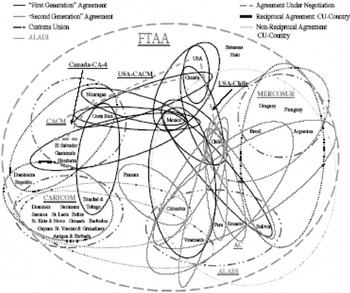
The number, level of detail, and subject matter of international agreements have grown exponentially in recent decades. From peacekeeping to telecommunication standards, from the monitoring of elections to the protection of endangered species, it seems that every policy issue is nowadays the subject of multiple trans-border agreements. The proliferation of international agreements multiplies the number of actors and rules relevant for any given decision of international cooperation. The Inter-American Development Bank's spaghetti bowl of Trade Agreements, shown in Figure 1 captures, perhaps in the extreme, this emerging density and complexity of international governance.
The Spaghetti Bowl: Trade agreements signed and under negotiations in the Americas
Source: “The Spaghetti Bowl of Trade Liberalization” in Latin American Economic Policies, Vol. 19, 2002.

Following David Victor and Kal Raustiala's analysis of “regimes complexes,” we call this growing phenomenon “international regime complexity.”Footnote 1 International regime complexity refers to the presence of nested, partially overlapping, and parallel international regimes that are not hierarchically ordered. Although rule complexity also exists in the domestic realm, the lack of hierarchy distinguishes international regime complexity, making it harder to resolve where political authority over an issue resides.Footnote 2
We are not the first to point out the need to think of international cooperation as a complex system.Footnote 3 But while this need is readily admitted, few studies and even fewer theories are available to guide scholars in thinking about the consequences of this complexity. The state-centric bias of international relations, combined with a tendency to focus on the origin rather than the implementation of formal rules, leads political scientists to focus overwhelmingly on the causes of international regime complexity. We are, however, more interested in its consequences.
How is the sheer complexity of international governance today, with its multiple set of rules and institutions, affecting international politics? Does international regime complexity impact decision-making and political strategies, as well as empower some actors and interest groups? How does complexity enhance or undermine the effectiveness of international regimes? More generally, what analytical insights can be gained by thinking about any single agreement as being embedded in a larger web of international rules and regimes? These questions, and others, are raised by the reality that, increasingly, international governance occurs via a multitude of nested, partially overlapping, and parallel trans-border agreements.
This introduction draws from a wide set of literatures to think about how the complexity of international governance may be shaping international politics. We locate this research question in existing and emerging literatures on complexity studies. Next we provide concrete ways to think about how regime complexity may influence the politics of international cooperation. We end by considering the implications of incorporating international regime complexity into quantitative and qualitative approaches to studying the politics of any single trans-border issue.
The symposium then proceeds with issue-specific contributions. We asked a set of scholars to reflect on how international regime complexity may be causally important for the issue they study. The contributions address a range of international issues—trade, military intervention, election monitoring, refugee politics, intellectual property policy, and human rights protection—and represent an original, though tentative, rethinking of an existing body of scholarship undertaken by each author. The insights gleaned, like the causal effects identified in this introduction, do not point in a single direction. Sometimes complexity empowers powerful states actors, while at other times NGOs and weaker actors gain from the overlap of institutions and rules. Sometimes overlap introduces positive feedback effects that enhance cooperation and the effectiveness of any one cooperative regime. Sometimes, however, complexity introduces unhelpful competition across actors, inefficiencies, and transaction costs that end up compromising the objectives of international cooperation and international governance.
It is not our ambition to make strong causal claims about unidirectional effects from complexity. Rather, the symposium provides scholars with insights from multiple disciplines to help them investigate the role of international regime complexity in areas they care about, in the hope that doing so will save others time and spur more research on this topic.
What We Know about International Regime Complexity
Political scientists have studied the issue of why and how international commitments proliferate and overlap under the rubrics of “nested institutions” and “complex interdependence.” Scholars have pointed out that sometimes agreements overlap because conversation about one topic leads to discussion about a related topic, creating spillover across issues.Footnote 4 Sometimes international agreements are intended only as a starting point, to be followed up by subsequent agreements.Footnote 5 Or sometimes sub-groups of states desire different or deeper cooperation than the whole, thus they create additional agreements.Footnote 6 Sometimes linkages across agreements are crafted to create packages that collectively are more attractive to various participants.Footnote 7 And sometimes second or third agreements are negotiated to create “strategic ambiguity” about how to interpret any single agreementFootnote 8 or to create redundancies that allow for continued cooperation should any single agreement fail. These ideas are about the origins of international regime complexity: where it came from, why it arose, and what it looks like today.
By contrast, this symposium is interested in the consequences of international regime complexity. With this focus we are connecting to an emerging field of complexity studies. A complex system is a system with a large number of elements, building blocks or agents capable of interacting with each other and with their environment. Scholars who study complexity note that within complex systems, knowledge of the elementary building blocks—a termite, a neuron, a single rule—does not even give a glimpse of the behavior of the whole, and may lead to faulty understandings of the building blocks themselves.Footnote 9 Scientists offer as an example the human brain. Researchers can discover a lot about neurons, but knowing about neurons in isolation does not add up to comprehending consciousness, let alone how the brain works as a whole. Similarly, we can study the dynamics of the Kyoto Protocol, but doing so will not ultimately help us understand how global warming gets addressed.
The interdisciplinary field of complexity studies has thus far primarily focused on mathematical and computational techniques to chart the relationships among actors and to analyze the evolutionary tendencies within complex systems.Footnote 10 Moving beyond the observation that most people are connected by six degrees of separation,Footnote 11 complexity scholars have created tools to map actor relationships to reveal nodes of relationships and dynamic interactions that may not be apparent to the naked eye.
Political scientists are beginning to think about how relationships within complex systems matter. For example, a group of scholars are mapping networked security relationships in the Commonwealth of Independent States, and asking more broadly if creating nested security institutions is a new alliance strategy.Footnote 12 The more we learn about the role of transnationally networked actors in international politics,Footnote 13 the more helpful political scientists may find network mapping techniques.
But these social network maps also have limitations, as sociologists have realized. Roger Gould cautions that social network analysis contributes to intellectual progress mainly where there is a pre-existing body of theory which can shape the questions and relationships investigated through network analysis.Footnote 14 In other words, we must first develop expectations about how regime complexity influences networked relationships and makes them causally important before we can know which relationships to map and what the mapping might mean.
Complexity scholars also use agent-based modeling to examine how the interactions of actors come to shape strategies and cooperation outcomes. For example, Robert Axelrod employs agent-based modeling to show how cooperation can emerge from actors using tit-for-tat reciprocity in their interactions,Footnote 15 and how norms, cultures, and conflicts can interact to create ethnic conflict and global polarization.Footnote 16 By changing decision-rules and making controlled assumptions about interactive effects during organizational development, complexity scholars are able to estimate when organizations will evolve linearly (in path-dependent, punctuated equilibrium, or cyclical ways), versus when they will develop in non-linear chaotic or random ways.Footnote 17 Sociologists consider organizational dynamics within groups such as the development of reputation and trust, and how factors like bounded rationality or preference affinities shape interactive outcomes within complex systems.Footnote 18
Agent-based modeling is useful when agents are autonomous yet interdependent, when agents follow simple rules (like tit-for-tat reciprocity), when agents are adaptive and backward-looking, and when rules and norms emerge from bottom-up interactions rather than to top-down political imposition.Footnote 19 But international regime complexity does not bubble up from below, nor do the politics of international regime complexity evolve purely through the interaction of the actors who negotiated the agreement. International agreements are negotiated by governments, transformed into domestic implementing legislation by legislative bodies, actually implemented by sub-state actors (administrative agencies, state governments, local police, contracted firms, NGOs, etc.), whose actions get reviewed by domestic and sometimes international courts. The result is that treaty implementation involves actors who played little to no part in crafting the original agreement. These differences do not mean that agent-based approaches cannot be useful—complexity scholars are developing modeling tools for different types of situations. These differences do, however, suggest limitations for models that rely on interactions among a single set of actors—e.g., states or NGOs.
We see the core insight of complexity studies as helpful—the ideas that understanding units does not sum up to the whole and that the dynamics of the whole shape the behavior of units and sub-parts. We believe that the first step is to develop some theoretical hunches about how international regime complexity matters. In the next section we build on research from a variety of disciplines to provide insights into the ways the international regime complexity may be causally important.
The Politics of International Regime Complexity
Many scholars believe that the formal relationships within and across international institutions are defining of the politics that follow, thus they invest in mapping and explaining differences in how international agreements relate to each other. Clearly the situation of parallel regimes (where there is no formal or direct substantive overlap) differs from overlapping regimes (where multiple institutions have authority over an issue, but agreements are not mutually exclusive or subsidiary to another) and nested regimes (where institutions are embedded within each other in concentric circles, like Russian dolls).Footnote 20 One could map out even more nuances in how regimes connect to each other, but it isn't clear that such distinctions causally shape the politics that follow. Not all overlaps will be causally significant, nor is it clear that nested regimes have fundamentally different politics compared to overlapping regimes in large part because the default situation is that international law does not establish hierarchy across treaties or regimes.
Maps of international regime complexity are helpful in identifying the actors and institutions involved in an issue. But we believe that international regime complexity is causally important in how it affects the strategies and dynamic interactions of actors. We identify five different pathways through which international regime complexity changes the strategies and dynamic interactions of actors. These pathways present both opportunities and challenges for the goal of developing effective and legitimate solutions to international problems.
The Implementation Stage Is Defining of Political Outcomes
Most international cooperation scholars focus on the negotiation of agreements, and in particular on the formal rules that influence politics. But political deals often get redefined during implementation because the actors who implement agreements have different priorities and are subject to different pressures than are the policy-makers who designed the deal in the first place. International regime complexity adds a new twist to implementation politics: international regime complexity reduces the clarity of legal obligation by introducing overlapping sets of legal rules and jurisdictions governing an issue. Lawyers refer to this problem as the “fragmentation” of international law.Footnote 21 Where state preferences are similar, lawyers overcome fragmentation by crafting agreements that resolve conflicts across regimes, and thus legal ambiguity is transitory. Where preferences diverge, states block attempts to clarify the rules and thus ambiguity persists, allowing countries to select their preferred rule or interpretation.
With the rules themselves or the hierarchy across rules remaining fundamentally ambiguous, agreements get defined and redefined across time and space. In her contribution to our symposium, Emilie Hafner-Burton finds that during the implementation stage, opponents of human rights linkages to trade agreements have used the Vienna Convention on the Law of Treaties to strip out the human rights requirements demanded by the European Parliament. But this strategy is only used when the human rights linkages become a barrier in bilateral relations, and thus for many agreements the linkage remains. In Stephanie Hofmann's study of European Defense and Security Policy (ESDP), preference divergence created significant ambiguity in the “Berlin Agreements,” which affected operations, creating delays and confusion on the ground. In the case of refugee policy analyzed by Alexander Betts, United Nations policy became redefined over time to take into account developments in parallel domains—migration and security policies. In all of these cases, the formal texts remained the same. Only in examining implementation were the transformations, either made possible or complicated by international regime complexity, revealed.
Implementation Politics Lessons
Lesson 1. International regime complexity contributes to international law fragmentation and rule ambiguity. Where state preferences are similar, states will coordinate to create a clear set of rules. Where preferences diverge, ambiguity will persist, allowing countries to select their preferred interpretation.
Lesson 2. Because states can select which rules to follow and because each international venue allows a different set of actors to be part of the political process, implementation politics will end up defining which international agreements become salient, and the meaning of international agreements.
Next steps. The next question to ask is from the sea of overlapping agreements, which agreements and which interpretations come to dominate over time? Which actors are able to influence interpretations and prioritization across agreements? When does a rule or an interpretation harden and become difficult to shift through reframing or reinterpretation?
International Regime Complexity Enables “Chessboard Politics”—Cross Institutional Political Strategies
We asked our contributors to consider the counterfactual question—what would have been a likely outcome if parallel and overlapping institutions did not exist? From this exercise we could see that even where decision-makers do not actively reference other institutions, parallel regime politics could sometimes explain the timing and content of the policies adopted. In some cases, the greatest action took place outside of the central institution of focus.
We use the concept of “chessboard politics” as a more open way of explaining how international regime complexity alters the strategic playing field. Once a density threshold is reached,Footnote 22 the existence of multiple institutions with authority over an issue allows moves made in a single international institution to reposition pawns, knights, and queens within other institutions. Sometimes repositioning is done intentionally, and sometimes it occurs incidentally.
A number of our contributors identified forum-shopping strategies where actors select the international venues based on where they are best able to promote specific policy preferences, with the goal of eliciting a decision that favors their interests. In her contribution to this symposium, Judith Kelley analyzes a case where governments shopped for election monitors they believed would render the most favorable declaration for them. In Hafner-Burton's study of trade and human rights, forum shopping was a means for voices excluded from one venue (the European Parliament has no role in World Trade Organization negotiations) to impose their preferences in a different venue (the European Parliament must approve bilateral trade agreements between the EU and individual countries). Not only did the European Parliament gain a voice, but the different bargaining context for the bilateral agreements limited the ability of weaker recipient states to veto the linkage between trade and human rights. In her study of the trade regime, Christina Davis explains the reasons why different forums have different politics, and thus the factors that shape actor choices and outcomes in different forums.
We also identified cross-institutional political strategies where actors promoted agenda across multiple international institutions to influence policy outcomes. Whereas forum-shopping is focused on achieving a desired outcome within a given regime (a favorable decision, for example), regime-shifting is designed to reshape the global structure of rules.Footnote 23 According to Larry Helfer, when developing countries were out-maneuvered within the World Trade Organization, they regime-shifted—they turned to parallel regimes where alternative priorities existed. Developing countries encouraged regimes, such as the World Health Organization, to speak to the balance of protecting intellectual property and promoting other goals—such as public health. Developing countries then invoked these statements and rules in the World Trade Organization, negotiating to have exceptions crafted in parallel venues written into the global rules. Alexander Betts discusses a similar strategy. European states created parallel multilateral venues focused on migration and internally displaced people where they arranged to keep potential refugees from reaching their territory. These alternative venues created both a mechanism and a language to transform a person fleeing persecution into a person seeking economic migration, and thus a way to avoid European obligations under International Refugee rules.
Strategic inconsistency is another cross-institutional strategy observed by Raustiala and Victor; contradictory rules are created in a parallel regime with the intention of undermining a rule in another agreement.Footnote 24 Helfer notes that developing countries also sought to create Intellectual Property interpretations that were inconsistent with TRIPs rules. Hofmann's contribution reveals a slightly different strategy, what one might call strategic ambiguity: the British desire to make NATO the primary security institution clashed repeatedly with the French desire that the ESDP be the primary security institution shaping the positions these states took in a variety of political debates over specific substantive policies—cooperation agreements between NATO and ESDP, decisions on the common resources for the ESDP, and decisions regarding specific interventions. These clashes ended up shaping the policies adopted in each institution, making them vaguer than originally intended.
Chessboard Politics Lessons
Lesson 1. International regime complexity enables cross institutional political strategies including: forum-shopping, regime-shifting, and strategic inconsistency. In forum-shopping, the shopper strategically selects the venue to gain a favorable interim decision for a specific problem. In creating strategic inconsistency, the actors intentionally create a contradictory rule in a parallel venue so as to widen their latitude in choosing which rule or interpretation to follow. In regime-shifting, actors may use forum-shopping, strategic inconsistency, or other strategies with the ultimate goal of redefining the larger political context so as to ultimately reshape the system of rules itself.
Next steps. Forum-shopping is the most oft-discussed though not necessarily the most common consequence of international regime complexity.Footnote 25 Christina Davis suggests that the possibility to shop among forums may well be less common than scholars imagine. We need to better understand how common it is for regime complexity to generate choice of forum opportunities, while identifying the other ways in which trans-institutional strategies operate—such as cross-institutional strategizing, and creating strategic inconsistency across agreements. We also need to give equal focus to non-strategic systems effects—that is, changes in the chessboard of international politics that are not the result of state strategizing (see our discussion of feedback effects).
Complexity Forces Bounded Rationality on Actors
The web of international rules, agreements, and regimes is so complex, with so many moving pieces, that it may well be impossible to keep track of changes within all institutions, and thus to strategize globally. Scholars who focus on organizational dynamics find that complexity inspires a strategy of incremental decision-making, where small steps are taken tentatively to minimize risk and where characterizations of the problem decisively shape outcomes.Footnote 26 Scholars building on the insights of political psychology find that complexity leads to selective information processing and a reliance on relations and heuristics to cut through what is an overwhelming amount of information. This reliance affects politics because what constitutes the “rational” choice is far less clear, and because the time horizons of politicians may be out of sync with the time needed for cause-effect outcomes to become clear. Where bounded rationality prevails, we are also likely to find unintended consequences and an important role for feedback effects in shaping outcomes.Footnote 27
Our contributors are looking at issue-areas rather than the behaviors of specific actors, thus they did not investigate how bounded rationality operates. Still, a few implications can follow from the reality that complexity increases the prevalence of bounded rationality. First, we may well find that complexity contributes to making states and IOs more permeable, creating a heightened role for experts and non-state actors which over time can dwarf in causal import the influence of governments.Footnote 28 In this respect, this analysis cuts against the grain of international relations scholars who enthusiastically embrace the principal-agent metaphor where the world is circumscribed to include only state principals and IO agents.Footnote 29 Second, we may also find that networks of experts coordinate transnationally to define the “problem” and the needed solution.Footnote 30 In this way, non-state and sub-state actors can end up monopolizing the information that governments receive, driving cross-national interest convergences or policy change.Footnote 31
Or, as Drezner suggests in his concluding piece, we may find that the reality of bounded rationality further advantages the rich and powerful–be they the most resourced states, firms able to hire expensive lawyers, or the most organized activists. These actors would be advantaged because they are the best placed to hire expert advice, and to fund and encourage the types of activities undertaken to influence problem framings and solution descriptions.
Bounded Rationality Lessons
Lesson 1. International regime complexity can create a heightened role for informers—experts, lawyers, and NGOs—which help states manage rule and institutional confusion.
Lesson 2. International regime complexity can increase actors' reliance on heuristics. Therefore, the way to influence actor behavior is to create problem framings and problem answers for governments. Because international regime complexity contributes to rule ambiguity and allows for cross-institutional strategies, complexity creates opportunities for political actors to shift framings.
Lesson 3. Causal complexity makes it harder to identify clear cause and effect relations, complicating the task of identifying optimal policies and assigning accountability for problematic decisions. Feedback effects, because they play out over time, are more likely to become defining of policy and politics where bounded rationality is present.
Next steps. We need to study further the roles, influence and behavior of the actors who help states and IOs find their way through complex terrains—the lawyers, NGOs, and sub-contractors, with awareness of what is going on at the ground level. We need to better understand heuristics—informal methods, ideologies, ideas, and rules of thumb. How are heuristics generated and changed? When and how do heuristics shape decision-making? How do heuristics vary across states, cultures and time? Once we know more about the heuristics states use, the formal approaches of complexity studies can help us think about how heuristics play out over time, and about how changing heuristics and assumptions may alter outcomes.
International Regime Complexity Generates Small Group Environments
We tend to assume that international cooperation will be the opposite of a small group environment because of the large number and heterogeneity of states involved. The typical assumptions in international relations analysis—that states are the unit of analysis, that “where you stand depends on where you sit” (that title or nationality defines the perspective the actor brings into the room)Footnote 32—also obscure the extent to which small groups are shaping international cooperation. By focusing on the names as well as titles of actors, network analysis can reveal the small groups operating in international policy domains.
Small groups involve face-to-face interactions where the group is small enough and interaction is sufficient for members to develop perceptions of each other. Groups, as opposed to collectivities of individuals, develop expectations, norms, shared goals, and differentiated roles for members.Footnote 33 International regime complexity contributes to creating small group environments by multiplying the number of international venues, and thus the occasions for state representatives to interact. Because international agreements are technical, diplomacy is a skill, and language knowledge is useful for international bargaining, it is increasingly the case that a single office and even a single individual will handle multiple portfolios. The more valuable expertise becomes, the more we will find that the same individual is crafting a country's policy for multiple institutions. Indeed, over the arc of an individual career, the same person may well serve in multiple capacities—for instance as a state representative, a member of a non-governmental organization, and an IO official.
Scholars have studied small group environments to understand how repeated interactions shape creativity, risk taking, and trust across actors. Complexity scholars focus on the nature of networked connections, examining how differences in the connections (degrees of separation or other types of differences) affect outcomes.Footnote 34 For example, Brian Uzzi finds that firms that create “small world” networks, where producers and suppliers are connected by few degrees of separation, behave differently than firms that do not create small world supplier networks.Footnote 35 Sociologists focus on how sub-cultures develop within small groups, and how familiarity of members shapes information processing, decision-making, and behavior of actors within the group.Footnote 36 Political analysts have imputed policy styles and outcomes to small group dynamics.Footnote 37
All of these literatures argue that smallness creates deeper connections among actors, providing multiple advantages. Small groups can be imbued with trust, which leads to a willingness to solve problems collectively and makes taking risks less costly. These factors facilitate innovation and also increase the value of reputation. Yves Dezalay and Bryant Garth show how small group dynamics help explain the development and rapid spread of the “Washington Consensus” (a set of economic best practices) within multinational institutions and individual states to create rapid policy change across a number of developing countries.Footnote 38 Antonin Cohen and Mikael Rask Madsen have shown how small group dynamics were also behind the explosion of supra-national agreements and legal mechanisms in Europe in the 1950s.Footnote 39 In this symposium, Davis suggests that the small group dynamic of trade negotiations may increase the value of reputation across agreements.
Small group environments can also present potential dangers—group think, in-group/outgroup rivalry, and a failure to fully monitor and respond to what goes on outside of embedded networks. The dangers can generate the types of decision-making pathologies Michael Barnett and Martha Finnemore observe within multilateral institutions.Footnote 40
Small Group Dynamics Lessons
International regime complexity contributes to creating small group environments by multiplying the number of international venues, and thus the occasions for states representatives to interact.
Lesson 1. The more technical an issue, and the more expertise is valuable, the more likely small group environments will exist. Small group environments make it easier for relationships based on trust to emerge, and they increase the willingness of actors to solve problems collectively, to experiment, and to take risks.
Lesson 2. The more insular a small group, the greater the risk of the down sides of small group dynamics/group think, in-group/out-group rivalry, and a failure to fully monitor and respond to what goes on outside of embedded networks.
Next steps. Once we have found out which actors guide states through international regime complexity, we can then investigate if and how repeat interactions across a small number of closely and multiply connected actors shape their interpretation and behavior. We can identify which issues are more likely to be influenced by small group dynamics, and we can begin to contrast domains characterized by small group politics with domains lacking such politics, and to study how widening the small group changes political behavior and outcomes.
We also need to better understand what “access for non-state actors” means. The many calls for greater “democracy” in IO policy-making suggest that further increasing the role of stake-holders will make IOs more responsive and thus more popular. But given that international regime complexity engenders both small group dynamics and bounded rationality, increasing stakeholder access could end up mainly increasing the influence of already connected actors. How do small group dynamics shape access and voice? What works to incorporate the voice of out-groups, and thus how do different techniques of providing access create different political outcomes?
Feedback Effects: Competition and Reverberation
International cooperation enthusiasts tend to stress the positive feedback effects from cooperation: learning and coalition building leading to critical masses of support, and the spillover-like expansion of international cooperation.Footnote 41 Yet positive spillover is not the only possible feedback effect from international cooperation. When we asked our contributors to consider the counterfactual—what the politics they were studying would look like if overlapping and parallel institutions did not exist—they identified a number of incidental systems effects caused by the reality of international regime complexity.
Kelley and Hofmann identify ongoing competition between IOs and NGOs: competition for constituents, resources, and projects, so as to demonstrate their effective organizational capacity. Some scholars expect competition to yield efficiency gains and to increase state control of IOs since states can forum shop.Footnote 42 Both Kelley and Hofmann find that where organizations are competing, actors lack an incentive to coordinate their efforts, thereby generating the types of persistent inefficiencies frequently lamented, such as repetitive efforts, turf battles, and uncoordinated policy that has achievements by one organization later undermined or erased. Kelley highlights that states did not want the UN to be the premier institution overseeing election monitoring. Instead, NGOs and regional organizations developed their own monitoring capacity. These organizations then competed for visibility, which led election monitoring organizations to concentrate on capitals (where the press congregates) instead of spreading their resources throughout the countryside. Competition also allowed recipient states to strategize—to select and encourage friendly IOs and NGOs, and to make it extremely hard for unfriendly IOs and NGOs to effectively monitor the elections. States were then able to spin and manipulate divergent monitoring reports to justify suspect elections.
In the case of European Defense and Security Policy, Hofmann finds that competition limited the imagination of policy-makers—the ESDP largely replicated NATO because it was what most European actors knew. Continued competition between the two security institutions further replicate the similarities, even though it would have been more efficient if the organization's developed complimentary as opposed to substitutable capacities.
Beyond this symposium, Clifford Bob argues that competition for resources among NGOs creates a market for morality, where fund raising and credit taking incentives as opposed to need determine which causes NGOs embrace.Footnote 43 R. Charli Carpenter finds that important causes can fail to gain attention because they cross the domains of too many NGOs, which makes the cause unattractive for specific NGOs because they cannot create a unique brand association between themselves and the cause.Footnote 44
Competition need not be wholly negative. Kelley finds that having multiple election monitors increases the resources available and provides ways to escape deadlock within single institutions. Indeed she suggests that if the UN had managed to make itself the premier election monitoring body, we might find fewer states willing to allow in election monitors. Competition can also spread the risks since failure by one actor will be less catastrophic if there are multiple service providers. Competition can also promote productive experimentation as different actors use different approaches, and it can force organizations to become better performers.
In addition to strategic efforts to shift multiple international game boards, our contributors found that changes within one institution could reverberate across parallel institutions. The international cooperation game board may shift as actors meet and are informed by their experiences in multiple forums (leading to changes in their policy preferences) and because events in one arena can reverberate in ways that states cannot fully anticipate or control. In Betts' analysis, the seemingly unrelated issue of security and migration came to define what was possible when it came to dealing with refugees, leading the United Nations High Commission on Refugees to reinterpret how it understood its mandate. In Davis' contribution, regional and issue specific trade agreements were not per se designed to undermine multilateral trade deals, but nonetheless such agreements sapped support for World Trade Organization (WTO) talks because in removing the easier issues, multilateral negotiations became harder and fewer actors had a direct stake in their success.
Accountability politics is another sort of systemic feedback effect. On the one hand, international regime complexity blurs which institution is authoritative, and thus makes it harder to assess which actors or institutions to hold accountable. On the other hand, international regime complexity can create access for more actors, and thereby be a force for greater political accountability. For the issue of Intellectual Property, it was clear that the TRIPs agreement did not meet the needs and desires of developing countries to have access to inexpensive medicines and to protect indigenous technologies. Helfer's discussion of how regime-shifting ended up altering global intellectual property rules can be read as an example of international rules being adjusted to take greater account of the interests of developing countries. While the requirements of TRIPs were not relaxed in any fundamental ways, developing countries were able to lock in more flexibility than American and European IP interests may have preferred, and they were thus able to resist aspects of U.S. pressure to adopt TRIPS-plus bilateral agreements.
It is also possible for popular accountability politics to redefine state preferences. Betts found that governments responded to popular concerns about influxes of foreigners by strategizing to keep refugees from entering their territories, and by finding ways to avoid classifying a person as a refugee. One result was that states end up sending individuals back to contexts where their safety cannot be assured. Another result is that the UNHCR developed new strategies to prod states to address the issue of internally displaced people.
Albert Hirschman famously identified three forms of political behavior—exit, voice, and loyalty.Footnote 45 Davis hypothesizes that international regime complexity could increase loyalty, in Hirschman's sense of the term, by increasing the reputation costs of breaking any one agreement. International regime complexity also arguably increases the prevalence of legal and illegal exit—non-compliance, regime avoidance, or withdrawal from an IO. International regime complexity can also make it easier for states to abandon an inconvenient obligation. Betts finds that international regime complexity combines with ambiguity to allow states to escape the inconvenient UN refugee institutions. Hafner-Burton shows how the Vienna Convention for Treaties was used to strip away the bilateral human rights provisions inserted by the European Parliament. And if parallel regimes provide substitutable benefits, states will also lose less by giving up any one agreement.
Feedback Effects Lessons
Lesson 1. International regime complexity creates competition among institutions and actors. Competition can have negative effects—turf battles and a failure to coordinate efforts. Competition can also have positive effects—increasing total resources, spreading risk, allowing experimentation. Competition also increases the options of aid recipients, allowing them to pick and choose which organization can service their needs.
Lesson 2. International regime complexity increases the chances of unintentional reverberations—changes in one institution having effects in parallel domains.
Lesson 3. International regime complexity makes it harder to locate which institution or actor is responsible for an issue, and thus it can undermine accountability.
Lesson 4. International regime complexity can increase the value of loyalty, because what states do in one arena will affect perceptions of others (e.g., states, citizens, firms) in other arenas.
Lesson 5. International regime complexity facilitates exit via non-compliance, regime shifting, or withdrawal from IOs.
Next steps. When is competition beneficial, and when is it pathological? Where is non-compliance a form of accountability politics, part of maintaining a fragile equilibrium? Where is non-compliance destructive of the normative order or an indication of regime failure?
This discussion has identified a number of ways in which the reality of international regime complexity can alter international politics. We do not expect the abovementioned factors to matter when there is a general consensus on an issue, since consensus will either be reflected in overlapping, nested and parallel agreements, or rules will quickly be coordinated to resolve ambiguities and contradictions across agreements. Thus, when the problem is diagnosed the same way by diverse actors and the understanding of the solution is similar and agreed upon, international regime complexity will not meaningfully affect international cooperation. But where there is significant political disagreement, we are both more likely to find international regime complexity and to find that this complexity is causally important.
Not all of the pathways we identified may be employable by actors seeking to promote their own specific agendas. Also, the above set of expectations can push in multiple directions. Thus we cannot develop a general theory of how international regime complexity will manifest itself or shape international politics. We can, however, say that where actor preferences diverge and a threshold of international regime complexity occurs, explanations involving the behavior of actors or the outcomes of cooperation politics will be more “fuzzy”—there will be multiple paths to an outcome, involving linked sets of behaviors and events. If the “fuzzy” nature of causal relations are ignored—e.g., the more analysts make assumptions about homogeneity of actors, interests, and institutions, and the more analysts ignore the relevance of parallel venues—the less accurate and insightful the analysis will be.Footnote 46
Methodological Implications of International Regime Complexity
International relations and comparative politics scholars are well versed in studying international cooperation, globalization, and international organizations. But we tend to study these phenomenon in discrete ways, focusing on pieces (institutions, policy issues, actors) and ignoring or defining as exogenous to our study the larger context. To think in terms of international regime complexity is to study interactive relationships and analyze how the whole shapes the pieces. Doing so leads us to consider how the same people and groups reappear in and navigate multiple dimensions, and how life in the multiple dimensions shapes strategies and preferences. Considering individual issues and institutions as being embedded in a larger whole of cooperation regimes can help us uncover new politics and identify new questions.
After surveying the literature and investigating the consequences of international regime complexity, we have come to conclude that the nature of connections across international regimes themselves—whether regimes are nested versus overlapping or parallel to each other—is probably not causally salient. Rather, international regime complexity has a causal influence primarily by creating a political environment that alters the behavior and political salience of states, IOs, and sub-state actors. While we do want to understand the origins of regime complexity, we urge international relations and comparative politics scholars to give equal weight to analyzing the consequences of regime complexity for issues they care about. We hope that the insights we have culled from complexity studies, sociology, organizational theory, and political psychology provide ways forward.
Even if scholars are not interested in this challenge, the arguments advanced in this symposium have implications for quantitative and qualitative methods of studying international cooperation and international phenomena. Quantitative studies need to rule out the possibility that politics occurring in overlapping or parallel domains are centrally defining the relationships they are studying, and thus scholars should as a matter of course include variables from other agreements and probe for multi-step interactive effects across issues and agreements. Qualitative studies should also as a matter of course check to see if choices and behaviors of actors are shaped by larger chessboard politics—is the timing or framing of an issue shaped by politics occurring in overlapping and parallel regimes where states and even individuals also operate? Qualitative studies should also ask the counterfactual—if the overlapping and parallel domains did not exist, would the politics we are studying be different? Would the actors' preferences, analyses, and strategies be different if the parallel regimes did not exist? Would the way the issue is defined and understood be different?
The findings of this symposium also suggest a significant reorientation in how one thinks about multilateralism and the politics of international cooperation. Most international relations analyses start with the “problem structure” of cooperation and state interests to understand international regime dynamics. The main implication of this symposium is that in the present era of international regime complexity, viewing cooperation in terms of states de novo coming together to pursue collective interests, may be highly misleading. Most new cooperative endeavors and most efforts to include new actors will need to be located within a structure that already has a lot of actors, interests, and hardened beliefs. Creating a fully new institution—a solution advocated, for example, by those who see the United Nations as beyond repair—may temporarily escape these forces. But over time the same factors that have generated international regime proliferation will create new means for chessboard politics, and the systemic reverberations across agreements will mean that even new institutions will be shaped by the existence of parallel and overlapping institutions. Given this reality, understanding international agreements and institutions as a piece of a larger structure may provide greater insight into actor behavior and international political outcomes.
We may well find, as Dan Drezner suggests, that the more things change, the more they stay the same. International regime complexity may empower new actors—informers who help states navigate international complexity and actors who have access in one forum but not another—but it does not change the fact of great power international dominance. Indeed complexity in some respects may advantage the most well-endowed actors who have the resources to work more easily through maze of rules and players. But because complexity creates openings for non-state actors to influence outcomes, and because not all chessboard politics can be calculated or controlled, international regime complexity matters even for powerful states. The lack of any ordering principle for international legal obligations means that no deal is supreme, and no multilateral outcome inherently more authoritative. Furthermore, powerful actors will still be interacting with actors who participate in and are shaped by politics in other domains, so that over time powerful actors will have to deal with the reality of parallel institutions that they cannot control.