

1. Introduction
In the classic fertility model (Becker, Reference Becker1973; Becker & Barro, Reference Becker and Barro1988), the family is the decision unit that weighs the marginal cost over the marginal benefit to determine the investment in children's quality and quantity. Empirical studies examining the effects of parents' education and income (Baudin et al., Reference Baudin, De La Croix and Gobbi2015; Siegel, Reference Siegel2017), the cost of children such as housing prices (Ge & Zhang, Reference Ge and Zhang2019), and education costs (d'Albis et al., Reference d'Albis, Gobbi and Greulich2017; Liu & Liu, Reference Liu and Liu2020) on fertility found differential effects of the wife's and husband's income on fertility but explained the difference from the cost and benefit perspective. However, these findings may also speak to the importance of considering within-household disagreement and bargaining in childbearing decisions.
Recent literature extended the classic collective household model and empirically examined the role of household bargaining in fertility decisions (Doepke & Kindermann, Reference Doepke and Kindermann2019; Rasul, Reference Rasul2008). These papers documented the existence of household disagreement over fertility willingness and showed that the effect of this disagreement on fertility appear to have different patterns in developed countries and developing countries (Doepke & Tertilt, Reference Doepke and Tertilt2018; Gipson & Hindin, Reference Gipson and Hindin2009; Hener, Reference Hener2015; Thomson et al., Reference Thomson, McDonald and Bumpass1990). It is likely that the within-household disagreement over fertility and the corresponding bargaining process heavily depends on the culture of the marriage market as well as the labor market faced by household participants. This paper focuses on fertility disagreement within marriage in China.
China is an outlier in many aspects: fertility is substantially lower than the average of countries with similar per capita GDP; female labor force participation is substantially higher than the rest of the world. These differences set China apart and it is thus worth a deeper exploration of the fertility bargaining process. Especially, China is increasingly facing the challenge of a low-fertility problem. Since 2016, the family planning policy has started to change, first switching to a universal two-child policy and then a universal three-child policy in 2021. However, the effect of loosening the family planning policy on fertility is much lower than expected. In 2021, the birth rate is only 7.52‰, only slightly higher than the death rate. The population size is expected to decrease further in the near future. Therefore, investigating the underlying mechanisms of fertility decisions has become the key to dealing with the low-fertility issue and thus promoting sustainable population development in the long run.
Current literature studying fertility in China mostly focuses on the individual and family level socioeconomic factors and family planning policies and other fertility-boosting policies (Li et al., Reference Li, Yi and Zhang2011; Yang et al., Reference Yang, Wen, Ma and Li2020). Few studies looked at the within-household bargaining of fertility decisions in China. This angle is becoming increasingly important in this crucial period of family planning policy transition from one-child to multiple-child because the disagreement within the family over fertility increases with the number of children (Qian & Jin, Reference Qian and Jin2018) and is more likely to affect the actual fertility decisions.
Our empirical analyses use data from the 2016 wave of the China Labor-force Dynamic Survey (CLDS). The CLDS surveys each adult member in the family and asks each member about their fertility willingness and the number of children in addition to other important socioeconomic information. We first provide an in-depth description of the within-household difference in fertility willingness. We then explore how the distribution of fertility disagreement affects the plan to have another child. Through further analyses of the heterogeneity of the effects of fertility disagreement, we try to speak to the role of bargaining power in the fertility decision process and thus increase the understanding of the intra-household fertility decision mechanism in China.
Our results first show that disagreement in fertility willingness is common, especially for birth beyond the first child. More than 11% of families show disagreement in the willingness to have two or more children, compared to only 1% in disagreement for the first child. The existence of fertility disagreement has significant effect on the plan to have more children. Compared to families in which both partners are willing to have two children, families in which only the husband has the two-child fertility willingness are significantly less likely to have birth plans for an additional child. However, if only the wife has the two-child willingness, the likelihood to have birth plans is no different from the both-agree case. In other words, the wife has the veto power in the planning to have another child.
We also attempt to understand how the distribution of bargaining power affects fertility decisions through heterogeneity analyses. We find that the wife's veto power in the childbearing plan concentrated on higher education and urban families and families where the wife agrees more with the value of market work. We interpret this difference as evidence that these families have more equal gender roles so the wife is more likely to have veto power. In addition, the wife's veto power is concentrated in families where the wife is employed or if housework is more evenly distributed within families or living with the husband's parents. We take this as evidence that higher bargaining power increases the veto power of fertility disagreement on childbearing plans.
Our study contributes to the literature in at least three ways. First, our analyses are closely linked with the expanding literature on household bargaining. Many studies have explored the household bargaining decision process and how bargaining powers can affect the household outcome. For example, there are several studies on the bargaining power of one partner and observed substantial changes in important changes in household outcomes including spending on education, consumption, etc. (Eswaran, Reference Eswaran2002; Patel et al., Reference Patel, Leonard, Reyes-García, McDade, Huanca, Tanner and Vadez2007). Particularly, one influential study found that by educating the wife about contraception, subsequent fertility is significantly lower (Ashraf et al., Reference Ashraf, Field and Lee2014). Our analyses add additional understanding of the role of household bargaining in determining fertility in China which is facing an urgent low-fertility challenge and is searching for a solution to improve the fertility rate.
Second, we add to the understanding of fertility decisions mechanism in developing countries. Some previous studies have pointed out that in some developing countries, the dominating player in fertility is the husband (Bankole, Reference Bankole1995; Doepke & Tertilt, Reference Doepke and Tertilt2018). The only empirical paper on this topic in China we find is Tong et al. (Reference Tong, Gan and Zhang2023): they examine the effect of fertility disagreement in 2014 on the behavior to have two children in 2018 in families with less than two children in 2014. Our paper differs from their study in terms of the outcomes being examined and the study population. Using 2018 data leaves less than 2 years after the two-child policy was announced to have children so the outcomes are incomplete. In contrast, our outcome – the plan to have children – does not suffer from such incompleteness. Moreover, close to half of families had already had a second child by 2014 and thus are excluded from the study sample in Tong et al. (Reference Tong, Gan and Zhang2023) so their sample is less representative of the population of interest. They also ignore the changes in fertility intention brought by the two-child policy. Our finding is slightly different from theirs as well: they find that husband's fertility willingness alone can prompt the birth of a second child in rural areas while we find veto power of the wife in both rural and urban areas. Our results point out the complexity of the bargaining process and its heterogeneous interaction with socioeconomic factors and particular country settings.
Third, our study contributes to the understanding of how bargaining power affects the process of translating fertility willingness disagreement into a birthing plan. Especially, current analyses also point out that there exists a common wedge between fertility willingness and the actual number of children and have tried to provide some explanations from socioeconomic perspectives (Song et al., Reference Song, Jin and Wu2019). Our analyses provide an additional angle: the disagreement within a marriage might play an important role in fertility willingness to translate into childbearing behaviors.
The remaining paper is organized as follows. The next section discusses the literature review and theoretical framework. Section 3 presents the dataset and empirical method. Section 4 discusses the main results. Section 5 concludes and discusses the results with some policy implications.
2. Literature review and theoretical framework
Becker's (Reference Becker1973) unitary household model often takes the household as a whole and neglects the within-household decision process. In another word, the partners in a marriage can make a perfect “commitment” to each other and as long as the total utility derived from childbearing is larger than the total cost to the family, it is optimal to have another child. However, in the presence of imperfect commitment within marriage, there exists the bargaining process reflecting the individual partner's preference, which thus could result in the possibility of the dissolution of marriage after childbearing. In such a collective household decision setting (Chiappori, Reference Chiappori1988), the utility of childbearing to each partner must be larger than the cost of children considering the possibility of marriage dissolution for the family to have another child. Thus, disagreement in fertility willingness could result in a sub-optimally lower number of children being born.
We borrow the theoretical framework from Doepke and Kindermann (Reference Doepke and Kindermann2019) to demonstrate the bargaining process of fertility decisions. Let us start with a simple case where there is a perfect commitment within marriage so that the fertility decision is optimal for the family unit. This simple model aims to show that bargaining can influence fertility decisions, so the model is greatly simplified to allow easy understanding. The reality of fertility decisions can be much more complex.
The utility of each partner is represented below (g ∈ f, m):

where b takes the value 0 or 1 and represents whether or not to have a child, and v g is the utility of childbirth. In this simple model, we only consider the decision of having one child. With perfect commitment, the family is subject to a single budget constraint and the distribution of benefits within marriage will be naturally sorted out. The budget constraint is below:

where $\emptyset$ is the cost of childrearing. α represents the efficiency gained from the division of labor within marriage. We can solve the optimal condition to have a child as

When the utility of childbearing for both partners together outweighs the cost, it is optimal to have a child. Denote the ex-post utility of women and men as u g(0) when no child is born and u g(1) when a child is born. The optimal condition implies:

Then, each partner is individually better off when the child is born. Thus under the commitment the couple always agrees about the fertility choice and this choice is efficient.
When bargaining exists within families, there will not be a perfect commitment between partners, and the imperfect commitment results in the dissolution of the marriage. In the case of marriage dissolution after childbirth, the reservation utility becomes

where τ g represents the proportion of childbearing cost shouldered by each partner and τ f + τ m = 1. Under imperfect commitment, childbearing is the optimal solution only when the two conditions below are both met:


The separate utilities from childbearing for both partners have to exceed the relative cost shouldered by each partner for having a child to be the optimal solution. Each optimal condition corresponds to one partner being better off with a child u m(1) ≥ u m(0) and u f(1) ≥ u f(0). Thus, when one condition holds and the other condition does not hold, there appears to be disagreement over fertility between husband and wife. The current model suggests that when the two partners do not agree on having a child, no birth would occur.
Comparing the two sets of optimal conditions, we can see that having imperfect commitment prevents some births from happening. On the one hand, if the utility from childbearing is distributed in a skewed form between two partners, the birth is unlikely to happen even if the total utility for the family is much higher than the cost. On the other hand, let us consider a family where the husband and wife derive the same utility from having a child (v f = v m). In the case of lack of commitment, the more equal the childcare arrangement, the more likely that both conditions are met or not met at the same time and both partners would agree on whether or not to have a child. When both partners have the same utility from having a child, the equal childcare distribution would make the optimal decision equivalent in both perfect commitment and lack of commitment cases. If the cost of childbearing is distributed unevenly, it will also prevent births whose overall utility is larger than the cost from happening. The existence of imperfect commitment resulted in fewer births than what is optimal.
The current empirical studies have demonstrated that there exists widespread disagreement over fertility within marriages both in developed countries and developing countries and that the effects of bargaining on fertility decisions show differential patterns. For example, studies based on low fertility in developed countries generally found that any disagreement between couples over fertility willingness reduced the probability of having another child (Thomson, Reference Thomson1997, the United States; Thomson & Hoem, Reference Thomson and Hoem1998, Sweden; Hener, Reference Hener2015, Germany). The negative effect is increasing with birth order. When it reaches the third child and beyond, both partners have veto power, i.e., if they do not both want more children, no children would be born (Testa et al., Reference Testa, Cavalli and Rosina2014). Studies based on developing countries find different conclusions compared to that in developed countries. In some cases, any one partner wanting more children would increase the probability of birth (Coombs & Chang, Reference Coombs and Chang1981; Gipson & Hindin, Reference Gipson and Hindin2009; Tan & Tey, Reference Tan and Tey1994). In other cases, the fertility willingness of the male partner dominates (Bankole, Reference Bankole1995; Doepke & Tertilt, Reference Doepke and Tertilt2018).
These results suggest that the disagreement over fertility within families could affect births and the bargaining power of each partner varies greatly across countries and societies. The bargaining process is affected by many factors including socioeconomic development, culture toward gender at the country level as well as individual economic status, and other factors. Among low-fertility western European countries, countries where males shoulder a smaller proportion of childcare, the veto power of the female in fertility decisions is stronger (Doepke & Kindermann, Reference Doepke and Kindermann2019). The female fertility willingness also affects the birth outcomes more in societies with more equal attitudes toward gender roles (Doepke & Tertilt, Reference Doepke and Tertilt2018).
To further explore the underlying bargaining process on fertility, we conduct heterogeneity analyses by the different socioeconomic backgrounds (education, hukou), attitude toward work, and other approximations to bargaining powers (employment, housework load, etc.). For education levels, higher educated partners might have higher bargaining power and their disagreement over fertility would have a stronger effect in deterring births. For hukou, partners with urban hukou may have stronger bargaining power and thus larger effects on fertility. Similar logics apply to other socioeconomic factors. Another factor to consider is that increasing education levels or urban hukou may change the family culture to be more modern and respect both partners more in spite of their bargaining power.
3. Data and empirical method
3.1 Data
We use data from the 2016 CLDS to conduct our empirical analyses. The CLDS was conducted by the Center for Social Survey of Sun Yat-sen University. The CLDS covers 29 provinces and municipalities in China (excluding Hong Kong, Macau, Taiwan, Tibet, and Hainan) and interviews all members of the sampled households who are of working age (aged 15–64) or older members (≥65) who are still working. The sampling method employs a multistage cluster, stratified sampling approach proportional to the size of the workforce. The sample includes 14,226 families with 21,086 individuals. Although this survey is designed to represent the workforce, as the fertility-related age group is fully included in the age range of the CLDS sampling the representativeness of the data should be satisfactory. The survey covers many aspects including education, employment, job mobility, as well as family characteristics.
One important reason to use CLDS data is that it interviews all members of the family who are between the ages of 15 and 64. We can thus match the couples together, and 3,024 couples were able to be matched in the sample. In particular, the survey covers information including the current number of children, individual fertility willingness as well as their plan to have another child. We thus can examine individual partners' fertility willingness and the relationship with their actual number of children and plans to have additional children.
Moreover, we choose wave 2016 because it is the year when the two-child policy started to be implemented. From the literature, the disagreement over fertility matters more for higher-order birth compared to the first child. Data from 2016 provide a better opportunity to detect any influence of disagreement and bargaining on fertility decisions.
3.2 Key variables
3.2.1 Fertility disagreement
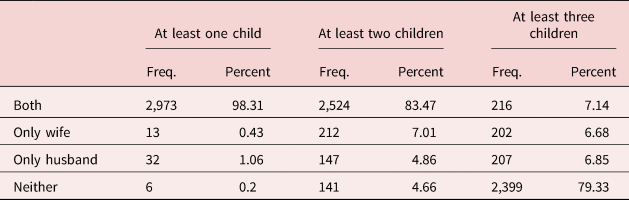
Our definition of fertility disagreement is based on the difference in fertility willingness between husband and wife. The fertility willingness is defined as the ideal number of children question answered by the wife and husband. We define the fertility willingness distribution within marriage as four groups: both agree (on wanting a child), only husband, only wife,Footnote 1 and neither. If the ideal number of children for both partners is more than or equal to one, then they fall into the “both agree” category. If the ideal number of children for the husband is more than one and the ideal number for the wife is zero, then they fall into the “only husband.” This definition can be applied to the first/second/third and more children.
Table 1 shows fertility willingness distribution within marriage by the number of children wanted. The first observation is that over 80% of families agree on wanting two children and almost 80% of families agree on not wanting three children. Fertility disagreement-wise, for the first child, only 1.5% of couples show disagreement. But for the second child, the disagreement proportion is over 11%, which is a noteworthy increase compared to the first child. The disagreement over fertility could thus be quite consequential for the birth of the second child and beyond.Footnote 2
Fertility disagreement between husband and wife

3.2.2 Childbearing plan
Our outcome variable is the plan to have children. The survey asks the family about their plan to have another child and they can choose from “definitely have one or more,” “definitely not,” and “uncertain.” We define a dummy variable of planning to have at least one more child which takes the value 1 if the answer is “definitely have one or more,” and 0 otherwise. Many previous studies have demonstrated the difference between the ideal number of children and additional childbearing plans (Islam & Bairagi, Reference Islam and Bairagi2003; Monnier, Reference Monnier1989). Although they are both hypothetical questions, the ideal number of children is framed to not consider the current situation but the plan to have more children is the expectation of actual action, which is closer to fertility behavior.
The relationship between fertility willingness, fertility planning, and eventual fertility behaviors has been examined extensively in the sociology literature. First, strong intention–behavior correlations are also observed in the fertility domain (Billari et al., Reference Billari, Philipov and Testa2009). Although fertility intentions have been a central theme in demographic research for some time, it has received renewed attention in recent years since intentions are now frequently analyzed in the framework of theory planned behavior, a general psychological theory concerning the link between attitudes and behavior (Ajzen, Reference Ajzen1991). Billari et al. (Reference Billari, Philipov and Testa2009) and Ajzen and Klobas (Reference Ajzen and Klobas2013) specifically discuss the possible application of theory planned behavior in the fertility domain. This framework separates “attitude toward having a child,” and “intention to have a child” with “birth of a child.” The current outcome variable could be viewed as studying the links between “attitude toward having a child” and “intention to have a child,” which is itself a valid part of the fertility determination process.
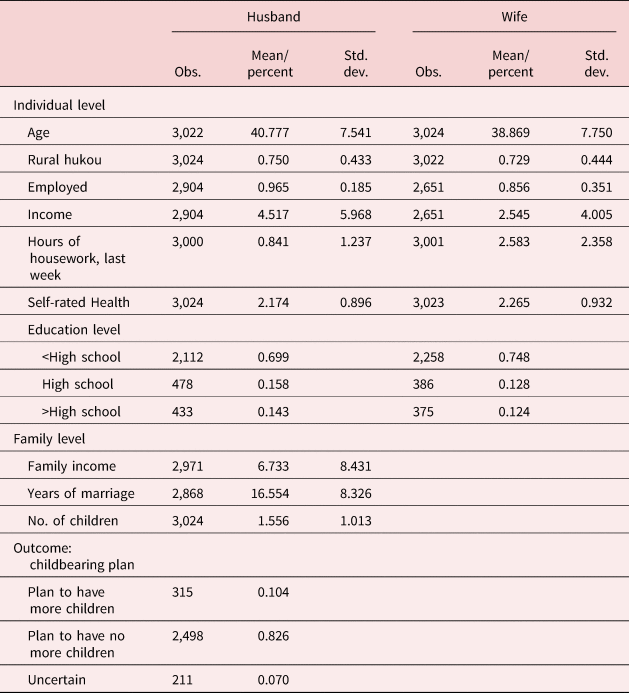
The bottom half of Table 2 reports the tabulation of the childbearing plan of the family. About 10% of families have a clear plan to have more children, and about 82.6% of families plan to not have more children in the future. In total, 7% of families are uncertain about whether or not to have children. In our main analyses, we focus on the category of “plan to have more children” and group the other two categories together. In robustness checks, we also focus on the category of “plan to have no more children” and put the uncertain group together with plans to have more children.
Summary statistics

3.3 Empirical model
Our analyses employ a simple linear regression model to study the relationship between childbearing plans and fertility disagreement. The model is specified below:

Here, plan i is a dummy variable that takes the value 1 if the family is planning to have at least one more child. The key explanatory variables are the binary variables including $wife\_only_i$ (only wife wanting more children), $husband\_only_i$
 (only husband wanting more children), and neither i (neither wanting a child) representing fertility disagreement within the family. β 1 to β 3 are the coefficients of interest; they tell us the effect of different types of fertility disagreement in childbearing planning. In these analyses, we are comparing couples with different fertility disagreements to couples in which both partners agree to have two children. $X_i^f$
 and $X_i^m$
 represents individual characteristics including age, education, hukou status, employment, housework hours, income, and self-rated health status of the wife and the husband, HH i represents family level characteristics including family income and years of marriage. The summary statistics are reported in Table 2.
We choose a linear model as our baseline model following the recommendation of Angrist and Pischke (Reference Angrist and Pischke2009). Our main goal is to describe the essential features of statistical relationships between fertility disagreement and childbearing plans, and we are not interested in predicting childbearing plans of individual families. Even if the underlying relationship is nonlinear, a linear regression provides the best linear approximation to it and is a satisfactory description of the statistical relationships. The linear model also facilitates heterogeneity analyses which adds to the appeal. Even though the advantages of a linear model, we also explore the robustness of our main results by using alternative model specifications such as the Probit model, changing the outcome variable (planning to have no more children), changing control variables, etc.
4. Results
In this section, we first explore the correlation between fertility disagreement and childbearing behaviors. Next, we present regression results and heterogeneity analyses to discuss the fertility bargaining process.
4.1 Correlation
We focus on the fertility disagreement over having the second child because Table 1 shows that the disagreement over the second child has the potential to matter the most for childbearing plans.
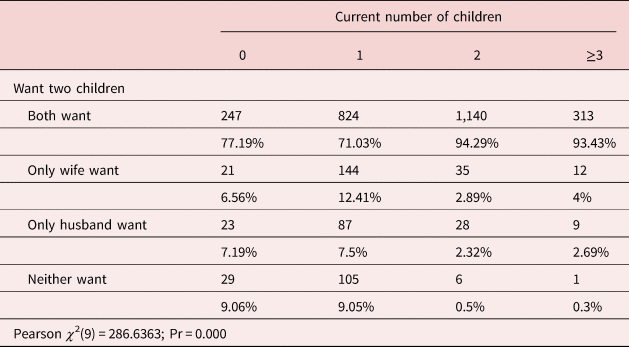
Table 3 shows the correlation between fertility disagreement and the number of children in the family. One startling contrast is between families with one child and families with two children. The proportion of fertility disagreement is much higher for families with one child: over 19% of families with one child have one partner who is willing to have one more child. The chi-square test shows that these differences appear to be statistically significant. From this comparison, it is reasonable to suspect that disagreement is an important factor explaining why these families have only one child but not two children.
Fertility disagreement and the number of children

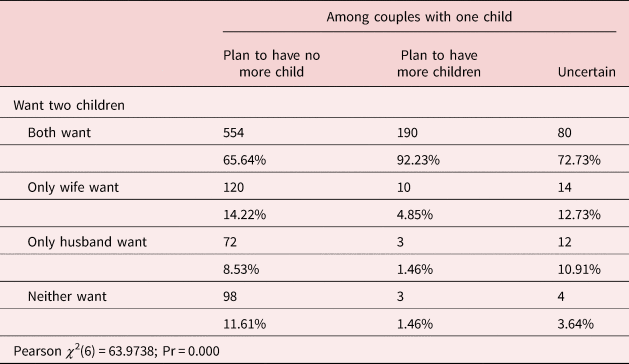
We next focus on couples with only one child and further explore the correlation between fertility disagreement and the plan to have more children. Table 4 shows the results. Only about 6% of couples planning to have more children disagree on fertility willingness compared to over 22% for those couples who plan to have no more children or are uncertain about additional birth. Both the correlation with the childbearing plan and with the current number of children suggest fertility disagreement plays an important role in determining childbearing behaviors.
Fertility disagreement and the plan to have children

4.2 Regression results
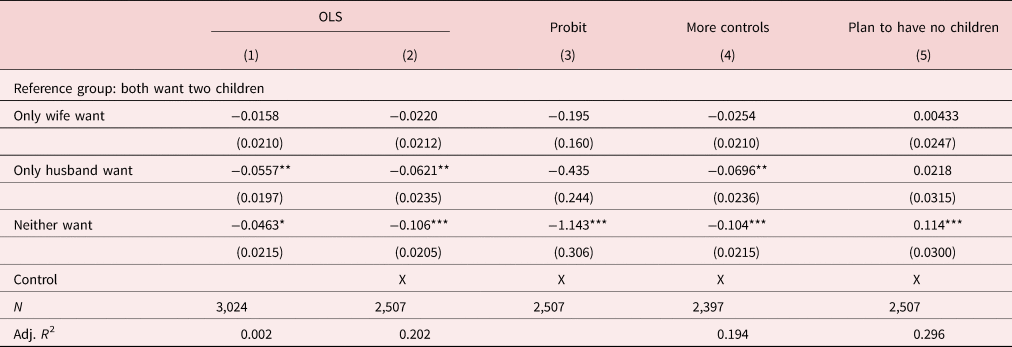
We report the regression results of the effect of fertility disagreement on the plan to have more children in Table 5. Column (1) reports the coefficients of fertility disagreement over the second child using the full sample without any control variables and column (2) is the same regression controlling for socioeconomic information of both husband and wife. The coefficients in the two columns are quite similar to each other, which speaks to the robustness of the results.
Main regression results

Note: Robust standard errors are reported in parentheses.
***p < 0.001, **p < 0.01, *p < 0.05.
In these regressions, we are comparing observations where only the wife/husband wants two children to observations where both partners want two children. The first result that is not surprising is that both partners agree on not wanting two children significantly decreases the likelihood of planning to have more children. The most interesting finding is based on the comparison of the coefficients of “Only wife” and “Only husband.” It appears that only the husband wanting a child significantly reduced the probability to plan for more children. In comparison, only the wife wanting a second child is not significantly different from both wanting a second child.
This result is consistent with the hypothesis that the wife has veto power over childbearing: when the wife does not want to have more children, fertility does not happen. In the literature, there have been studies mostly based on developed countries showing that both partners have veto power over childbearing (Doepke & Kindermann, Reference Doepke and Kindermann2019). Other studies find in some developing countries if the husband has fertility willingness it determines the subsequent birth. Our finding shows that in the setting of China, the wife's fertility willingness seems to be more important in the decision to have more children.
This result is interesting because it is in contrast with the difference in fertility willingness between husband and wife in Table 1. It appears that a higher proportion of families have only the wife wanting a second child than only the husband. On the other hand, the wife also holds the veto power in childbearing. Both these findings are different from the findings based in developed countries.
We also conduct Probit analyses and ordinary least-squares (OLS) analyses with additional control variables including length of the marriage and self-rated health for the robustness checks. It is possible that the longer a couple is together, their preference may become more similar so controlling for the length of marriage helps with this concern. As shown in columns (3) and (4), both results are consistent with the basic model where only husband wanting two children significantly decreases the likelihood of planning to have more children.
We also explore the robustness with changing definition of the outcome variable of definitely planning to have no more children. Column (5) reports the results. In contrast with the basic result, only husband wanting two children does not significantly increase the probability of definite planning to have no more children. This suggests that only husband wanting two children moves family from definitely having two children to no clear plans. Neither parents wanting two children increase the probability of have clear plan to not have more children.
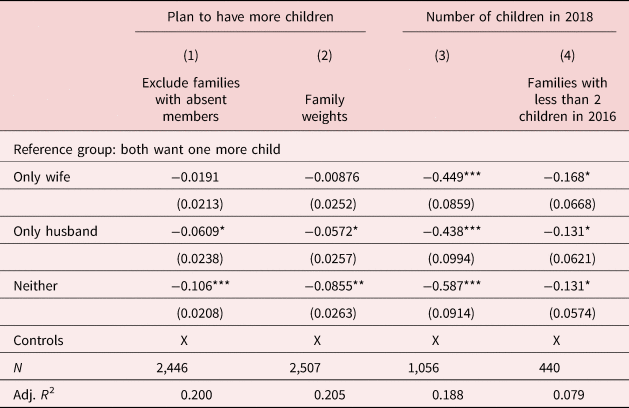
We also conduct additional robustness checks in Table 6. The first two columns address concerns on the survey details. As CLDS is a family survey, for qualified family members who are absent, their individual questionnaires are answered by others in the family.Footnote 3 Although the observations with information answered by other family members account for a small proportion of our sample, we exclude these observations and rerun the analyses. The result is reported in column (1) of Table 6. The survey provides weights for observations at the family level as well as the individual level. Since our analyses are conducted at the family level, we rerun weighted regressions using family weight and the results remain consistent in column (2). These results remain consistent with the current findings.
More robustness checks

Note: Robust standard errors are reported in parentheses.
***p < 0.001, **p < 0.01, *p < 0.05.
One important limitation of our data is that the outcome variable, “planning to have one more child,” is only answered by the wife. To address this concern, we utilize the “rolling” panel structure of the CLDS data. Parts of the samples in 2016 were reached in 2018 (the latest year available) and we matched our sample with the 2018 data and about one-third of the 2016 families are included in the panel sample. First, planning to have children for families with no or only one child in 2016 significantly increased the number of children in 2018. This implies that the outcome variable of planning to have children at least strongly and significantly affects the decision to have children, and the actualization rate of the plan is almost 30% in 2 years.
Despite the relatively low follow-up probability and limited sample size, we still tried to examine the link between disagreement in fertility willingness in 2016 and the number of children in 2018. The results are reported in columns (3) and (4). These results are mostly consistent with our findings in the paper. Neither parents wanting more children does reduce the number of children. The disagreement also significantly reduced the number of children. The difference between this result and the finding in the paper is that only husband want and only wife want appear to have similar effects in reducing fertility. This suggests that not only the wife has veto power of the fertility decision, but the husband also has veto power against having more children. At the very least, the findings do support our key takeaway in the paper that the disagreement in fertility desire has a significant role in reducing fertility decision and that the wife does have veto power. It also echoes our concern a bit that wife's “plan to have a baby” does reflect her willingness more so the husband's “veto” power is hidden.
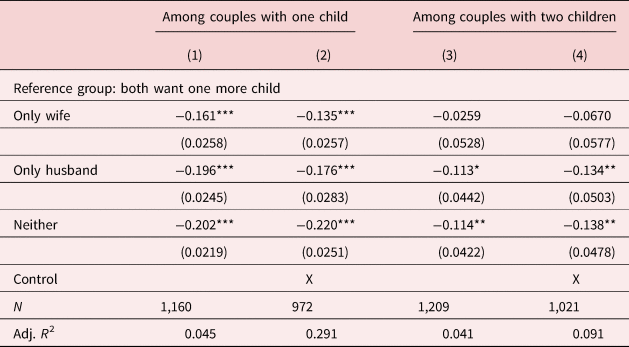
In the main analyses, we did not separate families with different numbers of children apart. Next, we examine the robustness and also explore the heterogeneity of the disagreement on childbearing plans in families with different numbers of children. The explanatory variables are also changed slightly to wanting one more child beyond the current number of children, instead of wanting two children. The results are reported in Table 7.
Regression results by the number of children

Note: Robust standard errors are reported in parentheses.
***p < 0.001, **p < 0.01, *p < 0.05.
It appears that the main results are driven by families with two children: among these families the wife has veto power over childbearing plans. For families with one child, both partners have veto power: either one disagreeing to have at least one more child significantly reduces the probability of making childbearing plans. There is almost no disagreement over having the first child and there are few families with no children, so we did not run this analysis on families with no children.
4.3 Heterogeneity
To further explore the bargaining process, we conduct heterogeneity analyses by different socioeconomic backgrounds, attitudes toward work, and other approximations of bargaining powers.
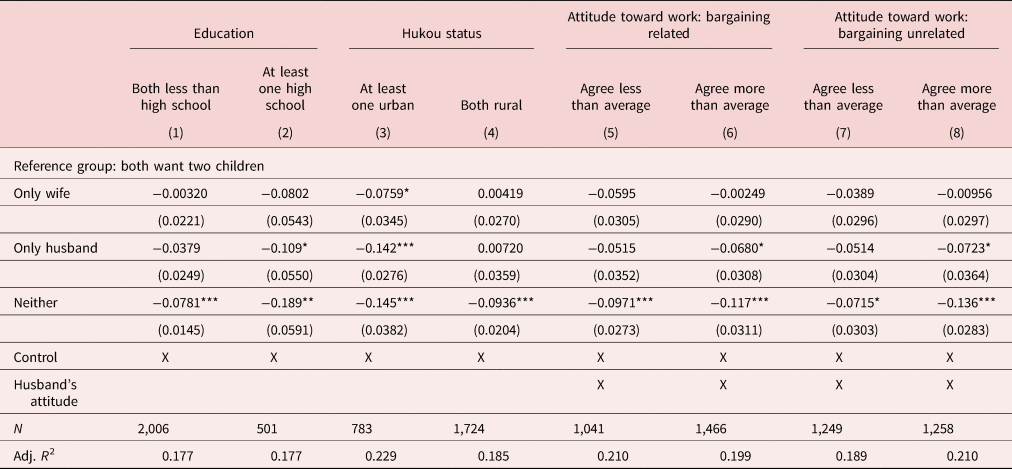
Couples from different socioeconomic backgrounds may have different bargaining norms which may help us understand more about the bargaining process. Table 8 presents the results by education, hukou status, and attitude toward work. We divide the samples into groups with at least one family member who has a high school degree and without. Comparing column (1) to column (2), the wife has veto power over the childbearing plan in families with higher education. Higher education usually translates to a more equal gender identity, which means that the wife is more likely to have a more equal say in the bargaining process. Similar logic applies to results by hukou status. We divide the samples into two groups, one with only rural hukou and the other with at least one partner of urban hukou. In columns (3) and (4), for families where at least one member has urban hukou, the wife has veto power. Marriages in urban areas are more likely to have a more equal gender role. So the finding is consistent with the results by education status. Notice that in the urban group, the husband also has veto power over fertility planning, i.e., his opposition to more children also reduced the planning. The second aspect to interpret the result with at least one urban hukou is a switch in preference for children. It is less of a bargaining power difference than how the family views children. For families where both parents are rural hukou, they may be more influenced by the traditional view to prefer larger families, so only neither partner wanting to have more children reduced fertility planning. Either wife or husband not wanting to have more children is not significantly different from both wanting more children. When at least one of the partners has urban hukou, they are leaning toward a more conservative view of more children, so only one partner wanting to have children reduced fertility planning no matter it is the husband or the wife.
Heterogeneity results by socioeconomic background and attitude toward work

Note: Robust standard errors are reported in parentheses.
***p < 0.001, **p < 0.01, *p < 0.05.
The last four columns divide the samples by the wife's attitude toward work, controlling for the husband's attitude. There are two sets of questions about the attitude toward work: one set asks whether the respondent agrees with the statement that work provides the value of earning a living, providing peace of mind, and earning respect to be bargaining related; the other asks whether work provides the chance to meet people, work fulfills interests, and work provides an opportunity to utilize one's ability. We propose that the first set be bargaining related and the second set be bargaining unrelated.
The results in column (5) show that in families where the wife does not agree with bargaining related work values, the husband and not the wife has veto power over childbearing plan. In other groups, the results are consistent with the main finding.
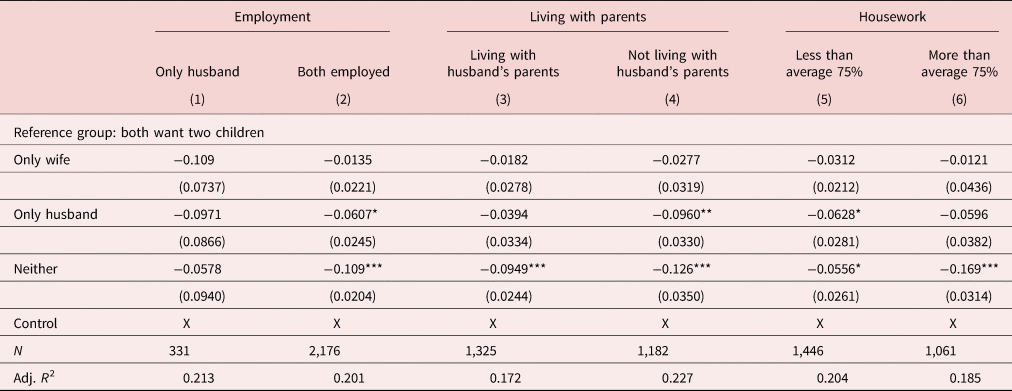
Table 9 tries to directly measure the level of bargaining power. From these analyses, our main takeaway is that in families where the wife is more likely to have higher bargaining power, they are more likely to have veto power for childbearing.
Heterogeneity results by bargaining power

Note: Robust standard errors are reported in parentheses.
***p < 0.001, **p < 0.01, *p < 0.05.
The comparison by employment speaks more to the bargaining power from the higher economic condition. In families where the wife is employed, she has childbearing veto power. In families where only the husband is employed, either parent wanting a second child increases the likelihood to have childbearing plans.
Columns (3) and (4) check heterogeneity across families with different levels of husband parent's involvement. Traditional families are centered around the husband and his parents are more involved in the family decisions. In those families, the wife is likely to have lower bargaining power. The results are partially consistent with this hypothesis: in families living with the husband's parents, the wife does not have veto power over childbearing plans. It is also likely that the non-traditional families are more responsive to either partner opposing to having more children so the disagreement from the husband has stronger effects too, consistent with “in traditional family, wife's preferences match also better to the family's birth planning.”
The last comparison is from a more direct measure of bargaining power in the household, the distribution of housework. In our sample, on average the wife takes up around 75% of housework measured in hours. So, we divide our sample into families in which the wife takes up more than the average proportion of housework and less than or equal to the average proportion. The results show that in families where the wife takes less housework, they have veto power over childbearing.
Families with more equal housework division may have more equal gender roles in general, so the husband opposing to have more children is also more respected so the coefficient of only wife want in (5) is larger in effect size than that in (6). In other words, husbands' veto power may increase with more equal gender roles, regardless of his bargaining power.
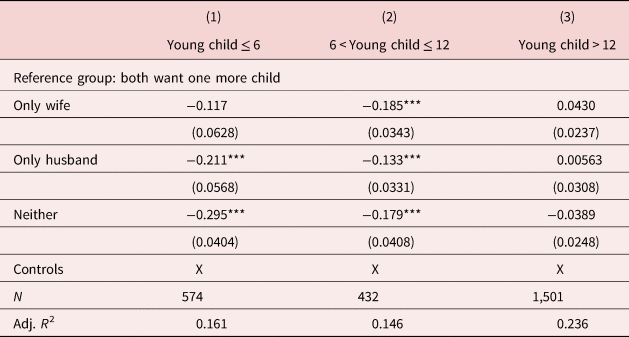
We also attempt to directly consider the difference in childcare burden. Our data do not specifically ask the childcare burden; childcare burden is included in the housework question. So we attempt to compare families with younger children and older children to see if we can observe any differences and speak on heterogeneity with different levels of childcare burden. Table 10 reports the heterogeneity for families with young age children and older children. We can see that the effects of disagreement focus on when children are younger. In families whose youngest children are already 12, they rarely plan to have more children. In the youngest group, wife has veto power which the husband does not. For middle age children group, both wife and husband disagreement reduced the planning. This does show that when childcare burden is higher because of young children's presence, the willingness of the wife matters more than when the overall childcare burden is lower.
Heterogeneity results by childcare burden

Note: Robust standard errors are reported in parentheses.
***p < 0.001, **p < 0.01, *p < 0.05.
5. Conclusion
In this paper, we study fertility disagreement within marriages and its implications on childbearing behaviors in China. Our finding shows that there exists a meaningful proportion of families where the wife and husband do not agree on fertility willingness. This is especially important for births beyond the first child. Our finding, in addition, shows that the disagreement has a significant impact on the childbearing plans of the family. Especially, when the wife does not agree to have an additional child, she has veto power over childbearing plans. In contrast, the veto power of the husband is less consistent. We also present interesting heterogeneity analyses showing that more equal gender role is key to the wife's veto power and higher bargaining power affects the influence of disagreement on childbearing plans.
The fertility disagreement discussed in this paper is also in contrast with gender differences in fertility preferences. We show the gender differences in fertility willingness in the CLDS data among all respondents and the fertility willingness differences between wife and husband in the matched couple sample in Appendix Table A1. Consistent with previous literature, in the general sample, the fertility desires of males and females are significantly different (Li & Xu, Reference Li and Xu2022). However, in the matched sample, the average fertility differences for husbands and wives are statistically equivalent. This contrast suggests that the matching process when forming a marriage has already resulted in husbands' and wives' fertility willingness being closer than in the general population, but the existence of disagreement within households is still present.
In the fertility disagreement tabulation, around 7% of families belong to the category of only wives wanting two or more children and this proportion is higher than the proportion of only husbands wanting two or more children. This is in contrast with many studies on developing countries where on average, husbands prefer significantly more children than their wives (Doepke & Tertilt, Reference Doepke and Tertilt2018; Rasul, Reference Rasul2008).
Two factors are most relevant to the decision to have children: financial cost and child care. In current China, it is still the wife who bears the larger proportion of child care and the expectation to provide for the family financially falls more on the husband. Only the wife wanting two or more children is more common than only the husband wanting more children which might suggest that the financial cost of children is the constricting factor for more families than the childcare burden.
Our findings have important policy implications. We show that disagreement over fertility willingness in marriages are common and has significant implication for fertility outcomes in China. This shows that fertility-boosting policies aiming to reduce the cost of having children should consider the overall cost and the distribution of the cost of raising children within families. In addition, policies may be more cost-effective to try to improve the fertility willingness of the partner with veto power in fertility decisions, i.e., the wife, and this may have a larger effect on improving fertility.
One interesting observation is that in the general sample, male and female respondents have significantly different gender preferences for children. The ideal number of sons is higher for male respondents while female respondents have higher fertility willingness for daughters. This pattern holds for the husband and wife sample.
Our analyses also have some limitations. One is that the childbearing plan is asked only for female respondents, so it can potentially be biased toward the wife's fertility desire. However, this should not be the main driver behind our results because the heterogeneity patterns still show up. The other one is that childbearing plans do not equal behaviors. We have addressed the concern using 2018 data to form a panel structure and find that disagreement in fertility desire has a significant role in reducing fertility decision. However, given the relative limited sample size and only 2 years between the two waves of survey, additional analyses may be needed.
Supplementary material
The supplementary material for this article can be found at https://doi.org/10.1017/dem.2025.2.
Data
The data will be available on request.
Acknowledgments
Financial support from the National Social Science Fund of China (20BRK044) is gratefully acknowledged. We thank the conference participants at the 2022 annual conference of China Population Association and the issues on low-fertility conference in 2022.
Competing interests
None.