




1 Introduction
Symmetric tensor products and antisymmetric tensor products are essential in various fields. For instance, symmetric tensors are foundational to general relativity [Reference Carroll3]. Additionally, symmetric tensor products play significant roles in multilinear algebra [Reference Greub9], representation theory [Reference Fulton and Harris7], and statistics [Reference McCullagh13]. Moreover, decomposing a symmetric tensor into a minimal linear combination of tensor powers of the same vector arises in mobile communications, machine learning, factor analysis of k-way arrays, biomedical engineering, psychometrics, and chemometrics [Reference Comon4–Reference De Lathauwer, De Moor and Vandewalle6, Reference Sidiropoulos, Bro and Giannakis16, Reference Smilde, Bro and Geladi18]. Furthermore, the symmetric part of a quantum geometric tensor has been utilized as a tool to detect quantum phase transitions in PT-symmetric quantum mechanics [Reference Zhang, Wang and Gong21]. In particular, symmetric tensor products of operators are crucial in the study of non-interacting systems [Reference Suetin, Kostrikin and Manin19] and are actively explored within the physics community [Reference Ibort, Marmo and Perez-Pardo10–Reference Lenz, Weinmann and Wirth12].
In the present article, we will study the norm of the symmetric and antisymmetric tensor product of operators. Let
 $\mathcal {H}$
be a Hilbert space and
 $\mathcal {B}(\mathcal {H})$
be the space of bounded linear operators on
 $\mathcal {H}$
. Let
 $\mathcal {H}^{\otimes n}$
be the full tensor space of
 $\mathcal {H}$
,
 $\mathcal {H}^{\odot n}$
be the symmetric tensor space of
 $\mathcal {H}$
, and
 $\mathcal {H}^{\wedge n}$
be the antisymmetric tensor space of
 $\mathcal {H}$
, as introduced in [Reference Parthasarathy14, p. 106]. For
 $\mathbf {v}_1, \mathbf {v}_2, \ldots , \mathbf {v}_n \in \mathcal {H}$
, let
 $\mathbf {v}_1 \odot \mathbf {v}_2 \odot \cdots \odot \mathbf {v}_n$
be the symmetric tensor and
 $\mathbf {v}_1 \wedge \mathbf {v}_2 \wedge \cdots \wedge \mathbf {v}_n$
be the antisymmetric tensor of
 $\mathbf {v}_1, \mathbf {v}_2, \dots , \mathbf {v}_n$
. For
 $\mathbb {A}_{1},\mathbb {A}_{2},\dots ,\mathbb {A}_{n} \in \mathcal {B}(\mathcal {H})$
, we define
 $\mathbb {A}_{1}\otimes \mathbb {A}_{2}\otimes \cdots \otimes \mathbb {A}_{n}$
on
 $\mathcal {H}^{\otimes n}$
as
 $$ \begin{align*}\left(\mathbb{A}_{1}\otimes\mathbb{A}_{2}\otimes\cdots\otimes\mathbb{A}_{n}\right)\left(\mathbf{v}_1 \otimes \mathbf{v}_2 \otimes \cdots \otimes \mathbf{v}_n\right)=\mathbb{A}_{1} \mathbf{v}_1 \otimes \mathbb{A}_{2} \mathbf{v}_2 \otimes \cdots \otimes \mathbb{A}_{n} \mathbf{v}_n. \end{align*} $$
Then, it is not difficult to see that
 $\mathcal {H}^{\odot n}$
and
 $\mathcal {H}^{\wedge n}$
are invariant under the action of
 $$ \begin{align*}\mathrm{S}_n\left(\mathbb{A}_{1},\mathbb{A}_{2},\dots,\mathbb{A}_{n}\right)=\frac{1}{n!} \sum_{\pi \in \Sigma_n}\left(\mathbb{A}_{\pi(1)} \otimes \mathbb{A}_{\pi(2)} \otimes \cdots \otimes \mathbb{A}_{\pi(n)}\right) \in \mathcal{B}\left(\mathcal{H}^{\otimes n}\right), \end{align*} $$
where
 $\Sigma _{n}$
is the group of permutations of
 $\left \{ 1,2,\ldots ,n \right \} $
. Set
 $$ \begin{align*}\mathbb{A}_{1} \odot \mathbb{A}_{2} \odot \cdots \odot \mathbb{A}_{n}=\mathrm{S}_{n}\left(\mathbb{A}_{1}, \mathbb{A}_{2}, \dots, \mathbb{A}_{n}\right)|_{\mathcal{H}^{\odot n}}\end{align*} $$
and
 $$ \begin{align*}\mathbb{A}_{1} \wedge \mathbb{A}_{2} \wedge \cdots \wedge \mathbb{A}_{n}=\mathrm{S}_{n}\left(\mathbb{A}_{1}, \mathbb{A}_{2}, \dots, \mathbb{A}_{n}\right)|_{\mathcal{H}^{\wedge n}}.\end{align*} $$
By [Reference Brown and Pearcy2, p. 162] and [Reference Simon17, (3.8.17)],
 $$ \begin{align*}\sigma(\mathbb{A}_1\otimes \mathbb{A}_2\otimes\cdots\otimes\mathbb A_n)=\sigma(\mathbb{A}_1)\dots\sigma(\mathbb{A}_n)\end{align*} $$
and
 $$ \begin{align*}\|\mathbb{A}_1\otimes \mathbb{A}_2\otimes\cdots\otimes\mathbb A_n\|=\prod\limits_{i=1}^n \|\mathbb A_i\|. \end{align*} $$
However, the spectra and norms of symmetric tensor products and antisymmetric tensor products of bounded operators are much more complicated. For example, in [Reference Garcia, O’Loughlin and Yu8, Proposition 7.2], Garcia et al. estimated the norms of the symmetric tensor product of diagonal operators
 $\mathbb A_1$
and
 $\mathbb A_2$
, and the sharpness of the following estimates was obtained:
 $$ \begin{align*}(\sqrt{2}-1)\|\mathbb A_1\|\cdot\|\mathbb A_2\|\leq\left\|\mathbb A_1\odot \mathbb A_2\right\|\leq\|\mathbb A_1\|\cdot\|\mathbb A_2\|; \end{align*} $$
moreover, they raised a series of problems aimed at exploring the norms and spectra of the symmetric and antisymmetric tensor product of operators. To continue, let
 $\{e_i\}_{i=0}^\infty $
be an orthonormal basis (ONB for short) of a complex Hilbert space
 $\cal H$
. In what follows, we always assume that the weight
 $\alpha =\{\alpha _i\}_{i=0}^\infty $
is convergent.
Let
 $ S_{\alpha } $
be a weighted shift operator on
 $\mathcal {H}$
with weights
 $\alpha $
, defined by
 $$\begin{align*}S_{\alpha} e_{i} = \alpha_{i} e_{i+1} \quad \text{for } i \ge 0, \end{align*}$$
which has been extensively studied in [Reference Shields15]. Let
 $ S_{\alpha }^{*} $
denote its adjoint operator. In particular, S is the forward shift operator with the constant weight
 $\alpha _i = 1$
for
 $ i \in \mathbb {N} $
.
The following problems were raised in [Reference Garcia, O’Loughlin and Yu8].
Problem 1.1 [Reference Garcia, O’Loughlin and Yu8, Problem 6]
Identify the norm and spectrum of arbitrary symmetric or antisymmetric tensor products of S and
 $S^{*}$
(for example, consider
 $S^2 \odot S \odot S^{*3} $
and
 $S^2 \wedge S \wedge S^{*3} $
).
Problem 1.2 [Reference Garcia, O’Loughlin and Yu8, Problem 7]
Describe the norm and spectrum of
 $S_{\alpha } \odot S_{\alpha }^{*}$
and
 $S_{\alpha } \wedge S_{\alpha }^{*}$
, in which
 $S_{\alpha }$
is a weighted shift operator. What can be said if more factors are included?
We note that Yang and Zhang [Reference Yang and Zhang20] addressed spectral-related aspects of Problem 1.2 very recently. In this article, we partially solve these problems. To clarify our main results, we need the assumption of the so-called regularity on the weight.
Definition 1.1 (Regularity): The weight
 $\alpha $
is called to be regular if
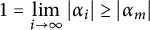
 $$ \begin{align*}\lim\limits_{i \to \infty } \left | \alpha_{i} \right | \ge \left | \alpha_{m} \right |, \text{ for any } m \in \mathbb{N}.\end{align*} $$
The following theorem is the main result in the present article, which partially gives an affirmative answer to Problems 1.1 and 1.2.
Theorem 1.3 Let
 $S_\alpha $
be a weighted shift operator with the convergent weight. Then, the following statements are equivalent:
-
(1)
 $\left \{ \alpha _{i} \right \} _{i=0}^{\infty }$
satisfies the regularity condition;
-
(2) for every
$ n \ge 2$
and every fixed
$\left ( l_{1}, l_{2},\ldots ,l_{n} \right )\in \mathbb {N}^{n}$
,
$$ \begin{align*}\|S_{\alpha}^{l_1}\odot\cdots \odot S_{\alpha}^{l_k}\odot S_{\alpha}^{*l_{k+1}}\odot\cdots \odot S_{\alpha}^{*l_{n}}\| =\mathop{\prod}_{i=1}^n\left \| S_{\alpha}^{{l_{i}}}\right\|;\end{align*} $$
-
(3) for every
$ n \ge 2$
and every fixed
$\left ( l_{1}, l_{2},\ldots ,l_{n} \right )\in \mathbb {N}^{n}$
,
$$ \begin{align*}\|S_{\alpha}^{l_1}\wedge\cdots \wedge S_{\alpha}^{l_k}\wedge S_{\alpha}^{*l_{k+1}}\wedge\cdots \wedge S_{\alpha}^{*l_{n}}\|=\mathop{\prod}_{i=1}^n\left \| S_{\alpha}^{{l_{i}}}\right\|.\end{align*} $$







In this case, set
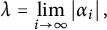 $\lambda =\lim \limits _{i \to \infty }\left | \alpha _{i} \right |,$
 $$ \begin{align*}\|S_{\alpha}^{l_1}\odot\cdots \odot S_{\alpha}^{l_k}\odot S_{\alpha}^{*l_{k+1}}\odot\cdots \odot S_{\alpha}^{*l_{n}}\|&=\|S_{\alpha}^{l_1}\wedge\cdots \wedge S_{\alpha}^{l_k}\wedge S_{\alpha}^{*l_{k+1}}\wedge\cdots \wedge S_{\alpha}^{*l_{n}}\|\\&=\lambda ^{ l_{1} + l_{2} + \cdots + l_{n} }.\end{align*} $$
Remark 1.4
-
1. As a consequence of the above theorem, for
$(l_1,\ldots ,l_n)\in \mathbb N^n,$
which partially solves Problem 1.1.
$$ \begin{align*}\|S^{l_1}\odot\cdots \odot S^{l_k}\odot S^{*l_{k+1}}\odot\cdots \odot S^{*l_{n}}\|=\|S^{l_1}\wedge\cdots \wedge S^{l_k}\wedge S^{*l_{k+1}}\wedge\cdots \wedge S^{*l_{n}}\|=1, \end{align*} $$
-
2. It is evident that the shift operators on many classical function space, including the Hardy shift and weighted Bergman shift, are regular.


This article is organized as follows. In Section 2, we provide some preparations to facilitate the proof of Theorem 1.3. Section 3 is devoted to the proof of our main result, Theorem 1.3. Finally, in Section 4, we solve [Reference Garcia, O’Loughlin and Yu8, Problems 1 and 2].
2 Preliminaries
In this section, we introduce some notations and preliminaries. For simplicity, set
 $$ \begin{align} S_{\alpha,t}= \begin{cases} S_{\alpha}^{t},& t> 0, \\ I,& t =0, \\ S_{\alpha}^{*\left | t \right | },& t < 0. \end{cases}\end{align} $$
For example,
 $S_{\alpha ,-2}=S_\alpha ^{*2}$
. Particularly,
 $$ \begin{align} S_{t}= \begin{cases} S^{t},& t> 0, \\ I,& t =0, \\ S^{*\left | t \right | },& t < 0. \end{cases} \end{align} $$
Moreover, for
 $i \in \mathbb {N}$
,
 $t \in \mathbb {Z}$
, write
 $$ \begin{align} \beta_{i,t} = \begin{cases} \alpha _{i}\alpha _{i+1}\dots\alpha _{i+t-1},& t> 0, \\ 1,& t =0, \\ \overline{\alpha_{i-1}\alpha_{i-2} \dots\alpha_{i+t}},& t < 0, \end{cases} \end{align} $$
and
 $$ \begin{align}\Gamma_{i,t} = \begin{cases} \min \left \{ \left | \alpha _{i} \right |, \dots,\left | \alpha _{i+t-1} \right | \right \} ,& t> 0, \\ 1 ,& t= 0, \\ \min \left \{ \left | \alpha_{i-1} \right |, \dots,\left | \alpha_{i+t} \right | \right \},& t < 0. \end{cases}\end{align} $$
For
 $\mathfrak {i}=(i_1,i_2,\ldots , i_n)\in \mathbb Z^n$
, write
 $$ \begin{align*}|\mathfrak{i}|=|i_1|+\cdots+|i_n|.\end{align*} $$
Define an equivalence relation
 $\sim _{\Sigma _n}$
on
 $\mathbb Z^n$
by
 $$ \begin{align*}\mathfrak{i}\sim_{\Sigma_n}\mathfrak{j}\end{align*} $$
if and only if there exists a permutation
 $\pi \in \Sigma _n$
such that
 $$ \begin{align*}i_k=j_{\pi (k)}, \quad k=1,\ldots, n. \end{align*} $$
Denote
 $\mathbb N^n/\Sigma _n$
and
 $\mathbb Z^n/\Sigma _n$
to be the quotient spaces and
 $[i_1,\ldots ,i_n] \in \mathbb Z^n/\Sigma _n $
(
 $[\mathfrak {i}]$
for short) is the coset of
 $\mathfrak {i}=(i_1,\ldots ,i_n)$
. For
 $\mathfrak {i}\in \mathbb Z^n$
,
 $\pi \in \Sigma _n$
, set
 $$ \begin{align} \mathfrak{i}_\pi=(i_{\pi(1)},\ldots,i_{\pi(n)}). \end{align} $$
The following lemma comes from the definition of the symmetric tensor product of operators and some direct calculations easily, and we omit its proof. For convenience, when
 $i<0$
, set
 $e_i=0$
and
 $\alpha _i=0$
.
Lemma 2.1 For
 $\mathfrak {i}\in \mathbb N^n$
,
 $$ \begin{align*}\begin{aligned} & \left ( S_{\alpha,{l_{1}}}\odot S_{\alpha,{l_{2}}}\odot \cdots \odot S_{\alpha,{l_{n}}} \right ) \left ( e_{i_{1} }\odot e_{i_{2} }\odot \cdots \odot e_{i_{n}} \right ) \\&\quad =\frac{1}{n!} \sum\limits_{\pi \in \Sigma _{n} }\beta_{i_{1},l_{\pi (1)}} \beta_{i_{2},l_{\pi (2)}}\dots\beta_{i_{n},l_{\pi (n)}} \left ( e_{i_{1}+l_{\pi (1)} }\odot e_{i_{2}+l_{\pi (2)} }\odot \cdots \odot e_{i_{n} +l_{\pi (n)}} \right ). \end{aligned}\end{align*} $$
To simplify the notation, for
 $\mathfrak {i}\in \mathbb N^n$
, set
 $$ \begin{align} e_{\mathfrak{i}}=e_{i_{1} }\odot e_{i_{2} }\odot \cdots \odot e_{i_{n}}, \end{align} $$
and it is easy to see that for any
 $\pi \in \Sigma _n$
,
 $e_{\mathfrak {i}}=e_{\mathfrak {i}_\pi }$
and write
 $$ \begin{align} e_{[\mathfrak{i}]}=e_{\mathfrak{i}}. \end{align} $$
In what follows, we will always fix the multiple index
 $\mathfrak {l}=(l_1,l_2,\ldots ,l_n)\in \mathbb {Z}^n$
and assume that
 $$ \begin{align} [l_{1}, l_{2},\ldots,l_{n}]=[\underbrace{{\tilde{l}_{1}},\dots,{\tilde{l}_{1}} }_{n_{1}} ,\dots,\underbrace{{\tilde{l}_{k}},\dots,{\tilde{l}_{k}} }_{n_{k}}] , \quad \mathrm{where} \ {\tilde{l}_{i}} \ne {\tilde{l}_{j}} \text{ for } i\not=j, \end{align} $$
and write
 $$ \begin{align} S_{\mathfrak{l}}=l_1+l_2+\cdots+l_n \text{ and }\mathscr{M}=\frac{n!}{n_{1}!\dots n_{k}! }. \end{align} $$
Furthermore, for
 $\mathfrak {i}\in \mathbb {N}^{n},$
to simply the notations let
 $$ \begin{align} R_{\mathfrak{i}}=\left\{[\mathfrak{j}]\in\mathbb N^n/\Sigma_n: \exists \, \pi \in \Sigma_{n}~s.t.~ [\mathfrak{j}+\mathfrak{l}_\pi]=[\mathfrak{i}]\right\}, \end{align} $$
and for a finite set
 $\mathcal {S}$
,
 $^{\# } \mathcal {S} $
is defined to be the cardinality of
 $\mathcal {S}$
. Then, it is easy to see that
 $$ \begin{align} ^{\# } R_{\mathfrak{i} } \le \ ^{\# } \left \{ \mathfrak{l}_\pi:\pi \in \Sigma_{n}\ \right \} = \mathscr{M}. \end{align} $$
Let
 $$ \begin{align} A_{k} = \begin{cases} \left \{ [\mathfrak{i}]\in \mathbb{N}^n/\Sigma_n: | \mathfrak{i} |=k \ and \ ^{\# } R_{\mathfrak{i} } <\mathscr{M} \right \},& k \geq 0, \\ \emptyset,& k < 0. \end{cases} \end{align} $$
Then, we have the following lemma.
Lemma 2.2 For
 $k>0$
sufficiently large, if
 $l_{1}, l_{2},\ldots ,l_{n}$
are not all equal, then there exists a constant
 $M>0$
, such that
 $^{\# } A_{k} \le Mk^{n-2}$
.
Proof Let
 $$ \begin{align}A_{k}^{\prime}=\left \{ \mathfrak{i} \in \mathbb{N}^n: | \mathfrak{i} |=k \ and \ ^{\# } R_{\mathfrak{i} } <\mathscr{M} \right \},~ k \geq 0.\end{align} $$
Obviously,
 $$ \begin{align*}^{\# }A_{k} \leq ^{\# }A_{k}^{\prime}.\end{align*} $$
Set
 $$ \begin{align*} B_{k}=\left \{ \mathfrak{i} \in A_{k}^{\prime}:\exists \, 1\le j\le n \text{ and } \exists \, \pi \in \Sigma_{n} \text{ such that } i_{j}-l_{\pi(j)}<0 \ \right \} \end{align*} $$
and
 $$ \begin{align*} D_{k}=\left \{ \mathfrak{i} \in A_{k}^{\prime}:\forall \, 1\le j\le n \text{ and } \forall \, \pi \in \Sigma_{n} \text{ such that } i_{j}-l_{\pi(j)}\ge 0 \ \right \}. \end{align*} $$
It is easy to see that
 $$ \begin{align}A_{k}^{\prime} = B_{k}\cup D_{k}.\end{align} $$
To obtain the desired result, it suffices to show that there exist constants
 $M_1,M_2>0$
such that
 $$ \begin{align} ^{\# } B_{k} \le M_{1}\left ( k+1 \right ) ^{n-2} \end{align} $$
and
 $$ \begin{align} ^{\# } D_{k} \le M_{2} \left ( k+1 \right ) ^{n-2}. \end{align} $$
For (2.15), by the definition of
 $B_{k}$
, we have
 $$ \begin{align*} B_{k}=\bigcup\limits_{j=1}^{n} \left \{ \mathfrak{i} \in A_{k}^{\prime}:\exists \, \pi \in \Sigma_{n} \text{ such that } i_{j}-l_{\pi(j)}<0 \ \right \}. \end{align*} $$
For
 $ 1 \le j \le n,$
let
 $$ \begin{align*}C_{k,j}=\left \{ \mathfrak{i} \in A_{k}^{\prime}:\exists \, \pi \in \Sigma_{n} \text{ such that } i_{j}-l_{\pi(j)}<0 \ \right \},\end{align*} $$
then obviously
 $$ \begin{align*}\begin{aligned} C_{k,j} & \subseteq \left \{ \mathfrak{i}\in\mathbb N^n: |\mathfrak{i}|=k, \exists \, \pi \in \Sigma_{n} \text{ such that } i_{j}-l_{\pi(j)}<0 \right \}. \end{aligned}\end{align*} $$
Set
 $$ \begin{align} h=\max \left \{ {\left | l_{1} \right | ,\left | l_{2} \right | ,\ldots ,\left | l_{n} \right | } \right \}. \end{align} $$
Then,
 $$ \begin{align*}\begin{aligned}^{\#}C_{k,j} \leq ^{\# } \bigcup\limits_{i_{j}=0}^{h} \left \{ \mathfrak{i} \in \mathbb{N}^n: |\mathfrak{i}|=k \ \right \} \leq \left ( h+1 \right ) \left ( k+1 \right ) ^{n-2}. \end{aligned}\end{align*} $$
Notice that
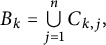 $B_{k}=\bigcup \limits _{j=1}^{n} C_{k,j},$
hence,
 $^{\# } B_{k} \le n\left ( h+1 \right ) \left ( k+1 \right ) ^{n-2}$
. Next, we will prove (2.16). For
 $ \mathfrak {i} \in D_{k}$
, by the definitions of
 $D_{k}$
and
 $A_{k}^{\prime }$
, we have
 $$ \begin{align} i_{j}-l_{\pi(j)}\ge 0,\quad \forall \, 1\le j\le n , \forall \, \pi \in \Sigma_{n} \text{ and } ^{\# } R_{\mathfrak{i} } <\mathscr{M}. \end{align} $$
 $$ \begin{align} ^{\# }\left\{ [\mathfrak{i}-\mathfrak{l}_\sigma]:\sigma \in \Sigma_n \right\}= ^{\# } R_{\mathfrak{i} } <\mathscr{M}. \end{align} $$
We claim that for any
 $\mathfrak {i}\in D_k$
, there exist
 $\sigma _{0}, \tau _{0} \in \Sigma _{n}$
, satisfying
 $\mathfrak {l}_{\sigma _0}\not =\mathfrak {l}_{\tau _0}$
, such that
 $$ \begin{align} [\mathfrak{i}-\mathfrak{l}_{\tau_0}] = [\mathfrak{i}-\mathfrak{l}_{\sigma_0}]. \end{align} $$
Otherwise, if for all
 $\sigma , \tau \in \Sigma _{n}$
such that
 $\mathfrak {l}_{\sigma }\not =\mathfrak {l}_{\tau }$
, we have
 $$ \begin{align*} [\mathfrak{i}-\mathfrak{l}_{\tau}]\not= [\mathfrak{i}-\mathfrak{l}_{\sigma}]. \end{align*} $$
Then,
 $$ \begin{align*}^{\# }\left\{ [\mathfrak{i}-\mathfrak{l}_\sigma]:\sigma \in \Sigma_n \right\}= \mathscr{M}, \end{align*} $$
which contradicts to (2.19) and the claim is proved. For
 $\tau $
,
 $ \sigma \in \Sigma _{n}$
,
 $\tau \not =\sigma $
, set
 $$ \begin{align*} D_{k,\tau ,\sigma}=\left \{ \mathfrak{i} \in D_{k}: \exists 1\leq a \neq b\leq n ~s.t.~ i_{a}-l_{\tau (a)} =i_{b}-l_{\sigma (b)}\right\}. \end{align*} $$
Obviously,
 $$ \begin{align*} D_{k,\tau ,\sigma}\subseteq \bigcup\limits_{1 \le a \ne b \le n} \{\mathfrak{i} \in \mathbb{N}^n: |\mathfrak{i}|=k, \ i_{a}-l_{\tau (a)} =i_{b}-l_{\sigma (b)} \}. \end{align*} $$
Therefore, by (2.20),
 $$ \begin{align} D_{k} \subseteq \bigcup\limits_{\tau \ne \sigma \in \Sigma_{n}} D_{k,\tau ,\sigma} \subseteq \bigcup\limits_{\tau \ne \sigma \in \Sigma_{n}} \bigcup\limits_{1 \le a \ne b \le n}\left \{\mathfrak{i} \in \mathbb{N}^n: |\mathfrak{i}|=k, \ i_{a}-l_{\tau (a)} =i_{b}-l_{\sigma (b)} \ \right \}. \end{align} $$
Notice that for
 $1 \le a \ne b \le n,$
 $$ \begin{align*}^{\# } \left \{\mathfrak{i}\in \mathbb{N}^n: |\mathfrak{i}|=k, \ i_{a}-l_{\tau (a)} =i_{b}-l_{\sigma (b)} \ \right \} \le \left ( k+1 \right ) ^{n-2}. \end{align*} $$
Therefore, by (2.21), we have
 $$ \begin{align*}^{\# } D_{k} \leq (n!)^{2}\,^{\# } D_{k,\tau ,\sigma} \le (n!)^{2}n^{2}\left ( k+1 \right ) ^{n-2}.\end{align*} $$
Notice that n is fixed, and the proof is completed.
Let
 $\left \{ e _{i} \right \} _{i=0}^{\infty } $
be an ONB for
 $\mathcal {H}$
. It is well known that for
 $i_1<i_2<\cdots <i_n$
,
 $$ \begin{align*}\left\|e^{k_{1}} _{i_1} \odot e_{i_2}^{k_{2}} \odot \cdots \odot e^{k_{n}}_{i_n}\right\|=\left(\frac{k_{1}!k_{2}!\dots k_{n}!}{\left ( k_{1}+ k_{2}+\cdots+k_{n} \right )! }\right)^{1 / 2}, \end{align*} $$
where
 $$ \begin{align*}e^{k_{j}} _{i_j} = \underbrace{e _{i_j}\odot \cdots \odot e _{i_j} }_{k_{j}}, \ 1 \le j \le n.\end{align*} $$
For
 $m=0,1,2,\ldots ,\mathscr {M}$
, set
 $$ \begin{align} E_{r,m} = \begin{cases} \left \{ [\mathfrak{i}]\in\mathbb N^n/\Sigma_n: \left | \mathfrak{i} \right |=r \ and \ ^{\# } R_{\mathfrak{i} } =m \right \},& r \geq 0, \\ \emptyset,& r < 0. \end{cases} \end{align} $$
Obviously,
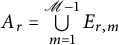 $A_r=\bigcup \limits _{m=1}^{\mathscr {M}-1}E_{r,m}$
. For simplicity, for
 $\mathfrak {i},\mathfrak {j}\in \mathbb N^n$
, let
 $$ \begin{align} N_{\mathfrak{j}, \mathfrak{i} }=\left \{ \pi\in\Sigma_{n}:[\mathfrak{i}+\mathfrak{l}_\pi]= [\mathfrak{j}] \right \}. \end{align} $$
Then, we have the following lemmas.
Lemma 2.3 If
 $l_{1},l_{2},\ldots ,l_{n}$
are not all equal, and for
 $\mathfrak {j}\in \mathbb N^n,$
there exist
 $1 \le s_0 < t_0 \le n$
such that
 $j_{s_0}=j_{t_0}.$
Then,
 $$ \begin{align}^{\# }\left \{[\mathfrak{j}-\mathfrak{l}_{\pi}]:\pi \in \Sigma_{n} \right \} \le \ ^{\# }\left \{ \mathfrak{l}_{\pi} :\pi \in \Sigma_{n} \right \} - 1.\end{align} $$
Proof Define
 $T \colon \, \left \{ \mathfrak {l}_{\pi } :\pi \in \Sigma _{n} \right \} \to \left \{[\mathfrak {j}-\mathfrak {l}_{\pi }] :\pi \in \Sigma _{n} \right \}$
by
 $$ \begin{align*} T: \mathfrak{l}_{\pi} \mapsto[\mathfrak{j}-\mathfrak{l}_{\pi}]. \end{align*} $$
Obviously, T is well-defined and surjective. Hence, in order to show (2.24), it suffices to prove that T is not injective. We will consider two cases.
-
Case 1:
$l_{s_0} \ne l_{t_0}.$
Set
$\pi _1=(1)$
and
$\pi _2=\left ( s_0t_0 \right )$
. Obviously,
$\mathfrak {l}_{\pi _1} \ne \mathfrak {l}_{\pi _2}.$
Since
$j_{s_0}=j_{t_0}$
, we have
$j_{s_0}-l_{s_0}=j_{t_0}-l_{s_0}$
and
$j_{t_0}-l_{t_0}=j_{s_0}-l_{t_0}$
. Hence, it is easy to see that which implies that T is not injective.
$$ \begin{align*}T\left( \mathfrak{l}_{\pi_1} \right) =[\mathfrak{j}-\mathfrak{l}_{\pi_1}]=[\mathfrak{j}-\mathfrak{l}_{\pi_2}]=T\left( \mathfrak{l}_{\pi_2}\right),\end{align*} $$
-
Case 2:
$l_{s_0}=l_{t_0}.$
Since
$l_{1},l_{2},\ldots ,l_{n}$
are not all equal, there exists
$1 \leq r_0 \leq n$
, such that
${l_{r_0} \neq l_{s_0}=l_{t_0}}$
. Set
$ \pi _1=(r_0s_0)$
and
$ \pi _2= (r_0t_0)$
. Obviously,
$\mathfrak {l}_{\pi _1} \ne \mathfrak {l}_{\pi _2}.$
Since
${j_{s_0}=j_{t_0}}$
and
$l_{s_0}=l_{t_0}$
, we have
$j_{s_0}-l_{r_0}=j_{t_0}-l_{r_0}$
,
$j_{t_0}-l_{t_0}=j_{s_0}-l_{s_0}$
, and
${j_{r_0}-l_{s_0}=j_{r_0}-l_{t_0}}$
. Hence, it is not difficult to see which implies that T is not injective.
$$ \begin{align*}T\left( \mathfrak{l}_{\pi_1} \right) =[\mathfrak{j}-\mathfrak{l}_{\pi_1}]=[\mathfrak{j}-\mathfrak{l}_{\pi_2}]=T\left( \mathfrak{l}_{\pi_2}\right),\end{align*} $$






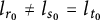






Lemma 2.4 Suppose that
 $l_{1},l_{2},\ldots ,l_{n}$
are not all equal. Then, for
 $k>0$
large enough, and every
 $\mathfrak {i},\mathfrak {j} \in \mathbb {N}^n,$
which satisfies that
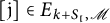
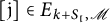 $[\mathfrak {j}] \in E_{k+S_{\mathfrak {l}},\mathscr {M}}$
and
 $[\mathfrak {i}] \in R_{\mathfrak {j} },$
we have
 $$ \begin{align*} \left \| e_{[\mathfrak{i}]} \right \|\leq \frac{{}^{\# } N_{\mathfrak{j},\mathfrak{i} }\mathscr{M}}{n!\sqrt{n!}}. \end{align*} $$
Proof Since
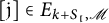 $[\mathfrak {j}]\in E_{k+S_{\mathfrak {l}},\mathscr {M}}$
, by the definition of
 $E_{k+S_{\mathfrak {l}},\mathscr {M}}$
in (2.22),
 $$ \begin{align} ^{\# } R_{\mathfrak{j} } =\mathscr{M}. \end{align} $$
We claim that for all
 $1 \le s < t \le n,$
 $$ \begin{align} j_{s} \ne j_{t}. \end{align} $$
Otherwise, there exists
 $1 \le s_0 < t_0 \le n$
, such that
 $$ \begin{align}j_{s_0}=j_{t_0}.\end{align} $$
By (2.10), obviously
 $$ \begin{align*}R_{\mathfrak{j} } = \left \{ [\mathfrak{j}-\mathfrak{l}_{\pi}] :\pi \in \Sigma_{n} , j_{i}-l_{\pi(i)} \ge 0, \forall \, 1\le i \le n\right \}.\end{align*} $$
Notice that
 $l_{1},l_{2},\ldots ,l_{n}$
are not all equal, hence by Lemma 2.3,
 $$ \begin{align*}\begin{aligned} ^{\# } R_{\mathfrak{j} } \le \ ^{\# }\left \{ [\mathfrak{j}-\mathfrak{l}_{\pi}] :\pi \in \Sigma_{n} \right \} \le \ ^{\# }\left \{ \mathfrak{l}_{\pi} :\pi \in \Sigma_{n} \right \} - 1 = \ \mathscr{M}-1, \end{aligned}\end{align*} $$
which contradicts to (2.25). The claim is proved. Write
 $$ \begin{align*}[i_1,\ldots,i_n]=[\underbrace{\widetilde{i_{1}},\ldots,\widetilde{i_{1}} }_{t_{1}} ,\dots,\underbrace{\widetilde{i_{s}},\dots,\widetilde{i_{s}} }_{t_{s}}], \mathrm{where} \ \widetilde{i_{1}} \ne \cdots \ne \widetilde{i_{s}}.\end{align*} $$
Since
 $[\mathfrak {i}] \in R_{\mathfrak {j} },$
we have
 $ N_{\mathfrak {j},\mathfrak {i} } \neq \emptyset .$
Therefore, by (2.23) and (2.26),
 $$ \begin{align*}\begin{aligned} ^{\# } N_{\mathfrak{j},\mathfrak{i} } &= \ ^{\# } \left \{\pi \in \Sigma_{n}:[\mathfrak{i}+\mathfrak{l}_{\pi}]=[\mathfrak{j}] \right \} \ge \ t_{1}!t_{2}!\dots t_{s}!n_{1}!\dots n_{k}!. \end{aligned}\end{align*} $$
Thus,
 $$ \begin{align*} \left \| e_{[\mathfrak{i}]} \right \|=\sqrt{\frac{t_{1}!t_{2}!\dots t_{s}!}{n!}} \leq \frac{t_{1}!t_{2}!\dots t_{s}!}{\sqrt{n!}} \leq\frac{{}^{\# } N_{\mathfrak{j},\mathfrak{i} }}{n_1!n_2!\dots n_k!\sqrt{n!}} = \frac{{}^{\# } N_{\mathfrak{j},\mathfrak{i} }\mathscr{M}}{n!\sqrt{n!}}.\\[-41pt] \end{align*} $$
For
 $k\geq 0, n\geq 1,$
using the notation in [Reference Andrews and Eriksson1, p. 55], denote
 $P(k,n)$
by the number of partitions of k into at most n parts, i.e.,
 $$ \begin{align}P(k,n)=\ {}^{\# }\left \{ [k_{1},\ldots,k_{n}] :\sum\limits_{i=1}^{n}k_{i}=k, k_{i}\ge0 \right \}.\end{align} $$
For
 $k<0$
,
 $n \ge 1$
, let
 $P(k,n)=0$
. Moreover, for
 $k\geq 0$
,
 $Q(k,n)$
is defined by the number of partitions of k into at most n ordered parts, i.e.,
 $$ \begin{align*}Q(k,n)=\ ^{\# }\left \{ \left ( k_{1},\ldots,k_{n} \right ) :\sum\limits_{i=1}^{n}k_{i}=k, k_{i}\ge0 \right \}.\end{align*} $$
The following lemma may be well-known, but we state it here for the readers’ convenience.
Lemma 2.5 For fixed
 $n \ge 1$
,
 $$ \begin{align*}\lim_{k \to \infty} \frac{P(k,n)}{P(k+1,n)} =1.\end{align*} $$
Proof For
 $n=1$
,
 $$ \begin{align*}\lim_{k \to \infty} \frac{P(k,1)}{P(k+1,1)} =\lim_{k \to \infty} \frac{k}{k+1} =1.\end{align*} $$
We will prove the lemma by induction. Suppose that
 $$ \begin{align} \lim_{k \to \infty} \frac{P(k,m)}{P(k+1,m)} =1, \end{align} $$
and we will prove
 $$ \begin{align} \lim_{k \to \infty} \frac{P(k,m+1)}{P(k+1,m+1)} =1. \end{align} $$
By [Reference Andrews and Eriksson1, p. 57], for
 $\left | q \right | <1$
, we have
 $$ \begin{align*}\sum\limits_{k=0}^{\infty }P (k,m)q^{k} =\frac{1}{\left ( 1-q \right ) \left ( 1-q^{2} \right )\dots\left ( 1-q^{m} \right)}.\end{align*} $$
It follows that
 $$ \begin{align*}\begin{aligned} \sum\limits_{k=0}^{\infty }P (k,m+1)q^{k} &=\left ( \sum\limits_{k=0}^{\infty }P (k,m)q^{k} \right ) \frac{1}{ 1-q^{m+1} } \\ &=\left ( \sum\limits_{k=0}^{\infty }P (k,m)q^{k} \right )\sum\limits_{k=0}^{\infty }\left ( q^{m+1} \right )^{k} \\&= \sum\limits_{k=0}^{\infty } \sum\limits_{i+j=k}P(i,m)f(j)q^{k}, \end{aligned}\end{align*} $$
where
 $$ \begin{align} f(j) = \begin{cases} 1, & j = k(m + 1), \quad k = 0, 1, 2, \ldots, \\ 0, & \text{otherwise}. \end{cases} \end{align} $$
Hence,
 $$ \begin{align} P (k,m+1)=\sum\limits_{i+j=k}P(i,m)f(j). \end{align} $$
For
 $s \in \mathbb {N}$
and
 $0 \le t \le m,$
let
 $k=\left ( m+1 \right )s+t$
. In order to prove (2.30), it suffices to show that for every
 $0 \le t \le m,$
 $$ \begin{align*}\lim_{s \to \infty}\frac{P\left ( \left ( m+1 \right ) s+t,m+1 \right ) }{P\left ( \left ( m+1 \right ) s+t+1,m+1 \right )}=1 .\end{align*} $$
 $$ \begin{align*}\begin{aligned} P\left ( \left ( m+1 \right ) s+t,m+1 \right ) &=\sum\limits_{i+j=\left ( m+1 \right ) s+t}P(i,m)f(j) \\&= \sum\limits_{i=0}^{s } P(\left ( m+1 \right ) i+t,m) \end{aligned}\end{align*} $$
and
 $$ \begin{align*}\begin{aligned} P\left ( \left ( m+1 \right ) s+t+1,m+1 \right ) &=\sum\limits_{i+j=\left ( m+1 \right ) s+t+1}P(i,m)f(j) \\&= \sum\limits_{i=-1}^{s } P(\left ( m+1 \right ) i+t+1,m). \end{aligned}\end{align*} $$
Then, by (2.29) and Stolz theorem, we have
 $$ \begin{align*} \lim_{s \to \infty}\frac{P\left ( \left ( m+1 \right ) s+t,m+1 \right ) }{P\left ( \left ( m+1 \right ) s+t+1,m+1 \right )} &=\lim_{s \to \infty}\frac{ \sum\limits_{i=0}^{s } P(\left ( m+1 \right ) i+t,m)}{\sum\limits_{i=-1}^{s } P(\left ( m+1 \right ) i+t+1,m)} \\&= \lim_{s \to \infty}\frac{ P(\left ( m+1 \right ) s+t,m)}{ P(\left ( m+1 \right ) s+t+1,m)} \\&= 1.\\[-33pt] \end{align*} $$
For
 $1>\varepsilon >0$
, let
 $$ \begin{align}\tilde{A}_{k+S_{\mathfrak{l}},\mathscr{M},\varepsilon } =\left \{ [\mathfrak{j}] \in E_{k+S_{\mathfrak{l}},\mathscr{M} }:\Gamma_{j_{m},-l_{\pi (m)}}> 1 - \varepsilon, \forall 1 \leq m \leq n, \forall \, \pi \in \Sigma_{n} \right \}\end{align} $$
and
 $$ \begin{align*}\check{A} _{k+S_{\mathfrak{l}},\mathscr{M},\varepsilon } =\left \{ [\mathfrak{j}] \in E_{k+S_{\mathfrak{l}},\mathscr{M} }:\exists \, \pi \in \Sigma_{n} \text{ and } \exists \, 1 \le m \le n ~s.t.~ \Gamma_{j_{m},-l_{\pi (m)}} \le 1 - \varepsilon \right \}.\end{align*} $$
It is easy to see that
 $$ \begin{align} E_{k+S_{\mathfrak{l}},\mathscr{M} } = \tilde{A}_{k+S_{\mathfrak{l}},\mathscr{M},\varepsilon } \sqcup \check{A} _{k+S_{\mathfrak{l}},\mathscr{M},\varepsilon }, \end{align} $$
where
 $\sqcup $
represents the disjoint union. Then, we have the following lemmas.
Lemma 2.6 If
 $\left \{ \alpha _{k} \right \} _{k=0}^{\infty }$
satisfies the regularity condition and
 $\lim \limits _{k\to \infty }|\alpha _k| = 1$
, then there exists a positive constant C, such that for
 $ k> 0$
large enough,
 $$ \begin{align*}^{\# } \check{A}_{k+S_{\mathfrak{l}},\mathscr{M} ,\varepsilon} \le C k ^{n-2}.\end{align*} $$
Proof For
 $1 \le m \le n$
, write
 $$ \begin{align*}\check{B} _{k+S_{\mathfrak{l}},\varepsilon,m }=\left \{ \mathfrak{j} \in \mathbb{N}^{n}: |\mathfrak{j}|=k+S_{\mathfrak{l}}, \exists \, \pi \in \Sigma_{n} ~s.t.~ \Gamma_{j_{m},-l_{\pi (m)}} \le 1 - \varepsilon \right \}\end{align*} $$
and
 $$ \begin{align*}\check{A} _{k+S_{\mathfrak{l}},\mathscr{M},\varepsilon }^{\prime} =\left \{ \mathfrak{j} \in \mathbb{N}^{n}: [\mathfrak{j}] \in E_{k+S_{\mathfrak{l}},\mathscr{M} }, \exists \, \pi \in \Sigma_{n} \text{ and } \exists \, 1 \le m \le n ~s.t.~ \Gamma_{j_{m},-l_{\pi (m)}} \le 1 - \varepsilon \right \}.\end{align*} $$
It is easy to see that
 $$ \begin{align}^\#\check{A} _{k+S_{\mathfrak{l}},\mathscr{M},\varepsilon } \leq \ ^\#\check{A} _{k+S_{\mathfrak{l}},\mathscr{M},\varepsilon }^{\prime} \end{align} $$
and
 $$ \begin{align} &\check{A} _{k+S_{\mathfrak{l}},\mathscr{M},\varepsilon }^{\prime} \nonumber\\&\quad \subseteq \left \{ \mathfrak{j} \in \mathbb{N}^{n}:|\mathfrak{j}|=k+S_{\mathfrak{l}}, \exists \, \pi \in \Sigma_{n} \text{ and } \exists \, 1 \le m \le n ~s.t.~ \Gamma_{j_{m},-l_{\pi (m)}} \le 1 - \varepsilon \right \}\nonumber\\&\quad =\bigcup_{m=1}^{n} \check{B} _{k+S_{\mathfrak{l}},\varepsilon,m }. \end{align} $$
Suppose that
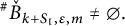 $^{\# } \check {B} _{k+S_{\mathfrak {l}},\varepsilon ,m }\neq \emptyset .$
Then, for
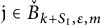 $\mathfrak {j} \in \check {B} _{k+S_{\mathfrak {l}},\varepsilon ,m }$
, there exists a
 $\pi \in \Sigma _n,$
such that
 $l_{\pi (m)}\neq 0$
and
 $\Gamma _{j_{m},-l_{\pi (m)}} \le 1 - \varepsilon $
, i.e.,
 $$ \begin{align} 1 - \varepsilon \ge \Gamma_{j_{m},-l_{\pi (m)}} = \begin{cases} \min \left \{ \left | \alpha _{j_{m}} \right |, \dots,\left | \alpha _{j_{m}-l_{\pi (m)}-1} \right | \right \}, &l_{\pi (m)}< 0, \\ \min \left \{ \left | \alpha _{j_{m}-1} \right |, \dots,\left | \alpha _{j_{m}-l_{\pi (m)}} \right | \right \}, &l_{\pi (m)}> 0. \end{cases} \end{align} $$
Since the weight
 $\alpha $
satisfies the regularity condition,
 $| \alpha _{k} |\leq \lim \limits _{i\to \infty }|\alpha _i|=1 $
holds for any
 $k \in \mathbb {N}$
. Thus, there exists an
 $N> 0$
such that for all
 $i> N$
,
 $$ \begin{align} \left | \alpha_{i} \right |> 1 - \varepsilon. \end{align} $$
Recall that
 $h=\max \left \{ {\left | l_{1} \right | ,\ldots ,\left | l_{n} \right | } \right \}$
is introduced in (2.17). Hence, by (2.37) and (2.38), for
 $\mathfrak {j} \in \check {B} _{k+S_{\mathfrak {l}},\varepsilon ,m }$
,
 $j_{m} \le N+h+1.$
It follows that for every
 $m\in \left \{ 1,2,\ldots ,n \right \} $
,
 $$ \begin{align} \check{B} _{k+S_{\mathfrak{l}},\varepsilon,m } \subseteq \bigcup\limits_{j_{m}=0}^{N+h+1 } \left \{ \mathfrak{j} \in \mathbb{N}^{n}:|\mathfrak{j}|=k+S_{\mathfrak{l}} \right \}. \end{align} $$
It is not hard to verify that for every fixed
 $0 \le t \le N+h+1$
,
 $$ \begin{align} ^\#\left \{ \mathfrak{j} \in \mathbb{N}^{n}:j_m=t, |\mathfrak{j}|=k+S_{\mathfrak{l}} \right \} \le \left ( k+S_{\mathfrak{l}}+1 \right ) ^{n-2}, \end{align} $$
then
 $$ \begin{align} ^{\# }\check{B} _{k+S_{\mathfrak{l}},\varepsilon,m } \le (N+h+2)\left ( k+S_{\mathfrak{l}}+1 \right ) ^{n-2}.\end{align} $$
Thus, by (2.35), (2.36), and (2.41), there is a positive constant C such that for
 $k>0$
large enough,
 $$ \begin{align*} ^{\# } \check{A} _{k+S_{\mathfrak{l}},\mathscr{M},\varepsilon } \le n(N+h+2)\left ( k+S_{\mathfrak{l}}+1 \right ) ^{n-2}\leq Ck^{n-2}.\\[-37pt] \end{align*} $$
Lemma 2.7 For
 $0 < \varepsilon < 1$
, we have
 $$ \begin{align*} \lim\limits_{k\to \infty}\frac{{}^{\# } \tilde{A}_{k+S_{\mathfrak{l}},\mathscr{M},\varepsilon } }{P(k,n) }= 1. \end{align*} $$
Proof Obviously,
 $$ \begin{align*}\bigcup_{j=0}^{\mathscr{M} } E_{k+S_{\mathfrak{l}} ,j} =\left \{ [\mathfrak{j}]\in \mathbb N^n/\Sigma_n : \left | \mathfrak{j}\right |=k+S_{\mathfrak{l}} \right \} \end{align*} $$
and
 $$ \begin{align*}^{\# } \left \{ [\mathfrak{j}]\in\mathbb N^n/\Sigma_n : \left | \mathfrak{j} \right |=k+S_{\mathfrak{l}} \right \} =P(k+S_{\mathfrak{l}}, n). \end{align*} $$
Notice that for
 $j\in \left \{ 0,1,\ldots ,\mathscr {M} \right \} $
,
 $E_{k+S_{\mathfrak {l}}, j}$
are mutually disjoint. Then, we have
 $$ \begin{align} ^{\# }E_{k+S_{\mathfrak{l}},\mathscr{M}} = P(k+S_{\mathfrak{l}},n) - \sum\limits_{j=0}^{\mathscr{M}-1} \ ^{\# }E_{k+S_{\mathfrak{l}},j}. \end{align} $$
It follows from (2.34) that
 $$ \begin{align} \begin{aligned} ^{\# } \tilde{A}_{k+S_{\mathfrak{l}},\mathscr{M},\varepsilon } &= \ ^{\# }E_{k+S_{\mathfrak{l}},\mathscr{M}} - \ ^{\# } \check{A}_{k+S_{\mathfrak{l}},\mathscr{M},\varepsilon } \\&= P(k+S_{\mathfrak{l}},n) - \sum\limits_{j=0}^{\mathscr{M}-1}\ ^{\# }E_{k+S_{\mathfrak{l}},j} - \ ^{\# } \check{A}_{k+S_{\mathfrak{l}},\mathscr{M},\varepsilon }. \end{aligned} \end{align} $$
For every
 $0 \le j \le \mathscr {M}-1$
and sufficiently large k, by (2.22), (2.12), and Lemma 2.2, there exists a constant
 $M>0$
such that
 $$ \begin{align*}^{\# } E_{k+S_{\mathfrak{l}},j} \le \ ^{\# } A_{k+S_{\mathfrak{l}}} \le M\left ( k+S_{\mathfrak{l}}\right ) ^{n-2}.\end{align*} $$
Additionally, it is not difficult to see that for sufficiently large k,
 $$ \begin{align} P(k+S_{\mathfrak{l}},n) \ge \frac{Q(k+S_{\mathfrak{l}},n)}{n!} = \frac{C_{k+S_{\mathfrak{l}}+n-1}^{n-1}}{n!}\end{align} $$
and
 $$ \begin{align}\lim\limits_{k \to \infty} \frac{\frac{C_{k+S_{\mathfrak{l}}+n-1}^{n-1}}{n!}}{k^{n-1}}> 0.\end{align} $$
Hence, for every
 $0 \le j \le \mathscr {M}-1$
,
 $$ \begin{align*}\varlimsup_{k\to \infty} \frac{{}^{\# } E_{k+S_{\mathfrak{l}},j} }{P(k+S_{\mathfrak{l}},n)}=0.\end{align*} $$
By Lemma 2.6, (2.44), and (2.45),
 $$ \begin{align*}\varlimsup_{k\to \infty} \frac{{}^{\# } \check{A}_{k+S_{\mathfrak{l}},\mathscr{M},\varepsilon } }{P(k+S_{\mathfrak{l}},n)} = 0.\end{align*} $$
Therefore, by (2.43),
 $$ \begin{align*}\lim\limits_{k\to \infty}\frac{{}^{\# } \tilde{A}_{k+S_{\mathfrak{l}},\mathscr{M},\varepsilon } }{P(k+S_{\mathfrak{l}},n) }=\lim\limits_{k\to \infty}\frac{P(k+S_{\mathfrak{l}},n) - \sum\limits_{j=0}^{\mathscr{M}-1} \ ^{\# } E_{k+S_{\mathfrak{l}},j} - \ ^{\# } \check{A}_{k+S_{\mathfrak{l}},\mathscr{M},\varepsilon } }{P(k+S_{\mathfrak{l}},n) } = 1. \end{align*} $$
Thus, by Lemma 2.5, we have
 $$ \begin{align*} \lim\limits_{k\to \infty}\frac{{}^{\# } \tilde{A}_{k+S_{\mathfrak{l}},\mathscr{M},\varepsilon } }{P(k,n) }= 1.\\[-41pt] \end{align*} $$
Lemma 2.8 For
 $k \geq 0$
and
 $0 \leq i_1 \leq \cdots \leq i_n$
satisfying
 $|\mathfrak {i}|=k,$
we have that for
 ${[\mathfrak {j}] \in \tilde {A}_{k+S_{\mathfrak {l}},\mathscr {M},\varepsilon }(0 < \varepsilon < 1)}$
and
 $\pi \in N_{\mathfrak {j}, \mathfrak {i} },$
it holds
 $$ \begin{align*} \left | \beta_{i_{a},l_{\pi (a)}} \right |>\left ( 1 - \varepsilon \right ) ^{ \left | l_{\pi(a)} \right | },\quad \forall 1 \le a \le n.\end{align*} $$
Proof Since
 $\pi \in N_{\mathfrak {j}, \mathfrak {i} },$
by (2.23),
 $$ \begin{align*} [\mathfrak{i}+\mathfrak{l}_\pi]= [\mathfrak{j}]. \end{align*} $$
Then, for every fixed
 $1 \le a \le n$
, there exists a
 $1 \le b \le n$
, such that
 $i_{a}+l_{\pi (a)}=j_{b}.$
Choose a
 $\tau _{0} \in \Sigma _{n}$
such that
 $\tau _{0}(b) = \pi (a)$
. Hence, from
 $[\mathfrak {j}] \in \tilde {A}_{k+S_{\mathfrak {l}},\mathscr {M},\varepsilon }$
and (2.33), we have
 $$ \begin{align} \Gamma_{i_{a}+l_{\pi (a)},-l_{\pi(a)}} = \Gamma_{i_{a}+l_{\pi (a)},-l_{\tau_0(b)}} = \Gamma_{j_{b},-l_{\tau_0(b)}}> 1 - \varepsilon. \end{align} $$
 $$ \begin{align} 1 - \varepsilon <\Gamma_{i_{a}+l_{\pi (a)},-l_{\pi(a)}}= \begin{cases} \min \left \{ \left | \alpha _{i_{a}+l_{\pi(a)}} \right |, \dots,\left | \alpha _{i_{a}-1} \right | \right \} ,&-l_{\pi(a)}> 0, \\ 1 ,&-l_{\pi(a)}= 0, \\ \min \left \{ \left | \alpha _{i_{a}+l_{\pi(a)}-1} \right |, \dots,\left | \alpha _{i_{a}} \right | \right \},& -l_{\pi(a)} < 0. \end{cases} \end{align} $$
 $$ \begin{align*} \left ( 1 - \varepsilon \right ) ^{ |l_{\pi(a)}| } <\left | \beta_{i_{a},l_{\pi (a)}} \right |= \begin{cases} \left | \alpha _{i_{a}-1} \dots \alpha _{i_{a}+l_{\pi(a)}} \right |,&-l_{\pi(a)}> 0, \\ 1 ,&-l_{\pi(a)}= 0, \\ \left | \alpha _{i_{a}} \dots \alpha _{i_{a}+l_{\pi(a)}-1} \right |,& -l_{\pi(a)} < 0. \end{cases} \end{align*} $$
The lemma is proved.
For any
 $\mathfrak {i} \in \mathbb {N}^n$
such that
 $|\mathfrak {i}|= k$
, let
 $$ \begin{align}\Sigma_{n,\mathfrak{i}}^{\prime}=\{\pi\in\Sigma_{n}: \mathfrak{i}+\mathfrak{l}_\pi \in \mathbb{N}^n\}\end{align} $$
and
 $$ \begin{align} P_{\mathfrak{i},k,t }=\left \{ \pi\in\Sigma_{n}:[\mathfrak{i}+\mathfrak{l}_\pi]\in E_{k+S_{\mathfrak{l}},t } \right \}, \quad 0 \leq t \leq \mathscr{M}. \end{align} $$
Obviously,
 $$ \begin{align*}P_{\mathfrak{i},k,0 }=\emptyset, \quad \Sigma_{n,\mathfrak{i}}^{\prime}= \mathop{\bigsqcup}_{t=1}^{\mathscr{M}}P_{\mathfrak{i},k,t},\end{align*} $$
where
 $\bigsqcup $
denotes the disjoint union. Moreover, by the definitions of
 $P_{\mathfrak {i},k,t }, N_{\mathfrak {j}, \mathfrak {i} },$
and
 $E_{k+S_{\mathfrak {l}},t }$
in (2.49), (2.23), and (2.22), it is easy to see that for
 $t\geq 1,$
 $$ \begin{align} P_{\mathfrak{i},k,t }= \bigsqcup\limits_{[\mathfrak{j}]\in E_{k+S_{\mathfrak{l}},t}} N_{\mathfrak{j},\mathfrak{i}}. \end{align} $$
Hence,
 $$ \begin{align} \Sigma_{n,\mathfrak{i}}^{\prime} = \mathop{\bigsqcup}_{t=1}^{\mathscr{M}}\bigsqcup\limits_{[\mathfrak{j}] \in E_{k+S_{\mathfrak{l}},t}} N_{\mathfrak{j},\mathfrak{i}}. \end{align} $$
3 Proof of the main result
In this section, we prove our main result, Theorem 1.3, which will be divided in two sections.
3.1 Proof of “
$(1)\Leftrightarrow (2)$
”

For
 $(1)\Rightarrow (2)$
, assume
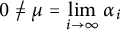 $0\not =\mu = \lim \limits _{i \rightarrow \infty }\alpha _i $
. Obviously, for every
 $(l_{1},l_{2},\ldots ,l_{n})\in \mathbb {Z}^n,$
 $$ \begin{align*}\left\|S_{\frac{\alpha}{\mu}, l_1}\odot\cdots\odot S_{\frac{\alpha}{\mu},l_n}\right\|={1\over |\mu|^{|\mathfrak{l}|}}\left\| S_{\alpha,{l_{1}}}\odot S_{\alpha,{l_{2}}}\odot \cdots \odot S_{\alpha,{l_{n}}}\right\|. \end{align*} $$
Without loss of generality, assume that
 $\lim \limits _{i\to \infty }\alpha _i=1$
. We claim that for every
 $(l_{1},l_{2},\ldots ,l_{n})\in \mathbb {Z}^n,$
 $$ \begin{align} \left \| S_{\alpha,{l_{1}}}\odot S_{\alpha,{l_{2}}}\odot \cdots \odot S_{\alpha,{l_{n}}} \right \| = 1. \end{align} $$
By [Reference Garcia, O’Loughlin and Yu8, Proposition 3.4],
 $$ \begin{align*}\left \| S_{\alpha,{l_{1}}}\odot S_{\alpha,{l_{2}}}\odot \cdots \odot S_{\alpha,{l_{n}}} \right \| \le 1.\end{align*} $$
The proof of the claim only requires proving
 $$ \begin{align}\left \| S_{\alpha,{l_{1}}}\odot S_{\alpha,{l_{2}}}\odot \cdots \odot S_{\alpha,{l_{n}}} \right \| \ge 1.\end{align} $$
We will consider this in two cases.
-
Case 1:
$l_{1}=l_{2}=\cdots =l_{n}=l$
are all equal.Without loss of generality, assume
$l>0$
. Since
$ 1=\lim \limits _{i \to \infty } \left | \alpha _{i} \right | \ge \left | \alpha _{m} \right | $
for any
$m \in \mathbb {N}$
, it follows that for any
$1> \varepsilon > 0$
, there exists an
$N> 0$
such that for all
$i> N$
, (3.3)Choose
$$ \begin{align}1> \left | \alpha_{i} \right | > 1 - \varepsilon.\end{align} $$
$\left \{ i_{j} \right \} _{j=1}^{n} $
large enough such that (3.4)Obviously,
$$ \begin{align} N < i_{1} < i_{2} < \cdots < i_{n}. \end{align} $$
Since for
$$ \begin{align*}\begin{aligned} \left ( S_{\alpha}^l\odot S_{\alpha}^l\odot \cdots \odot S_{\alpha}^l \right ) \left ( e_{[\mathfrak{i}]} \right ) =\left(\prod\limits_{j=1}^n \prod\limits_{k=1}^l\alpha_{i_{j}+k-1}\right)\left ( e_{i_{1}+l }\odot e_{i_{2}+l }\odot \cdots \odot e_{i_{n} +l} \right ). \end{aligned}\end{align*} $$
$j\not = k$
,
$i_j\not =i_k$
, we have hence, by (3.3),
$$ \begin{align*}\| e_{i_{1} }\odot e_{i_{2} }\odot \cdots \odot e_{i_{n}}\|=\left \| e_{i_{1}+l }\odot e_{i_{2}+l }\odot \cdots \odot e_{i_{n} +l} \right \| ={ 1\over \sqrt{n!}},\end{align*} $$
From the arbitrariness of
$$ \begin{align*}\left \| S_{\alpha}^l\odot S_{\alpha}^l\odot \cdots \odot S_{\alpha}^l\right \|\geq \left ( 1 - \varepsilon \right ) ^{nl}. \end{align*} $$
$\varepsilon $
, we have
$$ \begin{align*}\left \| S_{\alpha,{l_{1}}}\odot S_{\alpha,{l_{2}}}\odot \cdots \odot S_{\alpha,{l_{n}}} \right \| \ge 1.\end{align*} $$
-
Case 2:
$l_{1},l_{2},\ldots ,l_{n}$
are not all equal. -
Case 2.1:
$\alpha _i \geq 0$
for
$i\geq 0.$
For
$0 \leq i_1 \leq \cdots \leq i_n$
with
$|\mathfrak {i}|=k$
, let
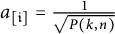
$a_{[\mathfrak {i}]}=\frac {1}{\sqrt {P(k,n)} }$
. Obviously
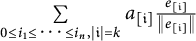
$\sum \limits \limits _{0 \leq i_1 \leq \cdots \leq i_n, |\mathfrak {i}|=k} a_{[\mathfrak {i}]} \frac { e_{[\mathfrak {i}]} }{\left \| e_{[\mathfrak {i}]} \right \| }$
is a unit vector. To calculate the norm of
$S_{\alpha ,{l_{1}}}\odot \cdots \odot S_{\alpha ,{l_{n}}}$
, we will estimate the norms of
$S_{\alpha ,{l_{1}}}\odot \cdots \odot S_{\alpha ,{l_{n}}}\left (\sum \limits _{0 \leq i_1 \leq \cdots \leq i_n, |\mathfrak {i}|=k}a_{[\mathfrak {i}]} \frac { e_{[\mathfrak {i}]} }{\left \| e_{[\mathfrak {i}]} \right \| }\right )$
. By the definition of
$\Sigma _{n,\mathfrak {i}}^{\prime }$
in (2.48), it is easy to see that for
$\pi \in \Sigma _{n}\backslash \Sigma _{n,\mathfrak {i}}^{\prime },$
Hence, by Lemma 2.1, (2.34), and (2.51), for
$$ \begin{align*}\beta_{i_{1},l_{\pi (1)}} \dots\beta_{i_{n},l_{\pi (n)}}=0.\end{align*} $$
$k>0$
large enough, we have (3.5)
$$ \begin{align} \begin{aligned} & \left ( S_{\alpha,{l_{1}}}\odot \cdots \odot S_{\alpha,{l_{n}}} \right ) \sum\limits_{0 \leq i_1 \leq \cdots \leq i_n, |\mathfrak{i}|=k}a_{[\mathfrak{i}]} \frac{ e_{[\mathfrak{i}]} }{\left \| e_{[\mathfrak{i}]} \right \| } \\&\quad = \sum\limits_{0 \leq i_1 \leq \cdots \leq i_n, |\mathfrak{i}|=k}\frac{a_{[\mathfrak{i}]}}{n!}\sum\limits_{\pi \in \Sigma_{n,\mathfrak{i}}^{\prime} }\frac{ \beta_{i_{1},l_{\pi (1)}} \dots\beta_{i_{n},l_{\pi (n)}}e_{[\mathfrak{i}+\mathfrak{l}_\pi]}}{\left \| e_{[\mathfrak{i}] } \right \| } \\&\quad = \sum\limits_{[\mathfrak{j}]\in E_{k+S_{\mathfrak{l}},\mathscr{M} } } \left (\sum\limits_{0 \leq i_1 \leq \cdots \leq i_n, |\mathfrak{i}|=k} \sum\limits_{\pi \in N_{\mathfrak{j}, \mathfrak{i} } }\frac{a_{[\mathfrak{i}]} \beta_{i_{1},l_{\pi (1)}} \dots\beta_{i_{n},l_{\pi (n)}}}{n!\left \| e_{[\mathfrak{i}]} \right \|} \right ) e_{[\mathfrak{j}]} \\&\qquad + \sum\limits_{t=1}^{\mathscr{M}-1}\sum\limits_{ [\mathfrak{j}]\in E_{k+S_{\mathfrak{l}},t } } \left ( \sum\limits_{0 \leq i_1 \leq \cdots \leq i_n, |\mathfrak{i}|=k} \sum\limits_{\pi \in N_{\mathfrak{j}, \mathfrak{i} } }\frac{ a_{[\mathfrak{i}] } \beta_{i_{1},l_{\pi (1)}} \cdots\beta_{i_{n},l_{\pi (n)}}}{n!\left \|e_{[\mathfrak{i}]} \right \|} \right ) e_{[\mathfrak{j}]} \\&\quad = \sum\limits_{[\mathfrak{j}]\in \tilde{A}_{k+S_{\mathfrak{l}},\mathscr{M},\varepsilon }} \left ( \sum\limits_{0 \leq i_1 \leq \cdots \leq i_n, |\mathfrak{i}|=k} \sum\limits_{\pi \in N_{\mathfrak{j}, \mathfrak{i} } }\frac{a_{[\mathfrak{i}]} \beta_{i_{1},l_{\pi (1)}}\dots\beta_{i_{n},l_{\pi (n)}}}{n!\left \| e_{[\mathfrak{i}]} \right \|} \right ) e_{[\mathfrak{j}]} \\&\qquad +\sum\limits_{[\mathfrak{j}]\in\check{A} _{k+S_{\mathfrak{l}},\mathscr{M},\varepsilon } } \left (\sum\limits_{0 \leq i_1 \leq \cdots \leq i_n, |\mathfrak{i}|=k} \sum\limits_{\pi \in N_{\mathfrak{j}, \mathfrak{i} } }\frac{a_{[\mathfrak{i}]} \beta_{i_{1},l_{\pi (1)}} \dots\beta_{i_{n},l_{\pi (n)}}}{n!\left \| e_{[\mathfrak{i}]} \right \|} \right ) e_{[\mathfrak{j}]} \\&\qquad + \sum\limits_{t=1}^{\mathscr{M}-1}\sum\limits_{[\mathfrak{j}]\in E_{k+S_{\mathfrak{l}},t } } \left (\sum\limits_{0 \leq i_1 \leq \cdots \leq i_n, |\mathfrak{i}|=k} \sum\limits_{\pi \in N_{\mathfrak{j}, \mathfrak{i} } }\frac{a_{[\mathfrak{i}]} \beta_{i_{1},l_{\pi (1)}} \dots\beta_{i_{n},l_{\pi (n)}}}{n!\left \| e_{[\mathfrak{i}]} \right \|} \right ) e_{[\mathfrak{j}]}. \end{aligned} \end{align} $$
For
$\mathfrak {j} \in \mathbb {N}^{n}$
satisfying
$[\mathfrak {j}] \in E_{k+S_{\mathfrak {l}},\mathscr {M} } $
, by (2.26), we have which implies that
$$ \begin{align*}j_{k_1} \ne j_{k_2}, \ 1 \le k_1 \ne k_2 \le n,\end{align*} $$
(3.6)Notice that
$$ \begin{align} \left \| e_{[\mathfrak{j}]} \right \| =\frac{1}{\sqrt{n!} }. \end{align} $$
$$ \begin{align*}\sum\limits_{[\mathfrak{j}]\in \tilde{A}_{k+S_{\mathfrak{l}},\mathscr{M},\varepsilon }} \left ( \sum\limits_{0 \leq i_1 \leq \cdots \leq i_n, |\mathfrak{i}|=k} \sum\limits_{\pi \in N_{\mathfrak{j}, \mathfrak{i} } }\frac{a_{[\mathfrak{i}]} \beta_{i_{1},l_{\pi (1)}}\dots\beta_{i_{n},l_{\pi (n)}}}{n!\left \| e_{[\mathfrak{i}]} \right \|} \right ) e_{[\mathfrak{j}]},\end{align*} $$
and
$$ \begin{align*}\sum\limits_{[\mathfrak{j}]\in\check{A} _{k+S_{\mathfrak{l}},\mathscr{M},\varepsilon } } \left (\sum\limits_{0 \leq i_1 \leq \cdots \leq i_n, |\mathfrak{i}|=k} \sum\limits_{\pi \in N_{\mathfrak{j}, \mathfrak{i} } }\frac{a_{[\mathfrak{i}]} \beta_{i_{1},l_{\pi (1)}} \dots\beta_{i_{n},l_{\pi (n)}}}{n!\left \| e_{[\mathfrak{i}]} \right \|} \right ) e_{[\mathfrak{j}]}\end{align*} $$
are pairwise orthogonal, hence, by (3.5) and (3.6), we have
$$ \begin{align*}\sum\limits_{t=1}^{\mathscr{M}-1}\sum\limits_{[\mathfrak{j}]\in E_{k+S_{\mathfrak{l}},t } } \left (\sum\limits_{0 \leq i_1 \leq \cdots \leq i_n, |\mathfrak{i}|=k} \sum\limits_{\pi \in N_{\mathfrak{j}, \mathfrak{i} } }\frac{a_{[\mathfrak{i}]} \beta_{i_{1},l_{\pi (1)}} \dots\beta_{i_{n},l_{\pi (n)}}}{n!\left \| e_{[\mathfrak{i}]} \right \|} \right ) e_{[\mathfrak{j}]}\end{align*} $$
(3.7)where the last inequality comes from Lemmas 2.4 and 2.8, together with the fact that
$$ \begin{align} \begin{aligned} & \left \| \left ( S_{\alpha,{l_{1}}}\odot S_{\alpha,{l_{2}}}\odot \cdots \odot S_{\alpha,{l_{n}}} \right ) \sum\limits_{0 \leq i_1 \leq \cdots \leq i_n, |\mathfrak{i}|=k}a_{[\mathfrak{i}]} \frac{ e_{[\mathfrak{i}]} }{\left \| e_{[\mathfrak{i}]} \right \| } \right \| ^{2} \\& \quad \ge \left \| \sum\limits_{[\mathfrak{j}]\in \tilde{A}_{k+S_{\mathfrak{l}},\mathscr{M},\varepsilon } } \left ( \sum\limits_{0 \leq i_1 \leq \cdots \leq i_n, |\mathfrak{i}|=k} \sum\limits_{\pi \in N_{\mathfrak{j}, \mathfrak{i} } } \frac{a_{[\mathfrak{i}]} \beta_{i_{1},l_{\pi (1)}}\dots\beta_{i_{n},l_{\pi (n)}}}{n!\left \| e_{[\mathfrak{i}]} \right \|} \right ) e_{[\mathfrak{j}]} \right \| ^{2} \\& \quad = \sum\limits_{[\mathfrak{j}]\in \tilde{A}_{k+S_{\mathfrak{l}},\mathscr{M},\varepsilon }} \left | \sum\limits_{0 \leq i_1 \leq \cdots \leq i_n, |\mathfrak{i}|=k} \sum\limits_{\pi \in N_{\mathfrak{j}, \mathfrak{i} } }\frac{a_{[\mathfrak{i}]} \beta_{i_{1},l_{\pi (1)}} \dots\beta_{i_{n},l_{\pi (n)}} }{n!\left \| e_{[\mathfrak{i}]} \right \|} \right | ^{2} \left \| e_{[\mathfrak{j}]} \right \| ^{2} \\& \quad = \frac{1}{n!}\sum\limits_{[\mathfrak{j}]\in \tilde{A}_{k+S_{\mathfrak{l}},\mathscr{M},\varepsilon}} \left | \sum\limits_{0 \leq i_1 \leq \cdots \leq i_n, |\mathfrak{i}|=k} \sum\limits_{\pi \in N_{\mathfrak{j}, \mathfrak{i} } }\frac{a_{[\mathfrak{i}]} \beta_{i_{1},l_{\pi (1)}} \dots\beta_{i_{n},l_{\pi (n)}} }{n!\left \| e_{[\mathfrak{i}]} \right \|} \right | ^{2}\\& \quad \ge \frac{{}^{\# } \tilde{A}_{k+S_{\mathfrak{l}},\mathscr{M},\varepsilon } }{P(k ,n) } \left ( 1 - \varepsilon \right ) ^{2\left ( \left | l_{1} \right | + \cdots +\left | l_{n} \right | \right ) }, \end{aligned} \end{align} $$
$[\mathfrak {i}] \in R_{\mathfrak {j} }$
if and only if
$N_{\mathfrak {j},\mathfrak {i} } \neq \emptyset .$
By Lemma 2.7, and hence,
$$ \begin{align*}\lim\limits_{k\to \infty}\frac{{}^{\# } \tilde{A}_{k+S_{\mathfrak{l}},\mathscr{M},\varepsilon } }{P(k,n) }\left ( 1 - \varepsilon \right ) ^{2\left ( \left | l_{1} \right | + \cdots +\left | l_{n} \right | \right ) } = \left ( 1 - \varepsilon \right ) ^{2\left ( \left | l_{1} \right | + \cdots +\left | l_{n} \right | \right ) },\end{align*} $$
From the arbitrariness of
$$ \begin{align*}\left \| S_{\alpha,{l_{1}}}\odot S_{\alpha,{l_{2}}}\odot \cdots \odot S_{\alpha,{l_{n}}} \right \| \ge \left ( 1 - \varepsilon \right ) ^{\left | l_{1} \right | + \cdots +\left | l_{n} \right |}.\end{align*} $$
$\varepsilon $
, we have
$$ \begin{align*}\left \| S_{\alpha,{l_{1}}}\odot S_{\alpha,{l_{2}}}\odot \cdots \odot S_{\alpha,{l_{n}}} \right \| \ge 1.\end{align*} $$
-
Case 2.2: General case:
$\alpha _i \in \mathbb {C}$
for
$i\geq 0$
and
$\lim \limits _{i\to \infty }\alpha _i=1$
. Set Obviously,
$$ \begin{align*}H_i=\overline{\mathrm{span}\{e_{i+1},e_{i+2},\ldots\}}.\end{align*} $$
$\lim \limits _{i\rightarrow \infty }\|(S_{\alpha }-S)|_{H_i}\|=0.$
Then, it is easy to see that (3.8)Notice that
$$ \begin{align}\lim\limits_{i\rightarrow \infty}\left \| (S_{\alpha,{l_{1}}}\odot S_{\alpha,{l_{2}}}\odot \cdots \odot S_{\alpha,{l_{n}}}-S_{{l_{1}}}\odot S_{{l_{2}}}\odot \cdots \odot S_{{l_{n}}})|_{H_i\odot \cdots \odot H_i} \right \|=0.\end{align} $$
(3.9)Hence, in order to show that
$$ \begin{align}\left \| S_{\alpha,{l_{1}}}\odot S_{\alpha,{l_{2}}}\odot \cdots \odot S_{\alpha,{l_{n}}}\right\|\geq \left \| S_{\alpha,{l_{1}}}\odot S_{\alpha,{l_{2}}}\odot \cdots \odot S_{\alpha,{l_{n}}}|_{H_i \odot \cdots \odot H_i}\right\|.\end{align} $$
by (3.8) and (3.9), it suffices to prove that for
$$ \begin{align*}\left \| S_{\alpha,{l_{1}}}\odot S_{\alpha,{l_{2}}}\odot \cdots \odot S_{\alpha,{l_{n}}}\right\|\geq 1,\end{align*} $$
$i\geq 0,$
(3.10)Set
$$ \begin{align}\|S_{{l_{1}}}\odot S_{{l_{2}}}\odot \cdots \odot S_{{l_{n}}}|_{H_i\odot \cdots \odot H_i}\|\geq 1.\end{align} $$
By some direct calculations,
$$ \begin{align*}(1)_i=\left( \underbrace{0,\ldots,0 }_{i+1} ,1,1,1,\dots \right), \quad i\geq 0.\end{align*} $$
(3.11)By Case 2.1,
$$ \begin{align}\|S_{{l_{1}}}\odot S_{{l_{2}}}\odot \cdots \odot S_{{l_{n}}}|_{H_i\odot \cdots \odot H_i}\|\geq \|S_{(1)_i,{l_{1}}}\odot S_{(1)_i,{l_{2}}}\odot \cdots \odot S_{(1)_i,{l_{n}}}\|, \quad i\geq0.\end{align} $$
(3.12)Therefore, (3.10) holds.
$$ \begin{align}\|S_{(1)_i,{l_{1}}}\odot S_{(1)_i,{l_{2}}}\odot \cdots \odot S_{(1)_i,{l_{n}}}\|=1, \quad i\geq0.\end{align} $$















Now, we prove
 $(2)\Rightarrow (1)$
. Without loss of generality, we suppose
 $\sup \{|\alpha _i| : i \geq 0\}=1.$
If
 $\{\alpha _{i}\}_{i=0}^{\infty }$
does not satisfy the regularity condition in Definition 1.1, then there exists a finite subset
 $\{i_j\}_{j=1}^N$
and
 $\delta < 1$
such that
 $$ \begin{align*}\begin{cases} |\alpha_{i_j}|=1, & j=1,\ldots,N, \\ |\alpha_i|< \delta, & i\not\in\{i_j: j=1,\ldots,N \}. \end{cases}\end{align*} $$
It follows from the definition of
 $\beta _{i, t}$
in (2.3) that there exists a constant
 $K\geq 2$
such that, for any nonnegative integers
 $j_1$
and
 $j_2$
satisfying
 $0 \leq j_1\leq j_2$
, we have
 $$ \begin{align*}|\beta_{j_1 - K, K} \beta_{j_2 - K, K}| < \delta.\end{align*} $$
We claim that
 $$ \begin{align} \left \| S_{\alpha}^K\odot S_{\alpha}^K\right \| < \left \| S_{\alpha}^K\right \|\left \| S_{\alpha}^K\right \|=1. \end{align} $$
In fact, for
 $(i_1,i_2) \in \mathbb {Z}^2$
, let
 $a_{[i_1, i_2] } \in \mathbb {C}$
such that
 $a_{[i_1, i_2]} = 0$
for
 $(i_1, i_2) \notin \mathbb {N}^2$
. By Lemma 2.1, for every
 $ k \geq 0,$
 $$ \begin{align*} \left( S_{\alpha,{K}}\odot S_{\alpha,{K}}\right) \sum_{0 \leq i_1 \leq i_2 \atop i_1 + i_2 = k}a_{[i_1 , i_2]} {\left( e_{i_{1} }\odot e_{i_{2} } \right) } =\sum_{0 \leq i_1 \leq i_2 \atop i_1 + i_2 = k}a_{[i_1 , i_2]}\beta_{i_{1},K} \beta_{i_{2},K} \left ( e_{i_{1}+K }\odot e_{i_{2}+K } \right ). \end{align*} $$
Therefore,
 $$ \begin{align} \begin{aligned} & \left\|\left( S_{\alpha,{K}}\odot S_{\alpha,{K}}\right) \sum_{0 \leq i_1 \leq i_2 \atop i_1 + i_2 = k}a_{[i_1 , i_2]}\frac{ e_{i_{1} }\odot e_{i_{2} } }{\left \| e_{i_{1} }\odot e_{i_{2} } \right \| }\right\|^2 \\&\quad\leq \sum\limits_{0 \leq j_1 \leq j_2 \atop j_1 + j_2 = k+2K } \left| \frac{a_{[j_1 -K,j_2-K] } \beta_{j_1 -K,K} \beta_{j_2-K,K}}{\left \| e_{j_1 -K }\odot e_{j_2-K} \right \|} \right|^2 \left\|e_{j_{1} }\odot e_{j_{2}} \right\|^2. \end{aligned} \end{align} $$
Thus, when
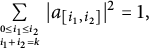 $\sum \limits _{0 \leq i_1 \leq i_2 \atop i_1 + i_2 = k}|a_{[i_1 , i_2]}|^2 =1,$
by (3.14),
 $$ \begin{align} \begin{aligned} & \left\|\left( S_{\alpha,{K}}\odot S_{\alpha,{K}}\right) \sum_{0 \leq i_1 \leq i_2 \atop i_1 + i_2 = k}a_{[i_1 , i_2]}\frac{ e_{i_{1} }\odot e_{i_{2} } }{\left \| e_{i_{1} }\odot e_{i_{2} } \right \| }\right\|^2 \\&\quad\leq \delta^2 \left(\sum\limits_{ 0 \leq j_1 \leq j_2 \atop j_1 + j_2 = k+2K } \left| \frac{a_{[j_1 -K,j_2-K] } }{\left \| e_{j_1 -K }\odot e_{j_2-K} \right \|} \right|^2 \left\|e_{j_{1} }\odot e_{j_{2}} \right\|^2\right) \\&\quad\leq \delta^2 \left(\sum\limits_{ 0 \leq j_1 \le j_2 \atop j_1 + j_2 = k+2K } \left| a_{[j_1 -K,j_2-K] } \right|^2 \right) \leq \delta^2 \left(\sum\limits_{ 0 \leq j_1 \le j_2 \atop j_1 + j_2 = k } \left| a_{\left\langle j_1 ,j_2\right\rangle } \right|^2 \right) =\delta^2 <1. \end{aligned} \end{align} $$
Notice that for
 $0\leq k_1 < k_2,$
 $$ \begin{align*}\left\langle\left( S_{\alpha,{K}}\odot S_{\alpha,{K}}\right) \sum_{0 \leq i_1 \leq i_2 \atop i_1 + i_2 = k_1}a_{[i_1 , i_2]}\frac{ e_{i_{1} }\odot e_{i_{2} } }{\left \| e_{i_{1} }\odot e_{i_{2} } \right \| }, \left( S_{\alpha,{K}}\odot S_{\alpha,{K}}\right) \sum_{0 \leq i_1 \leq i_2 \atop i_1 + i_2 = k_2}a_{[i_1 , i_2]}\frac{ e_{i_{1} }\odot e_{i_{2} } }{\left \| e_{i_{1} }\odot e_{i_{2} } \right \| }\right\rangle=0,\end{align*} $$
therefore,
 $$ \begin{align*} \left\|\left( S_{\alpha,{K}}\odot S_{\alpha,{K}}\right)\right\|=\sup\limits_{k\in\mathbb N}\left\{ \left\|\left( S_{\alpha,{K}}\odot S_{\alpha,{K}}\right) \sum_{0 \leq i_1 \leq i_2 \atop i_1 + i_2 = k}a_{[i_1 , i_2]}\frac{ e_{i_{1}}\odot e_{i_{2}}}{\left \| e_{i_{1} }\odot e_{i_{2} } \right \| }\right\|\right\}\leq\delta. \end{align*} $$
3.2 Proof of “
$(1)\Leftrightarrow (3)$
”

In this section, we prove
 $(1)\Leftrightarrow (3)$
. First, we need some notations and some lemmas. It will be seen that the lemmas listed below are similar to those in Section 2, however, we need more techniques from antisymmetric tensor products to deal with the proofs.
Lemma 3.1 For
 $\mathfrak {i}\in \mathbb N^n$
,
 $$ \begin{align*}\begin{aligned} & \left ( S_{\alpha,{l_{1}}}\wedge S_{\alpha,{l_{2}}}\wedge \cdots \wedge S_{\alpha,{l_{n}}} \right ) \left ( e_{i_{1} }\wedge e_{i_{2} }\wedge\cdots \wedge e_{i_{n} } \right ) \\&\quad =\frac{1}{n!} \sum\limits_{\pi \in \Sigma _{n} }\beta_{i_{1},l_{\pi (1)}} \beta_{i_{2},l_{\pi (2)}}\dots\beta_{i_{n},l_{\pi (n)}} \left ( e_{i_{1}+l_{\pi (1)} }\wedge e_{i_{2}+l_{\pi (2)} }\wedge \cdots \wedge e_{i_{n} +l_{\pi (n)}} \right ). \end{aligned}\end{align*} $$
In this section, we fix
 $d\geq 1.$
Let
 $$ \begin{align}W&=\{ \mathfrak{i} \in\mathbb N^n: d\leq i_1< \cdots < i_n\},\\\mathfrak{W}&=\{ \mathfrak{i}+\mathfrak{t} \in\mathbb N^n: \mathfrak{i} \in W, \mathfrak{t} \in\mathbb Z^n, |t_r|\leq |\mathfrak{l}|, i_1+t_{1}\neq\cdots \neq i_n+t_{n}\},\nonumber\end{align} $$
and
 $$ \begin{align*}W^{\prime}=\{ \mathfrak{i} \in W: i_1\geq d+|\mathfrak{l}|, i_r- i_{r-1}> 4 |\mathfrak{l}| ~for~all~ 2\leq r\leq n\}.\end{align*} $$
Then, we have the following lemma.
Lemma 3.2 For
 $\mathfrak {j}^{\prime }\in W^{\prime }, \mathfrak {j} \in \mathfrak {W}\backslash W^{\prime },$
we have
 $$ \begin{align}\left\langle e_{j_1^{\prime}} \wedge \cdots \wedge e_{j_n^{\prime}}, e_{j_1} \wedge \cdots \wedge e_{j_n}\right\rangle =0.\end{align} $$
Proof It is obvious that
 $W^\prime \subset W\subset \mathfrak {W}$
and for
 $j\in W\setminus W^\prime $
, the orthogonality (3.17) is trivial. Next, assume
 $j\in \mathfrak {W}\setminus W$
. Then, (3.17) is also trivial if
 $j_{r_0} < d$
for some
 $1\leq r_0\leq n$
.
At last, assume that for all
 $1 \leq r\leq n, j_{r}\geq d,$
i.e., there exists an integer
 $2\leq r_0\leq n$
such that
 $$ \begin{align*}j_{r_0-1}=i_{r_0-1}+t_{r_0-1}>j_{r_0}=i_{r_0}+t_{r_0}.\end{align*} $$
Hence,
 $$ \begin{align*}i_{r_0}-i_{r_0-1} < t_{r_0-1}-t_{r_0}\leq 2|\mathfrak{l}|,\end{align*} $$
which implies that
 $$ \begin{align*}j_{r_0-1}-j_{r_0}=i_{r_0-1}+t_{r_0-1}-(i_{r_0}+t_{r_0})\leq |i_{r_0-1}-i_{r_0}|+|t_{r_0}-t_{r_0-1}|\leq 4|\mathfrak{l}|.\end{align*} $$
Notice that
 $j_t^{\prime }- j_{t-1}^{\prime }> 4 |\mathfrak {l}|$
for all
 $2\leq t\leq n.$
Hence, (3.17) holds.
For a set
 $A\subseteq \mathbb N^n,$
write
 $$ \begin{align}A_{(k,n)}=^{\# }\{\mathfrak{i}\in A: |\mathfrak{i}|=k\}.\end{align} $$
Then, we have the following lemma.
Lemma 3.3 For
 $k> 0$
sufficiently large, there exists a constant
 $C_1>0$
, such that
 $$ \begin{align}\mathfrak{W}_{(k,n)}- W^{\prime}_{(k,n)}\leq C_1k^{n-2}.\end{align} $$
Proof For
 $\mathfrak {j}\in \mathfrak {W}\backslash W,$
by the proof of Lemma 3.2, it can be shown easily that there exists a constant
 $C_1^{\prime }>0$
, such that
 $$ \begin{align}\mathfrak{W}_{(k,n)}- W_{(k,n)}\leq C_1^{\prime}\left ( k+1 \right ) ^{n-2}.\end{align} $$
For
 $\mathfrak {j}\in W\backslash W^{\prime },$
by the definitions of W and
 $W^{\prime },$
there exists an integer
 $2\leq r_1\leq n$
such that
 $0< j_{r_1-1}-j_{r_1}\leq 4|\mathfrak {l}|$
or
 $j_1<d+|\mathfrak {l}|,$
which implies that there exists a constant
 ${C_2^{\prime }>0}$
, such that
 $$ \begin{align}W_{(k,n)}- W^{\prime}_{(k,n)}\leq C_2^{\prime}\left ( k+1 \right ) ^{n-2}.\end{align} $$
For
 $\mathfrak {i} \in \mathbb N^n,$
set
 $$ \begin{align} \mathcal{R}_{\mathfrak{i}}=\left\{\mathfrak{j} \in\mathbb N^n: d\leq j_1< \cdots < j_n, \exists \, \pi \in \Sigma_{n}~s.t.~ e_{j_1+l_{\pi(1)}} \wedge \cdots \wedge e_{j_n+l_{\pi(n)}}=e_{i_1} \wedge \cdots \wedge e_{i_n}\right\}. \end{align} $$
Then, it is easy to see that
 $$ \begin{align} ^{\# } \mathcal{R}_{\mathfrak{i} } \le \ ^{\# } \left \{ \mathfrak{l}_\pi:\pi \in \Sigma_{n}\ \right \} = \mathscr{M}. \end{align} $$
Set
 $$ \begin{align} \mathcal{A}_{k} = \begin{cases} \left \{ \mathfrak{i}\in \mathfrak{W}: | \mathfrak{i} |=k, \ ^{\# } \mathcal{R}_{\mathfrak{i}} <\mathscr{M} \right \},& k \geq 0, \\ \emptyset,& k < 0. \end{cases} \end{align} $$
Then, we have the following lemma.
Lemma 3.4 For
 $k>0$
sufficiently large, if
 $l_{1}, l_{2},\ldots ,l_{n}$
are not all equal, then there exists a constant
 $M>0$
, such that
 $^{\# }\mathcal {A}_{k} \le Mk^{n-2}$
.
Proof For
 $k>0,$
set
 $$ \begin{align} \mathcal{A}_{k}^{\prime} = \left \{ \mathfrak{i} \in W^{\prime}: | \mathfrak{i} |=k \text{ and } ^{\# } \mathcal{R}_{\mathfrak{i} } <\mathscr{M} \right \}. \end{align} $$
Obviously,
 $$ \begin{align*}\mathcal{A}_{k}\backslash \mathcal{A}_{k}^{\prime}=\left \{ \mathfrak{i} \in \mathfrak{W} \backslash W^{\prime}: | \mathfrak{i} |=k \text{ and } ^{\# } \mathcal{R}_{\mathfrak{i} } <\mathscr{M} \right \}.\end{align*} $$
Hence, by (3.19), there exists a constant
 $C_{1}> 0$
such that for
 $k> 0$
sufficiently large,
 $$ \begin{align}^{\# }\mathcal{A}_{k}\leq ^{\# }\mathcal{A}_{k}^{\prime}+ C_1k^{n-2}.\end{align} $$
Recall that
 $$ \begin{align*}A_{k}^{\prime}=\left \{ \mathfrak{i} \in \mathbb{N}^n: | \mathfrak{i} |=k \text{ and } ^{\# } R_{\mathfrak{i} } <\mathscr{M} \right \},~ k \geq 0\end{align*} $$
in (2.13). We claim that
 $$ \begin{align}\mathcal{A}_{k}^{\prime} \subseteq A_{k}^{\prime}.\end{align} $$
In fact, for
 $\mathfrak {i} \in \mathcal {A}_{k}^{\prime },$
by the definition of
 $R_{\mathfrak {i}}$
in (2.10),
 $$ \begin{align} R_{\mathfrak{i} }\subseteq \{[\mathfrak{i}- \mathfrak{l}_{\pi}] \in \mathbb N^n/\Sigma_n : \pi \in \Sigma_n\}.\end{align} $$
Since
 $\mathfrak {i} \in \mathcal {A}_{k}^{\prime }\subseteq W^{\prime }\subseteq W,$
we have
 $i_r- i_{r-1}> 4 |\mathfrak {l}|$
for all
 $2\leq r\leq n$
and
 $i_1\geq d+|\mathfrak {l}|$
, hence,
 $d\leq i_1-l_{\pi (1)}<\cdots <i_n-l_{\pi (n)}$
for every
 $\pi \in \Sigma _n.$
Then, by (3.22), it is easy to see that
 $$ \begin{align}\{\mathfrak{i}-\mathfrak{l}_{\pi} \in \mathbb N^n: \pi \in \Sigma_n\} \subseteq \mathcal{R}_{\mathfrak{i}}.\end{align} $$
Therefore, by (3.28) and (3.29), we have
 $ ^{\# } R_{\mathfrak {i} } \leq ^{\# } \mathcal {R}_{\mathfrak {i} },$
which implies that (3.27) holds. The claim is proved. By (2.14)–(2.16), there exists a constant
 $C_2>0$
, such that
 ${^{\# }A_{k}^{\prime }\leq C_2\left ( k+1 \right ) ^{n-2}.}$
Hence, (3.26) and (3.27) ensure that for
 $k> 0$
sufficiently large, there exists a constant
 $M>0$
, such that
 $^{\# }\mathcal {A}_{k} \le Mk^{n-2}$
.
For
 $m=0,1,2,\ldots ,\mathscr {M}$
, set
 $$ \begin{align} \mathcal{E}_{r,m} = \begin{cases} \left \{ \mathfrak{i}\in \mathfrak{W} :\left | \mathfrak{i} \right |=r \text{ and } ^{\# } \mathcal{R}_{\mathfrak{i} } =m \right \},& r \geq 0, \\ \emptyset,& r < 0. \end{cases} \end{align} $$
For simplicity, for
 $\mathfrak {i},\mathfrak {j}\in \mathbb N^n$
, let
 $$ \begin{align} \mathcal{N}_{\mathfrak{j}, \mathfrak{i} }=\left \{ \pi\in\Sigma_{n}:e_{i_1+l_{\pi(1)}} \wedge \cdots \wedge e_{i_n+l_{\pi(n)}}=e_{j_1} \wedge \cdots \wedge e_{j_n} \right \}. \end{align} $$
Then, for
 $k> 0$
sufficiently large,
 $\mathfrak {j} \in \mathcal {E}_{k+S_{\mathfrak {l}},\mathscr {M} } $
and
 $\mathfrak {i} \in \mathcal {R}_{\mathfrak {j} },$
we have
 $\mathcal {N}_{\mathfrak {j},\mathfrak {i} } \neq \emptyset .$
Therefore, by (3.31),
 $$ \begin{align*}\begin{aligned} ^{\# } \mathcal{N}_{\mathfrak{j},\mathfrak{i} } &= \ ^{\# } \left \{\pi \in \Sigma_{n}:e_{i_1+l_{\pi(1)}} \wedge \cdots \wedge e_{i_n+l_{\pi(n)}}=e_{j_1} \wedge \cdots \wedge e_{j_n} \right \} \ge \ n_{1}!\dots n_{k}!. \end{aligned}\end{align*} $$
Thus,
 $$ \begin{align} \left \| e_{i_1} \wedge \cdots \wedge e_{i_n} \right \| = \sqrt{\frac{1}{n!}} \leq\frac{{}^{\# } \mathcal{N}_{\mathfrak{j},\mathfrak{i} }}{n_1!n_2!\dots n_k!\sqrt{n!}} = \frac{{}^{\# } \mathcal{N}_{\mathfrak{j},\mathfrak{i} }\mathscr{M}}{n!\sqrt{n!}}. \end{align} $$
For
 $0< \varepsilon < 1$
, set
 $$ \begin{align} \tilde{\mathcal{A}}_{k+S_{\mathfrak{l}},\mathscr{M},\varepsilon } =\left \{ \mathfrak{j} \in \mathcal{E}_{k+S_{\mathfrak{l}},\mathscr{M} }:\Gamma_{j_{m},-l_{\pi (m)}}> 1 - \varepsilon, \forall 1 \leq m \leq n, \forall \, \pi \in \Sigma_{n} \right \} \end{align} $$
and
 $$ \begin{align}\check{\mathcal{A}} _{k+S_{\mathfrak{l}},\mathscr{M},\varepsilon } =\left \{ \mathfrak{j} \in \mathcal{E}_{k+S_{\mathfrak{l}},\mathscr{M} }:\exists \, \pi \in \Sigma_{n} \text{ and } \exists \, 1 \le m \le n ~s.t.~ \Gamma_{j_{m},-l_{\pi (m)}} \le 1 - \varepsilon \right \}.\end{align} $$
It is easy to see that
 $$ \begin{align} \mathcal{E}_{k+S_{\mathfrak{l}},\mathscr{M} } = \tilde{\mathcal{A}}_{k+S_{\mathfrak{l}},\mathscr{M},\varepsilon } \sqcup \check{\mathcal{A}} _{k+S_{\mathfrak{l}},\mathscr{M},\varepsilon }. \end{align} $$
The following lemma can be derived from (2.36) and (2.41), along with the fact that
 $$ \begin{align*}\check{\mathcal{A}}_{k+S_{\mathfrak{l}},\mathscr{M} ,\varepsilon}\subseteq \left \{ \mathfrak{j} \in \mathbb{N}^{n}:|\mathfrak{j}|=k+S_{\mathfrak{l}}, \exists \, \pi \in \Sigma_{n} \text{ and } \exists \, 1 \le m \le n ~s.t.~ \Gamma_{j_{m},-l_{\pi (m)}} \le 1 - \varepsilon \right\}.\end{align*} $$
Lemma 3.5 If
 $\left \{ \alpha _{k} \right \} _{k=0}^{\infty }$
satisfies the regularity condition and
 $\lim \limits _{k\to \infty }|\alpha _k| = 1$
, then there exists a positive constant C, such that for sufficiently large
 $ k>0$
,
 $$ \begin{align}^{\# } \check{\mathcal{A}}_{k+S_{\mathfrak{l}},\mathscr{M} ,\varepsilon} \le C k ^{n-2}.\end{align} $$
For
 $m=0,1,2,\ldots ,\mathscr {M}$
, set
 $$ \begin{align} \mathcal{E}_{r,m}^{\prime} = \begin{cases} \left \{ \mathfrak{i} \in W^{\prime}, \left | \mathfrak{i} \right |=r \text{ and } ^{\# } \mathcal{R}_{\mathfrak{i} } =m \right \},& r \geq 0, \\ \emptyset,& r < 0, \end{cases} \end{align} $$
and for
 $0< \varepsilon < 1$
, set
 $$ \begin{align} \tilde{\mathcal{A}}_{k+S_{\mathfrak{l}},\mathscr{M},\varepsilon }^{\prime} = \tilde{\mathcal{A}}_{k+S_{\mathfrak{l}},\mathscr{M},\varepsilon } \cap \mathcal{E}_{k+S_{\mathfrak{l}},\mathscr{M} }^{\prime} \end{align} $$
and
 $$ \begin{align*}\check{\mathcal{A}}^{\prime}_{k+S_{\mathfrak{l}},\mathscr{M},\varepsilon }=\check{\mathcal{A}}_{k+S_{\mathfrak{l}},\mathscr{M},\varepsilon } \cap \mathcal{E}_{k+S_{\mathfrak{l}},\mathscr{M} }^{\prime}.\end{align*} $$
Then, we have the following lemma.
Lemma 3.6 For
 $0 < \varepsilon < 1$
, we have
 $$ \begin{align*}\lim\limits_{k\to \infty}\frac{{}^{\# } \tilde{\mathcal{A}}_{k+S_{\mathfrak{l}},\mathscr{M},\varepsilon }^{\prime} }{W_{(k,n)} }= 1.\end{align*} $$
Proof For
 $k> 0$
sufficiently large, it is evident that
 $$ \begin{align} \bigcup_{j=0}^{\mathscr{M} } \mathcal{E}_{k+S_{\mathfrak{l}} ,j} =\left \{ \mathfrak{j} \in \mathfrak{W} : \left | \mathfrak{j}\right |=k+S_{\mathfrak{l}} \right \}. \end{align} $$
Notice that for
 $j\in \left \{ 0,1,\ldots ,\mathscr {M} \right \} $
,
 $\mathcal {E}_{k+S_{\mathfrak {l}}, j}$
are mutually disjoint. Then, by (3.35) and (3.39), we have
 $$ \begin{align} \begin{aligned} ^{\# } \tilde{\mathcal{A}}_{k+S_{\mathfrak{l}},\mathscr{M},\varepsilon } &= \ ^{\# }\mathcal{E}_{k+S_{\mathfrak{l}},\mathscr{M}} - \ ^{\# } \check{\mathcal{A}}_{k+S_{\mathfrak{l}},\mathscr{M},\varepsilon } \\&= \mathfrak{W}_{(k+S_{\mathfrak{l}},n)}- \sum\limits_{j=0}^{\mathscr{M}-1}\ ^{\# }\mathcal{E}_{k+S_{\mathfrak{l}},j} - \ ^{\# } \check{\mathcal{A}}_{k+S_{\mathfrak{l}},\mathscr{M},\varepsilon }. \end{aligned} \end{align} $$
We claim that
 $$ \begin{align} \lim\limits_{k\to \infty} \frac{{}^{\# } \tilde{\mathcal{A}}_{k+S_{\mathfrak{l}},\mathscr{M},\varepsilon } }{W_{(k+S_{\mathfrak{l}},n)}}=1.\end{align} $$
In fact, for every
 $0 \le j \le \mathscr {M}-1$
, by (3.30), (3.24), and Lemma 3.4,
 $$ \begin{align} ^{\# } \mathcal{E}_{k+S_{\mathfrak{l}},j} \le \ ^{\# } \mathcal{A}_{k+S_{\mathfrak{l}}} \le M\left ( k+S_{\mathfrak{l}}\right ) ^{n-2}.\end{align} $$
By (2.28), (3.16), and (3.18), it is easy to see that there exists a positive constant
 $C(n,d)$
depending only on n and d such that
 $$ \begin{align} |P(k,n)-W_{(k,n)}|\leq C(n,d) k^{n-2}. \end{align} $$
Hence, from (2.44), (2.45), (3.43), (3.42), and Lemma 3.5, for every
 $0 \le j \le \mathscr {M}-1$
,
 $$ \begin{align} \varlimsup_{k\to \infty} \frac{{}^{\# } \mathcal{E}_{k+S_{\mathfrak{l}},j} }{W_{(k+S_{\mathfrak{l}},n)}}=0, \quad \varlimsup_{k\to \infty} \frac{{}^{\# } \check{\mathcal{A}}_{k+S_{\mathfrak{l}},\mathscr{M},\varepsilon } }{W_{(k+S_{\mathfrak{l}},n)}} = 0.\end{align} $$
Additionally, (2.44), (2.45), (3.20), and (3.43) give
 $$ \begin{align} \lim\limits_{k\to \infty} \frac{\mathfrak{W}_{(k+S_{\mathfrak{l}},n)} }{W_{(k+S_{\mathfrak{l}},n)}} = 1.\end{align} $$
Hence, (3.40), (3.44), and (3.45) yield (3.41). The claim is proved.
Notice that
 $$ \begin{align*}\tilde{\mathcal{A}}_{k+S_{\mathfrak{l}},\mathscr{M},\varepsilon } \backslash \tilde{\mathcal{A}}_{k+S_{\mathfrak{l}},\mathscr{M},\varepsilon }^{\prime}=\left \{ \mathfrak{j} \in \mathcal{E}_{k+S_{\mathfrak{l}},\mathscr{M} }\backslash \mathcal{E}_{k+S_{\mathfrak{l}},\mathscr{M} }^{\prime}:\Gamma_{j_{m},-l_{\pi (m)}}> 1 - \varepsilon, \forall 1 \leq m \leq n, \forall \, \pi \in \Sigma_{n} \right \} \end{align*} $$
and by (3.19), there exists a positive constant
 $C_1$
such that
 $$ \begin{align*}\left|{}^{\# } \mathcal{E}_{k+S_{\mathfrak{l}},\mathscr{M} }-^{\# } \mathcal{E}_{k+S_{\mathfrak{l}},\mathscr{M}}^{\prime}\right|\leq \mathfrak{W}_{(k,n)}-W^{\prime}_{(k,n)}\leq C_1k^{n-2}.\end{align*} $$
Consequently, we have
 $$ \begin{align} \left|{}^{\# } \tilde{\mathcal{A}}_{k+S_{\mathfrak{l}},\mathscr{M},\varepsilon }-^{\# } \tilde{\mathcal{A}}_{k+S_{\mathfrak{l}},\mathscr{M},\varepsilon }^{\prime}\right|\leq C_1k^{n-2}.\end{align} $$
Therefore, by (2.44), (2.45), (3.43), (3.41), and (3.46),
 $$ \begin{align*}\lim\limits_{k\to \infty}\frac{{}^{\# } \tilde{\mathcal{A} }_{k+S_{\mathfrak{l}},\mathscr{M},\varepsilon } ^{\prime} }{W_{_{(k+S_{\mathfrak{l}},n)}} }= 1. \end{align*} $$
 $$ \begin{align*}\lim\limits_{k\to \infty}\frac {W_{_{(k+S_{\mathfrak{l}},n)}} }{W_{(k,n)} }= 1. \end{align*} $$
Thus,
 $$ \begin{align*} \lim\limits_{k\to \infty}\frac{{}^{\# } \tilde{\mathcal{A} }_{k+S_{\mathfrak{l}},\mathscr{M},\varepsilon }^{\prime} }{W_{(k,n)} }= 1.\\[-41pt] \end{align*} $$
The proof of the following lemma is similar to that of Lemma 2.8; for completeness, we list it here without providing the proof.
Lemma 3.7 For
 $k \geq 0$
and
 $d \leq i_1 < \cdots < i_n$
satisfying
 $|\mathfrak {i}|=k,$
we have that for
 ${\mathfrak {j} \in \tilde {\mathcal {A}}_{k+S_{\mathfrak {l}},\mathscr {M},\varepsilon }(0 < \varepsilon < 1)}$
and
 $\pi \in \mathcal {N}_{\mathfrak {j}, \mathfrak {i} },$
it holds
 $$ \begin{align*} \left | \beta_{i_{a},l_{\pi (a)}} \right |>\left ( 1 - \varepsilon \right ) ^{ \left | l_{\pi(a)} \right | },\quad \forall 1 \le a \le n.\end{align*} $$
For any
 $\mathfrak {i} \in \mathbb {N}^n$
such that
 $|\mathfrak {i}|= k$
and
 $d\leq i_1 < \cdots < i_n$
, let
 $$ \begin{align} \Sigma_{n,\mathfrak{i}}^{\prime\prime}=\{\pi\in\Sigma_{n}: \mathfrak{i}+\mathfrak{l}_\pi \in \mathbb{N}^n, i_1+l_{\pi(1)} \neq \cdots \neq i_n+l_{\pi(n)} \} \end{align} $$
and
 $$ \begin{align} \mathcal{P}_{\mathfrak{i},k,t }=\left \{ \pi\in\Sigma_{n}: \mathfrak{i}+\mathfrak{l}_\pi \in \mathcal{E}_{k+S_{\mathfrak{l}},t } \right \}, \quad 0 \leq t \leq \mathscr{M}. \end{align} $$
Obviously,
 $$ \begin{align} \mathcal{P}_{\mathfrak{i},k,0 }=\emptyset, \quad \Sigma_{n,\mathfrak{i}}^{\prime \prime}= \mathop{\bigsqcup}_{t=1}^{\mathscr{M}}\mathcal{P}_{\mathfrak{i},k,t}.\end{align} $$
Moreover, by the definitions of
 $\mathcal {P}_{\mathfrak {i},k,t }, \mathcal {N}_{\mathfrak {j}, \mathfrak {i} }$
, and
 $\mathcal {E}_{k+S_{\mathfrak {l}},t }$
in (3.48), (3.31), and (3.30), as well as Lemma 3.2, it is easy to see that for
 $t\geq 1,$
 $$ \begin{align} \mathcal{P}_{\mathfrak{i},k,t }= \mathop{\bigcup}\limits_{\mathfrak{j}\in \mathcal{E}_{k+S_{\mathfrak{l}},t}} \mathcal{N}_{\mathfrak{j},\mathfrak{i}}=\left(\mathop{\bigcup}\limits_{\mathfrak{j}\in \mathcal{E}_{k+S_{\mathfrak{l}},t}\backslash \mathcal{E}_{k+S_{\mathfrak{l}},t}^{\prime}} \mathcal{N}_{\mathfrak{j},\mathfrak{i}}\right)\bigsqcup \left(\bigsqcup\limits_{\mathfrak{j}\in \mathcal{E}_{k+S_{\mathfrak{l}},t}^{\prime}} \mathcal{N}_{\mathfrak{j},\mathfrak{i}}\right). \end{align} $$
Write
 $$ \begin{align} \Sigma_{n,\mathfrak{i}}^{\prime\prime\prime}=\left(\mathop{\bigsqcup}_{t=1}^{\mathscr{M}}\mathop{\bigcup}\limits_{\mathfrak{j}\in \mathcal{E}_{k+S_{\mathfrak{l}},t}\backslash \mathcal{E}_{k+S_{\mathfrak{l}},t}^{\prime}} \mathcal{N}_{\mathfrak{j},\mathfrak{i}}\right). \end{align} $$
Next, we are ready to prove
 $(1)\Leftrightarrow (3)$
of Theorem 1.3.
The proof of (1)
 $\Leftrightarrow $
(3) of Theorem 1.3. The proof is similar to that of
 $(1)\Leftrightarrow (2),$
and the only difference is the proof of Case 2 in
 $(1)\Rightarrow (2)$
. Assume
 $l_1,\ldots ,l_n$
are not all equal, and let
 $\alpha _i \geq 0$
for
 $i\geq 0$
with
 $\lim \limits _{i\rightarrow \infty }\alpha _i=1.$
Similar to (3.8)–(3.10), we need to prove for every fixed
 $d\geq 1,$
 $$ \begin{align}\left \| S_{{\alpha,l_{1}}}\wedge S_{{\alpha},l_{2}}\wedge \cdots \wedge S_{{\alpha,l_{n}}}|_{H_{d-1}\odot \cdots \odot H_{d-1}} \right \| \ge 1.\end{align} $$
For
 $d \leq i_1 < \cdots < i_n$
with
 $|\mathfrak {i}|=k$
, let
 $a_{\mathfrak {i}}=\frac {1}{\sqrt {W_{(k,n)}} }$
. Obviously,
 $\sum \limits \limits _{d \leq i_1 < \cdots < i_n, |\mathfrak {i}|=k} a_{\mathfrak {i}} \frac { e_{i_1} \wedge \cdots \wedge e_{i_n} }{\left \| e_{i_1} \wedge \cdots \wedge e_{i_n} \right \| }$
is a unit vector. To calculate the norm of
 $S_{{\alpha ,l_{1}}}\wedge S_{{\alpha ,l_{2}}}\wedge \cdots \wedge S_{{\alpha ,l_{n}}}|_{H_{d-1}\odot \cdots \odot H_{d-1}}$
, we will estimate the norms of
 $$ \begin{align*}S_{{\alpha,l_{1}}}\wedge S_{{\alpha,l_{2}}}\wedge \cdots \wedge S_{{\alpha,l_{n}}}\left(\sum\limits_{d \leq i_1 < \cdots < i_n, |\mathfrak{i}|=k}a_{\mathfrak{i}} \frac{ e_{i_1} \wedge \cdots \wedge e_{i_n} }{\left \| e_{i_1} \wedge \cdots \wedge e_{i_n} \right \| }\right).\end{align*} $$
By the definition of
 $\Sigma _{n,\mathfrak {i}}^{\prime \prime }$
in (3.47), it is easy to see that for
 $\pi \in \Sigma _{n}\backslash \Sigma _{n,\mathfrak {i}}^{\prime \prime },$
 $$ \begin{align*}e_{i_1+l_{\pi(1)}} \wedge \cdots \wedge e_{i_n+l_{\pi(n)}}=0.\end{align*} $$
Hence, by Lemma 3.1, (3.49)–(3.51), and (3.35), for
 $k>0$
large enough, we have
 $$ \begin{align} \begin{aligned} & \left (S_{{\alpha,l_{1}}}\wedge S_{{\alpha,l_{2}}}\wedge \cdots \wedge S_{{\alpha,l_{n}}} \right ) \sum\limits_{d \leq i_1 < \cdots < i_n, |\mathfrak{i}|=k}a_{\mathfrak{i}} \frac{ e_{i_1} \wedge \cdots \wedge e_{i_n} }{\left \| e_{i_1} \wedge \cdots \wedge e_{i_n} \right \| } \\& \quad = \sum\limits_{d \leq i_1 < \cdots < i_n, |\mathfrak{i}|=k}\frac{a_{{\mathfrak{i}}}}{n!}\sum\limits_{\pi \in \Sigma_{n,\mathfrak{i}}^{\prime \prime} }\frac{ \beta_{i_{1},l_{\pi (1)}} \dots\beta_{i_{n},l_{\pi (n)}}e_{i_1+l_{\pi(1)}} \wedge \cdots \wedge e_{i_n+l_{\pi(n)}}}{\left \| e_{i_1} \wedge \cdots \wedge e_{i_n} \right \| } \\& \quad = \sum\limits_{d \leq i_1 < \cdots < i_n, |\mathfrak{i}|=k}\frac{a_{{\mathfrak{i}}}}{n!}\sum\limits_{\pi \in \Sigma_{n,\mathfrak{i}}^{\prime \prime\prime} }\frac{ \beta_{i_{1},l_{\pi (1)}} \dots\beta_{i_{n},l_{\pi (n)}}e_{i_1+l_{\pi(1)}} \wedge \cdots \wedge e_{i_n+l_{\pi(n)}}}{\left \| e_{i_1} \wedge \cdots \wedge e_{i_n} \right \| } \\& \qquad +\sum\limits_{t=1}^{\mathscr{M}}\sum\limits_{ \mathfrak{j} \in \mathcal{E}_{k+S_{\mathfrak{l}},t}^{\prime} } \left ( \sum\limits_{d \leq i_1 < \cdots < i_n, |\mathfrak{i}|=k} \sum\limits_{\pi \in \mathcal{N}_{\mathfrak{j}, \mathfrak{i} } }\frac{ a_{\mathfrak{i}} \beta_{i_{1},l_{\pi (1)}} \dots\beta_{i_{n},l_{\pi (n)}}}{n!\left \|e_{i_1} \wedge \cdots \wedge e_{i_n} \right \|} \right ) e_{j_1} \wedge \cdots \wedge e_{j_n} \\&\quad= \sum\limits_{d \leq i_1 < \cdots < i_n, |\mathfrak{i}|=k}\frac{a_{{\mathfrak{i}}}}{n!}\sum\limits_{\pi \in \Sigma_{n,\mathfrak{i}}^{\prime \prime\prime} }\frac{ \beta_{i_{1},l_{\pi (1)}} \dots\beta_{i_{n},l_{\pi (n)}}e_{i_1+l_{\pi(1)}} \wedge \cdots \wedge e_{i_n+l_{\pi(n)}}}{\left \| e_{i_1} \wedge \cdots \wedge e_{i_n} \right \| }\\& \qquad + \sum\limits_{\mathfrak{j}\in \tilde{\mathcal{A}}_{k+S_{\mathfrak{l}},\mathscr{M},\varepsilon }^{\prime}} \left ( \sum\limits_{d \leq i_1 < \cdots < i_n, |\mathfrak{i}|=k} \sum\limits_{\pi \in \mathcal{N}_{\mathfrak{j}, \mathfrak{i} } }\frac{a_{\mathfrak{i}} \beta_{i_{1},l_{\pi (1)}}\dots\beta_{i_{n},l_{\pi (n)}}}{n!\left \| e_{i_1} \wedge \cdots \wedge e_{i_n} \right \|} \right ) e_{j_1} \wedge \cdots \wedge e_{j_n} \\& \qquad +\sum\limits_{\mathfrak{j}\in\check{\mathcal{A}} _{k+S_{\mathfrak{l}},\mathscr{M},\varepsilon }^{\prime} } \left (\sum\limits_{d \leq i_1 < \cdots < i_n, |\mathfrak{i}|=k} \sum\limits_{\pi \in \mathcal{N}_{\mathfrak{j}, \mathfrak{i} } }\frac{a_{\mathfrak{i}} \beta_{i_{1},l_{\pi (1)}} \dots\beta_{i_{n},l_{\pi (n)}}}{n!\left \| e_{i_1} \wedge \cdots \wedge e_{i_n} \right \|} \right ) e_{j_1} \wedge \cdots \wedge e_{j_n} \\& \qquad + \sum\limits_{t=1}^{\mathscr{M}-1}\sum\limits_{\mathfrak{j} \in \mathcal{E}_{k+S_{\mathfrak{l}},t}^{\prime} } \left (\sum\limits_{d \leq i_1 < \cdots < i_n, |\mathfrak{i}|=k} \sum\limits_{\pi \in \mathcal{N}_{\mathfrak{j}, \mathfrak{i} } }\frac{a_{\mathfrak{i}} \beta_{i_{1},l_{\pi (1)}} \dots\beta_{i_{n},l_{\pi (n)}}}{n!\left \| e_{i_1} \wedge \cdots \wedge e_{i_n} \right \|} \right ) e_{j_1} \wedge \cdots \wedge e_{j_n}. \end{aligned}\nonumber\\ \end{align} $$
From Lemma 3.2 and the definitions of
 $\Sigma _{n,\mathfrak {i}}^{\prime \prime \prime }, \tilde {\mathcal {A}}_{k+S_{\mathfrak {l}},\mathscr {M},\varepsilon }^{\prime }, \check {\mathcal {A}} _{k+S_{\mathfrak {l}},\mathscr {M},\varepsilon }^{\prime }$
, and
 $\mathcal {E}_{k+S_{\mathfrak {l}},t }^{\prime },$
the last four terms in the above expression are mutually orthogonal. Moreover, for
 $\mathfrak {j} \in \mathcal {E}_{k+S_{\mathfrak {l}},\mathscr {M}} $
, by (3.30), it is easy to see that
 $$ \begin{align} \left \| e_{j_1} \wedge \cdots \wedge e_{j_n} \right \| =\frac{1}{\sqrt{n!} }. \end{align} $$
It follows from (3.53) and (3.54) that
 $$ \begin{align} \begin{aligned} & \left \| \left (S_{{\alpha,l_{1}}}\wedge S_{{\alpha,l_{2}}}\wedge \cdots \wedge S_{{\alpha,l_{n}}} \right ) \sum\limits_{d \leq i_1 < \cdots < i_n, |\mathfrak{i}|=k}a_{ \mathfrak{i}} \frac{ e_{i_1} \wedge \cdots \wedge e_{i_n} }{\left \| e_{i_1} \wedge \cdots \wedge e_{i_n} \right \| } \right \| ^{2} \\& \quad \ge \left \| \sum\limits_{\mathfrak{j}\in \tilde{\mathcal{A}}_{k+S_{\mathfrak{l}},\mathscr{M},\varepsilon }^{\prime}} \left ( \sum\limits_{d \leq i_1 < \cdots < i_n, |\mathfrak{i}|=k} \sum\limits_{\pi \in \mathcal{N}_{\mathfrak{j}, \mathfrak{i} } } \frac{a_{ \mathfrak{i}} \beta_{i_{1},l_{\pi (1)}}\dots\beta_{i_{n},l_{\pi (n)}}}{n!\left \| e_{i_1} \wedge \cdots \wedge e_{i_n} \right \|} \right ) e_{j_1} \wedge \cdots \wedge e_{j_n} \right \| ^{2} \\& \quad = \sum\limits_{\mathfrak{j}\in \tilde{\mathcal{A}}_{k+S_{\mathfrak{l}},\mathscr{M},\varepsilon }^{\prime}} \left( \sum\limits_{d \leq i_1 < \cdots < i_n, |\mathfrak{i}|=k} \sum\limits_{\pi \in \mathcal{N}_{\mathfrak{j}, \mathfrak{i} } }\frac{a_{ \mathfrak{i}} \beta_{i_{1},l_{\pi (1)}} \dots\beta_{i_{n},l_{\pi (n)}} }{n!\left \| e_{i_1} \wedge \cdots \wedge e_{i_n} \right \|} \right ) ^{2} \left \| e_{j_1} \wedge \cdots \wedge e_{j_n} \right \| ^{2} \\& \quad = \frac{1}{n!}\sum\limits_{\mathfrak{j}\in \tilde{\mathcal{A}}_{k+S_{\mathfrak{l}},\mathscr{M},\varepsilon }^{\prime}} \left( \sum\limits_{d \leq i_1 < \cdots < i_n, |\mathfrak{i}|=k} \sum\limits_{\pi \in \mathcal{N}_{\mathfrak{j}, \mathfrak{i} } }\frac{a_{ \mathfrak{i}} \beta_{i_{1},l_{\pi (1)}} \dots\beta_{i_{n},l_{\pi (n)}} }{n!\left \| e_{i_1} \wedge \cdots \wedge e_{i_n} \right \|} \right ) ^{2}\\& \quad \ge \frac{{}^{\# } \tilde{\mathcal{A}}_{k+S_{\mathfrak{l}},\mathscr{M},\varepsilon }^{\prime} }{W_{(k,n)} } \left ( 1 - \varepsilon \right ) ^{2\left ( \left | l_{1} \right | + \cdots +\left | l_{n} \right | \right ) }, \end{aligned}\nonumber\\ \end{align} $$
where the last inequality comes from (3.32) and Lemma 3.7, together with the fact that
 $ \mathfrak {i} \in \mathcal {R}_{\mathfrak {j} }$
if and only if
 $\mathcal {N}_{\mathfrak {j},\mathfrak {i} } \neq \emptyset .$
Thus, by Lemma 3.6, (3.55), and the arbitrariness of
 $\varepsilon $
, we conclude that (3.52) holds.
4 Lower bound of the norm for symmetric tensor product
This section is devoted to solving [Reference Garcia, O’Loughlin and Yu8, Problems 1 and 2]. At first, recall that [Reference Garcia, O’Loughlin and Yu8, Problems 1 and 2] are stated as follows.
Problem 4.1 [Reference Garcia, O’Loughlin and Yu8, Problem 1]
For
 $x_{1},x_{2},\ldots x_{n} \in \mathcal {H}$
, is
 $$ \begin{align*}\frac{1}{\sqrt{n!} } \left \| x_{1} \right \| \left \| x_{2} \right \|\cdots \left \| x_{n} \right \| \le \left \| x_{1}\odot x_{2}\odot \cdots \odot x_{n} \right \|?\end{align*} $$
Problem 4.2 [Reference Garcia, O’Loughlin and Yu8, Problem 2]
For
 $\mathbb {A}_{1},\mathbb {A}_{2},\ldots ,\mathbb {A}_{n} \in \mathcal { B(H)}$
, is
 $$ \begin{align*} \frac{1}{\sqrt{n!} } \sup\limits_{x\in H \atop \left \| x \right \| =1} \left \{ \left \| \mathbb{A}_{1}x \right \| \left \| \mathbb{A}_{2}x \right \| \cdots \left \| \mathbb{A}_{n}x \right \| \right \} \le\left \| \mathbb{A}_{1}\odot \mathbb{A}_{2}\odot \cdots \odot \mathbb{A}_{n} \right \| ? \end{align*} $$
The following two propositions answer the above problems affirmatively.
Proposition 4.3 For
 $x_{1},x_{2},\ldots x_{n} \in \mathcal {H} $
,
 $$ \begin{align*} \frac{1}{\sqrt{n!} } \left \| x_{1} \right \| \left \| x_{2} \right \|\cdots \left \| x_{n} \right \| \le \left \| x_{1}\odot x_{2}\odot \cdots \odot x_{n} \right \|. \end{align*} $$
Proof Let
 $\left \{ e_{i} \right \} _{i=1}^{\infty } $
be an ONB for
 $\mathcal {H}$
. For every
 $i=1,2,\ldots ,n$
, write
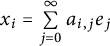 $x_{i}=\sum \limits _{j=0}^{\infty } a_{i,j} e_{j} $
, where
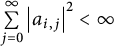 $\sum \limits _{j=0}^{\infty } \left | a_{i,j} \right | ^{2} <\infty $
. Obviously,
 $$ \begin{align*} \left \| x_{i} \right \| ^{2} =\sum\limits_{j=0}^{\infty } \left | a_{i,j} \right | ^{2}. \end{align*} $$
Since
 $$ \begin{align*}\begin{aligned} \left \| x_{1}\odot x_{2}\odot \cdots \odot x_{n} \right \|^{2} & = \left \| \sum\limits_{j=0}^{\infty } a_{1,j}e_{j} \odot \sum\limits_{j=0}^{\infty } a_{2,j}e_{j} \odot \cdots \odot \sum\limits_{j=0}^{\infty } a_{n,j}e_{j} \right \| ^{2} \\ & = \left \| \sum\limits_{i_{1}=0}^{\infty} \sum\limits_{i_{2}=0}^{\infty}\dots \sum\limits_{i_{n}=0}^{\infty} a_{1,i_{1}} a_{2,i_{2}} \dots a_{n,i_{n}} e_{i_{1} }\odot e_{i_{2} } \odot \cdots \odot e_{i_{n} } \right \| ^{2} \\ & = \sum_{i_{1},i_{2},\ldots,i_{n} \ge 0 }\left | a_{1,i_{1} } a_{2,i_{2} }\ldots a_{n,i_{n} }\right | ^{2}\left \| e_{i_{1} }\odot e_{i_{2} } \odot \cdots \odot e_{i_{n} } \right \| ^{2} \end{aligned}\end{align*} $$
and
 $$ \begin{align*} \left \| e_{i_{1} }\odot e_{i_{2} } \odot \cdots \odot e_{i_{n} } \right \|^{2} \ge \frac{1}{n!}, \end{align*} $$
we have
 $$ \begin{align*} \left \| x_{1}\odot x_{2}\odot \cdots \odot x_{n} \right \|^{2} \ge \frac{1}{n!}\prod\limits_{j=1}^{n} \sum\limits_{i_{j}=0}^{\infty} \left | a_{j,i_{j} } \right | ^{2} = \frac{1}{n!}\prod\limits_{j=1}^{n} \left \| x_{j} \right \|^{2}.\\[-43pt] \end{align*} $$
Proposition 4.4 For
 $\mathbb {A}_{1},\mathbb {A}_{2},\ldots ,\mathbb {A}_{n} \in \mathcal { B(H)}$
,
 $$ \begin{align*} \frac{1}{\sqrt{n!} } \sup\limits_{x\in \mathcal{H} \atop \left \| x \right \| =1} \left \{ \left \| \mathbb{A}_{1}x \right \| \left \| \mathbb{A}_{2}x \right \| \cdots \left \| \mathbb{A}_{n}x \right \| \right \} \le\left \| \mathbb{A}_{1}\odot \mathbb{A}_{2}\odot \cdots \odot \mathbb{A}_{n} \right \|. \end{align*} $$
Proof By Proposition 4.3,
 $$ \begin{align*} \left \| \mathbb{A}_{1}\odot \mathbb{A}_{2}\odot \cdots \odot \mathbb{A}_{n} \right \| & \ge \sup_{x\in \mathcal{H} \atop \left \| x \right \| =1}\left \| \left ( \mathbb{A}_{1}\odot \mathbb{A}_{2}\odot \cdots \odot \mathbb{A}_{n} \right ) \left ( x\otimes x\otimes \cdots \otimes x \right ) \right \| \\ & =\sup_{x\in \mathcal{H} \atop \left \| x \right \| =1}\left \| \mathbb{A}_{1}x\odot \mathbb{A}_{2}x\odot \cdots \odot \mathbb{A}_{n}x \right \| \\ & \ge \frac{1}{\sqrt{n!} } \sup_{x\in \mathcal{H} \atop \left \| x \right \| =1} \left \{ \left \| \mathbb{A}_{1}x \right \| \left \| \mathbb{A}_{2}x \right \| \cdots \left \| \mathbb{A}_{n}x \right \| \right \}.\\[-45pt] \end{align*} $$
Acknowledgements
The authors thank the referees for helpful suggestions, which make this article more readable.


