Introduction
Psychiatric disorders are highly prevalent and many conditions co-occur concurrently and sequentially (Kessler et al. Reference Kessler, Nelson, McGonagle, Liu, Swartz and Blazer1996, Reference Kessler, Chiu, Demler and Walters2005; Merikangas et al. Reference Merikangas, Zhang, Avenevoli, Acharyya, Neuenschwander and Angst2003). Of the 26% of participants who had at least one current psychiatric disorder in the US National Co-morbidity Survey Replication (NCS-R), 45% met criteria for two or more disorders (Kessler et al. Reference Kessler, Chiu, Demler and Walters2005). Similar results were found in Australia (Andrews et al. Reference Andrews, Slade and Issakidis2002). These findings raise questions about the nature and determinants of psychopathology (Kendler et al. Reference Kendler, Davis and Kessler1997; Andrews et al. Reference Andrews, Goldberg, Krueger, Carpenter, Hyman, Sachdev and Pine2009), and about the validity of existing systems of classification which may facilitate co-morbidity by using operational definitions and rejecting hierarchies (Tyrer, Reference Tyrer2001; Brugha, Reference Brugha2002; Shorter & Tyrer, Reference Shorter and Tyrer2003; Maj, Reference Maj2005; Goldberg, Reference Goldberg2010).
Co-morbidity is consistently associated with reduced quality of life, higher societal costs and poorer outcomes (Andrews et al. Reference Andrews, Slade and Issakidis2002; Jané-Llopis & Matytsina, Reference Jané-Llopis and Matytsina2006; Singh & Zarate, Reference Singh and Zarate2006; Fortin et al. Reference Fortin, Soubhi, Hudon, Bayliss and van den Akker2007; Nock et al. Reference Nock, Hwang, Sampson and Kessler2009; Pirkola et al. Reference Pirkola, Saarni, Suvisaari, Elovainio, Partonen, Aalto, Honkonen, Perala and Lonnqvist2009). But interpreting co-morbidity is difficult given the number of disorders and the ubiquity (Grant et al. Reference Grant, Hasin, Stinson, Dawson, Ruan, Goldstein, Smith, Saha and Huang2005; Lenzenweger et al. Reference Lenzenweger, Lane, Loranger and Kessler2006; Compton et al. Reference Compton, Thomas, Stinson and Grant2007) and complexity of observed correlations (Merikangas & Kalaydjian, Reference Merikangas and Kalaydjian2007). Recent research has gone beyond pairwise association to interrogating complex co-morbidity matrices (Kendler et al. Reference Kendler, Prescott, Myers and Neale2003; Kessler et al. Reference Kessler, Chiu, Demler and Walters2005; Richardson et al. Reference Richardson, Steiger, Schmitz, Joober, Bruce, Gauvin, Anestin, Dandurand, Howard and de Guzman2008; Veen et al. Reference Veen, de Rijk, Giltay, van Vliet, van Pelt and Zitman2009), both cross-sectionally and longitudinally (Kessler et al. Reference Kessler, Ormel, Petukhova, McLaughlin, Green, Russo, Stein, Zaslavsky, Aguilar-Gaxiola, Alonso, Andrade, Benjet, de Girolamo, de Graaf, Demyttenaere, Fayyad, Haro, Hu, Karam, Lee, Lepine, Matchsinger, Mihaescu-Pintia, Posada-Villa, Sagar and Üstün2011).
Estimated co-morbidity rates (two or more diagnoses among those with any disorder) in most national surveys range from 25% to 40% (Wittchen & Jacobi, Reference Wittchen and Jacobi2005; Merikangas & Kalaydjian, Reference Merikangas and Kalaydjian2007). Co-morbidity is even more evident when the denominator is disorders rather than people; 77% of all diagnoses identified in the NCS-R occurred among people who met criteria for two or more diagnoses (Kessler et al. Reference Kessler, Chiu, Demler and Walters2005). This is consistent with evidence that co-morbidity can be represented by a small number of underlying factors (Kendler et al. Reference Kendler, Prescott, Myers and Neale2003) corresponding to known patterns of risk (Kendler et al. Reference Kendler, Neale, Kessler, Heath and Eaves1992, Reference Kendler, Prescott, Myers and Neale2003).
Previous exploratory and confirmatory factor analyses of lifetime (Krueger, Reference Krueger1999) and 12-month prevalence (Vollebergh et al. Reference Vollebergh, Iedema, Bijl, de Graaf and Ormel2001; Slade & Watson, Reference Slade and Watson2006) data report best fit for a three-factor model of psychiatric morbidity, comprising an externalizing factor (drug and alcohol dependencies and antisocial personality disorder) plus two internalizing factors: anxious–misery (depression, dysthymia and generalized anxiety disorder) and fear (phobias and panic disorder). All three factors appear stable over time (Vollebergh et al. Reference Vollebergh, Iedema, Bijl, de Graaf and Ormel2001), apply equally to Diagnostic and Statistical Manual of Mental Disorders, third edition – revised (DSM-III-R), Diagnostic and Statistical Manual of Mental Disorders, fourth edition (DSM-IV) and International Classification of Disease (ICD-10) categories and correspond to underlying genetic risk for common psychiatric and substance-misuse disorders (Kendler et al. Reference Kendler, Prescott, Myers and Neale2003). Using symptom scores, Markon (Reference Markon2009) identified four factors: ‘internalizing’, ‘pathological introversion’, ‘thought disorder’ and ‘externalizing’; correlations were stronger (0.71 to 0.78) between the first three than between these and the externalizing factor (0.38 to 0.58).
As well as variations in measures and intervals used to ascertain psychiatric disorders, previous studies have also used different statistical approaches to co-morbidity. Kessler et al. (Reference Kessler, Chiu, Demler and Walters2005) highlighted the limitations of factor analysis after finding evidence of non-additive interactions between disorders. Descriptive analyses revealed complex co-morbidities; 433 out of a possible 219 (524288) combinations of disorders were found, ranging from one to 15 diagnoses per person. Exploratory latent class analysis (LCA) identified seven classes, three of which were highly co-morbid. In contrast to factor analysis which describes co-occurrence of symptoms, LCA identifies groups of people who have a similar profile of conditions. While broadly corresponding to the internalizing/externalizing paradigm, this study found overlap between these two types of disorder within classes (Vermunt & Magidson, Reference Vermunt, Magidson, Hagenaars and McCutcheon2002). Describing, quantifying and disentangling co-morbidity has significant implications for efforts to revise classifications of mental disorders (Goldberg, Reference Goldberg2010) and for delivering mental health services (Hall & Howard, Reference Hall and Howard2006; Fortin et al. Reference Fortin, Soubhi, Hudon, Bayliss and van den Akker2007). In light of this accumulating evidence that many ICD-10/DSM-IV disorders (which are predominantly atheoretical symptom-based syndromes) may coalesce into groups with common features and shared aetiology, it has been proposed that ICD-11 and Diagnostic and Statistical Manual of Mental Disorders, fifth edition (DSM-5) be organized according to five ‘meta’ clusters. These currently correspond to neurocognitive, neurodevelopmental, psychotic, emotional and externalizing disorders (Andrews et al. Reference Andrews, Goldberg, Krueger, Carpenter, Hyman, Sachdev and Pine2009; Goldberg et al. Reference Goldberg, Krueger, Andrews and Hobbs2009).
Our aims were to describe the extent and nature of psychiatric co-morbidity within a representative general population sample. We hypothesized that (i) there are two or more readily interpretable latent classes corresponding to internalizing and externalizing dimensions; (ii) classes would be characterized by numbers of disorders, and (iii) classes with higher numbers of disorders would have higher levels of impaired social functioning.
Method
Setting and participants
The Adult Psychiatric Morbidity Survey (APMS) 2007 is a survey of adults aged 16 years and over living in private households in England (McManus et al. Reference McManus, Meltzer, Brugha, Bebbington and Jenkins2009). A stratified random probability sample was used for selecting phase one addresses using postcode sectors as the primary sampling unit. One adult aged 16 years or over was selected at random to take part within eligible households. Phase two sampling was based on responses to phase one questionnaires and the estimated probability that a participant had one of the following conditions: psychosis, autistic spectrum disorder, borderline personality disorder or antisocial personality disorder. Phase one data were collected by lay interviewers and phase two by clinicians trained in administration of study measures.
A total of 519 postcode sectors in England were selected and 28 delivery points were randomly chosen in each sector, yielding a sample of 14 532 delivery points. Of these, 13 171 households were found to be eligible (90.6%). At phase one, 57% of those eligible agreed to take part, resulting in a sample of 7461 participants. Of those who were eligible for phase two interviews, 74% (n=630) took part. A final sample of 7325 was achieved.
Measures
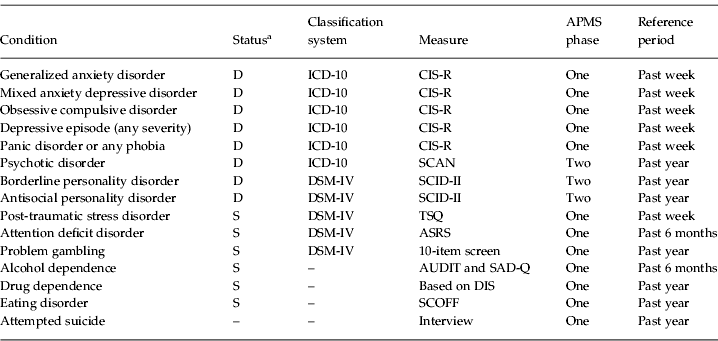
Fifteen mental disorders and problems (‘conditions’) were included, namely: anxiety (three disorders) and depressive disorders; mixed anxiety depressive disorder; psychosis (schizophrenia or affective psychosis); antisocial and borderline personality disorders; probable eating disorders; probable post-traumatic stress disorder (PTSD); probable attention deficit disorder (ADD); probable alcohol and drug dependence; problem gambling; and attempted suicide. Methods, criteria and reference periods are shown in Table 1.
Conditions included in co-morbidity analyses, with criteria and ascertainment methods

APMS, Adult Psychiatric Morbidity Survey; ICD, International Classification of Disease; CIS-R, Revised Clinical Interview Schedule; SCAN, Schedules for Clinical Assessment in Neuropsychiatry; DSM-IV, Diagnostic and Statistical Manual of Mental Disorders, fourth edition; SCID-II, Structured Clinical Interview for DSM-IV; TSQ, Trauma Screening Questionnaire; ASRS, Adult Attention Deficit Hyperactivity Disorder Self-Report Scale; AUDIT, Alcohol Use Disorders Identification Test; SAD-Q, Severity of Alcohol Dependence Questionnaire; DIS, Diagnosis Interview Schedule.
a D=present to diagnostic criteria; S=screen positive.
Using ICD-10 or DSM-IV criteria, 11 conditions were defined and eight were ascertained using structured clinical interviews. Reference periods ranged from 1 week (anxiety and depressive disorders), to 2 weeks (PTSD), 6 months (probable alcohol dependence, probable ADD) and 1 year (probable drug dependence, psychosis, personality disorders, probable eating disorders, problem gambling and attempted suicide).
ICD-10 diagnoses of depressive disorders (mild, moderate and severe), anxiety disorders (generalized anxiety disorder, obsessive compulsive disorder, panic disorder and phobias) and mixed anxiety depressive disorder were obtained using Revised Clinical Interview Schedule (CIS-R; Lewis et al. Reference Lewis, Pelosi, Araya and Dunn1992) data. Borderline and antisocial personality disorders were ascertained using the self-report Structured Clinical Interview for DSM-IV (SCID-II) questionnaire followed by SCID-II clinical interview (First et al. Reference First, Gibbon, Spitzer, William and Benjamin1997). Psychotic disorder was assessed by screening (Bebbington & Nayani, Reference Bebbington and Nayani1995) followed by clinical interview using the Schedules for Clinical Assessment in Neuropsychiatry (SCAN; WHO, 1999). Probable PTSD in the week prior to interview was assessed in two stages. The 10-item self-report Trauma Screening Questionnaire (TSQ; Brewin et al. Reference Brewin, Rose, Andrews, Green, Tata, McEvedy, Turner and Foa2002) was administered to those who reported a serious traumatic event in adulthood. Participants scoring ⩾6 on the TSQ were considered probable PTSD cases. Probable eating disorders were assessed using the SCOFF questionnaire (Morgan et al. Reference Morgan, Reid and Lacey1999), a five-item self-report questionnaire covering the past year. Those who endorsed ⩾2 SCOFF items and reported that feelings about food were significantly having an impact on their life were considered probable cases. Probable adult ADD in the preceding 6 months was assessed using the six-item Adult ADHD Self-Report Scale (ASRS; WHO, 2003). Individuals who endorsed all six items were considered probable cases.
All participants who reported drinking alcohol were asked to complete the Alcohol Use Disorders Identification Test (AUDIT; Saunders et al. Reference Saunders, Aasland, Babor, de la Fuente and Grant1993), a 10-item self report scale about hazardous consumption and symptoms of dependency. Those scoring ⩾10 (out of 40) completed the Severity of Alcohol Dependence Questionnaire (SADQ-C; Stockwell et al. Reference Stockwell, Sitharthan, McGrath and Lang1994), a 20-item measure of alcohol dependency. Drug use was elicited using a computer-assisted self-completion interview covering lifetime use of 13 named drugs. Probable dependence in the past year was determined for any reported use of eight drug types using five questions from the Diagnostic Interview Schedule (Malgady et al. Reference Malgady, Rogler and Tryon1992). Positive response to any item indicated probable drug dependence. Cannabis (2.7%, all adults) was by far the most common drug of dependence – and the sole drug of dependence for 75% of those classified as probably drug dependent. Probable problem gambling was defined as a score of ⩾3 on a 10-item screening measure (based on DSM-IV criteria) administered to all those who spent any money on gambling in the past year (Wardle et al. Reference Wardle, Sproston, Orford, Erens, Griffiths, Constantine and Pigott2007). All participants were asked about suicide attempts in the last year during the phase one interview. Social functioning was assessed using the eight-item Social Functioning Questionnaire (SFQ; Tyrer et al. Reference Tyrer, Nur, Crawford, Karlsen, MacLean, Rao and Johnson2005). Each item was scored from 0 to 3 (scale range 0 to 24), with higher scores indicating (more) problems with social functioning.
Missing data
Of the 7325 participants, 86.6% (6346 respondents) had complete data for all 15 conditions. Most remaining participants had missing data on just one or two conditions. Non-response usually took the form of someone answering ‘don't know’ or refusing to answer a question that was required for diagnosis. No data were missing for the most common disorders (generalized anxiety disorder, depression, obsessive-compulsive disorder, phobia/panic disorder, mixed anxiety depressive disorder and psychosis). Data were missing for fewer than 1% of participants regarding probable drug or alcohol dependencies, attempted suicide, probable adult ADD and probable eating disorder. For these, missing values were re-coded conservatively as ‘condition not present’ since the risk of misclassification arising from imputed data was considered too great.
Four conditions were affected by higher levels of missing data. For probable PTSD (missing values for 2.6% of participants), missing data were due mainly to ‘don't know’ responses to the stem question about the occurrence of severe trauma. We assumed that such people had probably not experienced a trauma severe enough to trigger PTSD. Cases were dropped where values for other PTSD items were missing. The same rule was applied to probable problem gambling (missing values for 6.2% of participants); if they were not sure whether or not they had gambled in the past year, this condition was coded as ‘not present’. For personality disorders (missing data in 6.1% and 6.3% of participants for antisocial and borderline personality disorders, respectively), the major cause was non-participation at phase two. Because the prevalence of personality disorder was extremely low, these cases were coded conservatively as ‘not present’ for the LCA. Replacing missing values where possible in this way increased the percentage of our sample available for LCA, from 85% to 99% of all respondents.
Analysis
LCA is a technique for finding subtypes of related cases (latent classes) from multivariate categorical data. The analysis fits a model to the data that identifies a given number of latent classes and generates probabilities for each participant of their being in each class. Individuals are assigned to the class for which they have the highest probability. LCA generates a parameterized model of class membership. These parameters allow the relationship between the original set of variables (i.e. variables indicating presence or absence of particular psychiatric conditions) and the final latent classes to be formally traced. LCA identifies the symptoms or characteristics that members of a class have in common.
Parameters for latent class models were estimated using maximum-likelihood techniques. One problem that can be encountered when using algorithms to produce maximum-likelihood estimation is the presence of local maxima. This means that during the estimation process, there are several solutions around which a model can converge (i.e. local maxima), but only one solution is the best (i.e. global maximum). The algorithm stops when a maximum is reached, but it cannot distinguish the global maximum from a local maximum (Neely-Barnes, Reference Neely-Barnes2010). If a model converges around a particular local maximum, instead of the global maximum, the best fitting solution can be missed (Vermunt & Magidson, Reference Vermunt, Magidson, Hagenaars and McCutcheon2002). To ensure successful convergence on the global maximum solution, latent class models should be estimated with different sets of random starting values. In this study, 500 random sets of starting values were used in the initial stage, and 20 optimizations were used in the final stage of convergence (Muthén & Muthén, Reference Muthén and Muthén2007). All models were inspected to ensure that the log likelihood value for each model was replicated several times, which increases confidence that the solution obtained is not a local maximum (Nylund et al. Reference Nylund, Asparouhov and Muthén2007).
There is no single definitive method for deciding upon the optimal number of latent classes (Dunn et al. Reference Dunn, Jordan and Croft2006). Selection was guided by statistical fit indices combined with an appropriate conceptual perspective (Acock, Reference Acock2005; Nagin, Reference Nagin2005). The small sample size relative to the possible number of permutations of study conditions (215=32 768), and the fact that most participants (n=5640) did not meet criteria for any of the study conditions meant that formal statistical tests needed to be interpreted cautiously. The following goodness-of-fit statistics were estimated: Akaike's Information Criterion (AIC; Akaike, Reference Akaike1987), Bayes' Information Criterion (BIC; Schwartz, Reference Schwartz1978), the sample size-adjusted BIC (SSABIC; Sclove, Reference Sclove1987), the Lo–Mendel–Rubin likelihood ratio test (LMR-LRT; Lo et al. Reference Lo, Mendell and Rubin2001) and the entropy (Ramaswany et al. Reference Ramaswany, De Sarbo, Reibstein and Robinson1993). Lower values on the AIC, BIC and the SSABIC reflect a good-fitting latent class model. The BIC is a global measure that weights the fit and parsimony of the latent class model (Breslau et al. Reference Breslau, Reboussin, Anthony and Storr2005). Recent research has shown that the BIC is more reliable than the other information criteria when using an optimal latent class model (Nylund et al. Reference Nylund, Asparouhov and Muthén2007). The LMR-LRT statistic was used in conjunction with other goodness-of-fit indices to compare models with differing numbers of latent classes: a non-significant value (p<0.05) indicated that the model with one less latent class was the more parsimonious solution. The entropy statistic, which ranges from 0 to 1, is a standardized summary measure of the classification accuracy of placing participants into classes based on their model-based posterior probabilities. Higher entropy values reflect better classification of individuals (Ramaswany et al. Reference Ramaswany, De Sarbo, Reibstein and Robinson1993).
Mean differences in SFQ scores (with 95% confidence intervals) between participants in different latent classes were estimated using Stata 10 (StataCorp LP, USA), and adjusted for age and sex using analysis of covariance. Multinomial logistic regression analysis was used to explore the relationship between latent class membership (posterior probabilities from the four-class model were used to classify each individual into their most likely class) and sex and age. The three symptomatic classes were compared with the ‘Unaffected’ class. The resulting odds ratios (ORs) indicate whether there is an increased (or decreased) likelihood of being in a symptomatic class compared with the reference class. Survey commands were used to control for the clustered sampling of participants within regions and postcode sectors.
Results
Prevalence of co-morbidity
Just under one-quarter of adults (23.0%) met the criteria for at least one of the conditions under study. Among all participants, 15.8% (68.7% of those with at least one condition) met criteria for just one condition, 4.4% (19.1% of those with any condition) met criteria for two conditions and 2.8% (12.2% of those with any condition) met criteria for three or more conditions. The latter group accounted for 30.8% of all conditions in the study sample.
Women met criteria for more conditions than men (mean 0.37 v. 0.33 conditions respectively, p=0.03); however, overall, there was no statistically significant difference between the proportion of men and women with two or more conditions (6.9% and 7.5%, respectively). The proportion of participants who met criteria for two or more conditions fell steadily with age among both men and women, to a statistically significant degree (Wald F=16.1, p<0.001). These rates fell from 12.3% among those aged from 16 to 24 years to 2.4% of those aged from 65 to 74 years and just 1.4% in those aged 75 years. There was no statistically significant difference between men and women in respect of this age trend (p=0.26).
Estimating latent class models
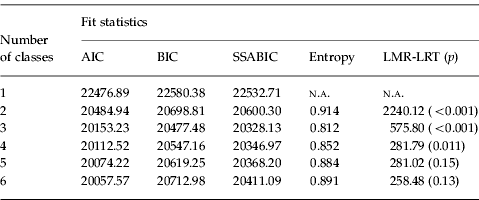
Six latent class models, from a one- to a six-class model, were estimated. We tried to estimate a seven-class model but the best log likelihood value for the solution was not replicated, which suggests that a global maximum for the model was not obtained (i.e. the model parameters were not trustworthy). Table 2 displays the goodness-of-fit statistics for these models. The AIC decreased from the one-class to the six-class model. The BIC and SSABIC both decreased from the one- to the three-class model, but increased again for the remaining models (and were in fact little different for three- and four-class models). The entropy statistics was highest for the one-class model, followed by the six-class model. Overall, goodness-of-fit indices suggest that a latent class model with between three and six classes offered a good explanation of the data. We chose the four-class model since this appeared more parsimonious than the five- or six-class models (based on the LMR-LRT statistic), and was more interpretable and clinically informative than the three-class model.
Fit statistics for latent class analysis incorporating the 15 study conditions (n=7325)

AIC, Akaike's Information Criterion; BIC, Bayes' Information Criterion; SSABIC, sample-size adjusted BIC; LMR-LRT, Lo–Mendel–Rubin likelihood ratio test; n.a., not applicable.
Characteristics of the four-class latent class model
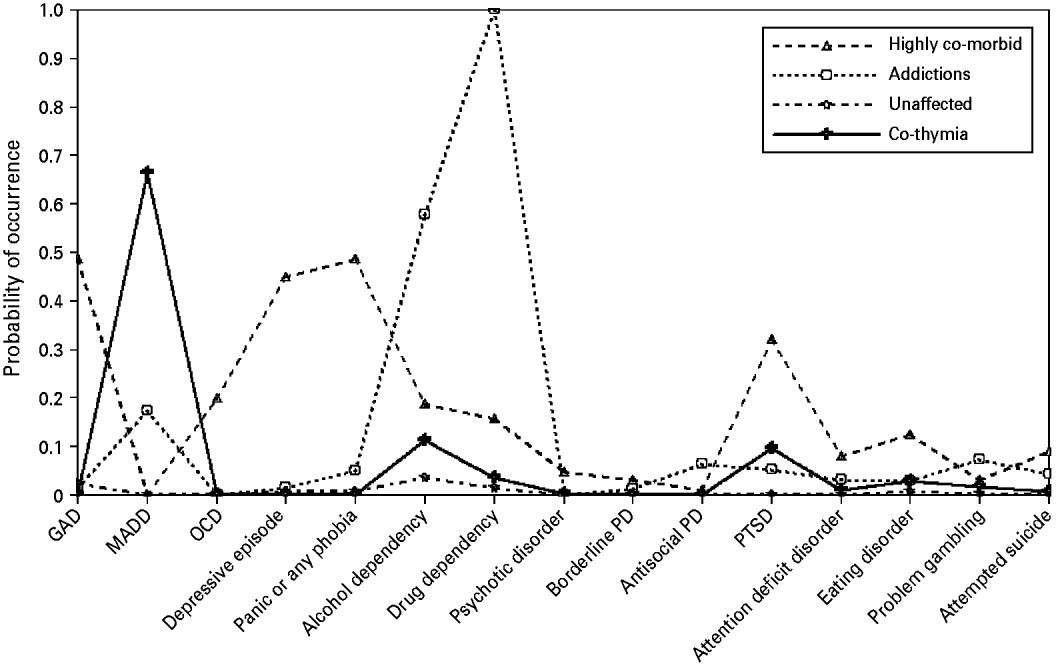
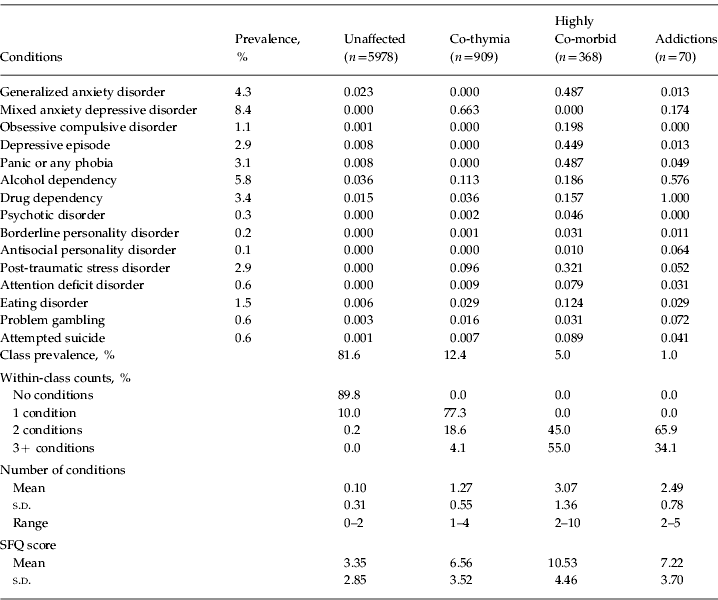
Conditional probabilities are shown in Table 3, and a profile plot for this model is shown in Fig. 1. Class one was the largest class, accounting for 81.6% of participants. We identified this class as ‘Unaffected’, since the probabilities of meeting criteria for 12 of 15 conditions were <1%; the mean number of conditions per class member was 0.10 (s.d.=0.31). Of the remaining three conditions, 3.6% met criteria for probable alcohol dependency, 2.3% generalized anxiety disorder and 1.5% probable drug dependency. Nearly 90% of class members failed to meet criteria for any of the study conditions. All participants with no psychiatric conditions were members of this class.
Estimated probabilities for the occurrence of the 15 study conditions in the four-class model. GAD, Generalized anxiety disorder; MADD, mixed anxiety depressive disorder; OCD, obsessive compulsive disorder; PD, personality disorder; PTSD, post-traumatic stress disorder.

Results of latent class analysis showing four-class model, showing within-class prevalence (%) of the 15 study conditions, class prevalence (% study sample allocated to each class), within-class count of conditions (%), mean number of conditions and mean SFQ scores for each class

SFQ, Social Functioning Questionnaire; s.d., standard deviation.
The second largest class, which we have called ‘Co-thymia’, accounted for 12.4% of participants. All class members met criteria for at least one condition, although most (77.3%) met criteria for just one condition (mean=1.27, s.d.=0.55). Around two-thirds (66.3%) met criteria for mixed anxiety depressive disorder but none of the other ICD-10 anxiety or depressive disorders. Around one-tenth of class members met criteria for probable alcohol dependency (11.3%) and probable PTSD (9.6%).
The third class was labelled ‘Highly Co-morbid’ and accounted for 5.0% of participants, all of whom met criteria for at least two conditions and 55% met criteria for three or more conditions (mean=3.07, s.d.=1.36). As well as the high degree of co-morbidity, this class was characterized by its polymorphism. Although both internalizing and externalizing conditions were represented, the former appeared to predominate, including generalized anxiety disorder and panic disorder/phobia (both occurring in 48.7% of class members), depressive episode (44.9%), probable PTSD (32.1%), obsessive-compulsive disorder (19.8%) and probable eating disorder (12.4%). Attempted suicide in the previous year (reported by 8.9% of class members) was more common here than in any of the other three classes, and accounted for 68.3% of all such reports (n=48) in the study sample. Externalizing conditions were also evident; 18.6% and 15.7% of class members, respectively, had probable alcohol or drug dependency, respectively, and 7.9% were probable cases of ADD (representing 73.7% of all those with this condition). Similarly, nearly all individuals who met criteria for a psychotic disorder (90.3% of all cases) and borderline personality disorder (87.2% of cases) were allocated to this class.
The fourth and final class, labelled ‘Addictions’, included 1.0% (n=70) of study participants. All class members met criteria for at least two conditions (mean=2.49, s.d.=0.78). Every class member (100%) met criteria for probable drug dependency and 57.6% also met criteria for probable alcohol dependency. Although only a minority of problem gamblers (9.7% of total cases) were allocated to this class, this was more frequent here (7.2% of class members) than in any of the other classes. Antisocial personality disorder was present in 6.4% of class members – a far higher proportion than in any other class – and represented 54.9% of all those who met criteria for this condition. Of the remaining conditions, mixed anxiety depressive disorder (17.4% of class members) featured strongly.
Men were significantly less likely than women to be in the ‘Co-thymia’ (OR 0.59, p<0.01) or ‘Highly Co-morbid’ classes (OR 0.67, p<0.01) but significantly more likely to be in the ‘Addictions’ class (OR 4.04; p<0.01). Younger respondents (aged 16–34 years) were significantly more likely than their older counterparts (aged >35 years) to be in the ‘Co-thymia’ (OR 1.39, p<0.01), ‘Highly Co-morbid’ (OR 1.65, p<0.01) or ‘Addictions’ classes (OR 13.52, p<0.01), compared with the ‘Unaffected’ class. Differences were observed between classes in SFQ scores and numbers of conditions (Table 3). After adjusting for age and sex, all of the classes differed to a statistically significant extent on these two measures, with the exception of SFQ scores for the ‘Co-thymia’ and ‘Addictions’ classes.
Discussion
Main findings
In keeping with previous research, there was a high degree of co-morbidity between study conditions. Overall, 23% of participants met criteria for at least one study condition. Of those that met criteria for any condition, 69% had just one condition, while 31% met criteria for two or more of these. This was in keeping with other national surveys (Merikangas & Kalaydjian, Reference Merikangas and Kalaydjian2007), though significantly lower than the rates (45% and 40%) found in the NCS-R (Kessler et al. Reference Kessler, Chiu, Demler and Walters2005) and the Australian National Survey of Mental Health and Well-Being (Andrews et al. Reference Andrews, Slade and Issakidis2002), respectively. In the former study, latent class analysis revealed seven classes of which three were highly co-morbid, compared with four classes in the present study, of which two showed evidence of significant co-morbidity, one highly so. Some of these differences are likely to be methodological in origin: although our study and those of Kessler et al. (Reference Kessler, Chiu, Demler and Walters2005) and Andrews et al. (Reference Andrews, Slade and Issakidis2002) included 15, 14 and 12 conditions, respectively, only between five and seven were common to any given pair of studies – notwithstanding definitional differences. The higher rates of co-morbidity in the other two surveys was also likely to be methodological in origin – for instance due to the inclusion of separate phobias plus panic disorder in the NCS-R and Australian National Survey compared with a single ‘panic disorder or phobia’ condition in the present study. This is consistent with evidence that co-morbidity is greatest between disorders within the same group (Andrews et al. Reference Andrews, Slade and Issakidis2002). And as elsewhere (Kessler et al. Reference Kessler, Chiu, Demler and Walters2005), psychiatric disorders were concentrated in a small proportion of the population: 3% of participants (12% of those with any condition) met criteria for three or more conditions and accounted for 31% of all study conditions. Latent class analyses succeeded in distinguishing between those with and those without any of the study conditions.
Strengths and limitations
The choice of conditions included in our analyses was determined by the available APMS data. However, our data derived from a national survey of psychiatric morbidity designed to inform commissioning of services on the basis of population need. Those responsible for conducting the survey were concerned to ascertain all mental disorders, and to include measures of problem behaviours that are closely related to mental disorders. We therefore included the most common mental disorders, namely anxiety and depressive disorders, probable PTSD, probable alcohol and drug dependency, rarer conditions (personality disorders, psychosis) and ‘problem’ behaviours: problem gambling and attempted suicide. A further limitation was that a number of conditions, though operationalized using ICD-10 or DSM-IV criteria, were ascertained using screening or other self-report measures and hence have been designated as ‘probable’ (PTSD, adult ADD, alcohol and drug dependence, eating disorders, problem gambling). This is likely to have resulted in some misclassification. In most cases (particularly probable drug and alcohol dependencies, eating disorders and PTSD) prevalences were likely to have been over-estimated. For other, rarer, conditions the effects (though modest) were probably more complicated. For example, similar rates of probable ADD in men and women suggest underestimation among men and/or overestimation in women. Nevertheless, overall prevalences argue against gross over-ascertainment of this condition.
There were other methodological considerations, including the diagnostic exclusivity of mixed anxiety depressive disorder (which by definition – here and in ICD-10 – cannot be co-morbid with other anxiety and depressive disorders). It was also possible that some study conditions shared common criteria that might have inflated co-morbidity – for instance gambling, drinking and misusing drugs make a diagnosis of antisocial personality disorder more likely, while suicidal acts contribute to the diagnoses of depression and borderline personality disorder. Likewise, alcohol and drug misuse are causes of other disorders. However, the main aim of the study was to describe and interpret patterns of co-morbidity as they occur.
Patterns of co-morbidity
The largest class comprised those unaffected by any condition. The most common conditions (anxiety and depressive disorders) dominated the other three classes. We found one predominantly internalizing class (Co-thymia), one mainly externalizing class (Addictions) and one highly co-morbid, polymorphous class. Classes differed in numbers of co-morbid conditions and social impairments. As in the NCS-R, we found overlap between internalizing and externalizing conditions within classes. In the (internalizing) Co-thymia class, 11% of class members met criteria for probable alcohol dependence, whereas 17.4% of those in the (externalizing) Addictions class met criteria for mixed anxiety depressive disorder. This overlap may reflect the psychological and physiological effects of alcohol and other psychoactive substances. And while this is consistent with population evidence that alcohol misuse tends to precede the onset of other psychiatric disorders more often than the reverse (Flensborg-Madsen et al. Reference Flensborg-Madsen, Mortensen, Knop, Becker, Sher and Gronbaek2009), relatively few participants in the Addictions class had more severe anxiety or depressive disorders (as opposed to mixed anxiety depressive disorders) relative to the high prevalence of drug and alcohol dependency. In contrast to factor analytic studies, we found no evidence of distinct internalizing classes corresponding to anxiety-misery versus fear (Vollebergh et al. Reference Vollebergh, Iedema, Bijl, de Graaf and Ormel2001; Slade & Wilson, Reference Slade and Watson2006).
We found informative patterns of co-morbidity. Although mixed anxiety depressive disorder often occurred alone, the high prevalence of probable alcohol dependency (and to a lesser extent probable drug dependency) in the Co-thymia class was unexpected. Of those in the (externalizing) Addictions class, 17% met criteria for mixed anxiety depressive disorder. It is possible that alcohol misuse and drug misuse were direct causes of, as well as responses to, the observed dysthymia among members of these classes.
Attempted suicide was most evident in the Highly Co-morbid class (along with the highest rates of depression and generalized anxiety disorder) and, to a lesser extent, the Addictions class. Attempted suicide featured rarely among members of the (internalizing) Co-thymia class. Our findings are consistent with recent reports of associations between PTSD and both attempted (Wilcox et al. Reference Wilcox, Storr and Breslau2009) and completed (Gradus et al. Reference Gradus, Qin, Lincoln, Miller, Lawler, Sørensen and Lash2010) suicide, and between suicidal thoughts and behaviours and anxiety disorders (Sareen et al. Reference Sareen, Cox, Afifi, de Graaf, Asmundson, ten Have and Stein2005). Examining patterns of co-morbidity in this sample also supports the view that suicide is a product of co-morbidity (Nock et al. Reference Nock, Hwang, Sampson and Kessler2009); attempted suicide was most common in classes with the highest mean number of conditions. These results are also consistent with evidence that attempted suicide results from a combination of low mood, agitation (restless anxiety and physiological arousal) and poor impulse control (Hawgood & De Leo, Reference Hawgood and De Leo2008).
Personality disorders were rare and occurred mainly in the Highly Co-morbid and Addictions classes. Over 90% of cases of probable psychosis occurred in the Highly Co-morbid class, and the remainder occurred in the Co-thymia class. This suggests that in a community sample, psychosis is most often found in people who are also likely to meet criteria for depression, anxiety and PTSD. This fits with the view that traumatic experiences and high levels of physiological arousal are common in psychosis, which may explain why attempted suicide was also most prevalent in the same classes. We found no strong patterning in the distribution of problem gambling. Although this was most prevalent in the Addictions class, absolute numbers of probable cases were greater in the other classes. We found no evidence of associations with antisocial personality disorder, adult ADD, drug or alcohol dependency, depression or anxiety disorders (Petry et al. Reference Petry, Stinson and Grant2005).
Our findings are timely, given proposals to organize DSM-5 and ICD-11 around five meta-clusters (Andrews et al. Reference Andrews, Goldberg, Krueger, Carpenter, Hyman, Sachdev and Pine2009; Kendler, Reference Kendler2009). To be useful, such groupings must be exhaustive and mutually exclusive; early indications suggest that they may not be (Andrews et al. Reference Andrews, Goldberg, Krueger, Carpenter, Hyman, Sachdev and Pine2009, Krueger & South, Reference Krueger and South2009). By contrast, our results support the notion of ‘polymorphous co-morbidity’ (Krueger & South, Reference Krueger and South2009). An example is alcohol misuse and drug misuse, which do not always covary and which may have different aetiologies. As Krueger & South (Reference Krueger and South2009) also point out, an important reason for overlap between internalizing and externalizing conditions is the heterogeneous, syndromal nature of many disorders included in co-morbidity and latent class analyses.
Conclusions
Our findings highlight the need to recognize co-morbidity when planning services, although treatments and guidelines (and pharmacological licensing) continue to be based on the single disease paradigm (Fortin et al. Reference Fortin, Soubhi, Hudon, Bayliss and van den Akker2007). Evidence that problems in social functioning are associated with numbers of conditions highlights the impacts of co-morbidity on clinical and social outcomes (Cerdá et al. Reference Cerdá, Sagdeo, Johnson and Galea2010). Likewise, while our findings are consistent with the suggestion that forthcoming revisions of DSM and ICD classifications should consist of large ‘meta’ groupings (Goldberg, Reference Goldberg2010), the real challenge remains of developing ways to treat co-morbidity that enhance care, improve outcomes and facilitate scientific advances in the aetiology and treatment of mental disorders.
Acknowledgements
All authors were involved (to varying degrees) in the design, data collection, reporting and archiving of APMS data.
Declaration of Interest
S.M. and D.H. are employed by the National Centre for Social Research, the primary contractor for APMS 2007.