

Introduction
In tropical Africa, local chickens are kept for meat, eggs, sold for emergency cash needs and also for their socio-cultural values (Osei-Amponsah, Kayang and Naazie, Reference Osei-Amponsah, Kayang and Naazie2012). Increasing the production efficiency of local chickens requires genetic improvement of their economically important traits. Genetic improvement depends on access to genetic variation and effective methods for exploiting it through selection. Local chickens in the tropics have high genetic variability within their populations (Muchadeyi et al., Reference Muchadeyi, Eding, Wollny, Groeneveld, Makuza and Shamsedin2007; Mwacharo et al., Reference Mwacharo, Nomura, Hanada, Jianlin, Hannote and Amano2007; Halima et al., Reference Halima, Neser, de Kock and van Marle-Koster2009; Osei-Amponsah et al., Reference Osei-Amponsah, Kayang, Naazie, Osei, Youssao, Yapi-Gnaore, Tixier-Boichard and Rognon2010) indicating high potential for genetic improvement of these chickens through selective breeding (Dana, vander Waaij and van Arendonk, Reference Dana, vander Waaij and van Arendonk2011). Economic traits are generally controlled by many genes, each with a rather small effect on the trait. For such traits, improvement depends on measuring genetic parameters such as heritability which are then used to predict response to selection. Genetic and phenotypic parameters are important for breeding value estimation and selection decisions (Melo et al., Reference Melo, Romano, Canet and Miquel2006; Kamali et al., Reference Kamali, Ghorbani, Moradi Sharbabak and Zamiri2007; Grosso et al., Reference Grosso, Balieiro, Eler, Ferraz, Mattos and Filho2010; Adeleke et al., Reference Adeleke, Peters, Ozoje, Ikeobi, Bamgbose and Adebambo2011; Dana, vander Waaij and van Arendonk, Reference Dana, vander Waaij and van Arendonk2011; Hidalgo et al., Reference Hidalgo, Martins, Leseur dos Santos, Oliveira de Quadros, Ton and Teixeira2011).
Genetic parameters describe genetic and environmental variation and might vary among populations and environments and should thus be estimated in different populations in their specific environments (Besbes et al., Reference Besbes, Ducrocq, Foulley, Protais, Tavernier, Tixier-Boichard and Beaumont1992; Khaldari et al., Reference Khaldari, Pakdel, Yegane, Javaremi and Berg2010). Furthermore, the relationship between production traits (body weight, egg size and egg number) and reproduction traits (fertility and hatchability) are of interest as they can affect the rate of genetic progress (Savegnago et al., Reference Savegnago, Buzanskas, Nunes, Ramos, Ledur, Nones and Munari2011). No work has been done on the evaluation of genetic parameters of productive traits of local chickens in Ghana. Such knowledge would enable optimization of breeding programmes to maximize genetic improvement of local chickens. The objective of this study was therefore to estimate the (co)variance components and hence the genetic and phenotypic parameters for economically important traits of local chickens as part of characterization of animal chicken genetic resources of Ghana.
Materials and methods
Experimental birds and management
The source of experimental chickens and their management have been described by Osei-Amponsah, Kayang and Naazie (Reference Osei-Amponsah, Kayang and Naazie2012). In brief, chickens from the same ecozone (forest or savannah) were grouped into families comprising a cock and five hens and the collection of fertile eggs began a week later. All eggs were labelled and incubated artificially using table top incubators. After hatching the chicks were tagged according to the sires and ecotype and reared on deep litter. All chicks were fed chick starter for 4 weeks, grower ration from 4 to 18 weeks and layer ration after 18 weeks. The diets were formulated using commercial protein concentrate and the composition of the ration fed to the experimental chickens as described by Osei-Amponsah et al. (Reference Osei-Amponsah, Kayang, Naazie, Arthur and Barchia2011). Feeding and other management practices were the same for all groups and routine vaccination and drug administration schedule were strictly adhered to.
Traits measured and estimation of genetic parameters
The chicks were weighed at hatch and subsequently fortnightly till the 12th week and then monthly till the 40th week for the purpose of describing their growth. Genetic parameters were estimated by variance components using a paternal half-sib animal model described by Becker (Reference Becker1992). A restricted maximum likelihood (REML) animal model was applied to body weight and shank length data of 422 local chickens (196 forest chickens and 226 savannah chickens) from hatch to 40 weeks to estimate (co)variance components, heritabilities, phenotypic and genotypic correlations of body weight and shank length. These components were also estimated for egg number and egg weight of local hens. Genetic parameter estimates of egg number and egg weight were made at the following age periods: 21–30 weeks, 31–40 weeks, 41–49 weeks as well as the entire period (21–49 weeks). In all cases, only sire components of variance were estimated as there were no trap nests and so dams could not be identified. All the REML analyses were carried out using the multiple trait derivative free restricted maximum likelihood (MTDFREML) software package (Boldman et al., Reference Boldman, Kreise, Van Vleck, van Tassel and Kachman1995). The REML method (Boldman et al., Reference Boldman, Kreise, Van Vleck, van Tassel and Kachman1995) allows for more accurate estimates of genetic parameters and estimates of breeding values (Zhang et al., Reference Zhang, Ning, Xu, Hou and Yang2005; Thompson, Reference Thompson2008). The REML animal model used in matrix notation was
 $${\bi y}=X{\bi b}+Z{\bi a}+{\rm e}$$
where y is a vector N × 1 of observations for body weight, shank length, egg number or egg weight; X is the design matrix of 0s and 1s describing which elements of b correspond to observations in y ; b is an unknown vector of fixed effects; Z is the design matrix of 0s and 1s relating elements of a to observations in y ; a is the vector of random additive direct genetic effects; e denotes the vector of random residual effects (temporal environmental).
Heritability of body weight and shank length was estimated using single-trait analysis. Genetic and phenotypic correlations between body weight and shank length were estimated using a two-trait analysis. A two-trait analysis was also employed to estimate variance components and heritability of egg number and egg weight at three different periods (21–30, 31–40 and 41–49 weeks) of the laying cycle and the entire laying period (21–49 weeks). Genetic correlations between egg weight and egg number were estimated for each period using the two-trait analysis.
Results
Variance components of growth traits
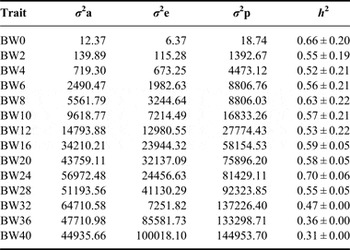
There were increases in additive genetic variance, residual variance, and phenotypic variance of body weight of local chickens from hatch to the 40th week. Additive heritability estimates of body weight based on the animal genetic model ranged from 0.31 to 0.70 with an overall estimate of 0.54 (Table 1).
Variance components and heritability estimates of body weight of local chickens by age§.

σ 2a, additive genetic variance; σ 2e, residual variance; σ 2p, phenotypic variance; h 2, heritability; BW0, body weight at hatch; BW2, body weight at 2 weeks, etc.
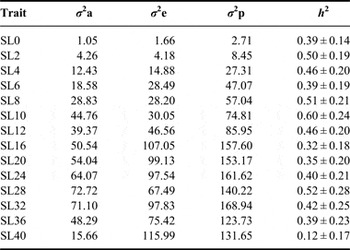
Additive genetic variance, residual variance and phenotypic variance of shank length of local chickens increased with age. Overall heritability estimates of shank length ranged from 0.12 to 0.60 with an average of 0.42 (Table 2).
Variance components and heritability estimates of shank length of local chickens by age.

σ 2a, additive genetic variance; σ 2e, residual variance; σ 2p, phenotypic variance; h 2, heritability; SL0, shank length at hatch; SL2, shank length at 2 weeks, etc.
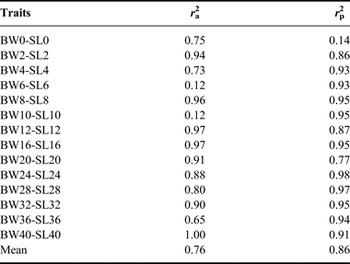
In general, there was high genetic correlation between body weight and shank length of local chickens (Table 3).
Genetic and phenotypic correlations between body weight and shank length of local chicken ecotypes by age.

r 2a, genetic correlation between body weight and shank length; r 2 p, phenotypic correlation between body weight and shank length; BW0, body weight at hatch; SL2, shank length at week 2, etc.
Variance components of reproductive traits
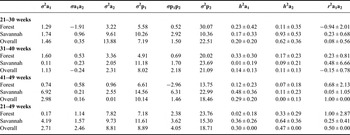
Table 4 shows that overall additive genetic variance fluctuated with age for egg number but decreased with age for egg weight. Phenotypic variance increased with age for egg number but decreased with age for egg weight except for the savannah ecotype. Overall, heritability of egg number fluctuated with age while heritability of egg weight decreased with age. Furthermore, heritabilities of both egg number and egg weight were higher in the savannah chicken ecotype than the forest ecotype. However, there was a stronger genetic correlation between egg number and egg weight of the forest than savannah chicken ecotype. A positive genetic correlation between egg number and egg weight (0.50) was obtained in local chickens.
Heritability, genetic and phenotypic correlations of egg number and egg weight of local chicken ecotypes by age.

σ 2a1, genetic variance of egg number; σa1a2, genetic covariance between egg number and egg weight; σ 2a2, additive genetic variance of egg weight; σ 2p1, phenotypic variance of egg number; σp1p2, phenotypic covariance between egg number and egg weight; σ 2p2, phenotypic variance of egg weight; h 2a1,heritability of egg number; h 2a2, heritability of egg weight; r 2a1a2, genetic correlation between egg number and egg weight.
Discussion
The additive component of the genetic variance is of particular interest because it is the primary determinant of the degree of resemblance between parent and progeny, and this governs the response rate of traits to selection (Larivière et al., Reference Larivière, Michaux, Verleyen and Leroy2009). The high additive genetic variance within the local chicken could be due to the lack of selection within the local chicken population. Relatively high additive genetic variance could also be due to absence of inbreeding as the families of birds were formed with samples from different parts of the country. The environmental variances were low as the birds were all kept at the same station or in a similar environment. Body weight of local chickens has enough additive genetic variation to enable selection and significant genetic gains would be expected if selection for body weight was carried out in the local chicken population. Selection to increase body weight to a level that allows local chickens to survive in the crude extensive systems of rural farmers of the developing world, while maintaining genetic diversity ought to be good objectives to aim at, as it is not likely these birds can be improved within a reasonable period of time to be competitive under intensive management.
Genetic and phenotypic correlations between body weight and shank length were generally high and positive. This means that similar genes affect body weight and shank length. Hence, selection and improvement in body weight will automatically increase shank length. The best age to select local chickens based on shank length is 10 weeks although the high positive and unfavourable genetic and phenotypic correlations with body weight suggest some caution be exercised. There is no commercial interest in having chickens with very long shanks. Consequently, selection within the local chicken population will be more useful if based on body weights, perhaps with some amount of negative pressure on shank length. The high phenotypic correlations between body weight and shank length represent an adaption for survival in the kinds of systems of management in which local chickens are kept. Longer shanks enable them to chase down insects and out compete each other in the process. Other researchers have documented the high and positive genetic and phenotypic correlations between body weight and shank length (Kabir et al., Reference Kabir, Oni, Akpa and Adeyinka2006) as has been obtained in this study.
There was no clear trend between heritability of body weight and age but heritability estimates reduced with age after 24 weeks of age. An estimate of 0.45 was obtained for body weight at 5 weeks in a male broiler line raised under tropical conditions in Brazil (Argentão et al., Reference Argentão, Filho, Marques, Souza, Eler and Ferraz2002) which is lower than what was obtained at either 4 or 6 weeks for local Ghanaian chicken. The heritability estimates of 0.59, 0.55 and 0.52 for body weight at 8, 10 and 12 weeks are all higher than heritability estimates of 0.42, 0.30 and 0.30 for body weight of free range broiler chickens in Argentina at 54, 68 and 75 days of age (Melo et al., Reference Melo, Romano, Canet and Miquel2006), indicating the lack of selection or inbreeding in these chickens. Heritability estimates of 0.51 and 0.86 have been reported for body weights of 8 months old roosters from a population selected for egg traits and a control line (Segura et al., Reference Segura, Gavora, Fairfull, Gowe and Buckland1990). Kiani-Manesh, Nejati-Javaremi and Saneei (Reference Kiani-Manesh, Nejati-Javaremi and Saneei2002) reported heritability estimates of 0.47, 0.69, 0.24 and 0.14 for 8-week body weights for native Iranian chicken raised at four breeding stations, while Kabir et al. (Reference Kabir, Oni, Akpa and Adeyinka2006) reported heritability estimates of 0.89 and 0.70 at 20 weeks of age; 0.68 and 0.56 at 30 weeks of age; 0.60 and 0.42 at 40 weeks of age for two strains of Rhode Island Red chickens.
This study therefore confirms the moderate-to-high heritability estimates of body weight of unselected chicken populations. This ranged from 0.52 to 0.63 within the first 8 weeks after hatch indicating the possibility of early selection. However, low heritability estimates of between 0.07 and 0.21 have been reported for Creole chickens from South Eastern Mexico from hatch to 16 weeks of age (Prado-González, Ramírez-Avila and Segura-Correa, Reference Prado-González, Ramírez-Avila and Segura-Correa2003). It was explained that dominance, epistatic and environmental effects were more important than genetic additive effects on body weight of Creole chickens. Adeyinka et al. (Reference Adeyinka, Oni, Nwagu and Adeyinka2006) obtained heritability estimates of 0.32, 0.22, 0.31, 0.24 and 0.20 for body weights at hatch, 2 weeks, 4 weeks, 6 weeks and 8 weeks, respectively, for naked neck broiler chickens. Adeleke et al. (Reference Adeleke, Peters, Ozoje, Ikeobi, Bamgbose and Adebambo2011) also reported heritability estimates of between 0.05 and 0.45 in Nigerian indigenous chickens. These estimates are low compared with those obtained at the respective ages in local Ghanaian chicken ecotypes, but is to be expected as broilers are intensively selected for their body weight and so should have reduced additive genetic variance.
The overall heritability of egg number of local chickens in this study, 0.30 falls within the low-to-moderate values (0.12–0.41) recorded for this trait by Besbes and Gibson (Reference Besbes and Gibson1998) for purebred and crossbred chickens. The overall heritability of egg number for savannah chickens (0.36) was higher than the forest chickens (0.02), which could indicate different response to the experimental environment by the local chicken ecotypes. Wei and van der Werf (Reference Wei and van der Werf1995) reported heritabilities of 0.04–0.51 for egg number. Overall heritability of egg weight of local chickens was 0.47 with 0.33 in the forest ecotype and 0.64 in the forest. The higher heritability of egg weight than egg number, a fitness trait, is expected and is in line with findings of other researchers. For instance, among local chickens in Nigeria, estimates of heritability were low (0.07) for egg number and moderate (0.31) for egg weight, with low genetic and phenotypic correlations between the two traits (Adedeji et al., Reference Adedeji, Adebambo, Ozoje, Ojedapo and Ige2006). A high heritability of 0.7 has been reported for egg weight in purebred and crossbred laying hens (Besbes and Gibson, Reference Besbes and Gibson1998). In another study on purebred and crossbred chickens, a heritability range of 0.23–0.45 was reported for egg weight in purebred and crossbred chickens (Wei and van der Werf, Reference Wei and van der Werf1995). Zhang et al. (Reference Zhang, Ning, Xu, Hou and Yang2005) reported heritabilities of egg weight of 0.63 in brown-egg dwarf layers. Kamali et al. (Reference Kamali, Ghorbani, Moradi Sharbabak and Zamiri2007) also reported heritabilities of 0.40 and 0.64, respectively, for egg number and egg weight in Iranian native fowls. The results of this study and of other researchers are in agreement that the heritability of egg weight is higher than that of egg number. Progress at improving egg number will therefore be slower than that for egg weight.
The best way to improve on egg number will be to reduce the length of the inter clutch interval by collecting the eggs as soon as they are laid and thus discouraging broodiness. Furthermore, heritability of egg weight in local chickens decreased with the laying period (0.62 between 21 and 30 weeks as against 0.39 between 31 and 49 weeks) and therefore selection for high egg weight should be carried out during the first phase of the laying cycle. The challenge now is to carry out selection within local chicken ecotypes to ensure that body weight, egg number and egg weight are improved upon. The moderate-to-high heritability of body weight of local chickens as well as their short generation interval should make this attainable.
Conclusions
Heritability estimates of body weight (0.54), shank length (0.42), egg weight (0.47) and egg number (0.30) are all moderate to high and indicate that these traits could be targeted in future improvement programmes for local chicken. Conservation strategies in local chicken will achieve the best results if body weight and egg weight are targeted in breeding programmes. Once hatch weight is improved and increased, the market age can be reduced or bigger birds could be sold at the current market ages. Compared with similar studies in chickens elsewhere, the heritability estimates of the productive traits studied are moderate to high. There is the need for some selection and improvement of local chickens to take full advantage of their adaptive potential as regards various environmental challenges and their genetic variability.
Acknowledgements
Appreciation is expressed to the Project on Promoting Sustainable Development in Agricultural Research Systems in the South (DURAS) for permission to use data and the University of Ghana Graduate Fellowship Programme for award of fellowship to R. Osei-Amponsah.