Worldwide, more than 2 million nosocomial infections impact 6 of every 100 hospital stays annually, resulting in the deaths of more than 90,000 patients.Reference Marler 1 Greater than 40% of nosocomial infections are attributed to cross contamination from healthcare workers who acquired the contaminant during patient care. 2 Hospital uniforms are a significant source of infectious contaminantsReference Willis-Owen, Subramanian, Kumari and Houlihan-Burne 3 – Reference Banu, Anand and Nagi 8 ; 1 study reported that up to 60% of hospital staff’s uniforms tested positive for multidrug-resistant organisms (MDROs).Reference Wiener-Well, Galuty, Rudensky, Schlesinger, Attias and Yinnon 9 Contaminated clothing may act as a vector for transmission to the hands of patients and staff, even after hand washing.Reference Griffin, Scott and Foster 10 , Reference Burger, Wijewardena, Clayson and Greatorex 11 Thus, it is currently recommended that in addition to hand hygiene, hospital uniforms be changed daily, regardless of their appearance (eg, soiled or unsoiled).Reference Loh, Ng and Holton 12 , Reference Kuehn 13 However, many healthcare workers do not adhere to this recommendation, increasing the risk of nosocomial infections.Reference Krueger, Murray, Mende, Guymon and Gerlinger 14
The abundance of infectious contaminants on hospital textiles has frequently been assessed on physicians’ white coats.Reference Willis-Owen, Subramanian, Kumari and Houlihan-Burne 3 – Reference Banu, Anand and Nagi 8 In particular, long sleeves increase the likelihood of contact between the textile and the patient during an episode of care (and may decrease the adequacy of hand washing).Reference Weber, Khan, Fader and Weber 15 The aim of this study was to assess differences in bacterial growth patterns on hospital uniforms versus employee-owned and maintained uniforms in a crossover study design to determine whether uniform choice might mitigate the risk of nosocomial infection in a military hospital.
Methods
Study design
Nurses who provided direct patient care and wore their military-approved uniforms to work were eligible for inclusion. Individuals were excluded if they only wore hospital-provided scrubs or were not in a direct patient care role. In total, 126 eligible nursing staff were enrolled and 118 completed both sampling days. The study was approved by the Institutional Review Board of the facility and informed consent was obtained from each participant.
We performed a randomized experimental crossover study for active duty military nurses who provided direct patient care within inpatient units at a large military medical center. A list of all eligible inpatient units (n = 7) was generated, and the order of uniform sampling was determined by random number table. All units assigned an even number wore their military-approved uniform first (50% nylon, 50% cotton), units assigned an odd number were sampled in hospital-provided scrubs first. Military nurses are currently allowed to wear 3 versions of the uniform to work: the traditional long-sleeved uniform, the traditional military uniform boots and pants, with a short-sleeved scrub top made of a similar nylon–cotton blend, or the short-sleeved scrub top with scrub-style khaki pants (Supplemental Fig. 1). Participants were not given special instructions for laundering or wear of their uniform prior to the day of sampling. Most staff wore the short-sleeved military-style scrub top. Hospital-provided scrubs are not to be worn outside the facility. As such, participants were provided a set of hospital scrubs (55% cotton, 45% polyester; Supplemental Figure 1) in a sealed pouch and instructed to change into them prior to the start of their shift on the day of sampling. Sampling occurred between November 2016 and November 2017.
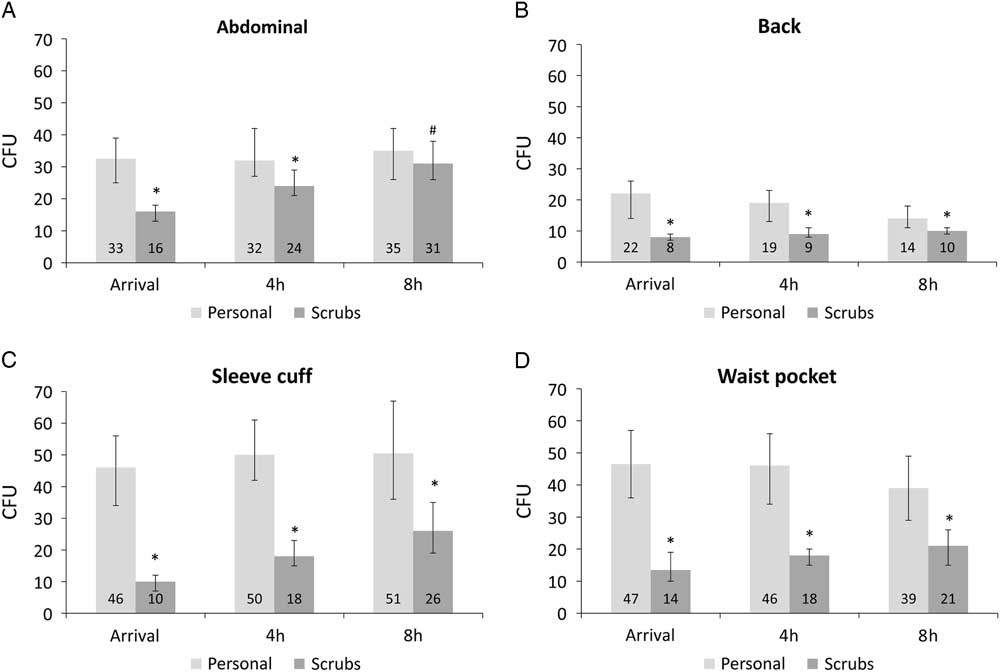
Median CFUs of different nursing uniforms over time. CFU: colony forming unit; results expressed as medians. A. results observed at abdominal site. B. results observed at the sleeve cuff of the participant's dominant arm. C. results observed at the back of the uniform. D. results observed at the waist pocket of the participant's dominant arm side. *P <0.001 between personally-owned uniform and hospital scrubs; #P<0.05 between personally-owned uniform and hospital scrubs.

Data collection
Replicate organism detection and counting (RODAC) plates (Contact I blood agar, Remel, Lenexa, KS) were used for the recovery of microorganisms. Each participant was sampled by RODAC impression at each of 6 designated sampling regions. Samples were collected from (1) the sleeve cuff of the dominant hand of the uniform worn (dominant hand was asked of participant at time of sampling but not recorded), (2) waistline pocket area of the dominant hand of the uniform worn, (3) front abdominal area of the uniform, and (4) lower back area of the uniform worn. Additionally, the volar surface of each wrist was sampled for a total of 6 RODAC plates per sampling event. Each participant was sampled on 2 separate working days, once in the military-approved uniform of their choosing and once in hospital-provided scrubs. On each sampling day, participants were sampled within 1 hour of arriving to work, after ~4 hours, and after ~8 hours. This procedure resulted in a total of 18 samples collected from each participant per sampling day (uniform type). Due to scheduling variability, the interval between the 2 sampling days varied; however, sampling was most commonly completed within the same week. Day and night shifts were equally represented within the study population.
All plates were incubated at 35–37○C for 24 hours. Plates were observed for growth, and the number of colony-forming units (CFU) was recorded utilizing a PROTOSReference Willis-Owen, Subramanian, Kumari and Houlihan-Burne 3 automated colony counter (Synbiosis, Frederick, MD). Over the course of the study, 8 participants were enrolled but did not complete data collection. Incomplete data was coded as ‘missing’ during analysis.
Statistical analysis
A repeated-measures, mixed-effects analysis was conducted to analyze CFU counts from the 2-period, 2-factor crossover design. Separate models were run at each sampling location to assess CFU differences between military-approved uniforms and hospital-provided scrubs. The models also examined the effect of time of sampling (0, 4, and 8 hours) and the interaction between time of sampling and type of uniform. Carryover effects were assessed and found to be nonsignificant. The CFU data were transformed to the log scale after adding 1 to account for zeroes (<1% of data) to enhance normality. Results are presented as median and interquartile range (IQR). Confidence intervals in the figures indicate ±95% upper and lower bounds on the median. The ratio for comparing levels between military-approved uniforms and hospital-provided scrubs was based on the ratio of geometric means. A significance level of .05 was used for all analyses, which were conducted using SAS version 9.4 software (SAS Institute, Cary, NC).
Results
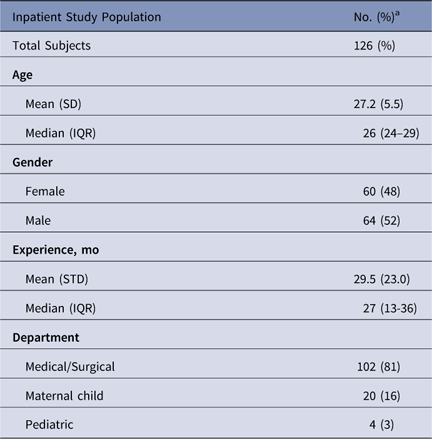
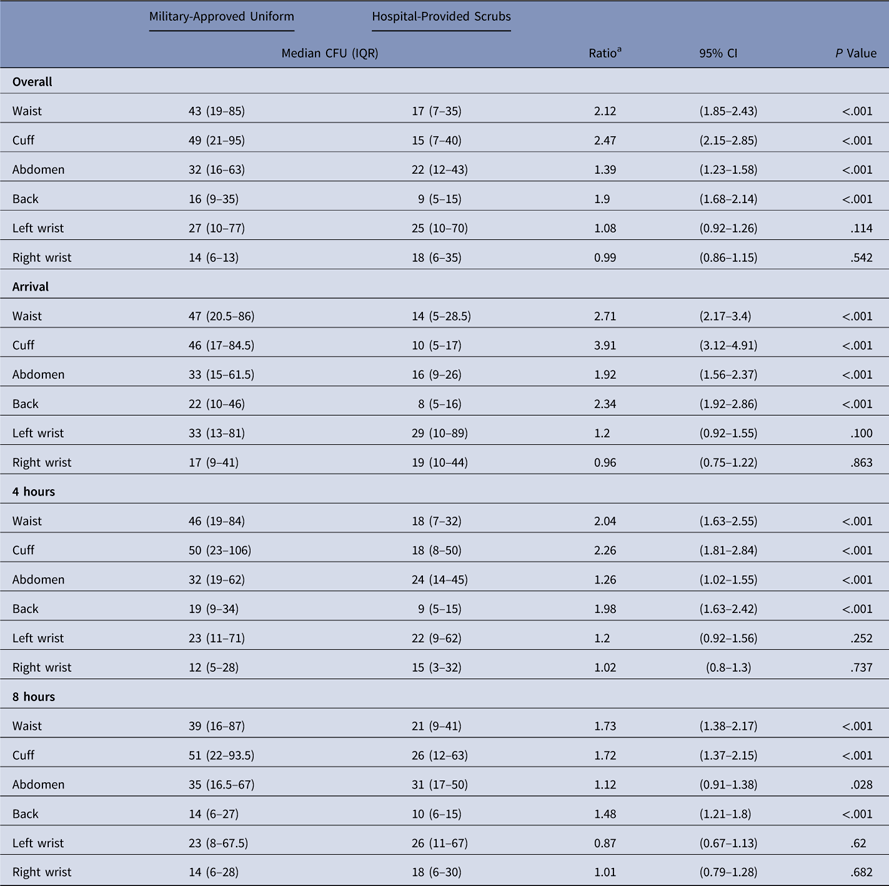
The study participants ranged from 20 to 39 years of age (mean age, 27.2 years) and were equally likely to be male as female. Nursing experience ranged from 1 month to 5 years (mean, 2.45 years) and most worked on medical or surgical wards (Table 1). Military-approved uniforms displayed higher median CFU compared to hospital-provided scrubs in general (P < .001). Overall, bacterial counts were highest on the sleeve cuff, waist, and abdomen regions of military-approved uniforms. Scrubs exhibited the highest contamination on the abdomen region (Table 2). Factors such as age, gender, and day or night shift were not associated with changes in CFU level.
Demographic Characteristics

Note. SD, standard deviation; IQR, interquartile range.
a Unless otherwise specified.
Colony-Forming Units (CFU) Uniform Comparison Over an 8-Hour Workday

Note. IQR, interquartile range; CI, confidence interval.
a From crossover analysis based on logged counts.
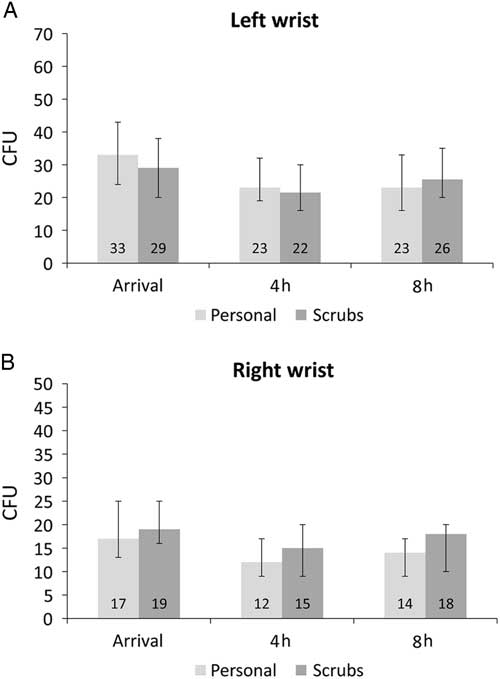
Differences in median CFU were observed for the 2 uniform groups at all 3 sampling times (Fig. 1). Ratios of geometric means for cuffs, waist, back, and abdomen regions based on paired data of CFUs on military-approved uniforms relative to hospital-provided scrubs were highest at the start of the shift (mean ratio=3.91, 2.71, 3.24, and 1.92, respectively, P<.001 for all) and lowest 8 hours later (ratio= 1.72, 1.73, 1.48, and 1.12 for cuff, waist, back, and abdomen regions, respectively, P = .028 for the abdomen region and P<.001 for others). Significant interactions were found between uniform type and sampling time for waist region (P=.017), cuff region (P<.001), and abdomen region (P<.001), which showed decreases in ratios over time. Interestingly, the back regions of the military-approved uniforms showed a significant decrease in CFU over time (P<.001), but no change was detected for hospital scrubs. The CFU levels on the wrist region did not differ between groups at any time point (Fig. 2).
Median CFUs of volar surfaces over time. CFU: colony forming unit; results expressed as medians. No statistical significance was observed between uniform type at any sampling point.

At the start of a shift, for military-approved uniforms, CFU levels were the highest for waist and cuff regions, followed by abdomen and back regions (median, 47, 46, 33, and 22, respectively), while for scrubs, CFU levels were similar among the 4 samples collected on the clothing (median, 14, 10, 16, and 8, for waist, cuff, abdomen, and back regions, respectively). The CFU levels on the left wrist region tended to be higher than those on the right wrist region. At the start of a shift, for nurses wearing military uniforms, CFU counts on the left wrist region were comparable to levels on the abdomen region (and were lower than the waist and cuff regions), but when wearing scrubs, the left wrist region had the highest median CFU among all sampling locations. The CFU levels on the wrist regions tended to decrease over time for both military uniforms and scrubs.
Discussion
The bacterial burden of clothing depends on a variety of behavioral and organizational factors including personal hygiene, laundering habits, and exposure to environmental contaminants. To limit the variability of laundering, storage, and transport of staff uniforms, many hospitals issue uniforms as an infection prevention strategy. Few studies have compared the bioburden of common hospital attire of healthcare workers to date.Reference Mitchell, Spencer and Edmiston 16 In this study, we aimed to describe differences in bacterial abundance across military-approved uniforms and hospital-provided scrubs in an inpatient population of military nursing staff. We report a significantly higher bacterial burden on military-approved versus hospital-provided scrubs across all time points.
Scrubs in our study demonstrated a time-dependent accumulation of bacteria (except on back), implying acquisition from the hospital environment (eg, from patients or a contaminated hand). Our findings support smaller studies that have reported that sterile uniforms can accrue large numbers of bacteria over the course of a single shift.Reference Sanon and Watkins 17 However, military-approved uniforms did not demonstrate this pattern. Possible reasons for this may include the significantly different rates of contamination upon arrival or the inherent differences in the microbial colonization of different fabric compositions (a phenomenon which has been previously reported).Reference Takashima, Shirai, Sageshima, Ikeda, Okamoto and Dohi 18 Additionally, repeat sampling of uniform areas throughout the day may have diluted bacterial accumulation at 4 and 8 hours of wear, which may have removed residing bacteria that would otherwise be present in subsequent samples. Other studies have circumvented repeat sampling by rotating among a pool of participants throughout different days and time points.Reference Burden, Cervantes, Weed, Keniston, Price and Albert 19 On the other hand, sampling subjects throughout the day allowed us to capture a more robust sample, simultaneously controlling for behavioral and textile variables that can occur in a rotating paradigm. Finally, due to the demonstrated rate of textile reinoculation that can occur in just 3 hours,Reference Burden, Cervantes, Weed, Keniston, Price and Albert 19 along with the apparent resistance of hospital scrubs to repeat sampling error, it is likely that a more complex phenomenon was at work here. Future studies focused explicitly on elucidating inherent microbial properties of different textiles should certainly control for real-world variables such as laundering, storage, transport, undershirts, etc.
The waist, sleeve cuff, and abdomen regions of both uniform types demonstrated the highest amount of bacterial accumulation. The prevalence of bacteria in these regions is likely due to either direct contact with contaminated surfaces (including contaminated gloves) or self-inoculation from contact with inadequately cleansed hands.Reference Munoz-Price, Arheart and Mills 20 Indeed, environmental contamination of the immediate patient environment has been identified as an independent risk factor for contamination of healthcare workers’ gloves and gowns.Reference Morgan, Rogawski and Thom 21 These findings highlight the need for frequent hand hygiene during episodes of care and improved hospital surface decontamination, which is often suboptimal and a contributor to nosocomial infections.Reference Peretz, Koiefman, Dinisman, Brodsky and Labay 22 – Reference Gardner, Muller and Prior 24
The number of bacteria recovered from wrists showed no differences across uniform type nor meaningful alteration over time, though we did find that the left wrist harbors higher levels of bacteria in general. We propose that this may be attributed to the tendency of participants to wash their dominant hand more thoroughly (majority were right handed) or the prevalence of watches, bracelets, and other accessories worn on the left wrist. These findings support the need for “bare below the elbows” policies in use at other facilities.Reference Bearman, Bryant and Leekha 25 Moreover, these findings suggest that bacterial contamination of hospital textiles bear unique properties compared to dermal surfaces.
Our findings, combined with studies demonstrating that sterilized uniforms can become reinoculated by 50% (of the 8 hours total bacteria) in as little as 3 hours,Reference Burden, Cervantes, Weed, Keniston, Price and Albert 26 highlight the need for the daily washing of uniforms. This is particularly important given that 30%–42% of the hospital staff do not wear a fresh uniform daily.Reference Wiener-Well, Galuty, Rudensky, Schlesinger, Attias and Yinnon 9 , Reference Callaghan 27 While more focused studies are needed to understand the inherent microbial attraction and retention of various textiles in a more controlled paradigm, this study provided the first, real-world snapshot of the bacterial abundance of 2 distinct uniform types in a military hospital.
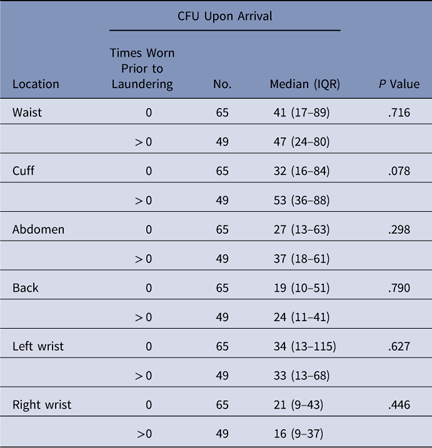
Future studies should delve deeper into the underlying factors that influence bacterial accumulation (hand hygiene, laundering, patient acuity, etc) because they may identify other avenues for infection prevention. In this study, we observed a pattern of elevated bacterial colonization on military uniforms previously worn (ie, not recently laundered), though this trend was not statistically significant (Table 3). In addition to the limitations of self-reported data, lack of direct observation impeded our ability to track potential environmental exposures that may have occurred prior to the participant’s arrival to work. Another important limitation of this study was that vertical transfer of pathogenic bacteria was not specifically assessed. While no study to date has specifically demonstrated staff to patient transmission through the uniform, a number of hospital textiles have been cited as possible sources of patient infections.Reference Fijan and Å ostar Turk 28 Moreover, it has been proposed that the impact of healthcare textiles may be underestimated due to lack of point-source investigations of textiles during outbreaks or infection.Reference Mitchell, Spencer and Edmiston 16 On the other hand, the bactericidal effectiveness of industrial and residential laundering has been previously demonstrated,Reference Lakdawala, Pham, Shah and Holton 29 – Reference Riley, Williams, Owen, Shen, Davies and Laird 31 though it is not a fool-proof solution.Reference Mitchell, Spencer and Edmiston 16
Colony-Forming Units (CFU) on Arrival Based on Days Worn Since Last Wash

Note. IQR, interquartile range.
In conclusion, we found that bacteria are present at much higher levels on military-approved uniforms than on hospital-provided scrubs at our institution. While additional work is needed to demonstrate a direct association between staff uniforms and nosocomial infections,Reference Weber, Khan, Fader and Weber 15 staff uniforms may contribute to the transmission of pathogens between patients.Reference Mitchell, Spencer and Edmiston 16 Hospital uniform policies could be expanded to require on-site outfit changes to minimize environmental contamination or, at minimum, daily laundering. The accumulation of bacteria observed on hospital-provided scrubs additionally warrants a closer look at the microbial environment within the hospital. In the future, integrated infection prevention approaches should consider behavioral and engineering factors such as hand hygiene, uniform policy, and environmental sanitation. Policy makers should additionally bear in mind that the high financial burden of antimicrobial resistance may be offset by critical changes to uniform policies, such as the expansion of hospital-provided scrubs to all personnel who provide direct patient care. We hope that the findings from this study can be used to educate staff about the role that hospital attire plays in the risk of cross contamination to improve adherence to hospital uniform washing guidelines recommended by the Centers for Disease Control and Prevention.
Supplementary materials
To view supplementary material for this article, please visit https://doi.org/10.1017/ice.2018.212
Acknowledgments
We thank the Triservice Nursing Research program for funding this research study. The views expressed in this manuscript are those of the author(s) and do not reflect the official policy or position of the Department of the Army, Department of Defense, or the US government.
Financial support
No financial support was provided relevant to this article.
Conflicts of interest
All authors report no conflicts of interest relevant to this article.