Introduction
Integrons are genetic platforms able to incorporate and express exogenous open reading frames (ORFs) (Mazel Reference Mazel2006). Bacteria carrying these elements can integrate mobile genetic elements (MGE) called gene cassettes, which in most cases correspond to a promoterless ORF associated with a recombination site called attC (Escudero et al. Reference Escudero, Loot, Nivina and Mazel2015, p. 4). Integrons may acquire determinants for drug resistance, virulence or metabolic functions potentially giving a host wide versatility in adaptation.
All integrons characterized to date comprise three functional elements: an integrase gene intI, encoding an integrase IntI, a primary recombination site attI adjacent to intI, and a transcriptional promoter Pc, located within intI and adjacent to attI (Hall & Collis Reference Hall and Collis1995). The orientation of Pc is divergent from within intI and drives transcription of adjacent gene cassettes (Collis & Hall Reference Collis and Hall1992, Jové et al. Reference Jové, Da Re, Denis, Mazel and Ploy2010). IntI catalyses gene cassette excision through attC x attC recombination from adjacent cassettes, and integration by recombination between its attC site and the integron platform attI site, using a specific recombination process (Bouvier et al. Reference Bouvier, Demarre and Mazel2005).
Class 1 integrons are the most widespread and most relevant clinically. They are found in transposons and often carried on plasmids and other MGE (Cambray et al. Reference Cambray, Guerout and Mazel2010, p. 144). Most class 1 integrons of clinical origin contain genes conferring streptomycin-spectinomycin (Strr-Spcr), ampicillin (Ampr) and trimethoprim resistance (Tmpr) (Fluit & Schmitz Reference Fluit and Schmitz2004, p. 273). They include two conserved segments (5'CS and 3'CS) flanking a variable region which corresponds to gene cassettes. The 5'CS region consists of intl and attI (Stokes & Hall Reference Stokes and Hall1989), but the 3'CS is less conserved and is missing in some cases. It contains qacEΔ1, which confers low-level resistance to quaternary ammonium compounds, sul1 involved in sulfonamide resistance and orf5 of unknown function (Partridge et al. Reference Partridge, Tsafnat, Coiera and Iredell2009, p. 760). While integrons have long been considered to play an important role in multi-antibiotic resistance in densely populated areas, DNA sequence analysis of environmental samples indicated that integrons are widely distributed in diverse natural environments (Rodríguez-Minguela et al. Reference Rodríguez-Minguela, Apajalahti, Chai, Cole and Tiedje2009), including Maritime and Continental Antarctica (Antelo et al. Reference Antelo, Romero and Batista2015).
Antarctica includes three main regions: Continental Antarctica, sub-Antarctica and Maritime Antarctica. The McMurdo Dry Valleys area of Continental Antarctica has been studied in greatest detail and like much of the continent is considered to be polar desert. Maritime Antarctica has a cool moist climate and is much less extreme in terms of humidity and temperature. King George Island is the largest island in this region. Over 90% of its surface is glaciated with most of its southern Fildes Peninsula becoming ice-free during the summer.
Our goal was to determine integron occurrence on Fildes Peninsula in an effort to develop a basic system to study their potential role in microbial genome dynamics and adaptation in this moderately extreme environment. Class 1 integron genes (intI1) were identified in five Tmpr/Ampr/Strr enterobacterial isolates. The integrase gene and adjacent region of these enterobacteria were very similar to each other. Plasmids from two isolates could be transferred to Escherichia coli (Migula) Castellani & Chalmers strain DH5α by conjugation. Plasmid DNA from the HP19 isolate was shotgun sequenced and assembled into 12 contigs. One contig, 7239 bp, was 100% identical with the corresponding sequence of p34998-210.894kb of Enterobacter hormaechei subsp. steigerwaltii Hoffmann et al. strain 34998 (CP012169.1) of clinical origin, including the integron region. This is the first study describing the presence of class 1 integrase genes on plasmids from Antarctic bacteria with the ability to transfer the antibiotic resistant phenotype.
Materials and methods
Sampling procedure
Samples of soil, sediment and microbial mat were collected from different sites on Fildes Peninsula, King George Island, South Shetland Islands during the 2008 and 2010 campaigns. Sampling sites included those with known bird and marine mammal influence (Ardley Island and the coast facing Drake Passage), those close to scientific stations (the coast facing Collins Bay, sites next to Artigas Base and streams next to Russian diesel tanks) and others with no obvious human or animal influence (streams next to Collins Glacier, the coast facing Norma Cove and Half Three Point). Samples were kept on ice until transfer to Montevideo, where they were stored at 5°C and at -20°C until processed.
Isolation and cultivation of bacteria
Serial dilutions of 1 g samples suspended in 1 ml phosphate buffered saline were plated on Luria–Bertani (LB) agar and incubated at 5°C and 25°C. Colonies having different characteristic morphologies were re-isolated on LB agar. Presumptive pure isolates were grown on LB broth and stored at -80°C in 20% glycerol. Antibiotic resistance was evaluated by growth at 5°C and 25°C on LB agar, except for Tmp for which Mueller–Hinton medium was used. The following antibiotic concentrations (µg ml-1) were used: Amp, 50; Tmp, 50; nalidixic acid (Nal), 100; Spc, 50 and Str, 50.
Growth profiles were done in LB broth in triplicate at 5°C, 25°C and 30°C. Escherichia coli DH5α was included as control. Bacterial growth was monitored by measurement at OD620nm in a colorimeter (Erma, Japan).
Bacterial conjugation
Escherichia coli DH5α (Nalr) was used as recipient and two representative Strr isolates as donor strains in conjugation experiments. Recipient and donor strains were grown overnight at 37°C in 5 ml LB broth with Nal and Str, respectively. The following day cells were transferred to fresh medium without antibiotics and grown until cultures reached OD620nm=0.5. Cells were washed, suspended in 5 ml of LB and mixed at ratios of 1:1 to 10:1 (cells of recipient:cells of donor). Then they were centrifuged, washed and placed on LB plates. Matings were incubated overnight at 5°C, 25°C and 30°C. Cells were then suspended in LB broth and plated on LB agar with Str (50 µg ml-1) and Nal (50 µg ml-1) to select for transconjugant growth at 37°C.
DNA manipulation
Genomic DNA was purified using the DNeasy Blood & Tissue Kit (Qiagen, Germany). Plasmid DNA extraction was done using Gene Plasmid Midprep Elute HP (Sigma-Aldrich, USA). Agarose gel electrophoresis was done using standard methods (Ausubel Reference Ausubel, Brent, Kingston, Moore, Seidman, Smith and Struhl1989). Plasmid and DNA fragments were purified using the QIAquick Gel Extraction Kit (Qiagen, Germany). Specific primers were purchased from IDT (Coralville, USA) and Taq DNA polymerase was obtained from SBS (China).
Polymerase chain reaction amplification
Class 1 integrons of clinical origin are usually associated with Ampr, Strr and Tmpr, and can be identified by polymerase chain reaction (PCR) analysis using primers designed to amplify a conserved segment of the intI1 gene (Mazel et al. Reference Mazel, Dychinco, Webb and Davies2000).
Amplifications were performed using a Thermo model Px2 R thermocycler (Thermo Fisher Scientific, USA). Reaction mixtures, with a final volume of 25 µl, contained: 2.5 µl 10× reaction buffer, 2.5 µl 10 µM each primer, 2.5 µl dNTPs (2 mM each), 0.5 µl Taq DNA polymerase (5 U µl-1), 1 µl DNA template (~50 ng of purified DNA) and 13.5 µl ultrapure water. Amplification conditions using primers intI1_fwd (5'GGGTCAAGGATCTGGATTTCG3') and intI1_rev (5'ACATGCGTGTAAATCATCGTCG3')(Mazel et al. Reference Mazel, Dychinco, Webb and Davies2000) were as follows: 94°C for 5 min, 30 cycles of 94°C for 30 s, 60°C for 30 s, 72°C for 1 min and a final extension at 72°C for 10 min. Plasmid pAT674 (Kmr) was used as positive control (Ploy et al. Reference Ploy, Courvalin and Lambert1998).
Reactions with 27_fwd (5'AGAGTTTGATCMTGGCTCAG3') and 1492_rev (5'GGTTACCTTGTTACGACTT3') (Lane Reference Lane1991) were incubated initially at 95°C for 2 min, followed by 35 cycles of 95°C for 15 s, 55°C for 30 s, 70°C for 1.5 min and a final extension at 70°C for 5 min. Reactions with primers for rep-PCR, ERIC_fwd (5'TGTAAGCTCCTGGGGATTCAC3') and ERIC_rev (5'AAGTAAGTGACTGGGGTGAGCG3') (Versalovic et al. Reference Versalovic, Koeuth and Lupski1991), were incubated initially at 94°C for 5 min, followed by 30 cycles of 94°C for 1 min, 52°C for 1 min, 65°C for 6 min and a final extension at 65°C for 16 min. Considering DNA sequence of pKOX105 (HM126016), a primer pair was designed to analyse the region located downstream of dfrA14: hyp_fwd(5'GATGTTTTCTTCCCGAGTATTCC3') and hyp_rev(5'CGTCATCGTTCCGTCCGTCCAATC3').
Sanger, Ion Torrent and Illumina sequencing procedures
DNA sequencing by Sanger was conducted at the Institute Pasteur (Paris, France) or at Macrogen (Seoul, Korea).
For Ion Torrent library construction, plasmid DNA was extracted and purified using the procedure mentioned previously. Sequencing was done in an Ion 316 Chip on an Ion PGM System (Thermo Fisher Scientific), in accordance with the manufacturer’s instructions, to obtain 200 bp long reads, generating 89 140 reads, with an average length of 202 bp, and a total of 18 million bases.
For Illumina NGS sequencing, total genomic DNA from transconjugant E. coli DH5α was purified and sequenced in a HiSeq 2500 sequencer at Macrogen. The sequencing reaction generated 10 155 134 reads and a total of 1.0 Gbp with an insert length of an average of 420 bp.
Data processing, contig assembly and annotation
Both Illumina and Ion Torrent sequencing reads were processed using CLC Genomics Workbench v9.5.1 (Qiagen). Adaptor and quality trimming were carried out before any assembly procedure. Illumina reads from E. coli DH5α were mapped using E. coli DH5α genome (PRJNA205928) to collect unmapped reads, corresponding to the conjugated plasmid from HP19 isolate. Unmapped reads from E. coli DH5α were combined with high quality Ion Torrent reads from the purified plasmid pHP19 to generate a consensus assembly. This was carried out with CLC Genomics Workbench De Novo Sequencing assembly option (word size=20, Buble size=50, Mismatch cost=2, Insertion cost=3, Deletion cost=3). All contigs produced were studied to eliminate those containing genomic DNA sequences derived from host bacteria and a final list of 12 contigs with a total of 248 262 bp was obtained.
DNA sequencing analysis and annotation of plasmid pHP19
Sequence analysis was done using BLASTn and BLASTx (http://blast.ncbi.nlm.nih.gov/Blast.cgi) (Zhang et al. Reference Zhang, Schwartz, Wagner and Miller2000). Annotation of draft pHP19 sequence and comparison with plasmids p34998-210.894kb (CP012169.1), pENT-d4a (CP008900.1) (Conlan et al. Reference Conlan, Thomas, Deming, Park, Lau, Dekker, Snitkin, Clark, Luong, Song, Tsai, Boitano, Dayal, Brooks, Schmidt, Young, Thomas, Bouffard, Blakesley, Mullikin, Korlach, Henderson, Frank, Palmore and Segre2014) and pKOX105 (Carattoli et al. Reference Carattoli, Aschbacher, March, Larcher, Livermore and Woodford2010, table 1) were performed using the RAST server (http://rast.nmpdr.org/rast.cgi) (Aziz et al. Reference Aziz, Bartels, Best, DeJongh, Disz, Edwards, Formsma, Gerdes, Glass, Kubal, Meyer, Olsen, Olson, Osterman, Overbeek, McNeil, Paarmann, Paczian, Parrello, Pusch, Reich, Stevens, Vassieva, Vonstein, Wilke and Zagnitko2008).
Results
Isolation of drug resistant bacteria
A collection of 250 bacterial isolates able to grow aerobically on LB agar at both 5°C and 25° was obtained. This medium selects for enterobacteria which have been identified as frequent hosts for class 1 integrons in clinical environments. Within this collection, 44 isolates grew on Amp, 42 on Tmp, and 27 isolates were able to grow on Str.
Selection of isolates carrying the intI1 gene
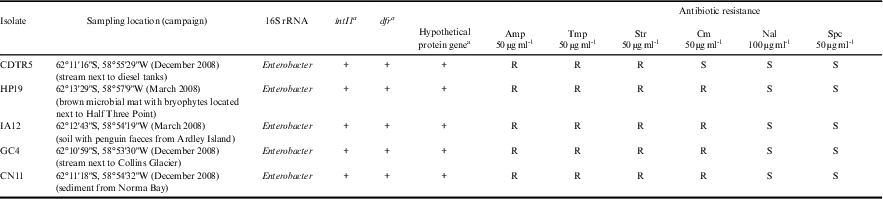
Genomic DNA from 32 AmprTmpr isolates, including representatives from each sampling site, were used as templates in PCR with primers int1_fwd–int1_rev. Eleven of these isolates were also resistant to Str. A single product of the expected size (~500 bp) was obtained from 13 isolates. DNA sequencing of these products confirmed the presence of class 1 integrons in isolates CDTR5, HP19, IA12, GC4 and CN11 (Table I). DNA sequences were highly similar between all isolates and represented different collection sites as well as samples from different years.
Description of Tmpr isolates from which a fragment of the expected size was amplified by PCR using primers int1_fwd–int1_rev.

R=resistant, S=sensitive.
a Gene detected by DNA sequence analysis.
Amp=ampicillin, Cm=chloramphenicol, Nal=nalidixic acid, Spc=spectinomycin, Str=streptomycin, Tmp=trimethoprim.
In addition, sequence analysis from the attI site (att2v) (Table I) in IntI1+ isolates indicated that all adjacent sequences contained dfrA14, encoding a dihydrofolate reductase conferring resistance to trimethoprim. Using BLASTn, the sequence exhibited over 99% identity with the dfrA14 gene found in the IncN plasmid pKOX105 of Klebsiella oxytoca (Flügge) Lautrop (HM126016). The high sequence similarities observed between those of our isolates and those of pKOX105 suggested the possibility that other similarities with this plasmid and our isolates might be expected. A primer pair was designed for DNA sequence analysis of part of the dfrA14 and its downstream region (Fig. 1). This primer pair (hyp_fwd and hyp_rev) was used for DNA sequence analysis of corresponding regions in the five isolates. The sequences were highly similar with hypORF, encoding a hypothetical protein located adjacent to dfrA14 in pKOX105. These results further suggested high similarity between these regions from our isolates, pKOX105 and a megaplasmid recently submitted to Genbank, p34998-210.894kb of E. hormaechei subsp. steigerwaltii of clinical origin (CP012169.1).
Representation of part of pKOX105 from Klebsiella oxytoca (HM126016), including intI, dfrA14 and open reading frames located downstream. b. Regions for which DNA sequences were obtained from our isolates with corresponding sequence positions to pKOX105.

Conjugation experiments
In order to establish if intI1-habouring plasmids could be conjugally transferred between bacteria and potentially enterobacteria, a conjugation assay was developed using CN11 and HP19 as donor strains and E. coli DH5α as a receptor. A few StrrNalr transconjugants were obtained by biparental matings incubated overnight at 5°C, 25°C and 30°C. Transconjugants were also Amp and Tmp resistant, suggesting that the genes encoding for these resistances were also carried on plasmids. The presence of intI genes in these transconjugants was confirmed by PCR and their identity confirmed by 16S rRNA sequence analysis.
DNA sequence analysis
A plasmid from the HP19 isolate (pHP19) was subjected to shotgun sequencing on Ion Torrent (IIBCE) and sequences were assembled. Besides expected resulting plasmid sequences, some contigs contained sequences of chromosomal origin. Then, genomic DNA from one transconjugant derived from DH5α and HP19 as a donor was sequenced at Macrogen in a HiSeq2500 sequencer. Chromosomal contigs were subtracted from the analysis and, comparing both results, 12 contigs were obtained in a total of 248 262 bp (GenBank accession numbers: contig 1 MF957306, contig 2 MF957307, contig 3 MF957308, contig 4 MF957309, contig 5 MF957310, contig 6 MF957311, contig 7 MF957312, contig 8 MF957313, contig 9 MF957314, contig 10 MF957315, contig 11 MF957316, contig 12 MF957317). Analysis of these contigs allowed identification that this plasmid was highly similar to p34998-210.894kb (Table S1 found at http://dx.doi.org/10.1017/S0954102017000414), including one contig of 7239 bp (number 6) that exhibited 100% identity in a region containing the integron (from position 46 126 to 53 364 of p34998-210.894kb). This contig includes, according to the annotation assigned by RAST, the integron region previously identified and other ORFs encoding a mobile element protein, two membrane binding proteins (TniB), a hypothetical protein and DNA-cytosine methyltransferase.
One contig (number 2) of 115 734 bp exhibited 99% identity with two regions that extend from position 72 628 to 112 768 and from 114 724 to 190 339 in plasmid p34998-210.894kb. This contig contained several ORFs required for conjugation and others encoding for putative proteins related to arsenic, chromate and tellurium resistance.
Contig 3 of 47 601 bp exhibited 99% similarity with a region that extends from position 204 300 to 210 894 and from 1 to 41 006 of plasmid p34998-210.894kb. This contig contained two ORFs (repA) encoding initiation replication proteins (RepFIIA and RepFIIB) and other ORFs encoding plasmid partitioning proteins (parA/parB and sopA/sopB). This contig also contained several ORFs required for conjugation and traX, which encodes an acetylase involved on the processes of pilus assembly, dynamics and mating pair stabilization exclusive for F plasmids. This region also contains putative genes encoding proteins involved in the detection of copper.
Six contigs, representing 48 250 bp, exhibited high similarity with plasmid pENT-d4a (CP008900.1) (60 338 bp), originally isolated from E. cloacae (Jordan) Hormaeche and Edwards ECNIH3, of clinical origin (Conlan et al. Reference Conlan, Thomas, Deming, Park, Lau, Dekker, Snitkin, Clark, Luong, Song, Tsai, Boitano, Dayal, Brooks, Schmidt, Young, Thomas, Bouffard, Blakesley, Mullikin, Korlach, Henderson, Frank, Palmore and Segre2014).
In this group of contigs with high identity to pENT-d4a, contig 9 (9289 bp) contains ORFs encoding ATPases required for assembly of type IV secretion complex and for secretion of T-DNA complex (VirB4 and VirB11), three membrane proteins (VirB8, VirB9 and VirB10) and a conjugative transfer lipoprotein PilN. Contig 10 (6076 bp) contains ORFs encoding a protein required for secretion system type II (PulF) and PilQ, an ATPase involved in conjugation. Contig 11 (5702 bp) contains ORFs encoding an integrase (shufflon-specific DNA recombinase) and a serine acetyltransferase. Contig 12 (7346 bp) contains ORFs for two resolvases, TradD, involved in conjugation of IncF plasmids and two TrwC, as relaxases of conjugative plasmids.
Together, these results suggest that, like plasmid p34998-210.894kb (CP012169.1), plasmid pHP19 contains two origins of replication and two systems involved in plasmid stability. These ORFs are highly conserved (99% by BLASTn), compared with the corresponding genes from p34998-210.894kb. The genes involved in conjugative processes are very probably functional as it was possible to transfer this plasmid from its original host to E. coli DH5α at various temperatures (see below). Finally, pHP19 also contains a conserved fragment (~7200 bp) almost identical to the region of p34998-210.894kb and pKOX105 which includes the class 1 integron element.
Growth profile and identification of IntI1+ isolates
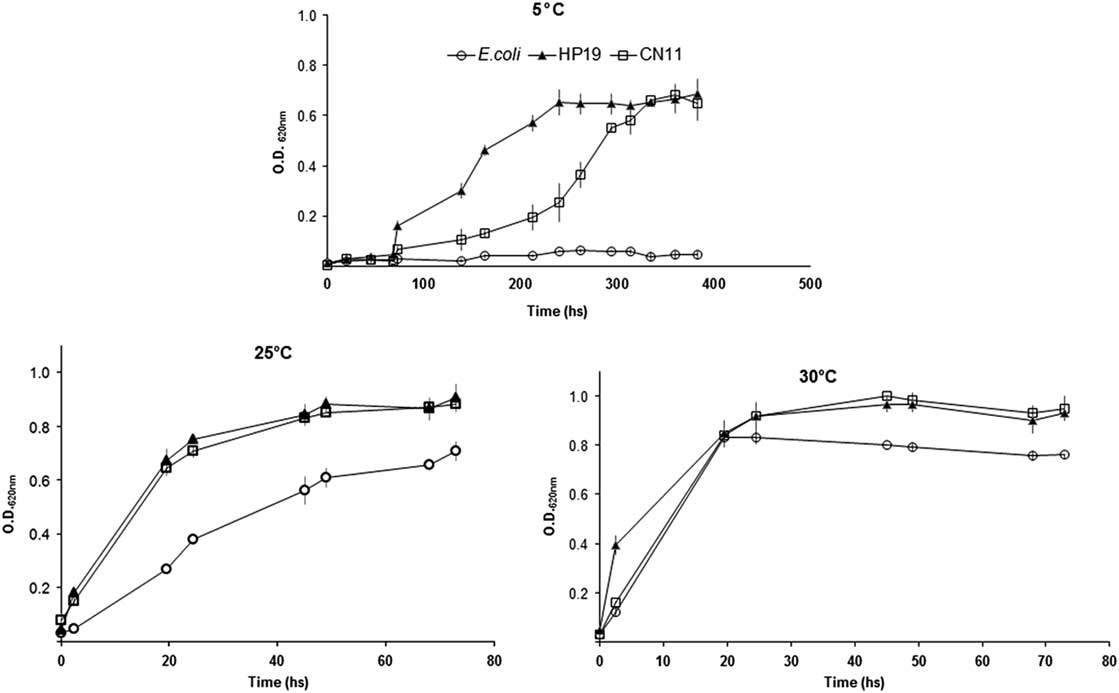
Figure 2 shows growth profiles for isolates HP19 and CN11 grown in LB broth at 5°C, 25°C and 30°C. Escherichia coli DH5α was included as a control strain. Antarctic isolates and strain DH5α showed sustained growth over time at 25°C and 30°C. At 5°C, HP19 and CN11 could grow after a prolonged lag period (60 hours), whereas DH5α did not grow under these conditions.
Growth of HP19 (triangles) and CN11 (squares) isolates compared with E. coli strain DH5α (circles) in Luria–Bertani broth at different temperatures. Data are presented as the mean of three replicates±standard deviation.
Sequence analysis of the 16S rRNA gene indicated that CDTR5, GC4, CN11, IA12 and HP19 isolates (GenBank accession numbers: MF928410, MF928411, MF928409, MF928407 and MF928408, respectively) are identical (100% identity) and belong to the genus Enterobacter. Sequences exhibited 99% identity with E. cloacae strain T137 (KC764978.1), E. asburiae (Brenner et al.) Hoffmann et al. strain R2-143 (JQ659607.1) and E. hormaechei subsp. steigerwaltii strain EN-562T (AJ853890.1). Finally, the electrophoretic profiles of the five IntI1+ isolates by rep-PCR (ERIC) were very similar (data not shown).
Discussion
Five enterobacteria resistant to Amp, Str and Tmp were isolated, each containing a dfrA14 cassette in a class 1 integron context. These regions are highly similar to that originally identified in pKOX105 of K. oxytoca (Carattoli et al. Reference Carattoli, Aschbacher, March, Larcher, Livermore and Woodford2010). The presence of integron genes in plasmids was confirmed in two of these isolates (CN11 and HP19) by conjugation using E. coli DH5α as a recipient strain. Complementing this assay, a plasmid from HP19 (pHP19) was shotgun sequenced and partially assembled. Most of the sequences were similar to those of plasmid p34998-210.894kb of E. hormaechei subsp. steigerwaltii of clinical origin (CP012169.1), including genes for replication, stability and conjugation. In addition, one of the contigs exhibited similarity to the corresponding region of p34998-210.894kb and pKOX105 (54 641 bp) (HM126016). According to RAST, this region includes the class 1 integron mentioned previously.
Other clustered genes related to mercury, arsenic, tellurite, nickel and copper resistance were identified, and were also identical to those found in p34998-210.894kb. Some regions, however, were similar to pENT-d4a, previously isolated from E. cloacae ECNIH3 of clinical origin. Thus this plasmid is probably a mosaic of portions of plasmids that have been characterized in mesophilic enterobacteria, suggesting that horizontal gene transfer between these bacteria and the Antarctic microbiota is rather common.
In a previous study, total DNA was extracted from samples collected from two sites on Fildes Peninsula (Half Three Point and Norma Cove) (Antelo et al. Reference Antelo, Romero and Batista2015). These DNA preparations were used as templates for PCR with the same primer pair used in this study (IntI1_fwd and IntI1_rev). Clone libraries were prepared using the amplicons and their inserts were sequenced. In total, 98 sequences were analysed, including 62 from Half Three Point and 36 from Norma Cove. In the Half Three Point library, 42 sequences were identical (99–100% identity) to those of the intI genes identified in our isolates. The origin of these intI1 genes is unknown, although the characteristics of our enterobacterial isolates suggest that animals or humans could be involved in their dissemination (Saikia et al. Reference Saikia, Saikia and Ramteke2008, Miller et al. Reference Miller, Gammon and Day2009).
Additional studies are required to determine the abundance of these elements in the environment and their origin, from anthropogenic or animal sources. Different species of sea birds that inhabit this area, as well as migratory birds arriving during the summer, could be involved in bacteria dispersion (Miller et al. Reference Miller, Gammon and Day2009). Similar results were obtained in previous studies (Saikia et al. Reference Saikia, Saikia and Ramteke2008), who isolated drug resistant enterobacteria from skua faeces in Dronning Maud Land (Schirmacher Oasis, Antarctica).
Sequence analysis of the 16S rRNA gene from our isolates exhibited 99% identity with the corresponding sequences from enterobacteria, including E. hormaechei subsp. steigerwaltii, of clinical origin (Hoffmann et al. Reference Hoffmann, Stindl, Ludwig, Stumpf, Mehlen, Monget, Pierard, Ziesing, Heesemann, Roggenkamp and Schleifer2005). Antarctic E. hormaechei isolates were also previously recovered from ornithogenic soil on Galíndez Island (Antarctica), next to the Ukrainian station (Tashyreva et al. Reference Tashyreva, Iutyns’ka and Tashyrev2009).
Finally, the electrophoretic profiles of the five isolates by rep-PCR (ERIC) were similar. The similarity found between these enterobacteria isolated from different sites of Fildes Peninsula suggests that an external component might function as the spreading factor.
Conclusions
Psychrotrophic antibiotic resistant enterobacteria could be circulating in the field in Antarctica. More research is needed to determine whether they were introduced recently via anthropogenic or animal sources.
We have confirmed, using a culture-dependent strategy, the presence of class 1 integrase genes and resistance cassettes carried on plasmids from Antarctic bacteria and demonstrated the ability of these elements to transfer an antibiotic resistant phenotype.
Acknowledgements
This work was supported by Instituto Antártico Uruguayo, ANII (Agencia Nacional de Investigación e Innovación), AMSUD Pasteur, PEDECIBA-Biología (Programa de Ciencias Básicas) and Fondo Conjunto de Cooperación México-Uruguay (URU 13/001). We thank Paul R. Gill and Héctor Romero for discussion and technical reading of the manuscript. We would like to thank the reviewers for their comments and corrections on the paper.
Author contribution
Conception and design of study: VA, DM, SB; acquisition of data: VA, AMG, VR; analysis and/or interpretation of data: VA, DM, JS, SB; drafting and revision of the manuscript: VA, DM, SB. All authors have approved the final version of the manuscript.
Supplemental material
A supplemental table will be found at http://dx.doi.org/10.1017/S0954102017000414.