Over the course of the last thirty years, women have made significant strides toward gender equity in politics. The percentage of women serving in state legislatures has risen from 8.1% in 1975 to more than 24% in 2013 (CAWP 2013). Not surprisingly, this increase of women in politics has sparked many questions and much research about the impact of women in public office (Carroll Reference Carroll and Carroll2001). While this body of scholarship has investigated such important and diverse topics as legislative strategies (Reingold Reference Reingold1996), conversational dynamics (Kathlene Reference Kathlene1994; Pearson and Dancey Reference Pearson and Dancey2011), and legislative effectiveness (Anzia and Berry Reference Anzia and Berry2011; Volden, Wiseman, and Wittmer Reference Volden, Wiseman and Wittmer2013), the substantive effects of having women in office have garnered the most attention.Footnote 1
This research consistently points out that, even after controlling for a host of other factors, female representatives are more likely to care about, sponsor, and/or vote for “women's issue” bills (e.g., Boles Reference Boles and Carroll2001; Bratton Reference Bratton2005; Bratton and Haynie Reference Bratton and Haynie1999; Dolan Reference Dolan1998; Frederick Reference Frederick2011; Gerrity, Obsorn, and Mendez 2007; Reingold Reference Reingold1992; Saint-Germain Reference Saint-Germain1989; Swers Reference Swers1998, Reference Swers and Rosenthal2002a, Reference Swers2002b, Reference Swers2005; Thomas Reference Thomas1991, Reference Thomas1994; Thomas and Welch Reference Thomas, Welch and Carroll2001; but see Barnello Reference Barnello1999; Barnello and Bratton Reference Barnello and Bratton2007; and Jenkins Reference Jenkins2012 for contingencies of this relationship).Footnote 2 Female legislators, for example, are more likely to support bills that promote equality, improve the status of women, and/or advocate for children and families. As Mansbridge (Reference Mansbridge2005, 622) writes, “… descriptive representation by gender improves substantive outcomes for women in every polity for which we have a measure.”
At the same time, research suggests that the contours of this relationship are nuanced. The link between descriptive and substantive representation, for example, is not equally strong across all legislative activities, such as sponsorship (Swers Reference Swers and Rosenthal2002a) or roll-call voting (Jenkins Reference Jenkins2012). Furthermore, scholars continue to debate how the percentage of women in a chamber, or critical mass, impacts individual sponsorship patterns, the activity of male legislators, and the output of the entire legislative chamber on issues concerning women (e.g., Beckwith Reference Beckwith2007; Berkman and O'Connor Reference Berkman and O'Connor1993; Bratton Reference Bratton2005; Cowell-Meyers and Langbein Reference Cowell-Meyers and Langbein2009; Kathlene Reference Kathlene1994; Reingold Reference Reingold2000). Research continues to consider the multitude of ways, and conditions under which, male legislators can be substantive representatives for women (Barnello and Bratton Reference Barnello and Bratton2007). And it remains a matter of debate how gender, partisan affiliation, ideology, and institutional dynamics interact to shape legislative portfolios (Carey, Niemi, and Powell Reference Carey, Niemi, Powell, Thomas and Wilcox1998; Dolan Reference Dolan1998; Jenkins Reference Jenkins2012; Poggione Reference Poggione2004; Swers Reference Swers2005; Swers and Larson Reference Swers, Larson, Thomas and Wilcox2005). Taken as a whole, this literature brings to bear many questions about when, how, and why the presence of female legislators impacts the passage of substantive legislation for women.
This article adds to this body of work by investigating how gendered leadership impacts the content of women's issue laws. Specifically, when female legislators disproportionately sponsor women's issue legislation, how is the content of that legislation affected? To answer this question, we first posit that a legislature signals its commitment to and prioritization of an issue by passing legislation that invests resources in the issue; it is through these resources that substantive benefits accrue and without these resources that the public policy may be innocuous. Thus, we are particularly interested in assessing the content of women's issue laws based on whether they allocate resources (financial and human) to an issue.
We choose as our test case a contemporary public policy issue that has become gendered and in which legislatures can choose to invest abundantly or not at all: human trafficking. Based on a content analysis of human trafficking legislation in every state from 2003 to 2008, we designed an original dataset that establishes our dependent variable—how much a state has invested in human trafficking.Footnote 3 With an interest in how the gender composition of the leadership for each state's bill(s) impacts state investment, we researched (for both legislative chambers) the percentage of women who sponsored the legislation and the percentage of total sponsors who were women. These two measures of gendered leadership present a fresh means by which to examine the link between descriptive and substantive representation.
In addition to this quantitative approach, we engaged in extensive interviews with key policy stakeholders (legislative sponsors, legislative aides, interest group members, government officials, and law-enforcement officers) in California, Kentucky, Minnesota, New York, Ohio, and Texas. Of the 43 states that had passed some type of human trafficking legislation as of 2008, these six states were chosen for two primary reasons. First, they represent wide geographic, political, and demographic ranges.Footnote 4 Second, these states characterize the full range of human trafficking legislation. On one end of the spectrum sits Ohio, which only just passed a stand-alone human trafficking law in 2011; and at the other end are California and New York, both of which have been celebrated for the comprehensiveness of their legislation.
Taken together, our qualitative and quantitative work tentatively suggests that disproportionate gendered leadership on gendered issues may have negative implications for substantive representation, particularly as it relates to state resources. States may be most likely to invest in women's issue areas when cosponsorship of this legislation is gender balanced between female and male legislators. These results complement, and extend, the body of work concerning the complicated link between descriptive and substantive representation.
THEORETICAL CONSIDERATIONS
A consistent finding in the gender and politics literature is that female legislators prioritize women's issues to a higher degree than do their male counterparts.Footnote 5 Female legislators, for instance, are more likely to support legislation that promotes equality, improves the status of women, supports social welfare programs, helps children and families, focuses on education, and/or concerns health. Previous scholarship has asked why this pattern occurs, with shared life experiences as one of the most common explanations (Mansbridge Reference Mansbridge1999).Footnote 6 Female legislators, for example, are thought to sponsor legislation pertaining to sexual harassment because they may have dealt with the issue in the past. And even if they never have experienced sexual harassment personally, they may feel an obligation to be surrogate representatives on behalf of other women who have.Footnote 7 This shared historical experience not only results in female lawmakers prioritizing women's issue bills through sponsorship, but also it is thought to create the perception that female lawmakers are the experts on these issues (Mansbridge Reference Mansbridge1999, 648). It is not surprising, therefore, that “both female and male representatives [feel] that women in elected office have a better sense of how to develop and implement feminist policy as a result of their life experiences” (Tamerius Reference Tamerius, Duerst-Lahti and Kelly1995, 102).
While this body of research helps to explain the motivations behind female legislators’ advocacy for women's issues, it does not consider the potential ramifications of such gendered issue framing. We suggest that within this current framework, women's issues may become synonymous with “not-men's issues,” implicitly exonerating male legislators from taking leadership roles in these policy domains. This is problematic on a number of fronts. First, men are not irrelevant in many of these so-called women's issues. Let us take domestic violence as an example. Women's groups brought this issue to the attention of the public, and it was thereafter a cause trumpeted by women, fitting squarely in the women's issue camp (Gagné Reference Gagné1996). Nevertheless, this issue is equally about men and women; women are disproportionately the victims, and men are disproportionately the offenders. Although men and women may have distinct roles, they both are important players in the perpetuation and prevention of domestic violence. Thus, even though this policy area fits the oft-used definition of a women's issue because its “policy consequences are likely to have a more immediate and direct impact on significantly larger numbers of women than of men” (Carroll Reference Carroll1985, 15), we argue that both sexes have a stake in working on the issue. Importantly, this framework applies to a significant number of women's issues, such as sexual discrimination and harassment, equal pay, childcare, early childhood education, and human trafficking.
While such gendered patterns are significant in and of themselves, this article is primarily concerned with the fact that a lack of male legislative leadership on women's issues may have important consequences for public policy. Despite this possibility, however, scholarship to date has not addressed fully how gendered leadership impacts the substance of women's issue laws.Footnote 8 In order to gain a more complete understanding of the ramifications of gendered issues, and thus gendered leadership, we will consider three institutional and leadership factors that may be of import for shaping the substance of legislation. The first factor, the gender composition of the legislature, has a strong basis in the literature, and thus we include it to replicate earlier findings. The second two factors, however—the percentage of women sponsoring a bill and the percentage of bill sponsors who are women—have been largely unexplored in the context of public policy.
First, we investigate how the gender composition of the legislature impacts the type of legislation a state passes, a notion that is rooted in critical mass theory. The body of work concerning critical mass was borne out of an attempt to understand how sex ratios impact organizations (Kanter Reference Kanter1977) and has since been extended to studying whether and how increasing the number of women in a legislature affects political behavior and policy outputs. Although the evidence is mixed regarding individual-level sponsorship patterns (e.g., Bratton Reference Bratton2005; Crowley Reference Crowley2004), and many questions remain about the impact of institutional conditions, male backlash, and ideological diversity (e.g., Bratton Reference Bratton2002; Kathlene Reference Kathlene1994), scholars find that increasing gender diversity within a legislature may lead to increased attention to, and successful passage of, women's issue bills (Bratton Reference Bratton2002, Reference Bratton2005; Murphy Reference Murphy1997; Saint-Germain Reference Saint-Germain1989; Thomas Reference Thomas1991, Reference Thomas1994; but see Cowell-Meyers and Langbein Reference Cowell-Meyers and Langbein2009 and Reingold Reference Reingold2000).Footnote 9 Murphy (Reference Murphy1997), for example, found that the strongest predictor of whether states had legislation requiring police to assist battered women was the percentage of women in the state legislature.Footnote 10 Taking all of this into consideration, we arrive at our first hypothesis:
Gender composition hypothesis: The higher the percentage of women in a legislature, the greater the likelihood that a state will invest in women's issues.
Although it is important to understand how the gender composition of the legislature impacts state investment, our primary purpose is to investigate how gendered leadership on a women's issue impacts the content of laws. Legislative leadership has been defined and measured in numerous ways, including seniority, committee assignments, or party leadership. Here, we define legislative leadership in terms of bill sponsorship, which is a common metric used by scholars. Jeydel and Taylor (Reference Jeydel and Taylor2003, 20), for example, argue that bill sponsorship is among the most important measures of “legislative effectiveness.” Sinclair (Reference Sinclair1989) shows that having an active sponsorship agenda is necessary for having political power and that legislators make a name for themselves in the mass media by sponsoring more bills. And Swers (Reference Swers2002b, 32) explains that sponsorship behavior “provides important insights about which members are working to place women's interests on the national agenda. In contrast to other legislative activities, like floor amending in which restrictive rules governing debate can prevent members from offering women's issue proposals, representatives have complete control over the number and content of the bills they sponsor.” Thus, leadership as defined by bill sponsorship has strong support throughout the literature.
While bill sponsorship inherently carries a certain level of prestige and power that makes it a form of legislative leadership, reasons for why legislators elect to sponsor bills are many. Schiller (Reference Schiller1995) argues that bill sponsorship is not exogenous but is a function of political and institutional variables with costs and benefits. Potential costs of sponsorship include depleting resources, opportunity costs, and political costs, while the benefits may include good public policy, material gains for their constituents, and developing a reputation as a policy expert and entrepreneur. Other strategic reasons to sponsor a bill include exchanging sponsorship for an institutional reward like a committee assignment (Wawro Reference Wawro2000), taking a position proactively on an issue and/or claiming credit for a valence issue or successful policy (e.g., Mayhew Reference Mayhew1974), or setting the legislative agenda on an issue (Bratton and Haynie Reference Bratton and Haynie1999; Tamerius Reference Tamerius, Duerst-Lahti and Kelly1995). Most likely, legislators will sponsor a bill to accomplish a combination of these goals (Fenno Reference Fenno1973; Hall Reference Hall1996). All of these strategic considerations in bill sponsorship suggest that legislators do not necessarily choose to sponsor legislation with the goal of getting it passed. Indeed, legislators may sponsor bills that they know are unlikely to pass for the purpose of agenda setting or position taking.
Regardless of the motivation behind bill sponsorship, we define sponsors of successful bills as policy leaders. Given the immense difficulty of pushing a bill through the legislative pipeline and the potential costs associated with such effort, even sponsors with non-policy-oriented motivations become policy leaders on that bill. Moreover, a legislator who originally sponsored a bill because of symbolic position taking or institutional posturing is still a policy leader; motivations and policy leadership are not necessarily contingent on one another. That the bill passed, and that a legislator chose to sponsor this successful piece of legislation, is a form of legislative leadership. For this reason, we choose to focus only on bills that were successfully passed into law.
Using this as a starting point, we suggest that the gender composition of legislative leadership coalitions will impact the content of bills; states will be more likely to invest resources in a women's issue when there is robust female legislative leadership, or in other words, when there is a strong coalition of female legislators sponsoring the bill. Coalitions form around a shared interest, and larger coalitions have more political power. Thus, we expect that female legislators will form coalitions around issues that are perceived to impact women disproportionately, and the more women in the legislature who sign on as sponsors, the more likely this coalition will be to advance “difficult” legislation, or in our case, state investment in human trafficking.
Although the relationship between the proportion of women sponsoring a bill and the content of legislation has been largely neglected in the literature, preliminary evidence does point to the significance of women's coalitions. For example, Thomas and Welch (Reference Thomas, Welch and Carroll2001) find that states with formal legislative women's caucuses are more likely to pass women's issue legislation; however, they do not examine the content of such legislation. We build on this line of research by suggesting that female coalitions are important not only for simply passing women's issue laws, but also for determining the content of those laws that come up for a vote. In particular, we expect states that have a larger female coalition around a women's issue to invest more state resources in the issue, thereby signaling that the legislature views this as an important and worthy cause. Thus, we hypothesize the following:
Female leadership hypothesis: The higher the percentage of female legislators who sponsor a bill, the greater the likelihood that a state will invest in women's issues.
A strong coalition of women is important, but what if this coalition does not also garner male support? To address this question, we analyze our last variable of interest, which is the percentage of bill sponsors who are women. We argue that a disproportionate number of female sponsors on women's issue legislation may have a negative impact on state investment in that issue. There are several reasons to expect this relationship. First, women are more likely to represent a high proportion of bill sponsors when there are very few sponsors overall, which is a result of female legislators’ higher propensity to take up women's issue bills. This is potentially problematic because, as previously explained, a small sponsoring coalition may be unable to advance “difficult” state-investment legislation. Second, an all-female (or mostly female) sponsoring coalition may signal that the bill has a specialized scope. Consequently, legislators may be hesitant to spend finite state resources on an issue that is perceived to impact, or be of interest to, only a subset of the population. In other words, legislators may not view state investment in these areas as a prudent use of state funds. Conversely, when male legislators join the sponsoring coalition, such bills may become legitimized; shared leadership between men and women may create the perception that an issue has a broader impact or, at the very least, is important enough to warrant state resources. Taking all of this into consideration, we hypothesize the following:
Gender balance hypothesis: When there is shared sponsorship responsibility among male and female legislators, states will be more likely to invest in women's issues.
HUMAN TRAFFICKING: A CONTEMPORARY GENDERED ISSUE
Our broad research question is, what are the state-investment implications of gendered leadership? We hypothesize that while a female legislative presence and a strong female sponsorship coalition may lead to increased state investment in a women's issue, disproportionate female leadership could actually be detrimental to the passage of such legislation. Testing our hypotheses requires analysis of a public policy issue that meets three criteria. First, it needs to be an issue from which states have a variety of legislative options to choose, some of which are more difficult to pass than others. In many public policy areas, states can pass legislation that has zero fiscal impact, which is usually considered easier legislation to pass, or they can pass legislation that has a significant fiscal impact, which signals that the issue is of supreme import.Footnote 11 Second, it needs to be an issue that is considered to fit within the conventional women's issue framework. Third, it must be a public policy issue with considerable variance on our main variables of interest. The issue of human trafficking meets these criteria very well.
Human trafficking, commonly referred to as modern-day slavery, is the illegal harboring of persons for labor or sexual exploitation.Footnote 12 The federal government passed the first anti-trafficking legislation in 2000, The Victims of Trafficking and Violence Protection Act (TVPA). The TVPA has been reauthorized four times, in 2003, 2005, 2008, and 2013, and it codifies the three-pronged approach to combating human trafficking: prosecution, prevention, and protection. It was not until 2003, however, that the issue was put on state legislative agendas. Washington and Texas were the first two states to pass anti-trafficking legislation, and their legislation made provisions for the prosecution prong, but not for prevention or protection. In 2004, Missouri and Florida followed suit and criminalized human trafficking in their states.
By the end of 2008, 38 states criminalized human trafficking. While this is a significant first step toward combating trafficking, criminalization alone is not considered to have direct fiscal impact and is therefore considered a relatively “easy” law to pass. For example, the primary sponsor of Kentucky's legislation, which criminalized human trafficking in 2007, said that passing criminalization legislation for human trafficking was not controversial but that securing state resources for the issue was nearly impossible. The original bill made provisions for counseling and other types of services to victims, but given the fiscal impact of those provisions, they were quickly bargained out. The legislator said, “In every given session, you take what you can get.” We seek to understand why 23 states passed some type of investment, while the other states may have bargained this out and “taken what they could get.”
Beyond state investment in human trafficking, this issue also is one that has become gendered. Female legislators are more likely than their male counterparts to focus on issues that are perceived to benefit female constituents disproportionately or that fall within the stereotypical female domain(s). We argue that human trafficking is a policy issue that fits aptly within this women's issue framework. First, the issue of human trafficking is constitutive of a number of other issues that are generally understood to be women's issues. These include issues of violence against women, women's health, women's rights, children, and families. Thus, in many ways, this issue is ideal, as it is one issue that represents a broad spectrum of women's issues. Also, many of the current questions regarding human trafficking legislation—such as whether the laws should differentiate between sex and labor trafficking, and whether domestic violence shelters are the appropriate aftercare facilities for trafficking victims—are the types of questions historically debated by feminist groups.Footnote 13
Furthermore, interest groups and media have framed the overall human trafficking problem as one dominated by commercial sexual exploitation, probably because the majority of trafficking victims worldwide are women and girls for the purpose of commercial sexual exploitation. In fact, it is estimated that 80% of transnational victims of human trafficking are women and girls (US Department of State 2007) and that 70% of these victims are trafficked into the commercial sex industry (US Department of Justice 2004). Furthermore, some research suggests that interest groups concerned with commercial sex trafficking, as opposed to labor trafficking, were most vocal in framing the issue legislatively (Weitzer Reference Weitzer2006). And an analysis of media reports on human trafficking from 1990 to 2006 shows that media focused predominantly on sex trafficking during the early problem definition phase (Fahy, Farrell, and McDevitt Reference Fahy, Farrell and McDevitt2006). As Farrell and Fahy (Reference Farrell and Fahy2009, 620) explain, “By the mid-1990s … human trafficking was largely framed as a women's rights problem.” The framing of the issue as one that disproportionately impacts women, coupled with the underlying issues sex trafficking touches upon, clearly places human trafficking on the women's issue list.
EMPIRICAL APPROACH
Dependent Variable: State Investment
Our dependent variable is state investment to combat human trafficking. We define state investment broadly: whether a state has adopted certain human trafficking programs that would require additional capital, either monetary or human. These programs include victim assistance, task forces, training, and reports. It is important to note that we measure state investment as the presence or absence of these programs that have potential fiscal or bureaucratic impact and not by the specific dollar amount a state has allocated to these programs.
We justify testing our hypotheses using only state investment, and this particular measure of state investment, for three primary reasons. First, we posit that when states pass laws that require a certain level of capital in the form of money or people, they are signaling that this issue is a priority to them. Thus, states that passed legislation that invests resources in the issue of human trafficking are signaling a prioritization of this issue, as opposed to states that do not invest any state resources. Second, the theory we aim to test is that states will invest more financial and human resources in a typically gendered issue when that issue is not disproportionately led by female legislators. Hence, the dependent variable must be an issue that is considered gendered and in which states can choose to invest significant or few resources. Our measure of state investment in human trafficking is that kind of variable. Third, since the dependent variable is a composite measure of four different ways to invest in an issue, this one state-investment measure incorporates a broad range of ways that states can choose to invest. For example, victim assistance measures will carry fiscal impact while reporting, task forces, and training will have significant bureaucratic implications. Thus, our measure of state investment is a more inclusive definition and measure of investment.
We analyzed every state bill on human trafficking from 2003 to 2008 and coded each according to whether it invested in the four aforementioned aspects of human trafficking.Footnote 14 We chose these four areas of state investment because they are inclusive of the means by which states have thus far invested in anti-human trafficking measures. The dataset includes 32 senate bills passed in 26 states, and 44 house bills passed in 31 states.
The first category, victim assistance, is whether the state has allocated funds toward victim shelters, counseling, and recovery activities. Only 13 states have made provisions in the law to assist victims of human trafficking, and these provisions vary greatly—from California, which provides state-funded social services for up to one year, to Wisconsin, which provides emergency services for 60 days. We code victim assistance as a one if the state has made any investment in this area, and a zero if it has not.
The second aspect of state investment is task forces. Some state laws require that a task force be formed—usually under the auspices of the Attorney General—that includes a cross-section of representatives from all relevant areas of government, law enforcement, and the community. Many of these task forces are engaged in activities such as producing reports on the nature and prevalence of human trafficking in their state, developing training programs for law enforcement and other stakeholders, and/or identifying protocols and shelters for assisting victims. As of 2008, 13 states had created human trafficking task forces. If a state mandated the formation of a human trafficking task force as part of its legislation, then we coded task force as a one. States without statutory task forces received a zero.
Third is training. Many state reports on human trafficking and other academic studies have identified the lack of training of law enforcement and other first responders to human trafficking as the greatest barrier to identifying and investigating cases of human trafficking (e.g., Farrell Reference Farrell2007). Thus, mandated training for state and local law enforcement is considered among the most important aspects of any state law on human trafficking and serves as a clear statement that the state is taking this issue seriously. Despite this, only five states have mandated state-initiated training programs. All states that mandated a state-led training curriculum in its law received a one while those states that did not make explicit provisions for training received a zero.
The final state-investment category is reports. In many cases, those states with task forces also have mandated reports, since reporting is considered a primary responsibility of task forces. States such as Delaware, Indiana, and Nebraska, however, mandated a state report be prepared on the prevalence of human trafficking without creating a task force. To date, 16 states have mandated reporting enshrined in law. Each state statutorily requiring a report on human trafficking received a one in our dataset, and those states with laws that are silent about reporting received a zero.
We utilize event history analyses to test each of our hypotheses, where the event is whether or not a state has adopted one of the four state-investment strategies for human trafficking identified above in a given year from 2003 to 2008 (Box-Steffensmeier and Zorn Reference Box-Steffensmeier and Zorn2002).Footnote 15 We pooled the data so that each observation is state-policy-year (Shipan and Volden Reference Shipan and Volden2006) because each of the four policies can be adopted by the same states in the same years. This approach dictates that the dependent variable takes on a value of zero for each year that the state did not adopt the policy, a value of one in the year that it adopted the policy, and is subsequently dropped from the dataset because it is no longer at risk of adopting the policy.Footnote 16 We also clustered the data by state-year to account for any lack of policy independence in the same state and year.Footnote 17 In other words, there is a total of only 53 laws passed across the country on human trafficking from 2003 to 2008. Those 53 laws can include provisions on a variety of things, including criminalization and different forms of state investment. We capitalize on the variety of state investments embedded in these 53 laws by drawing out each of them individually from the years 2003 to 2008.Footnote 18
Before discussing our institutional variables, it is important to reiterate that we are not comparing bills that were passed with bills that died on the floor. Rather, we are concerned with how gendered legislative leadership impacts the content of bills that make it all of the way through the legislative pipeline. In other words, in the following pages we examine how the percentage of women in the chamber, the percentage of female legislators sponsoring a bill, and the percentage of bill sponsors who are women shape the contours of legislation that is passed into law; we do not examine how such factors influence the likelihood of bill passage in the first place. We invite future research to take up this separate research question.
Institutional Variables
We are first interested in testing whether the gender composition of the legislature leads to bills that provide for state investment. In order to test this, we look at Percent Female in both the House and Senate for every state from 2003 to 2008 (CAWP 2013). Consistent with prior research, we anticipate that the more female legislators in the House and Senate, the more likely a state is to invest resources in a women's issue.
The second institutional variable is Percent Democrat in both the House and Senate from 2003 to 2008 (National Council of State Legislatures). We control for partisanship of the legislatures because it is well established that the two major political parties diverge significantly on issues of social welfare, and this partisan division is only growing stronger over time (Brewer Reference Brewer2005; Layman, Carsey, and Horowitz Reference Layman, Carsey and Horowitz2006). Given that we are predicting state investment, we might expect this coefficient to be positive given the Democratic platform of supporting social welfare programs. Nevertheless, some states simultaneously criminalized and invested in human trafficking, therefore making the Republican Party, as the “law and order conservatives,” just as likely to support the legislation as Democrats (Gibbs and Bankhead Reference Gibbs and Bankhead2001). Our interview data suggest that, indeed, both Democrats and Republicans support legislation on human trafficking. One Texas Democratic legislator said, “Republicans want to enhance penalties and criminalize, and Democrats are more focused on the social justice aspects of the issue.” A number of other legislators talked about consensus-building and broad-based coalitions that formed around the issue so that, as one New York legislator put it, “people that normally would be on opposite sides of the issue came together.” Taking all of this into consideration, we do not expect this variable to be significant in any of the models.
Leadership Variables
In addition to institutional factors, we include a variety of leadership variables. First, we created Percent Females Sponsoring in both the House and Senate by dividing the number of women in the chamber by the number of women who sponsored the human trafficking bill. In accordance with the female leadership hypothesis, we expect this variable to be positive across all models. The second leadership variable is Percent Sponsors Female in both the House and the Senate. This variable divides the total number of sponsors by the number of female sponsors. Consistent with the gender-balance hypothesis, we anticipate that this variable will be negative. The final leadership variable is Percent Chamber Sponsoring legislation, where we divide the total number of legislators in the chamber by the total number of sponsors. We also expect this variable to be negative, for when there are too many sponsors, the bill is likely to be watered down through the bargaining process, which means that controversial issues—such as how much capital is appropriate to invest in the issue—are often left out.
Control Variables
We also control for a variety of environmental, state-level, and temporal factors. First, we control for Policy Diffusion, which captures the proportion of neighboring states that passed human trafficking criminalization legislation in every year from 2003 to 2008.Footnote 19 The second environmental control, Media coverage of the human trafficking issue, was created through a LexisNexis search for newspaper articles with the terms “human trafficking” or “trafficking in persons” in every state from 2003 to 2008 (Farrell Reference Farrell2007).Footnote 20
Additional control variables include state-level variables that may impact the legislature's willingness to invest in the issue of human trafficking.Footnote 21 Specifically, we control for Illegal Immigrants Per Capita, drawn from the US Citizenship and Immigration Services Field Report, Violent Crime Per Capita, Population, and Surplus.Footnote 22 Our final control variables are Year (2003 takes on a value of 1, 2004 a value of 2, etc.) and Year Squared. These controls account for temporal changes in the baseline hazard rates and allow us to control for possible temporal dependence (Beck, Katz, and Tucker Reference Beck, Katz and Tucker1998). Our results are not substantively altered if we use year dummies rather than Year and Year-Squared.Footnote 23
RESULTS
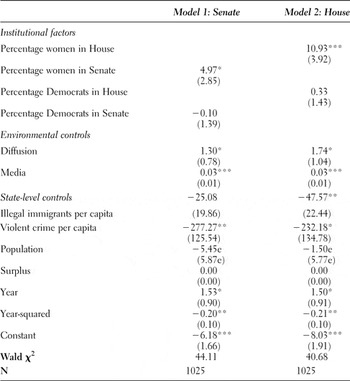
We begin our discussion of the results with Models 1 and 2 in Table 1. These models show that the percentage of women in the Senate (Model 1) and House (Model 2) significantly impacts whether states invest in human trafficking. Female legislators consistently advocate for issues that disproportionately impact women, and the human trafficking issue is widely viewed as one of these issues. These models extend existing research, as they show that the mere presence of female legislators in the House and Senate not only places women's issue legislation on the agenda, but also moves forward critical state-investment legislation.
Institutional factors

Note: Robust standard errors in parentheses, clustered by state-year. ***p < 0.01, **p < 0.05, *p < 0.10, one-tailed tests.
To put concrete figures to these results, we found that when the percentage of women in the House and Senate are set at their means (23% and 21%, respectively), the predicted probability of passing state-investment legislation is only 3% and 5%, respectively. On the other hand, when the percentage of women in the House and Senate is set at the maximum (43% in Maryland in 2005, and 47% in Arizona in 2008, respectively), the predicted probability of passing state-investment legislation increases to 24% for the House and 15% for the Senate. This result strongly supports our first hypothesis and provides additional confirmation for a body of extant research.
Importantly, these results hold even after controlling for the percentage of Democrats in the House and Senate. As expected, the partisan composition of the legislature is not a significant predictor as to whether a state invests in the issue of human trafficking. This has been a bipartisan issue in states across the country, as evidenced by the fact that state-investment legislation has passed in both Republican- and Democratic-controlled legislatures. Indeed, research suggests that it is precisely the bipartisan nature of the issue that facilitates the most comprehensive human trafficking laws, which both criminalize and invest in the issue (Bouché and Wittmer Reference Bouché and Wittmer2009). In other words, the fact that these variables are insignificant actually tells a significant story about the legislative benefits of bipartisanship, consensus building, and networking across the aisle.Footnote 24
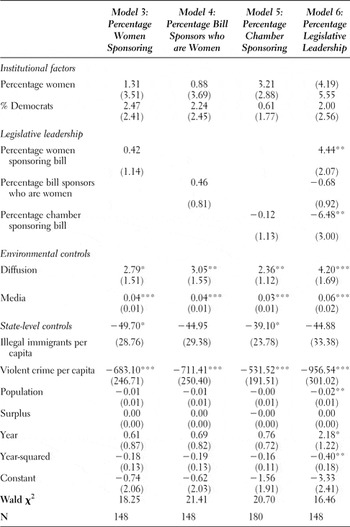
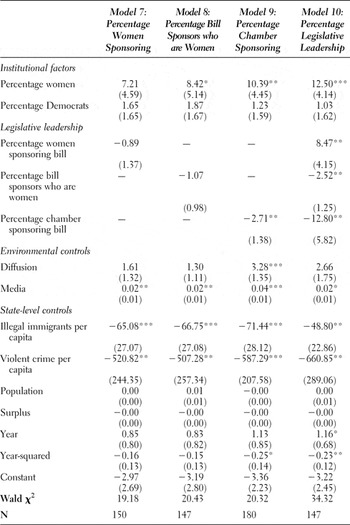
The first three models in Tables 2 (Senate) and 3 (House) control individually for each of the three respective leadership variables: the percent of female sponsors, the percent of bill sponsors who are women, and the percent of the chamber sponsoring. Importantly, these models show that when each of these leadership variables is assessed in isolation from the others, it is not significant in either chamber.Footnote 25 When we control for all three of these leadership factors in the same model, however (Models 6 [Senate] and 10 [House]), they are all significant.Footnote 26
Legislative leadership Senate

Note: Robust standard errors in parentheses, clustered by state-year. ***p < 0.01, **p < 0.05, *p < 0.10, one-tailed tests.
Legislative leadership House

Note: Robust standard errors in parentheses, clustered by state-year. ***p < 0.01, **p < 0.05, *p < 0.10, one-tailed tests.
First, this could be an issue of multicollinearity. In order to rule this out, we ran the models as OLS (rather than logit) models and postestimated the variance inflation factors (VIF), isolating the variance/covariance matrix of each independent variable with all the other independent variables.Footnote 27 Generally, VIF should be below ten, and it does not reach ten for any of the leadership variables in question.Footnote 28 These variables are not so highly correlated as to cause concern that the standard errors are being significantly impacted in the fully specified model. Thus, we rule out the explanation that these results are being driven by multicollinearity.
A second, and more viable, explanation is that the lack of significance of the leadership variables in the first three models of Tables 2 and 3 is due to an omitted variable problem. In particular, there appears to be a downward bias in the estimators of the non-fully specified models. This is apparent in that the absolute values of the coefficients increase in magnitude from the non-fully specified models to the fully specified models. This results from the three leadership variables being conditional on one another, as there are certain combinations of values for these variables that are impossibilities. For instance, if 100% of the chamber sponsors the legislation, then 100% of females in the chamber must also sponsor the legislation. In a slightly more complicated case, if women comprise 50% of a 100-person chamber and 50% of women sponsor the legislation, and there are 50 total sponsors, then it is apparent that all three of these variables work together in tandem, with 50% of women sponsoring, 50% of sponsors being female, and 50% of the chamber sponsoring. Thus, although these variables are not highly collinear, they work in tandem, and when one of them is absent, it leads to an omitted-variable problem.
It is for this reason that the remaining results focus on the fully-specified models (Models 6 and 10) in Tables 2 and 3. In both chambers, the percent of women who sponsor the legislation is a positive and significant predictor of the state investing in the issue of human trafficking. In fact, in the Senate, this is a more significant predictor than overall percent of women; after we control for the percent of women who sponsor the legislation, the overall percent of women in the Senate becomes insignificant. These results from both chambers strongly support our second hypothesis and the notion that a strong female coalition forming around a women's issue plays an instrumental role in passing legislation that invests state resources in that issue. Importantly, this is among the first studies to establish a positive and significant relationship between the proportion of women in the legislature who sponsor a women's issue bill and the content of the legislation that is passed.
The results become more nuanced, however, when we assess the next variable in Models 6 and 10: the percent of sponsors who are women, which is negative in both the Senate and the House (though significant only in the House). As more of the sponsors of human trafficking legislation are women, the less likely a state is to pass legislation investing in the issue. One may question whether this result is driven by the fact that higher proportions of female sponsors is a proxy for a bill with a high proportion of Democratic sponsors, and thus the partisan makeup of the sponsoring coalition would be the impetus behind the findings. To confront this possibility, we conducted two auxiliary analyses.
First, we looked at the percentage of Democratic sponsors in the House and the Senate across bills that invested state resources and bills that did not invest state resources. The mean of percent of Democratic sponsors in the Senate was 0.46 for bills that invested in human trafficking and 0.50 for bills that did not; the means for the House were 0.53 and 0.54, respectively. Importantly, neither of these differences is statistically significant.Footnote 29 It appears, therefore, that Democrats are no more likely than Republicans to sponsor bills concerning state investment. Second, we looked at the roll-call votes for human trafficking legislation sponsored in California, Kentucky, Minnesota, New York, and Texas, which represent the range of state-investment options (from Kentucky with zero state investment to New York with comprehensive state investment). These roll-call data allow us to ascertain whether some legislators, Republicans in particular, are less likely to vote for bills that invest significant resources in human trafficking. Across all five states, the maximum percentage of legislators voting against a bill was 3%. Thus, even after accounting for the content of the bill, support for human trafficking legislation seems to be a bipartisan issue.
Taking all of this into consideration, it is clear that Models 6 and 10 are not masking underlying ideological divisions. Rather, they provide tentative support for our third hypothesis, that disproportionate female sponsorship on a women's issue bill may be detrimental to the passage of substantively beneficial legislation on that issue. Passing legislation that invests state resources in the issue, thereby signaling prioritization of the issue, may require sponsorship from both male and female legislators.
Why might this be the case? Although there is a multitude of possibilities, we posit two. First, when the proportion of sponsors who are women is very high, it is usually because there are very few sponsors of the bill. These two variables are negatively and significantly correlated in both the House (–0.15, p<0.05) and Senate (–0.32, p<0.01). Numerous examples illustrate this point. For instance, in Arkansas there was only one sponsor of the legislation in the House, and that sponsor was female. As would be expected, Arkansas did not invest any state resources in human trafficking. A different example is Missouri, where there were seven sponsors in the Senate, all female, and the legislation criminalizes human trafficking but does not invest state resources in any of the four areas. In these cases, legislation is passed, but it is not necessarily the type of legislation that signals that the state is prioritizing the issue. In other words, when a women's issue is totally dominated by female legislators, the level of actual state investment in the issue could be jeopardized. This may be especially true when women cannot, or do not, form a sponsoring coalition to support the issue.
Second, because these female sponsors are pushing legislation that has largely been framed as a women's issue, an all or mostly female sponsoring coalition may perpetuate this women's issue focus. Consequently, allocating state resources to these issues may give legislators pause because, among other possible reasons, they do not believe that the problem is widespread enough to warrant significant state resources. Thus, when there are few sponsors, and when the few sponsors are women, the likelihood that a human trafficking law will contain “difficult” provisions, such as state investment, may be decreased.
Tables 2 and 3 also reveal that as a larger percentage of both the House and Senate sponsor the legislation, the less likely the state is to pass legislation that makes significant state investment in human trafficking. In other words, when a large proportion of the entire chamber sponsors the bill, a bill gets passed, but the content of the bill may be compromised. This was the case in Alaska, for instance, where 85% of the Senate sponsored SB 12 in 2006, a bill that criminalizes human trafficking but does not invest any state resources to combat the issue. Similarly, 63% of the Senate sponsored the human trafficking criminalization bill SB 1372 in Arizona in 2005, but the bill does not make any provisions in the four state-investment categories. In order for so many legislators to sign on as sponsors, compromises need to be brokered, and they often come at the expense of state investment. Therefore, when there are too few sponsors—and especially when these sponsors are women—or when there are too many sponsors, women's issue bills may get passed, but often without the requisite material resources.
DISCUSSION
Drawing on an original dataset of all human trafficking legislation that was passed between 2003 and 2008, we find that a female legislative presence and a strong female sponsorship coalition lead to increased state investment in a women's issue. At the same time, however, our results tentatively suggest that disproportionate female leadership may be detrimental to the content of legislation that is passed. These findings are important for several reasons.
First, they validate previous research that shows that an increasing presence of women in the legislature leads to more women's issue legislation. In addition, we build on this previous research by showing that an increased female legislative presence not only increases the passage of women's issue laws, but also impacts the content of those laws. Second, these findings point to the importance of female coalitions forming around women's issues. Although individual female sponsorship on women's issues is important for a multitude of reasons, such as setting the agenda for pro-woman policy, a state needs more than a few female legislators sponsoring women's issue legislation if it wants to signal prioritization of these bills and thereby pass the most substantively beneficial legislation. Third, our findings cautiously suggest that even with a strong female coalition, if only women (or mostly women) sponsor the legislation, then the substance of that legislation may be compromised. In other words, legislators wishing to push for state investment in a woman's issue may achieve the highest probability of success when they can gather a strong coalition of female sponsors and a near-equitable number of male legislators to join this sponsoring coalition.Footnote 30
More generally, these results illustrate the importance of reexamining the label “women's issues.” As is the case with human trafficking, the policy areas that have traditionally been considered women's issues—such as healthcare, family wellness, education, and social welfare—impact both men and women. Despite the fact that both men and women have a stake in these issues, they have nevertheless been characterized as falling within the stereotypical women's domain. Marie Wilson, founder of the White House Project, clearly explains this sentiment: “We have cut the human issues out, and left those to women and called them women's issues” (Bzdek Reference Bzdek2010). This article brings to the surface the idea that there may be non-trivial policy implications to this gendered framing. We find that framing what is actually a human issue as a women's issue triggers women to lead the charge but may suppress male legislative support.
Indeed, our interview data suggest that among those male legislators who did lead the cause in their states, they viewed the issue not as a women's issue, but as one of human rights. The policy entrepreneurs of the legislation in both Minnesota and New York were men, and our interviews with these sponsors revealed that they did not view human trafficking as a women's issue, but rather an issue of human rights. The legislator from New York took on human trafficking, stating, “How often do you have the ability to pass bills that save people's lives? In 21st-century America, slavery still exists in different forms.” The representative from Minnesota said that he never even considered gender roles when taking on this issue, perhaps because he recognizes that men are a serious part of the problem. This seems to indicate that whether an issue is considered to be a “women's issue” or a broader “human issue” influences male legislative sponsorship behavior. And of critical importance is that these leadership dynamics are instrumental in determining the substantive heft of the laws passed.
This article takes the first step in examining the implications of gendered framing for public policy, presenting several tentative findings with respect to legislative leadership. Future work can extend this framework in several ways. First, it is not clear whether our findings apply to all stereotypical women's issues or whether it is something specific about the women's issues involved with human trafficking, such as violence against women and women's health, that impacts male leadership and state investment. As we recognize that there is a wide variance in women's issues, future research could explore if these findings are replicated across other women's issues. Second, scholars can unpack more thoroughly this relationship between gendered leadership and the substance of legislation. If it is the case that disproportionate female leadership on women's issue bills decreases the substantive heft of those bills, then we must begin to understand why that is the case. Does such a sponsoring coalition signal a narrow scope to the bill, that the bill is less salient, and/or that the bill is only pertinent to women? Additionally, scholars should explore how gendered sponsorship of women's issue bills impacts how a bill fares through the legislative process. For example, are women's issue bills that are disproportionately sponsored by women saddled down by amendments, and/or are state-investment provisions compromised in the mark-up process? Finally, future work could analyze the implications of gendered leadership for institutional culture and public opinion. In particular, when it is mostly female legislators who push women's issues forward, it may entrench traditional gender roles within the institution by sending the message that men care about guns and women about butter. These institutional norms not only impact public policy, but also public opinion and political behavior. If female legislators disproportionately speak out on issues such as domestic violence, sexual discrimination, and the wage gap, then the public picks up on the signal that these are issues that women should care about more than men. The unintended consequence may be that men are exonerated from being responsible and accountable for these issues, that few men get involved, and that the next generation lacks role models whose behavior calls into question long-held gender norms and stereotypes.
Appendix
Variable descriptions, summary statistics, and sources