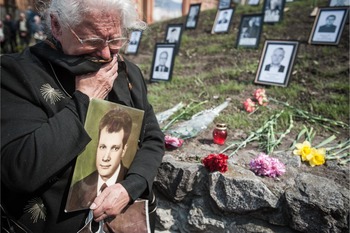
“Chocolates for the photographers?” asked a head-scarfed babushka next to the Chernobyl memorial in the capital of Ukraine. Handing me a sweet she said, “Thank you for doing what you do” and wiped away a tear. As Susan Sontag reminds us, since the invention of the technology, “photography has kept close company with death.”Footnote 3 The old woman was holding a photograph of her dead husband on the day that marked twenty-five years since the worst nuclear accident in history. A history that, for this woman and many thousands like her, is still being written—not of one event in 1986, but of a lifetime of memories, lived experiences, and loss. A large crowd of other widows stood around her with their own framed portraits of dead evacuees, liquidators, and other victims of Chernobyl (Chernobiltsi).Footnote 4 This sea of photographs, lovingly held by their relatives, like visible proof of an invisible tragedy, already outnumbered the official Soviet death toll by some margin.Footnote 5
The Chernobyl landscape is a place infused with contested meanings: for some, a rural idyll tarnished by the invisible specter of radiation; and for others, simply “a place called home.”Footnote 6 Its legacies run deeper than its unknowable death toll and spread far beyond the abandoned villages and overgrown industrial graveyards of the Exclusion Zone.Footnote 7 Instead they live on in the memories, photographs, and everyday lives of those who call this nuclear landscape “home”.
This paper is based on extensive ethnographic research primarily within communities living in the border region of the nuclear Exclusion Zone that surrounds Chernobyl. Living just beyond the confines of the nuclear “dead zone,” these communities occupy a liminal space—officially outside the prohibited nuclear territory, yet on land that is often just as contaminated as the terrain inside the fence.Footnote 8 Some of the villages under study were immediately adjacent to the divide between officially “clean” and officially “unclean” territory, with the border often proving porous in terms of local understandings of radiation risk. This deindustrial, yet bucolic, backwater is characterized by high unemployment and widespread marginalization. Many people in this region face negative social, economic, and health impacts due to its proximity to the world's worst nuclear catastrophe.
This paper will focus on the visual aspect and methodology of this research. The use of photography in this article is part of a wider move within geography to think reflexively and critically about the visual images we make and interpret.Footnote 9 In the context of Chernobyl, where the ability to “see” (in terms of nuclear radiation) is a privileged gaze, it is all the more important to explore the lay perspective in a participatory way by placing the power of the image back into the hands of the marginalized. By giving research participants disposable cameras to create and discuss their own images, this project places the Chernobyl residents' experience of the everyday at the center of the research. This methodology was adopted in conjunction with participant observation and in-depth interviews. The paper will use other forms of Chernobyl-related images as a framework for discussion, from portraits of deceased loved ones that blur the boundary between private and public space, to “official” news photographs that attempt to visually sum up the disaster, to guilt-ridden “ruin porn” that ignores the tragedy of its subject matter. Photography, and especially “participant photography,” is used to better see the realities of everyday life for those dwelling in the deindustrialized landscape of Chernobyl.
Very rarely has the sudden catastrophic failure of an industry damaged so many lives. More rarely still have the effects of such a failure been so widely contested, with estimates of the death toll from Chernobyl ranging from a few thousand to almost a million, depending on the source.Footnote 10 The women at the memorial were well aware that they were commemorating an event whose impact is still being negotiated. They were well aware, too, that the Ukrainian state wishes to redefine Chernobyl,Footnote 11 which currently consumes around six percent of its national budget.Footnote 12 By reducing Chernobyl from a permanent state of emergencyFootnote 13 through processes such as eliminating the compensation that surviving liquidators receive, the Ukrainian government both washes its hands of responsibility and reduces the exposed to “bare life.”Footnote 14
Agamben's notion of bare life is apposite when describing Ukrainian citizens whose bodies have been exposed to harmful radiation without adequate state protection or compensation. Like the Roman figure of “Homo Sacer,” which inspired Agamben's thinking, these exposed and neglected populations have been denied legal status by the state, producing irradiated bodies that “cannot be sacrificed yet may, nevertheless, be killed.”Footnote 15 Their biologies have been tainted by government-caused radiation, yet they remain stripped of rights to adequate legal help and support. Facing the joint reality of exposure to harmful nuclear pollution and state neglect has created a ‘double exposure’ that compounds the personal tragedies that Chernobyl has caused. This impact of Chernobyl, which goes beyond isotopes and radiation, is often overlooked by scientists who study the impact of the disaster purely in terms of deaths.
Unlike a war where the dead are a known quantity, the process of Chernobyl—with its measurable half-lives and immeasurable health impacts—is negotiable, both politically and historically. Huge levels of mistrust characterized life after Chernobyl, and the “opacity of events”Footnote 16 that shroud the accident in secrecy have impacted people's attitude to state advice today. While the magnitude and invisibilities of Chernobyl may never be fully understood, following the conceptions of de CerteauFootnote 17 and Lefebvre,Footnote 18 this article argues that it is at the level of lived experience and “everyday life” that we may get closest.Footnote 19
De Certeau, in his call for a focus on “everyday life,” describes looking down upon a city from a skyscraper. From this perspective, he suggests, a viewer can be fooled into feeling omniscient. Down below, however, people “make use of spaces that cannot be seen”Footnote 20 from above, and it is only by witnessing these hidden spaces of everyday life that we can reach a better understanding of a complex situation. Chernobyl, which contains so many unknowns and contested “truths,” is, therefore, best approached in this way. This paper will attempt to look into the concealed spaces of everyday life that have emerged in post-Chernobyl Ukraine.
The Photograph
Quite often during my ethnographic research in the villages that surround the Chernobyl Exclusion Zone in north Ukraine, a photograph would be produced of a dead loved one. Their faces would stare defiantly back like witnesses to the nuclear tragedy, testaments to the unseen menace of radiation. “How did they die?” I asked, knowing the answer. “Chernobyl, of course,” came the reply. Many tears were shed during the research interviews, and it is clear that Chernobyl has had, and is having, a catastrophic effect on many people's lives. This is not only directly due to radiation health impacts, but also to the stress caused by the disaster, especially for the many thousands of people who were forcibly evacuated after the accident (Figure 1). “Chernobyl took the dearest we had,” explained Maria, who lives on her own on a small farmstead on the edge of the Exclusion Zone, eighty miles north of Kyiv. “I live through memories now.” She continued,
We were promised that we would go back, in three days, twenty days, a year, then after a year and a half they began to build us small houses. The roof leaked. They cheated us all the time … when we came back, all of our friends died from stress. I have no relatives at all. My mother, brother, sister, husband have all died now. I have no one in this village I can speak to, no one … Let me show you the pictures of my friends and family …
Maria holding out her hand to show a photograph of her late husband. Like more than 350,000 other Soviet citizens, she was forced to evacuate her home, which was inside the Exclusion Zone. Maria was rehoused in poor quality accommodation, away from her social networks and family ties. Reproduced with permission from Thom Davies.

Like many in this region, Maria's husband was one of the 700,000 liquidators who helped with the clean-up operation in the months and years following the accident. She attributes his death to Chernobyl, and family photographs are now the only physical reminder of a world before the tragedy that would recast her life into a binary: “before and after” Chernobyl.Footnote 21 Indeed for many, Chernobyl “signalled a rupture between the present and the past, a moment that necessitated a re-evaluation of the self and society.”Footnote 22 For many, Chernobyl is a trauma that is ongoing, with the effects of long-term exposure to low-level radiation still not fully understood. One of the many ironies of Chernobyl is that for all the precise and meticulous Cold War science it took to tame the atom, once that science went wrong, uncertainty prevailed. Stories of death and illness relating to the accident are a common thread throughout communities near Chernobyl, and the accident is blamed, rightly or wrongly, for all manner of health issues; from increased alcoholism, to heart disease, and of course a wide range of cancers. However, during the interviews, attention always returned to the photograph. It was this everyday object more than any other that seemed to make the threat of invisible radiation appear more tangible.
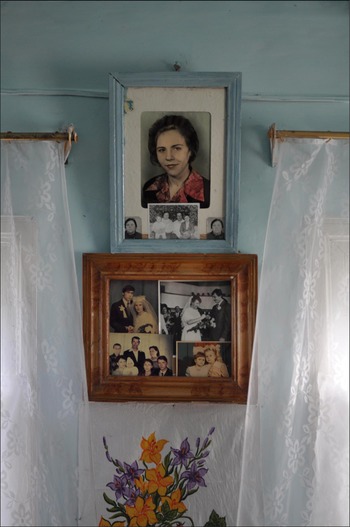
In modern society, family photographs are central to the creation of “home.”Footnote 23 Their potency increases further when the person depicted is not present.Footnote 24 Their key role within domestic space makes it even more striking when these images are seen outside of the home environment —at protests or memorials, where the most intimate things becomes the most public (Figure 2). Here the photographs, or rather the people “contained” within them, become witnesses in absentia—unable to be present due to the very event that is being remembered. This blurring of public and private space reinforces the personal tragedy of a national event. Some of the most familiar images we have of modern tragedies are often the pictures of people holding such photographs of their loved ones, as in the wake of terrorist attacks or natural disasters.Footnote 25 In Ukraine, with its orthodox tradition of religious iconography, this “secular icon”Footnote 26 of the deceased has a special potency. Where once the responsibility for remembering fell to the performers of laments, in more modern times the photograph has taken on this mantle.Footnote 27
Family photographs hung on the wall of a house in a village near Chernobyl in north Ukraine. Reproduced with permission from Thom Davies.

It is not just the family photograph that performs this role of remembrance. The professional photographers who were present at the memorial were all hoping to visually capture that perfect mixture of grief and memory. Diane Arbus, Susan Meiselas, and Susan Sontag, with varying levels of cynicism, all describe the camera as a “passport” that “annihilates moral boundaries and social inhibitions, freeing the photographer from any responsibility toward the people photographed.”Footnote 28 As other photographers and I gathered around the Chernobyl widows, hustling for the best position to “regard the pain of others,”Footnote 29 one photographer nudged me to look up. A widow, raising her hand to her face to cover her mouth, had just given the exact expression that the photographers were waiting for. A flutter of camera shutters clicked around me. The next day, the photographer Alexey Furman got his photograph published on the front page of the Kyiv Post, and his image became the “official” photograph of Chernobyl for that day (Figure 3). The way we remember is influenced by the images we see.
This photograph was on the front page of the Kyiv Post newspaper the day after the Chernobyl memorial. The caption read, “A woman cries during the requiem to the Liquidators and victims of the Chernobyl tragedy near the monument ‘To the victims of the Chernobyl tragedy’ in Kiev, Ukraine.” Reproduced with permission of photojournalist Alexey Furman.

Double Exposure
It was not just women at the remembrance ceremony. Men in wheelchairs gathered around the atom-shaped memorial in Kyiv. Some had missing limbs; others gangrene. In what Giorgio Agamben might refer to as post-atomic “bare life,”Footnote 30 these men had been exposed twice: once to the invisible radiation and then to the failures of Ukrainian governance. This double exposure, played out upon the bodies and everyday lives of these men and women, is a testament to how Chernobyl is an ongoing event.
All the men wore their “Chernobyl Liquidator” medals pinned to their jackets like veterans of an invisible war. The performativity of this remembrance had all the trimmings of Soviet War memorialization,Footnote 31 including the young Ukrainian soldiers who laid wreaths at the ceremony and the placing of red carnations, so often seen at memorials to “The Great Patriotic War.” A few kilometers from the reactor, a propaganda slogan on top of an abandoned building still reads, “Let the atom be a worker, not a soldier.” But it was the “soldier” who did so much of the symbolic work in post-Chernobyl Ukraine; it's better to make Chernobyl into a “war,” as we know how to remember war. From the Chernobyl clean-up workers being referred to as “Afgantsy Chernobylia” (Afghans of Chernobyl)Footnote 32 in reference to the decade-long Soviet-Afghan War, to the sound of the military band that played for the occasion, the “Chernobyl as War”Footnote 33 trope could not be clearer. But for all the war connotations, this was different. Unlike commemorating a military conflict, which has a start and an ending, this memorial had only one date, “1986,” thus hiding the ongoing nature of the catastrophe. It is, after all, hard to memorialize a process. Chernobyl is temporally and spatially uncontainable; its health effects still hang “in the abyss of scientific uncertainty.”Footnote 34
Ruin Porn
Deindustrialization is generally considered a slow process leading to “a fundamental change in the social fabric on a par with industrialization.”Footnote 35 Chernobyl, however, represents a different kind of decline—a sudden shock that transformed a landscape for generations. With the hindsight of history, this catastrophic event in 1986 serves as a forewarning of much greater change—the “profoundly unexpected and unimaginable”Footnote 36 end of the Soviet Union itself. Though Jefferson Cowie and Joseph Heathcott warn us to look “beyond the ruins” when looking at deindustrialization,Footnote 37 the crumbling buildings inside the Exclusion Zone, full of the abandoned detritus of late Soviet everyday life (the books, the old shoes, the forgotten objects), take on a special kind of meaning. Often photographed by visitors as they engage in “dark tourism,” these dystopian spaces of Chernobyl not only represent the failure of an industry, but also the collapse of an entire political system.Footnote 38
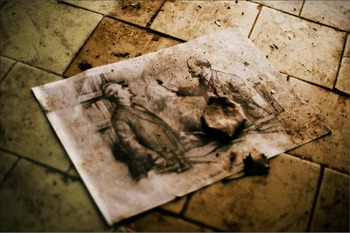
While wandering through a derelict school in a partially abandoned village on the outskirts of the Exclusion Zone, I found myself reproducing the same tired photographic clichés for which Chernobyl, at least visually, has become known. Walking over the broken glass and old Soviet textbooks in the school, I recreated my own collection “ruin porn”Footnote 39 ; a guilty visual process that celebrates urban decay while ignoring the tragedy that it represents. Susan Sontag suggests that “the photographer is not simply the person who records the past but the one who invents it,”Footnote 40 and here I was constructing my own work of fiction: a view of Chernobyl influenced just as much by what I had seen in popular culture as by the more nuanced view that the communities near Chernobyl had taught me. And so, it was a drawing of Lenin and Trotsky, dirtied and partially covered on the floor that my lens focused upon (Figure 4). The Chernobyl depicted here, in this “ruin pornography,” shows a landscape frozen twice: once by the post-Chernobyl abandonment that left the scene looking as it did in the late 1980s, and again by the camera that, as it always does, preserves “a thin slice of space as well as time.”Footnote 41
A poster of Lenin and Trotsky on the floor of an abandoned school near the village of Stari Sokoly, on the border of the Chernobyl Exclusion Zone. Reproduced with permission from Thom Davies.

Although clichéd images of ruin porn like this should be reflexively critiqued, they do go some way to show the connection between the past and the present in relation to Chernobyl. The Soviet symbols cannot go unnoticed. It is no coincidence that the structure that encloses the melted reactor, much like the building on Red Square that still houses Lenin's body, is referred to as a “tomb” or “sarcophagus”:Footnote 42 Chernobyl was the death knell of the Soviet Union. Unlike communism, though, the nuclear accident, with its pan-generational radioactivity, means “Chernobyl is not dead; it is just set in stone.”Footnote 43 Standing on the edge of the Exclusion Zone with the marginalized communities who exist in the liminal space between “clean” and “unclean” territory, these representations mean very little. A major critique of “ruin pornography” is that it “dramatizes spaces but never seeks out the people that inhabit and transform them.”Footnote 44 Indeed, the story of Chernobyl is only partially one of abandonment. In fact, many thousands of people still live in Chernobyl-affected territories. For example, the village in which the school lies is only partially abandoned. Some people had such traumatic experiences after their forced evacuation that they moved back to this border region to be nearer to their homeland and the communities they knew. Several hundred somosels (“partisans”), who are predominantly elderly returnees, even live semi-illegally within the contaminated space of the Exclusion Zone. And as for the empty homes and deserted buildings that cover Chernobyl's deindustrial landscape, these are infused with memory for those who were forced to leave.
One of these people is Sveta, in her mid-fifties, who now lives in Western Ukraine and longs to move back to the home she had to abandon after the disaster. She described how she would give up everything to “go home” to the life and social network that she had before her forced evacuation: “If I had a chance to live in Pripyat right now I would go on foot back to my own hometown. I would go on foot …”
Life for Sveta and her family was very difficult when they were moved away from the place that held so many happy memories. It involved a pan-Slavic journey that had them living temporarily in Belarus, Moscow, and Kyiv and eventually settling in the West Ukrainian city of Chernivtsi. Sveta's son Oleg described how they were often ostracized by the locals in their new town, explaining that “the other kids treated me horribly, because I was from Chernobyl.” Chernivtsi is over 500 km from Sveta's old home near the reactor—a very long walk indeed. As Sveta described her upheaval and displacement after the accident, she said, “I wanted to live close to my brother, but I had to wait … it was incredibly stressful.” For hundreds of thousands of evacuees, the 1986 accident created a rupture in their lives. It was only the start of a struggle that would not only include exposure to radiation, but also severed social networks, forced relocation, and a sudden break in their ability to negotiate everyday life. “The nature there was beautiful, too,” Sveta remembered, clutching a photograph of herself and her son in front of her parent's grave, which lies inside the Exclusion Zone. In the many years since the accident, she has gone back only once to her abandoned apartment in the Exclusion Zone. “We had forests, pine trees, mushrooms—big mushrooms, enormous—berries, blackberries,” she continued. On the long bus journey there, organized by a group of similarly displaced evacuees, they sang old Soviet songs and reminisced, she said, “but on the way back it was just silence. We just cried.”
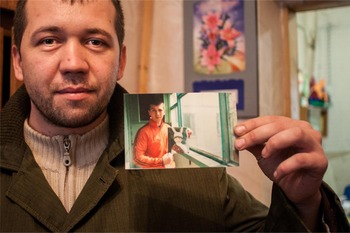
Her thirty-two-year-old son, Oleg, showed me a photograph he had taken on his one visit to the place of his childhood memories. Taken in an abandoned building near Chernobyl, it was unlike the “ruin pornography” that I, with my outsider's gaze, had made in the abandoned school. His was a deeply personal image. “Look at the photo,” he said. “I am here in orange. We lived in that flat. When we went back to our apartment it was completely empty—everything was stolen—apart from this one photograph. And so fifteen years later my mother took this portrait.”
The one object that Oleg found in his old flat was a portrait of himself: a six-year-old boy wearing a Soviet school uniform and bunny ears (Figure 5).
Every photograph is, by definition, an image of the past. In modern society, photography and memory are closely intertwined, especially in regard to family narratives. In a two-way process, photographs act as “ways of remembering but also as producing memory.”Footnote 45 The photograph his mother took of the teenage Oleg holding the Soviet portrait of his pre-Chernobyl self is the only version they have—they had to leave behind the photograph in their abandoned flat, fearing it was contaminated. “After we left the Zone we threw away our clothes,” Oleg explained.
A photo in a photo in a photo: Oleg holds a photograph of himself in his abandoned flat in Pripyat holding a photograph of himself before Chernobyl. Reproduced with permission from Thom Davies.

Making Sense
If we do look “beyond the ruins” and speak to those who still dwell in this region, we can see that Chernobyl is remembered as but one of a series of relatively recent anthropologically significant events, part of a larger set of recollections that stretch back through Soviet and post-Soviet space through personal memory and family lineage.Footnote 46 It is part of a brutal narrative that includes Ukraine's prewar famine, the horrors of the Gulag, the Great Patriotic War, Nazi occupation, the collapse of the USSR, and the post-socialist turmoil that followed. As Adriana Petryna points out, for those exposed to Chernobyl, these memories are more than mere reminiscences: They make “more transparent and predictable the machinations of state power by which family members … were victimized.”Footnote 47 As catastrophic as Chernobyl was—and remains to this day—it is not an isolated event in people's memories but a continuation of trauma that “references bodies as both subjects and objects of state power.”Footnote 48 These events form a way of making sense of Chernobyl, where making “sense” is a rare luxury: The lay perspective has been robbed of the ability to see, hear, or smell any sign of a radioactive danger that is “at once everywhere yet nowhere.”Footnote 49 In this landscape of radioactivity, memory goes some way to fill the gap that “sense” left void.
One very old woman who lives in the isolated village of Gubin, adjacent to the Exclusion Zone, described how, as a young teenager, she fought with the Ukrainian Resistance against German occupation. She explained how she was caught by a German soldier and was very lucky to escape execution. Pointing out the window, she described how German soldiers were billeted in the villages that now lie abandoned in the Exclusion Zone, drawing a comparison between the specter of radiation and the horrors of war. She commented poignantly that “at least when the Nazis were in my village you could see them.” Referring to the invisibility of radiation in this way highlights how the memory of one catastrophic event can help interpret the potential confusion of another. In the same way that official state-sanctioned memorialization, with its wreaths and minutes of silence, help to construct a nation, memory at the level of the everyday also serves a purpose—it makes sense of complex events and personal trauma.
Other elderly interviewees, with typical nostalgia for the days of the Soviet Union, sometimes conflated the events of Chernobyl with the collapse of the USSR. When asked how Chernobyl affected their lives, the respondents would sometimes pine for a return to communism, comparing life before Ukrainian independence with the daily struggle of post-socialist marginalization.Footnote 50 This “retrospective utopia”Footnote 51 that only nostalgia can create blurs the boundary between memory and history, turning two historically separate events into one view of the past. Jay Winter writes that “memory is history seen through affect,”Footnote 52 and indeed the emotional impact of traumatic events cannot go unnoticed. One woman, when questioned about Chernobyl, responded instead by bemoaning the collapse of the Soviet Union: “Before the USSR ended you could go and complain to the district administrators, whereas today nobody is interested in anyone.” She cited the lack of state help that has characterized both post-Chernobyl governance and the turmoil after the end of the Soviet Union. For others who live near Chernobyl, however, the difference between the two events could not be clearer. For ex-liquidators such as Sasha, who lives close to the Exclusion Zone, Chernobyl stood alone as a key marker in his life:
Of course, the collapse of the USSR has had a great impact, but it is not so great compared with Chernobyl, because the USSR is something that is now invisible, it is just a concept, whereas Chernobyl is everything you can touch, that you can see, that you can feel.
There is no conflation of events for Sasha, for whom the sudden fall of the Soviet Union is confined to the past, whereas Chernobyl is his all-encompassing and ever-present lived experience.Footnote 53 It is interesting that despite not being able to physically see radiation, he considers the collapse of the USSR the less “visible” of the two events; the end of an Empire is now just a memory, whereas living with the uncertain economic and health impacts of Chernobyl is a lived reality. Indeed, while many, such as the babushka from Gubin village, suggest it is the invisibility of the Chernobyl hazard that makes it so alarming, the situation is rather more complicated. Just like the concept of memory, which is simultaneously vivid and intangible, radiation is both an unseen and lived reality of everyday life. As Sasha said, “Chernobyl is everything,” and yet it is nothing. The invisibility of Chernobyl's dangers requires further discussion.
The Invisible
Some of the biggest successes and failures in modern science have related to “its ability to transcend human senses.”Footnote 54 Modern medicine is often cited as originating with the invention of the stethoscope in 1819, where for the first time doctors could use technology to see into the “hidden spaces of the body”Footnote 55 that were culturally and technologically off-limits to their lay patients. Foucault argues that the exclusionary nature of this method of creating effects of truth are inherently bound up with power, the “principle technology of power” being the gaze. Footnote 56 The inherently invisible nature of nuclear radiation has created a situation where the only way individuals experience its potential dangers are highly mediated.Footnote 57 Some argue that it is mediated through the lens of the “scientific gaze”Footnote 58 with its technocratic equipment and cartography, and filtered through the “eye of power.”Footnote 59
In technical terms, without Geiger counters and scientific training, an individual has no way of knowing if their backyard is safe or “dirty.” In the deindustrialized rural landscape of Chernobyl, radiation dangers remain invisible to the lay perspective. Anya, who lives in a small village that borders the Exclusion Zone, told me, “Many people asked me, ‘Are you afraid of radiation?’ and I tell them, ‘What can I do? It hasn't got any smell … and it is invisible, what can I do?’ There is not even any clicking …” The “clicking” of Geiger counters that she witnessed more than a quarter of a century earlier when gas-masked scientists checked her village to see if it would be designated for “compulsory evacuation” had not been heard for many years. The translation of radiation from the invisible realm to the experiential can only be done on a formal level by experts. Furthermore, these experts must be “credited by the state and [have] access to standardized, state-certified equipment and techniques.”Footnote 60 Anya is not a state-certified expert and is unable to “see” radiation, but she does know that her village avoided becoming part of the Exclusion Zone by a matter of meters. She also knows that the barbed-wire fence that is just a few minutes from her house does not stop invisible radiation.
Hecht discusses how, in relation to formal and informal understandings of radiation, the border between the nuclear and non-nuclear has been regularly disputed.Footnote 61 She describes how uranium mines in South Africa can only be treated as “nuclear workplaces” if radiation levels are recorded using scientific equipment. If these scientific tools or institutions do not exist, however, for whatever political or technical reason, “then the mines devolve into ordinary dangerous workplaces rather than specifically nuclear ones.”Footnote 62 Ontologically, the mines have stayed the same—they are contaminated, but without the ability to officially “see” the radiation, they remain “non-nuclear” spaces. This process of determining “nuclearity,” which occurs irrespective to whether radiation is present or not, includes political, technical, and social filters through which “nuclear” or “non-nuclear” can be decided.
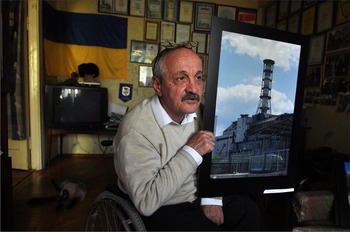
I noticed an example of this when talking to former liquidators about their memories of working in highly-contaminated regions near Chernobyl. Liquidators received some of the highest doses of radiation, either externally or through ingestion and inhalation.Footnote 63 Several described how they were given personal dosimeters to check the amount of radiation they absorbed. At the end of each working day they would report their level of exposure to the officer in charge. However, they were also told that if they reported a level above twenty-five Roentgens they would be punished (Figure 6).
Sergey Petrovych Krasilnikov, the head of the Union of Liquidators for the Svyatoshynskyi district of Kyiv, holding a photograph of the Lenin Reactor Number 4, the epicenter of the Chernobyl accident. “Since Chernobyl made me wheelchair bound in 1992, I have dedicated my life to writing about the accident,” he told the author. “Please show these photographs in Britain.” Reproduced with permission from Thom Davies.

Predictably, recorded levels of radiation remained consistently below this forbidden level. Not only were liquidators compelled to falsify and minimize their own doses, but their “official” doses were then changed by higher-ups on site.Footnote 64 This is another example of the “double exposure” that many victims of Chernobyl have faced. They were exposed not only to harmful levels of radiation, but also to a state that failed (and continues to fail) to provide necessary help or protection. Due to pressure from Soviet and post-Soviet authorities, and a determination to conceal the dangers that faced so many liquidators, the “official” radiation levels bore no relation to the actual levels affecting the bodies of the exposed. Despite the fact that radiation is “a physical phenomenon that exists independently of how it's detected or politicized,”Footnote 65 the invisibility of it leaves lay persons vulnerable to such technical and systemic tactics. One liquidator remembered that “on the roof of the reactor there were Japanese-operated robots that broke because of the radiation, but the people kept working … Now it is easier to say what does not hurt than what does.”
And yet, despite countless stories like this, many former liquidators struggle to prove that they deserve what few state benefits are on offer. This is because they do not have the necessary paperwork, having been pressured to falsely record their personal exposure levels at the time. Therefore memories of exposure, highlighted in the last interview quote, serve as nothing without the proof of contamination: the proof that you are damaged. When confronted with post-socialist bureaucracy and assessments of “nuclearity”—memory of events holds little power. Without the necessary legal status, and the ability to prove they have been damaged, liquidators and other Chernobyl sufferers have been recast as post-atomic “bare life”—their Chernobyl-related deaths occurring without consequence.
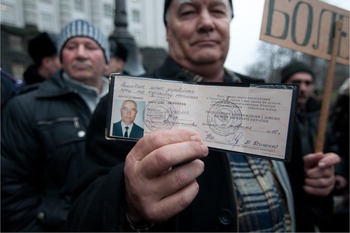
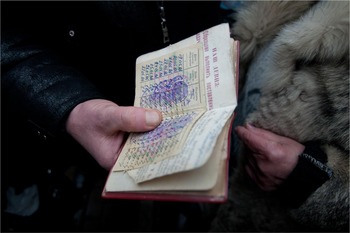
The visibility of these Liquidator documents, or “Chernobyl Passports,” convey mixed emotions for those who possess them. Liquidators are both proud and sad about the information these documents contain. Proud, because these documents make them heroic in eyes of some, as they sacrificed their health for the good of others. But because they are reminders of the biological damage that exposure to radiation may have caused, these documents are also sources of distress. At a protest in Kyiv against government compensation cuts, liquidators came up to me holding their Chernobyl Passports, thrusting their liquidator documents and photographic identification in front of my camera's lens (Figure 7 and 8). They were looking for acknowledgement, if not through compensation from the government, then at least visually. I was performing the role of a photojournalist.Footnote 66 I was bearing witness. The liquidators wanted to show that they deserved to be remembered, one former Chernobyl liquidator saying, in words doubtless uttered by many a disenfranchized worker over the years: “I'm not looking for help; I am just looking for respect and recognition.”
A Chernobyl liquidator holds out his liquidator identification at a protest in Kyiv. Reproduced with permission from Thom Davies.

A Chernobyl liquidator holds out documentation of the intensity of radiation (in Roentgen) he was exposed to May 19–27, 1986, less than a month after the accident. The writing at the top reads “Our Motto: To Exemplarily Fulfill the Given Tasks.” Reproduced with permission from Thom Davies.

Participant Photography
The use of photography in this article is part of a wider turn within human geography toward thinking critically and reflexively about the visual images we make and interpret.Footnote 67 Participant photography was used in order to better see (and, it is hoped, understand) the realities of everyday life for those dwelling in the deindustrialized landscape of Chernobyl. In the context of Chernobyl, where the ability to “see” (in terms of nuclear radiation) is a privileged gaze, it is all the more important to explore the lay perspective in a participatory way and thus place the power of the image back into the hands of the marginalized. Giving research participants disposable cameras to create and discuss their own images placed the Chernobyl residents' experience of the everyday at the center of this research. Other academics have successfully used this technique for researching marginalized groups, including children,Footnote 68 the disabled,Footnote 69 and refugeesFootnote 70 and often find that it treats the participants “as social actors rather than victims.”Footnote 71
Susan Sontag writes that “[b]etween photographer and subject, there has to be distance,”Footnote 72 and yet, when the photographer is the subject of the research, this distance is greatly reduced. In contrast, my “outsider gaze,” shown in all of the photographs I made, was reflexively troubling. Like the official and privileged view of radiation, my photographs were offering an “official” visual geography of life for those living with Chernobyl. The images and stories gained through participatory photography, however, were more revealing, often eliciting memories and unseen details of everyday life.
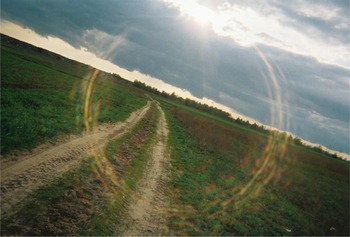
For example, a seemingly arbitrary photograph of a field near the home of one participant brought back memories of the days immediately after Chernobyl. This led to a wider discussion of the importance of place and local understandings of radiation. The vivid memories that these images evoked help to elucidate and explain everyday life after sudden post-atomic deindustrialization (Figure 9).
Participant photograph of a field in Orane Village, four kilometers from the Chernobyl Exclusion Zone. The bucolic scenes evident in images such as these hide the polluted nature of this deindustrialized landscape. Reproduced with permission from Thom Davies.

Olga, 31, whose brother died of thyroid cancer after Chernobyl, reminisced about the field near her childhood home: “I was helping my parents plant potatoes here when it happened. I remember a convoy of army trucks driving along that track towards Chernobyl. They were staring out of the windows at us, through their gas masks.” Prompted by these memories, she went on to explain how some of these fields were still contaminated, despite being outside the official Exclusion Zone. She explained how the local residents in her village knew which were safe and which were “dirty” choosing where to plant crops accordingly. This unseen reality of everyday life was made visible through participant photography, which “goes beyond visual representations” and shows how people construct and interpret the world around them.Footnote 73 Of course, to those who work these fields, the local understandings of radiation are not hidden at all, but to an outside observer such as the figure described by de Certeau who looks panoptically (and arrogantly) from atop a skyscraper, these nuances of everyday life are hidden from view as they are to the state that declared the whole territory “safe” by leaving it outside the Exclusion Zone. Participant photography can be used as a prism through which previously hidden details may emerge.
Likewise, other photographs prompted conversations about other “spaces that cannot be seen”Footnote 74 —the informal and illegal behaviors that normally remain invisible. For example, it is a normalized behavior for many in this border region to informally enter the Exclusion Zone to gather berries, pick mushrooms, and even to hunt for wild game. This often involves bribing the border guards who patrol the Exclusion Zone, which is roughly the size of Greater London. The barbed-wire fence that surrounds it not only fails to prevent radiation from escaping, but also does not stop people from illegally entering this officially radioactive space. This informal activity is not based on the opinion that radiation is unharmful, but instead it is a pragmatic approach to the hardships of everyday life in Chernobyl's shadow. Wide-scale post-socialist marginalization has meant many economically struggling Ukrainians “are compelled to worry more about putting food on the table than about the ‘ecological state’ (ekolohichnyi stan) of that food.”Footnote 75 This informal behavior is also an approach that privileges local knowledge over official state advice. One participant pointed out that “the level of radiation in the Zone and in the village is the same. The fence does not stop it.” Another was insistent that “into the zone for some kilometers it is clean” and that she knew where it was safe and where it was not. She “knew” this not through scientific or technical exploration, but through a localized sense of place. These everyday acts of resistance to the state through activities such as regularly crossing into prohibited space or illegally selling produce from the Zone, is in part a response to the “double exposure” that those who live with Chernobyl have suffered, where the state offers little or no protection from the consequences of nuclear disaster. Invisible to the state, these informal actions demonstrate that people whose bodies have been abandoned to the threats of radiation as post-atomic “bare life” still have agency and are capable of resistance.Footnote 76
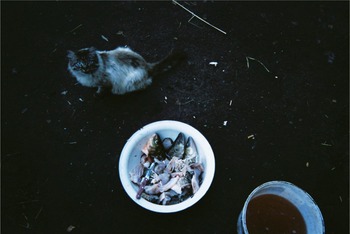
An unassuming photograph of a bowl of half-prepared fish and a patiently waiting cat (Figure 10) prompted a conversation about other unseen realities of everyday life. The participant who took the photo got the fish in exchange for a sack of potatoes from local men who fish illegally. “I have no money to pay them, only potatoes. If I have the money to pay them then I do.” Economic hardship is an everyday reality for most people who live in this deindustrial landscape. The importance of informal economic activity, including barter, social networks, and gift exchange, is very apparent in this region. Near Chernobyl, widespread unemployment and poverty sits alongside the invisible specter of radiation. This means risk perception among local inhabitants is not just a story of post-nuclear health, but economic survival. Informal economic activity plays a vital role in the survival tactics of those marginalized by Chernobyl. The fish in the photograph were caught illegally inside the Exclusion Zone, where fish are abundant, but where radiation levels are potentially very high. Sasha remembers how he saw the fish being caught with nets in the same water that runs past the abandoned reactor at the epicenter of Chernobyl.
A participant's photograph taken in his backyard, near Chernobyl. Reproduced with permission from Thom Davies.

Potentially dangerous informal activity around the Exclusion Zone is not based on a belief that radiation is unharmful, but from a sense of place attachment that privileges local knowledge. Real and imagined radiation exposure coexist with economic marginalization in this deindustrial post-atomic region. For marginalized communities near the Exclusion Zone who have received a ‘double exposure,’ Chernobyl has become a way of framing their collective sense of abandonment by the Ukrainian state.
Conclusion
The invisibility of many features of Chernobyl victims' lives, such as the illnesses, the informal economic activity, and continued existence on terrain that is scarcely less radioactive than the off-limits areas of the Exclusion Zone, is in stark contrast to the official commemoration of Chernobyl, where the accident, at least once a year, becomes very visible. The invisibility of these residents' experiences contrast with their desire to be more fully recognized or “seen” by the state, instead of being outcast as post-atomic bare life.
Just like the concept of memory, which is simultaneously vivid and intangible, radiation is both an unseen and lived reality of everyday life. The use of photography as a research tool allows us to better see the realities of everyday life for those dwelling in one of the most polluted deindustrialized landscapes on earth. Photographs can be used to access, discuss, and make sense of complicated memories. They become focal points through which we are reminded of, and constructed by, the past. For example, the memory of one event can help us sort through the potential confusion of another.
However we should be cautious about using photography as a research tool in an uncritical way. Photographs and quotations of speech are very similar in this sense—both are isolated slices of reality and are therefore vulnerable to misinterpretation. As Susan Sontag reminds us, “Photographs—and quotations—seem, because they are taken to be pieces of reality, more authentic than extended literary narratives”; more authentic, one could argue, than the “real thing.”Footnote 77 A photograph, when viewed out of context, can be interpreted in a misleading way, as can a quote from an interview, if viewed in isolation from the rest of the transcript. As photographer Garry Winogrand said: “putting four edges around a collection of information or facts transforms it,” and the same can be said for quotation marks.Footnote 78 However, by using photography as a framework for discussion, and by combining image and text, this article has aimed to shed new light on the complex and ongoing process that is Chernobyl.
All of the photographs in this article are, in some way “regarding the pain of others.”Footnote 79 From the snapshots of now-deceased loved ones that blur the boundary between public and private space; or the official news picture of a crying widow; or the clichéd ruin porn that ignores the tragedy of its subject matter, these images, like all photographs, have the potential to exploit. But the images created by the participants remove some of that ethical burden, and tell a somewhat different story. When combined with their memories and experiences of everyday life, the pictures they make can help us understand what it is like to live with Chernobyl. Photography can, in terms of lived experience, make the invisible specter of radiation a bit more tangible.
Those who have suffered from Chernobyl have been exposed twice: once to radiation and again to a state that fails to protect or adequately help them. Liquidators, for example, have fallen victim to this ‘double exposure’. Not only have they faced very dangerous levels of radiation, but they were then forced to falsify their documents with the result that today they cannot receive adequate compensation or medical treatment. Stripped of the protection of the state and allowed effectively a “death without consequences,”Footnote 80 we can think of those marginalized by Chernobyl in terms of Agamben's notion of “bare life.”
A thread of invisibility connects the informal activity of the marginalized and the radioactive pollution that defines this landscape; both are potentially invisible. The state, with its technology and processes of “nuclearity” has the power to “see” the harmful radiation and make it (in)visible, and yet it fails to (or chooses not to) recognize the informal economic activity that occurs in Chernobyl's forgotten borderlands. The marginalized, meanwhile, who have suffered the indignity of ‘double exposure’—subvert the deindustrial Exclusion Zone, using hidden spaces of resistance and local understandings of radiation risk to survive from day to day. They remain unable to officially ‘see’ harmful radiation, relying instead on a privileged sense of place and local knowledge to come to terms with a threat that remains in “everything you can touch, that you can see, that you can feel.”Footnote 81 Both the state and those it has marginalized have only a partial view.
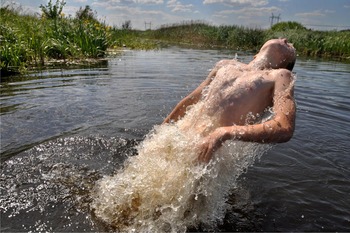
A photograph, too, can offer only a partial view of a situation—its borders perhaps concealing as much as it reveals (Figure 11). But in this article, photography has been used as a framework through which the everyday realities of life after Chernobyl can be discussed. Participant photography can be used as a prism through which it is possible to explore how people are living with radiation, and a way by which we might get the closest to discovering what de Certeau refers to as “spaces that cannot be seen.”
Vadim, 13, swimming in a river that runs through the Chernobyl Exclusion Zone in north Ukraine. The power lines visible in the background once buzzed with electricity from the nuclear reactor in Chernobyl. They now lie silent. Reproduced with permission from Thom Davies.